Introduction
Neuropsychological testing has emerged as a critical tool for concussion diagnosis and management due to the fact that cognitive tests are objective and sensitive to concussion (Echemendia & Cantu, Reference Echemendia and Cantu2003). Baseline testing, which involves taking a pre-injury assessment of athletes’ functioning before the start of play, has become the gold standard in concussion management (Barth et al., Reference Barth, Alves, Ryan, Macciocchi, Rimel, Jane and Nelson1989). Although some have raised questions regarding the validity and clinical utility of this approach (Randolf, McCrea, & Barr, Reference Randolf, McCrea and Barr2005), other research has supported the use of this model for diagnosing and managing sports-related brain injuries.
Whereas objective cognitive changes following sports-related concussion have been well-documented, mood and affective changes related to these injuries have received relatively little attention. There are important reasons to consider affective state within the context of a sports-concussion assessment. For example, psychiatric symptoms are common sequelae of neurological insult or injury, mild traumatic brain injury included (Busch & Alpern, Reference Busch and Alpern1998). In addition, mood disturbance is one of the components of Post-Concussion Syndrome (PCS), which includes persistent mood, cognitive, and somatic symptoms following head injury (Rao & Lyketsos, Reference Rao and Lyketsos2000). In athletes, mood changes could be, in part, related to psychosocial adjustment resulting from temporary removal from play and uncertainty about their recovery timeline. However, evidence suggests that disruption of central nervous system (CNS) functioning also contributes to post-concussion mood disturbance, above and beyond mood changes attributable to psychological and social concerns (Chen, Johnston, Petrides, & Ptito, Reference Chen, Johnston, Petrides and Ptito2008).
Mood disturbance following sports-related concussion is an important clinical issue. Although mood changes following a head injury may be transient, the consequence of depressed mood can be permanent. This issue was recently highlighted in the popular press when a University of Pennsylvania college football player tragically committed suicide, likely as a result of mood changes secondary to sports-related head injuries (Schwartz, Reference Schwartz2010). A thorough assessment of mood within post-concussion assessment could help prevent such tragic outcomes, particularly in light of evidence that head-injury related depression may be amenable to existing depression treatments (Frann, Uomoto, & Katon, Reference Frann, Uomoto and Katon2000).
There are other compelling reasons to consider mood within the context of neurocognitive assessment for concussion. A negative mood state could have an influence on other domains of functioning, namely cognitive and somatic symptom reporting and neurocognitive test performance. An extensive body of literature has demonstrated that negative mood in stressful situations is associated with more autonomic arousal (Watson & Pennebaker, Reference Watson and Pennebaker1989), greater symptom reporting (Katon, Reference Katon1984; Persson & Sjoberg, Reference Persson and Sjoberg1987), and poorer health outcomes (Salovey, O'Leary, Stretton, Fishkin, & Drake, Reference Salovey, O'Leary, Stretton, Fishkin and Drake1991). Various researchers have corroborated these findings by demonstrating that individuals with higher levels of negative affect tend to report more overall physical and psychological symptoms (Affleck, Tennen, Urrows, & Higgins, Reference Affleck, Tennen, Urrows and Higgins1992; Costa & McCrae, Reference Costa and McCrae1980; Costa, McCrae, & Zonderman, Reference Costa, McCrae and Zonderman1987; Van Hemert, Bakker, Vandenbroucke, & Valkenburg Reference Van Hemert, Bakker, Vandenbroucke and Valkenburg1993). Furthermore, research examining the neuropsychological correlates of depressed mood has revealed that negative affect is associated with deficits in several neurocognitive domains, specifically memory, attention, and executive functions (Christensen & Segal, Reference Christensen and Segal2001; Levens & Gotlib, Reference Levens and Gotlib2010; Moriya & Tanno Reference Moriya and Tanno2008).
Traditional measures of depression, like self-report questionnaires, are one method that could be used to assess depression after sports-related head injury. However, impressive evidence has accumulated suggesting that there are cognitive biases associated with depression and depression vulnerability (Scher, Ingram, & Segal, Reference Scher, Ingram and Segal2005), and some have argued that performance-based indicators of cognitive bias may be better measures of depression vulnerability than self-report questionnaires (Segal, Reference Segal1988). Affective Memory Bias (AMB) is defined as the tendency for people in negative moods to recall more negatively valenced information, and less positively valenced information. Previous research has demonstrated a link between affective memory bias and depression symptoms in neurological patient populations. For example, Bruce and Arnett (Reference Bruce and Arnett2005) conducted a study examining how depressive symptoms in MS patients affect their ability to recall positive and negative material. The researchers used an affective list-learning task to measure AMB. The results from the study indicated a significant relationship between depression and AMB in MS. More specifically, mildly and moderately depressed MS patients demonstrated a negative AMB when compared to MS patients who were not depressed, suggesting that AMB may be a promising performance-based method of identifying depression in individuals with neurological insult.
Performance-based indicators of depressed mood are appealing for several reasons. First, self-report methods of depression assessment rely on the individual's ability to report on psychological processes which may not always be accessible to conscious awareness. Second, athletes in particular may be likely to minimize psychiatric symptoms (Echemendia & Julian, Reference Echemendia and Julian2001; Echemendia & Cantu, Reference Echemendia and Cantu2003). Individuals participating in competitive sports have a powerful incentive to minimize the presence of post-concussion symptoms and may be eager to return to play as soon as possible because time away from participation could have implications for their athletic career, social status, or identity as an athlete (Bailey, Echemendia, & Arnett, Reference Bailey, Echemendia and Arnett2006).
With these considerations in mind, the current study was designed to examine the validity of a performance based measure of Affective Memory Bias (AMB). As noted above, AMB refers to a tendency to recall relatively more negatively valenced information when in a negative mood state, and relatively more positive information during a positive mood state (Blaney, Reference Blaney1986; Kensinger & Corkin, Reference Kensinger and Corkin2003; Wisco & Nolen-Hoeksema, Reference Wisco and Nolen-Hoeksema2009). Prior research has demonstrated a link between AMB and depression symptoms in neurological patient populations (e.g., Bruce & Arnett, Reference Bruce and Arnett2005), suggesting that AMB may be a promising method of identifying depression in individuals who have sustained sports-related concussions.
Establishing a performance based measure of affective state could allow for better detection of concussion-related depression and more accurate assessment of post-concussion neurocognitive functioning. The present study was designed specifically to evaluate the validity of two measures of affect that do not rely on self-report, specifically, AMB and examiners’ observation-based ratings of affective state in a collegiate athlete sample. To examine the validity of these measures, AMB and Examiner Affect Rating were compared with self-report measures of depression and general post-concussion symptomatology. We hypothesized that AMB, as demonstrated by a task developed in our lab, and examiner ratings of affect, would be significantly associated with a well-validated self-report measure of depression but not self-reports of post-concussion symptoms more generally. We chose the pre-injury time point for analysis because, compared with athletes post-concussion, athletes at baseline should have relatively less motivation to minimize affective or other symptoms.
Methods
Research Participants and Procedure
The current study used data from a concussion program at a large Division I University. This multi-sport program assesses athletes at risk for concussion before and following MTBI (Bailey et al., Reference Bailey, Echemendia and Arnett2006). All participating athletes complete a baseline neuropsychological battery before their first season on their respective team. Along with a neuropsychological evaluation at baseline, all athletes complete questionnaires about demographic information and any previous head injuries. Each participant signed an informed consent that explained how the neuropsychological data were to be used for both clinical and research purposes. The university Institutional Review Board reviewed and approved these original data collection procedures in 1995, and additional approval to continue to collect and analyze the data was obtained on January 29, 2010.
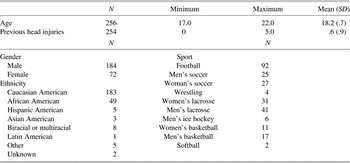
The current study examined 256 athletes at baseline who were administered the measures described in more detail below. A description of the sample is provided in Table 1.
Demographic characteristics of the sample

One goal of the current study was to examine whether those who exhibited very positive affect versus very negative affect during testing would be qualitatively different in respect to symptom reporting. To test this, two extreme affect groups were created by selecting those who scored at least one standard deviation below the mean on the two affect indices (negative affect group) and those who scored at least one standard deviation above the mean on affect indices (positive affect group). Tests were then conducted to examine differences in symptom reporting and cognitive performance between these two extreme affect groups.
Baseline testing was administered by either a doctoral-level clinical neuropsychologist, graduate, or undergraduate assistants who were trained by the doctoral-level clinical neuropsychologist. All test administrators were blind to the positive and negative affect groups, which were determined later. The order of tests administered was the same for both groups. The measures administered are described below.
Measures
The test battery involves a comprehensive assessment of cognitive, physiological, and affective symptoms. For the purposes of this study, we focused on the tests of psychological and post-concussion symptom reporting. More specifically, depressive symptom reporting was measured with the Beck Depression Inventory-Fast Screen (BDI-FS). The BDI-FS is an abbreviated, seven-item questionnaire based on the Beck Depression Inventory. The BDI-FS includes dysphoria, anhedonia, and suicide items from the original measure, and four other items that had high cognitive loadings in the factor analyses from the original BDI. The BDI-FS was developed to evaluate depressive symptoms that may be due biological, medical, alcohol, and/or substance abuse problems. It has been used with medical patients, individuals with mental health issues, as well as healthy adults. In addition, it is a well-validated measure of depression that is highly correlated with structured interview ratings of depression. For example, the BDI-FS is correlated with the Depression subscale from the Hospital Anxiety and Depression Scale (r = .62; p < .001) and the diagnosis of a DSM-IV mood disorder (r = .69; p < .001) (Beck, Steer, & Brown, Reference Beck, Steer and Brown2000).
A broader range of symptom reporting was measured with the Post-Concussion Symptom Scale (PCSS) and the ImPACT Total Symptom Score (ITSS). The PCSS and the ITSS were designed to assess subjective experience of common somatic, cognitive, and emotional symptoms of sports-related concussion. Research on the PCSS has revealed excellent internal consistency for this instrument ranging from .88 in healthy non-injured athletes to .94 in recently concussed athletes (Lovell et al., Reference Lovell, Iverson, Collins, Podell, Johnston, Pardini and Maroon2006). Validity of concussion symptom measurement scales is supported by research on the ImPACT that has demonstrated group differences between concussed and non-concussed athletes on the ITSS. This scale also improved classification of concussion in a discriminant function analysis (Schatz, Pardini, Lovell, Collins, & Podell, Reference Schatz, Pardini, Lovell, Collins and Podell2006).
In addition, a measure of observed affect was completed by the examiner. This measure ranged from 1 (indicating negative affect) to 5 (indicating positive affect). Examiners were trained to assess observation ratings of affect as part of a 3-month training program for administration of the sports-concussion battery. They were instructed to assign a numeric value to each participant according to manifest affect throughout the duration of the evaluation, with a rating of “3” indicating neutral affect, “1” indicating dysphoria, and “5” indicating elation. All examiners were blind to the hypotheses under investigation, and were instructed to complete affect rating before the administration of the BDI-FS to prevent contamination by the self-report measure. Affect was also measured by a performance based measure we call the Affective Verbal Learning Test (AVLT; Barwick & Arnett, Reference Barwick and Arnett2007). The AVLT contains a list of 16 words with an equivalent number of positively valenced words (e.g., glad, laugh, joy, hope) and negatively valenced words (e.g., doom, vile, pain, gloom). There are four different forms of the AVLT which have been equated in several ways. All the words used were one-syllable and each form had an equal number of positive and negative nouns, adjectives, and verbs. In addition, positive and negative words were equated for frequency of use in the English language, as well as the strength of affect rating.
The AVLT is administered by reading the list of words aloud and then asking the athlete to verbally repeat the list. There are three immediate recall trials and also a 20-min delay trial involved in this test. On the AVLT, an index of Initial Bias was calculated and used to measure affective memory bias at initial presentation of the word list. This index was developed by Bruce and Arnett (Reference Bruce and Arnett2005) in the context of a related task. Initial Bias was calculated by subtracting the total number of negative words from positive words recalled during the three immediate recall trials.
Results
Descriptive statistics for affective and symptom measures in the whole sample (N = 256), as well as the number of participants reporting a clinically significant level of symptoms, is provided in Table 2. For the BDI-FS, the clinical cutoff was a score of 2 or above. For other measures, a cutoff of 1.5 SD above the mean was used. Positive and negative affect groups for the Initial Bias and Examiner Affect Rating indices were formed based upon the mean and standard deviation for each measure of affect. The Examiner Rating Positive Affect group (N = 79) received a M(SD) affect rating of 5.0(0.3), whereas the Examiner Rating Negative affect group (N = 71) received a M(SD) affect rating of 2.8(0.4). A description of the AVLT Initial Bias groups is shown in Table 3. Correlations revealed that the Examiner Rating and the AVLT Initial Bias measures were not correlated (r = .07; not significant).
Descriptive statistics of affect and symptom measures in the whole sample

Note. For BDI-FS, the clinical cutoff was a score of 2 or above. For other measures, the clinical cut off was 1.5 SD above the mean.
BDI-FS = Beck Depression Inventory-Fast Screen, PCSS = Post-Concussion Symptom Score, ITSS = ImPACT Total Symptom Score, and AVLT = Affective Verbal Learning Test.
Recall of positive and negative words by AVLT Initial Bias groups

*p < .05.
**p < .01.
AVLT = Affective Verbal Learning Test.
These groups were created to examine differences in negative and positive affect groups on symptom reporting. Multivariate analyses of variance (MANOVAs) were conducted to examine differences in these outcomes between the different affect groups. To test the relationship with symptom reporting, the symptom indices (BDI-FS, PCSS, and ITSS) were entered as dependent variables and each dichotomized affect group (Initial Bias and Examiner Affect Rating) was used as the between group variable in two separate analyses. MANOVAs, shown in Table 4, demonstrated that when groups were created using Examiner Affect Ratings, significant between group differences were found for the PCSS and ITSS, but not the BDI-FS. In addition, when we compared groups created using the Initial Bias index from the AVLT, the positive and negative affect groups were significantly different on the BDI-FS, but not the PCSS or the ITSS. Table 4 also shows mean and standard deviations for the symptom indices based on affect measurement. To examine recall of words between the affect groups, the total number of positive and negative words combined that were recalled by each affect group was calculated. As shown in Table 3, the groups were not significantly different in their Total Recall.
Descriptives of symptom indices and MANOVA analyses by affect group

Note. Wilks’ lambdas for the groups above are as follows: Initial Bias, .948; and Examiner Affect Rating, .940.
*p < .05.
**p < .01.
MANOVA = multivariate analysis of variance; AVLT = Affective Verbal Learning Test, BDI-FS = Beck Depression Inventory-Fast Screen, PCSS = Post-Concussion Symptom Score, ITSS = ImPACT Total Symptom Score.
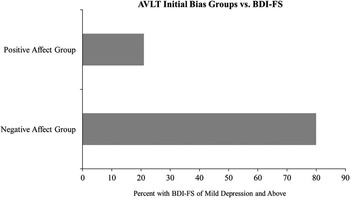
To determine whether the Initial Bias index from the AVLT would reveal affect group differences in the number of athletes reporting at least mild depression and no depression, a χ2 analysis was performed. The BDI-FS was dichotomized into two groups: Individuals with a BDI-FS score of 2 (mild) and above were placed in one group and individuals with a BDI-FS score of 0 (no depression) were placed in second group. We found that a significantly greater proportion of athletes reporting at least mild depression were in the negative compared with positive affect group, χ2 (1, N = 66) = 12.07, p = .001. As seen in Figure 1, 80% of individuals in the negative affect group from the AVLT Initial Bias index reported mild depression or above, while only 20% of individuals from the positive affect group from the AVLT Initial Bias index reported these higher levels of depressive symptoms.
Affective Verbal Learning Test (AVLT) Initial Bias affect group differences on the Beck Depression Inventory-Fast Screen (BDI-FS).

Discussion
The current study is the first, to our knowledge, to examine the validity of affect measurements in evaluating symptom reporting in athletes at baseline. The affect measurements examined included an objective performance based measure of initial affective memory bias (AVLT) and an examiner rating of observed affect. The results indicate that the examiner observed affect ratings were more predictive of broad symptom reporting, whereas the AVLT Initial Bias index differentiated individuals who were mildly depressed and above from athletes reporting no depression at baseline testing.
Positive and negative affect groups created using the Initial Bias AVLT index were not significantly different on either the PCSS or the ITSS. However, the groups were significantly different on the BDI-FS. The potential clinical utility of the AVLT was explored by dividing the sample into those reporting mild depression or above, and those reporting no depression on the BDI-FS. We found a significantly higher percentage of individuals reporting mild depression or above in the negative bias group. This finding suggests that individuals experiencing clinically significant levels of depression are more likely to exhibit a negative affective bias on the AVLT, and that individuals with a positive affective bias tend not to report significant depressive symptoms. Therefore, the current performance based measurement of AMB has utility in objectively identifying athletes as having significant depression symptoms versus not having significant symptoms, as measured by the BDI-FS.”
When affect was examined with examiner affect ratings, the positive and negative affect groups demonstrated significant differences on both the PCSS and ITSS, but not the BDI-FS. These results demonstrate that examiners’ behavioral observations of affect may be more reflective of an individual's general level of symptomatology, rather than depression symptomatology per se. When we examined the association between the AVLT and Examiner Affect scores we did not find that they were significantly related to one another. Although this was a surprising finding, it supports the results that the two measurements of affect are independent of one another and measure different aspects of symptomatology. Our results are consistent with studies showing that individuals in more negative affective states tend to report more psychological symptoms (Salovey et al., Reference Salovey, O'Leary, Stretton, Fishkin and Drake1991; Sanjuán, Pérez, Rueda, & Ruiz, Reference Sanjuán, Pérez, Rueda and Ruiz2008). In summary, the present findings indicate that the Examiner Rating of affect was a more valid indicator of general post-concussion symptom reporting in athletes compared to the AVLT, and the AVLT Initial Bias index was more specific to depressive symptom reporting in this sample. Furthermore, these results demonstrate more generally that measuring positive and negative affect during baseline testing could be a useful indicator of psychological functioning in athletes that does not rely on self-report.
There are important clinical implications of these findings. As previously noted, detecting the signs and symptoms of concussion can be difficult, and therefore determining more valid objective methods to assess the range of concussion effects is essential (Kelly, Reference Kelly1999; Covassin, Schatz, & Swanik, Reference Covassin, Schatz and Swanik2007). Our results suggest that observer and performance based measures of affect could be validly used in the context of baseline concussion testing. Results of this study suggest that performance on a test of affective memory bias, specifically the AVLT, is related to clinically significant levels of self-reported depression in a collegiate athlete sample. In the context of sports-related concussion evaluations, athletes may be inclined to minimize reporting of depression symptoms, and so the use of a performance-based measure of affect like the AVLT could be very useful. Our research is still preliminary, however, and replication of these findings is essential before a task like the AVLT can be applied clinically.
Despite these important findings, several limitations in the current study are noteworthy. Although the Initial Bias index on the AVLT was related to levels of depression at baseline, it is currently unknown whether this relationship is also present post-concussion. This will be an important area for future research to further explore the validity of the AVLT as a performance based measure of depressive symptoms at baseline and also following concussion. This study also used the BDI-FS as a measure of depression, and although this measure highly correlates with other measurements of depression, it is relatively less rigorous and provides fewer clinical details than a comprehensive structured interview. Given that the BDI-FS is a self-report measure, scores can be exaggerated and minimized, thereby limiting the accuracy of the information provided by a respondent. In addition, directionality in the relationship between AMB and depression cannot be assumed from the current study, and longitudinal work is needed to better understand the nature of their association. Furthermore, the examiner rating measure of athletes’ affective state was completed following baseline testing; therefore these ratings could possibly have been influenced by the examiners’ perception of athletes’ performance throughout baseline testing.
Identifying objective methods in baseline and post-concussion assessment remains imperative. As noted earlier, athletes may be motivated to underreport symptoms due to the fact that their report of post-concussive symptoms can reduce the likelihood that they will return to play. Therefore, receiving accurate information from athletes in regards to psychological symptoms and cognitive problems may be difficult following concussion. Using examiner behavioral assessments in conjunction with other objective measurements that do not rely on the athlete's self-report could improve the accuracy of baseline and post-concussion assessments. Future work should continue to explore the utility of behavioral and affect assessments in evaluating psychological and cognitive functioning in athletes. To more rigorously examine the validity of AMB as a depression measure, future research using a Multitrait-Multimethod approach to construct validation is warranted (Campbell & Fiske, Reference Campbell and Fiske1959). Additionally, continued work should focus on developing objective measures that are sensitive and valid for the evaluation of outcomes from concussion. This will allow individuals managing recovery from concussion and return to play decisions to have the most comprehensive and accurate information available on an athlete's level of functioning, allowing for optimal recommendations and treatment decisions.
Acknowledgments
The authors report no conflicts of interest and do not have a financial investment in this study or the outcome of the data.