INTRODUCTION
The adverse effects of poor sleep have been well-documented in healthy populations, with studies associating it with greater likelihood of developing cognitive impairment (Fortier-Brochu, Beaulieu-Bonneau, Ivers, & Morin, Reference Fortier-Brochu, Beaulieu-Bonneau, Ivers and Morin2012; Joo, Kim, Suh, & Hong, Reference Joo, Kim, Suh and Hong2014) and dementia in older adults (Chen, Lee, Sun, Oyang, & Fuh, Reference Chen, Lee, Sun, Oyang and Fuh2012; Cipriani, Lucetti, Danti, & Nuti, Reference Cipriani, Lucetti, Danti and Nuti2015; Cricco, Simonsick, & Foley, Reference Cricco, Simonsick and Foley2001; Foley et al., Reference Foley, Monjan, Masaki, Havlik, White and Launer2001). While some studies have associated deficits in attention (Chee, Tan, Parimal, & Zagorodnov, Reference Chee, Tan, Parimal and Zagorodnov2010) and executive function (Fernandez-Mendoza et al., Reference Fernandez-Mendoza, Calhoun, Bixler, Pejovic, Karataraki, Liao and Vgontzas2010; Shekleton et al., Reference Shekleton, Flynn-Evans, Miller, Epstein, Kirsch, Brogna and Rajaratnam2014) with poor sleep, a growing body of literature also demonstrates the adverse effects of poor sleep on memory performance (Backhaus et al., Reference Backhaus, Junghanns, Born, Hohaus, Faasch and Hohagen2006; Griessenberger et al., Reference Griessenberger, Heib, Lechinger, Luketina, Petzka, Moeckel and Schabus2013; Joo et al., Reference Joo, Kim, Suh and Hong2014; Walker & Stickgold, Reference Walker and Stickgold2004). In their meta-analysis of the neuropsychological difference between primary insomniacs and normal sleepers, Fortier-Brochu et al. (Reference Fortier-Brochu, Beaulieu-Bonneau, Ivers and Morin2012) found cognitive performance impairments in insomniacs with evidence of deficits in episodic memory, problem solving, and the retention and manipulation of working memory. Although studies suggest that attention directly affects memory encoding (Chun & Turk-Browne, Reference Chun and Turk-Browne2007), Fortier-Brochu and colleagues found no significant group differences in certain attention domains (e.g., alertness, complex reaction time, speed of information processing, selective attention, sustained attention/vigilance).
People living with HIV (PLWH) show a high prevalence of sleep problems (Lee et al., Reference Lee, Gay, Portillo, Coggins, Davis, Pullinger and Aouizerat2009; Rubinstein & Selwyn, Reference Rubinstein and Selwyn1998) with estimates ranging from 56% to 73% of PLWH reporting poor sleep compared to 10–30% of those in the general population (National Sleep Foundation, 2005). Sleep health (SH) is a broad term that refers to a multidimensional pattern of sleep-wakefulness that promotes well-being when adapted to individual, social, and environmental demands (Buysse, Reference Buysse2014). Good SH is characterized by subjective satisfaction, adequate duration, high efficiency, appropriate timing, and sustained alertness during waking hours. In comparison to healthy individuals, PLWH report worse SH that manifests in symptoms such as daytime sleepiness, fatigue, and overall poor sleep quality (Darko, McCutchan, Kripke, Gillin, & Golshan, Reference Darko, McCutchan, Kripke, Gillin and Golshan1992; Darko et al., Reference Darko, Miller, Gallen, White, Koziol, Brown and Munnell1995; Low, Preud’homme, Goforth, Omonuwa, & Krystal, Reference Low, Preud'homme, Goforth, Omonuwa and Krystal2011; Norman et al., Reference Norman, Resnick, Cohn, Duara, Herbst and Berger1988; Wibbeler, Reichelt, Husstedt, & Evers, Reference Wibbeler, Reichelt, Husstedt and Evers2012). Although problems with SH are commonly reported among PLWH, it is unclear whether poor sleep is a sequelae of disease pathology (White et al., Reference White, Darko, Brown, Miller, Hayduk, Kelly and Mitler1995) or a side effect of antiretroviral (ARV) medication (Jena, Sachdeva, Sharma, & Wanchu, Reference Jena, Sachdeva, Sharma and Wanchu2009; Kenedi & Goforth, Reference Kenedi and Goforth2011; Simen et al., Reference Simen, Ma, Svetnik, Mayleben, Maynard, Roth and Fraser2015).
PLWH also show a high prevalence of cognitive impairment (Heaton et al., Reference Heaton, Franklin, Ellis, McCutchan, Letendre, LeBlanc and Collier2011; Sanmarti et al., Reference Sanmarti, Ibáñez, Huertas, Badenes, Dalmau, Slevin and Jaen2014). However, despite the known relationship between sleep problems and cognitive impairment, the contribution of poor sleep to impairment in cognition among PLWH remains a relatively unexplored area of research. Gamaldo and colleagues (2013) investigated the associations between objective and subjective measures of sleep quality and cognitive functioning within a sample of PLWH, and found both subjective and objective indices of sleep continuity and quality to have a significant relationship with cognitive performance in HIV−positive (HIV+) individuals.
In another study, Byun, Gay, and Lee (Reference Byun, Gay and Lee2016) found poorer self-reported sleep quality to be associated with poorer self-reported cognitive functions in a sample of adults living with HIV. Although the relationship between HIV and cognitive impairment has been well-documented, with HIV+ individuals showcasing poorer overall cognitive functioning in areas such as attention, memory, concentration, psychomotor, and executive functioning (Becker, Thames, Woo, Castellon, & Hinkin, Reference Becker, Thames, Woo, Castellon and Hinkin2011; Heaton et al., Reference Heaton, Franklin, Ellis, McCutchan, Letendre, LeBlanc and Collier2011), no study to our knowledge has included a HIV−negative (HIV−) control group to compare the adverse effects poor SH on neurocognitive function among individuals with and without HIV−infection.
The purpose of the current study was to characterize HIV+ and HIV− individuals based upon their self-reported SH and to examine differences in cognitive performance. We hypothesized that HIV+ individuals with poor SH would perform significantly worse on cognitive performance compared with the other groups.
METHODS
Participants
The University of California, Los Angeles, Institutional Review Board approved study procedures and participants signed informed consent forms before participation. One hundred and sixteen HIV+ (n=66) and HIV− (n=50) participants were recruited from HIV clinics and the local community through local advertisements. Questionnaires and screeners about medical, neurological, and psychiatric history were used to screen for potential confounds (see Thames et al., Reference Thames, Kuhn, Williamson, Jones, Mahmood and Hammond2017). Briefly, participants were screened for neurological, psychiatric, and medical confounds using the Structured Clinical Interview (SCID) for DSM-IV (First, Spitzer, Gibbon, & Williams, Reference First, Spitzer, Gibbon and Williams1995), Mini-Mental State Examination (Folstein, Folstein, & McHugh, Reference Folstein, Folstein and McHugh1975), and questionnaires about neurological and medical history. Participants were excluded if they reported a history of head injury with a loss of consciousness (>30 min); neurological insult (e.g., seizures); HIV−associated central nervous system (CNS) opportunistic infections (e.g., CNS lymphoma); met diagnostic criteria for alcohol or substance dependence within the past year, and/or substance abuse within the past year (except alcohol and marijuana), current or past diagnosis of psychotic-spectrum disorder (per SCID); or MRI contraindications.
Neurocognitive Functioning, Sleep Health, and Immune Status
Participants were administered a brief cognitive test battery used in prior studies (Thames et al., Reference Thames, Kuhn, Williamson, Jones, Mahmood and Hammond2017; Thames, Mahmood, Burggren, Karimian, & Khun, Reference Thames, Mahmood, Burggren, Karimian and Kuhn2016). Briefly, the battery included tests of premorbid intellectual ability (Wide Range Achievement Test – 4th edition [WRAT-4; Wilkinson & Robertson, Reference Wilkinson and Robertson2004]), and cognitive tests classified into the domains of verbal fluency (Controlled Oral Word Association Test [Letter and Category Fluency]), executive functioning (Trail Making Test − Part B; Wechsler Adult Intelligence Scale − IV [WAIS-IV; Wechsler, Reference Wechsler2008] Letter-Number Sequencing subtest; Stroop Test [Interference condition; Golden & Freshwater, Reference Golden and Freshwater1978]), information processing speed (Trail Making Test − Part A; Stroop Test [Color and Word conditions; Reitan, Reference Reitan1958]; WAIS-IV Digit Symbol and Symbol Search subtests), learning (Brief Visual Memory Test-Revised [BVMT-R; Benedict, Reference Benedict1997]; Hopkins Verbal Learning Test-Revised [HVLT-R; Brandt & Benedict, Reference Brandt and Benedict2001] Immediate subtest), and memory (Brief Visual Memory Test-Revised [BVMT-R]; Hopkins Verbal Learning Test-Revised [HVLT-R] Delayed subtest).
All raw scores were converted to standardized t scores using published normative procedures and demographically corrected norms when available (Heaton, Miller, Taylor, & Grant, Reference Heaton, Miller, Taylor and Grant2004). We also obtained a global cognitive score by averaging the domain t scores, which is considered a standard approach to neurocognitive data interpretation (Heaton, Grant, & Matthews, Reference Heaton, Grant and Matthews1991; Miller & Rohling, Reference Miller and Rohling2001).
SH was assessed using the SATED scale (Buysse, Reference Buysse2014), which measures the quality of five dimensions of sleep within the past 30 days (SATED, i.e., S atisfaction with sleep, A lertness during waking hours, T iming of sleep, Sleep E fficiency, and Sleep D uration), along with a question addressing consistent sleep-wake cycles during the past month. A total score (i.e., “Overall Sleep Health”) is computed, which ranges from 0 to 12, with higher scores representing better SH [HIV/SH group range=2–12]. A subset of the participants (N=67; HIV+=36, HIV−=31) also completed the Pittsburgh Sleep Quality Index (PSQI; Buysse, Reynolds, Monk, Berman, & Kupfer, Reference Buysse, Reynolds, Monk, Berman and Kupfer1989), a psychometrically validated 19-item retrospective assessment of sleep quality over a 1-month period, with a global score ranging from 0 to 21 (higher scores indicate poorer sleep quality).
Note, this subset was reflective of the overall sample, with no significant difference on demographic variables (p’s>.05); however, consistent with the overall sample of N=116, the HIV+/SH− group demonstrated greater depression. PSQI global score was used to determine the ideal cutoff for the SATED scale for the purposes of group classification, as described in detail below. The AIDS Clinical Trials Group (ACTG; Chesney et al., Reference Chesney, Ickovics, Chambers, Gifford, Neidig, Zwickl and Wu2000) Adherence Baseline Questionnaire was also administered and current depression was assessed by the Beck Depression Inventory-2, with the sleep item excluded from the total score [BDI-II; Beck, Steer, & Brown, Reference Beck, Steer and Brown1996]). Participants underwent blood draw to confirm HIV status. Additional laboratory testing of CD4 and HIV viral load was conducted for the HIV+ participants.
Statistical Analyses
A cutoff score of half a standard deviation (SD) below the mean on the SATED was used to classify participants into distinct HIV/SH groups: HIV+/SH+ (n=34), HIV−/SH+ (n=32), HIV−/SH− (n=18), and HIV+/SH− (n=32). This cut-point was determined based upon its strongest predictive relationship to the PSQI. First, we correlated the PSQI score with the SATED total score. Correlations between the total score from the SATED and the PSQI were statistically significant (r=−.472; p<.001). Next, using an established cutoff score of 8 for the PSQI (Carpenter & Andrykowski, Reference Carpenter and Andrykowski1998; Fichtenberg, Putnam, Mann, Zafonte, & Millard, Reference Fichtenberg, Putnam, Mann, Zafonte and Millard2001), we categorized participants as poor sleepers [0] or good sleepers [1]. Then, discriminant functions analysis using the leave-one-out (LOO) jackknife classification was used to determine which SATED score best classified participants into sleep problem categories on the PSQI.
The cutoff score of 6 (i.e., 0.5 SD below mean) best classified group membership. The SATED cutoff score correctly classified self-reported sleep problems in 77% of cases on the PSQI. Additionally, results from a receiver operation characteristic (ROC) curve analysis demonstrated adequate sensitivity and specificity of the SATED scale, reflected by an area under curve of .80 (p<.001; CI: .69, .90).
Independent samples t tests, one-way analysis of variance (ANOVA), and Chi-square analyses were conducted to examine demographic and clinical characteristics between groups. We used ANOVA and multivariate ANOVA (MANOVA) to examine differences between HIV/SH groups on global neurocognitive functioning and individual cognitive domains.
RESULTS
Demographic Comparison
Of note, for demographic comparisons described below, SH was treated as a continuous variable and log-transformed due to a skewed distribution. Irrespective of SH status, HIV groups did not significantly differ in age, education, estimated premorbid IQ, and race/ethnicity (p’s>.10). However, there were significant differences in gender [χ 2(2)=7.19; p=.03] with significantly greater proportion of males and transgendered (male-to-female) participants in the HIV+ group compared to HIV−controls. Gender was not significantly related to SH and cognitive outcome variables of interest, and gender did not significantly differ between the HIV/SH groups (all p’s>.10). Therefore, we did not include gender as a covariate in statistical analyses.
Independent samples t test demonstrated a significant difference between the HIV status groups on SH [t(114)=−2.22; p=.03], current depression [t(114)=2.10; p=.04] and past (i.e., >12 months since study participation) marijuana [χ 2(1)=6.34; p=.01] and cocaine use [χ 2(1)=6.43; p=.01], with the HIV+ group reporting poorer SH, greater depression, and a greater proportion reporting past marijuana and cocaine use compared to HIV− controls. There were also statistically significant racial differences in SH [F(1,114)=9.35; p=.003] with African Americans reporting lower SH scores than European Americans. Depression symptoms (i.e., total BDI-II with sleep item removed) were significantly associated with SH, with greater depression related to worse SH; however, they were not significantly associated with cognitive measures. Depression was significantly different between the HIV/SH groups (F(3,112)=3.13; p=.03), with the HIV+ poor SH group reporting greater current depression compared to the HIV− good SH group only. No other HIV/SH group differences were found.
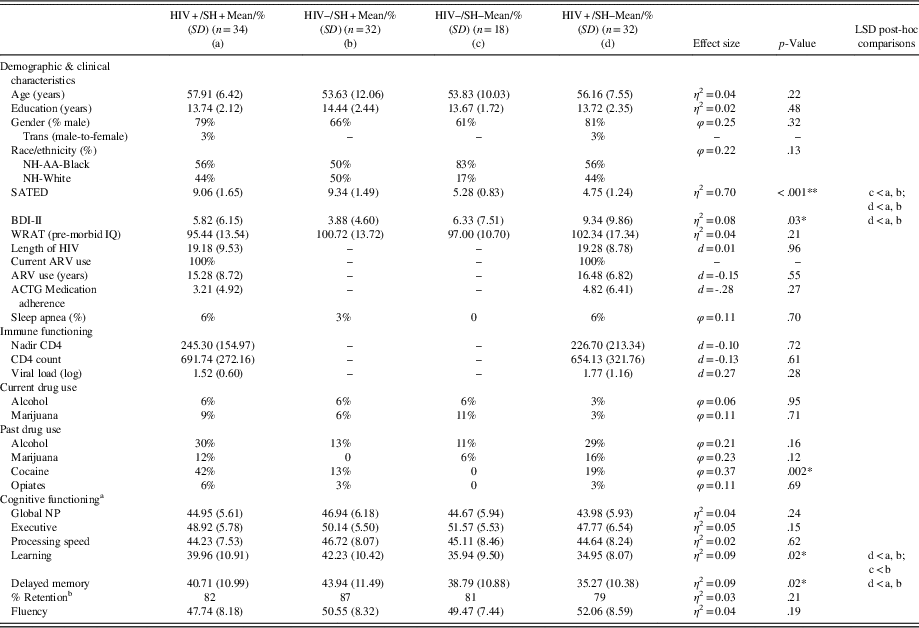
Partial correlations, with depression as a covariate, demonstrated comparable associations between sleep and cognition to correlations that did not include depression as a covariate. Furthermore, analyses with and without depression as a covariate resulted in similar findings, as such, the results from analyses without depression as a covariate are reported. Although the HIV+ group reported greater past use of cocaine and marijuana than the HIV− group, there were no differences in current use (p’s>.10). Moreover, past marijuana and cocaine use was not significantly related to SH or cognition (p’s>.05). Additionally, there were no differences in past use of drugs between HIV+ individuals who reported poor SH and HIV+ individuals who reported better SH. Hence, these were not included as covariates in our analyses. Table 1 reports the demographic comparison between the HIV/SH groups and descriptive statistics for significant outcomes of interest (reported below).
Participant demographics and group statistics

*p<0.05.
** p<0.001.
a All cognitive domains report results using T-scores.
b Average percent retained from highest learning trial score on BVMT and HVLT.
AA=African American; NH=non-Hispanic; NP=neuropsychological.
Within the HIV+ group, there was no relationship between SH and nadir CD4 [t(52)=−.37; p=.72], current CD4 [t(62)=−.41; p=.68] and log-transformed viral load [t(61)=−1.45; p=.15]. All HIV+ participants were on a stable regimen of cART and were clinically stable based upon current plasma CD4 count, and 79.4% had undetectable viral load (i.e.,<20 copies/mL).
HIV/SH Status and Neurocognitive Performance
Correlations between cognitive performance, depression, and SH are provided in Table 2. There was no significant difference between the HIV/SH groups on global neurocognitive performance [F(3,112)=1.44; p=.24; see Table 1 for statistics]. MANOVA demonstrated significant differences among the groups on individual cognitive domains [F(3,112)=1.95; p=.02; Λ=.77; η2 =.08]. Least significant difference (LSD) post hoc analyses demonstrated that the effects were in the domains of learning [F(3,112)=3.55; p=.02; η2 =.09] and delayed memory [F(3,112)=3.48; p=.02; η2 =.09], such that HIV+ individuals with poor SH had lower scores in these domains as compared to HIV+ individuals with good SH and the HIV−/SH+ group.
SATED scale, PSQI, Depression (as assessed by BDI-II), and cognitive domains (T-scores): Correlations and descriptive statistics (N=116)

*p<.05.
**p<.01.
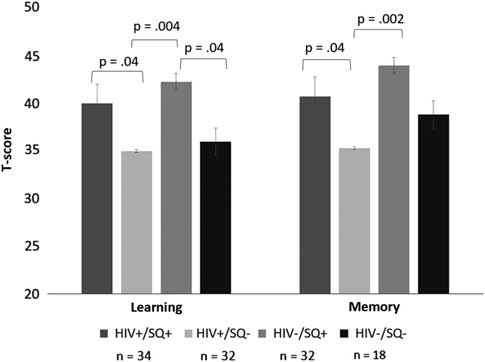
Furthermore, we examined the percent of information retained after a long-delay from the participants’ highest learning trial score (see Table 1). Although we did not find statistically significant differences, there was a trend toward lower retention scores among the HIV+/SH− group. HIV−controls with poor sleep health had lower learning scores compared to HIV−controls with good sleep health (see Figure 1). No other significant differences in cognitive performance were found.
HIV status and SQ effects on neurocognitive performance. Note. poor SQ (SQ−); good SQ (SQ+).

DISCUSSION
The primary interest of the current study was to characterize HIV+ and HIV− individuals based upon self-reported SH and to examine differences in cognitive performance. Considering the findings from most investigations of sleep effects have been comprised of medically healthy individuals, and problems with sleep health/quality are disproportionately high in the HIV−infected population, it is important to examine whether previous findings generalize to chronic disease populations.
The results demonstrate poor sleep to be associated with lower global cognitive performance across both HIV groups, with poorer performance on learning and memory domains driving this relationship. As expected, the HIV+ participants reported poorer SH compared to controls. Analyses investigating differences between classified groups on individual cognitive domains revealed that the HIV+/SH− group had lower learning and memory scores as compared to the HIV+/SH+ and HIV−/SH+ groups. Furthermore, the HIV−/SH− group had poorer learning performance compared to the HIV−/SH+ group. Together these results support our hypothesis of an adverse effect of poor SH in HIV+ individuals.
There were no statistically significant differences between the HIV+/SH+ group and the HIV− groups, suggesting that poor SH may contribute to cognitive problems in HIV, particularly in the domains of learning and memory, or that HIV+ individuals with worse cognitive functioning experience worse sleep health. Moreover, there were no statistically significant differences between the HIV+/SH− group and the HIV−/SH− group and the cognitive differences within the learning domain between SH groups was greater for the HIV−controls as compared to the HIV+ groups, underscoring the adverse impact of poor sleep on cognitive performance, regardless of HIV−status. Although not statistically significant, HIV+ individuals with poor sleep health had lower percent retention than HIV+ individuals with good sleep health and HIV−controls with good sleep health, indicating difficulty retaining previously encoded information over time.
These findings are consistent with previous studies associating poor sleep with deficits in learning and memory (Byun et al., Reference Byun, Gay and Lee2016; Fortier-Brochu et al., Reference Fortier-Brochu, Beaulieu-Bonneau, Ivers and Morin2012; Joo et al., Reference Joo, Kim, Suh and Hong2014), as well as imaging studies implicating abnormalities in fronto-temporal regions sub-serving these cognitive functions (Altena, Vrenken, Van Der Werf, van den Heuvel, & Van Someren, Reference Altena, Vrenken, Van Der Werf, van den Heuvel and Van Someren2010; Joo et al., Reference Joo, Kim, Suh and Hong2014, Reference Joo, Noh, Kim, Koo, Kim, Hwang and Hong2013; Neylan et al., Reference Neylan, Mueller, Wang, Metzler, Lenoci, Truran and Schuff2010; Riemann et al., Reference Riemann, Voderholzer, Spiegelhalder, Hornyak, Buysse, Nissen and Feige2007). Our findings suggest that sleep problems within medical populations are relevant to cognitive functioning, although the direction of this relationship remains unclear.
Although not a focus of the current study, mechanisms underlying changes in cognitive performance should be considered. Considering that both sleep problems and HIV status are associated with the increase of proinflammatory cytokines (e.g., interleukin-6 and tumor necrosis factor-alpha) (Breen et al., Reference Breen, Rezai, Nakajima, Hirano, Beall, Mitsuyasu and Martı́nez-Maza1990; Heffner et al., Reference Heffner, Ng, Suhr, France, Marshall, Pigeon and Moynihan2012; Irwin, Reference Irwin2015; Seay et al., Reference Seay, McIntosh, Fekete, Fletcher, Kumar, Schneiderman and Antoni2013; Wirth et al., Reference Wirth, Jaggers, Dudgeon, Hébert, Youngstedt, Blair and Hand2015), a possible mechanism underlying the additive effect of poor SH and HIV could be explained through increases in inflammatory responses which ultimately disrupt neural systems, such as the dopaminergic system (Felger & Miller, Reference Felger and Miller2012; González et al., Reference González, Moreno-Delgado, Moreno, Pérez-Capote, Franco, Mallol and Ferré2012). Studies in healthy and medical populations have found dopaminergic system dysfunction to adversely affect cognitive performance in domains such as learning, processing speed, and memory (Bäckman et al., Reference Bäckman, Karlsson, Fischer, Karlsson, Brehmer, Rieckmann and Nyberg2011; Chang et al., Reference Chang, Wang, Volkow, Ernst, Telang, Logan and Fowler2008; Kumar, Ownby, Waldrop-Valverde, Fernandez, & Kumar, Reference Kumar, Ownby, Waldrop-Valverde, Fernandez and Kumar2011). Future studies should examine the role of inflammatory response to cognitive problems among HIV+ individuals with poor sleep health.
Considering the etiology of sleep problems in HIV−infection remains up for debate (White et al., Reference White, Darko, Brown, Miller, Hayduk, Kelly and Mitler1995; Simen et al., Reference Simen, Ma, Svetnik, Mayleben, Maynard, Roth and Fraser2015), it is possible that ARV medication use may have potentially contributed to the increased sleep problems. However, the high levels of medication adherence reported by our HIV+ sample (regardless of SH status), the lack of significant difference in SH between the HIV+ and HIV− good SH groups, and the lack of significant difference between the HIV+ good and poor SH groups in their use of ARV medications reduces the concern that our findings were a result of ARV side effects. Nevertheless, future studies should investigate the contribution of ARV medication use on sleep-associated cognitive impairments.
There are limitations to the current study that must be acknowledged. The sample size is relatively small, and the use of self-report may not provide an accurate representation of objective sleep health. While some studies in healthy populations have shown a significant correlation between variables of objective and subjective measures of sleep (Landry, Best, & Liu-Ambrose, Reference Landry, Best and Liu-Ambrose2015), others have found no association (Grandner, Kripke, Yoon, & Youngstedt, Reference Grandner, Kripke, Yoon and Youngstedt2006). Within the HIV literature, however, self-reports of prolonged sleep latency and decreased sleep efficiency by asymptomatic individuals have been corroborated by polysomnographic results (e.g., Norman et al., Reference Norman, Chediak, Freeman, Kiel, Mendez, Duncan and Nolan1992; Wiegand et al., Reference Wiegand, Möller, Schreiber, Krieg, Fuchs, Wachter and Holsboer1991).
Furthermore, subjective indices of sleep have been shown to have a significant relationship with cognitive impairment in HIV+ individuals (Gamaldo et al., Reference Gamaldo, Gamaldo, Creighton, Salas, Selnes, David and Smith2013), thus, bolstering the use of self-report to examine SH. Although the HIV+ group reported greater past use of cocaine and marijuana than the HIV− group, there were no differences in current use, which we would expect to have had a greater impact on our results. Nevertheless, there were no differences in past use of drugs between HIV+ individuals who reported poor SH and HIV+ individuals who reported better SH and past cocaine/marijuana use was not significantly related to SH or cognition. Therefore, we are less concerned that greater past use of these drugs in the HIV+ group impacted our study results.
Although the HIV/SH groups did not significantly differ in terms of race/ethnicity, the largely homogenous representation of African-Americans in the HIV−/SH− did raise concerns about the potential impact on study findings. Indeed, African-Americans/Blacks are nearly twice as likely to report short sleep (Durrence & Lichstein, Reference Durrence and Lichstein2006; Krueger & Friedman, Reference Krueger and Friedman2009; Stamatakis, Kaplan, & Roberts, Reference Stamatakis, Kaplan and Roberts2007). A recent meta-analysis found that Blacks were more likely to be short sleepers than were Whites, with larger effect sizes in studies using objective as compared to self-reported measures of sleep duration (Ruiter, DeCoster, Jacobs, & Lichstein, Reference Ruiter, DeCoster, Jacobs and Lichstein2011). However, considering that the HIV+/SH− group (which had approximately equal proportions of Whites and Blacks) was found to demonstrate the lowest performance on measures of learning and memory, and that the proportion of HIV+ Blacks and Whites in the sample were approximately equal, we are less concerned that this is driven by group differences in the proportion of African Americans/Blacks.
We did not gather information regarding distress due to sleeping patterns, which could potentially be a mediator to the cognitive deficits associated with poor SH. PSQI data were not available for all study participants and characterization of participants into HIV/SH groups resulted in small cell sizes, which significantly impacted statistical power. Hence, our use of the SATED scale. Although the psychometric properties of the SATED scale have yet to be determined, the scale is brief, incorporates specific quantitative criteria to assess key dimensions of sleep that have been consistently associated with health outcomes, and addresses positive dimensions of sleep-wakefulness (Buysse, Reference Buysse2014). Additionally, the attributes comprising this sleep health measure are not specific to any sleep disorder; therefore, they are applicable to, and can be measured across, all populations, with and without sleep disorders.
We recognize that our cutoff score was validated using a subset of the sample, and, therefore, needs replication. Nevertheless, the SATED cutoff score that we used demonstrated adequate discriminative concurrent criterion validity, with a sensitivity of 77% and specificity of 70%. Furthermore, while our study uses a subjective measure of SH in a cross-sectional design, future studies would benefit from the concurrent use of an objective measure of SH in a longitudinal setting to determine long-lasting effects of poor SH in the context of chronic disease.
Finally, we did not determine whether participants were suffering from acute or chronic sleep disturbance; however, we identified 4% of total participants with sleep apnea through a self-report measure. As such, the differential effects of sleep disorder classifications, using standardized diagnostic procedures, should be considered in future investigations.
This is the first study, to our knowledge, to investigate the complex relationship between HIV status and poor SH on neurocognitive outcomes, with a specific focus on characterizing sleep health in HIV+ individuals. The study findings coincide with prior investigations of cognitive impairment associated with sleep problems. Furthermore, our findings suggest a strong link between SH and cognition among HIV+ individuals, and further studies are needed to determine if poor SH increases vulnerability to cognitive decline among individuals with HIV.
Our findings also highlight the clinical and scientific importance of monitoring sleep health and cognition to help identify individuals at greatest risk of poor health outcomes. In addition to classical assessment and evaluation methods (i.e., objective and subjective sleep measures), our findings suggest a need for clinicians to routinely inquire about cognitive functioning when determining a presence of sleep problems and implementing treatment options. Interventions such as sleep-aide medication and cognitive-behavioral therapies have continuously proven advantageous in the treatment of sleep-related problems. Thus, recognition of the impact of poor sleep health as well as adopting interventions could influence clinical outcomes, medication adherence, and the overall quality of life and well-being for PLWH. The current study underscores the utility of sleep health indices as potential tools in identifying problems with sleep and associated risk for development and progression of future HIV−associated neurocognitive disorder.
ACKNOWLEDGMENTS/ STUDY FUNDING
This work was supported by NIH/NIMH (K23 MH095661; PI: A. D. Thames; NIH/National Center for Advancing Translational Science (NCATS) UCLA CTSI Grant Number UL1TR001881). Disclosure of Interest: Authors report no conflict of interests or financial disclosures.