“Development is differentiation emerging from generality”
J. Jacobs, The nature of economies1. Introduction
The paradigmatic view since at least Jakobson (Reference Jakobson1968) has conceived child language acquisition not as the addition of language structures and rules, but as a reduction in the range of possible rules and structures. Through experience in the language of the community, the child selects and reinforces a subset from within the larger set of structural possibilities. Universal Grammar (UG) is thus conceived as the full set of possible grammars and linguistic categories, while language acquisition is the process of arriving at differentiation and specificity. Among the several contemporary advocates of universalism, Lebeaux (Reference Lebeaux1988) argues for the existence of structural defaults in grammatical development. These are minimal structures or mechanisms available to the child before language experience makes it possible to put in place language-specific options. A different perspective on universalism holds that all possible UG options are initially available and may remain to a certain extent within mature grammars. For instance, Roeper (Reference Roeper1999) proposes that the adult grammar can retain possibly conflicting UG-given parametric settings, but that these have different levels of lexical generality. Yang (Reference Yang2002) assumes that all parametric options are present in the child grammar, and that a frequency-sensitive learner-parser modifies the probability that a given grammar will be accessed. In this system, each parsed token sentence serves to strengthen the target and reduce the accessibility of competing grammars.
In this paper, we argue that data from bilingual language acquisition supports the default version of the universalist position proposed by Lebeaux, that is, of language development as specialization from generality. We consider one case of language interaction, a delay in the overt realization of direct objects in bilingual children. We argue that the early stages, characterized by the prevalence of omissions, correspond to an acquisition default, and that the presence of conflicting input in the bilingual's languages selectively increases the “life cycle” of the default hypothesis.
The paper is organized as follows. Section 2 discusses language interactions in bilingual development, and concludes that the primary locus of such interactions is the lexicon. The topic of section 3 is the distribution of direct objects and their acquisition in English and French monolingual and bilingual contexts. Section 4 presents a study of object realizations in two groups of French-speaking children, one growing up in an essentially monolingual environment and the other in a primarily bilingual environment. Section 5 presents our conclusions.
2. Bilingual language acquisition
2.1 The selective interdependence of the languages of the bilingual child
The last few decades of study on bilingual child development have settled the question of children's ability to simultaneously acquire two languages. The consensus is that bilingual children are able to acquire differentiated (autonomous) grammatical systems from the first stages, a position that has been known as the autonomous development view (Meisel, Reference Meisel1986, Reference Meisel, Hyltenstam and Obler1989, Reference Meisel, Cenoz and Genesee2001, Reference Meisel, Caunt-Nulton, Kulatilake and Woo2007a; Genesee, Reference Genesee1989; Paradis and Genesee Reference Paradis and Genesee1996; Paradis, Reference Paradis2001; Nicoladis, Reference Nicoladis2002; Müller, Reference Müller2003; and others). Empirical support for the autonomy view is robust: most sentences uttered by bilingual children are unaffected by transfer, and rates of acquisition in simultaneous bilingual children are often comparable with those of the monolingual child in many core aspects of grammatical development. To illustrate, Paradis and Genesee (Reference Paradis and Genesee1996) examined the acquisition of clausal syntax in French–English bilinguals: the bilingual data on the core sentential properties of case, finiteness and negation placement in French and English yields no evidence of interaction between the two systems. Furthermore, the bilingual children in their study fell within the normal range for timing of acquisition of these core aspects of sentence structure. The clear conclusion from this and comparable data is that two-year old simultaneous bilingual children already show full language specialization in their grammars.
More controversial than developmental autonomy is the question of language interaction in young bilinguals. We define language interaction broadly to include both transfer (the use of structures of one language in the other) as well as other forms of systemic interactions that include alterations in the developmental timetable of bilinguals in comparison with monolinguals. Some researchers argue against any form of systemic structural interaction between the two grammars. Meisel's (Reference Meisel, Caunt-Nulton, Kulatilake and Woo2007a) discussion on the arguments against interdependence indicates that transfer or interaction is limited to processing rather than representational effects. He suggests that most of the relevant data pertains to dominance and development in the weak language of young bilinguals. He does, however, leave open the possibility of quantitative (as opposed to qualitative) interactions in bilingual language development. Even authors that sustain that the two languages of a bilingual interact provide strong arguments that language interaction occurs in a highly constrained fashion, i.e. the two languages exert an influence over one another but in specific, restricted ways. This view has been argued for in various domains. In her study of phonological development in bilinguals, Paradis (Reference Paradis2001) argues that prosodic patterns in young bilingual children attest to system separation, but patterns of phonological truncation of polysyllabic words show system interdependence. Lleó, Kuchenbrandt, Kehoe and Trujillo (Reference Lleó, Kuchenbrandt, Kehoe, Trujillo and Müller2003) find evidence of system separation in the phonology of codas, but also show that bilingual children start to produce codas in Spanish earlier than monolingual children do, which they attribute to bootstrapping from German. Similar arguments are found in the domains of syntax (Gawlitzek-Maiwald and Tracy, Reference Gawlitzek-Maiwald and Tracy1996; Döpke, Reference Döpke2000; Kupisch, Reference Kupisch2006a, Reference Kupisch and Lleób) and morphology (Nicoladis, Reference Nicoladis2002).
Our study concentrates on the issue of developmental asynchronies as a possible locus to examine interaction in bilingual development. Developmental asynchronies occur when a given structure is typically acquired at different points in the two languages. As pointed out in Paradis and Genesee (Reference Paradis and Genesee1996), lack of interaction in the timing of development is clear evidence of independence. Alternatively, differences between the developmental timetables of bilinguals and monolinguals could be construed as evidence for interdependence between the bilingual's two languages, i.e., of quantitative interactions, under the perspective in Meisel (Reference Meisel, Caunt-Nulton, Kulatilake and Woo2007a). Timetable interactions can take the form of either delay (when the slower language delays acquisition of the property in the early language), or acceleration (when the early language boosts development in the slower language).
Interestingly, while earlier subtractive perspectives on child bilingualism focused on potential delays in development, some authors have found evidence in favor of acceleration effects in some language properties in some bilingual groups. For instance, Gawlitzek-Maiwald and Tracy (Reference Gawlitzek-Maiwald and Tracy1996) suggest that bilingual children are able to pool resources across languages, and rely on the faster language to produce more complex structures. Similarly, Döpke (Reference Döpke1998) finds that German bilingual children overgenerate the SVO order on the basis of overlapping structural configurations across languages, and views this as a form of boosting. In a different syntactic domain, Kupisch (Reference Kupisch2006a) reports acceleration in the acquisition of determiners in the German of a child who was simultaneously acquiring Italian.
Determining the extent and nature of language interaction has become the central question in the field today. Why is the acquisition of some structural properties seemingly affected by the presence of the other language, while for most other properties that is not the case? In this article, we explore this question by considering interactions in the timing of development in the bilingual child in the case of omissions of direct objects.
2.2 Objects in bilingual acquisition
Various accounts of the selective nature of interaction have been presented in the field, including some that specifically focus on the issue of object-drop in child language, such as Müller, Crysman and Kaiser (Reference Müller, Crysmann and Kaiser1996) and Müller and Hulk (Reference Müller and Hulk2001). These two studies examine illicit object omissions in the spontaneous speech of children who are simultaneously acquiring a Germanic and a Romance language (German–Italian, German–French and Dutch–French). Their results show no qualitative differences, only quantitative differences between bilinguals and monolinguals. The bilingual children in their studies have more target-deviant object omissions than their monolingual French and Italian counterparts, presumably because of an influence from German or Dutch, both topic-drop languages. These authors propose that the increased rate of object-drop in bilinguals is the result of “mapping-induced influence” (Müller and Hulk Reference Müller and Hulk2001, p. 17). They argue that cross-linguistic influence occurs if two conditions are met: first, the syntax of the two languages overlaps in surface structure, and second, the phenomena that overlap involve mapping onto an interface level. In the specific case of object-/topic-drop, the C(omplementizer) domain serves as an interface between sentence grammar and discourse. Under their system, object omissions in child French are analyzed as similar to the free topic-drop constructions found in Chinese. The null object is a variable whose referential content is recovered from the discourse through an empty IP-adjoined topic as shown in (1). This would thus be comparable to the recoverability mechanism used in topic-drop languages such as Chinese.
(1)


In their proposal, the change from a Chinese-type to a French-type grammar is triggered by the lexical instantiation of the C domain, which makes PRO illicit in the adjoined IP position. For the period of optional use of clitics, children would maintain two grammars, presumably in competition, along the lines of Roeper (Reference Roeper1999). This proposal has been challenged on theoretical and empirical grounds. One challenge concerns the use of the notion “overlapping structures”. Unsworth (Reference Unsworth2003) argues that this approach is too weak to make predictions about other domains, because it (i) merely describes a necessary but not sufficient condition, and (ii) the notion of overlap is completely unconstrained. Meisel (Reference Meisel, Caunt-Nulton, Kulatilake and Woo2007a) questions the possibility that data in one language can serve as input in the other. Another challenge considers the lack of correlation between object clitics and the emergence of elements in the CP field and the emergence of objects, which questions the topic-drop approach to early object omissions. Jakubowicz and Rigaut (Reference Jakubowicz and Rigaut2000) and van der Velde, Jakubowicz and Rigaut (Reference Van Der Velde, Jakubowicz and Rigaut2002) report that all the children in their study produced lexical complementizers, although the production of accusative clitics was low. Pirvulescu (Reference Pirvulescu, Belletti, Bennati, Chesi, DiDomenico and Ferrari2006) also shows that object clitics appear five months after the lexical instantiation of the CP domain. Finally, the C-domain approach also predicts that object omissions in French should occur at rates comparable to the ones found in languages such as Chinese, yet a study comparing the rate of omissions in a comparable experimental task found that Chinese and French children omit objects at different rates (Grüter Reference Grüter2006). These data constitute strong evidence against the parametric approach represented by the analysis in (1). Despite these challenges, we argue that the basic insight that developmental omissions may relate to a default representation of the empty category in object position remains of theoretical interest, under a different theoretical perspective, which we outline in section 3.
Serratrice, Sorace and Paoli (Reference Serratrice, Sorace and Paoli2004) compare the distribution of all referential arguments (subjects and objects) in the spontaneous speech of an Italian–English bilingual child to the speech of two groups of MLU-matched monolinguals. Since English is not a null object language, they predicted that this bilingual child would not drop objects in Italian any more than monolinguals do. Their results indicate some asymmetries: objects were omitted less than subjects, and object omissions were more frequent in Italian than in English. Overall, there was a low rate of illicit object omission, but whenever objects were omitted, omission was associated with informativeness (contextual recoverability). Serratrice et al.'s data on bilinguals was fully comparable to that of monolinguals with regard to the patterns of object omission.
Paradis, Crago and Genesee (Reference Paradis, Crago and Genesee2005/2006) evaluates objects in spontaneous language samples taken from nine three-year-old French monolingual and French–English bilingual children. Their data analysis concentrates on contexts where direct object pronominalization is possible, i.e. when the referent of the direct object is mentioned within the previous 10 lines in the transcript. They identify a significant difference in pronominal object production between French and English (77% vs. 92.2%). In the French data, the most common “non-clitic” object was object omission. French bilinguals used more strong pronouns, showing a possible influence of English, whereas monolinguals used more lexical DPs, and rates of object clitic production in bilingual and monolingual children had only a small quantitative difference (77% vs. 86%). Their analysis did not consider object omission directly, and the frequencies of null objects were relatively low for all groups. Therefore, one cannot specifically assess the volume of omission.
In sum, several studies have examined language interactions in bilinguals in the domain of object omission and reached different conclusions. Two studies found no bilingual effect. Paradis et al. found no differences between monolinguals and bilingual three-year-olds with respect to clitic production in pronominalization contexts. In Serratrice et al. (Reference Serratrice, Sorace and Paoli2004), bilingual children omitted objects at rates comparable to those of monolinguals. In contrast, Müller et al. (Reference Müller, Crysmann and Kaiser1996) and Müller and Hulk (Reference Müller and Hulk2001) found the rates of object omission to be higher in bilinguals than in monolinguals.
One cannot easily arrive at a clear generalization on the status of omissions in bilingual children on the basis of these studies. First, various authors use different baselines for computing object omissions. Müller and Hulk coded illicit object omissions, i.e. absent objects that are detected by native speakers as ungrammatical from the total number of transitive contexts. Serratrice and colleagues coded all potential referential arguments; the work offers no explicit discussion of how optional transitivity was dealt with, beyond the standard assumption that neither language allows null objects. The Paradis et al. study focuses on pronominalization contexts. A second issue is the question of evaluating omission in transitive structures in general, and coding optionally transitive verbs. According to Pirvulescu (Reference Pirvulescu, Belletti, Bennati, Chesi, DiDomenico and Ferrari2006), native speaker agreement on whether a verb requires an object in a given sample of corpus is very low. To reach reliability, she had to propose a much narrower definition of clitic context. Neither of the first two studies mentioned above report inter-rater reliability. However, Paradis et al.'s pronominalization approach, although broader than Pirvulescu's, yielded high rates of inter-rater reliability.Footnote 1 Last, but also very important, is the issue of the typology of the language pairs involved. Although the studies above all consider French or Italian, the studies that found bilingual differences had bilingual children whose other language was German or Dutch (both topic-drop languages), whereas the studies that found no delay also had as the other language English (not a topic-drop language).
In the next section we review the notion of transitivity, including the issues raised by optional transitivity, in order to clarify the nature of the problems inherent in the comparison of spontaneous speech, as well as to compare the distribution of null objects in French and English. We present a general approach to null objects, and consider the implications of this theoretical approach for acquisition.
3. Transitivity and null objects
3.1 Null objects in French and English
The traditional approach based on subcategorization frames or their equivalents is insufficient; for a recent discussion, see Gillon (Reference Gillon2006). It has long been recognized that verbs that are traditionally classified as transitive can regularly appear without an overt object in many, if not most, languages of the world. Conversely, verbs traditionally classified as intransitive accept various types of overt direct objects, including but not restricted to modified cognate objects, as shown in (2). Even transitive verbs that resist intransitive uses (such as annihilate and devour compared to eat) can be found in intransitive frames in corpora; see cases in (3).
- (2)
a. He lived a wonderful life.
b. He lived a nightmare.
(3)

Transitivity, as a lexical property, is thus not a categorical phenomenon: intransitive verbs can appear transitively and most transitive verbs alternate. A more accurate characterization would be to say that the difference between devour and eat is one of degree on a transitivity continuum. Accordingly, unergative verbs such as sleep are on one extreme, as they have low probabilities of selecting an overt object position on this continuum. Verbs such as devour are at the opposite side of the spectrum. As a result, rather than assume two lexical entries for verbs that can be used as optional transitives, one can adopt a single lexical entry (i.e., the transitive one) and derive intransitive uses through an independently needed theory of null objects. Transitivity is thus treated as a (potentially universal) grammatical property, not as an idiosyncratic lexical property.
Although the lexical problem of transitivity is theoretically the same across languages, in practice, there are syntactic differences in the treatment of null objects across languages that may present special input problems for children, even in the case of two languages such as French and English, which are not traditionally classified as null object languages. Let's examine these specific differences.
Cummins and Roberge (Reference Cummins and Roberge2005) propose a detailed classification of null objects in French based on the principle that the availability and interpretation of null objects follow from interactions between lexical semantics, syntax, and pragmatics. The syntax can provide a null object of a certain type that can then be interpreted by combining the semantic contribution of the verb with information from the linguistic and/or extralinguistic context. Their approach results in a complex classification for French. For our purposes, however, we can reduce their typology of null objects to two possibilities; see also Lambrecht and Lemoine (Reference Lambrecht, Lemoine, Chuquet and Frid1996) and Larjavaara (Reference Larjavaara2000). The null object has a definite anaphoric interpretationFootnote 2 as in (4a) or a generic interpretationFootnote 3 as in (4b) (examples from Cummins and Roberge, Reference Cummins and Roberge2005).
- (4)
a. A: Tu veux ce livrei?
B: Oh! Mais j'ai déjà lu pro i.
A: “Do you want this book?”
B: “Oh! I've already read Ø.”
b. Pendant mon congé sabbatique j'ai surtout l'intention de lire N.
“During my sabbatical I mainly intend to read Ø.”
The distinction is given in part by the type of null object used, i.e. pro vs. null bare N. We assume an analysis of French accusative clitics along the lines of Sportiche (Reference Sportiche, Rooryck and Zaring1992, Reference Sportiche1998), who attempts to combine a movement analysis and a base-generation analysis. As shown in (5) the clitic is the head of an AGR-type functional projection. A DP argument moves to the Spec position of the clitic projection and is then in a Spec–Head agreement relation with the clitic where feature checking can proceed.
(5)

Since the null object in (4a) has the same referential properties as the pro that would occur if a clitic had been used (Mais je l i’ai déjà lu proi), it makes sense to assume that this null object is also pro. The question is then to determine the nature of such a pro construction without clitic. Cummins and Roberge (Reference Cummins and Roberge2005) refer to this construction as “clitic-drop”. They propose that if clitics are analyzed as morphological markers on the verb and are represented by features spelled-out at PF, then in the clitic-drop construction no morphophonological realization is assigned to the features. This approach has several advantages. First, as stated in footnote 2, there is variability in the use of this construction, a “late” rule is compatible with this observation. Second, in most regional and social varieties of French, a third person accusative clitic drops when it co-occurs with a third person dative clitic.Footnote 4 Cummins and Roberge (Reference Cummins and Roberge2005) argue that the phenomenon appears to be morphophonologically motivated and may have given rise to the clitic-drop construction. Third, this analysis implies that clitic-drop – and therefore the existence of this kind of anaphoric null objects – does not necessarily exist in all languages with an accusative clitic system. Note, however, that this description pertains to clitic-drop, and it is by no means a necessary analysis of child object omission, as we discuss below.
As shown by the translations, English only allows the null objects associated with the null N type, i.e. (4b). If the presence of a pro null object in French is related to the accusative clitic system in this language, then the lack of such null objects in English follows straightforwardly; see Authier (Reference Authier1992). The grammaticality contrast in (6) is thus accounted for.
- (6)
a.
b. What did you do with the dirty dishesi?
*She washed pro i and I dried pro i.

Example (6a) lacks true reference to the dishes, as it is only inferred that the activities of washing and drying apply to the dishes. This can be accounted for by pragmatic inference on the N null object of the two verbs. In (6b), however, the context forces actual reference to an antecedent (as though there were pronouns: she washed them and I dried them) but an empty pronoun category is not available in English.
It is important to point out that the null object illustrated in (4a) is not likely to occur if the object under discussion is foregrounded; see section 4.1. We thus conclude that the common denominator between the two (adult) languages is the construction with a null bare N as object. We use this to propose a default initial setting in UG.
3.2 The null object hypothesis
The discussion above leads us to adopt a new view of transitivity as a syntactic constant that forces the merging of a complement and a verb. Under this view, a V root must systematically merge with a complement but the object may lack lexical content (i.e., it can be null). In this case, different modules contribute to the interpretation of the object. In order to implement this, in the case of intransitive and transitive verbs with no overt object, a bare N is merged to V, instead of a DP (or other types of overt complements), and enters into a semantic hyponymic relation with the V root (see Hale and Keyser Reference Hale and Keyser2002). This is the bare N that is opened to pragmatically-based inference in Cummins and Roberge's approach (4b), and it can be thought of as a null cognate object (Dobrovie-Sorin Reference Dobrovie-Sorin1998). The structures for unergative and transitive verbs, shown in (7), are thus very similar.
- (7)
a.
b.


Since this basic operation of merging of a null bare N applies to all verbs, we take it to be the minimal instantiation of transitivity. If a DP were merged to V in (7a) and (7b), it would be overt (or pro, in French) and referential (dance a tango or eat the soup).
3.3 How children acquire null objects in French and English
For acquisition purposes, we assume that this minimal instantiation of transitivity is the initial setting in UG, that is, the point of departure for L1 acquisition. In other words, what the child must learn is not that a given verb can or cannot appear with an object (i.e. is transitive, optionally transitive, or intransitive) but rather the particular semantic relation that holds between that verb and the object position as in (6) and (7). In the case of null objects, we consider that null objects are part of the universal, initial representation in the grammar of a child: a logical necessity of the core grammatical system that the child brings to the task of development.
We also consider the following hypotheses for interaction in the timing of disappearance of referential null objects in the grammar.
I. No interaction: Children will develop at the same rates in bilingual and monolingual contexts.
II. Delay: Bilingual children acquiring one language whose other language has more null objects may be delayed in the developmental resolution of ungrammatical null objects. This will predict delay in the English development of bilingual children, by virtue of contact with French, where children remain in a null object stage language, but no delay in French, since French is the slow language in comparison to English.
III. Boosting effects: Success in the language where null objects disappear first (i.e., the “fast” language) will promote acquisition in the language where null objects are retained longer (i.e., the “slow” language). This predicts that French–English bilinguals may stop omitting objects in French faster than monolinguals.
IV. Default retention: Children in a bilingual context may retain the default grammar of null objects for a longer period of time. Bilingual children, in either language, will exhibit a delay in the resolution of non-target object omissions.
Hypotheses I–III emerge from previous work, as discussed in section 2.1, whereas Hypothesis IV evolves from the assumption of the universality of transitive structures, as outlined in section 3.2. The underlying premise is that development in the domain of direct objects (i.e. understood here as restricting the initial default transitivity) is linked to input and lexical experience in a given language, something that is more limited, by necessity, in the bilingual child, as argued in Paradis and Genesee (Reference Paradis and Genesee1996).
4. The study
4.1 Participants
The populations studied were recruited from Toronto and Montréal, two highly multilingual cities, but with different linguistic profiles. Toronto has a very diverse, predominantly Asian immigrant population, with English as the primary language. Although French is a co-official language, and present in advertisements and media, it is not strongly represented in Toronto's demographics. The Statistics Canada (2001) Census indicates that only 1.2% of residents in the metropolitan Toronto area report having French as their first language, with an additional 0.2% having both French and English as their first language. Montréal, with its predominantly French-speaking population (67.3% report French only as first language, with an additional 0.9% reporting both French and English), represents a radically different environment for the Francophone children. Additionally, the children in our study were specifically recruited from schools in suburban areas, where the percentage of the monolingual French population is considerably higher than in core Montreal.
So, although both groups of children are growing up in bilingual Canada, the contexts of their language experience are radically different. The Montreal children attended a French language school and all came from monolingual families. The Toronto children were recruited from French language schools, which have a French-only policy, but admit young children in an immersion situation. Only those children described as monolingual French were included in the study. Despite parental and teacher identification of these children as monolingual French speakers, given the surrounding context, it is safe to assume that all the Toronto children had been exposed to English to some degree. Furthermore, several of these children came from mixed-language families. We can illustrate with the specific example of one of our participants. EC age 4, has a francophone mother and an anglophone father. Both speak to her in French, and speak French among themselves. She is described as not capable of speaking English, but “able to understand it somewhat”. We define this type of language learner as a child acquiring French L1 within a bilingual context.
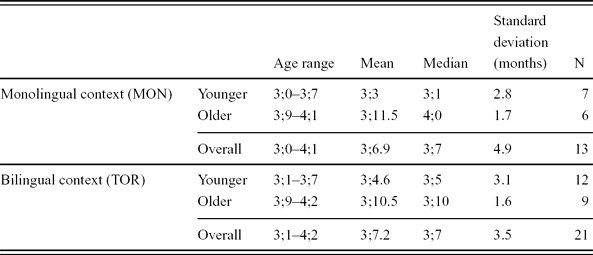
Twenty-one French-speaking preschool children from Toronto (children in the bilingual context) were included, and 13 age-matched children from Montreal (children in the monolingual context) were selected for comparison in this study. To ensure consistency of the age range between the two groups, we split both groups of children along the median age. Table 1 shows that the younger bilingual children are slightly older (1.6 months) than their monolingual counterparts, whereas the older bilinguals are slightly younger (1 month) than their monolingual counterparts. Overall, the monolingual control children are close age-matches of the children speaking French in the multilingual context.
Age comparison between children in the monolingual and the bilingual group.

4.2 Methods
We designed an elicited production study aiming to compare production of direct objects by children acquiring French in a bilingual context and children acquiring French in a monolingual context. The experimental approach bypasses the problem of reliability in the analysis of null objects in spontaneous speech, and does not need to rely on the problematic classification of verbs on a transitivity continuum. We propose to approach the question of object omission in bilinguals by considering null objects in definite contexts (4a) and in generic contexts (4b).
The standard method for object elicitation is a question–answer format. In Ingham (Reference Ingham1993/1994) the method targets optional transitivity. The preceding context contains an agent who is depicted acting upon an object, and a prompt asks What is x doing? Both a lexical DP and a null object are possible answers. The method in Schaeffer (Reference Schaeffer1997) and Jakubowicz, Nash, Rigau and Gérard (Reference Jakubowicz, Nash, Rigaut and Gérard1998) targets pronominal objects. The preceding linguistic context introduces the referent, and the prompting question includes the direct object within the VP: What is x doing with y/to y? The target response to this prompt is an object pronoun but, Pérez-Leroux, Pirvulescu and Roberge (Reference Pérez-Leroux, Pirvulescu, Roberge, Montreuil and Nishida2006) reported that adults were also willing to give a certain proportion of DP responses; however, they produced no object omissions.
In the study reported here, we follow the most common version of the method, utilized in Schaeffer (Reference Schaeffer1997) and subsequent work. The experimenter first presents the question for the puppet, who provides an incorrect response. The child is then invited to help the puppet answer the question correctly. An example is given in (8).
(8)

Children heard twelve stories with different optionally transitive verbs, and saw pictures depicting actions involving inanimate objects. Six stories had pronominal targets (as in (8)) and another six targeted optional contexts. In the optional contexts, a simpler question prompt (what is X doing?) is employed instead, as shown in (9), following the approach in Ingham (Reference Ingham1993/1994) and others. To emphasize an activity reading, our stories contained no mention of the object, and the puppet error involved naming a different activity. For complete details see Pérez-Leroux, Pirvulescu and Roberge (to appear).
(9)

4.3 Results
Data was transcribed and classified. As shown in (10), responses were classified as pronominal, null or lexical DP.
- (10)
a. Pronominal answer: Il la frappe. “He is hitting it.”
b. Null object answer: Il frappe Ø. “He is hitting”.
c. Lexical DP answer: Il frappe la balle. “He is hitting the ball.”
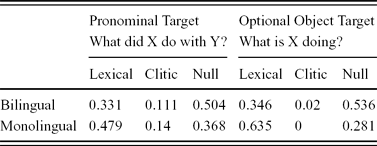
All responses that either did not include the target verb or were otherwise unrelated to the target question, were classified as “other”. One child gave responses with language mixing: “drink it” and “drawing”, and the rest of his answers were fully in French. These were also classified as “other”. The group averages for the proportion of response type given to the two object conditions in the study are presented in Table 2. Some examples of actual utterances from both groups of children are presented in (11)–(14).
(11)
(12)
(13)
(14)


Mean proportion of response type elicited per condition per group.

In the case of the pronominal target condition, where omission is illicit, children in both groups produced a small proportion of clitics, and most of the responses were either null objects or lexical DPs. This was comparable to the results in Pérez-Leroux et al. (to appear), where French-speaking children had some clitics at the age of three (approximately 13%, nearly identical to the monolingual children in the present study), but did not use them frequently until the ages of four and five in these specific experimental contexts. That study shows that French-speaking adults, in addition to the target response, 82% clitics, also produced some lexical DPs (18%), but did not omit. For the optional context, both bilingual and monolingual children produce null and lexical DPs, as expected, but the rates are radically different. Close to one-third of the responses from the monolingual children were null pronouns, and the other two thirds were lexical. These data were fully comparable to the performance of both French monolingual three-year-olds and French adults in Pérez-Leroux et al. (to appear).
There were substantial quantitative differences in the ratio of null and lexical direct objects between monolingual and bilingual children. In both the pronominal and the optional contexts bilinguals produced fewer lexical DPs, favoring object omission instead. This difference in rates of object omission in both contexts is highlighted in Figure 1.
Mean proportion of response types given to pronominal and optional contexts per group.

The primary goal of this study was to test whether there was a difference between rates of retention of null objects depending on whether children were growing up in bilingual or monolingual environments. For this purpose, the mean rate of null objects produced per condition for each subject was entered into statistical analysis with location (Montreal, the monolingual context, and Toronto, the bilingual context) as a between-subjects factor, and story condition as a within-subject factor. The analysis showed a substantial effect of living in a bilingual context: the bilingual context group had significantly higher rates of retention of object omission in comparison with the monolinguals, for both the pronominal target condition (50% vs. 37%, respectively) and the optional object condition (54% vs. 28%, respectively). The context factor (bilingual vs. monolingual context) was significant at F 1,32 = 6.121, p = .01. There was no significant effect of story condition (F 1,32 = .412, p = .52) nor significant interaction (F 1,32 = 1.897, p = .17).
We conducted an analysis of individual performance to see whether the results in Table 2 reflected differences among children rather than global preferences for omission across individuals within their groups. With respect to performance in the optional transitivity context, children were classified with regard to whether they preferred the omission response (i.e. more than half their answers were null) or not: these categories were labeled High/Low preference. For the pronominal contexts, they were then classified as persisting in the omission option if they had two or more ungrammatical omissions (Illicit Omission category, NO >1), or if they had one or less ungrammatical omission in the pronominal context they were placed in the No Illicit Omissions category.
Proportionally children were more likely to be in the Illicit Omission category (NO>1) if they were growing up in a monolingual context rather than in a bilingual environment (8/13 vs. 14/21), but this distribution is not significant (χ2 = .092, p = .76). For the optional transitivity contexts, 3/13 children in the monolingual context were in the High Preference category (NO≥3), but fully two-thirds (14/21) of the children in the bilingual context fell in this category. This difference in distribution was significant (χ2 = 6.103, p = .01). The fact that more children of the same age seemed to be in the High Omission Preference group, and in the Illicit Omission group if they were growing up in the bilingual context, supports the notion of a developmental delay for the children in the bilingual context.
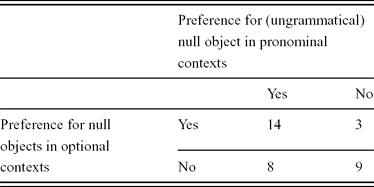
Additionally, we examined whether children showed overall individual preferences for null objects, under the premise that reliance on a default structure would appear across contexts, independently of the grammaticality status of these two types of null objects. Table 3 presents these results. A contingency analysis of the data in Table 3 results in significance (χ2 = 4.636, p = .03). These results suggest that children that are in a null object stage with respect to obligatory contexts also show a preference for null objects in the optional contexts. We interpret this fact to constitute further support for the proposal that the specific form of delay we observe in the bilingual children is not just about pronominal omission, but suggests a general pattern of retention of the default null object across contexts.
Number of children across groups classified in terms of preference for omission in optional contexts and production of illicit null object responses in the pronominal contexts.

5. Discussion
5.1 Summary and evaluation of hypotheses
Recall from previous discussion that the main hypothesis in the field would predict either no interaction (Hypothesis I), or delay for some language pairs, but not for this particular pair since French is the language where referential null objects are retained longer (Hypothesis II). This particular language pair could presumably create a boosting effect, where bilingual children would have fewer null objects than monolingual children, since the developmental timetable of English is such that referential null objects are eliminated earlier than in French (Hypothesis III). Only the default retention hypothesis (Hypothesis IV) provided a rationale for an extension of the null object stage that is independent of proficiency or dominance issues.Footnote 5 As discussed in section 4.1, the children we tested have mostly passive knowledge of English, so there is no possibility that French is the weaker language (see Meisel Reference Meisel, Caunt-Nulton, Kulatilake and Woo2007a, Reference Meiselb for a discussion of dominance as a source of delays). The results from this elicited production study clearly support the latter. Our data show that children acquiring French in a bilingual environment have higher rates of object omission in both conditions considered. For the optional transitivity scenarios, the children in the bilingual context had almost twice as many object omissions as the monolingual children from Montreal. Similarly, when the pronominal clitics were targeted, the monolingual children omitted clitics at two-thirds the rates of the bilinguals. The statistical analysis suggests that the two phenomena are associated (grammatical omission in the optional contexts, and illicit omission in the clitic contexts), so that our individual results can be interpreted as suggesting that at the same ages, more of the children growing up in bilingual environments are retaining the default null object with a full interpretive range.
5.2 Explaining development and delay
How can this bilingual delay be explained? Recall from our theoretical discussion that the availability and interpretation of null objects follow from interactions between lexical semantics, syntax and pragmatics. The common denominator between French and English is the construction where a verb is merged to a null bare N object, as in (4b), with a generic interpretation; this structure is also, we proposed, the default initial setting in UG. During the initial stage, this structure can bear a referential index but later this possibility disappears.
How does the child make a transition from the default N to pro? If the child starts with an unrestricted null object, some features of the experience guide the child in making inferences about the proper range of meanings of null objects.Footnote 6 But how much input and of what kind is necessary for this restriction or blocking process to succeed? The question of the actual quantity of input is a topic of current interest in generative approaches, with several studies showing that early acquisition of a grammatical property correlates to the overall frequency of the relevant input (Yang, Reference Yang2002; Legate and Yang, Reference Legate and Yang2005) as well as to the degree of variability in the relevant marker (Miller, Reference Miller2006). We propose that frequency will prove relevant in predicting development as well in the object domain, but the full empirical comparison of the various language types remains to be conducted. To date there is no corpus-based quantitative study of object omission in French and English that allows a full quantitative comparison between the two languages. There is, however, a partial analysis of the parental speech in four corpora presented in Pérez-Leroux, Pirvulescu, Roberge Tieu and Thomas (Reference Pérez-Leroux, Pirvulescu and Roberge2006). In this study, a sample of all tokens from six target verbs (build, cut, draw, drink, hit and eat) were extracted and analyzed for overall rates of omission. These verbs were selected on the basis of comparable intuitions of transitivity across translation equivalents in French and English. The study included three corpora from CHILDES: the Sachs and MacWhinney corpora (Sachs, Reference Sachs and Nelson1983; MacWhinney, Reference MacWhinney2000), for English, and the York corpus, for Canadian French (De Cat and Plunkett, Reference De Cat, Plunkett, Pusch and Raible2002). Additionally, the Pupier corpus (Pupier, Reference Pupier, Gagné and Pagé1981) was also analyzed for Canadian French. The validity of the comparison is limited by the quantitative difference in the sizes of the English and the French samples, and by the selective nature of the study (only six verbs). However, assuming qualitative comparability in these samples of parental speech, the data suggest substantial differences in the ratio of overall object omission: a total of 16% (126/797) object omissions were identified in the parental speech in English versus 37% (45/122) in French.
If this is indeed the correct scenario for development, children encounter a potential subset problem (Fodor and Sakas, Reference Fodor and Sakas2005), in the sense of starting with the broader grammar (which contains an unrestricted, all-purpose null object N, capable of bearing a referential index), and must arrive at a grammar where N is only generic.
(15)

Through experience, they learn that null objects have specific semantic properties across constructions. We argue that it is a very specific kind of experience that supports the relevant inferences about the proper range of meanings of null objects in the target grammar. The relevant experience may originate in discourse contexts where the parental feedback can clearly disambiguate between the generic and the referential interpretation, as for instance, under the scope of negation. However, such triggering contexts may be rare, and many uses of null objects are ambiguous in that they are compatible with inferred reference. Pérez-Leroux et al. (Reference Pérez-Leroux, Pirvulescu, Roberge, Tieu, Thomas, Gurski and Radisic2006) find that parental use of null objects can make up as much as half the total null objects in some of the corpora. Alternatively, while children are often confronted by ambiguous input, it is possible that, in the long range, they may detect the association between object omission and certain grammatical markers of tense and aspect; see Cummins and Roberge (Reference Cummins and Roberge2005) for a discussion on sentential properties that favour the null objects, which include present generic tense, infinitives, and others.
5.3 Two proposals on the lexicon as the source of the bilingual effect
The above discussion suggests that a full account of children's development in the domain of object omissions must take into consideration the problem of optional transitivity, as in (9), above. These cases are an integral part of the acquisition problem precisely because they relate to parametric differences: in a free null object language, a null object will cover the interpretive range that a definite pronoun has in a language like English. The child has no a priori knowledge of the nature of lexical optionality in transitivity patterns and discourse-licensed omission; the overall solution must involve the lexicon as well as the syntactic and discourse context. Since it cannot be assumed that any verb will appear exclusively as transitive or intransitive, this learning problem may correspond to a quantitative version of syntactic bootstrapping, such as that proposed by Merlo and Stevenson (Reference Merlo and Stevenson2001) within the context of an automatic machine verb-learning model. Syntactic bootstrapping is a lexical acquisition mechanism that extracts semantic information from the syntactic environments a word is associated with (see Gleitman, Cassidy, Nappa, Papafragou and Truesswell, Reference Gleitman, Cassidy, Nappa, Papafragou and Trueswell2005 for recent discussion). Merlo and Stevenson (Reference Merlo and Stevenson2001) enrich the standard notion of syntactic bootstrapping, which links a lexical item to its subcategorization frames, by adding to the representation the semantic features of the associated constituents (such as animacy, etc.), and the probabilistic weight of the relevant associations.
We propose that this perspective has potential implications for explaining language interaction in bilingual development, in regard to the developmental timetable of object omission. Our proposal has two variants: one that links the delay to the bilingual child's more limited lexical input, and another that links it to the additional complexity present in a bilingual lexicon.
The first variant follows the very simple reasoning outlined in Paradis and Genesee (Reference Paradis and Genesee1996). Bilingual children have less input (in one of their languages) than their monolingual peers, since they are likely to have comparable hours of language exposure, but these interactions will be divided between their two languages. This makes their finding of comparable timing for the acquisition of syntax particularly striking, because it shows that syntax exhibits robust development where children can maintain average timetables despite reduced input. However, the question of comparable development in the domain of the lexicon is more complex. Pearson, Fernandez and Oller (Reference Pearson, Fernández and Oller1993) and Pearson and Fernández (Reference Pearson and Fernández1994) note that bilingual children tend to have smaller vocabularies than monolinguals, when only one of their languages is considered. So, while syntax may remain unaffected by the bilingual reduction in input, development of the lexicon in one language is constrained in the bilingual context. Since transitivity and the acquisition of the omission patterns of objects depend so heavily on the lexicon, we predict bilingual delays independently from the type of languages involved in the bilingual situation.
The second approach we consider is conceptually more complex as it ties the delay in bilinguals to cross-language activation of comparable verbal entries. In other words, any additional source of variability in the representation of lexical transitivity (understood as the likelihood of a verb to appear with or without an object) will affect the overall development of null objects. Let's consider these steps one by one.
Lexical entries consist of a lexeme, which represents the phonological and morphological structure of the word, and a lemma, which includes the conceptual specification, specification of pragmatic conditions of use, and the relevant encoding of syntactic features (Levelt, Roelofs and Meyer, Reference Levelt, Roelofs and Meyer1999). In the mind of the bilingual speakers, lexical activation is not language selective (Kroll, Sumutka and Schwarts, Reference Kroll, Sumutka and Schwarts2005; Costa, La Heij and Navarrete, Reference Costa, La Heij and Navarrete2006; Kroll, Bobb and Wodniecka, Reference Kroll, Bobb and Wodniecka2006, among others); both lexicons remain active in word recognition and production. Lexical entries in one language can prime the entries in the other language that are related by either form or meaning. For instance, Miller and Kroll (Reference Miller and Kroll2002) report a cross-language semantic interference effect (i.e. a semantically-related word presented in the one language slows naming in the other language, but a semantically unrelated distractor does not). This semantic interference effect is the result of co-activation at the semantic level. Jiang (Reference Jiang2004) shows that word pairs that share a translation equivalent in the L1 are judged as more semantically related than the pairs that have independent translation equivalents.
Verb lemmas are linked to “combinatorial nodes”, which encode the different categorical frames (subcategorization) these verbs can associate with. According to Pickering and Branigan (Reference Pickering and Branigan1998), syntactic priming (the facilitation of a given structural frame by virtue of a prior presentation) happens by activating the representational nodes that encode the subcategorization frames with which a verb associates. Experimental work demonstrates that subcategorization patterns can be primed across languages (Loebell and Bock, Reference Loebell and Bock2003, and others). Speakers exposed to a double object construction or a PP dative in one language will choose that construction in completing a sentence in the other language. In Salamoura and Williams (Reference Salamoura and Williams2006), a lexical entry with a fixed selectional pattern in one language was able to prime the syntactic frame used in production in the other language, demonstrating that syntactic priming can be triggered across languages by a lexical entry alone.
The implications for bilingual acquisition are simple: a child exposed to two languages will have a certain degree of transparency between his two lexicons. Consider verb pairs such as eat/devour, follow/chase, which are related in sense but differ in omission patterns: eat and follow have optional object expression, whereas chase and devour strongly prefer lexical objects (but see 3.1, above). If one language (Language B) has a verb of the optional type, but the translation equivalent in the other language (Language A) follows an obligatory transitive pattern, use of the item in A may prime the overt object frame in B. The child, however, will continue to hear examples with missing objects in B, the optional language. Thus, bilingual co-activation is likely to introduce one layer of uncertainty in the resolution of transitivity patterns. This is schematized in Figure 2, which depicts cross-language priming in a pair of translation equivalents verbs. An example of a relevant scenario would be a French–English bilingual child use of trouver/find in (10), repeated below, a case of translation equivalents where the French entry is an optional transitive but the English translation equivalent shows a stronger preference for overt transitivity.
- (10)
a. J'ai cherché ce jouet toute la journée mais je n'ai/(ne l'ai) pas trouvé.
b. I looked for this toy all day but I didn't find *(it).
Cross-language activation of subcategorization frames for translation equivalents. Black nodes represent the shared conceptual nodes that make the two lexical items translation equivalents. The two striped nodes represent encoding for subcategorization frames (one transitive, one optional), and the gray lines indicate the hypothetical cross-language priming.

Children must solve the lexical problem (how likely is a given verb to drop the object?) concurrently with the syntactic problem (under what conditions does this language allow missing objects?). Acquiring two translation equivalents opens the possibility that the subcategorization frames in the two languages can influence each other. This will generate conflicting information about the transitivity of the target verbs, thus delaying the child's decisions about lexical transitivity and its associated syntactic consequences. However, there is no quantitative evidence as to the extent of these cross-language transitivity mismatches, so this must remain for now simply a possibility.
6. Conclusion
The previous literature on bilingual children learning a Romance language diverged on the matter of whether bilingual children had higher rates of clitic object omissions than their monolingual counterparts. Our findings are aligned with those of Müller et al. (Reference Müller, Crysmann and Kaiser1996) and Müller and Hulk (Reference Müller and Hulk2001), which show higher rates of null object retention. Interestingly, our French bilinguals showed a delay although their other language, English, is not a topic-drop language, in contrast with the studies mentioned above. Other studies that looked at bilingual children who had English as the other language, such as Serratrice et al. (Reference Serratrice, Sorace and Paoli2004) and Paradis et al. (Reference Paradis, Crago and Genesee2005/2006), did not identify differences in the behavior of objects. We believe this discrepancy might be due to the use of spontaneous vs. controlled elicitation data. Of course, this does not hold true for the Müller and Hulk study, where higher rates of object omission are found, but there is an additional factor involved in that study, which is that of language typology.
Because English-speaking children have been reported to cease omitting objects earlier than French-speaking children in obligatory contexts in controlled experiments (Pérez-Leroux et al., to appear), the findings in our study do not follow the acceleration type of pattern in asynchronous bilingual development, where contact with the early development language leads to earlier development in bilinguals as compared to monolinguals. In other words, the disappearance of the null object stage in the French of the French–English bilinguals could have been accelerated by contact with English, a language where object omissions disappear early. This was not the case. Our results seem to confirm Hypothesis IV, which predicted that children in a bilingual context would show a delay in the resolution of non-target object omissions because they would retain the default grammar of null objects for a longer period of time.
Our results confirm that such delays exist indeed. Our data suggest that bilinguals extend the use of null objects even in the case where the other language does not support optionality in object realization, and they do so both in pronominal and optional contexts. We interpret these results in favor of a form of delay arising when a given structure is a structural default in the sense of Lebeaux (Reference Lebeaux1988); that is, a first structural hypothesis, not yet parametrically defined, which may be retained in all adult grammars in restricted contexts. This default option serves to provide the computational basis for interpreting the object, when no other information is present.
The proposed default retention hypothesis is not a generalized model of bilingual delay: we suggest that such delays be restricted to situations in which solving a syntactic problem depends directly on information based on interactions between syntax and the lexicon.Footnote 7 The lexicon is an acquisitional domain highly sensitive to input frequency, whereas pure syntatic learning may be more robust, and less sensitive to the “demanding acquisitional setting” of a bilingual child (Meisel Reference Meisel, Caunt-Nulton, Kulatilake and Woo2007a, p. 27). We have suggested that bilingualism alters two aspects of the bilingual child's experience: (i) the relevant amount of input received within a single language; and (ii) the complexity of the input problem is different in the bilingual lexicon: the bilingual child receives potentially conflicting input about the transitivity patterns of lexical entries by virtue of cross-language activation of lexical entries. Either of these two factors, or a combination of both, might introduce alterations in the developmental timetable of object omission in the form of extending the period of default retention. The complexity of bilingual development thus provides us with a window through which we are able to observe, for a longer period of time, the underlying nature of the language faculty.