Asymptomatic bacteriuria is a common condition characterized by the presence of bacteria in the urine of someone without related symptoms (ie, dysuria, urgency, or increased frequency of urination). It is typically a benign finding in otherwise healthy individuals. Therefore, screening for and treating asymptomatic bacteriuria is only recommended in specific circumstances, such as during pregnancy and in the preoperative evaluation of patients undergoing urologic surgery. Reference Marschall, Piccirillo, Foxman, Zhang, Warren and Henderson1 Otherwise, studies have demonstrated that treating asymptomatic bacteriuria in adults has no benefit and may increase the risk of adverse events, antimicrobial resistance, and healthcare costs. Reducing antibiotic use for asymptomatic bacteriuria continues to be an important initiative for antimicrobial stewardship. Reference Trautner2
A large proportion of patients admitted with a diagnosis of urinary tract infection (UTI) do not meet clinical criteria for UTI set forth by the Infectious Disease Society of America (IDSA), and consequently, these patients are inappropriately treated with antibiotics. A positive urine culture is often discovered incidentally by urine studies, but without concerning symptoms, as identified by the IDSA. Appropriate indications for urinalysis (UA) with reflex or direct urine culture include urinary symptoms of increased frequency, urgency, hesitancy, dysuria, or hematuria, as well as suprapubic, pelvic, or flank pain or costovertebral angle tenderness on exam. Additional indications include fever, rigors, altered metal status, or lethargy without an identifiable cause. The IDSA also lists unexplained spasticity or dysreflexia in persons with spinal cord injury and new or worsening urinary symptoms in catheterized patients as suitable indications for urine testing. Reference Nicolle, Gupta and Bradley3
In many cases, unnecessary antibiotics begin in the emergency department (ED) with urine tests that are included in pre-existing order sets. Failure to reassess the need for continuation of antibiotics after admission reinforces the cycle. Changing prescribing patterns is difficult and the best intervention for achieving it is unclear. Previous studies have proven that 2 methods are successful in both reducing the number of urine cultures performed as well as limiting the overuse of antibiotics: (1) updates to urine test order sets and (2) adoption of educational decision aids or algorithms. Reference Yin, Kiss and Leis4–Reference Keller, Feldman, Smith, Pahwa, Cosgrove and Chida8 A prior antibiotic stewardship intervention that focused on decreasing unnecessary urine testing through provider education and feedback successfully reduced the use of inappropriate antibiotics to treat asymptomatic bacteriuria. Reference Trautner, Kelly and Petersen9,Reference Naik, Skelton, Amspoker, Glasgow and Trautner10 The purpose of this study was to assess the effectiveness of an electronic order set for urine studies on reducing the number of unnecessary urine cultures, catheter-associated urinary tract infection (CAUTI) rate, antibiotic use, as well as the overall associated financial impact.
Methods
Study design
This multicenter study was conducted at 5 hospitals in Texas that use the same electronic health record (EHR) system. The study populations included adult patients (inpatient and outpatient ED) at 5 Catholic Health Initiative (CHI) sites in Texas who had either a UA with reflex to culture, a UA without reflex to culture, or a urine culture (only) performed between June 2017 and June 2019. One of the hospitals is a quaternary academic medical center and the others are community hospitals. Providers include attendings, house staff, and advanced practitioners. All hospitals have established antimicrobial stewardship programs including dedicated pharmacists and infectious disease physicians. This study was approved by the Institutional Review Board of Baylor College of Medicine (IRB H-43077).
Intervention
The 5 sites recently added a new order set that replaced the old method of ordering urine studies. This new order set required the practitioner to choose from 3 options: (1) UA with reflex to urine culture, (2) UA without reflex, or (3) urine culture and UA together (Fig. 1). All 3 options were available separately prior to the order set. The order set provided clinical decision support by directing the practitioner to the correct test based on indication: suspected UTI, noninfectious indication, or screening purposes or neutropenia. Choosing ‘suspected UTI’ directed the practitioner to order a UA with reflex to culture, and choosing ‘noninfectious indication’ (eg, for patients with acute renal failure) directed the practitioner to order a UA with or without microscopy without reflex to culture. Choosing ‘screening for pregnancy or invasive urologic procedures’ or ‘neutropenia with urinary symptoms’ directed the practitioner to choose both direct urine culture and UA.
(A) The first clinical decision-making step when using the new order set at one of Baylor St Luke’s Medical Center (BSLMC) locations. Providers can choose from orders for suspected urinary tract infection (UTI), noninfectious indications, or screening purposes. Within each category, providers much choose the type of urine testing they would like to order. For example, if UTI is suspected, providers can only order a urinalysis (UA) with microscopic and reflex to culture. Direct cultures can only be selected for screening purposes or neutropenic patients with urinary symptoms. (B) The indication list for urinalysis with reflex to culture, which can be ordered for suspected urinary tract infection. The indications list is a hard stop; providers must choose the appropriate indication. Options include all criteria set forth by the Infectious Disease Society of America (IDSA) for urinary tract infection.

Practitioners were required to indicate a reason for ordering UA with reflex to culture based on the IDSA recommendation (Fig. 1). For direct urine cultures, they were required to provide an indication (either neutropenia plus symptoms or for screening purposes). In addition, we changed the criteria for reflex urine culture; previously, the criteria included (1) ≥5 white blood cells (WBC) per high-powered field (HPF), (2) positive leukocyte esterase, (3) positive nitrite, or (4) presence of bacteria. After the intervention, the standard was simply ≥10 WBC/HPF. No other antimicrobial stewardship changes occurred during the study. The intervention went live on June 25, 2018.
Patient identification and chart review
The preintervention group included patients with urine studies performed during June 2017 and May 2018 and the postintervention group included patients with urine studies performed during July 2018 and June 2019. The month of June 2018 was excluded as a washout period. The number of UA and urine cultures performed before and after the intervention were obtained using the EHR database (Epic, Epic Systems, Verona, WI) and TheraDoc surveillance system (Clinical Surveillance of Premier Healthcare Solutions, Charlotte, NC). Data were adjusted per 10,000 patient days.
We used chart review to assess appropriateness of using the order set at one of the centers (Baylor St Luke’s Medical Center). Overall, 50 patients who had a UA with reflex performed and 50 patients who had urine cultures performed were randomly selected, stratified by location of collection: wards, intensive care unit (ICU), or ED. Considering both the pre- and postintervention groups, 200 patients were randomly selected for chart review. Adherence to the IDSA guidelines for UTI was assessed by K.W. Reference Nicolle, Gupta and Bradley3 If criteria were met, the documented symptoms or indication for screening were recorded. For the postintervention group, charts were reviewed to determine whether the selections made on the order set were appropriate. To be deemed appropriate, the indication on the order set must have matched documented symptoms or laboratory findings elsewhere in the chart. For example, a selection of acute hematuria indication would require a documentation of this symptom in the patient chart for appropriateness. History of present illness, review of symptoms, and progress notes written within 48 hours prior to the urine study were reviewed. For neutropenic indications, patients must have had absolute neutrophilic count <1,000/mm3 within 48 hours prior to the study.
Days of therapy (DOT) was defined as the aggregate sum of days for which any amount of antimicrobial was given to an individual patient as documented in the EHR. The antibiotics considered included all β-lactams, fluoroquinolones, sulfamethoxazole/trimethoprim, nitrofurantoin, aminoglycosides, and fosfomycin. If 3 different antibiotics were given on the same day, this counted as 3 DOT. The DOT of these antibiotics were obtained via pharmacy records for patients with antibiotic order entry for a sole indication of UTI during the study period. Orders with >1 indication (eg, UTI and pneumonia) were excluded. Patients were included in the analysis regardless of chief complaint, symptoms, test results, or final diagnosis. Days of therapy were adjusted per 1,000 patient days.
The presence of CAUTI was determined via a TheraDoc surveillance system review by the infection preventionist using the Centers for Disease Control National Healthcare Surveillance Network (CDC-NHSN) definition of CAUTI. Device days (total number of patient days with a Foley catheter present) were obtained via the TheraDoc surveillance system. Monthly instances of CAUTI were reported to the CDC-NHSN along with total device days among patients admitted to the medicine wards and the ICU. The CAUTI rate was adjusted per 1,000 catheter days. The standardized infection ratio (SIR) was calculated by dividing observed infections (CAUTI) by expected infections (obtained through NHSN). The costs of urine culture and UA were US$39 and US$5, respectively, based on laboratory direct material, labor, and overhead. The cost of each DOT was determined by pharmacy acquisition cost, in addition to US$10 administration cost per each intravenous dose per day. Reference Cunha11 No administration cost was added for oral and intramuscular administration. A review of literature indicated that the average cost of a CAUTI was US$1,000. Reference Hollenbeak and Schilling12
Statistical analysis
The χ2 test was used to assess any difference in the rate of appropriateness of antibiotic use between the pre- and postintervention groups. Interrupted time-series analysis with segmented regression analysis (Newey–West) was used to examine the effect of our intervention on UA and urine culture orders per 10,000 patient days, DOT per 1,000 patient days, CAUTI per 10,000 catheter days, SIR, and financial cost per 1,000 patient days. Significance was defined as P < .05. Statistical analysis was performed using Stata version 13 software (StataCorp, College Station, TX).
Results
UA and urine study performed
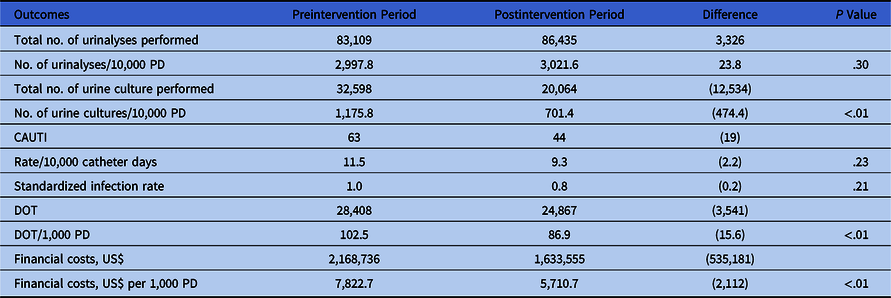
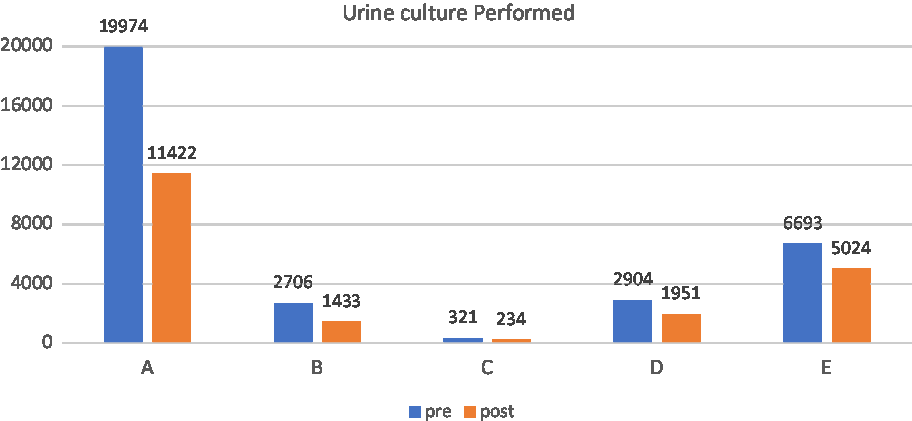
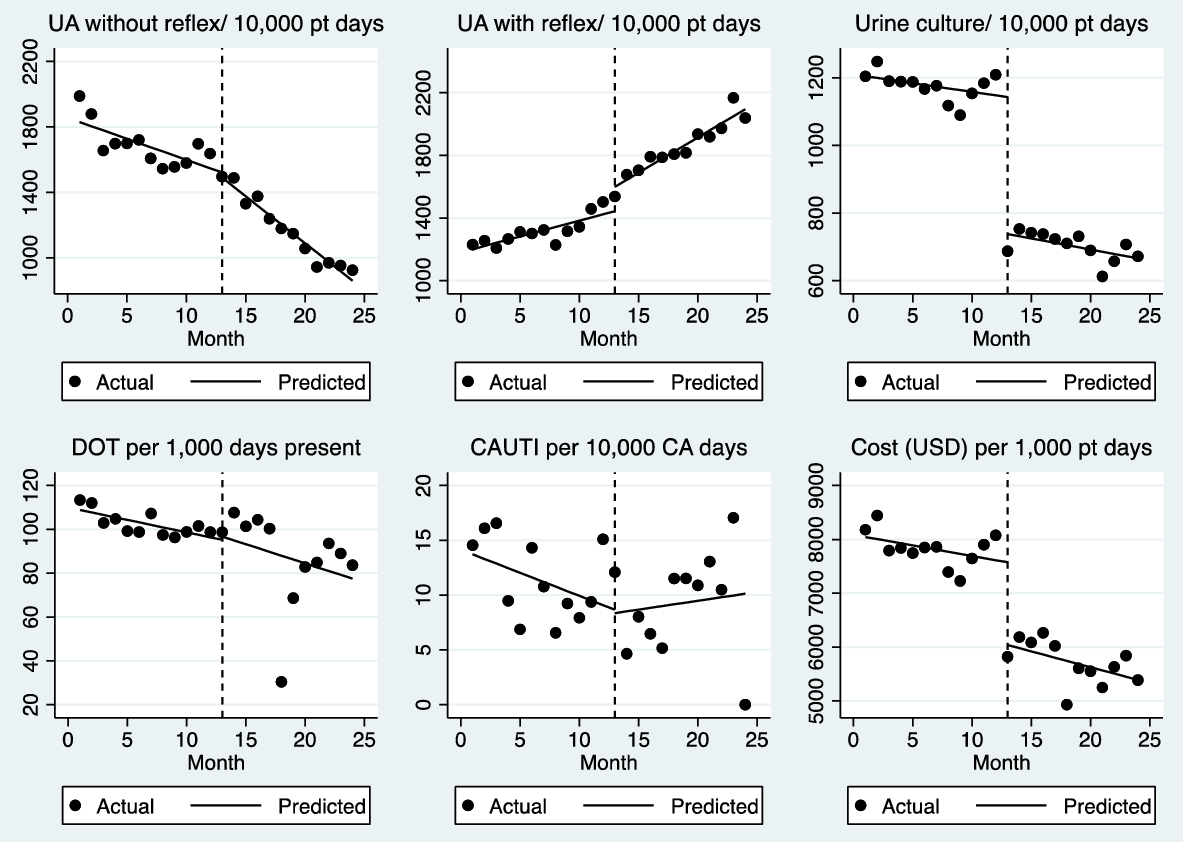
The total number of urine culture performed at all 5 division sites decreased from 32,598 before the intervention to 20,064 after the intervention (38.5% reduction) (Table 1). When adjusted per patient days, urine culture decreased from 1,175.8 tests per 10,000 patient days before the intervention to 701.4 after the intervention (40.4% reduction; P < .01). The number of urine culture performed decreased at each facility (Fig. 2). The ED was responsible for 43.8% of urine cultures performed. The urine culture reduction was seen across floor wards, the ICU, the ED, and the outpatient clinic (data not shown). The total numbers of UA orders were 2,997.8 tests per 10,000 patient days before the intervention and 3,021.6 after the intervention (0.8% increase; P = .30). Figure 3 provides a visual display of UA with reflex, UA without reflex, and urine culture performed per 10,000 patient days before and after the intervention.
Testing, Antibiotic Ordering, CAUTI, and Associated Financial Costs Before and After the Intervention

Note. CAUTI, catheter-associated urinary tract infection; DOT, days of therapy; PD, patient days.
Urine culture ordering stratified by each of the 5 hospitals included in this study.

Interrupted time-series analysis with Newey–West standard errors and 1 lag for urinalysis (UA) without reflex per 10,000 patient days (top left), UA with reflex per 10,000 patient days (top center), urine culture per 10,000 patient days (top right), DOT per 1,000 days present (bottom left), CAUTI per 10,000 catheter days (bottom center) and cost (US$) per 1,000 patient days (bottom right). The intervention was implemented in June 2018. Note. DOT, days of therapy; CAUTI, catheter-associated urinary tract infection; CA, catheter.

Appropriateness of urine culture
We reviewed the charts of 100 patients in the preintervention group (37 floor, 18 ICU, and 45 ED patients) and 100 patients in the postintervention group (31 floor, 20 ICU, and 49 ED patients). Of these 200 randomly selected patients, 42% met IDSA criteria in the preintervention group and 57% met criteria in the postintervention group (P = .03). The most common indication for ordering a UA with reflex or a urine culture was fever without a known source in the preintervention group and dysuria, urgency, frequency, or suprapubic pain in the postintervention group. Only 45% of the orders placed following the intervention were appropriate, meaning that the indication chosen on the order set matched the documented clinical picture based on chart review. The most common reason for mismatch was selecting the first indication option on the order set (fever or rigors) in a patient without symptoms (n = 16 of 100, 16.0%).
Days of therapy
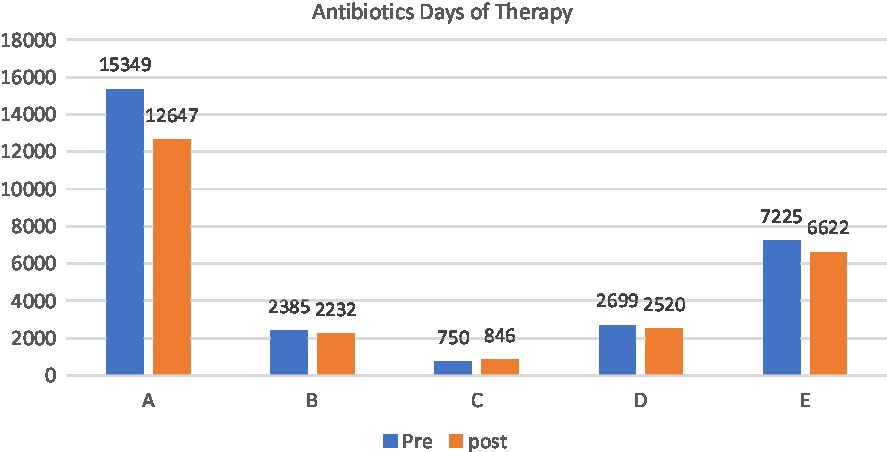
Antibiotic DOT for patients with UTI indication decreased from 28,408 per month before the intervention to 24,867 per month after the intervention (difference of 12.5%) (Fig. 3). When adjusted by patient days, DOT decreased from 102.5 per 1,000 patient days before the intervention to 86.9 after the intervention (difference of 15.2%; P < .01). The antibiotic DOT for patients with UTI indication decreased at 4 hospitals (Fig. 4).
Antibiotic days of therapy stratified by each of the 5 hospitals included in this study.

Catheter-associated UTIs
Overall, 63 cases of CAUTI were documented before the intervention compared to 44 cases after the intervention (30.2% reduction) (Fig. 3). When adjusted per catheter days, there were 11.5 CAUTI per 10,000 catheter days in the preintervention period compared with 9.3 in the postintervention period (P = .46). The CAUTI SIR was 1.0 before the intervention compared to 0.8 after the intervention (P = .23).
Financial impact
The estimated annual spending on urine culture decreased from US$1,271,322 before the intervention to US$782,496 after the intervention. The cost per 1,000 patient days is shown in Figure 3. Spending on UAs mildly increased from US$415,754.5 before the intervention to US$432,175 after the intervention. The estimated total annual spending on antibiotics given for UTI indication decreased from US$418,868 before the intervention to US$374,884 after the intervention. The estimated total annual spending on CAUTI decreased from US$63,000 before the intervention to US$44,000 after the intervention. The estimated total saving from the order set was US$535,181 over 12 months.
Discussion
In this study, we assessed how changing reflex criteria for urine culture in the EHR can be used to improve both diagnostic and antibiotic stewardship. The newly implemented urine culture order set and the reflex criteria were successful at reducing unnecessary urine culture ordering, limiting antimicrobial use, reducing costs, and improving reporting accuracy of CAUTI. Reducing unnecessary urine cultures is the first step in reaching any of these end points, and with the implementation of the order set, the 5 centers saw a 40% reduction in the overall number of urine cultures performed.
Other studies have shown that embedding clinical decision support systems into the EHR is one method of improving antibiotic stewardship in hospitalized patients. In their 2014 antimicrobial stewardship study, Hecker et al Reference Hecker, Fox and Son7 observed the effect of an order-set change in the ED on uncomplicated UTI diagnostic accuracy and adherence to treatment guidelines. They found that adherence to UTI guidelines increased from 44% at baseline to 82% following implementation of the new order set along with a 2-month audit and feedback period. Fluoroquinolone use for uncomplicated cystitis also decreased from 44% to 13%. Reference Hecker, Fox and Son7 Keller et al Reference Keller, Feldman, Smith, Pahwa, Cosgrove and Chida8 used passive clinical-decision messages in the EHR in conjunction with informational broadcasting in attempts to reduce urine testing and overtreatment of asymptomatic bacteriuria. The study showed that the number of cultures decreased by 6.3% (P ≤ .01); however, there was no significant reduction in cultures following UA (P = .33). They also found a reduction in antibiotic orders within 1–24 hours of urine cultures after the intervention (−0.24%; P = .04). Sullivan et al Reference Sullivan, Morgan and Leekha13 surveyed members of the Society for Healthcare Epidemiology of America Research Network. Urine culture indications were required in 17% of the hospitals and reflex criteria were implemented in 51%. The EHR was configured to preferentially allow providers to order reflex urine cultures in 27% of the hospitals surveyed. Reference Sullivan, Morgan and Leekha13
One of the main goals for implementing our order set was to reduce DOT for patients with asymptomatic bacteriuria. The Kicking CAUTI: The No Knee-Jerk Antibiotics campaign was built upon previously implemented interventions and focused on reducing urine culture ordering. Reference Trautner, Kelly and Petersen9,Reference Naik, Skelton, Amspoker, Glasgow and Trautner10 This campaign utilized audit and feedback delivered based on a simple algorithm that encouraged providers to think before ordering a urine culture in an otherwise asymptomatic patient. Overall, this intervention succeeded in reducing both screening for and treatment of asymptomatic bacteriuria; this method has since been utilized by many additional antibiotic stewardship programs. Our study showed a modest reduction of antibiotic DOT by 15%. The data obtained included all patients with selected antibiotics ordered solely for a UTI indication regardless of test results, other patient symptoms, chief complaint, or final diagnosis. Including all antibiotics ordered on such patients likely reduces the visible impact the changed order sets. Changing the way providers order antibiotics is a slow process that will require much effort, including culture change. A future quality-improvement study is needed and should include an informational component bundled with the clinical decision support order set.
Many practitioners chose the first urine culture indication even if the patient was asymptomatic. This choice may reflect a desire to speed up the process rather than reading each indication on the list. Although the infectious diseases department had communicated to providers via memos and meetings, education may have been lacking. The culture of these sites to order urine cultures despite lack of symptoms may have played a role in our results. It can be difficult to change the entire culture of ordering, especially in such a short time frame.
We detected a non–statistically significant reduction in CAUTI following the intervention, but with such a small subset of patients it is difficult to determine the extent to which this finding was due to the order set. Prior to the order set, an evaluation of all reported cases of CAUTI found that 25% would not have been called CAUTI if physician orders were updated to reflect the newer criteria of >10 WBC/HPF required for reflex to urine culture rather than >5 WBC/HPF. Additional confounders that have not been considered in this study may have affected the CAUTI rate, such as changes in insertion or maintenance practices.
Several challenges with the new order set must be considered. Providers have reported that the order set is not easy to find, and some emergency centers are still using paper orders rather than an EHR order set. There are ways to work around the order set; for example, providers may choose the wrong indication or the wrong type of test. Some existing preference lists (personalized functions for providers) also still include plain urine cultures. The biggest challenge to the new method is the institutional culture and habitual ordering practices. Providers are accustomed to ordering particular types of urine studies for certain indications, which may not be in accordance with the IDSA guidelines. Some providers order cultures for patients with bacteria on UA despite lack of symptoms because this is the institutional, and it will not change overnight.
Two variables were included in the intervention (order set and change in reflex criteria), which made it difficult to discern how much of the observed changes were attributable to each variable. Another limitation was the small subset of patients (n = 200) selected from 1 hospital for chart review. The appropriateness data relied on a small subset of the total number of patients accounted for during the study period. Additionally, we did not assess for adverse outcomes (eg, untreated UTI, delay in treatment, length of stay, hospital readmission or mortality).
Our results suggest that the order set is not always being used correctly and that a follow-up quality improvement study may be warranted. In the ED especially, where a choice remains between ordering urine studies individually and using the new order set, it may be beneficial to implement an educational algorithm. Practitioners may not be aware of the IDSA guidelines for screening and treating asymptomatic bacteriuria; this could be addressed using educational tools.
Perhaps most importantly, future studies should include a larger focus on prescribing practices of asymptomatic bacteriuria. Addressing the issue of overtreatment will improve patient care and help cut unnecessary spending even further. Antimicrobial stewardship regarding this matter must continue to limit overtreatment of asymptomatic bacteriuria and to maintain reduced hospital costs.
Acknowledgments
None.
Financial support
All other authors report no financial support.
Conflict of interest
B.W.T. reports grants from the National Institutes of Health, the Agency for Healthcare Research and Quality, the Centers for Disease Control and Prevention, Veterans’ Affairs Health Services Research and Development Service, grants and personal fees from Zambon Pharmaceuticals, and personal fees from Paratek Pharmaceuticals, outside the submitted work. All other authors report no conflicts of interest relevant to this article.