Introduction
Persons with dementia can present with aggressive behavior that causes significant distress to themselves, their caregivers, and others. This behavior is predictive of institutionalization and is associated with caregiver burden (Matsumoto et al., Reference Matsumoto2007; O'Donnell et al., Reference O'Donnell, Drachman, Barnes, Peterson, Swearer and Lew1992). Prevalence rates of aggression can be difficult to ascertain as persons with dementia can exhibit infrequent manifestations of aggression; however, the frequency of occurrence of aggression at some stage of the illness has been reported to be between 20–25% among persons with dementia living at home (Lyketsos et al., Reference Lyketsos, Steinberg, Tschanz, Norton, Steffens and Breitner2000) and around 80% living in care facilities (Brodaty et al., Reference Brodaty2001). Aggressive behavior can be physical, verbal, and sexual, and can occur independently or in conjunction with other non-cognitive symptoms, referred to collectively as the behavioral and psychological symptoms of dementia (BPSD).
By its nature, aggression cannot be ignored by caregivers and typically requires immediate attention. However aggressive behavior can be difficult to manage. Experts generally recommend that the first line of treatment should include non-pharmacological strategies but pharmacological interventions are often used despite limited effectiveness and risk of morbidity and mortality (Fossey et al., Reference Fossey2006). Reports of overmedication (Bishara et al., Reference Bishara, Taylor, Howard and Abdel-Tawab2009), inappropriate use of physical restraints (Kirkevold et al., Reference Kirkevold, Sandvik and Engedal2004), and patient abuse by caregivers (Compton et al., Reference Compton, Flanagan and Gregg1997) demonstrate poor attempts to manage this behavior. There is a clear case for guidance in directing the management of aggression in persons with dementia.
Clinical guidelines offer expert recommendations of evidence-based treatment actions to achieve desired health outcomes. The use of and adherence to clinical guidelines however in the general practice of medicine is low (Cabana et al., Reference Cabana1999). Difficulties associated with using guidelines include lack of time, conflicting evidence, recommendations that are too complex to interpret in a busy practice, and conflicting recommendations within and across guidelines (Sniderman and Furberg, Reference Sniderman and Furberg2009). Treatment using practice guidelines in the case of dementia care is further complicated by a relative lack of research funding compared to other disorders and a poor general awareness of this disorder (Knopman et al., Reference Knopman, Donohue and Gutterman2000; Luengo-Fernandez et al., Reference Luengo-Fernandez, Leal and Gray2011).
Computerized guidelines could potentially address some of the major limitations of paper guidelines by giving health professionals on-line and on-time assistance with clinical decision-making. They could also assist in the development of individualized intervention programs for patients by calculating the risks and likelihoods of positive and negative outcomes, depending on the patient's characteristics and the environment. Based upon the best available evidence, algorithms embedded into computerized clinical guidelines could adjust to specific circumstances. For example, the Archimedes Project has produced computerized guidelines for the management of diabetes in individual patients, incorporating biological and clinical data to predict patient outcomes (Eddy and Schlessinger, Reference Eddy and Schlessinger2003).
The ultimate aim of this project is to develop computerized clinical guidelines for the management of aggressive behavior in dementia which covers all areas of research and clinical practice, and which addresses the limitations of currently available guidelines by creating individualized treatment plans. The purpose of this paper is to develop a conceptual framework for the computerized guidelines.
The first stage of this project uses the tool of MindManager (Mindjet, 2008) to develop a concept map of the field of the management of aggression in dementia. This approach was pioneered more than two decades ago as a method for meaningful learning (Novak and Cañas, Reference Novak and Cañas2008). Concept maps are visual representations in the form of a diagram of the relationships among concepts in the literature that are used to formulate and answer specific questions (Novak and Cañas, Reference Novak and Cañas2008). Novak and Cañas (Reference Novak and Cañas2008) define a concept as a “perceived regularity in events or objects, or records of events or objects, designated by a label” (p. 1). Maps presenting concepts have been used as tools in business and education fields to organize and represent knowledge.
There are three key characteristics of concept maps that distinguish them from other graphical tools: the concepts are hierarchically arranged, with general concepts encompassing those that are more specific; the relationship between the concepts that belong to different groups can be expressed via cross-links; and specific examples of events or objects can be added to improve the understanding of a given concept. This paper focuses on the development of a concept map of the field of aggression in dementia, describing how the key concepts were found and how their structural arrangement was developed. The steps used closely align with those postulated by Novak and Cañas (Reference Novak and Cañas2008). Our approach builds on this by complementing an expert team of researchers with a literature review.
Methods
The concept map was developed in five steps, illustrated in Figure 1. In step 1, the knowledge domain for the development of the concept map was identified. Traditionally, aggression in dementia patients is classified as part of BPSD and is included in psychogeriatrics, aged care, neuropsychiatry, or mental health fields. The research team accepted the broad area of the “Mental health of patients with dementia” as the knowledge domain. In step 2, the context of the concept map was defined by constructing a focus question that has relevance in medical practice and in nursing care: How to manage aggression in patients with dementia.
The steps involved in developing the concept map “How to manage aggression in dementia.”

In step 3, we identified possible topics, ideas, and concepts that applied to the domain of interest. We conducted a broad online search for potential sources of knowledge, which followed with a broad literature search from these sources that were recorded on two preliminary concept maps. Sources identified to assist with the development of a comprehensive map of the field included journal databases such as PubMed, CINAHL, Scopus, and PsycInfo; the Google website; colleges and associations of physicians and psychiatrists in Australia, New Zealand, the UK, the USA, and Canada; guideline databases such as the National Guideline Clearinghouse, Trip Database, National Institute of Clinical Excellence, Scottish Intercollegiate Guidelines Network, and the New Zealand Guidelines Group; and gray literature found on websites of organizations including the Alzheimer's Associations.
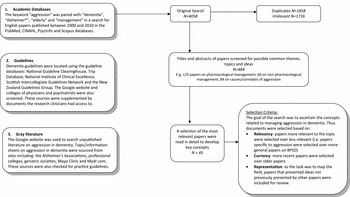
A large literature search identified possible key concepts and ideas that applied to this domain. Research papers were found by pairing the keyword “aggression” with “dementia,” “Alzheimer*,” “elderly,” and “management” in a search for English papers published since 2000 in the Pubmed, CINAHL, Scopus, and PsycInfo databases. Guidelines were located by using the keywords “dementia,” “aggression,” and “behavio(u)ral disturbances” in the guideline databases and CINAHL and Pubmed databases. Guidelines published in English since 2005 with a focus on aggression in the assessment and treatment sections were included for review. In the first stage of review, the titles of these sources were manually scanned for ideas pertaining to aggression in dementia. This was time-consuming work and was conducted primarily by a research assistant (NC). After duplicate and irrelevant research papers were discarded, the remaining titles and abstracts of all papers were scanned and grouped loosely into categories according to their main idea, such as pharmacological and non-pharmacological treatment, causes or correlates of aggression, and prevalence papers. This was an attempt to investigate the size and scope of aggression in the dementia field and to identify potential concepts that could be included in the map. Research papers and guidelines were the primary sources reviewed; however, a scan of documents found in the gray literature from consumer organizations such as the Alzheimer's associations was also conducted to ensure all ideas were covered.
In step 4, the most relevant research papers were read in detail, as well as the clinical guidelines on managing BPSD, and an initial attempt was made to group the key ideas to form concepts through an iterative process. The most relevant papers were selected based on three criteria: relevance, currency, and representation. That is, papers focusing specifically on aggression in dementia were favored over more general BPSD papers, and more recent papers were selected over older papers as, especially in the case of pharmacological management, substantial improvements in knowledge have been made in certain areas over the past decade. As the task was to map the whole field, papers that presented ideas not previously presented by other papers were also included for review; for example, there were a few papers on the personal story of the patient, so these were included.
We used MindManager software (Mindjet, 2008) to combine potential key concepts into a hierarchical concept map, based primarily on the structure used by current clinical guidelines. More specific concepts were encapsulated within more general concepts and cross-links between the groups of concepts were implemented. It is important to recognize that when new concepts were added to the map, the relationship between the dimensions of the map were also expanding, indicating that there may be close links between some of the concepts (e.g. between pharmacological treatment and the theory of the cause of the aggressive behavior).
Judgment was made to include ideas as key concepts based on four main characteristics: frequency of mention, empirical evidence, accepted effectiveness (e.g. in gray literature when empirical literature was absent), and the modifying impact of the idea on decision-making. It was clear from the initial review of papers what areas in aggression management were more frequently researched, such as the efficacy of pharmacological treatments, and this influenced the decision to include the idea as a key concept. However, concepts that received little attention in the empirical literature but greater attention in the guidelines and consumer literature (e.g. personal life story) could also be included in the map. The aim was to be inclusive rather than reductionist, as lack of evidence does not equate to lack of efficacy, and guidelines may touch on themes that are not empirically investigated (e.g. emergency treatment). This also meant that the concept map reflected what information was considered important by different groups in formulating treatment plans for individual dementia patients. The potential concepts and structure of the map were discussed with clinical academic old age psychiatrists at regular meetings.
In the final step, the concept map was revised by the research team, which consisted of both clinical and research experts in the field of psychogeriatrics.
Results
Search results
The results of the literature search are presented in Figure 2. The academic literature search yielded 4,058 papers originally, which, with the removal of duplicates (n = 1,858) and clearly irrelevant papers (n = 1,716), resulted in 484 papers manually screened for main topics and 45 research papers read in detail. Sixteen guidelines were read in detail, consisting of practice guidelines (n = 11), expert consensus guidelines (n = 4), and position statements (n = 1). Supplementary gray material was also considered, including approximately ten aggression in dementia topic sheets found via the websites of organizations including the Alzheimer's Associations and geriatric societies. Research papers and clinical guidelines were the major sources considered for review.
Results of the literature review for the topic “management of aggression in dementia.”

Major dimensions
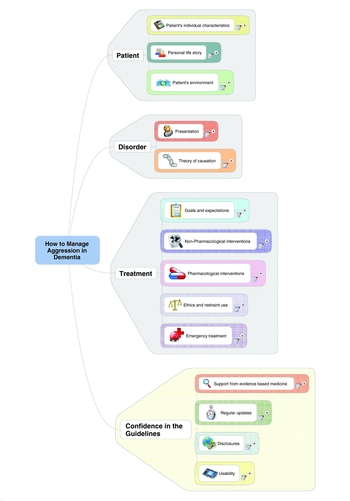
Four themes (dimensions) require consideration when developing individualized guidelines for the management of the aggressive dementia patient. Three of these dimensions and associated key concepts were related specifically to managing aggression in dementia: the Patient (e.g. individual characteristics, personal life story, and patient's environment), the Disorder (e.g. presentation of symptoms and the theory of the cause of the behavior), and the Treatment (e.g. goals and expectations, non-pharmacological and pharmacological interventions, ethical considerations, and emergency treatment). The fourth dimension, Confidence in the guidelines, which can be applied to guideline construction more generally referred to how well recommendations are supported by evidence, how regularly guidelines are updated, how disclosures regarding potential conflicts of interest are declared, and how useful and accessible guidelines are. These factors combined will influence the implementation of the framework for developing individualized guidelines.
A simplified version of the concept map in Figure 3 illustrates these main dimensions. The full map is also available as a downloadable interactive PDF document in Appendix A1, as supplementary material online attached to the electronic version of this paper at http://www.journals.cambridge.org/ipg). Readers will be able to open the map in Acrobat Reader versions 9 or higher. By clicking on the plus/minus (+/–) sign in the hierarchical tree, it is possible to expand or contract parts of the map in order to see more/less detail.
Simplified version of the concept map on the management of aggression in dementia.

Key concepts
(P1) Patient's individual characteristics
The literature in the field of the management of aggression in dementia frequently recommends that comprehensive assessments of the patient and his or her environment be conducted when developing treatment plans. This includes the demographic and clinical characteristics of the patient (Hall and O'Connor, Reference Hall and O'Connor2004). To our knowledge, no systematic review of the correlates or causes of aggression in dementia has been conducted. Nonetheless, there is general consensus in the literature that age, gender, physical and psychiatric comorbidities, and type and severity of dementia may all have a moderating impact on the feasibility of different treatments. For example, male gender has been associated with higher rates of physical aggression (Zuidema et al., Reference Zuidema, de Jonghe, Verhey and Koopmans2009), aggression has been associated with depression and greater functional impairment (Kunik et al., Reference Kunik2010), increased rates of aggression have been linked to greater cognitive decline (Herrmann et al., Reference Herrmann, Gauthier and Lysy2007), and antipsychotic medication has been contra-indicated for the management of aggression in persons with dementia with Lewy bodies (NICE-SCIE, 2006). The need to individually tailor treatment plans to functional, medical, and cognitive factors is frequently mentioned in the literature. There is also a need to untangle the causal factors of aggressive behavior with correlates of aggression to guide treatment more accurately.
(P2) Personal life story
Kitwood's (Reference Kitwood1997) theory of personhood emphasizes viewing the person with dementia as a social being with an individual experience. In this person-centered view, understanding the world from the perspective of the person with dementia is essential for the successful management of aggression. Dementia is marked by progressive cognitive decline and a subsequent inability to remember, communicate, and share a life story. Thus a patient's identity as an individual might be masked. The Royal College of Psychiatrists’ (2005) guideline and the NICE-SCIE (2006) guideline strongly endorse a social model of dementia that requires the history, likes, dislikes, culture, and family background of the patient to be considered in management plans. It is hypothesized that individualized management plans can be enhanced by understanding the biography and identity of the person with dementia (NICE-SCIE, 2006). For example, war veterans may have greater sensitivity to sudden interruptions by care staff and invasions of perceived personal space for bathing. Cultural backgrounds may also influence the way the person with dementia responds to the intrusions in privacy or personal space. Knowing the personal life story of the patient may assist in understanding what precipitates aggression and what the best methods for preventing future occurrences are.
The evidence base for the effectiveness of person-centered care is limited but growing. A cluster-randomized controlled trial found dementia mapping and person-centered care reduced levels of agitation in nursing home residents with dementia relative to usual care, and at four months follow-up (Chenoweth et al., Reference Chenoweth2009). The change was measured using the Cohen-Mansfield Agitation Inventory (CMAI) scale, which includes directly observable aggressive behaviors such as hitting and kicking (Cohen-Mansfield, Reference Cohen-Mansfield1986). Agitation/aggression as measured by the Neuropsychiatric Inventory was however not reduced (Chenoweth et al., Reference Chenoweth2009).
(P3) Patient's environment
The environment is frequently mentioned in the literature as a possible trigger of aggressive episodes or as the care setting in which intervention strategies are to be implemented. The place of residency such as the home, residential aged care facility, or hospital may have an impact on how the patient feels and interacts with others. It may also contribute to the confusion associated with being placed in a new environment (NICE-SCIE, 2006). Higher rates of behavioral disturbances have been associated with larger residential facilities (Brodaty et al., Reference Brodaty2001), greater caregiver burden (Kunik et al., Reference Kunik2010), and institutionalization (Gilley et al., Reference Gilley, Bienias, Wilson, Bennett, Beck and Evans2004). Other people also exist in the patient's environment, including informal and formal carers, and possibly other residents. All these aspects of the environment may contribute to a complex network of interactions that can lead to conflicting situations. Guidelines agree that the physical and social environment should be carefully considered as they may have strong implications for the effective management of aggression.
(D1) Presentation of symptoms
Aggression can manifest in different forms with different severities and frequencies (Keene et al., Reference Keene, Hope, Fairburn, Jacoby, Geldling and Ware1999). In the literature, aggression in dementia is referred to as agitation, behavioral or activity disturbances, and challenging behavior. Factor analysis of the CMAI has yielded at least four independent factors of behavioral disturbances of physical aggression, non-aggressive behavior, verbal agitation, and hiding/hoarding (Rabinowitz et al., Reference Rabinowitz, Davidson, De Deyn, Katz, Brodaty and Cohen-Mansfield2005). The manifestation of this behavior can be broadly classified as mild, moderate, or severe. The combination of these factors will impact how the symptom is managed, and several scales have been developed to measure the interaction of these factors, for example the Rating Scale for Aggressive Behavior in the Elderly (RAGE; Patel and Hope, Reference Patel and Hope1992).
(D2) Theory of causation
Multiple causes of aggression in persons with dementia have been investigated, including psychological, behavioral, neurobiological, and environmental causes. A systematic review of the causes of aggression was not located; however, theoretical approaches to aggressive behavior in dementia can guide management in cases where the cause is unclear. Psychosocial theories of aggression in dementia including the needs-driven dementia-compromised behavior model suggest that aggressive behavior is the manifestation of unmet needs that cannot be communicated otherwise (Algase et al., Reference Algase, Beck, Kolanowski, Whall, Berent and Richards1996). Possible issues that may manifest as aggression include pain, physical illness, psychiatric illness such as depression and psychosis, and infection. The antecedent behavior consequence model (ABC) uses learning principles to investigate the trigger of the aggressive behavior (Fossey et al., Reference Fossey2006). This approach is often utilized in caregiver intervention programs that focus on identifying and modifying potential precipitants of aggression (Fossey et al., Reference Fossey2006). Environmental theories of aggression focus on external stimuli that reduce functionality and cause distress to the patient, such as noise, light, overcrowding, and unfamiliar surroundings (Dettmore et al., Reference Dettmore, Kolanowski and Boustani2009). A person with dementia may have a heightened vulnerability to environmental stimuli and surrounding events, as proposed by the progressively lowered threshold framework (Dettmore et al., Reference Dettmore, Kolanowski and Boustani2009). Biological causes of aggression include structural, genetic, and neurotransmitter factors (Cummings, Reference Cummings2003). Clinical characteristics such as dementia severity and type of dementia can also influence rates of aggression (Herrmann et al., Reference Herrmann, Gauthier and Lysy2007). Individually tailoring interventions may be the most appropriate way of addressing the causes of aggression, as causes may also interact as suggested in Raskind's (Reference Raskind1999) additive model.
Discerning the cause of the aggression is critical to justifying choice of treatment. Serious risks have been associated with antipsychotic medication, so these drugs may be clinically best justified in instances of severe aggression where no potentially modifiable factors have been detected, suggesting a possible neurobiological etiology (Salzman et al., Reference Salzman2008). Instances of aggression caused by potentially modifiable factors, including caregiver approach to personal care and the reduction of external stimuli, warrant a different approach of treatment to a biological cause (van Mierlo et al., Reference van Mierlo, van Der Roest, Meiland and Dröes2010).
(T1) Goals and expectations
The clinical literature frequently recommends that an analysis of benefits and risks of treatment be conducted (Sink et al., Reference Sink, Holden and Yaffe2005). Examples of goals and outcomes of treatment include the reduction in frequency and severity of aggression; safety of patients, caregivers, and others; maintaining quality of life and level of general functioning; reduction of side effect of medications; and reduction of caregiver burden (NICE-SCIE, 2006; Rayner et al., Reference Rayner, O'Brien and Schoenbachler2006). Goals can be contradictory at times or the achievement of one goal may have higher priority over another.
(T2) Non-Pharmacological interventions
Non-pharmacological interventions are frequently indicated as the first line of treatment for aggression. Evidence for specific non-pharmacological treatments is growing and the quality of the studies is increasing; however, there are few systematic studies focusing on aggression. O'Connor and colleagues’ systematic review of psychosocial approaches for managing behavioral disturbances of dementia included 25 studies that met rigorous quality standards (O'Connor et al., Reference O'Connor, Ames, Gardner and King2008). There was limited but encouraging evidence for the efficacy of caregiver interventions and bathing interventions (bed baths and person-centered bathing) in reducing aggression in dementia, as well as evidence for simulated family presence and muscle relaxation in treating disruptive behavior more generally (O'Connor et al., Reference O'Connor, Ames, Gardner and King2008). Music therapy was most effective for managing aggression when participants’ preferred music was played during bath time. Snoezelen therapy (multi-sensory stimulation) was effective in reducing challenging behavior for some participants but not all (O'Connor et al., Reference O'Connor, Ames, Gardner and King2008). Interventions focusing on the individual's situation and problem behavior are generally the most successful (Livingston et al., Reference Livingston, Johnston, Katona, Paton and Lyketsos2005), and Ballard et al. (Reference Ballard2009) suggest that an intervention by a clinical psychologist may be valuable for severe symptoms.
(T3) Pharmacological interventions
A significant proportion of the empirical literature for managing aggression in dementia focuses on pharmacological interventions. Characteristics of the pharmacological interventions themselves, such as efficacy, safety, dose, time period of use, review date of medication, and possible contra-indications of individual drug therapies, may influence their use. A review of pharmacological interventions for aggression in patients with Alzheimer's disease found modest beneficial effects of atypical antipsychotics for short-term management (6–12 weeks), with the best evidence base for risperidone (Ballard et al., Reference Ballard2009). Associated adverse effects, however, including extrapyramidal symptoms and possible cerebrovascular events and increased mortality limit their long-term use (Ballard and Waite, Reference Ballard and Waite2006). More research is required to determine the efficacy of memantine, citalopram, and carbamazepine, and for the efficacy of pharmacological treatments for dementia other than Alzheimer's disease (Ballard and Corbett, Reference Ballard and Corbett2010). Antipsychotic medication should be avoided for patients with dementia with Lewy bodies who may be at greater risk of experiencing adverse effects (Sink et al., Reference Sink, Holden and Yaffe2005).
(T4) Ethics and restraint use
The issues of consent and restraint use are relevant to the management of aggression in dementia. These issues may have a modifying impact on the treatment implemented and will depend on the goals of treatment for the individual patient. Restraint is the restriction of a person's movement by physical means and seclusion is the isolation and confinement of an individual (Royal Australian and New Zealand College of Psychiatrists, 2010). Use of physical restraint has been associated with poorer health outcomes and well-being (Castle and Engberg, Reference Castle and Engberg2009; Meyer et al., Reference Meyer, Kopke, Haastert and Muhlhauser2009). Antipsychotic medication can also serve as a chemical restraint through sedation (Tariot et al., Reference Tariot, Profenno and Ismail2004). Professional organizations including the Royal Australian and New Zealand College of Psychiatrists (2010) declare that they are committed to minimizing the use of seclusion and restraint in persons with a mental illness. The decision to prescribe antipsychotic medication in patients with Alzheimer's disease has also been posed as an ethical question (Howe, Reference Howe2007). Discussions where possible with the patient and caregivers of the risks and benefits of antipsychotic medication as well as the need and process of obtaining informed consent is an ethical issue (Royal College of Psychiatrists, 2005).
(T5) Emergency treatment
Due to the nature of aggressive behavior, emergency treatment may be required. Protocols for immediate treatment of challenging behavior may define what constitutes this behavior, what treatment to follow, and what parties are involved. A risk assessment of harm to self or others, level of functioning, level of support available, and duration of problem behavior may inform whether emergency treatment is warranted. Although empirical literature on this topic is limited and emergency protocols are infrequently mentioned, it is clear that when the behavior is severe and potentially dangerous it will impact on management plans and the caregivers’ response to such behavior.
(C1) Support from evidence-based medicine
The method used in devising recommendations in practice guidelines may affect reliability in everyday clinical practice. Systematic reviews of research findings offer the best support for clinical recommendations. However there are relatively few systematic studies and reviews of treatments specifically for aggression in dementia, especially for non-pharmacological treatments. Despite an increase in studies and reviews investigating pharmacological interventions (e.g. Ballard et al., Reference Ballard2009), research specifically on causes and management of aggression are lacking. Literature reviews and expert consensus are also available as methods of recommending treatment options, but are inferior to systematic reviews in terms of rigor.
(C2) Regular updates
Information regarding the review date of the recommendations and where to access any updates is important to ensure timely transfer of knowledge from academic to clinical arenas (Sniderman and Furberg, Reference Sniderman and Furberg2009). The evidence base for pharmacological interventions for aggression in dementia has grown rapidly in the past decade and several guidelines have been released to support prescribing (e.g. The Royal College of Psychiatrists Faculty for the Psychiatry of Old Age, 2010). Risks associated with antipsychotic medication have spurred changes in recommendations of pharmacological treatment, and it is important that this is reflected in guideline documents. A commitment to revising, updating, and withdrawing expired recommendations will support an evidence-based practice while expanding utility of guidelines in this field.
(C3) Disclosures
Disclosures of potential biases, conflicts of interests, and endorsements enable clinicians to judge the validity and trustworthiness of the guidelines. Sniderman and Furberg (Reference Sniderman and Furberg2009) note that to be meaningful, disclosures must be complete and refer to past and future relationships conferring financial benefit. Full disclosure is necessary as there exists a market for drug trials in managing challenging behavior in dementia, and thus the possibility that researchers have conflicts of interest.
(C4) Usability
The usability of the guideline will influence its potential to guide clinical practice. Dementia guidelines may be too large in volume to be useful for busy practitioners or too narrow in focus to assist with complex cases. Knowledge transfer tools such as treatment algorithms and summary pages may be useful, especially in guiding prescribing practices. Similarly, guidelines can be best used when they are easily accessible. There are many organizations and professional bodies dedicated to dementia and finding the right guideline can be challenging, which can be compounded by outdated and loosely evidence-based recommendations.
Discussion
The task of developing clinical guidelines can be complex as it requires the application of current scientific knowledge to clinical practice in a useful form. Clinical guidelines can therefore differ in the material covered, the procedures used to construct the guideline, the evidence base of the recommendations, and the recommendations themselves. Developing guidelines represents a case of combining the science and art of medicine and this ratio often differs between sources. A search of 313 Australian clinical guidelines found that only 91 gave recommendations based on findings from a literature search (Buchan et al., Reference Buchan, Currie, Lourey and Duggan2010).
The purpose of this study was to create a framework for the development of new and comprehensive individualized guidelines for the management of aggression in dementia patients that can be useful to clinicians. It was not the purpose of this paper to evaluate the effectiveness of interventions as several recent papers have systematically reviewed pharmacological and non-pharmacological interventions for aggression and agitation in dementia (e.g. Ballard et al., Reference Ballard2009). Rather our focus was on determining the size and scope of the “aggression in dementia” field, so that the field could be represented in a way that facilitates meaningful learning, evaluation, and discussion using a shared language. Our work reveals that the knowledge space in which the management of aggression in dementia is considered is broad and expressed in different formats. Several commonly used terms were adopted in the map as key concepts, such as pharmacological interventions and non-pharmacological interventions; however, new terms had to be developed for concepts with less frequent mention, such as the personal life story and the theory of causation.
We encountered a number of methodological concerns in the design and implementation of this project. First, we wanted to make the process of reviewing the guidelines and construction of the concept map as scientific as possible. This included the possibility for other researchers to repeat and validate our results, as well as the presentation of the results in a format that could be easily shared and commented on by others. Secondly, the key concepts needed to be sound constructs with meaningful definitions, validated by frequent mention or significance to decision-making in the field. And thirdly, we acknowledged that the project should bring some new knowledge to the field to potentially direct the future development of clinical guidelines, in particular individualized guidelines. A formal systematic literature review was not appropriate for this project for reasons of its exclusiveness and bias towards strict evidence-based criteria. Traditionally, the protocol for conducting a systematic review is to cull methodologically weak reports until only strong reports remain. The exclusion–inclusion criteria can vary but the process is reductive in nature. This contradicted our need to perform a broad scan of the area of knowledge and to establish its true dimensions. Efficacy data from quality studies will be implemented later in the model-building stage.
Concept maps have strong psychological and epistemological foundations and supporters of this approach emphasize that concept maps promote meaningful learning and help to overcome “misconceptions” in the field (Novak and Cañas, Reference Novak and Cañas2008). Concept maps are based on inclusiveness, shared definitions, and hierarchical representations. For example, a person who is a novice in the specific clinical field of the management of aggression in dementia can “discover” key concepts when reading guidelines, their relationship with each other, and the cross-links between groups of concepts. Our approach to building a concept map builds on the five steps outlined in Novak and Cañas (Reference Novak and Cañas2008), as we included an extensive literature review on top of discussions with an expert team. The resulting concept map is presented in Appendix A1 (available online attached to the electronic version of this paper at http://www.journals.cambridge.org/ipg) as an interactive PDF document. Two teams working independently will most likely arrive at two different concept maps; however, this does not mean the method is invalid and insufficient for scientific investigations. Different professional groups could select different concepts and mark them as “key” concepts. Nurses may conceptualize the management of aggression in dementia differently compared to general practitioners or psychiatrists or psychologists. When different persons contribute to and edit the same concept map, they create a knowledge space where key ideas are shared, where discussion occurs in the same platform, and where consensus can be reached.
The concept map approach is appropriate for guideline development in the area of aggression in dementia. Our concept map aligns with the structure typically used in medical guidelines, as the primary dimensions to consider in management are the patient, disorder, and treatment. The corresponding concepts are relevant to aggression, particularly ethics and restraint use and theory of causation. As current treatment efforts are suboptimal, an aim of this map is to help clinicians consider the broader scope of aggressive behavior in dementia patients, to increase quality and success of treatment. This paper is the first step in the process of creating individualized clinical guidelines for the management of this behavior in individuals with dementia. We open our work to other researchers and clinicians for comment and change. Concept maps are designed to constantly evolve and respond to new findings, and we therefore welcome comments and discussion in a public arena. Our map at this stage does not incorporate systemic features of the long-term care facilities, such as the training of the staff and their support, and the characteristics of the caregiver in general may be under-represented. This is something that could be incorporated at a later stage. We leave our map open for refinement and group model-building.
The task of achieving comprehensive clinical guidelines involves the inclusion of information that is currently well represented in the field, as well as the information that is less represented or missing. In order to discern what (if any) material is missing in current guidelines on aggression management, we endeavored to critically investigate and evaluate the representation of the key concepts in published guidelines in a follow-up paper. Once we are certain of what is to be included in clinical guidelines (directed by the concept map and the evaluation process of existing clinical guidelines), we will build a Bayesian network which incorporates findings from evidence-based medicine, recommendations from clinical guidelines, and expert opinion on concepts with relatively less empirical attention. This process will end with the development and evaluation of a set of computerized clinical guidelines to support clinical decision-makers in their management of persons with dementia with challenging aggressive behavior. We anticipate the completion of this work in the next 18 months.
Conclusion
Managing aggression in dementia requires consideration of a wide range of factors relating to the individual patient, the nature of the disorder, treatment, and quality features of the guidelines. The field of enquiry is broad and can be confusing because different authors use different terminology and emphasize different issues. An interactive and hierarchical concept map provides a framework for sharing knowledge and the development of individualized clinical practice guidelines.
Conflict of interest
H. Brodaty is or has been an investigator for Pfizer, Novartis, Janssen, Lundbeck, Lilly, Medivation, Sanofi, and Voyager; a Sponsored speaker for Pfizer, Novartis, and Janssen; and a member of the Advisory Boards for Pfizer, Novartis, Janssen, Lundbeck, Wyeth, Merck, and Servier.
Description of authors' roles
VV conceived the study, oversaw its design and coordination, and assisted in drafting the paper and the concept map. NC conducted the literature search and drafted the concept map and the paper. BD, LFL, DO, and HB commented on the paper and the concept map.
Acknowledgment
This project was funded by a National Health and Medical Research grant no. 630596.
Supplementary material (online)
The concept map presented as an interactive PDF constitutes the supplementary material Appendix A1, attached to the electronic version of this paper at http://www.journals.cambridge.org/ipg. Readers can expand/collapse the sections of the map by clicking on the +/– signs. The map can only be opened with Adobe Acrobat Reader, versions 9 or higher.