An international outbreak of devastating surgical site infections (SSIs) with Mycobacterium chimaera has been linked to contaminated aerosols generated by heater-cooler units (HCUs) used during open-heart surgery.Reference Kohler, Kuster and Bloemberg 1 Since 2013, ~100 patients have been infected with this pathogen worldwide, with a mortality rate of up to 50%.Reference Marra, Diekema and Edmond 2 There is no standardized, established treatment for M. chimaera systemic infections with high morbidity and mortality, and relapses occur even after routine replacement of the cardiac valve involved. Nontuberculous mycobacteria have been cultured from most types of HCUs on the market.Reference Schreiber and Sax 3 , Reference Trudzinski, Schlotthauer and Kamp 4 However, to the best of our knowledge, nearly all infections were associated with one type of heater cooler, the 3T HCU (LivaNova, formerly produced by Stöckert, part of Sorin). 5 , Reference Hedge, Lamagni, Moore, Walker, Crook and Chand 6 It remains unclear why exposure to the 3T HCU led to infection. Exposure to other types of HCUs did not result in infections even though water tanks were also contaminated with M. chimaera.
Thus far, 5 patients at our institution have been documented with an M. chimaera infection. All patients had undergone cardiac surgery before June 2014 using a 3T HCU and had received a replacement or repair of a cardiac valve with insertion of prosthetic foreign material (composite graft and ascending aortic replacement (n=4) or mitral ring annuloplasty (n=1)). All 4 composite grafts were replaced by homografts, and all ascending aortic replacements were replaced by pericardial tubes. All patients are currently under antibiotic treatment with at least 4 different classes of drugs based on susceptibility results.
Prior to the official warning of the Swiss Federal Office for Public Health, 7 we had already started a continuous microbiological surveillance of the water in and air from our HCUs in June 2014. In our institution, 3 types of HCUs (3T HCU from LivaNova/Sorin, HCU30 and HCU40 from Maquet) had been in use since 2014, each standing inside the operating room (OR). We evaluated their microbiological contamination through continuous surveillance and by analyzing details of their constructional design, focusing on potential ways the mycobacteria could spread into the operating field. We speculated that the design of the HCUs may partly explain why the 3T HCU is almost exclusively involved in clinical cases.
METHODS
Setting
This study was conducted at the University Hospital Basel, Switzerland, a 800-bed tertiary-care center where ~700 open-heart surgeries are performed annually. By June 2014, the 3T HCUs were the commonly used type, with 1 HCU30 serving as backup. The examined 3T HCUs had then been in use since April 2012, and the HCU30 had been in use since July 2011. By August 2014, all 3T HCUs were replaced by new 3T HCUs. In mid-January 2016, all 3T HCUs were replaced by HCU40s. The operating suites are equipped with laminar airflow of 3.2×3.2 m. Infection control practices in the OR were checked every second day, and results on compliance were summarized on a dashboard in front of the cardiac surgery OR. Systematic surveillance of postoperative SSI was initiated in 2009Reference Troillet, Aghayev, Eisenring and Widmer 8 but no SSIs due to mycobacterial infections were identified prior to 2014.
Surveillance/Microbiological Sampling
Since June 2014, all HCUs have been continuously monitored for contamination with M. chimaera. Monthly water samples from the patient and cardioplegia circuits as well as air samples at a distance of ~1 m at the rear of each HCU (Supplemental Figure 1) before and during operating were obtained. Initially, an additional comparison was performed of air cultures sampled directly in front of the upper ventilator versus the lower ventilator of the rear of the contaminated 3T HCU. All samples were processed according to the protocol of the National Reference Centre of Mycobacteria, Switzerland. 9 In brief, each water sample was cultured using 2 methods: First, 100-mL water samples were filtered onto sterile cellulose nitrate membrane (Millipore System, Microfil Filter Funnels, EZ Pak membrane with filter pore-size 0.45 µm, Merck, Darmstadt, Germany) and incubated on Middlebrook 7H10 agar plates (Difco Mycobycteria Agar, Becton Dickinson, Franklin Lakes, NJ), with 10% OADC supplement (Becton Dickinson). Second, 50-mL water samples were centrifuged (3,300×g for 15 minutes) and 0.5 mL pellet material was inoculated in mycobacteria growth indicator tubes (MGITs, Becton Dickinson). Air samples were obtained with a microbiological air sampler (MAS-100 NT, MBV, Stäfa, Switzerland) using >160 L per sample and Middlebrook 7H10 agar plates with 10% OADC supplement. All cultures were incubated for 7 weeks at 37°C with 5%–10% CO2. Mycobacterial species were identified by partial 16S rRNA gene sequencing.Reference Deggim-Messmer, Bloemberg and Ritter 10
Airflow Measurements
The velocity of exhaust air was measured with an anemometer (Airflow-Testmaster, Laserliner Schweizer AG, Herisau, Switzerland). Measurements were performed by holding the anemometer vertically to the exhaust airflow at 5 cm from the sides of the HCUs. Each measurement was repeated 3 times during standby and during maximal cooling. The maximal air velocity was noted for each measurement. Results are reported as range between velocity during standby and maximal cooling. The airflow was visualized in smoke dispersal experiments using a hand-held smoke generator (FlowMarker, Tintschl AG, Erlangen, Germany).
Technical Data for HCUs
During summer 2014, we performed a risk analysis together with the manufacturer of the 3T HCU (LivaNova/Sorin). We opened the HCUs and checked the device for proper functioning, and we documented electric power consumption, type of ventilator, and other components of the HCU. In addition, we contacted the manufacturers (LivaNova/Sorin, London, UK, and Maquet Getinge Group, Gossau, Switzerland) of the HCUs and asked them to provide us with additional technical data.
Disinfection Protocols
By July 2014, the disinfection protocol of the 3T HCUs was intensified as recommended by the manufacturer including a monthly disinfection cycle by adding 200 mL 3% sodium hypochlorite (Maranon H, Ecolab, Northwich, UK) to the water tank. Water was then exchanged every second week, and 100 mL 3% hydrogen peroxide and 50 mL 3% hydrogen peroxide were added every 5 days. By end of June 2015, an official update of the disinfection procedures was released by the manufacturers, and this protocol was followed at our hospital. These procedures included disinfection with peracetic acid (Puristeril 340, Fresenius Medical Care, Bad Homburg, Germany) every second week, and water exchange weekly with addition of 100 mL 3% hydrogen peroxide. Disinfection of the HCU30 was performed through the incorporated thermodisinfection (ie, heating water to 90°C) weekly according to the instructions of the manufacturer. For the HCU40 in use since January 2016, disinfection with 2% tosylchloramide (Clorina, Lysoform, Brugg, CH) was performed monthly and water was exchanged every second week. By November 2016, the protocol was intensified according to the manufacturer by increasing the disinfection interval to once weekly. Bacterial filters were also installed (Pall-Aquasafe disposable water filters for filling the tanks of the HCUs).
Statistical Analysis
Variables were analyzed using the χ2 or Fisher exact test as appropriate. Two-tailed P values <.05 were considered significant. Analyses were performed using SPSS version 22.0.0.0 software (IBM, Armonk, NY).
RESULTS
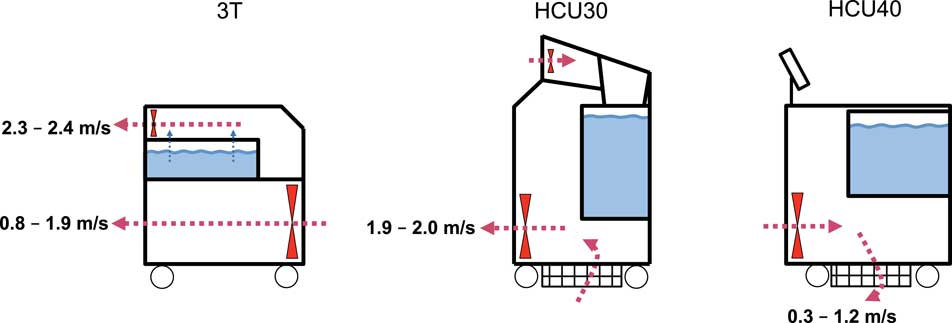
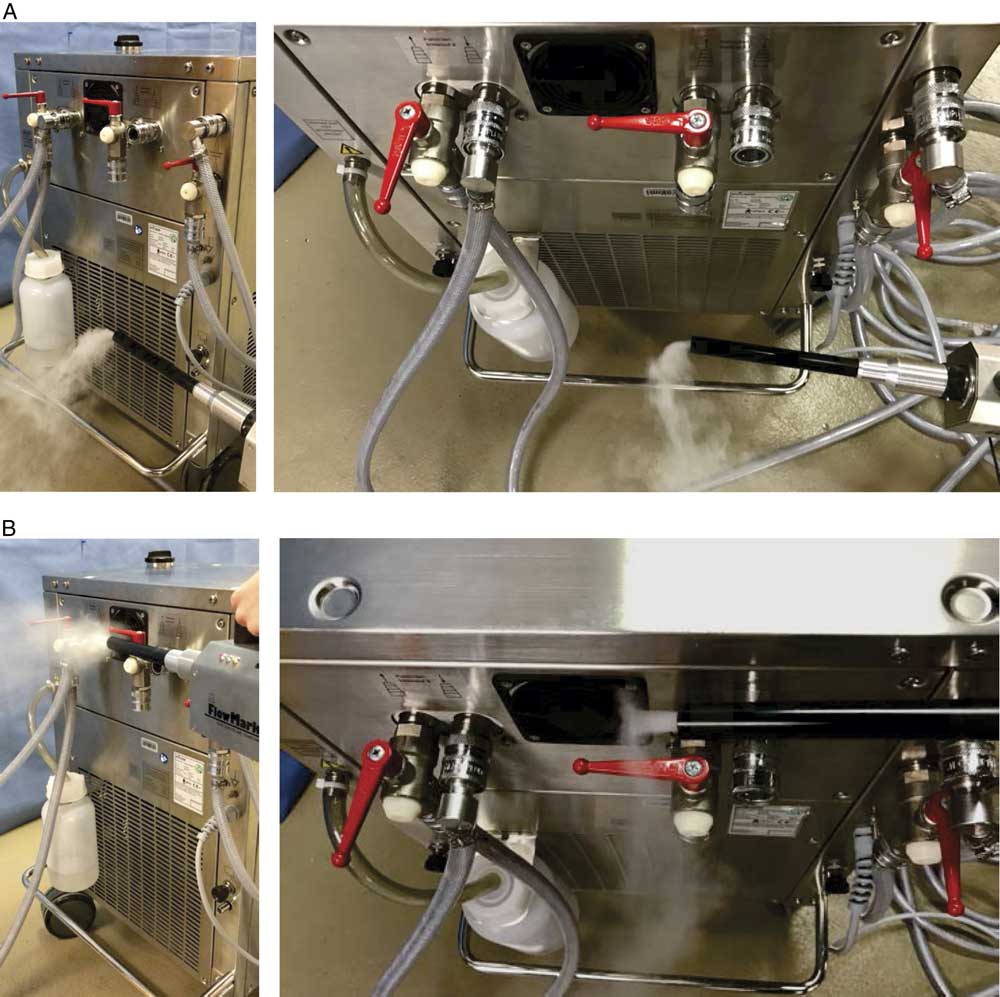
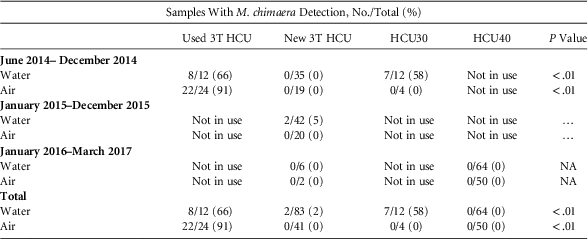
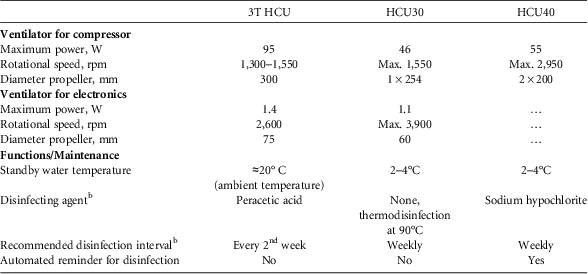
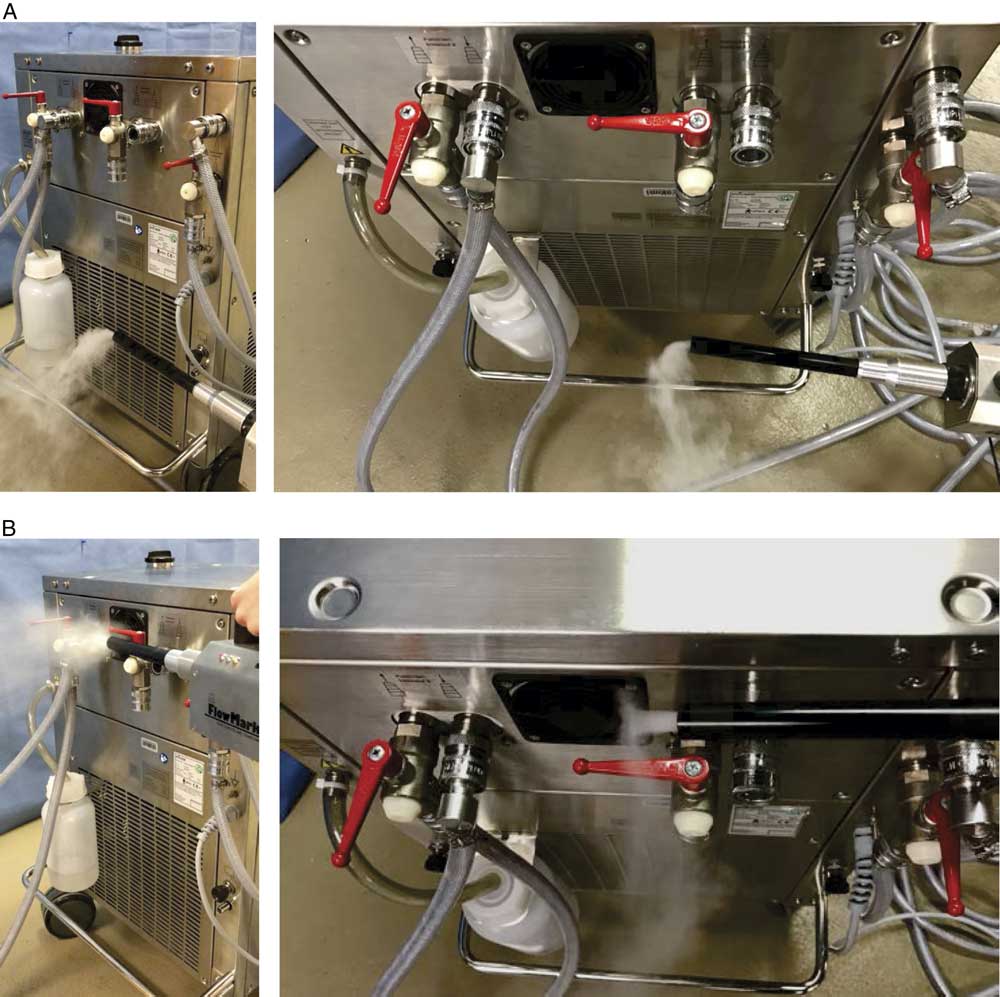
In 2014, contamination with M. chimaera was found in the water tanks of all 3T HCUs and in the HCU30 unit (Table 1). During usage, aerosolization of M. chimaera was initially detected in all 3T HCUs but not the HCU30. No aerosolization occurred with any HCU that had been switched off. Air cultures taken directly at the rear of the upper ventilator of contaminated 3T HCUs grew M. chimaera after 13 days, whereas cultures of the lower ventilator took 33 days. Despite intensified disinfection since July 2014 and despite the exchange of the 3T HCUs by August 2014, M. chimaera grew in 2 of 42 (5%) water samples from the 3T HCUs in 2015. Following a change to disinfection with peracetic acid, no further M. chimaera were detected. After replacing the 3T HCU with the HCU40 in mid-January 2016, M. chimaera could not be detected in any of the water and air samples obtained from this type of HCU over the complete surveillance period of 15 months (0 of 114). Therefore, we applied epidemiological methods in terms of a “case-control study” to compare the 3T HCUs with the HCU30 and the HCU40. We asked the manufacturers for detailed technical information. Both companies, LivaNova/Sorin and Maquet, kindly provided the requested data (Table 2). During the epidemiologic workup, we hypothesized that the exhaust air may substantially contribute to the dissemination of the mycobacteria. Therefore, we investigated the direction of airflow and measured the exhaust air velocity. The position of the ventilators and water tanks as well as the direction of airflow differed substantially among the 3 types of HCUs. We noted 4 main differences in the designs of the other HCUs compared to the 3T HCU: (1) continuous cooling of the water tank at 4°C, (2) location of cooling ventilators, (3) air flow direction, and (4) the HCU40 includes an electronic alarm to remind the user of the next disinfection cycle (Figure 1). The velocity of the air of the main ventilators for the compressors differed depending on the mode of action, with maximal air speed during cooling. Air cooling of the electronic board is solved differently depending on the HCU type. Only the 3T HCU has an additional ventilator for the electronic board exhaust air, thereby producing a second source of emitted airflow. This ventilator exhausted air at 75 cm above ground and was located directly on top of the water tank. This air speed was the highest of all measured (2.3–2.4 m/s) and remained constantly high after the HCU was switched on. In addition, this airflow was independent of the activity of cooling. The strong airflow of the upper ventilator was visualized in smoke dispersal experiments as well (Figure 2). Similarly, the HCU30 also contains a ventilator for cooling of the electronic control board. However, its airflow is directed inward and is not directly in contact with the water tank.
Differences of construction and airflow between the HCUs: ventilators in red, water tank in blue, red dotted arrows representing air flow direction, blue dotted arrows representing potential direction of aerosol leakage.

Side and top views of visualization of smoke dispersal from the lower ventilator for the compressor (A) and the upper ventilator for the electronics (B) of the 3T HCU.
Microbiological Results of Sampling of Water and Air (During Operation)

Technical Data for the Different Heater-Cooler Units (HCUs) Footnote a

a Provided by the manufacturers.
b By the end of the study, May 2017.
DISCUSSION
Currently, only the 3T HCU has been clearly linked to M. chimaera infections of patients through contaminated aerosols. 5 , Reference Hedge, Lamagni, Moore, Walker, Crook and Chand 6 , Reference van Ingen, Kohl and Kranzer 11 While the HCU30 showed contamination of the device but without aerosolization, only the HCU40 remained negative for M. chimaera during 15 months of intensified surveillance. These findings agree with those of internationally documented cases, which thus far have been associated with the 3T HCU. 5 However, the mode of transmission from the water tank and aerosolization to patients by the 3T HCU has not yet been fully elucidated, in particular, because other HCUs also contaminated with M. chimaera did not lead to contamination of air and subsequently to patients.
Our analysis revealed 4 main differences between the 3T HCU and the HCU30 and HCU40. First, the temperature in the water tank is held continuously at 2–4°C in the HCU30 and HCU40, but water remains at ambient temperature in the 3T HCU, potentially allowing M. chimaera to grow faster and/or to higher density (Table 2). Second, the airflow of the devices is considerably different. While the 3T HCU emits air horizontally at the rear from the 2 ventilators, the HCU40 directs the airflow from the sides toward the floor. Third, the electronics are located directly on top of the water tank in the 3T HCU, whereas in the HCU30 and HCU40 the electronics are positioned away from the water tank. The ventilator used to cool the electronics in the 3T HCU produces a constant high airflow at ~75 cm height coming from the compartment located directly above the water tank. It has been shown by Chand et alReference Chand, Lamagni and Kranzer 12 that unsealed holes of the water tank lead to substantial aerosol release into this upper compartment. Therefore, although producing a lower total airflow than the main ventilator below, the location combined with the ability of transferring a higher kinetic energy to aerosols as shown by our measurements may make the upper ventilator the main culprit of amplifying the risk of M. chimaera distribution. The much shorter time to positivity for air cultures taken close to the upper ventilator compared to the ones from the lower ventilator underlines this assumption. Fourth, the HCU40 includes an electronic reminder to notify the user if the next disinfection cycle is due.
Although the ventilator and its location in the HCU may act as an amplifier of risk for M. chimaera infections, other factors may also be relevant. Different amounts of aerosol leakage from the water tank and tubes may occur depending on water pump action, pump location, water temperature, water pressure and sealing of the water-containing parts. Interestingly, only those 3T HCUs in use for >2 years led to M. chimaera aerosolization whereas it took nearly a year for the new devices to grow detectable M. chimaera in the water but without air contamination. This difference may be explained by the amount of time M. chimaera needs to grow to a level at which aerosolization can occur. Other factors such as wear and tear of the sealing parts or new disinfection procedures may also have contributed to the different degree of aerosolization. Notably, after implementation of disinfection with peracetic acid, we no longer detected M. chimaera.
Microbiological differences of the contaminating strains may also play a relevant role. Van Ingen et alReference van Ingen, Kohl and Kranzer 11 showed that genetically different strains of M. chimaera contaminated 3T HCUs, but only 1 was mainly associated with infected patients. This finding may suggest differences in the ability of becoming aerosolized and of quickly contaminating implanted cardiac devices during the short intraoperative time window.
In several studies, it has been assumed that contamination of the 3T HCU occurred at the manufacturing site because strains recovered worldwide all derive from a single clone, which was also found at the production site.Reference Haller, Holler and Jacobshagen 13 – Reference van Ingen, Kohl and Kranzer 16 The source of M. chimaera in our HCU30 is not clear. Cross contamination from the 3T HCU may have occurred when they were used for the same extracorporeal membrane oxygenation devices before awareness of the outbreak. Contamination of the hospital water was ruled out by continuously negative water samples over the whole study period.
This study has several limitations. The long incubation period in our patients (median, 16 months) precluded timely epidemiologic workup at the time of transmission. The observational nature of the study in a real-life setting over a period of nearly 3 years may include confounders that were not recorded. However, the method of sampling and analysis of M. chimaera were standardized throughout the study period, and all M. chimaera isolates were confirmed by the Swiss National Center for Mycobacteria. Surely, the change of model as well as adapted disinfections protocols and the increasing awareness from the manufacturers and users have contributed to the decrease or, as in our hospital, to a sustained absence of M. chimaera in the Maquet HCUs since 2016. The HCU30 was used as a backup in 2014; therefore, fewer samples were taken from this unit than from the 3T HCU or the HCU40. As noted by Marra et al,Reference Marra, Diekema and Edmond 2 the results of mycobacterial culturing can be highly variable and sensitivity of the method is not known. Nevertheless, the FDA recommends considering microbiological sampling if contamination is suspected, 17 and the Swiss authorities (Federal Office of Public Health and SwissMedic) recommend routine sampling. 9 Furthermore, we did not perform quantitative sampling that may be important for estimating spread. However, such quantification is not standardized and is difficult to interpret. Finally, we cannot exclude the possibility that no other HCUs than the 3T aerosolizes M. chimaera. It could be argued that it is a statistical phenomenon and that all patients worldwide were contaminated through the 3T HCU because it is by far the most used type of HCU worldwide, with ~60% of the market share.Reference Marra, Diekema and Edmond 2 Nevertheless, this study provides strong evidence that the 3T HCU has the largest propensity to aerosolize M. chimaera due to its machine design. Further studies are needed to exclude M. chimaera aerosolization through other HCUs.
To solve the issue of air contamination in the operating room, several solutions have been proposed. Removing the HCU from the operating room can confer a definite solution. Containing the HCUs in a custom-made housing could also prevent spread of contaminated aerosols. However, knowledge about the main direction of airflow of the HCU is essential to optimizing each solution or, if the HCUs stay unprotected in the OR, to position them with the airflow directed away of the patient. Manufacturers should optimize the design of the HCUs so that aerosol production is minimized and produced aerosols are not expelled and do not come in contact with the ventilator air stream.
Not only M. chimaera but also other mycobacteria or water-living microorganisms can colonize HCUsReference Chand, Lamagni and Kranzer 12 , Reference Baker, Lewis and Alexander 18 and may theoretically lead to transmission to patients. Therefore, it will be worthwhile to develop materials with reduced potential for colonization. Regular exchange of the tubes can further minimize the risk for colonization. Concerning maintenance, all manufacturers have intensified the disinfection protocols and intervals. However, the recommended weekly disinfection, as for the HCU40, may lead to rapid attrition of the materials and generates relevant economic costs through increased workload. The optimal disinfection interval without increasing the risk for the patients still needs to be determined.
In conclusion, we believe that we have identified key issues in the design of HCUs that could explain the higher risk of dispersal by the 3T HCU. Especially the close contact of a strong ventilator to the aerosol-leaking water tank may be an important factor for aerosolization of M. chimaera in the 3T HCU. Also, the HCU40 differed in 4 major aspects of its design, and it showed continuous negative results during microbiological surveillance over 15 months of operation. Currently, many authorities recommend placing HCUs outside the OR. However, based on our study, such improved devices may remain in the OR during cardiac procedures. These results offer a starting point from which to design a new safer device to ensure the safety of patients undergoing cardiac surgery.
ACKNOWLEDGMENTS
Financial support: This study was funded without restriction by the University Hospital of Basel. Maquet GmbH provided an unrestricted grant to partly cover the microbiological analyses. Maquet GmbH did not have any access or influence on study design, data analysis, or manuscript writing.
Potential conflicts of interest. All authors declare no conflicts of interest.
SUPPLEMENTARY MATERIAL
To view supplementary material for this article, please visit https://doi.org/10.1017/ice.2018.102