Implications
Hyper-prolific pig breeds development has led to higher within-litter variation in BW gain, and higher number of growth retarded piglets. Growth retardation in early life is a multifactorial problem, leading to heterogeneity at the end of the nursery phase and higher mortality in the pre- and early post-weaning phase. Our research failed to identify shortcomings in nutrient use in these animals suggesting that they do not have permanent inefficiencies but fail to correct for compromised growth in early life. Methods to do so would improve the welfare and economics as small piglets are a disease risk and an economic burden.
Introduction
In intensive pig production there is an increase in the number of piglets born per litter. This has enlarged the within-litter variation in birth weight, especially increasing the proportion of low BW piglets (Foxcroft et al., Reference Foxcroft, Bee, Dixon, Hahn, Harding, Patterson, Putman, Sarmento, Smit, Tse and Town2007). To improve the homogeneity of batches of piglets, we need to understand the causes of variation in body size and growth performance in the nursery phase. By understanding the mechanisms behind growth retardation, it may be possible to adapt farm management, housing conditions and dietary nutrient supply to more closely meet the specific requirements of this population of piglets.
Based on the analysis of three data sets covering a period of 5 years, an algorithm was developed for predicting piglet BW at 10 weeks of age by including season of birth, BW at birth, at weaning and at 6 weeks of age (Paredes et al., Reference Paredes, Jansman, Verstegen, Awati, Buist, Quiniou, Hendriks and Gerrits2012). Based on this algorithm, 30 low (LP) and 30 high (HP) performing piglets were selected from a pool of 368 piglets at 6 weeks of age. The objectives of the current study were (1) to quantify the differences in performance of piglets in the defined LP and HP group and (2) to explore phenotypical traits that contribute to explain differences in growth performance during the nursery phase.
Material and methods
Animal housing and husbandry before selection
The procedures with animals described in the present study were conducted at the Nutreco Swine Research Centre (Sint Anthonis, the Netherlands) and were approved by the Animal Care and Use committee of Utrecht University, the Netherlands. One day before the expected farrowing date, all Hypor Libra sows (1st to 4th parity), were treated with 5 mg of prostaglandin PGF2α (Dinolytic, Zoetis, Capelle aan den IJssel, the Netherlands) to synchronize the farrowing process. The average litter size was 13.5±2.6 s.d. at birth. All piglets (n=454) were weighed individually and identified immediately after parturition with an ear tag. At birth, all piglets received an intramuscular injection of 15 mg/kg BW of ampicillin (Albipen; Intervet International, B. V., the Netherlands) and a 100 mg intramuscular injection of iron (Serumwerk Bernburg AG, Bernburg, Germany). Cross-fostering was avoided unless a sow did not have a sufficient number of teats to accommodate all piglets born. In three litters, the heaviest piglet of the litter was moved to a foster sow within 48 h after birth. Piglets with a birth weight below the mean minus two times the s.d. of the mean of the total population (3.5% of the batch with a birth weight: 0.39 to 0.69 kg; sex ratio 53% males and 47% females) were regarded as intrauterine growth restriction (IUGR) (McMillen et al., Reference McMillen, Adams, Ross, Coulter, Simonetta, Owens, Robinson and Edwards2001; Paredes et al., Reference Paredes, Jansman, Verstegen, Awati, Buist, Quiniou, Hendriks and Gerrits2012) and were not included in the present study. Males were anaesthetized and castrated on day 5 according to farm procedures. Due to 15.4% of mortality (mainly by crushing and spray legs) and morbidity (post-weaning diarrhoea and coughing), at 6 weeks of age 368 piglets were healthy and available for selection. Piglets remained with their littermates until the start of the study at 6 weeks of age. Piglets were weighed at birth, at 1 day of age (21.7±0.8 h), at weaning (21.6±1.0 days) and weekly during the post-weaning period until the end of the study (69.6±1.0 days). Performance data were collected from 6 to 10 weeks of age.
Selection of LP and HP piglets
Based on a data analysis of three different data sets (n=77 868 individual records) we identified BW at 6 weeks, at weaning and at birth and season of birth as main factors to predict piglet BW at 10 weeks of age (Paredes et al., Reference Paredes, Jansman, Verstegen, Awati, Buist, Quiniou, Hendriks and Gerrits2012). Applying an algorithm based on these factors, with the exception of season, we selected two groups for the present study (LP and HP piglets; n=60) when piglets were 6 weeks of age (41.6±1.0 days). LP piglets (n=30) were selected from a subpopulation of piglets with a predicted 10 weeks BW lower than the mean minus the s.d. of the population. HP piglets (n=30) were selected from a subpopulation of piglets with a predicted 10 weeks BW higher than the mean plus the s.d. of the population. In addition, piglets selected were healthy based on visual judgement, as described below, clinical blood chemistry, and were balanced for sex and litter of origin. Maximum one piglet per litter was selected in each performance group.
Visual health judgement was conducted 2 days before start of the study, and all piglets were judged on alertness, appearance of a round belly, presence of nasal and eye secretions, ocular and oral mucosa colour and hair brightness. On day 41 and 69 of age±1.0 day, 10 ml of blood were collected in serum gel and K-EDTA tubes from the jugular vein for determination of the following clinical chemistry parameters in blood plasma (tubes were centrifuged at 172×g for 10 min at 4°C): glucose, creatinine, sodium, potassium, calcium, phosphate, urea, total protein, albumin, direct and indirect bilirubin, alkaline phosphatase, glutamate dehydrogenase, total protein, glutamic pyruvic transaminase, γ-glutamyl transpeptidase, glutamic oxaloacetic transaminase, creatine kinase, magnesium, chloride and iron. To discard piglets with signs of inflammation, acute-phase proteins (haptoglobin and C-reactive protein) were determined. Clinical blood parameters were determined using standard procedures by Synlab (Augsburg, Germany). Haptoglobin and C-reactive protein concentrations were analysed by Synlab (Augsburg) using ELISA
Housing and husbandry during trial
The selected piglets (30 LP and 30 HH piglets) were placed individually in 0.8 m2 pens and randomly distributed over three similar climate-controlled departments with 20 cages each with an equal number of replicates in each department. Piglets had ad libitum access to feed and water. During the first 24 h after arrival in the facility lights were on continuously. Thereafter, a 16/8 h light/dark scheme was provided. Piglets were able to interact with each other through the barred pen divisions and were offered toys as environmental enrichment. During the study, one of the LP piglets was euthanized because it was cachectic. All evaluated parameters (creatinine kinase, magnesium, chloride, iron, C-reactive protein, haptoglobin and white and red blood count) were within normal ranges on this piglet.
Feeding
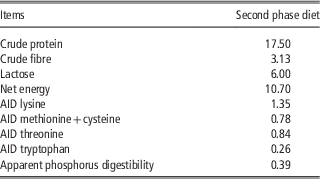
All piglets had access to a commercial creep feed, from day 14 of age until weaning, presented as gruel (2 : 1 water : feed), and replaced twice a day to stimulate feed intake. From weaning until 10 days post-weaning, all piglets were fed with a highly digestible and palatable commercial pelleted weaner diet. From day 11 to 14, a gradual transition (75 : 25, 50 : 50, 25 : 75 0 : 100) to a 2nd-phase diet (Table 1) took place. The 2nd phase diet was formulated to be highly digestible and palatable, and fulfilled the nutrient recommendations provided by National Research Council (1998). During the last week of the study (9 to 10 weeks of age) 0.3% chromium oxide was included, as indigestible marker, in the diet of a subgroup of 24 piglets for digestibility measurements.
Calculated nutrient composition (%) and net energy (MJ) of the experimental dietFootnote 1 (as fed) based on Centraal Veervoerderbureau (CVB, 2007)

AID=apparent ileal digestibility coefficient.
1 Provided the following per kg of diet: vitamin A 8000 IU; vitamin D3 2000 IU; vitamin E 30 mg; pantothenic acid 12 mg; vitamin K3 1.5 mg; vitamin B1 1 mg; vitamin B2 4 mg; vitamin B6 1 mg; vitamin B12 20 mcg; nicotinic acid 20 mg; folic acid 0.3 mg; choline chloride 150 mg; Cobalt 0.15 mg as basic cobaltous carbonate, monohydrate; copper 160 mg as cupric sulphate, pentahydrate; iron 100 mg as ferrous sulphate, monohydrate; iodine 1 mg as calcium iodate, anhydrous; manganese 30 mg as manganese oxide; zinc 100 mg as zinc sulphate; selenium 0.3 mg as sodium selenite.
Parameters measured in LP and HP piglets before selection
At 1 day of age (21.7±0.8 h) all piglets were weighed. From the weight increment between birth and 1 day of age, the colostrum intake in g, was estimated using the equation from Devillers et al. (Reference Devillers, Jvan, Prunier and Le Dividich2004). After weighing the animals the tail of the piglets was docked at about 75% of its total length. By pressing the docked part of the tail, a drop of blood was placed in the middle of the circle in a pre-treated chromatography filter paper (3MM Chr Filter paper, Whatman, Cat. No. 3030 917), following the procedure described by the producers of the Piglet Health Indicator (Betervee, the Netherlands). The selected tail blood samples were analysed for IgG level by a punch of 4.5 mm from the centre of the blood spot and eluted with an optimized dilution buffer (containing phosphate buffered saline, 10 mM phosphate buffer, 150 mM saline, pH 7.2). All sequential steps of the ELISA were carried out as described in Bianchi et al. (Reference Bianchi, Moonen-Leusen, van der Heijden and Bokhout1995). At day 7 and 14, the teat order was determined twice per day, that is, four times in total to evaluate the relationship between teat order and vitality of the piglets in later stages of life. The piglet location at the time of massaging the udder and milk ejection was recorded. The measurements were taken one min after the onset of udder massaging. The teats were divided in three regions: anterior: 1 to 2, middle: 3 to 5 and posterior: 6 or more.
Parameters measured in LP and HP piglets during the trial
When the piglets were 8 weeks of age they were exposed to a novel object test to determine their degree of fearfulness. An orange object (16 cm size), to which the piglets had not been exposed before, was introduced in the right front side of the cage of each piglet for 3 min. Latencies to approach, touch and chew the object were measured. Approaching was defined as two or more steps directly towards the object. Touching was defined as making contact between object and head, chest or legs of the piglets. At 9 weeks of age, behaviour of all individual piglets was recorded in their pen (home pen observations). Piglets were observed starting at 8 : 00, 9 : 15, 10 : 30, 13 : 00 and 14 : 15 h using 4-min instantaneous scan sampling. The Observer XT software package installed on a Pocket Observer 3.1 (Noldus Information Technology BV, Wageningen, the Netherlands) was used for behavioural recordings. The analysed behaviours were sitting, lying or sleeping, standing, explorative behaviour (nosing, rooting or chewing pen fixtures, floor or enrichment materials), comfort behaviour (rubbing the body against an object, scratching the body with hind leg or stretching part of the body), playing (gambolling, pivoting, jumping, and turning body axis, rolling, shaking object or shaking head while holding a toy that protrudes from their mouth), eating and drinking (the complete ethogram can be found in the Supplementary Table S1).
At 9 weeks of age, 12 piglets per performance group were randomly selected (four piglets/group/department) for morphometric and digestibility measurements. The selected piglets subsequently received a diet with 0.3% chromium oxide. During the last 3 days of week 10, faeces were collected from these piglets by rectal stimulation once per day obtaining approximately equal amounts per day. Samples were kept at 4°C and pooled over days within piglet, and subsequently mixed to obtain a homogenized sample for determination of dry matter (DM), N and gross energy (GE) total tract digestibility. One day before the piglets were sacrificed, body length was determined from the top of the head, from in between the ears, down to the tail head. In addition, distance from ear to ear and head circumference, from the most prominent part of the forehead around the widest part of the back of the head, was measured in the selected piglets. Piglets were sacrificed at the end of the trial by an intra-cardiac injection of pentobarbital sodium (Euthanasol 40% ASTfarma, B. V. Oudewater, the Netherlands), at a dose of 200 mg/kg BW. Liver, kidneys, heart, stomach, gallbladder, brain, spleen and colon were excised and weighed. The length, full and empty weight of the entire small intestine was determined, and ileal digesta were collected for determination of DM, N and GE ileal digestibility.
Faecal and ileal digesta samples were freeze-dried, feed samples were vacuum-dried at 80°C and freeze-dry faeces and digesta samples were dried in a forced air oven at 103°C. All samples were dried to a constant weight according to ISO Standard 6496 (1998b). Following freeze-drying, faeces and ileal samples were ground to pass a 1-mm screen and kept for analysis. Nitrogen content was measured in fresh feed, faeces and ileal digesta according to ISO Standard 5983 (1997). Crude ash content was determined in feed, faeces and ileal digesta. Samples were carefully incinerated in a muffle furnace by slowly increasing the temperature from 20°C to 550°C to prevent foaming, and subsequent incineration took place according to ISO Standard 5984 (2002). Gross energy content was analysed in feed, freeze-dried faeces and ileal content using adiabatic bomb calorimetry (model IKA-calorimeter C7000; IKA Werke GmbH and Co. KG, Staufen, Germany) according to ISO Standard 9831 (1998a). All analyses were carried out in duplicate.
Statistical analysis
Piglet growth performance and feed intake were analysed by week and over the 4-week period (6 to 10 weeks of age). For the weekly growth performance and feed intake, differences between performance groups were evaluated including performance group, sex and their interaction as independent variables using the MIXED procedure with the repeated option in SAS Version 9.1 (SAS Institute Inc., 2002). For the overall 4-week period differences between performance groups were evaluated including performance group, sex and their interaction as independent variables using the MIXED procedure in SAS Version 9.1 (SAS Institute Inc., 2002). From the teat order observations the percentage of piglets that did not change their selected teat during the 2 weeks (1 and 2 weeks of age) was determined. The UNIVARIATE procedure of SAS was used to test residuals for normality with the Shapiro–Wilk test, indicating the normal distribution of the data. A χ 2 test was used to determine whether piglets from the LP or HP piglets would suckle from a different teat order class (i.e. anterior, middle or posterior). The behavioural data obtained in the novel object test were analysed with the MIXED model of SAS after log transformation of the latencies. Differences between performance groups were evaluated including performance group, sex and their interaction as independent variables. For the home pen observations, all data were analysed using the MIXED model of SAS. Behavioural data were analysed as proportions of observations and arcsine-square root transformed when residuals were not normally distributed. Results of behavioural data are presented mentioning untransformed data but indicating the P-values from analysing transformed data. Clinical chemical blood parameters and concentrations of acute phase proteins were analysed using MIXED models determining the differences between performance groups by week and performance group×week interaction.
Results
Selection criteria
The selection of piglets was done from a pool of 368 piglets at 6 weeks of age, from an original batch of 430 piglets at weaning. A substantial number of piglets were excluded in the immediate post-weaning since they were showing signs of weakness. The selected piglets were clinically healthy, and remained healthy throughout the study. Values for the clinical chemical blood parameters were within the range of normal values for piglets as described by Kraft (Reference Kraft2005). Also concentrations of acute phase proteins were within the range for healthy piglets (Biocheck GmbH, 2005). The means per performance group at start and end of the study (6 and 10 weeks of age) of the complete blood chemistry analysis are presented in Supplementary Table S2. The observed BW at 10 weeks of age for LP and HP piglets were similar to those predicted based on the algorithm by Paredes et al. (Reference Paredes, Jansman, Verstegen, Awati, Buist, Quiniou, Hendriks and Gerrits2012). With LP piglets=19.1±0.7 kg predicted weight v. 20.2±0.6 kg observed; P=0.91; and HP=30.0±0.7 kg predicted weight v. 29.2±0.6 kg observed, P=0.88.
Parameters measured in LP and HP piglets before selection
The estimated colostrum intake at 1 day of age (21.7±0.8 h) was similar between performance groups (LP=263 and HP=311 g; s.e.=33.2, P=0.31), both on absolute and when expressed per kg BW0.75. Ninety three per cent of the piglets remained suckling from the teat initially selected throughout the 1st 2 weeks of life. When analysing the distribution of LP and HP piglets drinking in the anterior, middle or posterior teats we observed a tendency for LP piglets to drink mainly from the middle ones, whereas HP piglets drink mainly from the anterior and middle teats (interaction performance group and teat position, P=0.06). Teat selection appeared to be unrelated to BW at 6 and 10 weeks of age (P=0.60 and 0.18, respectively).
Parameters measured in LP and HP piglets during the trial
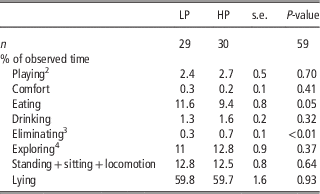
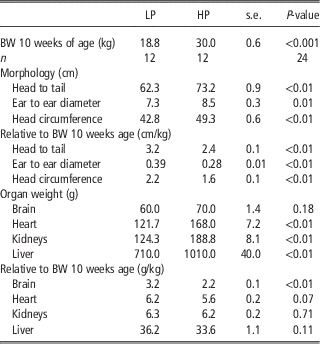
LP and HP piglets did not differ in the latency to approach a novel object (LP and HP=5 s; P=0.70), but HP piglets tended to touch the object 5 s faster than LP piglets (P=0.098). The LP and HP piglets did not differ in the duration of the time spent lying, exploring or in any of the other observed behaviours (Table 2), except that the LP piglets tended to spend more time eating (P=0.05). HP piglets were 17% longer when compared with LP piglets (P<0.01). Yet, body length per kg BW was 32% higher for the LP piglets (P<0.01). Head size and diameter were 15% larger for the HP piglets compared with the LP piglets (P<0.01). When relating the head circumference to BW, though, the ratio was 35% higher for LP piglets (P<0.01; Table 3). Weight of heart, liver and kidneys were higher for the HP piglets (P<0.01). Relative to the weight of the brain, weights of the heart, kidney and liver were higher in the HP compared with the LP piglets (heart 2.0 v. 2.6; kidney 2.0 v. 2.9, and liver 11.4 v. 15.5 for LP and HP piglets, respectively; P<0.01). Relative to BW, the weight of the heart tended to be higher in LP piglets (LP=6.2 and HP=5.6 g/kg BW; P=0.07). Relative weight of the liver and kidney did not show differences between performance groups (liver=36.2 v. 33.6 g/kg BW and kidney=6.3 v. 6.2 for the LP and HP piglets, respectively; P=0.11 and 0.71).
Home pen observationsFootnote 1 of low and high performing (LP and HP) piglets at 9 weeks of age

1 Piglets were observed starting at: 8 : 00, 9 : 15, 10 : 30, 13 : 00 and 14 : 15 h using a 4-min instantaneous scan sampling.
2 Values are from uncorrected performance group means and P-values are based on transformed data.
3 Eliminating includes urinating and defecating.
4 Exploring includes rooting, nosing and chewing object.
Piglet morphology and conformation of low and high performing (LP and HP) piglets at 10 weeks of ageFootnote 1

1 BW 10 weeks=BW at the end of the study at 69.6±1.0 days after birth.
The empty small intestine was 270 g lighter for the LP piglets and 187 cm shorter compared with HP piglets (P<0.01). When expressed relative to BW, the LP piglets showed a 21% higher weight of the small intestine (P<0.01) and a 36% longer length (P<0.01). The small intestinal weight relative to the average daily food intake (ADFI) over week 6 to 10 was 4 g/kg total FI higher for the LP piglets (P<0.01) than for the HP piglets. Apparent total tract digestibility of DM (LP=0.87, HP=0.87; P=0.51), N (LP=0.84, HP=0.84; P=0.74) and GE (LP=0.87, HP=0.87; P=0.73) and ileal digestibility of DM (LP=0.77, HP=0.79; P=0.37), N (LP=0.80, HP=0.83; P=0.20) and GE (LP=0.80, HP=0.81; P=0.55) were similar between the LP and HP piglets.
Animal performance
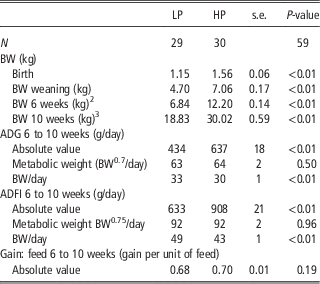
We were able to select for a large contrast in BW at 6 weeks of age between performance groups, with a range between 4.5 and 7.8 kg and between 10.8 and 13.9 kg for LP and HP piglets at 6 weeks of age, respectively. Performance data are presented in Table 4. Average daily gain (ADG) and ADFI was lower for the LP piglets from 6 to 10 weeks of age (P<0.01) but when expressed per kg BW0.75 the differences disappear (P=0.50 and 0.96). Gain : feed (G : F) from 6 to 10 weeks of age was similar between performance groups (P=0.19).
Performance for low and high performing (LP and HP) piglets from 6 to 10 weeks of ageFootnote 1

ADG=average daily gain; ADFI=average daily feed intake.
1 Study length=28.0±1.0 days from 6 to 10 weeks of age.
2 BW 6 weeks=BW at start of the study at 41.6±1.0 days after birth when piglets were individually housed.
3 BW 10 weeks=BW at the end of the study at 69.6±1.0 days after birth.
Discussion
Understanding the causes behind growth retardation and finding solutions to provide these piglets a chance to express their utmost potential might help us reduce mortality in the farrowing phase and heterogeneity at the end of the nursery phase. The aims of the present study were to quantify the differences in performance between healthy LP (6.8±0.1 kg BW at 6 weeks of age) and HP (12.2±0.1 kg BW at 6 weeks of age) piglets, selected based on an algorithm developed previously (Paredes et al., Reference Paredes, Jansman, Verstegen, Awati, Buist, Quiniou, Hendriks and Gerrits2012). In addition, our 2nd aim was to explore phenotypical traits that contribute to explain the differences in growth performance. Piglets with a very low birth weight, which were considered as IUGR (McMillen et al., Reference McMillen, Adams, Ross, Coulter, Simonetta, Owens, Robinson and Edwards2001; Paredes et al., Reference Paredes, Jansman, Verstegen, Awati, Buist, Quiniou, Hendriks and Gerrits2012) and discarded for this study. Results of muscle fibre analysis of the piglets selected are published elsewhere (Paredes et al., Reference Paredes, Kalbe, Jansman, Verstegen, van Hees, Lösel, Gerrits and Rehfeldt2013). We also aimed to rule out clinical disease as a cause for growth retardation of the selected piglets: the concentrations of acute phase proteins and blood chemistry parameters together with a visual check-up indicated that piglets in both performance groups were clinically healthy during the study.
In the farrowing phase, we focused on colostrum intake and whether piglets would drink always from their selected teat or would switch to another teat during the suckling period. IgG concentration in blood, reflects the amount of antibodies the piglet had obtained from the sow via the colostrum (Damm et al., Reference Damm, Friggens, Nielsen, Ingvartsen and Pedersen2002). We aimed to use the IgG concentration as an indication of nutrient intake and relate it to growth in the 1st 24 h, yet the high variation of this parameter (CV 68) did not allow us to make this relation. The estimated colostrum intake showed no differences between groups (LP=263 and HP=311 g; P=0.31). One explanation for this could be the time lapsed from birth to colostrum intake, yet we can only hypothesise as it was not measured. During this study, most piglets continued to suckle from the teat selected in the early postnatal period during the entire suckling phase, in agreement with McBride (Reference McBride1963). The LP piglets tended to suckle from the middle teats whereas the HP piglets tended to suckle from the anterior or middle teats. Kim et al. (Reference Kim, Hurley, Hant and Easter2000) stated that piglets occupying the anterior teats during the lactation phase would have a BW gain advantage in later life. We did, however, not observe such advantage in performance from 1 to 10 weeks of age for the piglets drinking in the anterior teats. We did not observe a correlation between teat order and birth weight, in agreement with Kim et al. (Reference Kim, Hurley, Hant and Easter2000) nor between teat order and weaning weight or performance group (LP or HP piglets).
For the behavioural traits, our findings showed that LP piglets tended to take more time before touching an unfamiliar object. This may be interpreted as a higher level of fearfulness of the LP piglets compared with HP piglets. Gieling et al. (Reference Gieling, Park, Nordquist and van der Staay2011) suggested that there are cognitive differences between low and normal birth weight piglets as, in their study, low birth weight piglets had more difficulty in performing a spatial memory task after the location of rewards had changed. This suggests that small piglets may have more difficulty in switching from a known situation to a new one. When evaluating the duration of time which both performance groups of piglets spent on different behaviours during the day, it should be noted that the piglets in our study were housed individually, and their behaviour might be different than for grouped-housed piglets. We observed a tendency for a larger proportion of time spent eating for the LP piglets (P=0.05). Feed intake during week 9 was higher for the HP piglets (LP=794 and HP=1149 g/day; P<0.01). The estimated eating rate of piglets during the behavioural tests was calculated assuming an average daily amount, determined based on week 9 of age; equal eating patter over 24 h, equal error between groups and equal day–night pattern, such that the relative differences remain. Based on these assumptions, we calculated a substantially lower eating rate in the LP piglets (3.3. v. 4.9 g/min, P=0.02) compared with the HP piglets. The reduced eating rate for the LP piglets is in line with the findings of Bruininx et al. (Reference Bruininx, van der Peet-Schwering, Schrama, Vereijken, Vesseur, Everts, den Hartog and Beynen2001), who stated that lighter piglets after weaning paid more daily visits to the feeder, but that each visit resulted in a lower intake of feed when compared with their heavier counterparts. Our own results evaluating the feed intake behaviour of the two performance groups when provided a commercial diet is in agreement with the results from Bruininx et al. (Reference Bruininx, van der Peet-Schwering, Schrama, Vereijken, Vesseur, Everts, den Hartog and Beynen2001) describing that LP piglets have a lower eating rate when compared with HP piglets (P<0.01).
The anatomical development might be hampered in utero or in the postnatal period due to factors such as nutrition and maternal environment. For the current study we did not focus on the in utero phase and we assumed that the piglets selected were not hampered in their pre and postnatal performance in the gestational phase. For this purpose, we excluded the piglets considered as IUGR. The brain is one of the first organs to mature and has the first priority in normal development (Widdowson and McCance, Reference Widdowson and McCance1960). Brain sparing, a physiological adaptation mechanism from the foetus to increase the delivery of oxygenated blood to the brain at the expense of other organs, has been studied in animal species such as rats (Desai and Crowtheri (Reference Desai and Crowtheri1996)), pigs (Widdowson and McCance, Reference Widdowson and McCance1960; Ritacco et al., Reference Ritacco, Radecki and Schoknecht1997) and in humans (Winick et al., Reference Winick, Rosso and Waterlow1970) during periods of maternal nutrient restriction. Our results showed that there were no differences in absolute brain weight between performance groups, indicating that brain development has had priority relative to other organs in LP piglets. When analysing brain weight as per kg BW, LP piglets had a higher brain weight (LP=3.2 v. HP=2.2 g/kg BW; P<0.01). When considering the weights of the different organs excised and expressed as a ratio of brain weight, we found that the size of heart, liver, and kidney and the small intestine were smaller in LP piglets. In contrast, body length and head circumference related to BW were higher for the LP piglets (P<0.01). The higher brain circumference, higher body length and head circumference when piglets are fed ad libitum, provides us an indication of the real intrinsic priorities for these piglets. Body length characteristics, together with the muscle characteristic analysis of these two groups (Paredes et al., Reference Paredes, Kalbe, Jansman, Verstegen, van Hees, Lösel, Gerrits and Rehfeldt2013), which revealed a superior muscularity for the HP piglets in terms of greater total fibre number and fibre cross sectional area clearly indicate that LP piglets have a priority for skeletal development rather than protein deposition and lean mass accretion.
The morphological differences of the LP piglets from the HP pigs were not as marked as those described for IUGR (Sacy et al., Reference Sacy, Le Treut, Schmidely and Chevaux2010), but show signs of similar phenomena. LP piglets might be a middle category in terms of anatomical development between IUGR and average weight piglets in the litter. The small intestine of LP piglets was proportionally longer, thinner, but heavier per g of ingested feed when compared with HP piglets, at 10 weeks of age, in line with other studies (Wang et al., Reference Wang, Yong, Fangxiong, Ruo, Reinhold and Christoffersen2005 in IUGR piglets). These findings led us to speculate that LP piglets had an increased surface to absorb nutrients in the intestinal tract, in agreement with the findings of Han et al. (Reference Han, Hu, Xuan, Ding, Luo, Bai, He, Zhang and Che2013) for IUGR piglets.
We did not observe differences in apparent ileal or total tract digestibility of DM, N and GE between LP and HP piglets, at 10 weeks of age, but the longer small intestine of the LP piglets led us to speculate that they would have a higher energy expenditure related to intestinal tissue leading to a lower NE value, in agreement with the results of Jones et al. (Reference Jones, Patience, Gabler and Main2011b). One may expect that once the digestive system is challenged with a diet with a lower digestibility, differences might appear in apparent nutrient absorption between groups.
When comparing performance data of pigs differing in BW, correcting for the differences in size of animals is a complicated issue, as some processes are directly proportional to absolute BW and others to metabolic BW. For the latter, different coefficients for BW correction has been proposed (Brody, Reference Brody1945). Labussière et al. (Reference Labussière, van Milgen, de Lange and Noblet2011) referred to a different factor for growing pigs, calves and sows. When expressed as a ratio of BW, the differences in ADG reversed, and fractional growth rates in LP piglets were higher compared with HP piglets. This is in line with the findings of others (Poore and Fowden, Reference Poore and Fowden2004; Magowan et al., Reference Magowan, Ball, McCracken, Beattie, Bradford, Robinson, Scott, Gordon and Mayne2011). Poore and Fowden (Reference Poore and Fowden2004) related the increase in fractional growth rate to improved insulin sensitivity early in life after impaired intrauterine growth. When expressed in g/day, ADFI of LP piglets was lower when compared with HP piglets. This was also observed by Ritacco et al. (Reference Ritacco, Radecki and Schoknecht1997). They claimed, however, that regardless of their intake level small piglets grow more efficiently than controls, which implies a higher G : F for the small piglets. We observed no consistent differences in G : F between LP and HP piglets. This is in line with the findings of Jones et al. (Reference Jones, Gabler, Patience and Main2011a) who observed no difference in G : F, despite the differences in ADG between light and heavy littermates selected at weaning. When assuming similar requirements for maintenance per kg BW0.75 (Agricultural Research Council (ARC), 1981), the efficiency of utilization of feed intake above maintenance can be calculated. When doing so the LP piglets required 3.0 MJ/day whereas the HP piglets required 4.4 MJ/day for maintenance. The calculated feed intake for maintenance for the LP piglets was 213 v. HP piglets 306 g/day (P<0.01). Calculated feed intake above maintenance was 419 v. 600 g/day for the LP and HP piglets, respectively (P<0.01). The calculated efficiency of feed utilization above maintenance tended to be lower for the LP (1.0 and 1.1 g/g for the LP and HP piglets, respectively; P=0.09; all calculations based on ARC, 1981). We speculate that when persistent throughout the grower and finisher phases, this lower efficiency for BW gain would not enable LP pigs to catch up with HP pigs.
Conclusions
Despite differences in the length and weight of the small intestine, ileal and fecal N and GE digestibility were similar between HP and LP piglets. The lower growth performance of LP compared with HP piglets from 6 to 10 weeks of age is caused by an inability to engage compensatory gain and compensatory feed intake. Differences in feed intake and ADG between LP and HP piglets depended on the way they were expressed. In g/day, LP pigs had a reduced ADFI and ADG. When expressed per kg BW0.75, these differences disappeared, and when expressed per kg BW, LP piglets achieved higher rates of ADFI and ADG. The feed : gain ratio was unaffected, but utilization of ingested feed above maintenance tended to be higher in HP piglets, suggesting the inability of LP piglets to compensate. The reduced ADFI in g/day in LP piglets coincided with a reduced eating rate. Behavioural comparison between LP and HP piglets indicate that LP piglets tend to be more fearful towards novelty. Morphological comparisons, for example, increased body length and head circumference relative to BW at 10 weeks of age, indicate that LP piglets have an increased priority for skeletal growth compared with HP piglets.
Acknowledgement
The authors gratefully acknowledge J. P. J. Balemans, J. C. Mancera Gracia, J. W. van Lagen, A. C. Bartels and all the technical staff of the experimental facility Swine Research Centre, Halfweg, Sint Anthonis, the Netherlands for their valuable contribution during the execution of the study.