Introduction
For approximately a century it has been consistently asserted that there is no sex difference in general intelligence defined as the IQ obtained from tests of a number cognitive abilities like the Wechsler and Stanford–Binet tests. This assertion was advanced in the first half of the twentieth century by Burt and Moore (Reference Burt and Moore1912), Terman (Reference Terman1916) and Spearman (Reference Spearman1923). In the second half of the twentieth century it was reaffirmed by Cattell (Reference Cattell1971, p. 131), who stated ‘it is now demonstrated by countless and large samples that on the two main general cognitive abilities – fluid and crystallized intelligence – men and women, boys and girls, show no significant differences,’ and by Brody (Reference Brody1992, p. 323), who said ‘gender differences in general intelligence are small and virtually non-existent’.
This consensus has been disputed by Lynn (Reference Lynn1994, Reference Lynn1999), who has argued that while there is virtually no sex difference in general intelligence among children up to the age of 15 years, from this age onwards males develop a small average advantage that increases with age reaching approximately 4 IQ points among adults. In his first presentation of this thesis, Lynn (Reference Lynn1994) proposed that intelligence should be defined as the sum of verbal comprehension, reasoning and spatial abilities, based on the hierarchical model of Gustafsson (Reference Gustafsson1984) and endorsed by Bouchard (Reference Bouchard1993, p. 34), who wrote that it ‘probably incorporates the consensus more than any other’. Lynn (Reference Lynn1994) presented data showing that adult men obtained higher average IQs of 1.7 IQ points on verbal comprehension, 1.8 IQ points on verbal reasoning, 2.4 IQ points for non-verbal reasoning (averaged to 2.1 IQ points for reasoning) and 7.5 IQ points for spatial abilities. These three IQs were averaged to 3.8 IQ points, rounded to 4 IQ points, for the adult male advantage on general intelligence. Further evidence for this thesis was given by Lynn (Reference Lynn1999).
Lynn’s thesis was disputed by Mackintosh (Reference Mackintosh1996, p. 567), who argued the Progressive Matrices are the best measure of reasoning ability, that there was no difference between the scores obtained by men and women on this test, and hence ‘there is no sex difference in general intelligence worth speaking of’. In response to this criticism, Lynn and Irwing (Reference Lynn and Irwing2004) published a meta-analysis of sex differences on the Progressive Matrices that showed that in general population samples there were virtually no differences up to the age of 15 years, but from this age onwards males obtained higher average scores reaching a 5 IQ point advantage among adults. In a subsequent meta-analysis of the Progressive Matrices in university student samples, Irwing and Lynn (Reference Irwing and Lynn2005) reported that men obtained a 4.6 IQ point higher mean IQ than women.
Lynn’s thesis and data have been generally ignored by students of this question, who have continued to assert that there is no sex difference in general intelligence. Thus, Halpern (Reference Halpern2000, p. 218) wrote that ‘sex differences have not been found in general intelligence’; Bartholomew (Reference Bartholomew2004, p. 91) ‘men have larger brains than women but display no significant advantage in cognitive performance’; Anderson (Reference Anderson2004, p. 829): ‘it is an important finding of intelligence testing that there is no difference between the sexes in average intellectual ability’; Johnson et al. (Reference Johnson, Carothers and Deary2009, p. 594): ‘there is little, if any, mean sex difference in general intelligence’ (this paper makes this assertion on the basis of the results of two studies of 10- to 12-year-olds in which there was no sex difference in IQ); Halpern (Reference Halpern2012, p. 233) ‘females and males score identically on IQ tests’; and Ritchie (Reference Ritchie2015, p. 105): ‘women tend to do better than men on verbal measures, and men tend to outperform women on tests of spatial ability; these small differences balance out so that the average general score is the same’.
The Wechsler test provides some of the best data with which to evaluate Lynn’s thesis and the alternative that there is no sex difference in general intelligence. This measures a wide range of verbal comprehension, verbal and non-verbal reasoning, spatial, perceptual and memory abilities that are summed to give the Full Scale IQ as a measure of general intelligence. It has been asserted by Halpern (Reference Halpern2000, p. 91) that the WAIS Full Scale IQ ‘does not show sex differences’ and that on the American WAIS IV there is no sex difference on the Full Scale IQ (Halpern, Reference Halpern2012, p. 115). The same assertion has been made by Anderson (Reference Anderson2004, p. 829): ‘the evidence that there is no sex difference in general ability is overwhelming. This is true whether general ability is defined as an IQ score calculated from an omnibus test of intellectual abilities such as the various Wechsler tests, or whether it is defined as a score on a single test of general intelligence, such as the Ravens Matrices.’
These assertions are incorrect for the standardization samples of American adults. The WAIS standardization of 1955 men obtained a higher average IQ of 1.5 IQ points for men than women (Matarazzo, Reference Matarazzo1972, Table 12.10, p. 353); the WAIS-R standardization of 1978 men obtained a 2.2 IQ point higher average IQ than for women (Matarazzo et al., Reference Matarazzo, Bornstein, McDermott and Noonan1986); and the WAIS-III standardization of 1995 men obtained a higher average IQ of 2.7 IQ points for men than women (Irwing, Reference Irwing2012).
To examine this disputed issue further, this study reports data on sex differences on the WISC-III for samples in Sudan and the United States.
Method
The sample consisted of 556 boys and 658 girls with a mean age of 8.5 years (standard deviation 0.5) applying to schools for gifted students between 2007 and 2014 in Sudan. The sample was taken from Khartoum and came from a diversity of schools throughout the city.
The children were tested by trained psychologists with the Sudanese WISC-III, originally constructed and standardized in the United States and subsequently standardized in Sudan. Permission was secured from the General Director of the National Commission for the Gifted in Sudan. The WISC-III consists of thirteen subtests. Six of these are verbal and seven are performance (non-verbal), which are summed to give Verbal and seven Performance IQs. Factor analyses of the subtests have revealed the presence of four factors designated Index IQs and consisting of: (Reference Anderson1) Verbal Comprehension, scored as the sum of the Information, Similarities, Vocabulary and Comprehension subtests; (Reference Bartholomew2) Perceptual Organization, scored as the sum of the Picture Completion, Picture Arrangement, Block Design and Object Assembly subtests; (Reference Bouchard3) Freedom from Distractibility, scored as the sum of the Arithmetic and Digit Span subtests; and Processing Speed, scored as the sum of the Coding and Symbol Search subtests. The scores of the thirteen subtests are summed to give the Full Scale IQ as a measure of general intelligence, defined as the average of a wide range of cognitive abilities.
Results
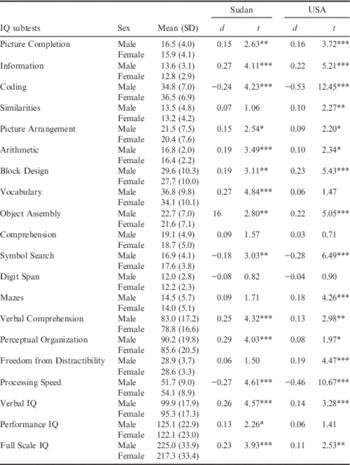
Table 1 gives the scores and standard deviations of the Sudanese males and females on the thirteen subtests, the Verbal and Performance IQs, the four Index IQs and the Full Scale IQ. These are followed by the ds (the differences between the means of the males and females divided by the pooled standard deviations), the t-values as tests of the statistical significance of the differences and the ds and the t-values for the American standardization sample of 2200 given in Psychological Corporation (2006).
Sex differences on the WISC-III in Sudan and the United States

Negative ds denote higher scores by females.
*p<0.05; p**<0.01; ***p<0.001.
Discussion
There are three points of interest in the results. First, the sex differences in the thirteen subtests, the Verbal and Performance IQs, the four Index IQs and the Full Scale IQ are very similar in the samples in Sudan and the United States. This is shown by the correlation of 0.878 (p<0.001) between the sex differences in the thirteen subtests and the consistency of the sex differences in the Verbal and Performance IQs, the four Index IQs and the Full Scale IQs in the two samples. Thus, males obtained significantly higher scores on Picture Completion, Information, Picture Arrangement, Arithmetic, Block Design and Object Assembly in both samples, while females obtained significantly higher scores on Coding, Symbol Search and Digit Span in both samples. The male advantage in Information of 0.27d in Sudan and 0.22d in the United States confirms the results of the meta-analysis of sex differences in general knowledge by Tran et al. (Reference Tran, Hofer and Voracek2014). There were only two minor inconsistencies in the results. These were that males obtained a significantly higher score than females on Vocabulary in the Sudan sample, while the higher score of males in the United States sample was not significant, and males obtained a significantly higher score than females on Mazes in the United States sample, while the higher score of males in the Sudan sample was not significant. These consistencies are also present in the four Index IQs and in the Full Scale IQs, in which males obtained higher averages in both samples. Although the child sample from Sudan was a high-IQ sample and not representative of the population, and this may be regarded as a limitation of the study, there appears to be no reason why this should bias the results. The close similarity between the sex differences in two such different cultures as Sudan and the United States suggests that these differences probably have a genetic basis.
Second, the assertions of Halpern (Reference Halpern2000, p. 91; 2012, p. 115) and Anderson (Reference Anderson2004, p. 829) that there is no sex difference in the Wechsler Full Scale IQ is disconfirmed by the two present samples, which showed that males obtained significantly higher average IQs in Sudan and the United States of 0.23d and 0.11d, respectively. The results are a further confirmation of the results of previous samples noted in the Introduction and of the thesis advanced by Lynn (Reference Lynn1994, Reference Lynn1999), that males have a higher average IQ than females. In particular, the present results are a disconfirmation of the assertion by Ritchie (Reference Ritchie2015, p. 105) that women tend to perform better than men on verbal measures. Contrary to this contention, the results show that in the samples of both the Sudan and the United States males obtained significantly higher results on the Verbal Comprehension Index IQ of 0.25d and 0.13d, and on the Verbal IQ of 0.26d and 0.14d, respectively.
Third, the higher IQs obtained by males in all these Wechsler samples is obtained despite efforts by the test developers to construct tests on which males and females obtain the same IQs. Thus Matarazzo (Reference Matarazzo1972, p. 352) stated ‘from the very beginning test developers of the best known intelligence scales (Binet, Terman, and Wechsler) took great care to counterbalance or eliminate from their final scale any items or subtests which empirically were found to result in a higher score for one sex over the other,’ and Kaufman and Lichtenberger (Reference Kaufman and Lichtenberger2002, p. 98) claimed ‘test developers have consistently tried to avoid gender bias during the test development phase’. These endeavours have probably reduced the true male advantage but have evidently not succeeded in eliminating it.
Acknowledgment
The authors extend their appreciation to the Deanship of Scientific Research, King Saud University, for funding this work through the International Research Group Project RG-1436-028.