

Introduction
Preterm birth (PTB), low birthweight (LBW) and small for gestational age (SGA) are adverse birth phenotypes that contribute significantly to infant morbidity and mortality, as well as adult-onset chronic diseases.Reference Gluckman, Cutfield, Hofman and Hanson1–Reference Yajnik and Deshmukh3 The connection between adverse birth outcomes with adult chronic diseases has been explained under the Developmental Origins of Health and Disease (DOHaD) framework.Reference Barker4–Reference Sinclair, Lea, Rees and Young15 A key construct of the DOHaD framework is fetal programming, also known as intrauterine programming or developmental programming. Intrauterine programming is the process by which early insults at critical stages of fetal development lead to permanent changes in tissue structure and function,Reference Fowden, Giussani and Forhead16 which may increase predisposition to metabolic,Reference Rinaudo and Wang17 cardiovascular,Reference Rueda-Clausen, Morton and Davidge18, Reference Ojeda, Grigore and Alexander19 renalReference Woods20 and even some psychological disordersReference Beydoun and Saftlas21, Reference Ward and Phillips22 in adulthood. The public health significance of DOHaD lies in the prevention and early identification of those adverse birth phenotypes that will likely have persistent morbidity through childhood and adulthood.Reference Salihu, Mbah, Alio and Kirby23 The present review focuses on the role of folic acid (FA) supplementation in averting adverse birth phenotypes. After a conceptual overview, we discuss biological pathways potentially implicated in adverse birth phenotypes vis-à-vis the epidemiologic evidence of FA supplementation as a potential intervention to curtail some adverse phenotypic expressions.
Prenatal insults
Prenatal insults are exogenous agents, endogenous factors, or adverse intrauterine conditions that can disrupt normal development during the embryonic period. Prenatal insults could directly affect either the formation of organs or physiological functions, or by disrupting fetal developmental processes (such as fetal programming). The effect will depend on the type, timing, duration and severity of the exposure.Reference Johnson, Newman and Schmidt24 Adverse conditions known to impact fetal development include nutritional imbalances (e.g. macro- or micronutrient deficiencies), altered oxygen delivery (e.g. uteroplacental insufficiency), metabolic/hormonal shifts (e.g. endocrine disruptors or maternal stress) and possibly fetal immune activation responses.Reference Gabory, Attig and Junien25–Reference Romero, Chaiworapongsa and Espinoza29 In response to such adverse intrauterine conditions, the feto-placental unit will try to adapt in an effort to maximize fetal survival. The success of the fetal response will depend on how prenatal insults are encoded in the biological systems of the fetus, the subsequent expression of birth phenotypes, and the conferred survival advantage for both intrauterine and extrauterine life.
Programming mechanisms
As stated by Fowden et al.,Reference Fowden, Giussani and Forhead16 ‘intrauterine programming can occur at any level within the affected physiological system and may involve structural and functional changes in genes, cells, tissues, and even whole organs’ (p. 32). Notably, this comprehensive definition denotes fetal and placental effects at multiple levels, including genetic, epigenetic, cellular, tissue and organ-level mechanisms.
At the genes level, direct genetic links have been implicated between intrauterine growth and adult diseases.Reference Fowden, Giussani and Forhead16, Reference Young30 Gene selection and mutations are mechanisms that can result from environmental influences at conception. For instance, Young noted that at least some of the relationship between adverse phenotypes and disease susceptibility may have their origins at imprinted loci (e.g. unusual genes expressed from only one parental allele). Imprinted genes that regulate fetal growth and birthweight can be disrupted in early embryological development, which can affect specific organs and increase disease susceptibility in a variety of ways.Reference Young30 Specific gene mutations, such as polymorphisms of key enzymes, may occur primarily in certain cases; however, those monogenetic changes are relatively rare and cannot explain the wide variation in disease susceptibility across the birthweight range.Reference Young30
A more frequently involved programming mechanism may be epigenetic modification, which have drawn significant attention in fetal programming studies. Epigenetic modifications are structural adaptations of chromosomal regions that result in functional modifications to the genome without altering the underlying DNA sequence.Reference Bird31 Epigenetic changes remain through cell divisions and can be transmitted through generations.Reference Bird31 Within this type of intrauterine programming, three main epigenetic mechanisms have been postulated: post-translational modification of histones (by methylation, acetylation, sumoylation and phosphorylation), micro-RNA variations and DNA methylation (covalent modification of cytosine).Reference Callinan and Feinberg32 DNA methylation is the most well studied mechanism, which involves the transfer of methyl groups to the DNA (a carbon and three hydrogens through a covalent bond).Reference Burdge, Hanson, Slater-Jefferies and Lillycrop33 DNA methylation reactions occur in a highly complex and regulated pathway that is limited by the availability of certain methyl donor molecules, such as FA, methionine, choline and vitamin B12.Reference Crider, Yang, Berry and Bailey34 Among these, only FA is capable of generating de novo one carbon group.Reference Jacob35
At the cellular level, fetal programming may be expressed by altered protein synthesis and changes in cellular protein abundance (e.g. insulin-signaling pathways, enzymes involved in the amino acid and purine metabolism and placental receptors).Reference Fowden, Giussani and Forhead16 At the tissue and organ level, morphological changes may occur in the number of cells in the tissue, vascularity changes or evident malformations.
Success of the feto-placental response to early insults
Lewis et al. Reference Lewis, Cleal and Hanson36 noted that programming mechanisms have been subject to evolutionary selective pressure. As extrapolated from evolutionary theory, phenotypic variants that are best adapted to the intrauterine conditions will be those most likely to survive in utero and also promote survival postnatally. Hence, successful feto-placental responses should not only contribute to the fitness and survival of the fetus during intrauterine life, but also prepare the fetus for extrauterine life and confer reproductive success.Reference Myatt37 Conversely, placental or fetal failure to adapt to adverse maternal environments in a manner that leads to extinction (i.e. fetal death) can be described as lack of adaptive fitness or failed response.
Another form of failed adaptive response occurs when feto-placental adaptations confer survival during intrauterine life, but do not promote intact survival in the extrauterine environment. Such a response is only partially adaptive because the reproductive success is compromised in the long run (e.g. increased risk of infant and adult morbidity).Reference Baig, Belsare, Watve and Jog38–Reference Wells41 A mismatch between the adaptive capability of the feto-infant phenotype and the conditions to be confronted later in life has been proposed as an additional explanation.Reference Fisher, Steele and Karrow42
Under certain conditions, spontaneous preterm birth (SPTB), LBW, and SGA could be the result of feto-placental adaptive responses to prenatal insults.Reference Gluckman, Cutfield, Hofman and Hanson1–Reference Yajnik and Deshmukh3 However, it is important to highlight that not all cases of SPTB, LBW and SGA can be considered the end result of feto-placental adaptations to prenatal insults. In fact, many cases of adverse birth outcomes occur among well-nourished mothers with no diseases or risk factors. However, when a prenatal insult can be identified, a degree of feto-placental adaptation is likely to have occurred. For example, in cases of utero-placental insufficiency, the fetus adapt to the blood flow restriction by adjusting the fetal body size and function to the restricted nutrition and oxygen supply. In such a case, SGA/IUGR/LBW phenotype could be seen as the outcome from an adaptive mechanism to enhance intrauterine survival.
Another example is the SPTB phenotype that results from feto-placental adaptations to prenatal insults. In particular, inflammation/infection, activation of the maternal–fetal hypothalamic–pituitary–adrenal axis (i.e. maternal stress), decidual hemorrhage and uterine distension are all recognized prenatal insults that can trigger preterm delivery. In such cases, SPTB represents an attempt to escape persistent intrauterine insults. However, in many SPTB cases, a cause or risk factor cannot be identified and mechanisms other than feto-placental adaptation may be in place. Medically indicated PTB cannot be considered adaptive either, but the preceding exposure to pregnancy complications (e.g. pre-eclampsia, hemorrhage, infection, gestational diabetes) may have already resulted in fetal programming that persists in later life.
SPTB, LBW and SGA are birth phenotypes that have multiple causes, many of which likely have nothing to do with programming mechanisms. However, when these outcomes can be traced to prenatal insults that triggered fetal programming changes, the following general but encompassing classification of fetal programming outcomes can be applied:
1. Completely successful: The intrauterine insult is completely overcome and the fetus reverses to normal developmental trajectory. This is compatible with a live birth devoid of any morbidity and is well adapted to appropriately meet the demands of extrauterine life (from birth to adulthood).
2. Partially successful: The intrauterine adverse condition leads to substantial physiologic changes in the fetus that threaten optimal growth and survival, leading to the following phenotypes: SGA/IUGR, LBW or SPTB. This category excludes cases where a prenatal insult cannot be identified, and hence fetal programming is likely not involved.
3. Adaptive failure: Intrauterine adaptive mechanisms completely fail because of the intensity/severity of the insult that overcomes fetal developmental plasticity. This could lead to demise of the developing fetus in the form of the following phenotypes: (i) miscarriage/spontaneous abortion: fetal programming failure that occurs early in utero before the embryo/fetus reaches viability; and (ii) stillbirth: fetal programming failure that occurs after the fetus has attained viability. However, this category excludes cases of pregnancy loss that result from fetal aneuploidy and other chromosomal anomalies incompatible with life, which cannot be considered to have resulted from a programming failure.
We argue that this categorization could help researchers to explore the role of FA on fetal programming of birth phenotypes. The role of FA supplementation is well documented in the prevention of neural tube defects (NTDs) and other congenital malformations.Reference Geisel43, Reference Wilson, Johnson and Wyatt44 However, the role of FA in the prevention of non-anomalous adverse birth phenotypes such as SPTB, LBW and IUGR is unclear. It has been hypothesized that epigenetic mechanisms, such as impaired DNA methylation, could play a role in the fetal programming of birth phenotypes.Reference Dominguez-Salas, Cox, Prentice, Hennig and Moore45 FA is directly involved in key epigenetic mechanisms, as one carbon donor in DNA methylation reactions.Reference Yajnik and Deshmukh46, Reference Hussain47 Animal studies demonstrated that impaired DNA methylation can be altered by folate supplementation, thereby changing birth phenotypes.Reference Dominguez-Salas, Cox, Prentice, Hennig and Moore45 Hence, FA supplementation presents potential for averting adverse birth phenotypes. Nevertheless, the available literature remains scattered and there is a need to review the evidence on FA as a potential population-based intervention to curtail adverse birth phenotypic expressions. The main objective of this narrative overviewReference Green, Johnson and Adams48 was to identify, select and appraise relevant studies that assess the relationship of FA with non-anomalous birth phenotypes. We sought to answer the following questions: (1) What are the biological arguments to support a role of FA on non-anomalous birth outcomes? (2) Is there any evidence that FA supplementation can avert non-anomalous birth outcomes? and (3) What are the biopsychosocial factors that must be considered for future research studies in this area?
Methods
We searched Medline (Pubmed and Ovid) for all studies published up to 2012, with abstracts in English. We used the ‘related citations’ feature to identify additional articles, and searched back references. We used combinations of Medical Subject Headings (folic acid, pregnancy outcome [all outcomes]) and non-indexed key words (‘fetal programming’, ‘fetal origins’, ‘intrauterine programming’ and ‘developmental origins’). To assess the biological arguments, we included articles that discussed the mechanistic basis of FA in human populations, whereas for the epidemiological evidence we included experimental studies or high-quality cohort studies that were evaluating FA nutriture on pregnancy outcomes. Although we focused on PTB, LBW and SGA, we also included other outcomes such as stillbirths, abortions and other placental-related outcomes. LBW has been criticized as a key indicator of fetal health status because of its heterogeneous natureReference Wilcox49 that comprises two entities: SGA as well as infants that were born early (PTB). Because of this heterogeneity, it is well accepted now that discussion of LBW should be expanded to include a separate discussion for SGA and PTB. To be in line with this scientific view, we included not only LBW but also its two main components, PTB and SGA. In the scientific literature, the term SGA is frequently interchanged with IUGR as done also in this paper. We excluded articles discussing only NTDs or other congenital malformation, articles where FA was not considered, and articles that discussed fetal programming implications for non-human populations. The analysis follows a qualitative synthesis strategy.
Discussion
Biological arguments for the role of FA on birth phenotypes
FA is a water-soluble B vitamin essential for maternal health, fetal growth and placental function.Reference Goh and Koren50 FA and the amino acid methionine serve as the key components in methyl transferase reactions (one-carbon metabolic reactions), which are influenced by food intake and require vitamins B12, pyridoxine, riboflavin as co-factors.Reference Kalhan and Marczewski51 One-carbon metabolic reactions are essential for protein and DNA synthesis, as well as for genomic stability and epigenetic regulation of gene expression.Reference Yajnik and Deshmukh46 Owing to the FA role as methyl donor in DNA methylation processes, researchers have suggested that FA may play a key role in fetal programming of disease in adult life.Reference Sinclair, Lea, Rees and Young15, Reference Yajnik and Deshmukh52, Reference Sinclair, Allegrucci and Singh53
The requirements for FA increase markedly during pregnancy because of rapidly growing cells in the fetus and the placenta, making women particularly vulnerable to FA deficiency in the presence of inadequate dietary supply.Reference Goh and Koren50 Without supplementation, folate concentrations in maternal serum, plasma and red blood cells continue to decrease from the fifth month of pregnancy onwards, even after several weeks post-delivery.Reference Smits and Essed54 Fetal folate levels are regulated by the active placental transport via folate receptors that keep a constant flow from the maternal serum to fetal circulation.Reference Solanky, Requena Jimenez, D'Souza, Sibley and Glazier55 On the other hand, sub-normal levels of maternal folate compromise the normal function of the placenta.Reference Rosenquist and Finnell56 FA deficiency in the mother manifests as macrocytic anemia, whereas at the cellular level it leads to disrupted protein and nucleic acid synthesis, increased levels of homocysteine; and/or disruptions of genetic/epigenetic processes, such as impaired DNA methylation and oxidative stress.Reference Scholl and Johnson57
One important metabolic effect of low folate levels is disruption of methionine metabolism, which may result in accumulation of total plasma homocysteine (tHcy). The amino acid homocysteine is a product of the methionine metabolism. Folate serves as a methyl donor in the conversion of homocysteine into methionine. Thus, low folate results in elevated levels of tHcy. Hyperhomocysteinemia has been suggested to induce abnormal fetal development by inhibiting the function of N-methyl-d-aspartate receptors in the neural epithelium, thereby implicated in NTDs.Reference Rosenquist and Finnell56
It has been suggested that the accumulation of tHcy increases the risk of PTB, which could be mediated by placental vasculopathy. A case–control study (207 SPTB cases, 444 term controls) by Kramer et al.Reference Kramer, Kahn and Rozen58 found that women with above the median plasma homocysteine were associated with the risk of SPTB [adjusted odds ratios (OR) = 1.9 (95% 1.1–3.3)]. Women with high homocysteine concentrations were more likely to have decidual vasculopathy [OR = 1.9 (1.1–3.5)]. However, the association between decidual vasculopathy and PTB was not statistical significant [OR = 1.5 (0.9–2.7)]. As noted by Murphy et al.,Reference Murphy and Fernandez-Ballart59 several studies have identified an association between elevated tHcy with subfertility, congenital developmental defects, pre-eclampsia and intrauterine growth retardation. However, the evidence is still conflicting regarding an association between elevated tHcy and other adverse pregnancy outcomes such as miscarriage, gestational diabetes, premature rupture of the membranes and placental abruption.Reference Murphy and Fernandez-Ballart59
Certain women are more likely to be folate-deficient or functional folate deficient under normal serum levels because of genetic variants in the folate metabolic pathway. One key enzyme is the 5,10 methylenetetrahydrofolate reductase (MTHFR), which transfers one-carbon unit away from purine and pyrimidine synthesis and channels it into the provision of methyl groups for S-adenosylmethionine-mediated methylation reactions.Reference Scholl and Johnson57 Many MTHFR mutations are silent, however, some women with MTHFR polymorphisms may have increased metabolic requirements for folate and will need higher doses of FA to avoid functional folate deficiency.Reference Scholl and Johnson57 The possibility of a cocktail effect of multiple mutations also needs to be considered. For example, three families of genes may be involved in the methionine–homocysteine pathways affected by FA deficiency, including folate-receptor genes, genes that regular methionine–homocysteine metabolism and genes that codify the receptor for the N-methyl-d-aspartate (an amino acid derivative).Reference Rosenquist and Finnell56
Epigenetic mechanisms are believed to be implicated in human disease processes.Reference Burdge and Lillycrop60 Folate-dependent methylation of DNA is an essential epigenetic mechanism that regulates genetic expression, in which adding methyl molecules to cytosine residues within CpG islands results generally in inhibition of transcription.Reference Dean, Lucifero and Santos61 For example, when hypomethylation of DNA occurs, abnormal gene expression with associated pathophysiologic changes may occur.Reference Yin, Zhang and Lv62 Nevertheless, the specific mechanisms how particular perturbations of the maternal compartment are transmitted through the placenta and incorporated into the fetal biological systems and the respective birth phenotypes remain to be fully established. It can be hypothesized that disturbances in maternal folate nutriture may potentially affect the methylation of genes in the placenta, and since the placental serves as a nutrient sensor to the fetus, this can result in nutritional or hormonal dysregulation in the fetus.Reference Jansson and Powell63
Inflammation mediated by cytokines is considered an important pathological pathway in the causation of some adverse birth phenotypes, such as SPTB, which may be triggered by infection. Interestingly, maternal serum folate vitamers (i.e. 5MeTHF, 5FoTHF and FA) are associated with cervical cytokine concentrations, which suggest a possible link between folate and PTB risk via inflammatory pathways.Reference Simhan, Himes, Venkataramanan and Bodnar64 Low folate levels inhibits the proliferation of primary human CD8 lymphocytes in vitro.Reference Courtemanche, Elson-Schwab, Mashiyama, Kerry and Ames65 Furthermore, FA supplementation has been shown to decrease circulating inflammatory markers, such as 1-acid glycoprotein and C-reactive protein.Reference Dhur, Galan and Hercberg66
Because of the role FA plays in protein and nucleic acid synthesis, as well as on DNA methylation, it is possible that FA may be involved in fetal programming of birth phenotypes. On the other hand, the specific epigenomic, genomic and proteomic pathways associated to specific developmental processes that affect fetal growth regulation and birth timing are still under elucidation.
Evidence from epidemiological studies
In order to establish FA as a plausible factor implicated in the programming of adverse birth phenotypes, it also is necessary to assess other causality criteria, such as the strength of the association between maternal FA deficiency and adverse birth outcomes through epidemiological studies.Reference Hill67 The association must be consistent across studies and populations. FA deficiency (functional or absolute) must be specifically linked to fetal programming outcomes such as SPTB, LBW and SGA, whereas FA supplementation must reduce or avert adverse outcomes. A dose-response relationship must be present. The effect on SPTB, LBW and/or SGA prevention must be appropriately evaluated through experimental studies that assess the effect of FA supplementation. Ultimately, researchers must consider alternate explanations of their research findings. In this context, we conducted a brief review of the epidemiologic evidence on FA supplementation as a preventative strategy to reduce non-anomalous adverse birth phenotypes.
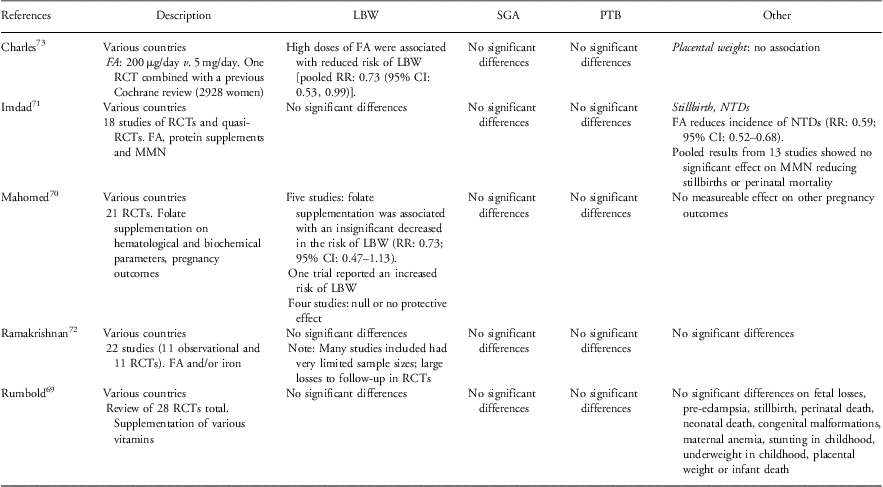
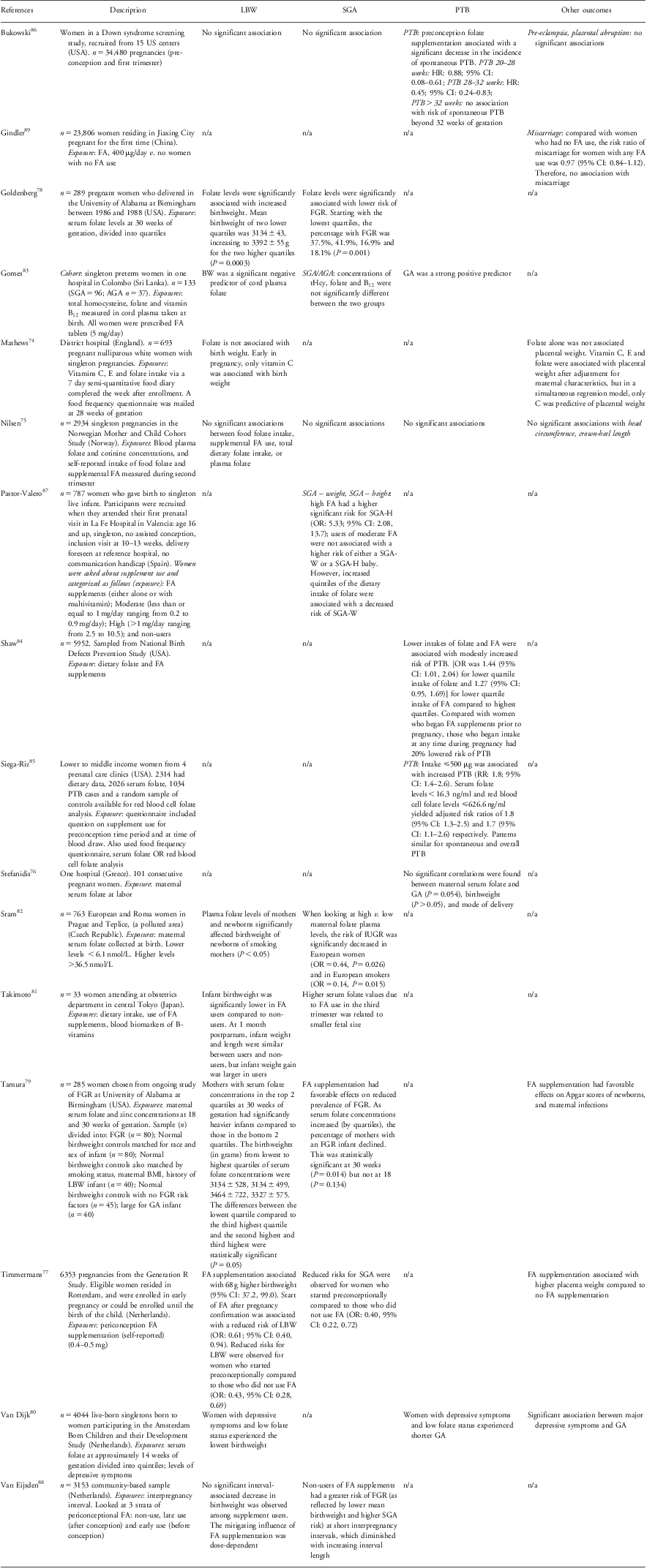
We organized our findings by two evidence levels: level of evidence A (data derived from reviews of multiple randomized clinical trials (RCTs) or meta-analysis), and level of evidence B (from non-randomized trials, or cohort studies).68 Case–control studies were excluded as they carry higher risk of bias and are of lower evidence quality when considering the effectiveness of interventions. Results from review articles are presented in Table 1 and cohort studies in Table 2. Owing to the heterogeneity of studies, it was not possible to combine epidemiological studies into pooled estimates through meta-analyses.
Systematic reviews/meta-analyses on the role of FA supplementation on adverse pregnancy outcomes

LBW, low birthweight; SGA, small for gestational age; PTB, preterm birth; CI, confidence interval; FA, folic acid; HR, hazard ratio; IFA, iron plus folic acid; MMN, multiple micronutrients; NTD, neural tube defect; RCT, randomized controlled trial; RR, relative risk.
Cohort studies on the association of FA with adverse pregnancy outcomes
n/a, not reported or not available; ABW, adequate/appropriate birthweight; AGA, appropriate for gestational age; CI, confidence interval; FA, folic acid; tHcy, homocystein; FGR, fetal growth restriction; HR, hazard ratio; IFA, iron plus folic acid; LBW, low birthweight; MMN, multiple micronutrients; NTD, neural tube defect; OR, odds ratio; PTB, preterm birth; RCT, randomized controlled trial; RDA, recommended daily allowance; RR, relative risk; RSA, recurrent spontaneous abortion; SGA, small for gestational age; SPTB, spontaneous preterm birth; GA, gestational age.
Type ‘A’ evidence: reviews from multiple trials
Reviews of RCTs find no association of FA with PTB, SGA, LBW and all other outcomes studied.Reference Rumbold, Middleton, Pan and Crowther69–Reference Ramakrishnan, Manjrekar, Rivera, Gonzales-Cossio and Martorell72 One exception is a re-analysis of a Cochrane Review that included an additional large RCT, which found a 37% decrease in LBW [pooled relative risk (RR): 0.73; 95% confidence interval: 0.53, 0.99].Reference Charles, Ness and Campbell73 With regards to fetal mortality (a result of adaptive failure), because of the reduced incidence of NTDs, FA decreases stillbirths.Reference Imdad, Yakoob and Bhutta71 However, this review failed to find direct evidence that FA reduces non-NTD-related stillbirths.
It is important to note that the available meta-analyses carry several sources of heterogeneity. Studies also vary by different maternal folate measures or in many cases total absence of baseline measures. This situation implies that many supplementation studies may not address women that could be benefit most (deficient mothers confounded with non-deficient mothers). When maternal folate was assessed, different FA measures were used (red blood cells, plasma, serum, urinary, homocysteine levels and oral intake surveys). The pre- or post-fortification status was rarely disclosed, which is an important factor to consider because pregnant populations exposed to food fortification with FA could be already folate replete compared with those without fortification (more likely to be folate deplete). Other sources of heterogeneity were in comparison groups (i.e. iron folate, iron only, micronutrients folate or placebo), timing of supplementation (periconceptual, or during the first, second, or third trimester), FA dose (range 125 mcg–9 mg daily), and geographical regions (with different dietary practices).
Type ‘B’ evidence: cohort studies
LBW phenotype
All studies were conducted in high-income countries. Three found no association between birthweight and FA.Reference Mathews, Yudkin and Neil74–Reference Stefanidis, Stefos and Vekris76 Four observed higher birthweight associated with higher FA levelsReference Timmermans, Jaddoe, Hofman, Steegers-Theunissen and Steegers77–Reference Van Dijk, Van Eijsden, Stronks, Gemke and Vrijkotte80 and one study noted a link between FA use and a higher risk of lower birthweight.Reference Takimoto, Hayashi and Kusama81 Two studies did find a positive association between FA levels and LBW.Reference Timmermans, Jaddoe, Hofman, Steegers-Theunissen and Steegers77, Reference Sram, Binkova, Lnenickova, Solansky and Dejmek82 One of these observed the positive relationship in smokers only.Reference Sram, Binkova, Lnenickova, Solansky and Dejmek82
PTB phenotype
Most studies looked at overall PTB, including medically indicated and SPTB. Unless specifically noted, studies did not differentiate type of PTB. Four research studies in high-income countries examined the relationship between PTB and FA. All found the protective effect of FA to be statistically significant. One study noted increasing gestational age with ascending folate levels.Reference Gomes, Lindner and Tennekoon83 Another study found that women who began intake of FA during the second or third trimester had a decreased risk of PTB compared with women who began preconceptionally.Reference Shaw, Carmichael, Yang, Siega-Riz and Study84 Having the lowest quartile intake of folate was associated with a heightened risk of PTB.Reference Shaw, Carmichael, Yang, Siega-Riz and Study84 Two more studies specifically assessed the effect of FA on SPTB in high-income countries. One found the heightened risk held true for spontaneous and overall PTB for low folate in the third trimester.Reference Siega-Riz, Savitz, Zeisel, Thorp and Herring85 A study involving folate supplementation in the first trimester found a diminished risk of early SPTB compared with women who did not take supplements, with the risk of early SPTB inversely proportional to the duration of folate supplementation preconceptionally.Reference Bukowski, Malone and Porter86
SGA phenotype
One cohort study conducted in a low- to middle-income country found no association of FA with SGA.Reference Gomes, Lindner and Tennekoon83 Also, two studies in high-income countries found no statistically significant association between SGA and FA.Reference Nilsen, Vollset and Monsen75, Reference Bukowski, Malone and Porter86
In contrast, five studies in high-income countries did observe an association.Reference Timmermans, Jaddoe, Hofman, Steegers-Theunissen and Steegers77, Reference Takimoto, Hayashi and Kusama81, Reference Sram, Binkova, Lnenickova, Solansky and Dejmek82, Reference Pastor-Valero, Navarrete-Munoz and Rebagliato87, Reference van Eijsden, Smits, van der Wal and Bonsel88 One such study demonstrated increased dietary intake of folate was associated with a lowered risk of SGA.Reference Pastor-Valero, Navarrete-Munoz and Rebagliato87 A study on FA supplementation found that women who started supplementing preconceptionally had a reduced risk for SGA.Reference Timmermans, Jaddoe, Hofman, Steegers-Theunissen and Steegers77 The third study provided a closer examination of interpregnancy interval, and found that non-use of FA supplements was associated with an increased risk of SGA at short interpregnancy intervals.Reference van Eijsden, Smits, van der Wal and Bonsel88 The risk declined with higher interpregnancy lengths. However, among supplement users, no increase in SGA risk was noted.Reference van Eijsden, Smits, van der Wal and Bonsel88 One study found nearly a three-fold lowered risk of IUGR for women in the highest tertile of maternal plasma folate levels compared with the lowest tertile, and this diminished risk was more marked among smokers.Reference Sram, Binkova, Lnenickova, Solansky and Dejmek82 Finally, a small study found an inverse association of high serum folate from FA use in the third trimester with smaller fetal size.Reference Takimoto, Hayashi and Kusama81
Other outcomes: placental weight, pre-eclampsia, placental abruption and spontaneous abortions
Adverse placenta-related outcomes may be the consequence of perturbed fetal programming and should be considered part of the expression of adverse birth phenotypes.Reference Jansson and Powell63 However, evidence from prospective studies have failed to confirm a relationship between FA and placenta-related outcomes, including placental abruption, pre-eclampsia and placental weight.Reference Mathews, Yudkin and Neil74, Reference Bukowski, Malone and Porter86 With regards to spontaneous abortion, an observational study in a low- to middle-income country found no association of FA with spontaneous abortion.Reference Gindler, Li and Berry89
Implications for future research
Owing to the limitations found in epidemiological studies, we argue that a biopsychosocial perspective (Fig. 1) is needed to guide researchers in the identification of gaps at multiple levels and for planning more focused and efficient studies on the role of FA in proximate causal pathways of non-anomalous adverse pregnancy outcomes. The health of the baby is intrinsically linked to mothers’ health, which is influenced by an array of biopsychosocial factors.Reference Bhutta, Lassi, Blanc and Donnay90, Reference St-Laurent, De Wals and Moutquin91 The biopsychosocial model (BPSM) is an inclusive explanatory model that includes ‘all the levels of organization pertinent to health and disease, from subatomic particles through molecules, cells, tissues, organs, organ systems, the person, the family, the community, the culture, and ultimately biosphere’ (p. 175).Reference Engel92 The BPSM recognizes that the person is part of a larger complex multi-layered system that includes structural, behavioral, psychosocial and the health care system.Reference Stineman and Streim93 The determinants of birth outcomes are multifactorial and maternal nutriture is just one link in a complex causal web. In addition to genetic, epigenetic and metabolic/nutritional factors, other determinants that need to be considered include: structural, behavioral, health care system and other environmental factors.
Biopsychosocial model of fetal programming, birth phenotypes and the role of folic acid.
Structural factors
Socioeconomic factors such as education,Reference Baraka, Steurbaut and Leemans94–Reference Goldberg, Alvarado and Chavez96 incomeReference de Jong-van den Berg, Hernandez-Diaz, Werler, Louik and Mitchell97, Reference Forster, Wills, Denning and Bolger98 and employmentReference McGuire, Cleary, Sahm and Murphy99 influence birth outcomes not only through access to nutritious food, prenatal care access and utilization, health insurance coverage and health literacy. Because an optimal diet during the periconceptional and pregnancy periods depends largely on the social and economic development of the population, low-income countries with significant levels of poverty may find their efforts to supplement FA or implement FA fortification ineffective because of social-structural barriers that affect both FA interventions and adverse birth phenotypes.
The discrepancies in the effectiveness of FA supplementation to reduce non-NTD pregnancy outcomes in low- and high-income countries may be partially explained by inequalities in socio-economic and living conditions. Food fortification policies may not reach the neediest population sometimes.Reference Imhoff-Kunsch, Flores, Dary and Martorell100 In this context, pre- and post-fortification status and maternal folate levels must be correlated and monitored longitudinally.Reference Oakley and Tulchinsky101 Other important structural factors associated with folate deficiency include race/ethnicityReference Baraka, Steurbaut and Leemans94, Reference Goldberg, Alvarado and Chavez96, Reference van Eijsden, van der Wal and Bonsel102 or immigrant status,Reference Canfield, Przybyla and Case95, Reference McGuire, Cleary, Sahm and Murphy99, Reference Ray, Singh and Burrows103 marital status,Reference Ray, Singh and Burrows103, Reference Nilsen, Vollset and Gjessing104 and maternal age.Reference Canfield, Przybyla and Case95, Reference Goldberg, Alvarado and Chavez96, Reference McGuire, Cleary, Sahm and Murphy99, Reference Paulik, Csaszar, Kozinszky and Nagymajtenyi105 Special attention to cultural dietary practices is also needed for studies assessing the role of FA supplementation in selected populations, as variation in the food preparation and consumption patterns can drive differences in the effectiveness of interventions based on regular dietary intake of folate. Also relevant is the level of community awareness of the importance of folate intake for a healthy pregnancy and avoidance of toxic exposures that interfere with folate metabolism.
Behavioral and psychological factors
Maternal folate levels depend on the consumption of natural sources of FA (e.g. liver, fresh fruits and leafy green vegetables) and use of supplements, but also on the demands for nutrients. For instance, women with a short interpregnancy interval who become pregnant before folate restoration is complete will be at risk of having sub-optimal folate levels and adverse pregnancy outcomes.Reference Smits and Essed54 This situation may be more likely in resource-poor settings and less likely in high-income countries or in countries with national FA fortification programs, since cereal and grain products are fortified with FA. Still, there are exceptions in high-income countries as well: data from the National Health and Nutrition Examination Survey suggest that two-thirds of US women of childbearing age who are not pregnant do not consume the recommended levels of FA, with blacks and Hispanics most likely to consume low levels of daily FA.Reference Yang, Carter and Mulinare106 Other behavioral determinants include: lack of awareness of FA,Reference van Eijsden, van der Wal and Bonsel102 unplanned pregnancy,Reference Goldberg, Alvarado and Chavez96, Reference de Jong-van den Berg, Hernandez-Diaz, Werler, Louik and Mitchell97, Reference Ray, Singh and Burrows103 lack of vitamins supplements pre-pregnancyReference Paulik, Csaszar, Kozinszky and Nagymajtenyi105; higher parity,Reference Forster, Wills, Denning and Bolger98, Reference Nilsen, Vollset and Gjessing104 higher BMI,Reference Goldberg, Alvarado and Chavez96 and being a smoker.Reference Forster, Wills, Denning and Bolger98, Reference McGuire, Cleary, Sahm and Murphy99, Reference Nilsen, Vollset and Gjessing104
Pregnant women in low- to middle-income countries may be particularly vulnerable to tobacco exposure due to the limited enforcement of policies that regulate tobacco consumption.Reference Ray, Singh and Burrows103 Tobacco exposure is not only independently associated with adverse birth phenotypes such as PTB and LBWReference Burguet, Kaminski and Abraham-Lerat107, Reference Jauniaux and Burton108 and infant mortality,Reference Salihu, Aliyu, Pierre-Louis and Alexander109 but is also associated with diminished folate levels.Reference Mannino, Mulinare, Ford and Schwartz110 The effectiveness of FA supplements is likely to be influenced by the smoking status of the mother (nonsmoking, passive smoking and smoking).Reference Ashford, Hahn and Hall111 The impact of paternal smoking and second hand smoke (SHS) exposure for the pregnant woman (passive smoker) remains a considerable challenge for improving birth outcomes.Reference Alio, Salihu, Kornosky, Richman and Marty112, Reference Suarez, Felkner, Brender, Canfield and Hendricks113 SHS increases risk for PTB, respiratory distress of the neonate, intensive care unit admission and other neonatal complications.Reference Ashford, Hahn and Hall111 On the other hand, higher doses of FA may confer partial protection among pregnant smokers, but this issue needs to be further explored in RCT studies.
Among other factors, maternal depression has been associated with low folate levels.Reference Morris, Fava, Jacques, Selhub and Rosenberg114 FA is necessary for the production of 5-OH tryptamine and S-adenosyl methionine, which are both potent antidepressants.Reference Young115–Reference Papakostas, Cassiello and Iovieno117 Thus, low folate levels have been associated with mood disorders and poor response to antidepressant treatment.Reference Bottiglieri118, Reference Farah119 Depressed mothers are more likely to drink, smoke, eat poorly and not take prenatal vitamins, which may further decrease folate levels. Increasing folate levels in depressed patients may ameliorate depressive symptoms and lead to other general health improvements.Reference Abou-Saleh and Coppen120
The health care system
The health care system plays an important role in influencing maternal behaviors. Planned pregnancy advice given before pregnancy by a health care professional is associated with periconceptional use of FA.Reference McDonnell, Johnson, Doyle and Sayers121 Private health care coverage is linked to use of FA.Reference McGuire, Cleary, Sahm and Murphy99, Reference McDonnell, Johnson, Doyle and Sayers121 Low- to middle-income countries that provide universal access the continuum of maternal, newborn and child care, will be in a better position to implement FA interventions.
Exposure to environmental chemicals and FA
The importance of concurrent exposure to environmental chemicals within the context of FA nutriture and adverse birth phenotypes is noteworthy despite the paucity of data. For instance, we demonstrated the greater likelihood for adverse fetal outcomes because of exposure to particulate matter.Reference Salihu, Ghaji and Mbah122 However, the mechanisms between folate deficiency and exposure to environmental chemicals remains poorly understood. For example, DNA methylation patterns are altered by bisphenol A and phthalates, which could be counteracted with methyl donors such as FA.Reference Dolinoy, Huang and Jirtle123, Reference Singh and Li124 However, large epidemiological studies looking at the role of FA supplementation in the amelioration of their effects on populations at risk are lacking. Other concurrent toxic exposures, such as organic solvents, pesticides, water nitrates, heavy metals, ionizing radiation and water disinfection by products need to be further investigated.Reference Sullivan125, Reference Sever126
Conclusion
This review focused on the role FA supplementation to prevent adverse birth phenotypes. Biological evidence suggests that FA supplementation has potential to curtail adverse birth phenotypic expressions. The evidence from epidemiological studies is promising. However, more studies are needed a conclusive answer. Particularly, reviews of clinical trials found no association, but there is considerable heterogeneity among studies considered. Evidence from observational studies indicates that FA supplementation may positively impact overall PTB, SPTB and IUGR. The influence of other potential confounders including contextual and psychobehavioral factors in non-RCTs cannot be ruled out. Thus, the conclusion of the role of FA in averting adverse birth phenotypes is still tentative and more consistent intervention studies are needed.
Future studies should adopt a consistent methodology that include assessment of maternal intake (dietary sources and supplementation), measures of long-term folate status (i.e. red blood cells folate), plasma or serum levels (as indicator of short-term maternal intake), urine folate (folate excess), homocysteine levels (as functional indicator of one-carbon metabolism), other micronutrients levels, FA dose, and timing of supplementation (peri-conceptual, first trimester, second trimester and third trimester). The fortification statuses of the countries where studies are conducted must also be documented in research protocols. We argue that a biopsychosocial approach can permit an enhanced critical appraisal of study findings regarding the heterogeneity of the adverse outcomes and better decision making regarding the utility of FA interventions.
Acknowledgments
None.
Financial Support
The present paper was supported by a grant from the James and Esther King Biomedical Research Program (2010–2015) awarded to the first author (Hamisu Salihu), Florida Department of Health.
Conflicts of Interest
The authors declare that they have no competing interests.
Authors’ contributions
H.S. contributed the overall conception and design of the manuscript, and contributed to revisions to the manuscript. A.S. and C. d. conducted literature searches, data extraction, and were responsible for writing analysis and interpretation. A. A. contributed to the adaptation of biopsychosocial perspective and its graphical depiction.