In the world of camel milkers, it is a common misbelieve that milk ejection in camels can only be induced by suckling and/or direct contact of the mother with the calf. Nevertheless, manual stimulation of the teats is thought to play only a complementary role (Yagil et al. Reference Yagil, Van Creveld, Abu-R'Kaik and Merin1999; Seifu, Reference Seifu2009; Eisa et al. Reference Eisa, Abu-Nikhaila, Abd El Majid and Abdel Moniem2012). Because stimulation of the milk ejection reflex can be difficult to obtain in camels, manual prestimulation can help especially before machine milking. Conversely, machine milking could be very difficult to manage if calves were present in the parlour, as shown for cows (De Passillé et al. Reference De Passillé, Marnet, Lapierre and Rushen2008) and ewes (Marnet & Négrao, Reference Marnet and Negrao2000) because of the maternal and selective behaviour of the mother to their own young, which inhibit milk ejection reflex in response to mechanical milking. Previous studies confirmed that machine milking of camels without calves is more efficient; however, adaptation to machine-milking procedures remains difficult (Hammadi et al. Reference Hammadi, Atigui, Ayadi, Barmat, Belgacem, Khaldi and Khorchani2010). Juhaz & Nagy (Reference Juhasz, Nagy, Nagy, Huszenicza and Juhasz2008) reported that successful training of camels to machine milking requires a good understanding of the behaviour of this species, and experienced herdsmen. Nevertheless, there are no precise guidelines for training and machine milking in camels.
In dairy camels, over 90% of milk is located in the alveolar compartment of the udder (Caja et al. Reference Caja, Salama, Fathy, El-Sayed and Salama2011; Atigui et al. Reference Atigui, Hammadi, Barmat, Farhat, Khorchani and Marnet2014). Therefore, milk ejection from the alveoli is required during sucking or machine milking. As shown for species with small cisterns, such as buffaloes (Ambord et al. Reference Ambord, Stoffel and Bruckmaier2010) and cows (Rasmussen et al. Reference Rasmussen, Frimer, Galton and Petersson1992; Bruckmaier & Hilger, Reference Bruckmaier and Hilger2001), udder pre-stimulation ensures higher milk flow rate, faster milking and reduced occurrence of bimodal curves. Bimodal curves occur in 41·9% of milk flow patterns in camels suggesting that udder pre-stimulation could be useful in this species (Atigui et al. Reference Atigui, Hammadi, Barmat, Farhat, Khorchani and Marnet2014).
Bruckmaier et al. (Reference Bruckmaier, Schams and Blum1994) stated that continuously elevated concentrations of oxytocin during milking are necessary to achieve complete udder empting in dairy cows. This suggests that any perturbation of animals with lack of cisternal storage, during milk removal, might cause incomplete milking. Previous studies in camels showed that when animals are exposed to environmental modifications milk ejection can be partially or totally inhibited (Atigui et al. Reference Atigui, Hammadi, Barmat, Farhat, Khorchani and Marnet2014). Modifications that should be avoided during milking include unusual noises, unfamiliar people, bad previous experiences, inadequate housing, therapeutic interventions (Squines, Reference Squines2003). The effect of these stressors on milk ejection in camels remains unknown.
Several authors recommend attaching milking clusters 30 s after udder stimulation in order to take advantage of the stimulatory effect of oxytocin (Gorewit & Gasman, Reference Gorewit and Gasman1985; Bruckmaier et al. Reference Bruckmaier, Schams and Blum1994; Labussière, Reference Labussière, Martinet, Houdebine and Head1999). Recent studies showed that high producing cows (Prim'Holstein breed) with larger cistern are less affected by delaying milking after udder stimulation (Billon et al. Reference Billon, Gaudin and Huneau2006). A small delay could even be beneficial in allowing maximum increase of intramammary pressure before cluster attachment (Neijenhuis & Hillerton, Reference Neijenhuis and Hillerton2003). There are no studies on the effect of the interval between udder prestimulation and cluster attachment on milk ejection efficiency in camels. This effect, if it exists, becomes highly relevant in herds that practise batch prestimulation where several females are prepared when only one or two milking machines are available.
Several behavioural and hormonal methods have been used to evaluate stress level and its effect on adaptation to machine milking. Three parameters (step-kick behaviour, milk cortisol concentration and heart-rate) are used to objectively evaluate adaptation of cows to milking (Wenzel et al. Reference Wenzel, Schönreiter-Fischer and Unshelm2012). In addition, stress related behaviours such as frequency of urination and defaecation, vocalisation (Rushen et al. Reference Rushen, de Passille and Munksgaard1999, Reference Rushen, Munksgaard, Marnet and DePassille2001), vigilance (Welp et al. Reference Welp, Rushen, Kramer, Festa-Bianchet and De Passillé2004) and escape responses (Hemsworth et al. Reference Hemsworth, Barnett and Coleman1993) are also used as a measure of fear in dairy cows.
There is a complete paucity of scientific studies on milking-associated behaviour and reaction to various milking procedures in dairy camels. The objectives of this study were to investigate the effects of changing the machine-milking routine (pre-stimulation, perturbation of surroundings before or during milking, delay before cluster attachment) on the occurrence of milk ejection, milk flow kinetic characteristics and milking-related behaviour of dairy camels.
Materials and methods
Animals and management
Clinically healthy Maghrebi dromedary camels from the experimental farm of the Arid Lands Institute (IRA, Chenchou, Tunisia) were used for the experiments. Camels were kept in a loose housing barn and each fed with a daily ration of a forage mixture of 10 kg of alfalfa hay (dry matter, DM, 89·6%; crude protein, CP, 14·8%; neutral detergent fibre, NDF, 42·2%; net energy for lactation, NEL, 1·22 Mcal/kg; on a DM basis), and 6 kg of fresh alfalfa (DM 15·0%; CP 18·7%; NDF 40·1%; NEL 1·28 Mcal/kg; on a DM basis), supplemented with 2 kg of a commercial concentrate (DM 92·8%; CP 18·0%; NEL 1·73 Mcal/kg; on a DM basis). Animals had free access to water.
Milking routine
All camels were allowed to nurse for the first 3 months of lactation before complete weaning and transition to machine milking exclusively. After training, camels were routinely milked twice a day (8·00 and 16·00) in a restraining stall using a portable milking machine (Model AM/T115, AGROMILK, 42020 S. Polo d'Enza, Reggio Emilia, Italy) which was set at 48 kPa, 80 pulsations/min and 60 : 40 pulsation ratio previously determined to be the best for these animals (Atigui et al. Reference Atigui, Hammadi, Barmat, Khorchani and Marnet2011). Clusters were attached within 10 s after cleaning the teats with a wet cotton towel and drying them. A machine stripping was performed 15 s after the milk flow decreased to less than 0·1 kg/min (detected by Lactocorder® milkmeter), by manual massage and pulling down the milking cluster before vacuum shut-off. Teats were dipped (Polycide, Laboratoires Interchem, Tunis, Tunisia) following removal of the cluster.
Experiment 1: effect of manual pre-stimulation and stressful stimuli before and during milking
The aim of this experiment was to determine the effects of a 30-s pre-stimulation and of disturbance of animals before and during machine milking on milk ejection, milk removal and milking-related behaviour of dairy camels. Eight Maghrebi camels (484·0±15·5 kg) in their 2nd to 6th lactation and well trained to machine milking were used. At the start of the experiment, the females were at 171·0±57·4 d in milk, DIM, with a daily milk production of 7·0–9·5 kg.
Experimental design consisted of a 4×4 Latin square with 8 animals allocated randomly to 4 treatments (T1, T2, T3 and T4) during 4 d. Experimental milking was limited to morning milkings. Evening milking had a normal milking routine to avoid treatment interference between days.
The first treatment (T1) consisted of milking without pre-stimulation; the milking cluster was attached without washing the udder except for a quick (<10 s) wipe to clean the teats if necessary. The second treatment (T2) consisted of milking following a pre-milking stimulation of 30 s prior to cluster attachment. Stimulation consisted of fore-stripping and manual massage of the teats and floor of the udder. The third treatment (T3) was similar to T1 but with the addition of an unusual sound (irregular loud sound produced by hitting a metal can at a distance of 1 m from the camel's shoulder) applied during the entire milking procedure. The last treatment (T4) was similar to T3 treatment but the noise was applied after milk ejection occurred (visually determined when teats suddenly swell above the level of the mouthpiece of liner – always visible when cups were attached) and until the end of milking. Milk flow recording started at the time of cluster attachment for all treatments.
Experiment 2: effect of delaying cluster attachment
This experiment was conducted to assess the effect of delaying cluster attachment on the machine-milking process, milk removal and milking-related behaviour of dromedary camels. Twelve Maghrebi camels (492·5±19·5 kg body weight), in their 1st to 7th lactation and well trained to machine milking were used. Females were at 217·2±93·3 DIM with a daily milk yield of 3·5–10·5 kg at the beginning of the trial.
The experimental design consisted of a 4×4 Latin square with 12 animals randomly allocated to one of 4 treatments (D0, D1, D2, and D4) during 4 d. Experimental milking was limited to morning milkings, and evening milking had a normal milking routine to avoid treatment interference between days. In all treatments, camels were pre-stimulated for 30 s which included fore-stripping and manual massages of the teats and of the floor of the udder with a cotton towel soaked in warm water. Treatments were milking without delay after udder stimulation (D0); milking after 1-min (D1); 2-min (D2) and 4-min delay (D4). Milk flow recording started manually at the time of cluster attachment.
Milk flow recording and evaluation
Milk flow was continuously recorded during milking using an electronic milk flow meter (Lactocorder®, WMB AG, Balgache, Switzerland) especially calibrated to low milk flow rates (<0·05 kg/min; goat calibration). Because the software connected to these devices is not developed for camel milking, we only use it for milk flow and quantity recording after validation of the measurement by weighing the bucket before and after milking. The following milking parameters were evaluated : time to milk ejection occurrence (from start of manual udder stimulation or cluster attachment till milk ejection occurs – swelling of the higher part of the teats detected by visual observation, always possible when teat cups are attached), total individual milking duration (from cluster attachment till their removal when milk flow ceased), machine milk yield (when milk flow exceeded 0·250 kg/min until it dropped below 0·100 kg/min), milk stripping yield (volume collected when milk flow re-exceeded 0·250 kg/min till cluster removal, 15 s after machine milk ceased) and bimodality as a sign of delayed milk ejection (2 observed successive milk emissions with the first one occurring just after cluster attachment, followed by a significant decline in milk flow before occurrence of a second milk flow rise after 1 min or more. Abrupt, very short and/or accidental milk flow drops inducing a milk flow curve pattern close to two-peak emission patterns were not considered as bimodality). We did not use the bimodality detection by Lactocorder® because Lactopro® software is not adapted for this diagnosis in camels. Residual milk was harvested after an intravenous injection of 10 IU of synthetic oxytocin (Biocytocine, Laboratoires Biove, Arques, France) after machine milk flow ceased, and measured by lactocorder after a new attachment of cluster. Milk flow curves were evaluated and a type score was attributed for all milk kinetic curves, according to Atigui et al. (Reference Atigui, Hammadi, Barmat, Farhat, Khorchani and Marnet2014). Type 1 milk kinetic curves were characterised by a sharp peak flow curve with a continuous increase in the milk flow followed by a declining phase without going through a plateau phase. Type 2 was characterised by milk flow curves with intermediate milk flow rate and a significant plateau phase. Finally, type 3 milk flow curves were characterised by a low milk flow rate and a longer milking duration. Prior to the experiments, 75% of the animals of the first trial showed type 1 milk flow patterns and 25% were classified as type 2, while animals used in the second trial were classified, 50% as type 1, 41·7% as type 2 and 8·3% as type 3.
Behaviour recording
A focal animal continuous recording method (Martin & Bateson, Reference Martin and Bateson1993) was used to describe camel behaviour. The observed behaviours were selected among those widely considered as indicators of acute stress or fear and welfare in cattle during milking (Rushen et al. Reference Rushen, Munksgaard, Marnet and DePassille2001; Welp et al. Reference Welp, Rushen, Kramer, Festa-Bianchet and De Passillé2004). A familiar observer recorded camel behaviour during the entire duration of milking process (from the time the animal entered the milking parlour until it left). A step was scored whenever one hoof was lifted vertically of the ground. A kick was defined as a hind leg movement in any direction and any distance. Signs of vigilance were monitored. A camel was considered as vigilant whenever it moved its head high and looked around while pricking up its ears. Occurrence of rumination, defaecation, urination, vocalisation and trying to escape the milking parlour was noted. Camels usually defaecate once when milk ejection is about to occur. Conversely, when extremely afraid, camels defaecate frequently to the point of diarrhoea. In the present study, diarrhoea was never observed, and only solid defaecation prior to milk ejection was registered. In this case, we considered defaecation (solid faeces) as a sign of comfort and well-being for dairy camels and not as a stress sign as reported by Rushen et al. (Reference Rushen, Munksgaard, Marnet and DePassille2001) for dairy cows.
Statistical analyses
Statistical analyses were carried out using the program SAS (SAS version 9.0, SAS Inst. Inc., Cary NC, USA). Results are presented as means±sem. Data of milk ejection, milk flow, milk yields, stepping and kicking occurrence were analysed using the MIXED procedure. The model included general mean, fixed effect of the treatments (1–4), random effect of the animal (1–8 in the first trial and 1–12 in the second), fixed effect of day (1–4), interaction between treatment effect and day effect and random error. Differences between means were tested by Tukey's test. Level of statistical significance was set at P<0·05, unless otherwise stated.
The FREQ procedure was used to evaluate treatment effect on milk flow curve types, bimodality, signs of vigilance, vocalisation, urination, defaecation, rumination and trying to escape during milking. Except for milk flow curve type, we used COMPPROP multiple comparisons procedure for a 2×4 contingency table analysis for proportions variance analysis when the Chi-square test was significant. Pearson correlation coefficients among milking traits and behavioural frequencies were calculated using the CORR procedure.
Results
Experiment 1: effect of manual pre-stimulation and stressful stimuli before and during milking
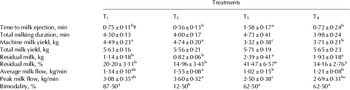
As shown in Table 1, time to milk ejection was not significantly reduced after manual pre-stimulation (about 11 s), but was significantly lengthened for treatment T3 compared with control milking. Mean total milk yields and total milking duration were similar for all experimental milkings but differences among machine milk yields as well as residual milk yields were highly significant (P<0·001) between treatments. Percentage of residual milk was minimal when udder pre-stimulation was performed and maximal when exceptional noise was applied during milking and represented respectively 14·9% vs. 41·5% of total milk yield against 20·2% in control milking. Average and peak milk flow rates were significantly higher for pre-stimulated and control treatments and lower when the noise was applied. Machine stripping yield was extremely low in all treatments.
Effect of prestimulation and environmental perturbations (before and after milk ejection) on milking characteristics. Control milking (T1), milking with a total 30-s pre-stimulation (T2), milking with environmental perturbations (unusual noises) applied from the beginning of milking (T3) or after (T4) occurrence of milk ejection

† a,b,c Means in the same line without a common superscript letter are significantly different (P<0·05)
Percentage of milk flow curves with bimodal patterns significantly dropped when camels were manually pre-stimulated (Table 2). As indicated above, all camels showed type 1 (75%) and type 2 (25%) milk flow pattern before the start of this experiment. However, when noise was applied, type 3 flow patterns appeared and their percentage reached 62·5% in T3 treatment.
Effect of prestimulation and environmental perturbations (before and after milk ejection) on change in repartition of milk flow pattern percentage within animals. Control milking (T1), milking with 30-s pre-stimulation (T2), milking with environmental perturbations (unusual noises) applied from the beginning of milking (T3) or after (T4) occurrence of milk ejection. Type 1: milk flow curves with high and sharp peak milk flow rate followed by a declining phase without plateau phase. Type 2: milk flow curves with intermediate milk flow rate and a significant plateau phase. Type 3: milk flow curves with low milk flow rate and long term milking

χ2=14·78, P=0·0220
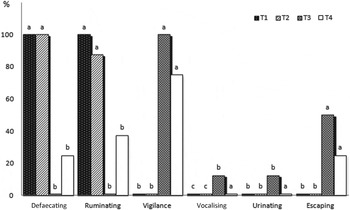
Camel behaviour in the milking parlour (Fig. 1) showed significant differences between groups. During control and pre-stimulated milkings, indicators of normal and well-being behaviour for camels during milking were more frequently displayed (P<0·0001). However, when noise was applied, both before and after milk ejection, camels showed more signs of vigilance (P<0·0001) and tried to escape the milking parlour (P=0·029). Nevertheless, vocalisation and urination were not significantly different among treatments.
Frequency of occurrence of some normal and welfare behaviours (defaecating, ruminating) and stress behaviours (vigilance, vocalisation, urination, attempt to escape) in dairy camels during control milking (T1), milking with pre-stimulation (T2), or milking with environmental perturbation (noises) applied from the beginning of milking (T3) or after (T4) milk ejection. For each behaviour, bars with different superscripts (a, b, c) are significantly different (α=0·05).

Experiment 2: effect of delaying cluster attachment
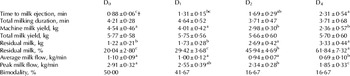
Effects of delayed cluster attachments on milk yields and milking characteristics are summarised in Table 3. Time to milk ejection increased significantly whereas total milking duration was not affected by delayed cluster attachment. Machine milk yield decreased and residual milk increased significantly when milking cluster attachment was delayed more than 2 min (P<0·0001). This residual milk represented 20% of total milk when milking clusters were attached immediately and rose to 62% when milking was delayed for 4 min. Nevertheless, total milk yields were not affected by treatments. Average and peak milk flow rates were significantly lowered when cluster attachment was delayed. However, stripping yield was not affected by duration of attachment delay.
Effect of delayed milking-cluster attachment on milk yields and milking characteristics. (D0): Control milking with direct attachment of the milking clusters, (D1):1-min delay, (D2): 2-min delay, (D4): 4-min delay

† a,b,c Means in the same line without a common superscript are significantly different (P<0·05)
Despite a lack of significant difference between proportions of milk flow curves with bimodal pattern, the repartition of milk flow curves pattern (Table 4) differed between treatments with 75% of total milk flow curves scored as type 3 when milking was delayed for 4 min after udder stimulation, compared with 8·33% for D0 and D1 treatments.
Effect of delayed milking clusters attachment on change in repartition of milk flow pattern percentage within animals. (D0): Control milking with direct attachment of the milking clusters, (D1):1-min delay, (D2): 2-min delay, (D4): 4-min delay. Type 1: milk flow curves with high and sharp peak milk flow rate followed by a declining phase without plateau phase. Type 2: milk flow curves with intermediate milk flow rate and a significant plateau phase. Type 3: milk flow curves with low milk flow rate and long term milking

χ2=17·72, P=0·0070
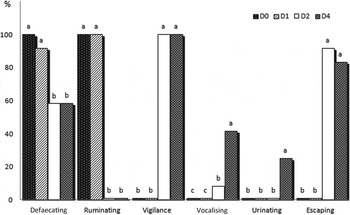
Camels behaved similarly when milking clusters were attached immediately or after 1 min (Fig. 2). No acute stress behaviour was observed in D0 and D1 groups. All animals ruminated during milking and almost all defaecated prior to milk ejection. However, when camels waited for over 2 min, they started to show signs of vigilance and tried to escape from the milking parlour. Acute stress was observed when the delay in milking reached 4 min. More than 40% of camels started groaning and 25% urinated before and/or during milking.
Frequency of occurrence of some normal and welfare behaviours (defaecation, rumination) and stress behaviour (vigilance, vocalisation, urination, attempt to escape) in dairy camels during control milking with direct attachment of the milking clusters (D0), and after 1-min delay (D1), 2-min delay (D2) or 4-min delay (D4). For each behaviour, bars with different superscripts (a, b, c) are significantly different (α=0·05)

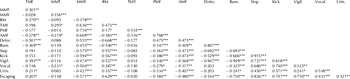
Pearson correlation
Correlations among milking traits and behaviours during milking were strong and predictable (Table 5). A high and positive correlation was detected between time to milk ejection and residual milk. Average and peak milk flow rates were positively correlated to machine milk yield. Although residual milk was never related to peak milk flow, it was negatively related to average milk flow rate.
Pearson correlation among ‘milkability’ traits and milking related behaviours in dairy camels†

† TME: Time to milk ejection MMT: Milking duration (min); MMY: Machine milk yield (kg); RM: Residual milk (kg); TMY: Total milk yield (kg); PMF: Peak milk flow (kg/min); AMF: Average milk flow (kg/min); Defec.: Defaecation; Rum.: Rumination. Vigil.: Vigilance ; Vocal.: Vocalization; Urin.: Urination
*P<0·05. **P<0·01. ***P<0·001
Correlation among behaviours and milking traits showed that defaecation and rumination were strongly and positively linked to machine milk yield, peak and average milk flow and negatively correlated to time to milk ejection and residual milk. Stepping, kicking, vocalising, urinating and trying to escape the milking parlour during milking were highly and negatively correlated to machine milk yield, to peak and average milk flow rates and conversely to residual milk.
Discussion
Effects of prestimulation during milking
In the first trial, during the control treatment (T1) camels were milked immediately after a lack, or a delicate and very short cleaning of the teats to avoid prestimulation. When udders were manually pre-stimulated for 30 s, milk ejection occurred faster (about 0·6 min). Although the difference was not significant between these treatments owing to marked inter-animal variability, this suggests that milking clusters were attached close to when milk ejection occurred, thus at the best moment to take advantage of the highest intramammary pressure. This is also a good way to significantly reduce the incidence of ‘problematic’ bimodality due to delayed milk ejection. Reduction or lack of bimodality is then, in camels, a good sign of efficient milking as reported in cows (Bruckmaier & Blum, Reference Bruckmaier and Blum1996; Dzidic et al. Reference Dzidic, Macuhova and Bruckmaier2004). In the present experiment, incidence of bimodality decreased with pre-stimulation treatment since alveolar milk was immediately available in the cistern when milking started, thus it is probable that the two milk fractions merged. Salamon et al. (Reference Salamon, Matokovic, Batinic and Dzidic2011) found similar results in the dairy cow, with the highest number of bimodal curves observed in absence of pre-stimulation. Pre-stimulation also increased the proportion of type 1 milk flow pattern which suggests that a proper pre-milking preparation remains a good practice to improve milking efficiency in dairy camels even if not necessary at the same level for all animals.
Pre-stimulation did not influence significantly the other recorded milking characteristics in our experiment though milking duration, peak and average flow rates showed an improvement. Also, residual milk did not differ between conventional milking and milking with prestimulation [20 and 15% respectively compared with 10 to 17·8% of total milk yield within the cow udder (Schmidt, Reference Schmidt1971)] which confirms the efficiency of our machine milking protocol in evoking a milk ejection reflex alone.
To conclude, prestimulation appears to be not obligatory for an efficient udder emptying in our conditions because of good machine milking equipment and settings used, well-trained animals and the long inter-milking interval of 16 h but could be more useful in worse conditions. Indeed, Kaskous & Bruckmaier (Reference Kaskous and Bruckmaier2011) showed that a short pre-stimulation and latency period before cluster attachment improve milking efficiency in dairy cows, especially at low levels of udder filling such as in late lactation or short milking intervals.
Effects of stress before or during milking
Camels are usually afraid of sudden changes in their routine, such as sudden movements, threatening or aggressive actions, unfamiliar people, unusual sounds, changes in floor surfaces or levels, and wall and fence types. In the present experiment, in presence of noise during the entire milking (T3), milk ejection was not totally inhibited but was significantly delayed (1·5 min). Since camels have a very limited cisternal milk volume (Caja et al. Reference Caja, Salama, Fathy, El-Sayed and Salama2011; Atigui et al. Reference Atigui, Hammadi, Barmat, Farhat, Khorchani and Marnet2014) such a delayed milk ejection implies milking on empty teats until milk ejection occurs, which exposes animals to high risks of mastitis, as reported for dairy buffaloes (Borghese et al. Reference Borghese, Rasmussen and Thomas2007). Machine milk yield decreased significantly and residual milk increased to over 40% of total milk yield when animals were exposed to unusual sounds before and even after milk ejection (T3 & T4). Such a disruption of milk ejection could be caused by a central inhibition of the milk ejection reflex, as reported by Bruckmaier et al. (Reference Bruckmaier, Schams and Blum1993) when cows were milked in unfamiliar surroundings. Nevertheless, this was not the case in T4 treatment because unusual sounds were produced after stimulation of milk ejection. In this treatment, we observed delayed and incomplete milk ejection that could be explained by a rapid reduction of blood flow and oxytocin access to mammary gland possibly due to the intramammary vasoconstrictive action of noradrenaline and adrenaline secreted when animals were stressed (Gorewit & Aromando, Reference Gorewit and Aromando1985). This could explain the drop of average and peak milk flow registered in T4 and T3 treatments (Table 1). Nevertheless, a third explanation was offered for this incomplete milk ejection linked to stimulation of α-adrenergic receptors in milk ducts and teat walls able to inhibit milk transfer from the alveoli to the cistern and milk passage through the teat canal (Bruckmaier et al. Reference Bruckmaier, Mayer and Schams1991; Hammon et al. Reference Hammon, Bruckmaier, Honegger and Blum1994). This explanation is supported by our results for T4 treatment in which milk yield decreased and residual milk increased significantly despite an observed milk ejection. However, an effect via the teat contraction is less probable because α-adrenergic receptor stimulation seems unable to reduce milk flow in cows when teats are submitted to the vacuum of the milking machine, as demonstrated by Bernabé & Ricordel (Reference Bernabé and Ricordel1985).
The study of the milk flow kinetics registered in the first experiment, showed that all studied camels had good milk flow curve scoring (75% type 1 and 25% type 2). Yet, when animals were disturbed, type 3 curves occurred more frequently (up to 62·50%). Atigui et al. (Reference Atigui, Hammadi, Barmat, Farhat, Khorchani and Marnet2014) also reported that easily disturbed animals showing generally type 1 and type 2 milk flow patterns in good milking conditions, could show type 3 patterns when exposed to environmental modifications.
Effects of delayed teat cup attachment before milking
The increasing time to milk ejection observed with increasing attachment delay intervals, confirms the importance of the stimulatory effect of milking machine in addition to manual prestimulation, to induce milk ejection in dairy camels. In dairy cows, the stimulation by the liner during milking pulsation has been described as effective as manual stimulation in inducing oxytocin release (Bruckmaier & Blum, Reference Bruckmaier and Blum1996). Even cluster attachment without liner pulsation can produce sufficient oxytocin release to induce an alveolar milk ejection (Weiss et al. Reference Weiss, Dzidic and Bruckmaier2003). Interestingly, we were able to visually detect a second milk ejection reflex for some camels when they waited up to 4 min to attach the clusters. It is possible that well-trained and less fearful camels might be able to have a second new milk ejection reflex in response to the stimulatory effect of teat-cup attachment after such a delay. Billon et al. (Reference Billon, Gaudin and Huneau2006) described a similar phenomenon for high-producing cows when milking units attachment was delayed for 4–6 min.
When cup attachment was delayed, machine milk yield decreased and residual milk increased significantly. About 62% of total milk remained in the udder when clusters were not attached up to 4 min after udder stimulation. In fact, because of the very limited cisternal volume of camels (only about 5% of total milk is stored in the cistern, Atigui et al. Reference Atigui, Hammadi, Barmat, Farhat, Khorchani and Marnet2014) alveolar milk volume could not be totally transferred to the cistern if milk is not removed simultaneously from the udder, unless a second milk ejection reflex took place. To maximise milking efficiency in dairy cows, units should be attached from 45–90 s from the beginning of stimulation (Rasmussen et al. Reference Rasmussen, Frimer, Galton and Petersson1992). Reinemann et al. (Reference Reinemann, Mein and Ruegg2001) reported that delaying teat-cup attachment more than 3 min resulted in more residual milk and lower milk yields. A high milk flow rate immediately after unit attachment followed by immediate reduction of milk flow rate also indicates an insufficient stimulation (Reinemann et al. Reference Reinemann, Mein and Ruegg2001).
In our experiment, when milk removal was delayed, occurrence of type 3 pattern increased from 8 to 75% for 0-and 4-min cup attachment delay, respectively. Incidence of type 3 milk flow curves coincide with a significantly lower average and peak milk flow rates. Occurrence of bimodality also decreased significantly when cluster attachment was delayed. This indicates that alveolar milk was already available before the cisternal milk fraction was removed. However, despite this transfer of milk from alveoli to cisterns, the total collected milk was significantly lowered with increasing delay. This might be explained by a milk return to the alveolar compartment owing to increasing pressure within the limited cisternal space. Caja et al. (Reference Caja, Ayadi and Knight2004) described that milk returns to the ductal and alveolar compartments when cows were not milked promptly after milk ejection. They termed this effect ‘cisternal recoil’. Later in 2011, Caja et al. described even stronger cisternal recoil in camels not milked immediately.
Even though our two experiments were conducted separately and were not designed to be comparable, it is surprising to see that a long delay of over 2 min could induce more milk retention (46–62% of residual milk) and more important milk flow reduction (0·94–0·69 l/min) than an acute perturbation applied before or during milking (41–34% and 1·00 and 1·2 l/min with stress, respectively). Thus, because of their specific anatomy, it is important to underline that a rapid and efficient milk removal is more important than a perfect stimulation for camels. The routine used frequently in large herds in Tunisia with batch preparation of udders (sometimes with oxytocin injection) followed by machine milking with limited number of cluster is absolutely to be avoided.
Effects of modification of milking routine on camels’ behaviour
For all treatments in both trials, camels entered calmly the milking parlour in the usual sequence of milking without having to hasten them. During control milking, camels were calm during the entire process. All camels defaecated (solid faeces) prior to milk ejection and ruminated throughout milking. No signs of vigilance, stepping or kicking were registered as for cows in good milking conditions (Jacobs & Siegford, Reference Jacobs and Siegford2012). This indicates that camels used in this study were well adapted to our milking routine. In dairy buffaloes, Cavallina et al. (Reference Cavallina, Roncoroni, Campagna, Minero and Canali2008) found that all animals with spontaneous milk ejection defaecated while none of the animals that required oxytocin injection to be milked did. This suggests that dairy camels and dairy buffaloes react differently from dairy cows in which this behaviour is associated with stress of the animals (Rushen et al. Reference Rushen, Munksgaard, Marnet and DePassille2001). Solid defaecation could be considered as an indicator of normal milk ejection reflex stimulation during milking in camels. There was no significant effect (P>0·10) of pre-stimulation and of 1-min delay in cluster attachment on behaviour compared with control. However, when milking was delayed for 4 min after udder stimulation, vocalisation and urination behaviours became significantly higher. This reaction in camels is different from that observed in cows where delay in teat cup attachment by 1–4 min or interruption of teat stimulation had no negative effect on milk removal and behaviour (for example after multiple failed attempts of attachment of teat cups by robotic machine milking) (Macuhova et al. Reference Macuhova, Tancin and Bruckmaier2004). Signs of discomfort, like urination or standing in the cubicle instead of lying after milking time were only seen when cows were left without milking and were rejected from the automatic milking systems (Stefanowska et al. Reference Stefanowska, Plavsic, Ipema and Hendriks2000). In general, cows respond to this discomfort with reduced or lacking OT release and hence incomplete milk ejection (Wellnitz et al. Reference Wellnitz, Bruckmaier and Blum1997; Macuhova et al. Reference Macuhova, Tancin, Kraetzl, Meyer and Bruckmaier2002, Reference Macuhova, Tancin and Bruckmaier2004) or increased milk retention in the udder (Rushen et al. Reference Rushen, de Passille and Munksgaard1999).
Similarly, in the present study, perturbations of environment resulted in an increased frequency of stress-related behaviours. Although, for T4 treatment, some animals defaecated and ruminated before we applied the aversive noises because treatment was applied after milk ejection, 75% of them were alerted.
Defaecation before milk ejection and rumination during milking were positively correlated to machine milk yield and had a high negative correlation with time to milk ejection and residual milk. However, vigilance behaviour was highly and positively correlated with residual milk and time to milk ejection. A strong negative correlation was detected between vigilance behaviour and defaecation (r=−0·95; P<0·0001) and rumination (r=−0·95; P<0·0001) behaviours. Welp et al. (Reference Welp, Rushen, Kramer, Festa-Bianchet and De Passillé2004) reported that measures of vigilance in dairy cows may provide information on the degree of fearfulness of the animals. Bobic et al. (Reference Bobic, Mijić, Kneževič, Šperanda, Antunovič, Baban, Sakač, Frizon and Koturič2011) found that when cows feel threatened, insecure and frightened, a stress reaction (characterised by increased levels of β-endorphin, cortisol, ACTH and catecholamines) appears. These hormonal changes lead to an increase in blood pressure and heart rate as well as alterations in the release of milk and decreased productivity. In our study, disturbances of dairy camels before or during milking, led to loss of milk, suggesting a negative physiological response. On the other hand, proper udder preparation including fore-stripping and manual massage of teats resulted in an efficient milk removal, less bimodality and shortened milking. Because of the very small cistern and strong cisternal elastic recoil in dairy camels, the delay between the start of teat stimulation and cluster attachment should not exceed 1 min to limit milk retention.
In conclusion, our experiments clearly show that efficient milking routine in dairy camels should emphasise udder prestimulation, rapid cluster attachment and a calm environment in the milking parlour as all these parameters have a significant effect on complete and rapid milk ejection.
This work was carried out in collaboration between the Arid Lands Institute (IRESA- MESRS Tunisia) and the AGROCAMPUS OUEST-INRA (France). The authors are grateful to Mr Mohamed Dhaoui, Mr Mohamed Farhat, Mr Bechir Saafi and Mr Lassaad Khalfalli for their careful assistance in animal management. The authors would also like to thank Pr. Ahmed Tibary for kindly suggesting stylistic improvements to the text. This document was partially funded by the European Union through the PROCAMED Project: Promotion des systèmes camelins innovants et des filières locales pour une gestion durable des territoires sahariens: reference number IB/1.1/493. The contents of this document are the sole responsibility of the authors and can under no circumstances be regarded as reflecting the position of the European Union.