Introduction
The threat to human survival posed by HIV/AIDS has few parallels. The seriousness of HIV/AIDS stems from the risk that it poses not just to the individual that it strikes, but also in its potential to spread quickly to others who come in contact with the infected persons. In 2002, for example, 3.1 million people died of AIDS. Another 42 million people were infected with HIV/AIDS. As the Human Development Report (2003) noted, ‘One of the most crippling plagues in modern history, AIDS has struck every country, devastating many in sub-Saharan Africa,’ (p. 99). Though far behind sub-Saharan Africa in the number of persons infected, South and South-East Asia is the next most HIV-affected region with 3.8 million adults and children reported living with HIV (UNAIDS, 2009). As the second most populous country in this region, behind China, India is of particular concern, and provides the context for this study. According to India's National AIDS Control Organisation (NACO), India's AIDS figure is the third largest in the world, and remains the largest in Asia. The 2006 estimates, the latest that are available, suggest that the national adult prevalence of HIV/AIDS in India is approximately 0.36%, amounting to approximately 2.5 million people living with HIV and AIDS – almost 50% of the previous estimate of 5.2 million people (see the NACO website, www.nacoonline.org, for further details). A particularly alarming finding is that of Gangakhedkar et al. (Reference Gangakhedkar, Bentley, Divekar, Gadkari, Mehendale and Shepherd1997), who report that not only are female sex workers (FSW) at very high risk in India but that ‘infection with HIV is increasing in non-FSWs, previously thought to be at low risk in India,’ (p. 2090).
At the aggregate country level, India stands out as one of the most ill-informed countries in the world on HIV/AIDS, with less than 30% of its women in the age group 15–24 years, and between 30 and 40% of its men in the same age group, having comprehensive correct knowledge of HIV over the period 2003–2008 (United Nations, 2010, p. 410). The widespread realization that ignorance is a significant contributor to the spread of HIV/AIDS has led to a large literature in India that has tried to assess the extent of people's awareness and knowledge of the disease. This includes the studies by Izhar (Reference Izhar1990) on data from Aligarh town and Srinagar city, Balk & Lahiri (Reference Balk and Lahiri1997) on 30,000 ever-married women in thirteen HIV-prone Indian states, Sachdev (Reference Sachdev1998) on Delhi university students, Lal et al. (Reference Lal, Vasan, Sarma and Thankappan2000) on college students in Kerala, Hawkes & Santhiya (Reference Hawkes and Santhiya2002) on sexually transmitted infections in India as a whole, Kattumuri (Reference Kattumuri2003) on HIV/AIDS patients in Tamil Nadu, Pallikadavath et al. (Reference Pallikadavath, Sanneh, Mewhirter and Stones2005) on rural women in Maharashtra and Tamil Nadu, and, recently, by Bloom & Griffiths (Reference Bloom and Griffiths2007) on women from three culturally contrasting states of Karnataka, Kerala and Tamil Nadu. The results are varied and region-specific but the overall message from these studies is that, while knowledge of the disease in India remains quite low and grossly inadequate, the level of awareness is alarmingly low for rural women, who are particularly vulnerable to this disease. A significant limitation of the above cited literature, which this paper attempts to address, is that knowledge is equated with simple awareness of HIV and no attempt is made to quantify the soundness of that knowledge among those who have heard of the disease. This reflects both lack of information and the absence of a satisfactory methodology for combining various aspects of the knowledge base into a single overall measure of knowledge.
The present study is in the tradition of the literature mentioned above. It takes as the starting point, as does much of the literature, that the most effective way of stopping the spread and securing reversal of HIV/AIDS is a two-step action plan consisting of (a) making more people aware of the disease and (b) improving knowledge of the disease among those who have heard of it. This motivated the present study by pointing to the importance of quantifying both (a) and (b) and the need to investigate the determinants of both awareness and knowledge of HIV/AIDS. In the following discussion, the term ‘unaware’ is used to denote the fact that the respondent has never heard of HIV/AIDS, and the term ‘ignorance’ is used to measure the lack of knowledge of HIV/AIDS among those who have heard of the disease.
The chief motivation of this study rests on the premise that ignorance per se is a significant contributor to the spread of HIV/AIDS, and that promoting full awareness is the principal way of preventing such a spread. This premise needs to be qualified by noting that, in the case of a socially conservative country such as India, this may not be entirely true. Social conservatism and strong religious beliefs in India, rather than full awareness of HIV/AIDS, prevents multiple sex partners and provides the first layer of defence against the spread of the disease. This also suggests that a combination of ignorance of the disease and the weakening of social conservatism and religious beliefs makes the backward classes particularly vulnerable to the spread of HIV/AIDS. While the prevalence of social conservatism and strong religious beliefs distinguish India from other high-risk areas such as Africa, this does not detract from the fact that promoting knowledge of HIV/AIDS is an important tool in the fight against the disease both in India and elsewhere. This study provides empirical support for the importance of knowledge by presenting strong Indian evidence that suggests a positive correlation between an individual's lack of knowledge of HIV/AIDS and her/his non-adoption of safe sex practice, such as the use of condoms during intercourse.
The study has the following principal distinguishing features that mark a departure from the previous literature. First, it proposes a new methodology for measuring the respondent's correct knowledge of HIV/AIDS or, rather, the lack of it, which will be called ‘ignorance’ in this paper. In quantifying the knowledge level on HIV among people who have heard of the disease, this study goes beyond previous studies that were limited to quantifying people's simple awareness of the disease without further exploring the nature or the determinants of that knowledge. Viewing the lack of correct knowledge on various aspects of HIV/AIDS as knowledge deprivation, the paper shows how the recent literature on the measurement of multi-dimensional deprivation can be profitably used to measure the multi-dimensional ignorance of HIV/AIDS. The present study illustrates the power and usefulness of this new approach by using it to measure and analyse the true understanding of the disease among Indians.
Second, the study covers all the Indian states and over a time period that includes the recent economic reforms in India and beyond. Since this was a period that saw a significant decline in economic deprivation (see Jayaraj & Subramanian, Reference Jayaraj and Subramanian2010; Mishra & Ray, Reference Mishra and Ray2010), it is of interest to explore if this was accompanied by a similar decline in unawareness and ignorance of HIV/AIDS. This study also provides the first evidence on how the socially disadvantaged classes in India, namely, the scheduled classes and tribes (SC/ST), fare on the HIV/AIDS knowledge measure in comparison with the other social groups.
Third, the study uses unit record data to assess the principal determinants of the unawareness and ignorance of the disease. In this context, the study uses gender-disaggregated information to provide evidence on the influence of women's empowerment in decision-making on their HIV awareness and knowledge along with that of their partners. An important theme running throughout the study is the need to draw a distinction between simple awareness of HIV/AIDS and the soundness of that knowledge. Consistent with that distinction, this paper reports and compares both the magnitude and determinants of awareness and knowledge of the disease.
The multi-dimensional ignorance measures of HIV and their properties
The literature on multi-dimensional deprivation, on which the proposed measures of multi-dimensional ignorance or knowledge deprivation are based, contains several excellent expositions (see, for example, Chakravarty & Majumder, Reference Chakravarty and Majumder2005; Chakravarty & D'Ambrosio, Reference Chakravarty and D'Ambrosio2006; Jayaraj & Subramanian, Reference Jayaraj and Subramanian2010). No attempt is thus made here at a comprehensive discussion of the measures.
There are two alternative approaches to measuring multi-dimensional ignorance of HIV/AIDS. If a respondent is asked questions on different aspects of the disease, the answer to each question is either correct or incorrect. There are two ways of aggregating the information on the respondents' answers on the questions and over the regions/states into a single measure of knowledge deprivation. Both are followed in this study. Each involves measuring incorrectness in an answer to a specific question across all respondents and then aggregating these question-specific ignorance indices into a single number that measures the overall ignorance faced by a country or a region. They differ with respect to the emphasis placed when disaggregating the overall ignorance and working out the percentage contribution of each of the aggregated units. The first (see, for example, Klasen, Reference Klasen2000; Bourguignon & Chakravarty, Reference Bourguignon and Chakravarty2003; Chakravarty & Majumder, Reference Chakravarty and Majumder2005) follows the spirit of the Human Development Index (HDI) in defining overall ignorance as a linear function of the question-specific ignorance magnitudes. This approach does not consider regional disaggregation and treats the whole country as the unit of analysis. It considers the weights of the question-specific components in the measure of overall ignorance as either fixed exogenously (as with the HDI) or determines them from data by principal components (Klasen, Reference Klasen2000) or estimates them as the ignorance shares of each question in overall ignorance and calculated as percentages using additively decomposable ignorance measures (Bourguignon & Chakravarty, Reference Bourguignon and Chakravarty2003; Chakravarty & Majumder, Reference Chakravarty and Majumder2005). In the second approach (Chakravarty & D'Ambrosio, Reference Chakravarty and D'Ambrosio2006; Jayaraj & Subramanian, Reference Jayaraj and Subramanian2010), the emphasis is on the regional disaggregation of the ignorance measure for the country or group of countries and defining it as additive in the ignorance measures of the subgroups or regions. Jayaraj & Subramanian (Reference Jayaraj and Subramanian2010) modify the approach of Chakravarty & D'Ambrosio (Reference Chakravarty and D'Ambrosio2006) to make it more suitable for the unit record data that are considered in the present study.
This study is a hybrid of both approaches since it compares the ignorance both by questions and by regions with respect to one another and calculates the percentage contribution of each question/state to the overall deprivation. Another approach that could be usefully adopted, instead of the present ‘sum score approach’, is that provided by Item Response Theory (IRT). These models are mathematical equations representing the relationship between a respondent's underlying level on a latent trait and probability of a particular item response using non-linear economic functions (Reise et al., Reference Reise, Widaman and Pugh1993). The potential of this approach has been demonstrated in a recent study by Cappellari & Jenkins (Reference Cappellari and Jenkins2006). However, as these authors conclude, ‘We have provided an entirely practical argument for the continued use of the sum-score approach. It is very simple to implement and to understand, and appears to provide the same conclusions,’ (p. 14). While their conclusion, along with the fact that the IRT modelling does not readily fit the multi-dimensional knowledge deprivation methodology, justifies use of the sum-score approach, a comparison of the two approaches in the present context promises to be a fertile ground for further research.
Let there be K (≥1) questions on HIV/AIDS. Let  denote the percentage of individuals in Indian state j that gave an incorrect answer to question k. Let xk denote the corresponding ignorance rate on question k in the country as a whole.
The ignorance faced by state j is given by:
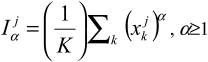
The parameter α is chosen a priori by the evaluator. If all the states are now pooled and the region/country considered as a whole, then the measure of ignorance or knowledge deprivation of HIV/AIDS is given by:
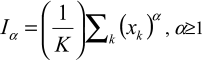
The ratio  gives the percentage contribution of ignorance by state j on question k to that of the country as a whole. If this ratio is deflated by the population share of state j, i.e. sj, then the value of the population-adjusted parameter,
 tells us if state j is more ignorant than the rest on account of question k (if > 1) or not (if < 1). The ratio of
 scaled by the population share of state j tells us the deprivation in knowledge or ignorance in state j vis-à-vis the rest of the region/country after aggregating over all the questions on HIV/AIDS.
The seven key properties that are satisfied by Iα are:
1. If the answers to all the questions are correct, then the overall measure
 must be 0.
2. The value of
will lie between the minimal and maximal values of across the K questions.3. Ceteris paribus, one more incorrect answer must increase the overall measure of ignorance.
4. An equi-proportionate increase in the ignorance rate on all questions will increase the overall measure by the same proportion.
5. Ceteris paribus, the increase in overall ignorance due to a given increase in incorrectness in the answer to a single question is larger the higher the ignorance on that question. This property is satisfied if α>1.
6. This index is additively decomposable both between states and between questions.
7. Given the unchanged population size for the country as a whole, migration of residents from a less ignorant state to a more ignorant state will increase the ignorance or incorrectness of knowledge of HIV/AIDS in the country as a whole.
 must be 0.
 across the K questions.
The second approach adopted in this study is now briefly explained. Instead of starting from the question-specific headcount ignorance rates, this approach takes a slightly different route by starting from the proportion of households who are ignorant on 1, 2, 3, etc. questions, and then aggregating these into regional ignorance or knowledge deprivation rates and from that to that of the nation as a whole. A key point of departure from the previous approach is that, unlike before, the precise wording of the question does not matter here, only the number of incorrect answers matters. Following the notation used by Jayaraj & Subramanian (Reference Jayaraj and Subramanian2010), let nj denote the number of households that gave incorrect answers to exactly j questions, j∈{0,1, … ,K}. Let the total number of households or individuals be denoted by n. Then, three possible headcount rates of ignorance are as follows.


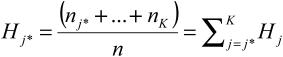
The terms HI, HU and Hj * are headcount rates of multi-dimensional knowledge deprivation or ignorance. While HI denotes the headcount ignorance rates of individuals who gave incorrect answers to all K questions, and is referred to as the ‘intersection method’, HU denotes the corresponding headcount rates of households that gave incorrect answers to at least one question and is referred to as the ‘union method’. It is clear that while HI understates the magnitude of ignorance, HU overstates it. Alternatively, HI measures the magnitude of extreme ignorance while HU measures the aggregate of mild, moderate and extreme ignorance. A compromise is Hj *, which lies between HI and HU, where j* is specified a priori. It approaches the former when j* moves towards K, and approaches the latter when j* moves towards 1.
A more sophisticated measure than Hj *, along the lines of Atkinson's (Reference Atkinson1970) inequality measure and Foster et al.'s (Reference Foster, Greer and Thorbecke1984) poverty measure, has been suggested by Jayaraj & Subramanian (Reference Jayaraj and Subramanian2010) and is as follows:
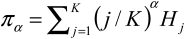
The parameter α behaves like the α in the case of the Atkinson (Reference Atkinson1970) and Foster et al. Reference Foster, Greer and Thorbecke1984) measures. As α increases from 1 to higher values, πα gives greater weight to the ignorance rates of households that gave incorrect answers to more and more questions, i.e. the more ignorant households and, at very high α values, it measures the magnitudes of extreme ignorance. This is similar to the interpretation of α as an ‘inequality aversion’ parameter in the Atkinson (Reference Atkinson1970) inequality measure.
If  is the ignorance measure of a state h, then
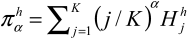
The percentage contribution of Indian state h to overall ignorance in the country is represented by the ratio 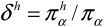 .
If δh is deflated by population share sh of state h, i.e. define ηh=δh/sh, then ηh>1 suggests that state h is more ignorant or knowledge-deprived on HIV than the region/country as whole, and less deprived if ηh<1. Note that, in the context of this study, h can also refer to the members of the scheduled classes/tribes (SC/ST), so that ηh will be used as a convenient measure to assess if the SC/ST members are more ignorant or less ignorant on HIV/AIDS than the others.
Similar to the axiomatic properties described for the ignorance measure Iα, given by eqn (2), the following principal properties are satisfied by πα, given by eqn (6).
1. Anonymity: the wording of the question does not affect the ignorance measure.
2. Ceteris paribus, if the range of knowledge deprivation, i.e. the number of questions increases, then the measure will register an increase.
3. Ceteris paribus, if a household i gives an incorrect answer to one more question but household j gives a correct answer to one more question and household i is ignorant on more questions than household j, then the measure will register an increase in ignorance. This property will hold if α>1 and is analogous to the Pigou-Dalton transfer principle in the context of income transfer.
4. The ignorance measure is additively decomposable in the population subgroups, i.e. can be written as a population share weighted average of the subgroup ignorance measures. This property is satisfied if α≥0, and is particularly convenient in the context of the present study.
Data and Methods
The National Family and Health Survey (NFHS), on which this study is based, is a large-scale, multi-round survey conducted on a representative sample of households throughout India (see the website, www.nfhsindia.org, for further details). The First National Family Health Survey (NFHS-1) was conducted in 1992–93 in a limited number of states in India. The survey collected extensive information on population, health and nutrition, with an emphasis on women and young children. The Second National Family Health Survey (NFHS-2) was conducted in 1998–99 in all 26 states of India with added features on the quality of health and family planning services, domestic violence, reproductive health, anaemia, the nutrition of women and the status of women. The Third National Family Health Survey (NFHS-3) was carried out in 2005–2006. All the three NFHS rounds provided information on the respondents' awareness of HIV/AIDS (yes/no). Respondents who showed awareness were asked questions on various aspects of the disease. The present study considers NFHS-1 and NFHS-3. These two surveys span a time interval (1992/93–2005/06) that includes the period of economic reforms in India and beyond. The coverage of states is larger in the case of NFHS-3, which includes all the constituent states of the Indian union, unlike NFHS-1, which considered only six states, namely, Assam, Gujarat, Maharashtra, Punjab/Delhi, Tamil Nadu and West Bengal. While NFHS-1 asked a set of seven questions on knowledge and awareness of HIV/AIDS, this was extended to nine questions in NFHS-3. Also, while NFHS-1 interviewed ever-married women of reproductive age only, NFHS-3 interviewed both men and women thus allowing an examination of the gender effect on the responses. The NFHS-3 also contained information on variables that measure women's autonomy that NFHS-1 did not. These include qualitative information on the female's say in household's spending decisions, especially large and daily household purchases, her own health, etc. A more complete listing of the variables on female say is contained in Ray & Sinha (Reference Ray and Sinha2010, Appendix A1). This study exploits this information in NFHS-3 and provides evidence on the effect of women's say in household decision-making on the probability of her awareness of the disease and of her knowledge base on HIV, along with that of her partner. This enquiry is in line with the recent evidence in the economics literature that suggests that household behaviour is affected by shifts in the balance of power in intra-household decision-making (see, for example, Basu, Reference Basu2006; Lancaster et al., Reference Lancaster, Maitra and Ray2006).
The study is based on the unit record information on HIV/AIDS awareness and knowledge in the NFHS-1 and NFHS-3 conducted in India. These surveys contain information, at the level of the individual, on her/his responses to each question on HIV/AIDS, along with a host of demographic and health information on that individual's age, gender, state of literacy, state of residence, anaemic status, BMI, etc. The questions asked were:
1. Can one avoid HIV/AIDS by having no sex?
2. Can one avoid HIV/AIDS by using condoms?
3. Can one avoid HIV/AIDS by having only one sex partner?
4. Can one avoid HIV/AIDS by avoiding mosquito bites?
5. Can one get HIV/AIDS by sharing food utensils with an HIV-infected person?
6. Can a healthy-looking person have HIV/AIDS?
7. Can HIV/AIDS be transmitted from mother to child during pregnancy?
8. Should an HIV-positive person be allowed to continue teaching?
9. Should you buy vegetables from a shopkeeper who has HIV/AIDS?
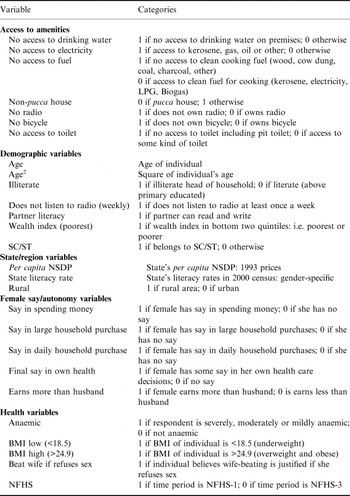
Besides information on HIV knowledge, the NFHS-1 and NFHS-3 data sets also contain information on whether the household that the individual belongs to has access to the following basic amenities: drinking water, electricity, clean fuel for cooking, pucca house, toilet facility, bicycle and radio. In addition, the data sets contain information on the education of the household head, and whether the household belongs to the poorest wealth quintile. A full listing of the variables is presented in Ray & Sinha (Reference Ray and Sinha2010, Appendix A1), but is given briefly here in Table 1.
Description of the regression variables, NFHS-1 and NFHS-2

The states included in the analysis include Andhra Pradesh, Assam, Bihar, Gujarat, Delhi, Jammu and Kashmir, Karnataka, Kerala, Madhya Pradesh, Maharashtra, Orissa, Rajasthan, Tamil Nadu, Uttar Pradesh and West Bengal.
The study is performed in two stages. The first stage measures and compares the rates of awareness and knowledge deprivation of HIV between NFHS-1 and NFHS-3 and reports their estimation on a variety of individual-, household- and state-level characteristics. The second stage uses the additional information in NFHS-3 in the estimation, paying particular attention to the effects of the intra-household decision variables on HIV awareness and knowledge. In comparing the knowledge deprivation rates between NFHS-1 and NFHS-3, the study considered the HIV knowledge questions, common to both rounds, to ensure comparability. The first seven questions were comparable across NFHS-1 and NFHS-3 and were used to construct the seven point knowledge incorrect index. The two remaining questions were exclusive to NFHS-3 and, along with the above seven questions, provide the basis for further calculations of knowledge deprivation using only the NFHS-3 data on HIV. State-level information on macro-variables such as the per capita net domestic product, the literacy rate of the respondent's state of residence and the state's proportion of backward classes (SC/ST) was obtained from the national accounts statistics.
The central motivation of this study rests on the assumed importance of awareness and knowledge of HIV/AIDS in avoiding the spread of the disease. In the words of Tang et al. (Reference Tang, Petrie and Prasada Rao2009), ‘Some current unavoidable deaths from AIDS would have been avoided if greater efforts were put onto sex education campaigns years ago to reduce the HIV infection rate,’ (p. S69). Table 2, which uses the information from the NFHS-3 on the respondent's use of safe sex practices, provides strong empirical support for this importance. This table presents the correlation estimates between lack of knowledge and risk, based on the NFHS-3 data, disaggregated by gender and distinguished between high and low HIV/AIDS prevalence states. While the former is measured by a binary variable that takes the value 1 if the individual answers more than three out of the nine questions on HIV/AIDS incorrectly, and 0 otherwise, the latter is measured by another binary variable that takes the value 1 if the respondent doesn't use a condom and 0 otherwise. The correlation estimates between these qualitative variables are statistically significant everywhere at 5% level of significance, implying a strong positive association between an individual's ignorance of HIV/AIDS and her/his non-adoption of safe sex practices. This result draws attention to the need to target information campaigns at the role played by the adoption of safe sex practices such as condom usage in preventing HIV/AIDS. As the evidence of Basu et al. (Reference Basu, Jana, Rotheram-Borus, Swendenman, Lee, Newman and Weiss2004), based on two small urban communities in north-eastern India, shows, there is much scope for effective community-level intervention in increasing condom use and maintaining low HIV prevalence among sex workers. The disaggregated estimates of Table 2 also show that this association is stronger for females than for males and, likewise, stronger in the low-prevalence than in the high-prevalence states. The interaction of gender with the incidence of HIV/AIDS in the individual's state of residence is also evident from this table. Females in low-incidence states are particularly vulnerable. The policy message is clear: information campaigns on the adoption of safe sex practices should be directed at females, especially in the low-prevalence states. The NFHS-3 data also contained information on the HIV status of the respondents. The study found that HIV-infected individuals are much less well informed about HIV than HIV-negative individuals. This highlights the policy importance of the magnitude and determinants of AIDS/HIV knowledge and awareness in India.

a Incorrect HIV/AIDS knowledge is a binary variable where it is 1 if incorrect knowledge index is greater than 3 (i.e. more than three questions out of nine were answered incorrectly by the individual) and 0 if incorrect knowledge index is less than or equal to 3.
b Risky sexual behaviour is represented by a binary variable that takes the value 1 if a condom was not used by the individual at last sex and 0 otherwise.
c The high-prevalence states are: Andhra Pradesh, Karnataka, Maharashtra, Manipur and Tamil Nadu; the rest are low-prevalence states.
* Significant at 5% level.
Results
Estimates of unawareness rates and knowledge deprivation of HIV/AIDS
Space considerations prevent all the data from being reported here, but they can be found in Ray & Sinha (Reference Ray and Sinha2010). The following summary features of the evidence on HIV/AIDS unawareness and knowledge, based on the six states surveyed in both NFHS-1 and NFHS-3 and the first seven questions listed above, are worth noting from Ray & Sinha (Reference Ray and Sinha2010):
(a) Incorrect answers to the first three questions constitute over 50% of the explanation of knowledge deprivation and this share increases to over 80% as the value of α is increased. This is generally true of both sectors and for both NFHS rounds. This suggests that steps to increase knowledge awareness of HIV should target the dissemination of the correct answer to the questions on the practice of safe sex methods. It underlines the significance of the result, reported in Table 2, that lack of knowledge of the disease increases the individual's risk of exposure by her/his non-adoption of safe sex practices such as condom use. It is interesting to note the rural/urban difference, with the rural areas reporting the question on condom use as the prime contributor, while the urban areas find that incorrect answer to the question on multiple partners is the prime contributor to overall knowledge deprivation. Lack of knowledge on the last question, namely on the mother-to-daughter transmission, matters relatively little in the total picture on knowledge deprivation.
(b) The rural headcount rates are, with some significant exceptions, higher than the urban rates. The unawareness and deprivation rates have, generally, declined over the time period 1992/93–2005/6. The unawareness rates were unacceptably high at the start of the period, especially in rural areas, but have declined sharply thanks to an awareness-increasing drive, which has had a large impact in urban areas.
(c) The SC/ST display higher ignorance of the correct answer in the case of some questions, but not in others. However, the SC/ST report higher rates of complete unawareness of HIV than the other socioeconomic groups.
(d) There is variation between states on both unawareness and ignorance, with knowledge deprivation rates varying between questions. The states that display the highest rates of unawareness are not necessarily the ones that display the highest rates of knowledge deprivation on all the seven questions. This is a significant result since it suggests that a state or states that should be prioritized for action to promote HIV awareness need not be the same state or states that should be earmarked for action to reduce knowledge deprivation. In the latter context, the state that is to be prioritized will vary with the question that is being used for knowledge improvement.
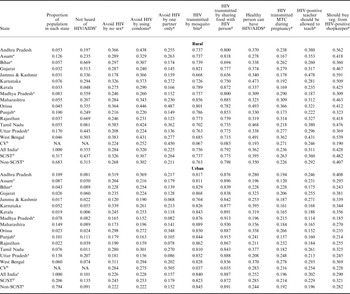
A more complete picture is presented in Table 3, which reports, for each of the fifteen states and the all-India sample, the headcount rates of HIV/AIDS unawareness and of incorrect answers to the nine questions on HIV/AIDS in NFHS-3. This table also presents the breakdown between the backward classes (SC/ST) and the others. While the overall picture does not change markedly, the additional questions asked in NFHS-3 on allowing HIV-infected individuals, especially shopkeepers, to continue with their trade, contributed significantly to overall knowledge deprivation and this reduced the contribution of the incorrect answers to the questions on safe sex. The backwardness of the SC/ST individuals in terms of their lower awareness of HIV comes out strongly in this enlarged context of all the Indian states. Almost without exception, the SC/ST group records greater headcount rates of unawareness and incorrect knowledge of various aspects of HIV/AIDS than the rest of the population. This result was also underlined by the calculations reported in Ray & Sinha (Reference Ray and Sinha2010), which showed that among those who have never heard of HIV/AIDS, the share of the SC/ST group is much larger than their share of the total population. In other words, a member of the backward classes is much less likely to have heard of the disease and is less knowledgeable of the disease than one from the non-backward classes. The divide between the SC/ST and the rest is much greater in the case of the HIV/AIDS unaware group than that with respect to incorrect answers among those who have heard of the disease. A comparison of the headcount rates of incorrect answers between the SC/ST group and the others reveals some interesting differences between questions on the magnitude of the differential in incorrect knowledge between the two socioeconomic groups. Table 3 also shows that the rural population records much higher rates of unawareness and incorrect knowledge than the urban population, and that the divide between the backward classes and the rest is much larger in the rural than in the urban areas.
Head count rates of incorrect answers to HIV/AIDS questions, by state, NFHS-3
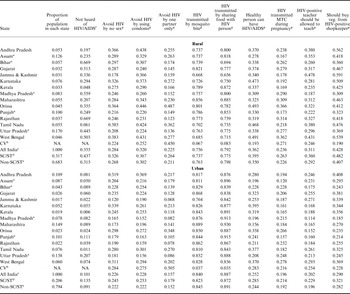
a Assam includes Manipur, Meghalaya and Tripura; Punjab includes Haryana, Himachal Pradesh and Delhi; Uttar Pradesh includes Uttranchal; Madhya Pradesh includes Chattisgarh; and Bihar includes Jharkhand.
b Coefficient of variation within states.
c ‘All India’ means only the fifteen states included in the analysis.
d SC/ST implies all the SC/ST across the 25 states.
e Non-SC/ST implies the OBC, general caste and the respondents who did not know their caste.
f ‘Not heard of HIV’ is the proportion of respondents who said ‘No’ to the question.
g Proportion of people who responded incorrectly (in terms of the HIV transmission risk by the factor).
The temporal movement in the estimates of multi-dimensional deprivation, calculated using eqn (6) on the HIV/AIDS knowledge data of the six states that feature in both the NFHS-1 and NFHS-3 and reported in Ray & Sinha (Reference Ray and Sinha2010), confirms that there has been a decline in multi-dimensional knowledge deprivation across all six states and at the ‘all India’ level. The rural indices exceed their urban counterparts in both NFHS-1 and NFHS-3. The picture with respect to the states is not always uniform between the rural and urban areas. For example, rural Assam and rural West Bengal appear more advanced than the others in their knowledge of HIV, but urban West Bengal turns out to be backward in both the NFHS rounds. The relative backwardness of the SC/ST groups in their knowledge of HIV comes out quite clearly from the estimates of multi-dimensional knowledge deprivation. The urban areas report a larger differential than the rural areas between the knowledge base of the SC/ST group and the others, though the urban differential narrowed sharply over this period.
These results on multi-dimensional knowledge deprivation relate to the six states that are common in both NFHS data sets where HIV knowledge-related questions were asked.
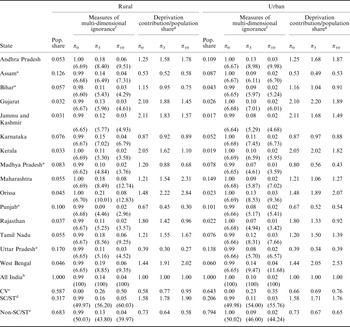
Table 4 reports the estimates of multi-dimensional knowledge deprivation of HIV/AIDS in NFHS-3 for all fifteen states. The backwardness of the SC/ST groups on HIV awareness and knowledge is again evident. Consistent with the estimates presented in Table 3, the rural rates exceed the urban rates, confirming the lack of awareness and knowledge of the disease in the rural population compared with the urban population. The deprivation indices of the various states are fairly close to one another at α=0, but divergences open up at higher α values. This is confirmed by the reported increase in the coefficient of variation between states of the πα values with α. If the interpretation of α is recalled, this result suggests that the states do vary widely on the knowledge measure if individuals who lack the correct knowledge on more and more questions are focused on. There seems to be no strong negative association between state-level economic affluence and knowledge deprivation, with some of the economically more advanced states recording higher rates of knowledge deprivation on HIV than the poorer states.
Multi-dimensional ignorance of HIV/AIDS in NFHS-3 (nine-point knowledge index), rural and urban
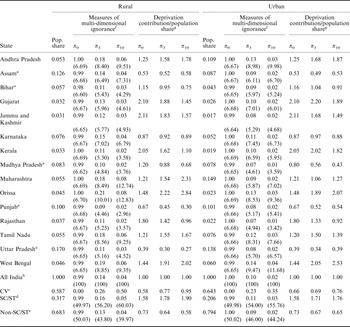
a Assam includes Manipur, Meghalaya and Tripura; Punjab include Haryana, Himachal Pradesh and Delhi; Uttar Pradesh includes Uttaranchal; Madhya Pradesh includes Chattisgarh; and Bihar includes Jharkhand.
b ‘All India’ means only the fifteen states included in the analysis.
c Coefficient of variation within states.
d SC/ST includes all the SC/ST across the 25 states.
e Non-SC/ST includes the OBC, general caste and the respondents who did not know their caste.
f Percentage contribution of each state's π to sum of fifteen states, i.e. (πi/Σπi)×100, is in parentheses.
g Percentage contribution=(πi/Σπi)/population share.
Regression estimates of the determinants of HIV unawareness and knowledge deprivation
The results on the lack of any strong association on aggregate state-level data between deprivation in living standards and that in knowledge of HIV/AIDS should not be taken to deny the role of improvement in living standards in promoting HIV awareness of the individual and reducing his/her knowledge deprivation. The results at the level of individuals discussed in this sub-section are at variance with the lack of correlation at the state level reported above. The estimates of the logit regression of the HIV awareness variable (1=heard of HIV, 0=not heard) on a set of individual and state of residence characteristics using the pooled NFHS-1 and NFHS-3 data sets have been reported in Ray & Sinha (2010, Table 19). The following features are worth noting. Older women are more likely to have heard of HIV and are more knowledgeable of the disease. The positive role played by improved living standards in promoting awareness and reducing knowledge deprivation is evident from the sign and the statistical significance of the coefficient estimates of the living standards (or amenities) variables. For example, an individual who has access to electricity, fuel, radio and toilet is more likely to have heard of HIV, and be more knowledgeable of the disease. The positive role of the economic factors is seen quite clearly from the estimated coefficient of the wealth variable: women who belong to the poorer households, namely those in the first two wealth quintiles, are less likely to have heard of HIV and are less knowledgeable of this disease. Literacy matters too: women in households with an illiterate household head are less likely to have heard of HIV and are less knowledgeable of it. However, while the state's literacy rate has little effect on HIV awareness, it does help to increase knowledge of HIV. The regression estimates confirm the backwardness of the SC/ST women in terms of both their awareness and knowledge of HIV/AIDS. The time coefficient confirms the decline in awareness and improvement in knowledge of the disease in India in the period between the NFHS-1 and NFHS-3 data sets, which spans the reforms and the immediate post-reforms time periods.
Gender, women's say in household decisions and awareness/knowledge of HIV
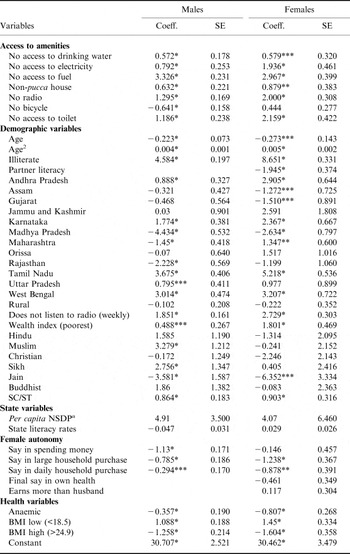
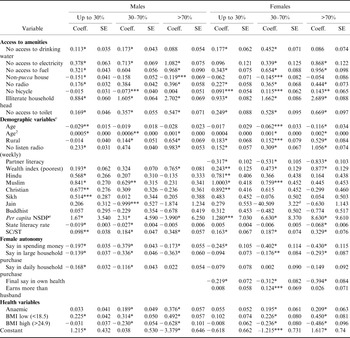
The NFHS-3 data allowed an examination of the effect of gender, and of the female's say in household decision-making, on her and her partner's HIV awareness and knowledge by providing information on men and women separately and additional information on female's autonomy and empowerment. The evidence is presented in Table 5 (awareness) and Table 6 (knowledge), respectively, with the latter measured by the fraction of the nine questions that were answered incorrectly. These tables report, respectively, the logit and OLS coefficient estimates of awareness and knowledge of HIV. Each table reports the estimates for men and women separately allowing a gender-based comparison between the coefficient estimates. The principal results from the regressions on the pooled NFHS-1 and NFHS-3 data sets, which are noted above, hold here as well. For example, lack of education of the household head and lack of access to basic amenities such as electricity and clean fuel reduce the individual's chances of hearing of HIV and, also, reduce the knowledge base of those who have heard of it. Household affluence, measured by the wealth variable, also plays a strong role in promoting HIV awareness and knowledge. The wealth effect is much stronger for females than for males.
Logistic regressions for males and females (NFHS-3), dependent variable ‘heard of HIV/AIDS’a
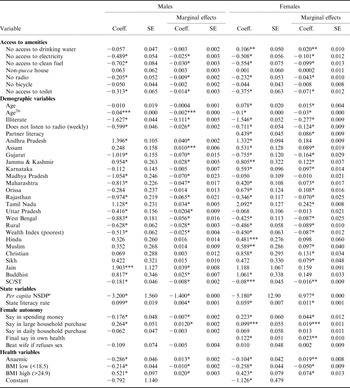
a ‘Heard of HIV/AIDS’ takes value of 1 if individual has heard of HIV/AIDS, and 0 otherwise.
b Coefficients multiplied by 102.
c Coefficient and standard deviations for per capita NSDP has been multiplied by 105 and 106 respectively.
* p<0.01; **p<0.05; ***p<0.10.
Percentage of questions incorrectly answered, OLS regression results (NFHS-3)

a Per capita NSDP for males and females multiplied by 105.
* p<0.01; **p<0.05; ***p<0.10.
The scheduled classes and tribes (SC/ST) are backward in their awareness and knowledge of HIV, and this holds true of both males and females. The residents of a highly literate state are more likely to have heard of HIV than those in a less-literate state, but this does not hold for knowledge of HIV. The positive role played by improved state literacy rates in spreading the awareness of HIV is in stark contrast to the absence of a similar association between the state's per capita net domestic product and HIV awareness. The richer states are not the ones with greater awareness or superior knowledge of HIV on the part of their residents. In other words, while improved literacy both at the individual and state levels helps in promoting HIV awareness and knowledge, in the case of wealth and affluence the effects seem to be stronger at the individual level than at the state level. Most of the qualitative results hold for both men and women, though there is some variation across gender in both size and significance. The strong regional effects, which are evident from the statistical significance of the coefficient estimates of the state dummies in both the tables, suggests that the policies need to be tailored to local realities; a universal policy for the whole country will not be effective.
Of particular interest are the estimated coefficients of the variables that measure the female's power in decision-making in a variety of areas. Females who have a greater say in the household's overall spending decisions are more likely to have heard of HIV, but their male partners are less likely to be aware of the disease. This can be attributed to the fact that such women are likely to be more exposed to outside knowledge and information than their partners. It is interesting to note that this result extends to male partners in the case of incorrect knowledge (Table 6). The sign and significance of the female autonomy coefficients provide general support for the idea that an effective way of promoting awareness of HIV and improving the knowledge of both men and women of this disease is by the empowerment of women in household decision-making. Women with greater say on their own health are more aware and more knowledgeable of HIV than those who lack that say. It is not just gender that matters but the power, or the lack of it, enjoyed by the female in decision-making. These results are consistent with the evidence of Lancaster et al. (Reference Lancaster, Maitra and Ray2006) who, building on the analytical framework of Basu (Reference Basu2006), found a strong correlation in India between educational outcomes and women's autonomy in making household decisions. There is strong evidence that health status matters too: undernourished men and women with low BMI are less aware of HIV and less knowledgeable of the disease.
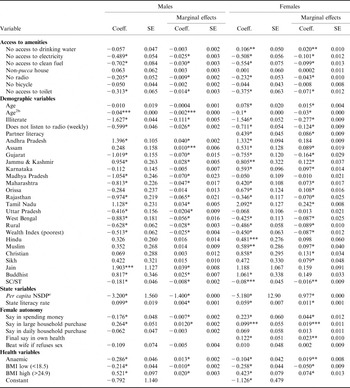
Further evidence on the role played by standard of living indicators, namely access to basic utilities, for example, radio and bicycle, and by household characteristics such as education and wealth, in promoting knowledge of HIV is presented in Table 7 in the form of multinomial logit estimates, with perfect knowledge (i.e. all questions correctly answered) treated as the default option. This table also takes advantage of the information available in NFHS-3, but not in NFHS-1, to present evidence on the role played by female's empowerment in promoting knowledge of HIV not just of themselves but also of their male partners in the household. This table follows Tables 5 and 6 in presenting the estimates by the gender of the respondent to allow a comparison between the males and females with respect to the sign and magnitude of the various effects. Though the effects often differ in size and significance between males and females, they rarely differ qualitatively in direction.

a Marginal effects available upon request.
b Levels of incorrect knowledge: 1 (up to 30% incorrect); 2 (30–70% incorrect); 3 (over 70% incorrect); 0 (no incorrect answers is base case).
c State effects not reported.
d Coefficient divided by 108.
e Coefficient and standard deviations for per capita NSDP has been multiplied by 105 and 106 respectively.
* p<0.01; **p<0.05; ***p<0.1.
Increased respondent's age tends to improve one's knowledge of HIV. The statistical significance of the age-squared coefficient suggests, however, an inverted U relationship between HIV knowledge, with very elderly individuals displaying less knowledge of the disease than the middle-aged ones. Clearly, this is one area where the policy-makers cannot rely on the intergenerational transmission of knowledge. An improvement in standard of living helps in promoting knowledge of HIV by allowing greater access to information channels such as radio and greater mobility by providing individuals with their own bicycles and cheaper modes of transport.
The multinomial logit estimates provide strong evidence on the positive role played by education in promoting knowledge of HIV/AIDS. Improved levels of literacy, whether at the level of the individual by removing her/his status as an illiterate individual or at the state level by improving the state's literacy rate, help to promote knowledge of HIV/AIDS. A result of some significance is that females living with literate partners are better informed of the disease than those whose partners have not received primary education. In other words, for females, it is not only their own education that helps but also that of their partners in making them better informed of HIV. This result is consistent with the thesis of Basu & Foster (Reference Basu and Foster1998), and extended by Subramanian (Reference Subramanian2004), which introduced the concept of ‘proximate literacy’ on the positive education externality flowing from a literate member to other members of the household. As female education has improved in India during this period, this will have been a significant contributory factor to the increased awareness and wider dissemination of knowledge of the disease.
Table 7 confirms the positive role played by female empowerment in decision-making in improving their knowledge of HIV. In fact, it helps to make their male partners better informed as well. Interestingly, a greater say by females in large household purchases has a larger effect in promoting their male partners' knowledge of HIV/AIDS than their own. Households where females have a say on spending money are much better informed on HIV/AIDS on account of both their male and female members. One of the most significant results in this context is the large positive effect that empowering women to make decisions on their own health has on making them better informed about HIV/AIDS. The present results add to the findings of Bloom & Griffiths (Reference Bloom and Griffiths2007), who found using NFHS-2 data that women's autonomy can play a positive role in promoting HIV awareness. Apart from using a more recent data set and utilizing more information on intra-household decision-making, this paper extends the Bloom & Griffiths (Reference Bloom and Griffiths2007) study by considering a wider range of dimensions on the respondents' knowledge of the disease using a multi-dimensional approach. The Indian evidence on the positive role that women's empowerment in decision-making plays in improving health outcomes is consistent with evidence for other countries (see, for example, Schuler & Hashemi (Reference Schuler and Hashemi1994)'s evidence for Bangladesh).
These results show that India has made great strides during the reforms and the immediate post-reforms period in promoting HIV awareness and making its citizens better informed on HIV. The reforms period witnessed an increase in education, household wealth and affluence, accompanied by a reduction in multi-dimensional deprivation, which was reflected in increased access to basic amenities such as electricity and information sources such as radio and television. There was also an increase in women's empowerment, as reflected in the greater female say in household decision-making and in matters relating to her health.
Conclusion
While there is evidence of increasing awareness and improvement in our knowledge base of HIV/AIDS, they are still at alarmingly low levels. This is particularly so in India, which is one of the most ill informed countries on this disease, especially among rural Indian women. Notwithstanding the success of antiretroviral therapy in driving a decline in HIV/AIDS-related mortality, the lack of awareness and knowledge of the disease poses serious risks that require policy action. With an AIDS figure for India that is the third largest in the world, success in reducing the threat posed by HIV in India has huge global ramifications. This paper rests on the view that the best way to fight the disease is to take steps to avoid it. The best way of achieving that is to make people aware of the disease and help them acquire sound information on ways of avoiding it. This study presents evidence that underlines this importance by finding that HIV/AIDS-infected individuals have a lower understanding of this disease than those who are not infected. The study also finds that lack of knowledge of HIV/AIDS is associated with an increased risk of exposure to it because of non-adoption of safe sex practice.
This study was undertaken against this background of the importance of quantifying both the magnitude and determinants of HIV/AIDS unawareness and ignorance, drawing a distinction between the two. The contribution has been both methodological and empirical. The study shows that the multi-dimensional approach, which has been favoured recently over uni-dimensional approaches in quantifying deprivation, can also be used profitably to assess the soundness of knowledge of HIV based on the respondents' answers to questions on various aspects of the disease. As more and more questions are asked in future surveys on this and other health-related issues, the approach proposed here has the potential to be of much wider use.
The Indian evidence shows that there has been an increase in awareness and knowledge of HIV during a period that has seen significant economic gains and reduction in deprivation. The results show that the principal contributory factors have been (a) increased access to basic amenities, (b) increase in education at the individual level and in literacy rates at the state level, and (c) women's empowerment in household decision-making. It is important to note from the statistical significance of several of the coefficient estimates that the knowledge gain on HIV cannot be attributed to a single factor. The absence of a strong correlation between the state-level economic deprivation and state-level ignorance of HIV/AIDS points to the importance of not relying on economic advancement alone to promote knowledge of this deadly disease.
An advantage of the decomposable multi-dimensional deprivation measures is that it helps us identify regions, groups and aspects of the knowledge that contribute prominently to overall knowledge deprivation. The study illustrates this usefulness by finding that SC/ST individuals are less knowledgeable of this disease than others. The study also finds that failure to appreciate the importance of adopting safe sex practices is one of the principal contributors to overall knowledge deprivation, and specific information campaigns are required to target this deficiency. The usefulness of the multi-dimensional approach will encourage the collection of a more comprehensive set of information on HIV/AIDS in future family health surveys.
Acknowledgments
The research for this paper was funded by Australian Research Council Discovery Grants (DP0773489, DP0878012). Helpful advice from Ankita Mishra is gratefully acknowledged. The authors also acknowledge a set of extremely helpful remarks from an anonymous reviewer of this journal.