Introduction
The common eider, Somateria mollissima, is circumpolar in its distribution in the northern hemisphere, breeding along coastal areas after the break-up of ice, and wintering in cool boreal and sub-arctic waters where ice does not prevent access to their feeding grounds. As with most sea ducks, it is a specialized feeder, diving to consume molluscs, especially blue mussel, Mytilus edulis, crustaceans and other benthic prey (Goudie et al., Reference Goudie, Robertson, Reed, Poole and Gill2000). Since the early 1980s, population declines have been reported from several areas across their circumpolar range, with a variety of unknown causes being identified (Robertson & Gilchrist, Reference Robertson and Gilchrist1998; Suydam et al., Reference Suydam, Dickson, Fadely and Quakenbush2000; Camphuysen et al., Reference Camphuysen, Berrevoets, Cremers, Dekinga, Dekker, Ens, van der Have, Kats, Kuiken, Leopold, van der Meer and Piersma2002; Lehikoinen et al., Reference Lehikoinen, Christensen, Öst, Kilpi, Saurola and Vattulainen2008, Hario et al., Reference Hario, Mazerolle and Saurola2009), while increases have been observed in other regions (Chaulk et al., Reference Chaulk, Robertson, Collins, Montevecchi and Turner2005; Rail & Cotter, Reference Rail and Cotter2007; D'Alba et al., Reference D'Alba, Monaghan and Nager2010). Starvation, disease, parasites, heavy metals in the food chain, oil pollution, predation, hunting pressure and habitat degradation have all been suggested as possible causes for mass die-offs of this and other species of eiders (Robertson & Gilchrist, Reference Robertson and Gilchrist1998; Camphuysen et al., Reference Camphuysen, Berrevoets, Cremers, Dekinga, Dekker, Ens, van der Have, Kats, Kuiken, Leopold, van der Meer and Piersma2002; Bustnes & Galaktionov, Reference Bustnes and Galaktionov2004; Borgsteede et al., Reference Borgsteede, Okulewicz, Zoun and Okulewicz2005; Miles et al., Reference Miles, Flint, Trust, Ricca, Spring, Arrieta, Hollmen and Wilson2007; Descamps et al., Reference Descamps, Gilchrist, Bêty, Butler and Forbes2009).
The over-wintering population of common eiders in Newfoundland is estimated at about 100,000 birds (Gilliland et al., Reference Gilliland, Gilchrist, Rockwell, Robertson, Savard, Merkel and Mosbech2009). Eiders are hunted legally in an annual recreational harvest; however, an illegal harvest, such as hunting outside of the legal season or taking more numbers than permitted, persists in some areas of Newfoundland (Chardine et al., Reference Chardine, Robertson and Gilchrist2008). Oiling of common eiders and other seabirds is a chronic problem in Newfoundland (Khan & Ryan, Reference Khan and Ryan1991; Wiese & Ryan, Reference Wiese and Ryan2003), with estimates of hundreds of thousands of other marine birds in the late 1990s (Wiese & Robertson, Reference Wiese and Robertson2004). An estimated 1400 common eiders were oiled in southeastern Newfoundland during the winter (February and March) of 2005 (S.G. Gilliland, unpubl. data), after crude or refined oil or oily bilge water was discharged by one or more passing ships offshore. Some eiders ingested the oil while attempting to clean their feathers, most ceased feeding altogether, starved, died shortly afterwards and were retrieved subsequently by officials.
Diving sea ducks are hosts to variety of parasites, some of which have been associated with loss of body mass (Bishop & Threlfall, Reference Bishop and Threlfall1974; Khan & Ryan, Reference Khan and Ryan1991). At least four taxa have been identified in common eiders, including trematodes, cestodes, nematodes and acanthocephalans (Bishop & Threlfall, Reference Bishop and Threlfall1974; Bustnes & Galaktionov, Reference Bustnes and Galaktionov2004; Borgsteede et al., Reference Borgsteede, Okulewicz, Zoun and Okulewicz2005). Most of these parasites were acquired after feeding on infected molluscs and crustaceans (Liat & Pike, Reference Liat and Pike1980; Ching, Reference Ching1989). Prevalence of one of these, an acanthocephalan, Polymorphus ( = Parafilicollis) botulus, was high, varying up to 100%, and total numbers in the hundreds have been recorded previously (Bishop & Threlfall, Reference Bishop and Threlfall1974). The parasite infected several species of diving ducks and was also acquired from species of molluscs and crustaceans (Thompson, Reference Thompson1985; Ching, Reference Ching1989).
Gastrointestinal erosion commonly occurs in sea birds following ingestion of petroleum hydrocarbons (Leighton et al., Reference Leighton, Peakall and Butler1983, and references therein; Khan & Ryan, Reference Khan and Ryan1991, and references therein). A study on the effects of an oil slick on the common murre, Uria aalge, revealed lesions in the liver, erosion of the epithelium of the intestinal tract and a paucity of metazoan parasites (Khan & Ryan, Reference Khan and Ryan1991; Khan, unpubl. data). Previous observations on marine fish exposed to petroleum hydrocarbons, mimicking the action of anti-helminthic drugs, revealed that metazoan parasites were voided and the mean abundance and prevalence were significantly lower than in control or reference samples (Khan & Thulin, Reference Khan and Thulin1991). In view of these findings, the present study was conducted to ascertain the influence of crude oil on the commonly occurring metazoan parasites in the digestive tract of the common eider following exposure in the field and comparison with samples that were not contaminated with oil.
Materials and methods
Collection and examination of common eiders
Adult common eiders of both sexes, either found recently dead with a heavy coating of a tarry slick and others with similar deposits on the feathers that were unable to fly, were captured between February and April 2005 on the south-eastern shore of Newfoundland (46°36′–46°51′N, 53°29′–54°11′W), euthanized and held frozen at − 20°C. The type of oil involved is unknown as chemical analysis of the oil has not been released by the Canadian Coast Guard pending litigation. Reference samples were obtained from the same area after the wildlife enforcement officers confiscated the birds from hunters who had shot the birds illegally offshore during the same period of the year. All these birds were also held frozen. At autopsy, specimens, approximately similar numbers of the two sexes, were thawed and the digestive tracts, including the oesophagus, proventriculus, gizzard and its lining, duodenum, small and large intestine and caeca, were removed and examined (Bishop, Reference Bishop1971). This involved washing each longitudinally dissected digestive tract with running water into a sieve (~150 μm mesh), transferring the contents afterwards into Petri dishes, and examination and removal of the parasites using a binocular microscope. (10–40 × magnification). The parasites were enumerated and preserved in 70% ethanol with 5% glycerol.
Trematodes and cestodes were stained with borax carmine before mounting on glass slides, while nematodes and acanthocephalans were cleared in Rubin's fluid and mounted in Canada balsam for microscopic examination and identification, using the illustrations and stained specimens of Bishop (Reference Bishop1971) as a guide for identification. The digestive tracts of both oiled and reference eiders were fixed in 10% formalin and samples of the mid- to hind-intestine processed for histological examination following standard laboratory procedures. These sections (10 μm in thickness) were stained with haematoxylin and eosin.
Data analysis
Logarithmic transformation of the data only on commonly occurring parasites of reference eiders was performed to remove any variability. One-way analysis of variance (ANOVA) was used to compare abundance between the two groups of eiders and then followed by a post-hoc test (Scheffe's F test, P = 0.05) if the initial analysis was significant. Chi-square and Fisher's exact probability tests were used to compare prevalence between the groups. Prevalence (%) and mean abundance ( ± standard error, SE) are used as proposed by Bush et al. (Reference Bush, Lafferty, Lotz and Shostak1997).
Results
Oil-soaked dead and live common eiders were collected on sandy beaches where dark, gelatinous slicks appeared in patches and also as tarry deposits that were widely distributed on rocky outcrops of the coast. Blobs of floating slick and a sheen on the surface of the water were observed, especially at high tide. Both dead and the live eiders, unable to fly or escape from capture, were severely emaciated with little breast muscle, in contrast to the robust condition of the reference birds. All of these oiled eiders had ingested oil as they tried to clean their feathers.
Examination of the digestive tract of the two groups of eiders revealed differences. Only an oily liquid mass was observed throughout the gut of the oiled birds. In contrast, a mushy mass with bivalve shells and sand were present in the reference birds. The partially digested mushy mass was composed of remains of blue mussel, Mytilus edulis, and unidentified crustaceans. The quantity of food in the crop varied from a small amount to partially filled, but none was fully distended.
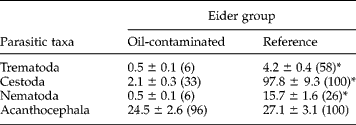
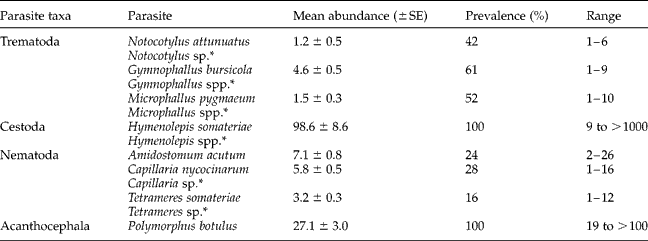
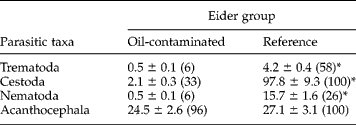
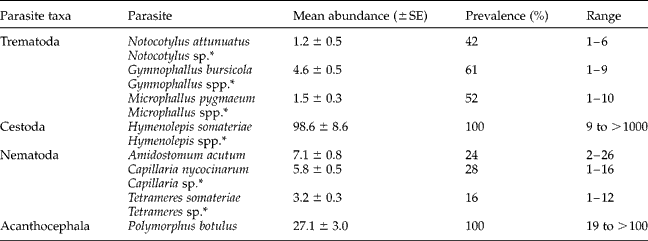
Abundance and prevalence of the total number of parasitic taxa, namely Trematoda, Cestoda and Nematoda, were significantly greater in the reference than in the oiled ducks (table 1). However, no difference was apparent in the infection with an acanthocephalan, P. botulus. The proboscis of the parasite, appearing as a nodule, was embedded in the submucosa of the posterior quarter of the small intestine of both groups of eiders. Some nodules did not have parasites attached. A total of eight genera of commonly occurring metazoan parasites was identified in the reference eiders that were free of oil. Three genera of trematodes, Notocotylus, Gymnophallus and Microphallus spp.; one cestode genus, namely Hymenolepis; three nematode genera comprising Capillaria, Amidostomum and Tetrameres; and the acanthocephalan, P. botulus, were identified (table 2). Although some specimens of the endoparasitic helminths from the reference eiders were identified, morphological characteristics of others were not sufficiently clear for species identification. These included species of the genera of the trematodes, Notocotylus, Gymnophallus and Microphallus, the cestode, Hymenolepis and the nematodes, Capillaria and Tetrameres. Polymorphus botulus and the cestode Hymenolepis spp. were more prevalent (100 and 100% respectively) than any of the trematodes or nematodes. Mean abundance of Hymenolepis spp. was by far the greatest (98.6 ± 8.6), followed by the acanthocephalan (27.1 ± 3.0) and considerably less among the other groups of parasites, including the gymnophallid trematodes (Gymnophallus and Microphallus spp.).
Mean abundance±SE and prevalence (%) of major parasitic taxa infecting the digestive tract of the common eider, S. mollissima, contaminated with (n=33) and without (reference, n=39) crude oil slick in coastal Newfoundland.
* Significantly different (P < 0.01) from the oil-contaminated group.
Abundance (mean±SE), prevalence (%) and range of commonly occurring metazoan parasites infecting the digestive tract of the common eider, S. mollissima (n=39), in coastal Newfoundland.
* Species identification unknown.
Eiders contaminated with the oil harboured fewer genera of parasitic species than the reference group and the mean abundance and prevalence of the three taxa of parasitic trematodes, cestodes and nematodes, were considerably lower. The cestode, Hymenolepis sp., was significantly different between the two groups of birds, as were the trematode and nematode groups (table 1). Only one trematode species, Gymnophallus sp., and one nematode, Amidostomum acutum, were present in the digestive tract of the oiled birds.
Discussion
Thousands of sea birds, including common eiders and common murres (Uria aalge) have died each year during winter–spring in coastal Newfoundland from crude oil, bilge water or bunker sea oil spilled accidentally or deliberately (Khan & Ryan, Reference Khan and Ryan1991). The tarry deposits caused the plumage to mat and affected insulation against subzero sea-water temperatures. The birds, unable to fly, lost condition, became emaciated and eventually succumbed, washing up on beaches. Others, on shore, became immobile and, unable to feed, died. Deterrents against discharging petroleum hydrocarbons in Canadian coastal waters over the years have proven ineffective.
The results presented here suggest that some parasites, including the cestode, Hymenolepis sp., the gymnophallid trematodes and nematodes, were voided following ingestion of the oil slick by the common eiders. It is likely that voiding was the result of contact with the oil that caused toxicity. Alternatively, the presence of pathological lesions in the intestinal wall suggested that the digestive process was interrupted, resulting in paucity of nutrients for the worms. Erosion of the intestinal wall has been observed in another sea bird after ingestion of oil droplets (Khan & Ryan, Reference Khan and Ryan1991). Previous studies have also reported that marine fish exposed to petroleum hydrocarbons tend to harbour fewer metazoan parasites in the digestive tract compared to controls or reference samples (Khan & Thulin, Reference Khan and Thulin1991). Some specimens of the acanthocephalan, P. botulus, were apparently not affected in the oiled eiders since the probosces of these parasites were firmly embedded in the intestinal wall, culminating in granuloma formations that prevented shedding after death.
Few species (eight) of the commonly occurring parasites and their abundance were recorded in oil-free eiders in the present study. In contrast, Bishop & Threlfall (Reference Bishop and Threlfall1974) noted a greater number of commonly occurring species and a substantially greater mean abundance of endoparasitic helminths in eiders sampled in Newfoundland during the 1960s from areas adjacent to that of the present study. The cestode, Hymenolepis sp., and two genera of trematodes, Microphallus and Gymnophallus spp., were more abundant and harboured a wider range in numbers, in the thousands, than in the present study. Additionally, the acanthocephalan, P. botulus, and the nematode, Fimbriarioides sp., occurred in the hundreds. Another study, conducted in the north Wadden Sea, reported a substantially greater intensity of P. botulus and Microphallus and Gymnophallus spp. than in the present study (Thieltges et al., Reference Thieltges, Hussel and Baekgaard2006). The latter study also observed a greater intensity of P. botulus and Amidostomum sp., in juveniles than in male or female adult birds, whereas this was reversed with an infection with Gymnophallus sp. While these eiders were sampled at different times of the year from various areas, these results clearly indicated that the endoparasitic helminth fauna were more diverse and abundant than in our study. The apparent decline in abundance of commonly occurring parasites and maximum numbers in a single host, noted herein, compared to others, might be related to the season of sampling, as an infection with P. botulus, and presumably all other gastrointestinal parasites, declined during winter in eiders examined from the Scottish coast (Liat & Pike, Reference Liat and Pike1980). Additionally, the potentially infected prey base and its availability probably shifted as a result of climatic changes that occurred in the north-western Atlantic during the mid-1980s and onwards (Drinkwater, Reference Drinkwater2004). Several studies have reported that a series of cascading events affected the entire marine food chain, which included sea birds (Carscadden et al., Reference Carscadden, Montevecchi, Davoren and Nakashima2002, and references therein). However, winter ice-cover is less extensive in coastal Newfoundland than in previous decades, allowing eiders a greater selection of potential foraging areas.
Declining common eider populations have been reported in Europe and populations in Newfoundland were declining in the 1970s and 1980s (Goudie et al., Reference Goudie, Robertson, Reed, Poole and Gill2000; Camphuysen et al., Reference Camphuysen, Berrevoets, Cremers, Dekinga, Dekker, Ens, van der Have, Kats, Kuiken, Leopold, van der Meer and Piersma2002; Hario et al., Reference Hario, Mazerolle and Saurola2009). While infestation by some parasites, especially P. botulus and A. acutum, are known to cause lesions that eventually can affect body condition, there is no evidence that they are involved in mass mortality or a decrease in populations of eiders (Borgsteede et al., Reference Borgsteede, Okulewicz, Zoun and Okulewicz2005; Thieltges et al., Reference Thieltges, Hussel and Baekgaard2006). Although oil spills appear to be a cause of mortality, food shortage has been associated with mass die-offs and population declines (Robertson & Gilchrist, Reference Robertson and Gilchrist1998; Camphuysen et al., Reference Camphuysen, Berrevoets, Cremers, Dekinga, Dekker, Ens, van der Have, Kats, Kuiken, Leopold, van der Meer and Piersma2002). One of these declines was caused by a decrease of blue mussel and cockle (Spisula) stocks in the Wadden Sea area after heavy fishing and, eventually, this culminated in starvation and death (Camphuysen et al., Reference Camphuysen, Berrevoets, Cremers, Dekinga, Dekker, Ens, van der Have, Kats, Kuiken, Leopold, van der Meer and Piersma2002). Specific to Newfoundland, hunting has been a major factor in population trends, but with changing climate, and its impact on the prey base and availability of prey due to less ice cover, the role of food and associated parasites may play a larger role in the dynamics of common eider populations. These variables will need to be considered in future studies (Gilliland & Robertson, Reference Gilliland and Robertson2009; Gilliland et al., Reference Gilliland, Gilchrist, Rockwell, Robertson, Savard, Merkel and Mosbech2009). Additionally, it is suggested that the endoparasitic helminths be removed prior to freezing of the carcasses of eiders and fixed in an alcohol–formalin–acetic acid mixture to ensure that important morphological characteristics be preserved for species identification after staining.
Acknowledgements
This study was supported by funding from the Natural Sciences and Engineering Council of Canada to R.A.K. Environment Canada, Canadian Coast Guard (Department of Fisheries and Oceans) and Parks and Natural Areas Division, Government of Newfoundland and Labrador, retrieved the birds used in this study. The authors are also grateful to the referees for their suggestions in revising the manuscript.