INTRODUCTION
There are approximately 47 million small ruminants in Ethiopia, of which half are sheep (Ovis aries) and the other half goats (Capra hircus) (CACC, 2004). Sheep and goats are an integral part of mixed-farming systems in most parts of the country. These systems, particularly those in the highland areas, are under threat because of shrinking cultivated areas per household, reduced feed availability and land degradation, which are making it difficult to sustain large ruminants (Aune et al., Reference Aune, Bussa, Asfaw and Ayele2001). This situation increases the contribution that can be made by small ruminants owing to their higher resource efficiency compared to cattle under severe restriction of resources. Results of a recent study in the southern highlands showed that cattle experienced greater mortality than small ruminants during the seasons of feed scarcity (Desta and Oba, Reference Desta and Oba2004), indicating further comparative advantages of small ruminants due to their adaptability to harsh environments. The growing demand for sheep and goats in both domestic and export markets has also been reported (Kocho, Reference Kocho2007). In particular, the demand for young males at export abattoirs has been increasing in recent years. According to Kocho (Reference Kocho2007), small ruminant keepers are aware of the current high market values and demand for small ruminants, and some of them are trying to make use of this opportunity through altered management practices, such as fattening.
Until recently, small ruminants received little institutional support or attention from researchers in Ethiopia. In most cases, research on small ruminants has been done on-station and consisted mainly of nutritional or epidemiological studies. Research on small ruminants geared towards production systems is lacking, particularly in southern Ethiopia. The few small ruminant development programmes undertaken so far have been for the most part unsuccessful or unsustainable. One of the main reasons for the failures of these programmes appears to be the lack of focus on the actual production objectives of the farmers to whom new technologies were promoted (Ayalew et al., Reference Ayalew, Rischkowsky, King and Bruns2003).
A key feature of small ruminants in Ethiopia is that they fulfil multiple roles, ranging from socio-cultural purposes to providing meat, milk and manure. The general reasons for keeping small ruminants, however, can vary from area to area and are primarily determined by economic, cultural and ecological factors. Household resources such as farm size, livestock number and household size are expected to affect the livelihood strategies that include decisions on keeping livestock for a particular purpose. On the other hand, roles and functions change as availability of resources changes continuously. Describing and comparing the existing small ruminant production systems and analysing their critical production constraints are important tools for diagnosing the status of and trends in these systems in order to develop management practices that will result in positive changes (Ehui et al., Reference Ehui, Ahmed, Gebremedhin, Benin, Nin Pratt and Lapar2003; Udo and Cornelissen, Reference Udo and Cornelissen1998).
This study therefore aimed to explore the reasons why farmers in mixed-farming systems of southern Ethiopia keep small ruminants and to evaluate the existing status of and prospects for improvement of this sector.
MATERIALS AND METHODS
Study area
The study was carried out in two mixed-farming areas of southern Ethiopia, namely Adilo and Kofele. Adilo, which is situated around the border of Badawacho and Kedida Gamela districts, represents the most densely populated areas in Ethiopia with more than 500 people km−2 while the country average is less than 70 (CSA, 2005). Kofele represents an area of the southern highlands populated at medium level (212 people km−2), and the farmers keep more livestock than their counterparts in Adilo. Both areas are prominent suppliers of small ruminants to the neighbouring big cities (e.g. Shashemene, Awassa) and Addis Ababa, particularly during holidays. Production is increasingly directed towards these growing markets. Besides small ruminants, farmers often keep cattle (Bos indicus) and chicken (Gallus gallus domesticus) and grow crops like enset (Ensete ventricosum), maize (Zea mays) and potato (Solanum tuberosum). Enset (commonly known as ‘false banana’) is one of the major food crops in Ethiopia particularly in the densely populated south and southwestern parts. The root is the main edible portion of the plant.
The annual rainfall distribution at both study sites has a bimodal pattern. During the four years from 2000 to 2003 annual rainfall ranged between 1055 and 1194 mm at the two meteorological sites in Adilo (Shone and Durame), and was about 1200 mm in Kofele (NMSA, 2004). Kofele is a typical highland area with a relatively cool climate, food sufficiency and fairly high agricultural potential in terms of land availability and soil fertility. The altitude of the district ranges from 2000 to 3050 m asl, and the mean monthly minimum and maximum temperatures for the years 2000 to 2003 were 7.5 and 19.6 °C, respectively (NMSA, 2004). Adilo is a mid-altitude area characterized by land scarcity and food deficiency. The altitude of most of the villages around Adilo is between 1600 and 2000 m asl.
Sampling and data collection
The sampling procedure started with the identification of the supplier villages in the two small ruminant market sheds, namely at Adilo and Kofele. A small ruminant market shed is defined as the area where livestock keepers are located who supply live sheep and goats to a given market centre. Identification was undertaken in close consultation with the livestock experts of the bureau of agriculture in the respective areas. Among those villages situated in the small ruminant market shed, those found to be major suppliers and located in relative proximity to the centre of the main market were considered for further sampling, and 10 were purposively selected from each study site. Supplier villages were designated in terms of the kebele (previously called ‘Peasant Association’). The kebele is the lowest administrative unit in rural Ethiopia and normally consists of a small number of villages and hundreds or thousands of households. The final sampling framework was composed of households that had at least five small ruminants, had a minimum of one year's experience in small ruminant husbandry and were willing to participate. From the list of households that fulfilled the criteria at each kebele, on average 20 households were selected using random numbers, which represented around 10% of the sampled population. A structured questionnaire was used to collect information on demographic characteristics of the households, crop–livestock farming systems, reasons for keeping sheep and goats, husbandry practices and other socio-economic aspects of sheep and goats. The questionnaire consisted of open-ended, closed-ended and scaled-responses. The interviews were conducted between April and July 2004. A total of 399 households (200 in Kofele, and 199 in Adilo) were interviewed. Group discussions were held with 7–12 key informants once in each study area in order to gain a greater insight in to the topics covered during the structured interviews and to check whether patterns found in the households were validated by the focus group.
Data analysis
Descriptive statistics were used to characterize households and selected husbandry practices. To evaluate the effects of age of the head of the household, the literacy of the household head, family size, farm size and livestock number in terms of Tropical Livestock Units (TLUs) on the practice of keeping small ruminants, logistic regression was employed using the PROC GENMOD of the Statistical Analysis System version 8.2 (SAS, 2001). Age of the household head was included in the model as a proxy for experience in small ruminant production and management. The literacy of the household head was considered as a binary variable, where 0 was assigned for those who could not read or write and 1 for the others. Family size which might affect the household livelihood strategy through labour supply or competition for resources was also considered. Farm size (ha) of the household was included as a measure of resource endowment. Livestock number measured in TLUs was taken as a proxy for household wealth status. The gender dummy was not included in the model since the number of female household heads in the study was very small.
The logit model is given by:

where,
p = the probability that a household keeps sheep or goats for purpose i,
β0, β1, β2, β3, β4 and β5 = regression coefficients,
a = age of the household head,
e = educational level in terms of literacy of the household head,
h = household size,
f = farm size, and
l = livestock number in terms of TLU.
The logit model was also used to examine differences in the objective of keeping small ruminants among the households in the two study areas.
An index was developed to provide an overall ranking of constraints to small ruminant production in the study areas. The index was calculated as the sum of single constraint ranks [(3 for rank 1) + (2 for rank 2) + (1 for rank 3)] divided by the sum of all weighed constraints mentioned by the respondents at each site.
RESULTS
Household characteristics
Only seven of the total 399 respondents (i.e. household heads) were females. The average age of Adilo and Kofele respondents was 40 years (range: 20–89) and 42 years (range: 18–95), respectively. Regarding religion, the majority of the sampled households in Kofele area were Muslims while the majority of the respondents in Adilo were evangelical Christians. Ninety-four percent of the respondents from Kofele were Oromos, and 96% of the Adilo respondents were from the Kembata and Hadiya ethnic groups. The family size in Kofele (mean: 9.8; range: 1–25) was higher (p < 0.001) than in Adilo (mean: 8.5; range: 1–18). Fifty-seven percent of the husbands and 27% of the wives were able to read and write.
Determinants of keeping small ruminants for a specific purpose
Out of the total respondents, 273 (44% and 93%, respectively, for Adilo and Kofele farmers) owned only sheep, 12 (6% and 0.5%) owned only goats and 114 (50% and 7%) owned both sheep and goats.
The reasons for keeping small ruminants included cash generation, meat, milk, manure and breeding (as a breeding stock). Though most households kept sheep and goats for multiple purposes, the primary purpose for keeping them at both sites was as a means of generating cash. The animals were mostly sold when cash was needed for specific purposes such as buying farm inputs and covering school expenses. Kofele key informants indicated that small ruminants were considered as the ‘hedge for cattle’ since they are the first to be sold when immediate needs for cash are encountered. Similar responses were obtained during the group discussion with Adilo farmers.
Almost all households mentioned cash generation as their foremost consideration in rearing sheep and goats. Therefore, the logistic regression is not carried out for cash since parameters may not be satisfactorily estimated as a result of very low variation among various groups.
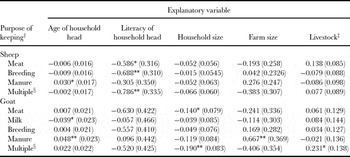
In Adilo area, older households were more likely (p < 0.1) to rear sheep for manure than their younger counterparts (Table 1). Older households and those households with larger farms showed a significantly higher inclination (p < 0.05) to keep goats for manure. The impact of family size was negative and significant (p < 0.05) for keeping goats for more than three objectives. Households with larger families tended to be less likely (p < 0.1) to keep goats for household meat consumption while older households tended to be less likely (p < 0.1) to keep goats for milk.
Coefficients (standard errors) of logistic regressions for the objectives of keeping sheep and goats in Adilo area.

*, **, ***Mean coefficient statistically significant at 10%, 5% and 1% levels of probability, respectively.
†Cash generation was not considered in the analysis because of very low variation among groups.
‡Measured in Tropical Livestock Unit, TLU, (0.7 TLU = 1 head of cattle; 0.5 TLU = 1 head of horse, donkey or mule; 0.1 TLU = 1 head of sheep or goat).
§Multiple represents more than three purposes of keeping small ruminants which may include purposes like: income generation, meat, milk, manure, breeding, festivities, saving, dowry and manure.
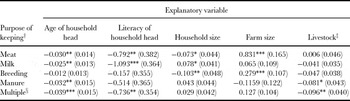
On the other hand, farm size significantly increased (p < 0.01) the odds of keeping sheep for breeding and meat production in Kofele area (Table 2). Older sheep keepers and also those with better education were less likely to keep sheep for milk, meat and multiple purposes. Those farmers who owned more livestock units had fewer objectives for rearing small ruminants. Households with larger families showed a higher tendency (p < 0.1) to rear sheep for home milk consumption and a lesser tendency to keep them for breeding and meat consumption. Households owning more livestock units showed a lower (p < 0.1) inclination to keep sheep for manure. Unlike the case in Adilo, older farmers were less likely to keep sheep for manure in Kofele.
Coefficients (standard errors) of logistic regressions for the objectives of keeping sheep in Kofele area.

*, **, ***Mean coefficient statistically significant at 10%, 5% and 1% levels of probability respectively.
†Cash generation was not considered in the analysis because of very low variation among groups.
‡Measured in Tropical Livestock Unit, TLU, (0.7 TLU = 1 head of cattle; 0.5 TLU = 1 head of horse, donkey or mule; 0.1 TLU = 1 head of sheep or goat).
§Multiple represents more than three purposes of keeping sheep which may include purposes like: income generation, meat, milk, manure, breeding, festivities, saving, dowry and manure.
The results revealed that literate farmers tended to restrict themselves to fewer objectives for rearing small ruminants, and their primary reason is income generation (Tables 1 and 2).
There were differences in the objectives for keeping the dominant small ruminant species, sheep, between households at the two study sites. Sheep keepers in Kofele gave significantly greater consideration to meat and milk production (p < 0.001) than those in Adilo. However, about one-third of the sheep keepers at both sites reported keeping their animals for more than three objectives.
Following the overriding objective of income generation for the household, keeping small ruminants for meat production (i.e. for household meat consumption) was found to be the second most important reason. Half of the farmers interviewed mentioned it as an objective for keeping sheep and goats. Nevertheless, most households reported that they consume meat only on a few days in a year. Almost all households in Adilo and the majority of the households in Kofele reported the consumption of meat only during holidays.
Milk was also reported to be one of the major purposes for the goat owners in both sites and for sheep owners in Kofele. According to key informants, the Adilo community believes that goat milk is nutritious and has medicinal value. It is given to small children, the elderly and the sick. Particularly when the small children get emaciated, the provision of goat's milk (mainly colostrum) is said to trigger faster growth. According to key informants, goat's milk could also be provided to calves with the intention of encouraging better growth, resistance to certain diseases and as an alternative milk source when cows do not produce enough milk. Sheep's milk is not utilized for human consumption in Adilo.
Two-thirds of the respondents in Kofele reported that they keep sheep for milk production. The consumption of sheep's milk is very familiar in Kofele. The practice of consuming sheep's milk has existed around Kofele for a long period and its taste is said to be very much appreciated in the district. The key informants said that the addition of a small amount of sheep's milk is sufficient to whiten their coffee as sheep's milk is thicker than both cow's and goat's milk.
Competition and complementarities: land use and feeding
In both sites, small ruminants compete with crops for land use during the wet season. Herded grazing is the most common practice in the study area, followed by unherded (particularly in the dry season) and tethered (particularly in the wet season). Management techniques such as tethering, herding and overnight enclosure have been widely practiced in both sites in order to keep small ruminants out of the fields during the crop growing season. However, the intensity of the management system was found to be higher in Adilo area. Sixty-seven percent of the households in Adilo indicated that they usually tether their small ruminants particularly during the cropping season. In addition, about 30% of the respondents in Adilo reported that they employed zero-grazing while this practice was not reported in Kofele. Conflicts with adjacent farm owners as a result of crop damage were also reported during the cropping season, particularly for goats.
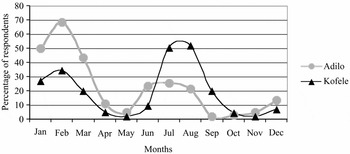
The respondents were asked in which months they encountered shortages of feed for their small ruminants. Figure 1 shows the monthly distribution of feed shortage for small ruminants in the two study areas. The major rainy season, which lies between June and August, is the period in which half of the farmers in Kofele reported feed shortages for their sheep and goats. On the other hand, 70% of the farmers in Adilo experienced feed shortages for their small ruminants in the middle of the dry season.
Annual pattern of feed shortage, by study area.

In both sites, small ruminants seem to be dependant on crop residues mainly in the dry season during which the biomass of the natural grazing lands is very low; the continuing reduction of the grazing area over the years as a result of the increasing cropping area was also mentioned as a contributory factor. Having a very limited farm size in Adilo area, 83% of the sheep keepers mentioned crop residues (e.g. crop aftermath, cereal straw, maize stalks) as a major feed resource during the dry season. This figure is even greater than the proportion of sheep keepers (61%) that reported natural grazing land as a major feed resource for their sheep.
Since grazing alone could not meet the nutrient requirements of their animals, almost all respondents in Adilo (100%) and Kofele (97%) mentioned the supplementation of at least a part of their flock during the dry season. The proportions of the respondents that practice wet season supplementation were 94% for Adilo and 82% for Kofele. In general, roughage supplementation is higher during the dry than the wet season. In contrast, mineral (mainly table salt) supplementation is more frequent during the wet season than the dry season. Adult male small ruminants tended to be the most frequently supplemented animals at both sites. The reason is the higher demand for these animals in the prevailing markets compared to animals in other age and sex categories. Though there is a slight indication of its emergence, small ruminant fattening is not a common practice in Kofele. On the other hand, 93% of the respondents from Adilo reported that they fatten their animals for sale. But, there are variations in the duration of the fattening period and in the type of feeds utilized for fattening. The principal feedstuffs used for sheep fattening are farm-produced sweet potato and maize. The utilization of brewery and distillery by-products was also reported by 88% of the farmers in Adilo. One-third of the respondents reported that they were using industrial by-products such as wheat bran and oilseed cake to a limited extent. The traditional fattening might last from a few months up to two or three years. The group discussion participants were asked whether the prolonged fattening was economical. They unanimously indicated that the prolonged fattening was mainly carried out in order to take advantage of their animals as a live bank. If the animal was sold when they do not need the cash immediately, it might lead to unreasonable expenditure. Yet they mentioned that the intensive fattening process had been undertaken for two to three months before the intended marketing time.
Informal insurance and sharing arrangements
A local insurance arrangement has evolved in the Adilo area. Some of the sheep farmers, especially those fattening a large number of animals on a regular basis, initiated the insurance system some years ago. It is usually practiced among the sheep fatteners within the same community. The scheme has a chairman and a secretary. When one of the fattening animals of a member is sick, the cause is closely followed by the members summoned by the chairman for that specific incident. If upon the investigation, the cause of sickness is found to be a nutritional disorder (e.g. bloat), and declared to be safe for human consumption the members divide meat among themselves provided that the sick animal was slaughtered before its last breath. If the cause of sickness and death is assumed to be other than a nutritional disorder, the animal is declared unsafe and is therefore discarded. Either way, members pay the owner some money and in such systems approximately three-quarters of the estimated price of the animal can be recovered. This kind of informal insurance arrangement has been established in the communities for a number of years among cattle raisers. Kofele key informants also reported the existence of similar arrangements for cattle, but not for small ruminants.
According to the key informants in the Adilo area, most farmers keep only one or two breeding females. However, sharing arrangements involving small ruminants are common among households. In addition to advantages in tackling the shortage of feed and problems related to labour scarcity, these arrangements are also recognized as mechanisms for helping poor people for the common benefit, by giving them a female animal on loan for a certain period of time. Though there are various forms of such kinds of exchange, the commonest one is a sharing arrangement for small ruminants by which the owner leases the breeding female that remains the property of the owner, and the offspring are shared equally. If a purchased animal is given to the raiser particularly for fattening, the owner will have the initial price of the animal along with half of the profit obtained in the final sale.
Production problems
The farmers interviewed were asked to rank problems related to small ruminant production in their respective area.
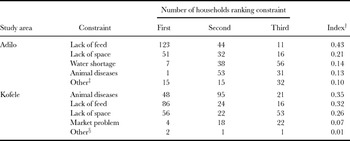
Shortage of feed, which is directly related to decreasing farm size, was ranked as the number one constraint by the respondents from Adilo (Table 3). Lack of space (i.e. shortage of space for small ruminant husbandry) and water shortages were the second and third ranked constraints. Animal diseases, lack of feed and lack of space were the constraints in order of their seriousness in Kofele area.
Constraints for small ruminant production reported and ranked by owners, by study area.

†Index = sum of single constraint ranks[(3 for rank 1) + (2 for rank 2) + (1 for rank 3)] divided by sum of all weighed constraints mentioned by the respondents in each site.
‡Includes market problem, lack of money and predators.
§Includes water shortage and predators.
DISCUSSION
Reasons for keeping small ruminants
The primary reason for keeping sheep and goats is to generate cash income for the households through the sale of live animals. Small ruminants are considered as assets that can be converted readily into cash to meet immediate household financial obligations such as paying school fees, buying fertilizers or other agricultural inputs. Meat production for household consumption was mentioned as the second important objective of keeping small ruminants; however, the majority of households consume meat only during major holidays. This study indicates that small ruminants are becoming ‘cash animals’ in the mixed-farming systems of southern Ethiopia. An investigation carried out on the mixed-farming systems of northern Ethiopia also indicated that sheep were sold throughout the year and were becoming an important source of cash income for smallholder farmers (Dibissa, Reference Dibissa2000).
The widespread consumption of sheep's milk in Kofele indicates the variation in local tastes and preferences in the mixed-farming systems of Ethiopia, reflecting social history and culture. Sheep's milk consumption is rarely reported in sub-Saharan Africa (Josserand and Ariza-Nino, Reference Josserand and Ariza-Nino1982; Panin and Mahabile, Reference Panin and Mahabile1997).
In both study sites, owning large ruminants (which considerably influence the TLU value) seem to undermine the objective of rearing small ruminants for manure. Owning a large number of cattle has been an indication of wealth in the study areas, and those households who own large numbers of cattle could use the manure of their large ruminants and are also more able to purchase chemical fertilizers. In their recent publication on enset-based farming systems in southern Ethiopia, Desta and Oba (Reference Desta and Oba2004) also reported the dependence of enset farming on intensive manuring from large herds. The manure of small ruminants could play a vital role in the absence of cattle. This was particularly indicated among enset growing farmers in Kofele.
The reason for the literate household heads to concentrate only on a few purposes for keeping small ruminants is probably due to their interest in increasing their profit through the important objective of cash generation. This may indicate an increasing pattern of specialization as the literacy level of the households is increasing. Damite and Negatu (Reference Damite and Negatu2004) also reported that relatively better educated household heads in southern Ethiopia were not interested in diversification; a higher level of education might therefore inspire households to concentrate on specific objectives. The influence of the age of the household head on rearing small ruminants may be associated with experience and capital accumulation by relatively older household heads. Older household heads in Adilo revealed a higher tendency to keep sheep for manure than their younger counterparts. This may also be an indication of greater adherence to traditional practices by relatively older farmers. On the other hand, the most likely explanation for the negative effect of age on odds of keeping sheep for manure in Kofele could be that older farmers have significantly larger (p < 0.05) farm size and they may opt to apply either chemical fertilizers or manure from larger animals.
Challenges and opportunities
The critical problem identified from both individual interviews and the group discussions was feed shortage. This is aggravated by the reduced landholding (which leads to low production of crop and crop residues), reduced communal grazing areas (since most of them have been used for crop production) and the frequent droughts, particularly in Adilo. The first two factors are directly linked to increasing human population in the areas. For instance, one investigation carried out three decades ago showed that the average farm size in Kofele had been more than 7 ha, which is remarkably bigger than the average holding of the respondents in this survey (≈3 ha) and in the recent report by the regional government, i.e. less than 1.7 ha (ARDU, 1978; BPED, 2000). Diminishing landholding aggravates the competition between small ruminants and crops for land use, particularly during the cropping season. Husbandry practices such as tethering, herding and overnight enclosure have been widely practiced at both sites to keep small ruminants out of the cropped land. Similar practices were also reported in the mixed-farming systems of northern Ethiopia (Dibissa, Reference Dibissa2000). This pressure may also persuade farmers to respond by reducing the flock size of their sheep and goats. The disease problem was underlined as a major problem in Kofele where marshy areas are increasingly used for grazing as more suitable lands are gradually allocated to cropping activities.
Recognizing the socio-economic significance of sheep and goats, the households are responding by intensifying their management systems. The increasing sheep fattening practice in the Adilo area in particular is induced by compelling factors like the growing transport infrastructure and market opportunities on the one hand and increasing population density and concomitant diminishing farm size on the other. A recent study pointed out that the reduction in grazing lands in sub-Saharan Africa could increase the significance of crop residues and make the fattening practice more profitable (Tiffen, Reference Tiffen2006). According to Peden et al. (Reference Peden, Tadesse and Misra2007), the use of crop residues can boost farm incomes and enhance water productivity compared to other feed resources. However, there should be economic and environmental considerations since the improper utilization of crop residues may have a negative effect on soil productivity (Peden et al., Reference Peden, Tadesse and Misra2007). Improving the quantity and quality of food-feed crops like pigeon pea (Cajanus cajan) can benefit farmers in mixed crop–livestock systems (Lenné et al., Reference Lenné, Fernandez-Rivera and Blümmel2003). The condition of the small ruminant production system observed in Adilo could be an indication of the future course of development of systems in places like Kofele in response to similar driving forces. Diminishing land holding (grazing area) being a problem that can hardly be overcome, the screening of alternative feed resources and feeding strategies might be an option for development. This, on the other hand, needs focused research on the appraisal of both indigenous and novel feed resources and their integration into a given farming system (Nin et al., Reference Nin, Ehui, Benin, Evenson and Pingali2007). Giving better access to concentrates may also be an alternative if price relations are favourable.
Though the animals were mostly sold when cash was needed for specific purposes, peak small ruminant markets were during holidays (particularly around Easter and the Ethiopian New Year, which is mostly celebrated on September 11). This is in agreement with the reported high demand for small ruminants in the urban areas during the same period (Ehui et al., Reference Ehui, Benin and Gebreselassie2000; Taye and Abebe, Reference Taye and Abebe2000). The selling price of small ruminants is relatively high around these holidays (Taye and Abebe, Reference Taye and Abebe2000). These markets seem very important since most of the major holidays of the Ethiopian Christian and Muslim populations occur around this period and the income obtained from the sales could be used to cover the expenses for the festivals. In addition, these markets take place when the farmers need money to purchase agricultural inputs for the rainy season (June to August) and to cover school-related expenses in the new academic year, which starts shortly after the Ethiopian New Year.
Tiffen (Reference Tiffen2006) indicated that the rising urban population is increasing demand for livestock products and that this is an important driving force in East African livestock systems with concurrent changes in feeding systems and the role of grazing, fodder and penning. The growth rate of the urban population in Ethiopia is one of the highest in the world (UN, 1999). Correspondingly, the demand for small ruminants in urban areas of Ethiopia is predicted to step up with the escalating population, which would provide a good opportunity for small ruminant keepers in the mixed-farming systems of Ethiopia (Ehui et al., Reference Ehui, Benin and Gebreselassie2000).
Ethiopian rural society has many important traditional and indigenous institutions that can be strengthened and transformed to take part in various development activities (Dejene, Reference Dejene2003). The informal insurance scheme and the existing sharing arrangements among the sheep fatteners of the Adilo area can, therefore, be considered as an entry point for future interventions and should receive special attention in future research. Furthermore, where the frequency of droughts and other natural calamities has been increasing, such insurance schemes can be considered as positive initiatives in terms of managing risk and vulnerability.
Using group discussions with the purpose of verifying issues identified in the survey was valuable. The discussion also helped to illuminate points which might have been overlooked through a questionnaire. On the other hand, it was noticed that care should be taken so that some individuals, particularly the oldest, do not dominate the discussions. In a society that gives much value to eldership, it is important to make sure younger members can express their views. The same argument holds true to encourage the participation of women in the group. If such precautions are taken, reliable information can be extracted.
Thorough monitoring of the productive and economic performance of small ruminants and their existing level of integration with crop production and other livestock keeping is required to capture a full picture of their contribution thereby verifying possible intervention areas. The responses to the questions raised during the survey largely relied on recall by the respondents. Repeated visits, direct observation and measurements over a realistic period are needed to estimate productive parameters and to track recurrent events.
Acknowledgements
The willingness of the farmers in the study area to participate in the investigation is gratefully acknowledged. We would also like to thank the University of Hawassa – NORAD (Norwegian Agency for Development Cooperation) project and DAAD (German Academic Exchange Service) for their generous support during the study period. Thanks also to two anonymous reviewers for their helpful comments.