INTRODUCTION
Tremendous variation exists in the burial rites observed in excavated graves in Roman Britain. The choice of cremation or inhumation was simply the first step, to be followed by the finer details of its execution, and the selection and deposition of grave goods, if any. In a cemetery used over a very long period, broad changes in the rite can be observed over time, for example, a decline in the use of grave goods and an increased use of inhumation in the late Roman period. However, the observable differences in a single cemetery used for perhaps only 75–100 years tend to be concentrated in the choice of grave goods and this can be attributed to the result of the wealth and status of the deceased and to other physical and cultural considerations, such as gender, age, and the religious or superstitious beliefs of the mourners. Just as differences exist between individual graves within one cemetery, so close similarities in the choice of grave goods exist between individual graves in different cemeteries, and it can be assumed that the same social considerations apply for each of these burials. Often the similarity is simple and widespread, such as the deposition of a single pot or a single coin, but it can be much more complex, and the selection of the same range of artefacts for individuals of much the same age implies that a very specific set of conditions dictated the choice of grave goods.
A distinctive group of infant burials from eastern Roman Britain containing one or more jet bear figurines, together with one or more coins and one or more ceramic beakers, provided the initial inspiration for this paper, but it soon became apparent that the choice of each coin was as important as the choice of figurine. Increasing the dataset to include other child graves with coins demonstrated that the reverse image could play a major part in selection.
Coin reverse types are rarely considered in any discussion of grave goods, even though figurative art was widely used in the expression of Romano-British religious belief and any image found in a funerary context should ideally be considered in much the same way as an ex voto found at a sanctuary, that is, as a symbol of the beliefs, sentiments and aspirations of the depositor. Coins placed in burials as Charon's fee fulfil their monetary function in symbolic fashion and are a recognised and accepted example of a link between religion and coinage.Footnote 1 It will be demonstrated below that other coins in burials were used as amulets, setting them apart from both real and symbolic monetary units.
THE BURIAL GROUPS
The burials have been divided into two groups: those of young infants containing a jet bear figurine or figurines, and those of infants or older children containing amulets and/or coins, the latter often pierced and sometimes antique. Material closely related to each group is described in the Appendices.
GROUP 1: BURIALS CONTAINING A JET BEAR FIGURINE
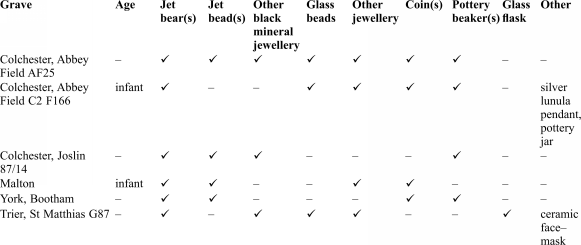
Five infant burials in eastern Roman Britain (three of them in Colchester) have produced six jet bears (Table 1). Four of the graves also contained at least one jet bead and one coin, and three of the four held a small beaker.Footnote 2 One burial was more richly furnished, but the grave goods had similar general characteristics; they included glass and frit beads, but none of black mineral, five coins and three beakers, as well as other items. A seventh bear has been found at York but not in a burial. Two jet bears are also known from Germany, one from Cologne and one from Trier; the latter was found in a child burial. These finds and the associated dating evidence are summarised below and in Appendix 1.
GRAVE GOODS FROM GROUP 1 BURIALS

Colchester, Abbey Field: 2000.1, Area A, Feature 25
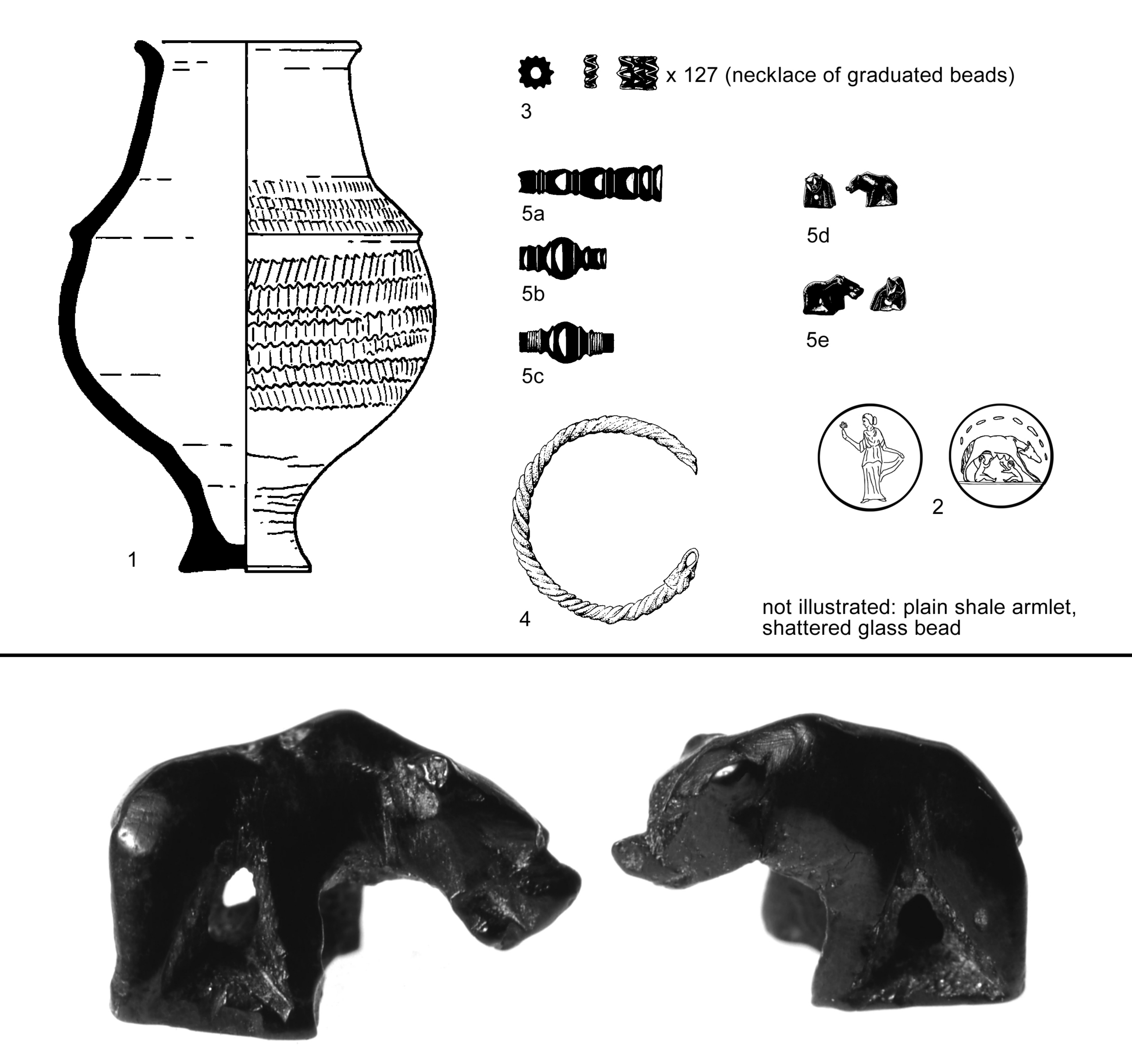
The Roman cemetery area of Abbey Field lies on a plateau to the south of the town.Footnote 3 Excavated early in 2000, AF25 consists of the cremation burial of a child in a nailed wooden box about 0.3 by 0.35 m in plan and at least 0.2 m high, together with a later third- or fourth-century small pentice-moulded colour-coat beaker, form CAM 395, probably a Nene Valley product (fig. 1, 1), two coins (fig. 1, 2), and a pile of jewellery. The two coins are much worn, second-century sestertii, one of Faustina II with reverse of Spes (c. a.d. 146–161) and one of Antoninus Pius with reverse of the Roman she-wolf suckling the twins Romulus and Remus (c. a.d. 140–143/4).Footnote 4 The jewellery consists of a necklace of subtly graduated interlocking jet beads (fig. 1, 3), a plain shale bracelet, a copper-alloy cable bracelet (fig. 1, 4), and a bracelet made up of threaded glass and jet cylinder beads and two tiny jet bears (fig. 1, 5a–e). The single glass bead was turquoise in colour and had shattered beyond repair in situ. Four necklaces similar to that from Abbey Field are known from Britain: from York, Chelmsford, London, and the Butt Road cemetery at Colchester. Interlocking beads of the same form have also been found at Wroxeter and thirteen were incorporated into a bead bracelet or necklace found at Cologne. All belong to the fourth century, with the Chelmsford necklace dated to the first half of the century (see Appendix 1) and the Butt Road one probably to the second half.Footnote 5
Grave deposits from burial AF 25, Abbey Field, Colchester. Scale: drawings 1:2, except coins, not to scale; photographs approximately 4:1. (Nos 1 and 3–5 from drawings by E. Spurgeon and J. Walker. Images © Colchester Archaeological Trust; photographs P. Crummy)

The bears are 11 and 14 mm long, with the hole separating the right and left forelegs and hind legs used as the thread hole (fig. 1, bottom). Each stands on a small platform. They are carved in the act of walking, with the head of one swinging to the left, the other to the right. The style of the carving is quite rudimentary and angular, but the characteristic form and movement of the animals are clearly conveyed.
Colchester, Abbey Field: 2004.96, Area C2, Feature 166
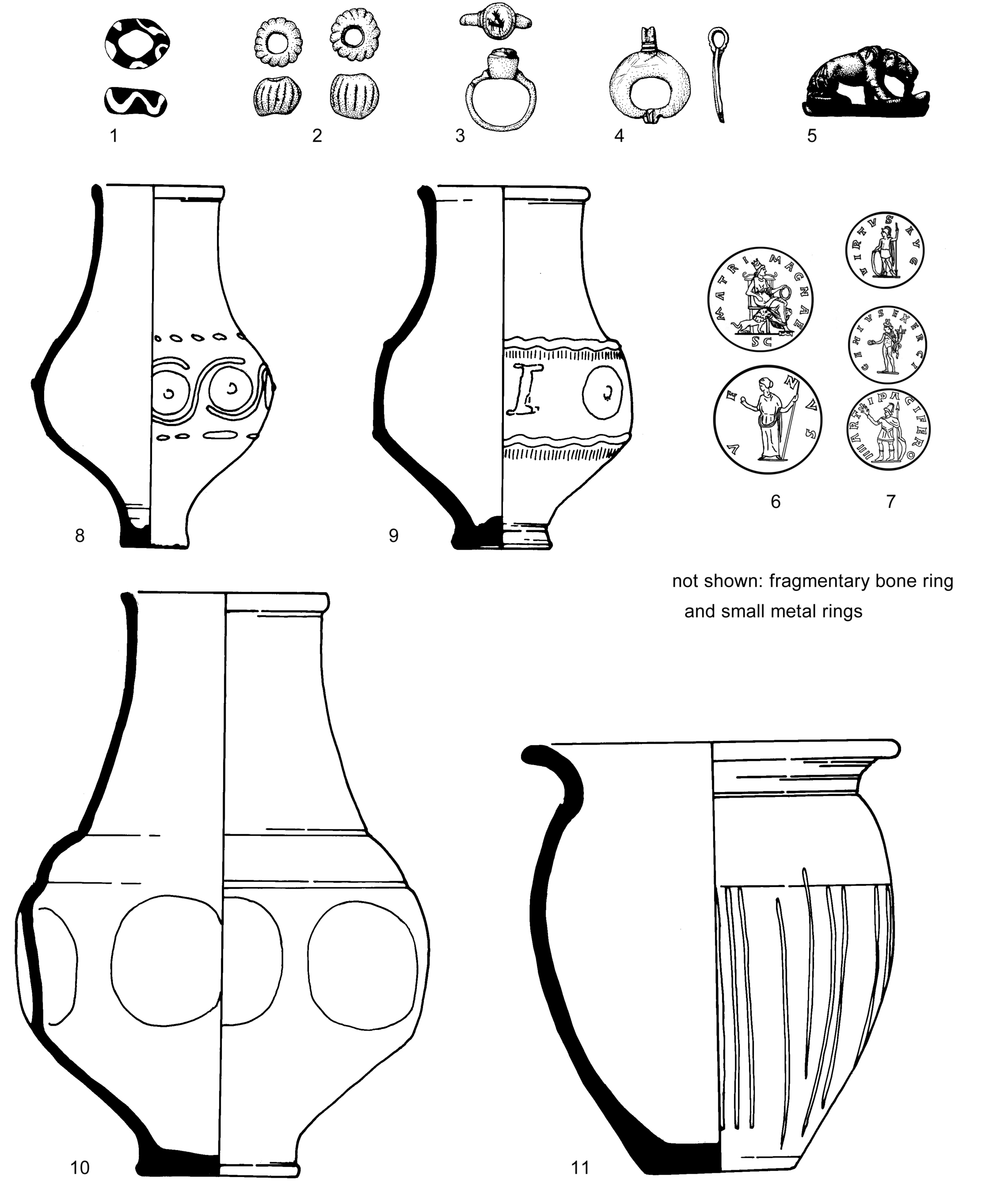
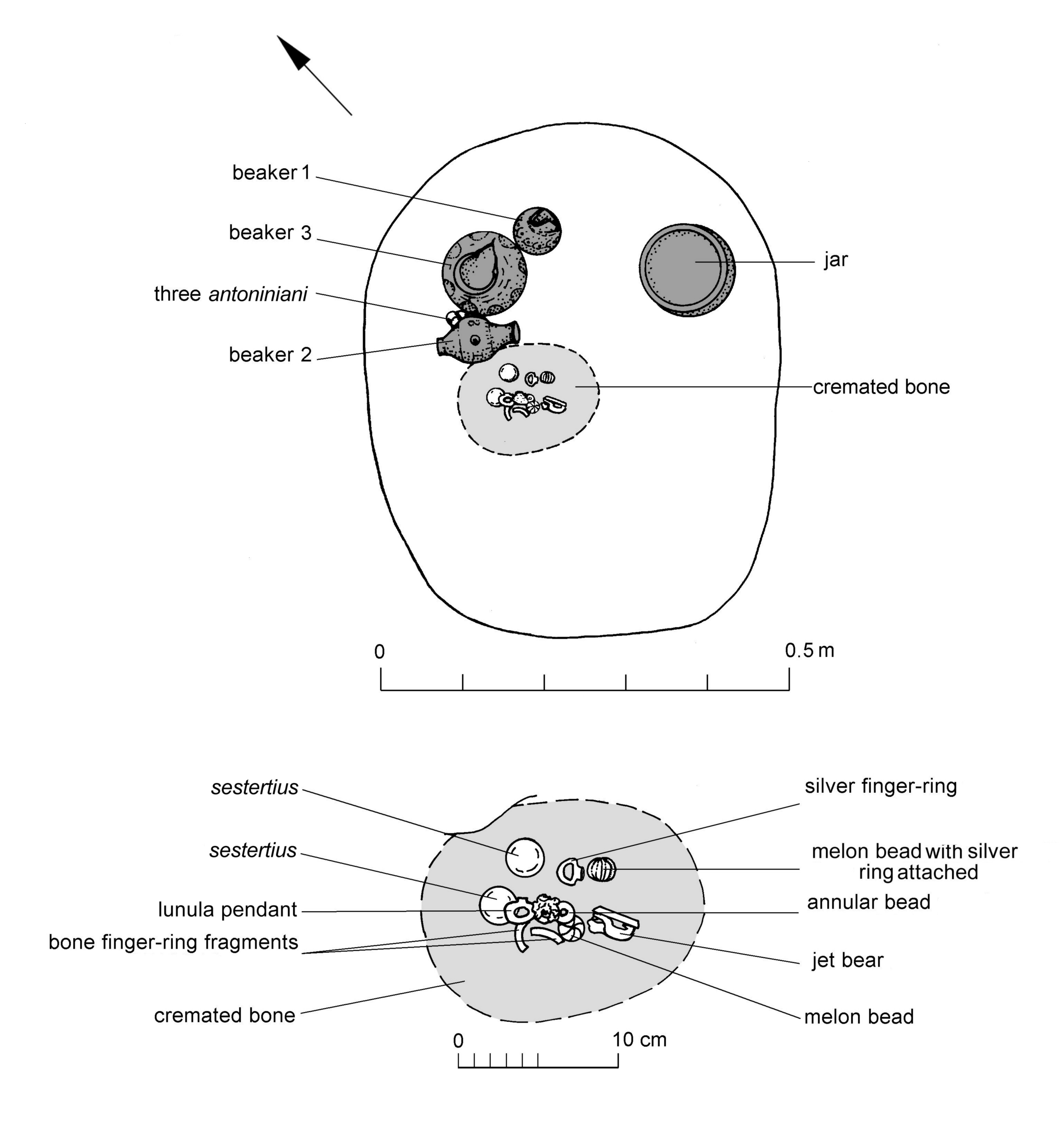
In 2004 a further excavation on a nearby area of Abbey Field was undertaken as part of the Garrison Urban Village redevelopment.Footnote 6 Cremation C2 F166 was an infant burial that contained three beakers and a black burnished ware (BB2) jar (fig. 2, 8–11), five coins (fig. 2, 6–7), a blue glass bead with white marvered zigzag trail (fig. 2, 1), two small frit melon beads (fig. 2, 2), a silver finger-ring set with a carnelian intaglio (fig. 2, 3), a silver lunula pendant (fig. 2, 4), a bone finger-ring, and a jet bear figurine (fig. 2, 5). The glass bead and one of the melon beads were closely associated in the grave with small rings, one of silver and one of copper alloy. The beads, rings, finger-rings, pendant and figurine may have been strung together and/or deposited in a bag together with two of the coins fig. 3, both sestertii of Faustina II, one with reverse Matri Magnae showing Cybele enthroned, and the other Venus. Three antoniniani were found with the pots, two of Claudius II (Gothicus), one with reverse Genius Exerci and the other Virtus Aug, and one of Gallienus with reverse Marti Pacifero. Each had been placed in the grave with the reverse uppermost. The group of pots ranges in date from the mid-third to the mid-fourth century. The beakers are all in different fabrics, Nene Valley ware (fig. 2, 8; form CAM 408–410), Rhenish ware (fig. 2, 9; Symonds Trier form 1Footnote 7) and local grey ware (fig. 2, 10; copy of CAM 395); the barbotine decoration on the Rhenish beaker includes the word BIBE.
Grave deposits from burial CF166, Abbey Field, Colchester. Scale 1:2, except coins, not to scale. (Nos 1–4 and 8–11 from drawings by E. Spurgeon, Colchester Archaeological Trust)

Plan of burial CF166 from Abbey Field, Colchester. (From a drawing by E. Spurgeon, Colchester Archaeological Trust)

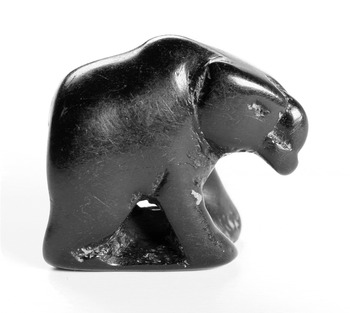
The bear is 38 mm long and stands on a small platform; in places the head and body are grooved to indicate the shaggy pelt, with the hump receiving particular emphasis. The animal is shown eating a pile of fruit fig. 4.
Jet bear from burial CF166, Abbey Field, Colchester. Scale approximately 3:1. (Image © Colchester Archaeological Trust; photograph E. Spurgeon)

Colchester, Joslin Collection 87/14
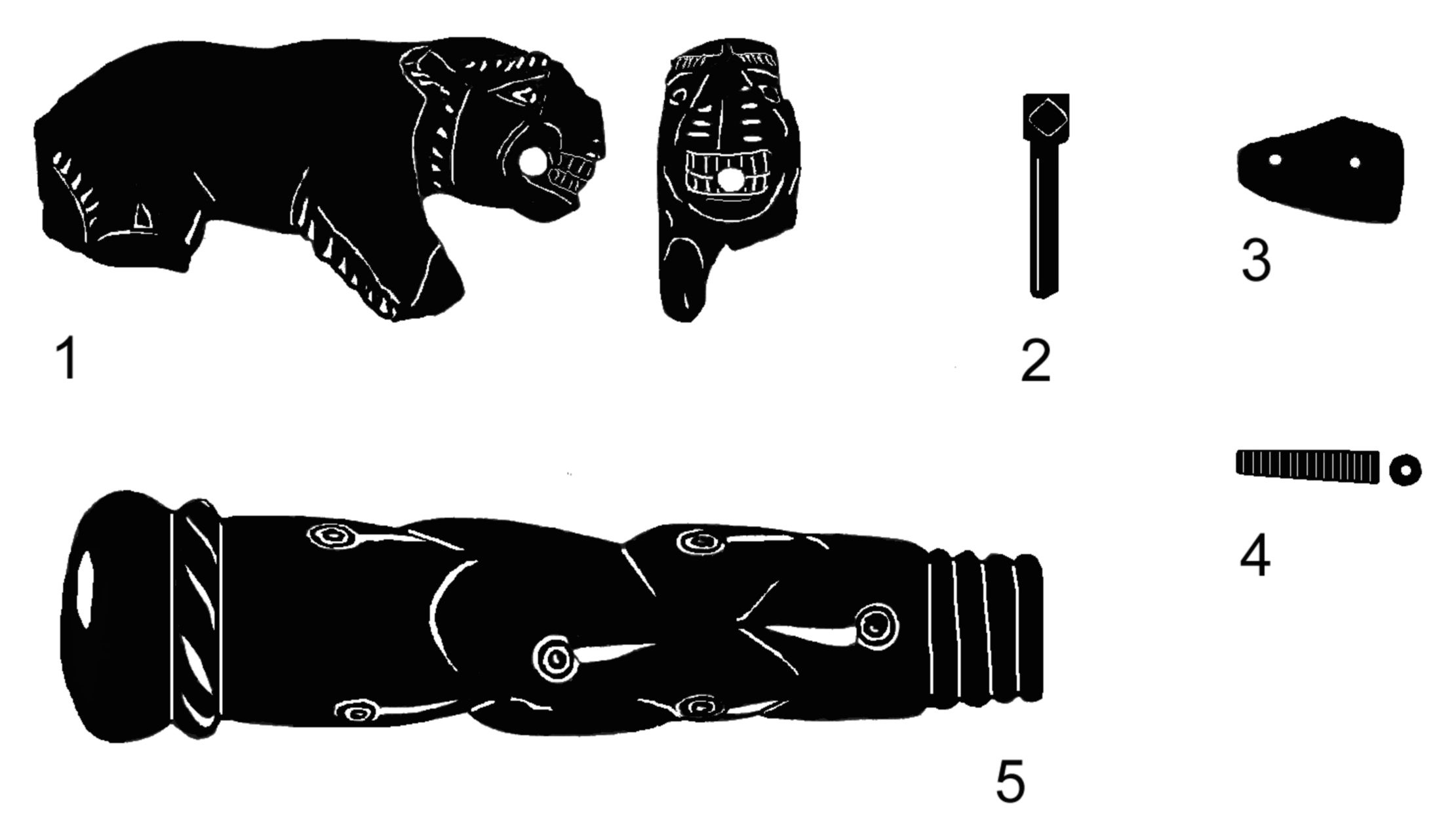
George Joslin was a nineteenth-century antiquarian and amateur archaeologist whose private collection was acquired by Colchester Museum on its foundation. The grave groups in the Joslin Collection are not wholly reliable, for the vessels were often separated out from the other objects. Grave Group 87/14 appears to be uncontaminated as the objects are consistent with those from the other jet bear graves from the town. It is composed of an indented colour-coat beaker (fig. 5, 1), three jet cylinder beads (fig. 5, 2), a jet ring, too large to be a finger-ring (fig. 5, 3), a jet bracelet (fig. 5, 4), and a jet bear figurine (fig. 5, 5). No precise information is available as to the location of the grave itself, but it is likely to have lain west of the town in the area that was being developed at the time that Joslin was forming his collection. If any bones were recovered they have long since been lost. May dated the group to a.d. 140–190, but it is clearly later.Footnote 8 Most of the graves in the western cemetery along modern Lexden Road are early Roman, but late Roman burials are known from closer to the town, at Maldon Road and Butt Road in particular.
Colchester, Joslin Collection grave group 87/14. Scale: drawings 1:2; photograph approximately 3:1. (Image © Colchester and Ipswich Museums; photograph A.-M. Bojko)

The bear is 28 mm long. It stands on a small platform and is of a smooth, static style (fig. 5, bottom). It is perforated vertically through the hump of the shoulders and has grooves radiating outwards from the hole.
York, Bootham
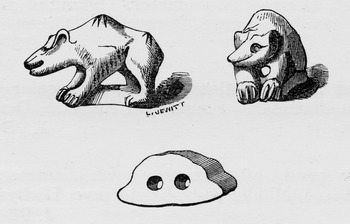
A grave group, found in 1845 during work at Bootham on the York to Scarborough railway, consisted of a jet bear (fig. 6, top), a jet lunette bead of the same type as those on a bracelet from Chelmsford T9 (fig. 6, bottom; see Appendix 1), a follis of Constantine I, reverse Soli Invicto Comiti (a.d. 312–315; Cohen 536), and a small Castor ware beaker. The group is now in the Bateman Collection in Museums Sheffield.Footnote 9 The objects were supposedly found in the beaker, but the Victorian workman who found them may have emptied the pot so that it could be used to carry them. No bones, cremated or otherwise, were reported. The bear stands slightly crouched on a small platform with its head swung to the right. There is a hole surrounded by radiating grooves passing through the shoulders like that on the Colchester Joslin Collection bear and a hole passing from front to back between the legs to allow it to be worn as an amulet, as on the Colchester Abbey Field AF25 bears. It is 20 mm long.
The jet bear and lunette bead from Bootham, York, as drawn by the artist and antiquarian Llewellyn Jewitt in Howarth 1899, 228. Scale approximately 2:1. (Image © Museums Sheffield)

Malton, north-east cemetery
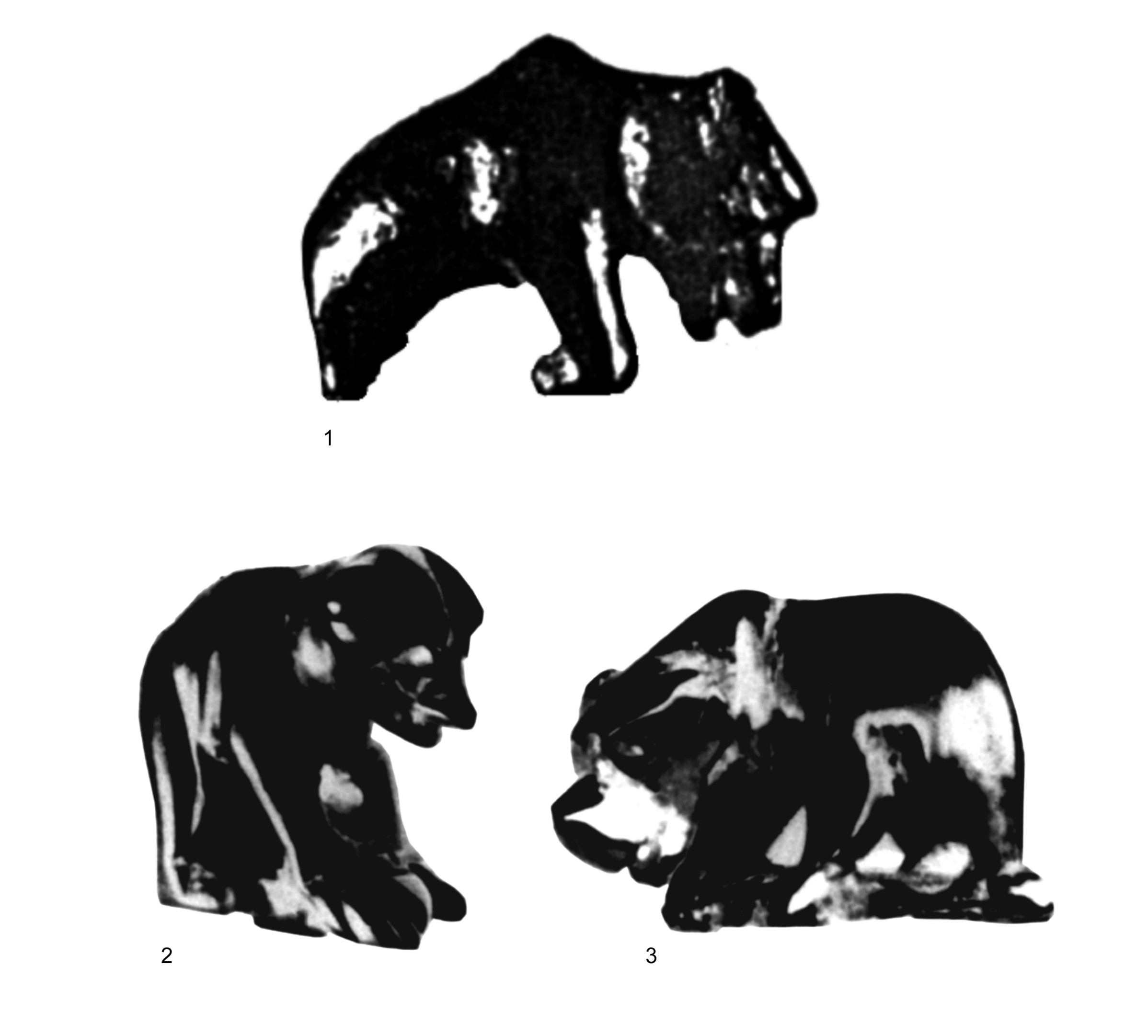
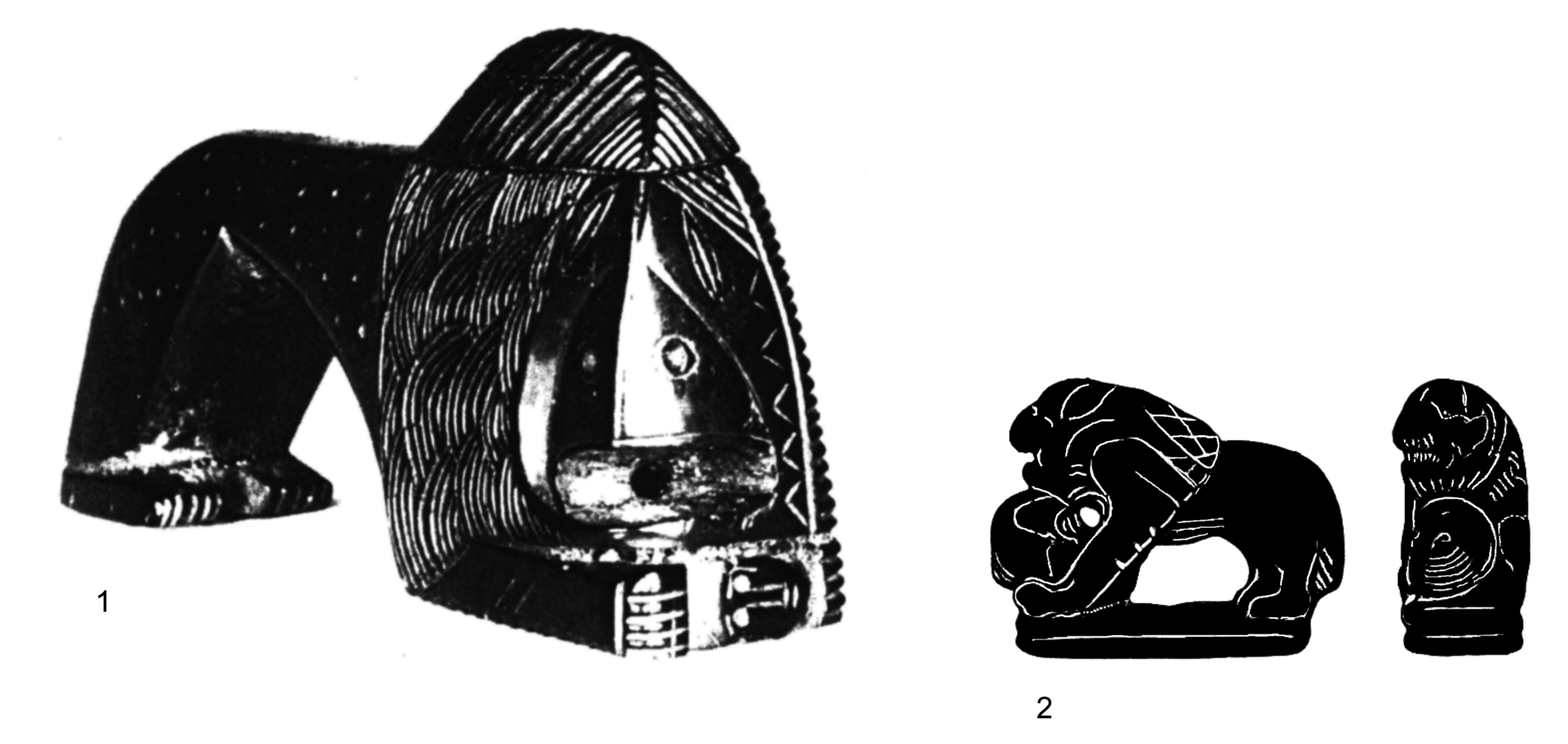
Excavations in 1929 by Dr J.L. Kirk outside the north-east gate of the Roman fort at Malton, Yorks., uncovered 32 infant burials. One corpse had been buried with a plain copper-alloy bracelet, a denarius of Caracalla dated a.d. 215–218, an annular jet bead, 20 mm in diameter, and a jet bear figurine, 23 mm long.Footnote 10 The excavation has not been published and the grave group can unfortunately no longer be reassembled.Footnote 11 Corder described a few of the finds in a note published in 1948. The bear is very worn and lacks its feet and platform; it is 24 mm long (fig. 7, 1).
The jet bears from burials at (1) Malton, (2) Trier, and (3) Cologne. Scale approximately 3:1. (No. 1 after Corder 1948, nos 2–3 after Hagen 1937)

Trier, St Matthias, Grave 87
A late Roman grave group consisting of a jet bear, a jet finger-ring, a bone hairpin with pine-cone head, two segmented beads (probably bottle- or bag-shaped as only the top sphere is pierced), a small glass bath flask, and a female face-mask with diadem in a white ceramic fabric.Footnote 12 The bear is 18 mm long and similar in style to the Abbey Field and Malton bears and to that from Cologne described below. The animal is shown in motion, the head swinging to the left (fig. 7, 2). It was destroyed, together with the face-mask, during World War II.Footnote 13
Related material
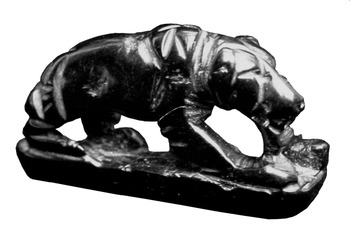
Appendix 1 lists a number of other jet animals, including a second bear from York and one from Cologne. Some of these animals may be disturbed grave deposits, most particularly the Cologne bear, which is 18 mm long (fig. 7, 3). A copper-alloy bear cub from a presumed child or infant grave in Cologne is also described. No burials were found at the St Stephen's site on Fishergate that produced the second York bear, which is very worn (fig. 8), but the finds assemblage suggests ritual activity on the site and it may have been a votive deposit. At 17.5 mm long and 15.5 mm high it is very compact but comparatively tall.Footnote 14
The jet bear from the St Stephen's site, Fishergate, York. Scale 4:1. (Image © York Archaeological Trust)

GROUP 2: GRAVES WITH COINS AND/OR AMULETS
Five graves from Butt Road, Colchester and one from Lankhills, Winchester, form Group 2. Four of the graves contain pierced coins and all contain amulets. The Group 1 grave C2 F166 from Abbey Field, Colchester, would also sit comfortably within this selection. The related material in Appendix 2 consists of other grave deposits from both sites, and some coins from funerary features on other sites.
Colchester, Butt Road, Grave 278
The Butt Road cemetery site lies outside the south-west gate of the Roman town. In the early fourth century (Period 1 Phase 3) the area was used for north–south-aligned burials; in Period 2, beginning c. a.d. 320/40, the alignment of the burials switched to east–west and a cemetery church was built.
Grave 278 was one of a large group of Period 1 Phase 3 graves containing a high proportion of child burials. No bones survived, but its size was appropriate for an infant. Beneath the collapsed west wall of the coffin lay a corroded mass of small copper-alloy rings or links fused together by iron corrosion products. This mass contained a copper-alloy bell (fig. 9, 1), a horned phallus (fig. 9, 2), a pierced dog's canine tooth (fig. 9, 3), an amber head of an Ethiopian or pygmy (fig. 9, 4), an as of Hadrian (a.d. 117–138) mounted in a silver frame to display the reverse of the emperor mounted carrying a spear (fig. 9, 5), a pierced copy of an as of Claudius I (a.d. 43–54) with Minerva reverse (fig. 9, 6), and a pierced denarius of Julia Maesa (a.d. 218–225), reverse Pudicitia (fig. 9, 7).Footnote 15
Amulets from Grave 278, Butt Road, Colchester. Scale 1:1, except coins 6–7, not to scale. Coin 6 is very worn and only the unshaded area remains visible. (Nos 1–5 from drawings by R.H. Moyes and T. Cook)

Colchester, Butt Road, Grave 94
Near the west end of this Period 2 infant or child burial, probably close to the head, lay a short length of iron chain on which were suspended two copper-alloy bells.Footnote 16
Colchester, Butt Road, Grave 503
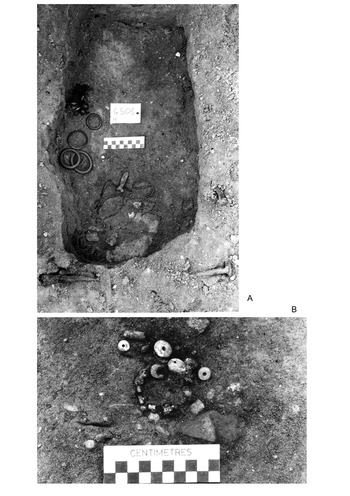
In Period 2 a young infant, found in a coffin about 0.7 m long and 0.3 m wide, had been buried wearing two necklaces made of long jet cylinder beads and five bracelets of jet and shale, all on the left arm; a group of five jet beads and three other objects, all probably strung together, was deposited in a pouch or bag placed near or in the left hand (fig. 10, A). The amulets consisted of a worn copper-alloy disc (too uniformly thin to have been a coin), an iron finger-ring, and a coin of Diadumenian, reverse Princ Iuventutis (a.d. 217–218) pierced by a fragment of a nail shank. The burial was dated to c. a.d. 320/40–330/50 on stratigraphic grounds.Footnote 17
A: Grave 503, Butt Road, Colchester. B: Grave 15, Butt Road, Colchester. (Images © Colchester Archaeological Trust)

Colchester, Butt Road, Grave 15
This Period 2 grave was of a young infant buried with a glass jug placed inside the coffin at the head end and two bracelets placed near the right shoulder (fig. 10, B). One bracelet was of iron with bands of tinned or silvered copper alloy at intervals, and with an annular bead of greenish glass threaded on between two of the bands. The other was a loose string of seven beads and two coins. Three beads were amber, one green glass, one blue glass, and two black glass. The coins were of the House of Valentinian, reverse Gloria Romanorum (a.d. 364–378), and were much worn. They date the grave to the very late fourth or early fifth century, supported by the stratigraphy and the presence of black glass beads, which did not reach Britain from workshops in Germany until that time.Footnote 18
Colchester, Butt Road, Grave 406
In this grave an infant or young child had been buried with a string of beads and other objects, all placed inside the coffin at the west end. The other items were a pierced coin of Valens, reverse Securitas Reipublicae (a.d. 367–375), and a silver lunula pendant. No bone remained, but comparison with the positions of similar strings and groups of jewellery suggests it lay near the head. Three beads were of blue glass, one of yellow glass, two of jet, five of amber. As with Grave 15, the coin evidence dated Grave 406 to the end of Period 2, the last third of the fourth or the early fifth century.Footnote 19
Winchester, Lankhills, Grave 450
The Roman cemetery at Lankhills lies to the north-west of the Roman town, on the east side of the Winchester–Cirencester road. It forms part of the extensive cemetery complex between that road and the Winchester–Silchester road further to the east. Lankhills contained a number of infant burials of which Grave 450 was the only one to contain overtly amuletic items. A coffined inhumation of a child aged six to nine months, it was dated stratigraphically to a.d. 390–410 and contained two pierced canines, probably of dog or wolf, and fragments of pewter and glass that were all that remained of a pewter pendant with glass inset similar to examples from Ickham, Kent, and Oudenburg, Belgium.Footnote 20
INTERPRETATION
A number of artefact groups appear in the data above: bears, pottery beakers, coins, jewellery, and a variety of amulets. All are resonant with more complex religious and cultural meaning, consistently building up the iconography of protection, including victory over death and resurrection. Their underlying import is explored below, briefly in the case of well-known amuletic items such as the lunulae and bells, more expansively for bears and coin reverses, neither of which have previously been examined in detail in a funerary context; these two latter subjects are then developed in the discussion section into two themes that come together in a single conclusion. The reasons for the selection of materials and the location of objects within inhumation burials are also examined here, drawing upon information from the related material described in the Appendices where appropriate.
BEAKERS
The almost consistent presence of beakers in the graves containing jet bears relates to the age of the dead children. Beakers in themselves carry no particular religious meaning, but as drinking vessels and containers of liquids they are appropriate for infants and, given the rarity of tettines as site finds, were probably the first ceramic vessel used on a daily basis by most children. The motto BIBE on one of the vessels in Abbey Field C2 F166 is particularly apposite in the context of a parent urging a child to take nourishment.
LUNULAE AND PHALLI
The silver lunulae in Abbey Field C2 F166 and Butt Road G406, and the lunula combined with a phallus in Butt Road G278, are unmistakable protective devices in both apotropaic and chthonic contexts. The horned phallus combines male and female fertility symbols to produce doubly powerful protection against misfortune and evil, and the silver lunulae may also have been doubly effective for they mimic not only the shape of the crescent moon but also its colour.
The crescent moon is an early sky symbol and its use as an amulet can be tracked back to Mesopotamia in the fourth millennium b.c. At first probably used by women as a symbol of and for the menstrual cycle and fertility, like the phallus (see below) it later became a general prophylactic against evil.Footnote 21 Used in this way it is well-represented in Roman Britain. Brooches employing the motif are found in the first and second centuries, and lunula pendants are sometimes found as site finds, often associated with military equipment, many pieces of which also incorporated the horned moon into their designs. In the classical pantheon the moon is the emblem of Artemis-Diana, but it is also personified as Luna (Selene), an image that appears, appropriately, on first-century picture lamps. Each of the gold necklaces in the Backworth hoard has a crescent moon pendant as well as a solar wheel symbol, a silver necklace from Newstead also has a wheel and a crescent, and similar silver crescents and wheels were among the items in the Snettisham treasure from Norfolk. Wheels and crescents were also used as votive offerings at sanctuary sites both here and in Roman Gaul. The wheel represents daytime and rebirth; the crescent as a waning moon represents night and death, as a waxing moon regeneration. Lunula amulets appear on pipeclay mother-goddess figurines made in the Rhineland, strengthening their fertility and chthonic aspects, and also on the pipeclay busts of infants or small children, which demonstrates their protective purpose. They were an important feature of a Roman girl's costume, referred to as early as Plautus (c. 254–184 b.c.) and as late as Isidore of Seville (c. a.d. 560–636).Footnote 22
The phallus as a protective image permeated Roman life, occurring on a wide range of objects from wall plaques to small amulets, lamps to wall paintings. All were ways of averting the evil eye, rather than charms to ensure sexual potency. Young boys in Republican Rome wore phallic amulets to guard them from danger as they grew up, and small gold rings with a phallus on the bezel from London and Faversham must belong to this tradition, as well as a small gold pendant from Braintree.Footnote 23 Phallic imagery is rather less pervasive in Britain than in Italy, but the association with children remains, and it also frequently occurs on sites connected with the Roman army and on horse-gear that may be either military or civilian.Footnote 24
Fist-and-phallus amulets combine both male and female protective devices, as the fist represents the vulvate symbol of the fig-hand (mano fica) gesture, the thumb protruding between the middle and forefinger. Five copper-alloy fist-and-phallus amulets were buried with an infant at Catterick, perhaps a foundation deposit for a temenos, and another example was found in the same area.Footnote 25 In Butt Road G278 the phallus is integrated with the female symbol of a horned moon, thereby similarly increasing its effectiveness. The combination also occurs on cavalry harness pendants, sometimes again with the mano fica, and one lunula harness pendant from Zugmantel has a suspension ring (part of the original casting) on its outer edge from which has been hung a phallic amulet with central suspension loop. Some phallic amulets with a central suspension loop are crescentic and represent the most economic means of combining both images.Footnote 26 A further example of phallic imagery in G278 may occur on the amber head (see below).
HUMAN HEAD
The amuletic importance of the amber head, which is unique in Roman Britain, must be based on both its material and its form. Pliny notes several facts about amber, of which the most pertinent here are its electro-static properties, which must have appeared quite magical, its high cost, its use for protective amulets for babies, and that, worn on a necklace, it was a remedy for fever.Footnote 27 The rarity of amber objects in Roman Britain would add to the perceived magico-medical properties of the head from Butt Road G278. Henig thought it an Aquileian product of the early Empire that represents an Ethiopian or pygmy, and that its prominent nose may be intended to be phallic. If it is Aquileian it would, like the coins in the grave, be an antique or an heirloom, but it may not be much older than the grave itself. It is undamaged, has no noticeable wear at the perforation, is quite crudely fashioned compared with the high quality of most of the Aquileian assemblage, and so may well be a later piece made in Germany or Gaul. Similar heads of late Roman date occur in jet in Germany and Belgium, one of which, from Coninxheim, is particularly close to the Butt Road piece.Footnote 28
PIERCED CANINE TEETH
Pliny notes that a black dog's tooth could be used as a febrifuge, and that a wolf's tooth helped with teething problems and nightmares in a child. In sympathetic magic this is an example of like to combat like, with a dog worrying a bone matching the restlessness of a feverish patient. Clarke proposed an Anglo-Saxon origin for the Lankhills G450 teeth (and by association for the child), but both Pliny's observations and archaeological finds show that this need not be correct.Footnote 29 Pierced animal teeth are certainly well-attested in Anglo-Saxon contexts, but they also occur much earlier in Britain, for example at Skara Brae and with Late Bronze Age material in the Heathery Burn Cave, while pierced dog/wolf/fox teeth occur in Romano-British contexts dating from the first to the fourth century at, for example, Baldock, Chichester, Witham, Foxton, Aldborough and Castleford, as well as G278 at Colchester.Footnote 30 The Chichester tooth comes from a well-furnished grave and seems to have been part of a bead string. A bear tooth found in a cabinet at Pompeii highlights the medicinal use of animal teeth, and dog, bear and lion tooth pendants have been found at Augst. Ross has suggested, with particular reference to a pierced bear's canine from Chesters, Northumberland, that they may also have been used as hunting charms, but this is not appropriate in the context of infant burials.Footnote 31
Most pierced teeth are perforated at one end, but those from Lankhills and Castleford have the hole in the centre and so, when suspended, their curved shape would be emphasised. This may be a deliberate attempt to stress the dog's underworld associations by reference to the crescent moon (see ‘Lunulae’ above). The dog in Romano-Celtic religion has a chthonic aspect as the guide and guardian of the soul on its journey between life and death, often being associated with the three Mothers, the horse-goddess Epona, Sequana and Sucellus, as well as with healing deities such as Apollo, Nodens and Asclepius.Footnote 32 In addition, the path to the underworld was guarded by the triple-headed Cerberus, and the association is further stressed by a figurine of a wolf-god devouring a man found near Oxford. Dogs have sometimes been killed and placed in graves to accompany children to the afterlife, or a model dog might be used instead. At Lankhills one dog was buried on an empty coffin and a second had been dismembered, its backbone tied to form a circle, then added to the grave fill.Footnote 33 Dogs were not only used as funerary deposits but were also sacrificed, singly or in groups, and placed in shafts, pits and wells as dedicatory offerings or closure offerings; in Britain this practice predates the Roman period. Some infants accompanied by dogs were buried in shafts, blurring the division between funerary and dedicatory. The intercessory role of the animal can also be seen in the deposition of dog-shaped bone amulets at the sanctuary of Sequana at the sources of the Seine.Footnote 34
The tooth amulets in the infant graves at Lankhills and Butt Road may be examples of local magic using similar beliefs to that of Pliny's febrifuge, and they may also be representative of the dog as the companion of healing deities, many of whom also had power in the underworld. The dual aspect of the dog companion implies that the amulets were used prophylactically during the last illness of the children at Lankhills and Colchester, and then to represent a protective canine guide on their journey to the afterlife.
BELLS AND OTHER NOISE-MAKING OBJECTS
Making noise was used in the ancient world to drive away evil, as seen in the use of cymbals, rattles and crotales during the worship of Isis and Bacchus, and of mobile charms (tintinnabuli) in domestic houses, the latter combining bells with other apotropaic images, such as phalli. Ovid described the priests of Cybele in religious procession playing flutes, beating on drums and striking cymbal against cymbal to produce tinkling sounds (tinnitus). One plate from a large pair of cymbals, 180 mm across, was found in the Temple of Cybele at Neuss (Nordrhein-Westfalen), a pair only 110 mm across at Pompeii, and two small finger cymbals, only 45 mm across, from the burial of a juvenile at Colchester; the latter may have been the type meant by Ovid.Footnote 35
The use of bells as protective devices was widespread. Like the lunula and phallus they occur on both military and civilian horse-trappings, together with jangles of various forms.Footnote 36 Fifty-eight small bells used as votive deposits were found in the sanctuary at Les Bolards, Nuits-Saint-Georges (Côte d'Or), and bells with a melon bead fixed inside were buried as threshold foundation deposits in buildings in Colchester and Scole, Norfolk.Footnote 37 In several instances bells have been found with the graves of children. In the Roman catacombs they were set into the mortar sealing children's tombs, a protective device which appears to be particularly common in the fourth century but must have originated much earlier, as a small bell was found with the cremation of a perinatal infant dated to the late first or early second century in the cemetery at Valladas, St-Paul-Trois-Châteaux (Drôme).Footnote 38
The bell in Butt Road Grave 278 undoubtedly served the same purpose. The pair of bells on the iron chain in Grave 94 and the bell on an armlet in Grave 1 (Appendix 2) can be seen in the same light. In a wider sense the copper-alloy disc on the armlet in Butt Road Grave 503, all the pierced and suspended coins, the pendant amulets, beads and finger-rings may all have doubled as noise-making devices. Some, such as the amber head and the ceramic face mask in the Trier grave (Table 1), fall into the class of objects known as crepundia, amuletic miniatures or curiosities that were collected and highly prized by young girls. They were often strung together or stored in a small box and would have made interesting noises when shaken or rolled around, with varying actions altering the quality of the sound. As crepundia comes from crepare, to rattle or clatter, using them in this way must have been an integral part of both their charm and their effectiveness.Footnote 39
BEADS AND FINGER-RINGS
Both object types are more readily categorised as jewellery than amulets, but in the context of these graves they add yet further weight to the mass of protective deposited material. Given the careful selection of other items in both Group 1 and Group 2 graves, similar attention was surely given to the choice of beads. The amber used for the human head and the silver used for the lunulae add to their apotropaic impact, but substances like amber and jet would have been effective just as beads, and coloured glass beads, through their similarity to gemstones, may also have been credited with medicinal and amuletic properties. Pliny notes that jet cured tooth-ache and had a beneficial effect upon scrofula when combined with wax; its fumes could alleviate hysterics, detect epilepsy and could be used to test virginity. Solinus observed that like amber it was electrostatic. A large jet bead from the grave of a British healer at Stanway was probably both professional equipment and dress accessory.Footnote 40
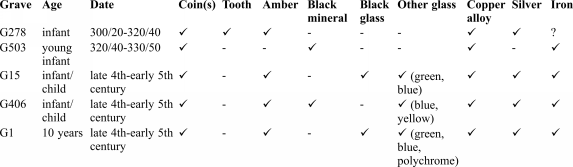
Cool considers that in north Britain in the late Roman period certain materials or colours seemed to take on increasing importance, with white/cream bone and ivory bracelets, red ceramic counters and spindlewhorls, and black glass, jet, or shale finger-rings occurring regularly in contexts dating to the late Roman transition; Allason-Jones suggests that in the very late fourth and early fifth centuries black glass was credited with the same powers as jet.Footnote 41 The occurrence of bone, silver, jet and carnelian in Abbey Field C2 F166 supports the former and Table 2 supports the latter, with black glass occurring in some graves at Butt Road and black mineral (jet and/or shale) in others. Green glass beads could be used as subsitutes for emeralds, so might yellow glass have been a substitute for amber, credited with the same powers?Footnote 42 Both are rare in late Roman contexts, offering little chance for a similar pattern to emerge, and both occur in Butt Road Grave 406.
MATERIAL OF GRAVE GOODS FROM GROUP 2 GRAVES AT BUTT ROAD, COLCHESTER

When more than one glass bead was placed in the Butt Road graves they were invariably of more than one colour. The colours may have been important individually, or perhaps in combination. Among the coloured gemstones, Pliny mentions that malachite (green) was believed to protect children and was a prophylactic against danger, and that in the East ‘everybody’ wore a green stone as an amulet. He dismisses the claim of quack magicians that amethysts inscribed with the names of the sun and moon and worn round the neck with baboon hairs and swallow feathers were a protection against spells.Footnote 43 Colours were also seen as significant in a more general sense, such as imperial purple. Tacitus thought it better for an orator to wear a rough (shaggy/woollen) toga rather than colourful clothing, which was associated with prostitutes (‘vel hirta toga induere quam fucatis et meretriciis vestibus insignire’). Mourners and those awaiting trial wore dull colours such as black, brown, grey or cream, while the colours appropriate for the clothing of Christian women were subject to debate, as was the use of coloured cosmetics. In the first century a.d. the colour purple used for the stripe on the toga praetexta worn by both boys and girls in Rome was described as protective by Persius, who defined it as a guardian (custos) of the young.Footnote 44
The recognition of the importance of colour in the Roman world is not proof that all beads of coloured glass in late Roman Britain were regarded as significant or credited with beneficial powers. Nevertheless, there are examples in other cultures in other periods that enhance the possibility. In Late Bronze Age Mesopotamia coloured glass was believed to have the same amuletic properties as the stone it matched in hue, and glass bead necklaces had both protective and curative powers.Footnote 45 In modern Sarawak beads of various types are still worn for protection or to strengthen the soul of an individual or community; in the nineteenth century beads were tied to the left wrist of corpses, varying according to the age and rank of the individual, to ensure admittance to the land of the dead.Footnote 46 Most pertinently for late Roman Britain, Meaney has demonstrated that glass beads in Migration Period Europe could be credited with magical properties, and in this light the multi-coloured bead accompanying the bell amulet on the armlet in Butt Road G1 is probably an example of the apotropaic or prophylactic use of coloured glass.Footnote 47
An intention of including a wide range of materials in a grave is apparent where finger-rings were among the deposits (see ‘Materials’ below). None are of copper alloy, the commonest material used for rings in the late Roman period. There was one of iron on the bead string in Butt Road G503, which was probably antique when buried. It may have been an heirloom, but is more likely to represent the inclusion of a protective piece of iron. Using a piece of iron to draw a circle around both infants and adults was believed to ward off noxious influences, while rust and small fragments of iron were added to ointments and other medicines used to treat a variety of ailments.Footnote 48 One finger-ring in Abbey Field C2 F166 was of ivory and the other of silver with a carnelian intaglio of a stag. The animal is associated with Artemis-Diana, a link emphasised by the use of silver, and the ring may have been used to invoke her. As the Greek Artemis is also closely associated with bears, the intaglio may be a second reference to her cult in this grave (see ‘Discussion’).
BEARS
Of the nine jet bears found in Britain and Germany, seven come from burials. That in itself could be taken as sufficient evidence that their significance is funerary, but they do not exist in isolation. Pipeclay bear figurines have been found in cemeteries on the Continent, the most striking being one from Brescia, Italy, that shows the animal sitting on its haunches and holding a lamp aloft, an image that undoubtedly represents the animal as both a guide and a companion (fig. 11). A bear may accompany an enigmatic male figurine found in an infant burial from Arrington, Cambs., but the identification of the animal is very tentative (see below). Further funerary associations are provided by Late Iron Age graves in Gaul containing bear teeth, and by other continental and British first-century b.c. and first-century a.d. graves containing bear claws, sometimes all that remained of whole skins. Indeed, the practice of depositing bear claw and tooth amulets in graves developed much earlier in the prehistoric period.Footnote 49
Ceramic bear with lamp, from Brescia, north Italy. Scale 1:2. (After Bezzi Martini 1987)

As the most powerful mammal of northern Europe and the Mediterranean region, the brown bear (Ursus arctos) may, like the carnivorous lion, have represented all-devouring death, but it can be seen as more benign in character than the lion, particularly as it is the animal's passion for fruit that figures strongly in Roman iconography. A mosaic from Trier shows a bear raiding an orchard and a relief from the town shows a bear eating a pile of apples. The latter scene also occurs on a mosaic from Ostia and was used for one of the jet bears from Colchester.Footnote 50
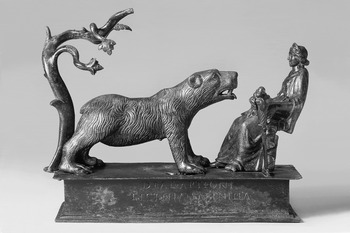
Two Gaulish local deities are linked to the bear (artos): Mercury Artaios is recorded at Beaucroissant, Isère, and the goddess Artio in the Rhine-Moselle area. Artio is a local goddess of both agriculture and the forest. Found at Muri, near Berne, a bronze figure scene shows her seated, wearing a diadem and with a basket of fruit on a pedestal beside her, while a bear approaches from beneath a tree (fig. 12); an inscription on the base reads ‘Deae Artioni Licinia Sabinilla’. Her basket of fruit is not only a representation of plenty and the bear's favourite food, but through fertility it also links her to Mother Goddess figures, suggesting that as her companion the bear may parallel the dog in its aspect of a guide to the underworld. The diademed face-mask placed in the Trier grave with a jet bear may represent her image. Artio is also represented by an inscription ‘Artioni Biber’ on a rock near Ernzen, Luxembourg, although Ternes has suggested that this may be related to Gaulish art (rock), rather than artos.Footnote 51 Mercury Artaios, from his name and from the location of Beaucroissant in the Rhône-Alpes region of France, on the edge of the Alps and in an area that is still wooded today, must have been a conflation of the Roman Mercury with a local god of forests and forest animals, perhaps, like Artio, with a link to agriculture.Footnote 52 Both Artio and Artaios are found in areas where agricultural fields meet the forest and so interaction between the inhabitants of the two environments would have been inevitable. The raids of bears on orchards and even beehives must have been part of the seasonal cycle, and hunters, charcoal-burners and timber workers, among others, ventured into the natural habitat of the bear. There was a clear need to invoke the aid of a deity linked to the animal in order to ward off its depredations. Like his female counterpart, Artaios may also have had a chthonic aspect, as one of the roles of Mercury was to escort the souls of the dead (for a bear cub figurine from Cologne found with two animal companions of Mercury see Appendix 1).
Dea Artio figure group from Muri, Switzerland. (Image © Historisches Museum Bern (BHM); photograph S. Rebsamen)

Another deity that is sometimes depicted with a bear is Silvanus, a rustic god of Italian origin who had a wide-ranging triple aspect as Agrestis, Domesticus and Orientalis, effectively covering all aspects of rural domestic life — the cultivated fields, the home, and the boundaries of property. As his name suggests he was forest-dwelling and therefore venerated by those who exploited the resources of the forest, including hunters; in this he was often linked to Diana.Footnote 53 He was venerated in the Rhineland by ursarii, military bear hunters picked from within the legions to supply the amphitheatres with the beasts and given quotas to fulfil within specific periods. He is shown on a votive plinth (preserved as casts at both Xanten and Bonn) set up by Cessorinus Ammausius, ursarius of legio XXX Ulpia Victrix, with a bear standing at his side eating fruit, the motif already noted at Trier, Ostia and Colchester. A group of ursarii set up an inscription at Zurich to both Silvanus and Diana, and a bear trap found in the fort at Zugmantel implies the presence of another ursarius there.Footnote 54
Sometimes bears were used as executioners rather than victims. Writing in the reign of Titus (a.d. 79–81), Martial describes Caledonian bears being used to dispatch criminals dressed and posed as mythological figures in set-piece arena executions, and a Gaulish ceramic figurine that shows a bound female captive seated on a bull and under attack from a small bear crouched on the bull's shoulders may depict such a scene.Footnote 55 Martial's use of ‘Caledonia’ implies that British bears were among the resources of the new province tapped by Rome, but he may have chosen the word as a metaphor rather than as an accurate record of the animal's origin. By naming a source from beyond Empire, the civilised world, he emphasised the wildness and savagery of the animals. Once Britannia was brought within the Empire, Caledonia became the epitome of the shadowy lands on its margins, its name lending to the bears of the arena a far different aspect from that of the almost domestic creature gently approaching Artio's basket of fruit.
Ross described the bear as a divine animal in Celtic religion and offered Matunus, named in an inscription from High Rochester, Northumberland, as a possible northern British bear god, arguing an etymological connection to another Gaulish word for bear, matus. She proposed that the jet bears from York and Malton were linked to his worship, but she was not aware of those from southern Britain and without more substantial supporting evidence her interpretation of Matunus remains very uncertain.Footnote 56
Two external observations hint that the bear had symbolic importance to the inhabitants of Britain in the Late Iron Age and Roman periods. First, the country was described by Diodorus Siculus, c. 30 b.c., as ‘very cold, as would be expected for a region lying under the Bear itself’, a reference to Ursa Major, which can be used as a general north point because it appears to revolve around Polaris, the North Star. This description is probably simply a conventional metaphor for ‘in the north’, just as septentriones (the seven plough-oxen) was not only the name for the seven stars that make up the Plough, the most easily recognised element of Ursa Major, but was also used as a metonym for the north or the north wind. As Diodorus was writing from a southern perspective, some evidence from Britain itself would be needed to substantiate the idea that its inhabitants regarded themselves as particularly associated with the Great Bear.Footnote 57 Second, in the late fourth century a.d. the poet Claudian's description of the personification of Britannia has her clothed in the pelt of a Caledonian beast, almost certainly intended to mean that of a bear:
Then spoke Britain, clothed in the pelt of a Caledonian beast, her cheeks tattooed, and an azure cloak, rivalling the swell of Ocean, sweeping to her feet.Footnote 58
Although this image is undoubtedly a formulaic description that was informed by a long poetic tradition, Britannia's animal fur clothing, like her tattooed cheeks and sea-girt coast (the sky-blue cloak), were no doubt perceived as accurate. Comparison with the accuracy of the descriptions of Spain, Gaul, Italy and Africa shows that the image of Britain was informed by reality, however archaic. Within the literary memory of Rome it was understood that Britons wore furs, although, like Martial, Claudian has made the practice seem even more barbaric by giving the source of the pelt as Caledonia, beyond Empire, with its hint of the savagery of the wild beasts of the amphitheatre.Footnote 59
Giving some credibility to the image drawn by Claudian are bearskins, represented by only the phalanges, found among the grave goods in the rich burial at Welwyn Garden City, dated to c. 10 b.c., and a well-furnished cremation at The Tene, Baldock, dated to the first half of the first century b.c. In these contexts both skins were clearly luxury items belonging to people of wealth and high status. Schönfelder has suggested that the use of bearskins was an indication of Germanic influence, but it is more appropriate to see them as part of a very much wider northern tradition, provoked by the harsh climate.Footnote 60 There is no reason to see them as specifically British.
The iconographic evidence for bears in Roman Britain is quite limited. They appear on some figured pottery, a few small objects such as the South Shields cameo, and are sometimes represented among the beasts on Orphean mosaics. Many of these items are imported, making images of bears on British-made objects quite rare, although the figured pottery includes British colour-coat vessels with venatio scenes. Had a bear-god or goddess been prominent among the cults of Roman Britain we might expect to see rather more bear images, in particular among the wide range of plate brooches and metal figurines from the province, but this is not the case.Footnote 61
The number of bear bones found in Britain is very small and they are generally described as coming from performing animals or victims of bear-baiting.Footnote 62 This limited archaeological evidence implies either that the animals were not generally hunted here for their meat, pelts and the medicinal properties attributed to their fat,Footnote 63 or that they were largely confined to remote forests, or that the overwhelming majority of captured animals were exported. An altar from the fort at Birdoswald dedicated to Silvanus is tantalisingly similar to the stones set up by ursarii in the Rhineland, having been erected by the venatores of Banna (probably Bewcastle). Bears caught either south or north of the Wall were probably destined for export, and documentary evidence suggests that few were used in provincial amphitheatres, most being destined for Rome. There, hundreds of bears could be slaughtered in a day, with Commodus personally accounting for the equivalent of a single hunter's annual quota in a few hours.Footnote 64
Against this generally thin background, the jet bears stand out prominently as a group of funerary artefacts, the coherence of their contexts inviting interpretation of the animal as a protective guardian for the dead children with whom they were buried. That they were amulets rather than toys is demonstrated by their contexts, particularly by the recovery of the pair from Abbey Field AF25, Colchester, in situ among threaded beads, and by their size. They range in length from 11 mm to 38 mm, with the degree of detail increasing accordingly, but the smallest captures the physical characteristics of the animal as effectively as the largest. The mother-goddess guardian of infants symbolized by the bears need not necessarily be the Rhine-Moselle Artio. The existence of an unnamed British bear-goddess can be inferred; she may be entirely indigenous, or an introduction derived from Artio or from a more distant source. A source distant in both time and place is readily provided by the cultic practices associated with Artemis, who from the Classical to Roman periods in Attica was associated with bears, bear-priestesses, bear-children, bear-guardians, and childbirth. The possible links between Artemis, Artio and the goddess represented by the jet bears are developed below in the Discussion.
COINS
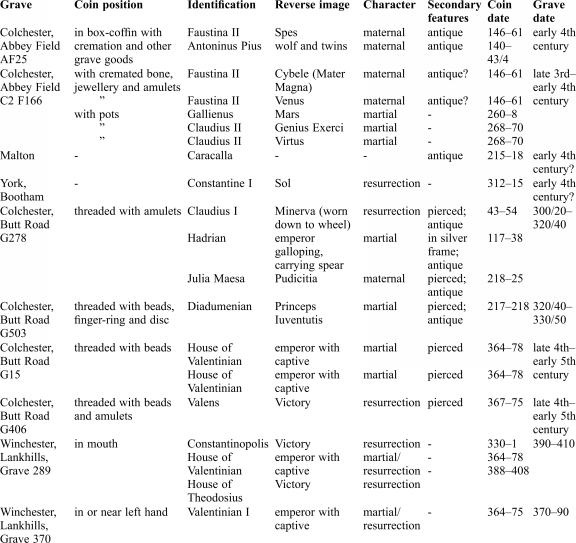
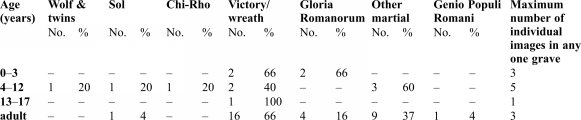
Interpretations are offered below for the coins in individual graves and the replication of iconography between burials is defined. Not only could the female deities and personifications represented here have been selected for their attributes, but when viewed as a group they seem to have been chosen more as representations of a generic rather than a specific mother (fig. 13, Group A). Similarly, the male images are martial, but seem to have been chosen not as representations of any one warrior-god but as generic representatives of masculine protection (fig. 13, Group B). Together the two groups act as substitute parents for the dead children. Minerva shown as a warrior overlaps both groups. In some cases the reverses in Groups A and B hint at resurrection, Cybele most particularly, and in the mid- to late fourth century when the pairing of male and female images disappears, the martial reverses persist and are joined by images more strongly resonant of resurrection and rebirth (fig. 13, Group C). Here the emperor carrying a labarum with a chi-rho overlaps two groups. The reverse images and other data are summarised in Table 3.
Coin reverses in Group 1 and Group 2 graves. Group A, female/maternal figures; Group B, male/martial figures; Group C, rebirth/resurrection images.

COINS IN INFANT GRAVES AT COLCHESTER AND LANKHILLS, WINCHESTER

Colchester, Abbey Field, AF25
The two coins in this fourth-century grave may have been antique when buried, as hoard evidence shows that good quality coins of the second century remained in circulation until the late third century but not into the fourth.Footnote 65 The reverse of Spes, holding a flower in her right hand and lifting her skirt with her left (FIG. 13, 1), is the personification of innocent childlike hope, an appropriate image in an apotropaic context and protective when used as a grave gift from a parent to a young child. The she-wolf suckling Romulus and Remus on the other coin (FIG. 13, 2) would have been a familiar and easily understood image of the Roman state. It may have been selected to harness the power of the Roman state to guard the child in death, but it is a powerful portrayal of maternal protection and sustenance that is appropriate for a helpless unweaned infant and it also invokes the dog as the guide and guardian of the soul on its journey to the underworld.
Colchester, Abbey Field 2004, C2 F166
All the coins had been placed in the grave with the reverse face uppermost, a contextual detail that underpins the interpretations presented here. The pottery ranges in date from mid-third to mid-fourth century so it is not certain if all or any of these coins were antique at the time of burial. The three third-century reverses are all male martial images, while the second-century reverses both show female deities; together they can be seen as appropriate promises of maternal and paternal protection in the afterlife. Genius Exerci, Virtus Aug, and Marti Pacifero all show warrior figures and together present a strong case for deliberate selection (FIG. 13, 7–9).Footnote 66 One of the goddesses is Venus, who was often venerated as a mother goddess, protector of domestic life and fertility (FIG. 13, 3).Footnote 67 The other is Cybele, shown enthroned and accompanied by a pair of lions, with the legend Matri Magnae (FIG. 13, 4). The funerary aspect of lions has been mentioned above, and the cult of the Great Mother also promised resurrection. In some Romano-British funerary contexts jet and other black minerals may have been used to refer to the ‘Black Stone’, the chief symbol of Cybele's cult that was transferred from Phrygia to Rome in 204 b.c. Cybele had followers in at least some British settlements, where continental influence was strong or the population was chiefly drawn from the Continent. On military sites in the North there is an altar dedicated to her from Corbridge, a statue from Carvoran, and a probable gallus burial at Catterick furnished with a suite of black mineral jewellery. There are several objects related to her worship from London, including elaborately decorated bronze forceps (so-called castration clamps) from the Thames and possibly an altar. Colchester has produced little Cybele material, but there is a head of Attis among the collections of the Colchester Museum. Among the Group 1 graves containing jet bears, that from Trier contained a hairpin with pine-cone head, which may also be a reference to the rites of the Great Goddess through the pine tree's association with Attis. On the other hand, the pine cone is also associated with Mithras through the incense used in his worship, with Bacchus through his cone-tipped thyrsus, and with Silvanus who is shown standing beneath a stone pine or carrying a pine branch.Footnote 68
York
The coin found with the York bear is of Constantine I, reverse Soli Invicto Comiti (FIG. 13, 15). The legend is martial and the image of the radiate Sol conveys the idea of the cycle of life appropriate to many religions, whether they believed in resurrection through the intercession of a saviour deity, or in reincarnation in the Platonic sense, or in a more substantial afterlife, the same as life but ‘other’. Expressed simply, the rising sun of a new day is an image of new beginnings appropriate for an infant, and the sun as giver of life could be seen as a powerful ally in the fight against illness or as a guardian in the afterlife.
Malton
The coin of Caracalla found with the Malton jet bear can, unfortunately, no longer be located, but it would again have been antique or at least long-used when buried, since it is described as a late issue of a.d. 215–218. The reverse types minted by Caracalla on denarii after a.d. 215 include several images that would be appropriate in a healing or funerary context, some of which occur in other graves discussed here. Those most worth noting are a walking lion, Pluto with Cerberus, Luna (wearing a crescent headdress and riding in a biga drawn by bulls), Sol, and Asclepius.
Colchester, Butt Road, Grave 278
The three coins in this burial were all antique when buried; that of Claudius was about 300 years old, that of Hadrian 200 years old, and that of Julia Maesa about 100 years old, but it is difficult to believe that their neat spread across the centuries was deliberate. There are, moreover, striking differences between the three. The Julia Maesa denarius is good hoard material and not much worn, its piercing is narrow and delicately made. In contrast the asses are well worn; as the original details of their reverse images are unlikely to have survived in oral tradition, what is visible now must be very close to what was visible in the early fourth century, and any interpretation must therefore be based on their present condition.
The Claudian as is so worn as to be virtually unidentifiable, and the hole through it is wide and simply hammered through from the obverse, leaving the edge on the reverse burred. This implies that the obverse was the most important side, but the hole is at the back of the emperor's neck so that the portrait would not be upright when the coin was suspended. The reverse type is of Minerva holding a shield and brandishing a spear, an image spanning Groups A and B (FIG. 13, 5) and one that would make a good apotropaic or prophylactic amulet. In its present condition, however, only the rim of the shield and Minerva's left arm passing across it can now be seen, resembling part of a spoked wheel and lying directly beneath the suspension hole (fig. 9, 6). Minerva is shown as triumphant over death on lead coffins, and in her Celtic sky-goddess aspects has links with the solar wheel.Footnote 69
The Hadrianic as is less worn, and the decoration and position of the frame show that it was selected for the reverse image. Showing the emperor mounted and holding a spear, it picks up the martial theme of other coins in these graves (FIG. 13, 10). He is both protective and aggressive, paralleling the rider god who is so well represented in Britain and on the Continent. Particularly pertinent examples are horse-and-rider brooches, the relief from Stragglethorpe, Lincs., which shows a rider god spearing a monster, and images of Bellerophon slaying the Chimaera. In Gaul the rider god appears as both Mars and Jupiter, the latter shown on Jupiter-columns trampling monsters. An apotropaic rider image from the tomb of an infant in Rome shows a hunter spearing a beast; the rider has been identified as Solomon, and the theme that of the triumph of good over evil.Footnote 70
The perforation on the denarius of Julia Maesa is set so that the empress's portrait hangs upright. She appears as a Mother figure, her chthonic aspect enhanced by being in silver, the colour of the moon. The reverse type, Pudicitia, symbolises modesty, chastity and purity; she is authoritative, shown seated with a sceptre in her left hand (FIG. 13, 6). Both this reverse and that of the mounted emperor may have been taken as images of particular deities, parallels to a stone relief from Kingscote, Glos., which shows a rider-god paired with a seated goddess. Unfortunately, the inscription on the relief does not name the deities, being simply ‘Iul(i)us l(ibens) s(oluit)’.Footnote 71
In Grave 278 the choice of female and male images again provides symbols of both maternal and paternal protection, with resurrection perhaps represented by the wheel image on the worn Claudian coin. Both maternal and paternal protection can also be seen among the objects deposited with an infant at Arrington, Cambs. The child suffered from hydrocephalus and was buried in a lead coffin with a wooden box full of pipeclay figurines on the lid: a bald-headed infant, a long-haired child, a seated youth pulling a thorn from his foot, a Mother Goddess, a cloaked male possibly with a bear, three rams, and a bullock or ox. The first three appear to represent the stages between infancy and maturity that the dead child would pass through as he (presumably) continued to grow in the afterlife, while the Mother Goddess and the enigmatic cloaked male appear to be substitute parents. The animals may represent sacrificial beasts, or, if deposited by a family whose wealth lay in pastoral farming, might be representative of the flocks and herds essential for both status and survival.Footnote 72
Colchester, Butt Road, Grave 503
The burial contained a pierced antique coin of Diadumenian (son of the emperor Macrinus, a.d. 217–218) with the reverse legend Princ Iuventutis (FIG. 13, 11). It is rare, if not unique, in Roman Britain, and is little worn, probably having been curated or hoarded almost from the time of minting.Footnote 73 The grave is dated to c. a.d. 320/40–330/50, making the coin about 100 years old when buried. The obverse portrait would be upright when the coin was suspended while the reverse hung at five o'clock; it shows the young Caesar in military costume holding a standard in his right hand and with two other standards set to his left, again a protective and aggressive martial image.
Colchester, Butt Road, Grave 15
Both coins in this burial are very worn House of Valentinian issues. They had clearly been in circulation for some time, may have been antique, and the date of the burial could lie well into the fifth century. The piercings appear to respect neither obverse nor reverse, but are set to avoid passing through both the crown of the emperor's head on the obverse and the figure of the emperor on the reverse. Both coins have the reverse type of Gloria Romanorum, showing the emperor dragging a captive behind him with his right hand and holding a labarum in his left (FIG. 13, 12). This political message of imperial might defeating the barbarian threat has both aggressive and protective implications and the chi-rho on the labarum gives it additional, Christian, impact. The monogram is found not only on the official coinage and on objects associated with the Christian religion but also throughout daily life. It was scratched onto vessels, perhaps as a protective symbol or as a sign of ownership, and appears to have been conflated with the solar wheel, sometimes appearing in this form on small personal amulets.Footnote 74 The coins in G15 may therefore have been chosen as apotropaic amulets or as symbols of resurrection, and so fall into both Group B and Group C.
Colchester, Butt Road, Grave 406
The coin on the bracelet in Grave 406 is of Valens, contemporary with those in Grave 15, and again possibly antique when buried. The piercing respects the reverse, being set to one side of the figure of Victory and passing through the back of the portrait on the obverse. The reverse legend and image, Securitas Reipublicae, Victory bearing a wreath and palm (FIG. 13, 16), are again both overtly political and apotropaic: Securitas has a clear protective meaning, while triumphant Victory, the conqueror of death, has an apotropaic value and promises resurrection.
Related burials from Lankhills and Poundbury
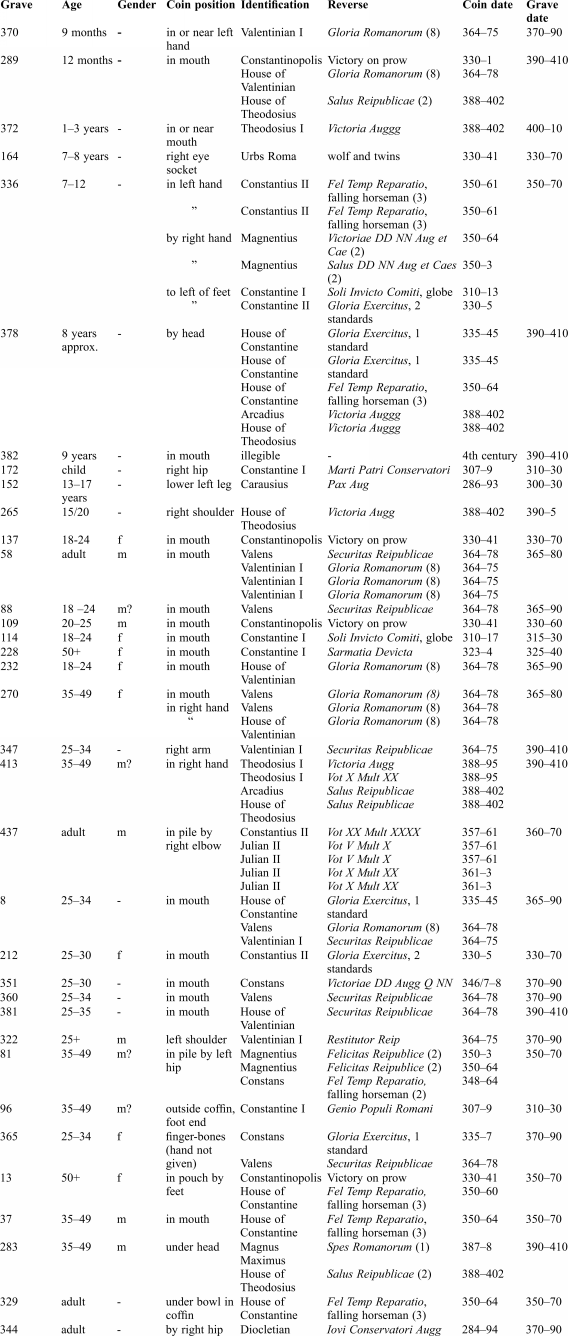
A nine-month-old child buried in Grave 370 at Lankhills had in, or close to, its left hand a coin of Valentinian I with the same Gloria Romanorum reverse as that of the coins in Butt Road Grave 15. Also at Lankhills, an infant in Grave 289 was buried with three coins in the mouth; one also has the Gloria Romanorum reverse, and the other two show images of Victory. The coins in both burials can be interpreted as ferryman's fees, yet both are slightly unusual — three coins in the mouth instead of one in Lankhills Grave 289, and the coin in or near the left hand rather than the customary right in Lankhills Grave 370 (see ‘Position’ below). Other infant/child graves at Lankhills held coins that may have had a protective purpose beyond use as Charon's fee (see ‘Discussion’). Poundbury Grave 370 may not be an infant grave, but is mentioned here since it contained a pierced antique coin of Postumus, with the reverse of a galley and the legend Laetitia Aug. In a funerary context this can be seen as a clear reference to the journey to the Blessed Isles. There was only one other antique coin at Poundbury, an issue of Elagabalus, reverse illegible, which had been placed in the mouth of a middle-aged male in Grave 1163.Footnote 75
MATERIALS
The importance of material in the selection of grave goods is shown in Tables 1 and 2. Table 1 shows the consistent presence of electrostatic jet jewellery or of jet-imitative black mineral jewellery in all the Group 1 graves — apart from Abbey Field C2 F166, which instead has a jet bear and is closer in general material character to the Group 2 graves — whilst Table 2 shows the range of materials present in some of the Group 2 graves. There appears to have been a deliberate intention in several of the Group 2 graves to include iron, and in some to include silver (or silver- or tin-plating). Butt Road Grave 278 in Group 2 has the widest range of materials, but evidence of attempts to maximise the materials present can also be seen in other graves cited above and in Appendix 2: the use of iron for the chain in Grave 94; copper alloy, iron and white metal for the armlet in Grave 15; and the white-metal plating on one strand of the copper-alloy armlet in Grave 1, as well as the iron clapper on the attached bell. The same can be said of the iron finger-ring, plain copper-alloy disc, and perhaps also the coin of Diadumenian with the jet beads in Grave 503; the silver lunula pendant in Grave 406; and the silver and bone finger-rings in Abbey Field C2 F166.
A particularly unusual object from an infant burial found during excavations in the 1960s at Verulam Hills Field, St Albans, Herts., is pertinent here. The child was buried in a lead-lined coffin with a small group of crepundia that included two imported murex shells and a now amorphous lead object interpreted by the excavator as a phallic amulet, all contained in a wooden box placed at the foot of the body. Placed between the left arm and the body was a hollow iron rod on which were set hexagonal beads of shale and bone, producing a banded effect. This eye-catching object may have been a rattle; it was certainly too complex to be a spindle or distaff as the excavator suggested. It may have been a prophylactic that deliberately incorporated contrasting colours and substances, but is more likely to be an example of apotropaic magic.Footnote 76
Pauli has defined the amulets from prehistoric graves in the northern Alpine region into groups that taken together represent the full range of apotropaic equipment: first, noise-making objects; second, objects of meaningful shape; third, objects with special external qualities; fourth, curiosities and remarkable objects; and fifth, objects made of a material valued for special properties.Footnote 77 In the context of his analysis, the gathering together of a range of materials in the Romano-British burials would work towards building up an effective apotropaic collection of grave deposits and items from the graves can easily be assigned to one or more of his groups. Bells are the most obvious examples of the first category, but any suspended item may clatter against its neighbours. Objects of meaningful shape would include the lunulae, the phalli, the canine tooth, the human head, and the bears. Reflective, light-absorbing and coloured objects all class as having special external qualities, and this would include all items of silver, burnished copper alloy, jet, glass, and amber; the unusual rod from Verulam Hills Field also belongs here, with the combination of contrasting colours being particularly powerful. The human head must rank as a curiosity and the bears as both curiosities and remarkable objects, as would the shells and rod from Verulam Hills Field. The electrostatic properties of both jet and amber place the bears and much of the jewellery into the fifth group, and iron also had protective qualities. As with several of the objects, coins fit into several groups: when suspended they make noise; they can be classed as solar symbols or moon symbols by virtue of their colour and shape; they may reflect light; and, in a fourth-century milieu where coin reverses show little variation, the images on the surfaces of antique coins make them both remarkable and curious.
The significance of the objects in these graves therefore relies upon material as well as upon shape, properties and symbolic purpose. The various colours and properties of the surfaces would all have contributed both singly and together towards the efficacy of the amulets — and this should include the jewellery of all materials — in providing protection for the dead children.
POSITION
The importance of the position of objects in graves can be seen in the frequent occurrence of coins — used as the ferryman's fee — in the mouth or on the eye, or close to the right hand. They were placed where the dead person could easily find them, or where Charon could easily find and take them for himself. The physical form of the body remained important after death.
A remarkable use of coin reverse imagery relative to body position occurs in Lankhills Grave 336, a well-furnished older child's grave (see Appendix 2). The burial was dated to a.d. 350–370 and most of the six coins in the burial were probably still in circulation at that time, apart perhaps from a follis of Constantine I. They had clearly been selected as three pairs and deliberately placed in a protective pattern. Two coins were by the child's right hand, two in the left hand, and two to the left of the feet (fig. 14).Footnote 78 The two in the left hand were a true pair, with only the mint marks differing; both are in the Fel Temp Reparatio series of Constantius II, with the reverse of Virtus spearing a falling horseman (FIG. 13, 14). The design has, beyond its political message, a protective-aggressive interpretation linked to the rider image seen in Butt Road G278. The coins by the right hand are both of Magnentius, one with the reverse Victoriae DD NN Aug et Cae showing two Victories standing facing each other and holding a shield, the other with Salus DD NN Aug et Cae showing a chi-rho flanked by alpha and omega (FIG. 13, 17–18). One of the two by the feet was of Constantine II, with the reverse of Gloria Exercitus with two soldiers and two standards between them (FIG. 13, 13), the other was of Constantine I, reverse Soli Invicto Comiti, a type which was also used in the York jet bear burial (FIG. 13, 15). The three pairs can be interpreted as martial (physical, practical) protection in the left hand; religious (spiritual, otherworldly) protection on the right; and both forms of protection at the feet, with the invincible Sol as a symbol of the triumph of day over night, light over dark, life over death. That the pair on the left were clasped in the hand rather than placed beside it lays emphasis upon them, matched by the position of other items in these burials, such as the coin in Lankhills Grave 370, the pierced canines in Lankhills Grave 450, the black mineral armlets in Butt Road G503, and the bead/pendant collections in Butt Road G503 and G15.
Grave 336, Lankhills, Winchester. (After Clarke 1979)

The consistent placing of coins with the reverse upwards in the Group 1 Colchester burials emphasises the importance of the reverse images in a funerary context and also the level of detail pursued by the mourning families. The careful placement is paralleled by pipeclay figurines in some second-century infant burials at Argentomarus (Argenton-sur-Creuse, France), which stresses their use as beneficial guardians. In one neonatal burial two Venus figurines, a nursing Mother Goddess and two horses were placed in a circle around the burial urn towards the top of the grave pit, and in the tile-lined inhumation of a weaning infant two Venus figurines were placed so that they flanked the infant's head. The lesser importance of physical nourishment is shown by a tettine placed by the right foot in this burial.Footnote 79
It is significant that many of the coins and other items in the graves described here were in or close to the left hand, on the left arm, or close to the left side. Another, more unusual, amuletic item placed in the left hand is the pierced pebble held by the person buried beneath the temple-mausoleum at Lullingstone, Kent.Footnote 80 In late Roman Britain the left, sinister, side seems to have been perceived in death as most vulnerable to attack by malign influences, and the side most requiring the protective power of amulets or materials credited with beneficial qualities.Footnote 81 In a protective sense this is demonstrated by the positions of the coins in Lankhills Grave 336, for the only ones held by the child were the pair with martial reverse type in the left hand. This may be matched by the martial reverse of the coin in the left hand of Lankhills infant Grave 370.
DISCUSSION
The iconography of coin reverses in infant graves is here set into a wider context to demonstrate the validity of the interpretation. The association of the bear with Artemis is developed and a possible link to Silvanus briefly examined. The social identity of the children buried with jet bears is explored.
DELIBERATE SELECTION OF COIN REVERSES
Coins in graves are usually interpreted as ferryman's fees and are customarily placed in the mouth, on the eyes, or in or near the right hand, a pattern of deposition common to both child and adult burials at Lankhills (Table 4) and elsewhere.Footnote 82 At Lankhills other positions are quite rare, while some multiple deposits imply that a single coin might be perceived as inadequate. Only two graves of infants of one year or younger at Lankhills contained coins, but although only six out of over 700 burials in the Butt Road cemetery contained coins, four of those six were of infants and the coins themselves were either pierced or provided with an alternative method of suspension (Table 3). Many of the coins in the Butt Road infant graves were antique, while those from Colchester Abbey Field and Malton, and perhaps also some from Lankhills, were probably also out of circulation (although it is difficult to be certain with the long-lived second-century aes and with third-century coins perhaps deposited only a few decades beyond their mint date). Other examples no doubt exist but are hard to detect, particularly where they are the only closely-dated item among the grave goods and there is no phased vertical stratigraphy to fall back upon for refinement or correction of the excavator's proposed terminus post quem.
POSITIONS OF COINS IN GRAVES AT LANKHILLS

The reverse types of the coins in the Group 1 and Group 2 burials all have a direct relevance in the context of a sick or dead child. Other coins, such as those framing the girl in Lankhills Grave 336 and the pierced antique coin in Poundbury Grave 370, also held a visual relevance that went beyond use as the ferryman's fee. At Watersmeet, Huntingdon, another pertinent late Roman grave contained an antique copper-alloy unit of Tasciovanus (late first century b.c.) that had been placed either in the mouth or on the eye of a male juvenile.Footnote 83 The horse on the reverse prompts association with Epona in her role as a goddess of death and the underworld.Footnote 84 The coin also adds a new twist to this study, as it provides not only a companion for the dead youth on the journey to the afterlife, but also a direct message to the underworld. A product of the mint at Verlamion, the coin bears the letters VIR beneath the horse. The skeleton is that of a child/adolescent, perhaps a boy who had past his fourteenth year and so had acquired the legal status of a man (vir), making the coin a token of absolute proof in the afterlife that he had indeed reached this stage in life.
Other pertinent coins include two Urbs Roma coins with wolf and twins reverse from infant graves at Ashton, Northants., and a burnt issue of Antoninus Pius with a funeral pyre on the reverse found in a feature containing pyre debris at Holborough, Kent. The latter had presumably been burnt with the body, perhaps having been placed in the mouth or hand.Footnote 85 Infant burial Tombe 67 (probably of a neonate or perinate) in the Rue Perdue cemetery at Tournai, Belgium, contained a jug, a beaker, part of a bracelet and a coin of Constantinopolis, reverse Victory. A bronze strap-ring used as a hinge on a wooden box, still retaining two iron split-pins and iron escutcheons, was also in the grave, which indicates the intentional inclusion of a range of materials. In the same cemetery a child aged from two and a half to six years buried in Tombe 74 was accompanied by a beaker, a fragment of a bronze bracelet, two ebony bracelets and three coins of Constantine I: one with reverse of Marti Conserv(atori) showing Mars with shield and spear, one with reverse Virtus Exercit(us) showing two captives sitting beneath a standard bearing VOT XX, and the last with reverse Beata Tranquillitas showing an altar inscribed with VOTIS XX and surmounted by a globe. There is a military and religious slant to the reverses that matches the theme of those from the British burials and again there seems to have been deliberate inclusion of a range of materials.Footnote 86 A coin of Philip I found in a post-Roman cemetery in Béruges, France, can also be included here, for it has the reverse type of a walking lion. The coin was pierced so that the lion was upright when suspended, while the emperor's bust was upside down. Domestic cats, like dogs, were sometimes placed in child burials as the guide and protective companion of the infant, although incidences of this practice are rare and some cases may be misidentifications of the bones of lap-dogs; like lions they would have symbolised the power of death.Footnote 87
These examples of the amuletic use of coins are taken only from published sources, few of which record the reverse of a coin or refer to a standard catalogue, and no doubt further research would show that the practice was more widely spread. It may even have extended into the Migration Period, as at the transitional (very late Roman to early Anglo-Saxon) cemetery in Great Chesterford, Essex, where four out of eight inhumations with coins were infant burials and they contained twelve out of the total of seventeen coins. Of the other four graves one was of an older child and another an adolescent-adult, leaving only two coins deriving from mature adult inhumations. One 0–2-month-old infant had a coin of Gallienus with panther reverse by the feet and an iron finger-ring by the head, and a 12–18-month-old had an amber bead and a pierced coin of Claudius II with an altar on the reverse strung around the neck; both burials may be early. In a grave dated to a.d. 450–500 a girl aged 10–12 years held a coin of Lucilla with Iunoni Lucinae reverse in her left hand; the goddess watched over childbirth and is a maternal protective image. A coin of Tetricus I with Fides Militum reverse had been placed on the skull of a young man aged 15–25 years in a burial that Evison considered to be of a Romano-Briton. The image can be seen both as a comment on achievement and as protective.Footnote 88
Quite how antique coins came to be available for deposition so long after their period of circulation is not clear. They may be accidental finds of either hoards or casual losses, and in some cases here, such as the denarius of Julia Maesa from Butt Road Grave 278, the hoard explanation seems fitting. However, the wear noted on some of the coins from these burials suggests that they had been both in circulation and/or used as prophylactic amulets for some considerable time before deposition, as has also been noted for pierced antique coins found in late and post-Roman contexts in France.Footnote 89 Whether they were deliberately removed from circulation for this purpose or were collected later from accidental finds is unlikely ever to be determined, but their prolonged use shows that a belief in the potency of antique coins as amulets was long-lived.
It is far more difficult to detect deliberate selection with fourth-century issues, of which many have a martial reverse or show Victory. Some evidence of selection can nevertheless be detected. Table 5 shows the fourth-century coins from burials at Lankhills by the character of the reverse, with repeated images in a single grave counting only once, and also by the number of times the image occurs as a percentage of the graves in each age group. The final column shows the greatest number of individual (different) images in any one grave in that age group. Percentages appear high because of the small number of burials. Images of Victory occur in burials of infants, older children and adults, which might imply some evidence for selection over other reverses. Only in adult burials is Victory represented by a wreath. There is a preference for Gloria Romanorum in infant burials, but it is lost if all the martial images are combined. Older children had a wider range of reverse types than any other group, including the maternal/dog image of the suckling wolf, and also the greatest number of individual images in any one grave were those found with the older child in Grave 336 (fig. 14). The most important point raised by Table 5 may be the distinction it implies between local practice at Lankhills and at Butt Road, where infants but no older children had coins and most were clearly amuletic (Table 3).
REVERSE IMAGES OF FOURTH-CENTURY COINS IN GRAVES AT LANKHILLS BY AGE GROUP
(No.: the number of graves with that image or image type. %: percentage of the number of graves in that age group.)

In summary, when a coin in a Roman period infant grave is very old or antique, and/or it is perforated, then there is good reason to suppose that it has been deliberately selected for use either as an agent of beneficial magic during illness, or as a guardian image for the afterlife, or both. Such an interpretation is more difficult to support for fourth-century coins, but this should not prevent consideration of coin reverses as meaningful in funerary contexts.
THE AMIABLE BEAR, ARTEMIS AND CHILDREN
Looking beyond its use as a commodity in the leisure and military economies of the Roman Empire, the bear has always been deeply embedded in the myth-making traditions of northern Europe, Asia and America as a powerful protective force, and in the Roman period, as at other times, the animal was undoubtedly attributed with many layers of symbolic meaning. Ursus arctos, the brown bear native to Europe and other regions, shares with humans a considerable number of behavioural and physical characteristics, some of which have brought the two species into direct competition for millennia, such as sheltering in caves, building forest shelters from vegetation, standing erect, swimming, climbing trees and an omnivorous diet, most particularly fruit, honey and fish.Footnote 90 The face of the bear is quite similar to that of man, especially from the front, and when skinned the animal is shown to be slimmer than the thick pelt implies, making the likeness appear even closer, while a man wearing a bear-pelt could be taken as one of the beasts. These resemblances have given rise in many societies at many periods to stories of humans being reared by bears or shape-shifting to bear form, with shamans of several northern cultures and Viking berserkers being among the latter. Euphemistic names used among peoples who regarded direct reference to the animal as taboo stress the concept of relationship, such as ‘old man’ in Sweden, ‘old claw man’ and ‘fur father’ in Siberia, ‘little uncle’ in the Carpathians, ‘the old man with the fur garment’ in Lapland, and ‘cousin’ and ‘grandfather’ among several native North American tribes.Footnote 91
Several myths illustrate the tangle of human and bear recognised by the Greeks, some belonging to a prevailing myth in the eastern Mediterranean of a divine child with an animal nurse. Atalanta, the virgin huntress of Arcadia, was exposed in the forest by her father, but was nursed by a bear sent by Artemis and then raised by hunters. The infant Zeus Kynosaura was hidden from his father in a cave in western Crete and his nurse was later turned into the Little Bear. There is evidence of a bear cult in the cave, still known today as the cave of Arkouda, the she-bear.Footnote 92 When the nymph Kallisto, a virgin dedicated to Artemis, took Zeus as her lover, Artemis (or Hera) turned her into a bear, but the son born from their union, Arcas (credited with founding Arcadia), was born fully human. As an adult hunter he unknowingly attacked his mother, but Zeus (or Artemis) took pity on them and set them together among the stars, Kallisto as the constellation of the Great Bear, Ursa Major, and Arcas as either Ursa Minor or, alternatively, the bright star Arcturus in the constellation of Boötes, which lies close to the Great and Little Bear.Footnote 93 ‘Arcas’ and the first element of ‘Arcturus’ both derive from Greek arktos (bear), and a similar but earlier origin may lie behind ‘Artemis’.
The close association of Artemis with both the bear and children is further reflected in her cult practices and in some of her epithets. Girls between the ages of five and ten devoted to her cult at Brauron and Munichia in Attica were known as arktoi (little bears), and their adult carers appear to have dressed as bears, a reflection of the she-bear's nurturing aspect. Both carers and children also dressed in robes the colour of a bear's pelt. Fragments of a krater found at Brauron show both a priestess conducting the mysteries at her festival (arkteia) with hands raised in prayer and a male worshipper wearing bear masks (fig. 15).Footnote 94 As well as presiding over the fecundity of animals and their death in the hunt, Artemis was also concerned with childbirth and child-rearing: as Artemis Lochia she cared for women in childbirth and as Artemis Hegemone she was leader of children. Diodorus Siculus records her as Artemis Kourotrophos, skilled in healing young children and in knowing which foods were suitable for babies. Kourotrophos is usually applied to goddesses depicted as nursing mothers, which might be thought inappropriate for the virgin Artemis, but her dual nature is manifested through the bear Artemis-Kallisto in both the story of Atalanta and in the Attic sanctuaries. She was also regarded as a substitute mother for orphaned children, reflected at her sanctuary at Brauron by the dedication of the clothing of women who died in childbirth, and by sarcophagus decorations showing a bear watching over the parting of a child from a dying mother.Footnote 95 Early indications of the Artemis cult in Greece point to her having a strong chthonic role, and she was also a giver of wise counsel; at Athens she was honoured as the architect of the victories at Marathon and Salamis. Both textual references and excavation finds suggest that her origins lay beyond Greece, perhaps in Anatolia; the cult statue of the goddess that Apollo orders Orestes to steal in Iphigenia in Tauris was located by Euripides in Scythia.Footnote 96
Krater fragments from Brauron showing a priestess and a male worshipper wearing bear masks. Only parts of the surviving sherds are shown. Not to scale. (After Kahil 1979)

Votive images or figurines of bears have been found at sanctuaries of Artemis and at one, Lousoi (Achaea), many votive bear teeth were found. Bears were also sacrificed to the goddess; at Patras (Achaea) live bear cubs were thrown onto a bonfire together with game animals. Though bears were victims at some cult sites, at others the reverse was true. One story of the foundation of the cult at Brauron has it that when her sacred bear was killed by an Athenian youth Artemis ravaged the city with a plague and agreed to remove it only if a number of girls served her as arktoi. Another version based on the Artemis sanctuary at Piraeus held that the goddess demanded the sacrifice of a girl as compensation for the bear's death.Footnote 97 Kahil considers that the cult of Artemis may have preceded that of Athena, both on the Acropolis and in the affections of the city. That the association of the goddess with the bear survived into the Roman period in Greece is demonstrated by a terracotta bear of that date recovered from the Acropolis at Athens, where the cult of Artemis Brauronia had a temple.Footnote 98
As well as the theriomorphism, inter-species mixing and ambiguous attitudes to bears that appear in these myths and cult practices, there are also strong elements of rebirth, resurrection, and guardianship. A link between the bear and rebirth is provided by the animals emerging from the caves or shelters where they have hibernated, particularly the females with their cubs. Pliny erroneously believed that the young were born as blind, hairless, amorphous scraps of flesh that were licked into shape by their mother, granting peculiar and almost miraculous power to her maternal instincts, an idea that persisted to at least medieval times.Footnote 99 The bear's habit of hibernation is linked more widely to death and rebirth by some northern peoples, who also credited the creature with the defeat of night and winter darkness to ensure the return of the sun. The parallels to elements of Graeco-Roman mythology regarding the solar cycle and the journey to the afterlife are clear, with the bear cast in the roles taken by major deities.Footnote 100 The protective bear also appears in apotropaic carvings dated to c. a.d. 1174 flanking the door of the leaning campanile at Pisa. They show beneficent animals defending the entrance from dragons — a bear and bull on one side, a bear and ram on the other. In medieval bestiaries and other sources the dragon represented the Devil, the ram and bull were symbols of physical vigour, while the bear was noted for the careful nurture of its young and a knowledge of healing plants — its characteristics inherited unchanged from Artemis Kourotrophos.Footnote 101
An inscription in Zurich to Diana and Silvanus, set up by a group of ursarii, was inspired not by the bear being seen as her habitual (or even occasional) companion but by the prowess of Artemis-Diana as a hunter. Depictions of Silvanus with a bear clearly emphasise the animal as a victim of the hunt, one of the resources of the god's forest habitat. He was venerated by the ursarii for the protection he could provide when they entered the forest in search of that resource, just as he was worshipped by others in a wide variety of occupations associated with the natural resources of woods and forests: farm managers, timber workers, carpenters, quarrymen, hunters, and metal-workers dependent on charcoal to feed their hearths.Footnote 102 It is only as a symbol of her nurturing aspect that the bear represents Artemis, and it is no doubt pertinent that there is only one small bear among the very large collection of amber amuletic pendants and figurines from Aquileia, despite its proximity to mountainous regions such as the Julian Alps and Dolomites. The Brescia ceramic bear-lamp, from the edge of the Dolomites, seems to demonstrate the tradition of depositing a light in burials yet may also refer to Artemis, who was often shown bearing a torch.Footnote 103
The characteristics of the bear preserved in medieval bestiaries and its appearance among the benign guardian beasts on the campanile at Pisa provide evidence for the longevity of myths and folk tales concerning Artemis in her animal guise and show that such ideas and iconography also survived for centuries at a public level. Although the Roman Diana took on many of the roles of Artemis, particularly regarding childbirth,Footnote 104 no seamless line of iconography can be traced between the Greek cult and the bear figurines found in Germany, Gaul and Britain. The animal's nurturing aspect probably existed at the level of folk religion in many communities, exemplified by the cult of Dea Artio in the Rhine-Moselle area, by the bear figurines in infant burials, and perhaps also by Mercury Artaios in the Rhône-Alpes region, since Mercury was a benign deity who interceded with the gods on behalf of humans. An etymological connection between Artemis and Artio/Artaios seems a reasonable assumption, as well as one between all three and the root of an ancient word for bear.
It may be that the bear-mother goddess represented by the late Roman jet bears in Britain was a direct transmission rather than an indigenous cult. None are from mountainous or wild regions and their recovery from the major urban centres of Colchester and York and the military establishment at Malton, all in the east and all places most open to continental influence, defies any assumption that they were associated with a local folk deity of forested mountains, a description that could be applied to Artio or Mercury Artaios. In Abbey Field C2 F166 at Colchester, a burial rich with classical Roman rather than indigenous Romano-British imagery, the bear's association with a silver lunula pendant and a silver ring with a stag intaglio (fig. 2, 3–4) even hints that she may have been Artemis herself, while the jet bear found at York on a site with evidence for ritual activity may point to a cult of the goddess.
IDENTITY
Most infants and older children went to the afterlife entirely unaccompanied by any image or object, and, therefore, the families of children buried with these grave goods must have been in some way ‘different’ from the main body of the population. Both groups of graves defined here show considerable consistency in their choice of grave goods, especially Group 1, which suggests motivation by a common religious and social identity, perhaps membership of a small cult or of a much larger one which tapped into or subsumed regional beliefs. The deceased in graves that contain noticeably ‘different’ artefacts in Britain in the late Roman period are frequently identified either as military personnel of continental origin and their families or as devotees of a common religion. Other factors might also be pertinent; Allason-Jones has defined travellers moving around the Empire and gift exchange as two reasons for the widely scattered distribution of rare object types, and Cool has also pointed out that the Roman élite often had estates in more than one province and moved between them.Footnote 105
It would be easy to place both the Group 1 and Group 2 graves into either the military or the religious group, or both. The graves containing jet bears are from urban and/or military sites. The black glass beads and probably also those of amber in some Group 2 graves are of Germanic origin, whilst the choice of martial images as symbols of paternal protection on the coins in both Group 1 and Group 2 burials may be direct personal references to soldier fathers. Although no specifically late Roman military establishment has yet been found in or immediately adjacent to Colchester, it does lie on the Saxon Shore and its port would have been a suitable landing point for ships setting out from the mouth of the Rhine with troops transferred from the Continent. Troop movements such as these may account for the scatter of late Roman military equipment from the town.Footnote 106
The strands of religious thought are more complex and the presence of both maternal and military images in Abbey Field C2 F166 are a reminder that one grave can reflect the differing religious beliefs and familial roles and concerns of both parents. The graves containing resurrection images in both Group 1 and Group 2 graves may point to members of one of the eastern cults. Black minerals were popular in the period and also resonate with the colour of mourning clothes and the cult of Cybele. The York burial with both a jet bear and a coin reverse of Sol Invictus also hints at a pagan belief in rebirth and resurrection, and some of the Butt Road infants with coin amulets and black mineral jewellery had been buried in a Christian cemetery. Given the military nature of several of the coin reverses, together with a belief in resurrection, the worship of Mithras, the soldier's god, cannot be discounted. Where several amulets are present there is an accumulation of apotropaic power generated by coloured and shining objects, gendered objects, wild creatures such as the bears, dog teeth and ?Ethiopian head (and see other creatures in Appendix 1), noise-making objects, electrostatic objects, as well as the military and maternal imagery of the coins. The interpretation of the bears hinges upon whether they can be seen as both wild and maternal, and therefore evidence for a folk cult of a bear-mother goddess who shared, even if very distantly and loosely, those attributes of Artemis-Kallisto associated with childbirth and child-rearing and the knowledge of the healing plants appropriate for sick children. The figurines may have ‘officiated’ at many successful lyings-in, or represented the goddess as part of the religious enhancement of medical treatment, before being deposited with a dead infant, which would account for their varying degrees of wear.
The collections of amulets in Butt Road Grave 278 and Abbey Field C2 F166 (which also contained the largest and most elaborate bear) and the magnificent jewellery in Lankhills Grave 336 and Chelmsford T9 all imply access to a considerable degree of wealth, but the token single jet beads with the Malton and York bears, together with the damaged state of the Malton bear and the degree of wear on the second York bear and on many of the coins, are much more in keeping with the inherent power of the objects than with a display of wealth.
Another group of ‘different’ parents in Britain is represented by those few families (only seventeen recovered to date) who raised tombstones for their children and inscribed them with commemorative epithets.Footnote 107 This is more certainly an indication of wealth, although geographically skewed to those areas of Roman Britain with suitable stone for tombstones. Although the funerary rites associated with both groups mark them out as distinctive within the general run of Romano-British burials, the link between the two groups of families is not economic status but a deeply personal understanding of the concept of mors immatura, the unnatural early death of a family member. Both the tombstone-raising families and the protective-image-depositing families wished to express their grief in tangible form, but differed in the means of expression. The former raised a visible, public, formal, above-ground memorial, and the other deposited private, below-ground items only visible in the underworld.Footnote 108 The first group derived comfort from making a public statement, the second from their belief in the power of the buried objects to protect. This latter belief conveys both a sense of determination to protect the child by all possible means in life and a general perception of the reality not only of the dangers of the afterlife but also of the beings who could be called upon to act as parental substitutes, a view grounded in and bolstered by a long tradition of supplying the dead with necessities for the afterlife. To them a display of status was less important than the child's need for protection, which was therefore provided in the form of amulets and other tokens invoking chthonic beings as guardians. Once buried, the objects were invisible to the living, their effect was reserved for the dead and for those believed to watch over them.
CONCLUSION
Both pagans and Christians in the classical world believed that the souls of those who had suffered death before their time, mors immatura, would not be at rest in the next world but were condemned to wait until they had attained — in death — their allotted span of years, usually sufficient for them to reach maturity, marry and reproduce before dying in old age. They included neo- or perinatal infants, children and juveniles, women who died in childbirth, criminals who were unjustly executed, soldiers, suicides, and victims of accidents and murder. The early third-century Christian writer Tertullian believed that the untimely dead wandered the earth, while Virgil portrayed them as lingering before the gates of Hades, with the souls of the infants crying pitifully. Both Homer and Virgil described how the journey of these unhappy souls to a final rest could be hastened by providing them with a fitting burial and also with gifts for them to use to pass further on into the circles of Hades.Footnote 109 A corollary to these beliefs is demonstrated in the infant and child graves discussed here, the provision of protection in the form of amulets and images of guardians.
The diversity and syncretism of religious ideas and superstitions weave a rich tapestry of beliefs that can make it difficult to extract a single thread of thought underpinning the selection of burial deposits. The interpretation and discussion sections of this paper have therefore ranged widely over the ideas that lay behind the choice of objects deposited in the infant burials examined here, and have touched upon the extension of similar beliefs into the medieval period. Coin reverses and jet bears as well as more obvious amulets, such as pierced canines and lunula pendants, have been shown to unite in common themes of motherhood, physical protection and chthonic protection, ensuring that infants and older children did not travel to the next life alone and unguarded. The use of the image of the nurturing bear attests to a specific group of people in Roman Britain who shared what was probably a widespread, if scattered and unconnected, folk belief in a bear-mother deity. The protective relevance of coin reverses is one that deserves further exploration, not least for resurrection images on fourth-century coins, but can only be substantiated by further examples provided by the careful on-site recording and lifting of coins from all burials, not just those of infants, the preservation of the record throughout post-excavation conservation and analysis, and the dissemination of these details together with a full description of the coin.
APPENDIX 1: OTHER ANIMALS MADE OF BLACK MINERALS
Only jet animals carved in the round are listed here. Narrower representations, such as a jet hare from Silchester and a jet eagle head from Colchester, are probably parts of knife handles. The Silchester animal was identified by Lawson as a lion, but it is almost certainly a hare. The missing tail must be a scut as it rises from the rump, rather than extending behind it or drooping downwards as would a feline or canine tail. The position of the long hind legs and the forward crouch are also hare-like, and can be compared with hare plate-brooches. Also not included here are two jet arena figure groups from Germany: one from Speyer shows a lion attacking a venator and the other, from Trier, shows a lion crouched on the back of a bull and biting its neck.Footnote 110
Many of the jet figurines from Britain and Germany are linked, directly or indirectly, to burials: a lion from a grave at Chelmsford, a hare from grave fill in Colchester, a snail from a grave at Cologne, a lion from the same cemetery at Cologne (but with no record of direct association with a burial), and a rather enigmatic figurine (lioness or tiger) found close to both baby and lamb burials at Chew Park in Somerset. The Chelmsford lion clasps a human head between its paws, a funerary symbol of the all-devouring jaws of death, and the damaged Cologne lion almost certainly also held a head (fig. 16). The protective use of felines has been noted above, and Henig has linked the Chelmsford lion to Dionysus-Bacchus.Footnote 111 As an image of fertility the hare may also be an appropriate creature to place in a burial; it was a major repeating motif on a samian bowl used as a burial urn in an infant grave at Argenton-sur-Creuse, France, suggesting that it had a chthonic meaning specifically with infants, perhaps connected to the high mortality rate among leverets.Footnote 112 The symbolism of the edible snail from Cologne may lie in the species’ fertility, or may be solely implicit in the jet from which it was made. Alternatively, the shell, the house carried upon its back, may refer to domestic protection for a dead child.
Jet lions from (1) Cologne and (2) Chelmsford. (No. 1 after Hagen 1937, No. 2 after Drury 1988)

York
A jet bear associated with a shale bangle was found in 2006 in a pit on the site of a medieval cemetery that had disturbed earlier Roman features (fig. 8). It is very short, a feature that may have been dictated by the available piece of jet or it may be intended to represent a cub rather than an adult animal. The surface is worn and has many fine scratches.Footnote 113
Cologne
There are no details regarding the context of a jet bear close in style to those from Trier, Malton and Colchester Abbey Field. Like them it has been carved in the act of walking, with its head swinging to the left; it is 18 mm long (fig. 7, 3). A small copper-alloy figurine of a seated bear cub, only 30 mm high, from a grave found in 1902–3 in the Luxemburger Strasse cemetery to the south-west of the town is worth noting here. It was found in what was presumed to be a child's or infant's grave with two other small figurines, a cock and a tortoise, both animals associated with Mercury and in a funerary context no doubt representing him in his role as psychopomp. A link to a deity similar to Mercury Artaios, or to both Mercury and Artio as separate divinities, is suggested by this group.Footnote 114
Cologne, Luxemburger Strasse
A large jet lion of highly stylised form, length 80 mm, came from the area of the south-west cemetery at Cologne. Its massive head bends down towards the front paws, which may have clasped a human head, now missing (fig. 16, 1).Footnote 115
Cologne, Luxemburger Strasse, Grave 152
This grave, also from the south-west cemetery, contained a jet figurine of an edible snail, 32 mm high, with the lines of the shell inlaid with gold.Footnote 116
South Shields
An unfinished shale animal head from South Shields, identified as a fox. If this is all that remains of an intended composite figurine, then the finished product would have been substantially larger than any of the jet bears. No stratigraphy is attached to the object.Footnote 117
Chelmsford, Orchard Hall site, T9
During excavations by Chelmsford Archaeological Trust in 1972–73 a large collection of jet jewellery, a shattered glass pipette bottle, two black-burnished ware dishes (one inverted over the other), and a figurine of a lion were found at one side of a large pit. A few iron nails with traces of oak suggested that some, or perhaps all, of these objects had been contained in a wooden box. The assemblage was defined as T9 and dated to the first half of the fourth century.Footnote 118
The lion is 45 mm long, stands on a small platform, and clasps a human head between its forepaws (fig. 16, 2). A hole, now damaged, was drilled through the mouth to provide a means of suspension. The jewellery consists of a necklace of cylindrical jet beads with a Medusa-head pendant in the centre; a necklace of jet interlocking beads, carefully graded to increase in size towards the centre of the string; two jet hairpins; a shale bracelet; and a bracelet or wrist-strap of jet lunette and cylindrical beads. The lion lay close to a cluster of jet interlocking beads and was probably part of that necklace.Footnote 119
Several characteristics of T9 indicate that the feature was an inhumation burial of a young woman, probably an adolescent, rather than a hoard deposit. First, the soil was very acidic and both bones and nails are unlikely to have survived well. Second, a body image is provided by the relationships between the beads, the shale bracelet, and the hairpins (fig. 17). The pins lay on the left side of the head, the beads passed fully around the neck, so that some lay at the back of the head, and the bracelet was on the left wrist. The glass vessel would have lain close to the left hand, or may have even been placed within it. The body images of adult inhumation G537 and infant inhumation G503 (fig. 10, A) at Butt Road were similarly defined by jewellery. Third, the inversion of one dish over the other suggests the deposition of food for a dead person and the position of the pots suggests that they were placed outside the head end of a coffin. At Butt Road all but one of the ceramic vessels from Period 2 graves were placed outside the coffin, just under half at the head end. Fourth, Drury estimated the minimum size of a box needed to contain the jewellery to be about 0.9 by 0.3 m. This is much longer than would be expected for a jewellery box, but a coffin that could contain an adolescent burial based on the body plan defined above would measure about 1.5 by 0.5 m, leaving space in the grave for the dishes to lie outside the coffin.Footnote 120
Plan of black mineral jewellery and vessels in Chelmsford T9. The line of an animal burrow is shown by the central trail of beads. (After Drury 1988)

Chew Park
Excavations in the 1940s and 1950s at the Roman villa in Chew Park, Somerset, uncovered the skeleton of a young infant close to an inside wall in Room III. Specialist reports do not agree on the age at death, which is given as either newborn, possibly premature, or about seven months old. Ten deposits of sheep and lamb bones were also found in the villa, with up to seventeen individuals represented and only one a complete skeleton; two were in the same room as the child. These features were not sealed and later robbing has made their interpretation difficult. They were described as either foundation burials or as perhaps intrusive, post-dating the use of the villa.Footnote 121
Room V, adjacent to Room III, produced a number of objects, including five of jet: a figurine of a tiger or lioness, 49 mm long (fig. 18, 1), the upper part of a hairpin with faceted cuboid head (fig. 18, 2), a damaged triangular or lunette bead with four perforations (fig. 18, 3), a long cylinder bead (fig. 18, 4), and a Hercules club knife handle (fig. 18, 5). The feet of the figurine are missing, but were probably set on a platform. Suspension holes are drilled both into and across the snarling mouth with its bared teeth.Footnote 122 Considering the later robbing on this site, there is some possibility that all five jet objects (a remarkable number for casual loss in one area) derive from either the infant burial in Room III or from a similar disturbed burial in Room V.
Jet feline and jewellery from Chew Park villa. Scale 1:1. (After Rahtz and Greenfield 1977)

Colchester, Butt Road, fill of Grave 444
A large jet hare figurine, 72 mm long, lay in the fill of G444, with one end embedded in the wood stain of the coffin's end-board. The animal lacks its head and the front of the base, and its use as a grave deposit is far from certain.Footnote 123
APPENDIX 2: GRAVE DEPOSITS RELATED TO GROUP 2
Colchester, Butt Road, Grave 1
A ten-year-old girl was buried with a suite of jewellery that included a copper-alloy bracelet fitted with a copper-alloy bell with an iron clapper and a blue glass bead with pale blue trail flanked by thin margins of red. The bracelet was of amateurish manufacture, consisting of a single strand of round-section copper-alloy wire around which was wrapped, rather irregularly, a thin rectangular strand of copper-alloy wire plated with white metal. The grave post-dates a.d. 364, and two black glass beads on a necklace in the grave confirm a date in the very late fourth or the early fifth century.Footnote 124
Winchester, Lankhills, Grave 370
No coins in infant graves at Lankhills had been perforated for suspension, but the position of one suggests a link to some of the coins in the Group 2 graves. Grave 370 was the burial of a nine-month-old child in which a single coin had been placed in or near the left hand. The coin was of Valentinian I, reverse Gloria Romanorum (a.d. 364–375), and so possibly contemporary with the burial, which is dated stratigraphically to a.d. 370–390. It could be seen simply as the ferryman's fee, but is included here because of the age of the child and the use of the left hand.Footnote 125
Winchester, Lankhills, Grave 289
This grave, stratigraphically dated to a.d. 390–410, is the only other young infant burial at Lankhills with coins. Three coins had been placed in the infant's mouth: Constantinopolis, reverse Victory on prow (a.d. 330–341), House of Valentinian, reverse Gloria Romanorum (a.d. 364–378), and House of Theodosius, reverse Salus Reipublicae (a.d. 388–408).Footnote 126
Winchester, Lankhills, Grave 336
The child in the well-furnished burial G336, dated to a.d. 350–370, was aged between seven and twelve years.Footnote 127 The full set of grave goods comprised: one silver and four copper-alloy metal hairpins, set in a pile to the right of the head; a pottery beaker to the left of the head together with a length of copper-alloy wire (possibly part of a bracelet); two necklaces of glass, bone and coral beads; a group of coral beads found in the same area, but seemingly not part of either necklace; a copper-alloy bracelet on the lower right arm or wrist and two coins of Magnentius, reverses Victoriae DD NN Avg et Cae and Salus DD NN Avg et Cae (a.d. 350–353, 350–364) close to the right wrist; ten bracelets on the lower left arm, six of bronze and four of bone; a silver ring and two coins of Constantius II, reverses Fel Temp Reparatio, falling horseman (a.d. 350–361) among the bones of the left hand; two copper-alloy finger-rings, a pile of beads (probably a bracelet), and two coins, one of Constantine I, reverse Soli Invicto Comiti (a.d. 310–313), and one of Constantine II, reverse Gloria Exercitus (a.d. 330–335), to the left of the feet; a jet spindlewhorl and an iron barrel-padlock key with two copper-alloy rings hooked onto one end in a pouch to the right of the feet; and a single glass board game counter beyond the feet in the centre of that end of the coffin.Footnote 128
Poundbury, Grave 370
Coins deposited in graves in the late Roman cemetery at Poundbury were generally contemporary issues placed in adult burials as ferryman's fees, but that in G370 differed from the majority by being both antique and perforated. The grave cut was 1.3 m long and 0.66 m wide, both longer and wider than an infant burial but short for an adult. Coffin nails were only found at the west end, suggesting that the coffin was shorter than the grave, and no bones survived. Both factors support the interpretation that this was a child burial. A pile of unidentified animal bones lay in the south-east corner of the grave and the coin, an antoninianus of Postumus, reverse Laetitia Aug (a.d. 260–268), was found at the west end. There were no other grave goods.Footnote 129
Watersmeet, Huntingdon
In a late Roman grave at Watersmeet, Huntingdon, a copper-alloy coin of Tasciovanus (late first century b.c.) had been placed either in the mouth or on the eye of a juvenile. The reverse of the coin shows a horse (see Discussion).Footnote 130
Holborough, Kent
A burnt coin of Antoninus Pius with a funeral pyre on the reverse was found in a feature containing pyre debris at Holborough, Kent. It had presumably been burnt with the body, perhaps having been placed in the mouth or hand.Footnote 131
Ashton, Northamptonshire
Two Constantinian Urbs Roma coins found in the fill of infant graves may have been placed there deliberately.Footnote 132
Winchester, Lankhills, Grave 164
An Urbs Roma coin was placed over the right eye of a seven-year-old child.Footnote 133
ACKNOWLEDGEMENTS
I am particularly grateful to Joanna Bird for her interest, encouragement and several useful suggestions and references. Thanks for their help, whether practical or theoretical, are also due to Anne-Maria Bojko, Emma Hogarth and Dr P.R. Sealey (all of Colchester and Ipswich Museums), Emma Spurgeon and Philip Crummy (Colchester Archaeological Trust), Clara Morgan (Museums Sheffield), Nicola Rogers (York Archaeological Trust), Jolanda Studer (Historisches Museum Bern), Frank Wiggle (Malton Museum Foundation), Dr S. Faust (Rheinisches Landesmuseum, Trier), Lindsay Allason-Jones (University of Newcastle upon Tyne), Hella Eckardt (University of Reading), Rebecca Gowland (Durham University), Elizabeth Hartley (Yorkshire Museum), Adrian James (Society of Antiquaries of London Library), Dr D. Boič (Inštitut za arheologijo ZRC-SAZU, Ljubljana), Johan Nicolay (Rijksuniversiteit Groningen), Kathy Saas (Provinciaal Archeologisch Museum, Velzeke), Hilary Cool, Jamie Crummy, Kate Crummy, Martin Henig, Ruth Leary, Patrick Ottaway and Richard Reece. Images were generously provided by York Archaeological Trust, Museums Sheffield, Colchester Archaeological Trust, Colchester and Ipswich Museums, and the Bern Historisches Museum. I am indebted to Emma Spurgeon, Ben Holloway, Kate Orr and Laura Pooley, variously now or formerly of Colchester Archaeological Trust, for their careful recording of coin obverse/reverse positions from burials excavated at Colchester in the early to mid-2000s, and to Emma Hogarth of Colchester and Ipswich Museums for maintaining the record of position during conservation. Finally, I am also grateful to the two anonymous referees for this paper for their most helpful criticism and suggestions, and to the editor for allowing a late insertion.
- CIL
Corpus Inscriptionum Latinarum
- Kalevala
Kalevala, the Land of Heroes II, trans. W.F. Kirby (1962), London
- RIB I
R.G. Collingwood and R.P. Wright, The Roman Inscriptions of Britain I (1965), Oxford