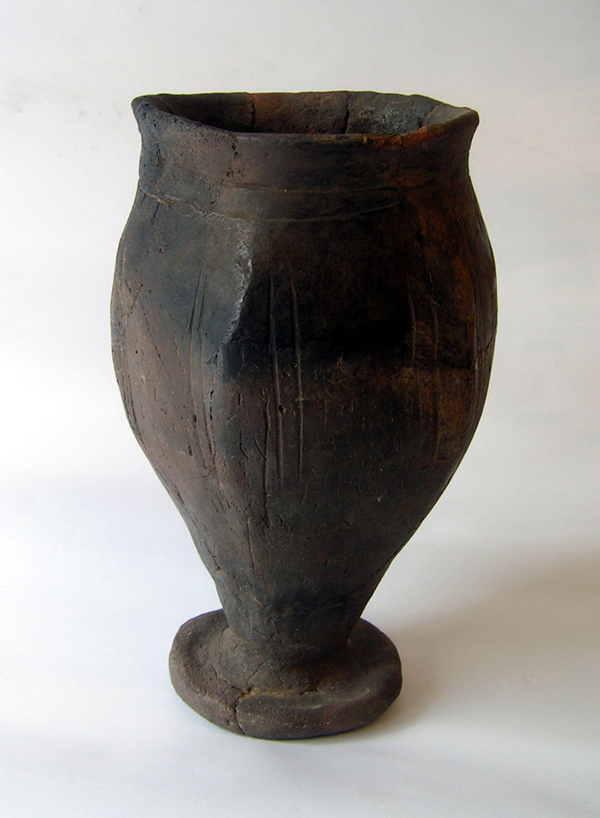
Archaeologists uncovered this little handmade pot, only 18 centimeters high, next to the head of a dead adult buried in the first half of the fifth century in a cemetery at Alton, in Hampshire. A few of Alton's later graves contained spectacular objects––swords, shields, fancy disc brooches, and an elaborate silver, gold-gilt, and garnet belt buckleFootnote 1––but the bulk of its burials, which date to a few generations after the withdrawal of the Roman state from Britain, included only a few simple objects or nothing at all.Footnote 2 This pot, which is from one of these early graves, was described as a “pedestal pot” by the late, great ceramics expert J. N. L. Myers, and he argued that it had been made by Jutes, one the peoples identified by the Venerable Bede in the eighth century as having taken part in the adventus Saxonum, “the coming of the English” to Britain.Footnote 3 Although the cemetery's excavator, Vera Evison, doubted the pot's Jutish antecedents, she nonetheless concurred that it, the cemetery it was found in, and the people buried within it were all Anglo-Saxon.Footnote 4
Scholars not only apply the ethnic label “Anglo-Saxon” to this pot but use it as a matter of course to describe all handmade ceramics produced in Britain in the fifth and early sixth centuries, and these ceramics, in turn, are employed to distinguish early medieval burials and settlement sites from Roman-period ones and to identify communities of Anglo-Saxon immigrants and their descendants. But a long, hard think about the little pot from Alton highlights the difficulties (tautological and otherwise) that arise when we ascribe ethnic identities to things and then turn around and use those things to determine the ethnicities of their makers and users.
There is no doubt that Myers and Evison were right in thinking that the Alton pot was produced and buried in the post-Roman period. Most ceramics used in Britain under Roman rule were mass-produced, wheel-thrown, and kiln-fired, and the tempers added to the clay of these pots were inorganic rather than organic.Footnote 5 This pot, on the other hand, like the vast majority of pots available in Britain in the first couple of hundred years after Rome's fall, was handmade and organic tempered and had been fired in a bonfire or a clamp.Footnote 6 Yet none of these things make the Alton pot “Anglo-Saxon.” Sometime in the decades after 400, in the aftermath of the economic implosion that accompanied imperial withdrawal, professional craftsmen in Britain could no longer make a living,Footnote 7 and the skills and technologies associated with their trades disappeared with them. One of the results is that people ceased to have access to the kinds of mass-produced, newly made containers that had until recently cluttered their houses.Footnote 8 Another is that since most people had purchased their pots, the knowledge and skills needed to throw a pot on a wheel or fire it in a kiln were not things that most households possessed.Footnote 9 Nonetheless, people native to Britain continued to need pots, so it does not necessarily follow that pots made in less sophisticated ways in the aftermath of the economic collapse were the handiwork of people new to Britain.Footnote 10 Indeed, anyone familiar with late Roman pottery will immediately see that this pedestal pot is not “Germanic” in the least but is rather a not very successful, handmade version of a Roman-period folded beaker, made by someone without the technologies or know-how of Roman-period potters, who had produced folded beakers by the wagonload. This beaker was fashioned, nonetheless, by someone who not only knew what a Roman beaker was supposed to look like, but wanted one.Footnote 11
Post-Roman beaker found in a fifth-century grave in Alton, Hampshire. Image courtesy of Hampshire Cultural Trust.

Beakers like this often served in the Roman period as grave gifts, and archaeologists have recovered hundreds from cemeteries, where they were often placed, as was the one at Alton, next to the heads of the dead.Footnote 12 In life, these beakers were used for wine or beer,Footnote 13 so their appearance in cemeteries may hint at the feasting and drinking that took place during the Roman period at the gravesite. Beakers were then widely available, so mourners would not have to be particularly well-off to procure one for a funeral. Still, there are hints that people economized when they could: beakers found in graves are often “seconds,” suggesting that less-than-perfect wares were available at special bargain prices for just such occasions.Footnote 14
The appearance of this beaker in a grave dug only a generation or two after Rome's withdrawal from Britain suggests that people burying at Alton, although they were no longer able to procure traditional, mass-produced, Roman-style pottery, were nonetheless familiar with the late Roman tradition of beaker burial and the rituals that accompanied it. The morphology of this pot, its placement in the grave, and its referencing of age-old traditions tell a very different story from the technologies that had been used to produce it. They suggest that Roman-style pots were still being made in the early fifth century, either by people who knew a little about potting, perhaps because their families had once made a living at it, or by amateurs for use in their own households. These things argue that the people who put this beaker in the ground were participating in ritual acts and engaging with material culture in ways that indigenous people across lowland Britain had been doing for centuries.
Once we see this little pot for what it is––an awkwardly fashioned, folded beaker, handmade and used by people who had very particular ideas about what pots should look like and how they should be used––we begin to see that other objects buried with Alton's earliest dead hint that at least some people here continued to engage with material culture in ways that people in the neighborhood had been doing for a very long time, even if whole classes of once common objects were rapidly disappearing because of the collapse of the Roman state and economy in Britain. One young woman buried at Alton, for example, wore a brooch on each shoulder, a fashion not followed by women in the fourth century.Footnote 15 Her brooches, however, were made in the Quoit-brooch style,Footnote 16 which, much like the pot, was at one time identified as a Jutish styleFootnote 17 but is now recognized as a category of fifth-century metalwork that evolved out of late Roman provincial metalworking traditions. Objects made in this style were the handiwork of craftsmen who are better described as post-Roman than “Anglo-Saxon,” since they are related to tastes and technologies found within the empire rather than outside of it.Footnote 18 Another of Alton's early burials, this one a cremation, employed an old Roman cooking pot as a receptacle for the dead person's ashes.Footnote 19 There was a long tradition, in the Roman period, of using kitchen pots in exactly this way.
The post-Roman folded beaker allows us to see traditional Romano-British material culture and material practices continuing into the fifth century, and it helps us understand the problem of the blanket labeling of all objects made after ca. 400 as “Anglo-Saxon.” Categorizing pots in this way has been especially pernicious, because ceramics are one of the few durable artifacts that survive from the period, and they are often our only way of seeing the people who lived in post-fall Britain. Because pottery dating to the fifth and early sixth centuries, including the Alton beaker, is labeled “Anglo-Saxon,” the people using it become “Anglo-Saxons” as well. The result is that several million people whose parents and grandparents had lived in Britain under Rome are erased from history.Footnote 20 Imposing ethnic labels like “Anglo-Saxon” on pots not only makes the vast majority of people living in fifth-century Britain invisible but it forecloses the very real possibility that the material culture and lifeways developing in Britain over the course of the fifth and sixth centuries were the handiwork not just of new peoples moving into Britain from the edges of the Roman world but of the many more individuals whose families had been there all along.
Over the course of the next couple of centuries, indigenes and newcomers together would build a new material world and forge a new identity, and their descendants, as the writings of Bede make clear, would eventually come to think of themselves as English. But as with most identities, this concoction was not rooted in birth or blood, and far from being a timeless, monolithic thing, it was historically constructed and advanced and maintained over the generations by shared material culture and material practices that evolved over the first couple of centuries of the Middle Ages.Footnote 21 But the “Anglo-Saxons” were nowhere to be found in the fifth century because they had not yet invented themselves.