It does not always happen that academic debates result in an agreed victory or a tidy consensus. As often as not, the protagonists lose interest, or the terrain itself shifts. For that reason, it is worth remarking on the fact that after around two decades of debating the roots of ethnicity in Africa, something like a consensus has in fact emerged. The colonial thesis that Africans were born into “tribes” that were rooted in a timeless past has been effectively critiqued by historians and social scientists alike. Arguably beginning with John Iliffe, revisionists advanced a challenging antithesis, namely that colonial administrative practices generated the very identities that officials and missionaries took for granted.Footnote 1 In Iliffe's famous formulation: “The British wrongly believed that Tanganyikans belonged to tribes; Tanganyikans created tribes to function within the colonial framework.”Footnote 2 Although Iliffe coined the term “the creation of tribes,” it was Terence Ranger's contribution to The Invention of Tradition that really sparked an interest in the historicity of ethnicity in Africa.Footnote 3 In fact, this was only one facet of Ranger's overall argument, one that was a good deal more nuanced than he has sometimes been given credit for. Be that as it may, the time was evidently ripe for a historiographical break, and during the 1980s and 1990s historians set about demonstrating that particular ethnic groups were indeed the product of an interplay between European interventions—by administrators, missionaries, employers, and colonial ethnographers—and selective African appropriations—through the agency of Christian converts, educated elites, urban migrants, and rural patriarchs.Footnote 4 The steady accretion of case-study material has subsequently culminated in reflections that have distilled the broad comparative lessons.Footnote 5 These have been helpful in creating a sense of agreement that the debate was necessary, whilst underscoring that a law of diminishing returns has set in, something more generally true of debates about constructivist approaches to identity.
The net result is that neither the thesis nor the antithesis finds much favor amongst historians today, at least in their pure forms. The idea that modern ‘tribes’ are rooted in the mists of time flies in the face of the fact that the Igbo of Nigeria, for example, only began to coalesce in the interwar period. But equally, the ‘invention’ paradigm assumes that identities are donned and shed according to a short-term and largely instrumentalist logic. It seems much more likely that the boundaries of self-identification have constantly mutated in line with the shifting configurations of space and power.Footnote 6 Colonial structures certainly did force Africans to rethink their relations with their neighbors, but there is no reason to believe that this was the first time this had occurred. For example, Islamic reformism in eighteenth- and nineteenth-century West Africa produced a complex interplay between religious and ethnic identities that remain salient for inter-group relations to this day. By focusing attention on the ways in which identities have mutated—whether by a process of scaling up (as in the Igbo case) or by a process of segmentation (for example, between pastoralist and sedentary Fulani/Fulbe across West Africa)—one is signaling an important element of continuity-within-change.
Importantly, these processes have left historical stretch-marks that are evident to this day. Tony Cohen's interpretation of symbolism as a mnemonic trigger that helps to connect past and present precisely because of the “very imprecision of the references to the past” is worth bearing in mind.Footnote 7 But this is also a rather presentist formulation. The very act of shifting the markers of identity at some point in the past may become encoded in memory, which, in turn, may be ritualized and expressed in symbolic forms. A similar argument has been made for the internalization of memories of the slave trade, most notably by Rosalind Shaw, but it has a wider application.Footnote 8 For West Africanists, perhaps the classic example is the founding myth of the Asante state, which held that the Golden Stool descended from the sky and thereafter embodied the soul (sumsum) of a single Asante people. This was part of a very practical project of binding hitherto separate Akan chiefdoms into an integral political unit at the start of the eighteenth century, even if the pre-existing foci of identification were never entirely erased.Footnote 9 In this case and countless others, symbolism is not just a present-day pursuit that stands outside historical processes—looking back at them, as it were, from afar—but may be deeply embedded within them right from the start. In seeking to rescue Bourdieu's concept of habitus from the charge that it posits a “closed cycle of repetitive change,” Shaw makes the following pertinent observation about how the past and the present can be connected through memory: “People do not respond as tabulae rasae when they construct and confront transformative events and political processes; rather, experiences of those events and processes that become sedimented as memory are themselves mediated and configured by memory. From such a position we can recast persistence, recurrence, and reproduction as integral parts of transformation and innovation rather than as their antithesis.”Footnote 10
The implication is that a fuller understanding of the dynamics of African identity requires some sense of longer-range processes, especially in West Africa where the roots of many contemporary identities can be traced back several centuries. Unfortunately, this is something that the debate about ethnicity in Africa, with its very modern frame of reference, has obscured. This paper makes a case for putting the history back into the study of African identities. I focus on the evolution of two sets of paired identities in West Africa where it is possible to impart some time-depth to questions of identity: those of the Mandinka and the Jola (or Diola) in what is now the Casamance region of Senegal and the Gambia, and the Ewe and the Agotime of what is now the Ghana-Togo borderlands. These cases are by no means exceptional, and in some respects a fuller case could be made for other parts of West Africa where the historical record is even richer.Footnote 11 The aim here is partly to recharge the debate about African ethnicities and partly to bring this debate to a wider audience that is interested in matters of identity construction.
HOW FAR WERE WEST AFRICAN IDENTITIES ETHNIC?
At least one African historian has warned against the dangers of reading ethnicity back into the pre-colonial past. In the words of Donald Wright, “Ethnicity as we think of it—a clear identity with, and strong loyalties to, an ethnic group—almost certainly did not exist in precolonial Africa.” Writing with special reference to the Gambia, he observes that identities were a “permeable membrane through which passed marriage partners, members of secret societies or occupational groupings, magico-religious figures (Muslims and non-Muslims) and just about everybody else.”Footnote 12 This echoes the observation that Iliffe made with respect to what is now Tanzania in the 1970s.Footnote 13 The point is well-taken: there is abundant evidence that before the twentieth century Africans were multi-lingual, held multiple self-ascriptions, shifted their identities, forged wider networks, and valued themselves on the basis of other criteria such as occupation and caste. However, no ethnicity has ever been hermetically sealed or free-floating. The points that Wright makes would hold equally well for the contemporary period, but there would be little sense in denying the salience of ethnicity today. One reason why he is so emphatic is in order to counter the colonial image of a continent populated by so many distinct ‘tribes.’ But at this stage, it is arguably superfluous to continue insisting on this point, and historians would be better advised to concentrate on understanding, in far greater detail, how identities were shaped and reinforced through everyday practice prior to the advent of colonialism.
The sources that are available to historians of pre-colonial African identities are the familiar ones. Firstly, there are the European written accounts of the fifteenth to the nineteenth centuries. Because they are written from the ‘outside,’ they may misconstrue some realities and simplify complexities. But their weakness is also their greatest strength, namely that they tend to identify the broad contours of inter-group boundaries with some clarity. It is true that they do not present a world of permeable membranes (Wright) or groups that merge seamlessly into each other (Iliffe). The reality they typically present is a rather one-dimensional one, but Europeans were also rather good at describing what they did comprehend. It might be argued that Europeans simply imposed their cognitive grid on African realities, but this is not terribly convincing. European observers tended to know their limitations and typically sought the help of African intermediaries—that is, interpreters in a cultural as well as a linguistic sense—who, in the process of codifying realities systematized everyday perceptions about the relationship between one group and the next. The exercise was selective, of course, but it portrayed one aspect of a lived reality.
There were two filters at work: African interpreters codified and transmitted basic information, while their European counterparts fitted what they heard into their own cognitive grids. But precisely because Europeans were unfamiliar with their fields of observation, they tended to relay information as faithfully as they could. The standard format of seventeenth- and eighteenth-century texts by traders and travelers to West Africa contains discrete—one might almost say disembodied—sections in which detailed description is interspersed with passages that represent the author's own opinions about the similarities and differences between European and African ways of doing things. The former represent almost an off-stage concession to the reader that the author has limited confidence in his ability to interpret behavior, and so faithfully records it for others to reflect upon. Whereas the more opinionated passages may now only be useful for getting at the workings of the European mind, the descriptive ones remain extremely useful to the historian because they are unburdened by the self-confident authorial voice. Hence it is difficult to read Richard Jobson's description of societies living along the Gambia River in 1620–1621 without being impressed by the fundamental familiarity of the world he describes and its resonance on points of detail with ethnographic accounts written in the twentieth century.Footnote 14 Not every writer was such an astute observer, but very many were—and, crucially for our purposes, they took matters of identity very seriously.
The second kind of source consists of the oral traditions of peoples who inhabit the regions today. These present a version of reality that does not necessarily clash with that of European accounts. If anything, they glide past each other, only sometimes achieving mutual recognition when they describe the same particular events. Whereas this is often the cause of frustration, what I wish to argue is that this is actually rather fortunate for the historian because they add in the dimensions that may be missing from the European accounts. European observers tended to focus on royal courts and trading towns—and took the trouble to inscribe these on maps—while oral traditions tend to relate the histories of particular lineages and ruling groups that are not spatially bounded in quite the same way. These relate to both courts and trading towns, but they also recount the histories of settlements that Europeans had no interest in and never visited. Moreover, these oral traditions display webs of interconnectedness in a way that European accounts never could.Footnote 15 Putting these different sources together enables one to write history in something approximating a multidimensional fashion. A familiar objection is that oral traditions are often difficult to reconcile, or that they tell an official history that may gloss over inconvenient realities—as with the traditions recounted by the Mandinka jeli or praise-singers. But, once again, their weakness can also be a strength, at least when it comes to writing up questions of identity. For the complex map they provide of the relations between ruling lineages is essential for making sense of identity, if only from the top down.
The lack of fit between the various traditions may also be significant in its own right because it may point to dissonance in a relationship—sometimes offering a perspective from the periphery or even from below. These again enable the historian to approach the question of identity from a presumption of complexity. To rule the modern concept of ethnicity out of court with respect to the pre-colonial period is to risk creating an artificial rupture between colonialism and what came before it, whereas historians need to look for the concatenations over time. Some would maintain that the concept of ethnicity is misleading, or even demeaning to Africans, and that “nation” would provide a more appropriate terminology. However, the baggage attached to the term “nation” by virtue of its association with the history of Europe in the eighteenth and more especially the nineteenth century creates more problems than it resolves.Footnote 16 Ethnicity, which we may take to refer to any form of ‘we-they’ distinction, is more open-ended and has the advantage that it does not presume any particular political form. That is, it can coexist with states and decentralized political forms, as we will see. Having presented a case for taking the pre-colonial matrices of identity seriously, I turn now to the two sets of case studies.
Mapping Mandinka and Jola in the Senegambia
The assemblage of peoples living along the Gambia River were visited by a succession of European traders over some five centuries, some of whom took the effort to record what they witnessed. Europeans, mostly French and Portuguese, also passed back and forth along the Casamance river further south and relayed back information of a similar kind. These written records, normally accompanied by maps, are helpful in forming a picture of the cultures and identities of peoples living between the Gambia and the Casamance rivers, although these become more fuzzy with distance from the respective river banks and the nomenclature shifts repeatedly.Footnote 17 Moreover, the picture consists of a series of snapshots, often punctuated by long gaps. Oral traditions have been collected more recently, and in the Gambian case, this has been systematically done.Footnote 18 These provide a qualitatively different set of data for the same inter-riverine region. One thing that emerges clearly enough from the written and oral sources alike is that the region in question used to be inhabited by Bainuk (or Bainunka) peoples who were subjected to demographic pressure from Jola- and Mandinka-speaking peoples. The eventual outcome was that the Bainuks were reduced to very small pockets, to the extent that they have become virtually invisible today.Footnote 19 This should not be taken to mean, however, that there was a single Bainuk tribe that was dramatically displaced by an influx of Jola and Mandinka settlers. There were distinct Bainuk polities and a network of trade linking the two river systems that their traders controlled. It is even more misleading to imagine that the Bainuks were casualties of a pre-colonial genocide, a term that Roche unwisely invokes in his otherwise reliable history of the Casamance.Footnote 20 The original Mandinka and Jola would have arrived in small numbers and would in all likelihood have been forced to accept the political dominance of Bainuk rulers. Gradually, the demographic balance seems to have shifted, with the result that the Bainuk were eventually absorbed into the Mandinka and Jola subgroups. Peter Mark puts the timing of Jola penetration into Buluf (north of the Casamance river) as the start of the seventeenth century. He notes that whereas Alvares d'Almada (writing in 1594) only identified a Bainuk-speaking people called the Jabundos, Lemos Coelho (in 1669) referred to “Felupos,” who later came to be known as Jolas.Footnote 21 Today, Bainuk traces remain in place names and in family names like Koli, Sambou, and Diatta.Footnote 22
Oral traditions tend to present a more dramatic picture of events. Bainuk accounts refer to the killing of one of their kings who cursed future generations, predicting that they would forever be a subject people. In modern parlance, the Bainuks were condemned to become deracinated. Mandinka and Jola traditions refer to conquest, but this telescopes what was likely to have been a slow process of cultural absorption. Indeed, Wright has gone as far as to suggest that there may never have been large-scale Mandinka migrations into the Gambia River region. Even relatively small groups of traders, who intermarried with local populations, could have exerted a cultural influence that led to their hosts adopting a Mandinka identity, whilst preserving their earlier patronyms.Footnote 23 However, this surely presupposes a sufficiently large demographic presence for the Mandinka to have exerted such an influence, rather than being absorbed themselves. There certainly were bouts of open warfare between Bainuks and Jola groups in the seventeenth century, but the latter did not emerge triumphant in a single war or even a series of engagements. The Jola were initially on the receiving end of enslavement by Bainuk rulers, as is clear from an account by Jajolet de la Courbe relating to 1685–1687. However, a version of the same source makes clear that Bainuk rulers felt the need to protect themselves against Jola attacks, suggesting that the forces were finely balanced.Footnote 24
The oral traditions of the recent past convey some sense of the underlying complexities. Roche refers to Bainuk traditions of migration from the direction of the Gabou empire (in what is now Guinea-Bissau), and specifically to two towns called Brikama—one being the large town in Kombo today—as settlements founded by them.Footnote 25 The tradition of migration from Gabou is also remembered today by ruling lines in Mandinka towns in Kombo.Footnote 26 They state that the first Mandinka settlers clashed with resident Bainuks who were there already, forcing the former to seek reinforcements from Gabou.Footnote 27 This could be taken to mean that there were three waves of in-migration from Gabou: one by Bainuks and two by Mandinkas. But it is also likely that the mixing of these two peoples has also led to an admixture of traditions. Because many Mandinkas today concede that their forebears were in fact Bainuks, it is extremely difficult to distinguish conquerors from conquered, or settlers from autochthons.
Unfortunately, Jobson's seventeenth-century account, which is focused on areas further upstream, says nothing about the Bainuk or the Jola peoples. It does comment extensively on the Mandinka and their relations with the Fulbe. The latter Johnson depicts rather sympathetically as the downtrodden clients of their Mandinka neighbors, from whom they are distinguished by language, physical appearance, and mode of living: “Their profession is keeping of Cattle, some Goats they have, but the Heards they tend are Beefes, whereof they are aboundantly stored: In some places they have settled Townes, but for the most part they are still wandering; uniting themselves in kindred and families, and so drive their heards together… . [T]he Mandingo, or Blacke-man applies himselfe, at no time, in keeping or preserving of Cattle, but leaves it to the painefull Fulby.”Footnote 28
Jobson's account is perhaps over-drawn, but as a description of inter-ethnic relations, it presents a recognizable account of the symbiosis between pastoralists and agriculturalists. The terms ‘Mandingo’ and ‘Fulbe’ were clearly not of Jobson's invention: they were certainly used by the peoples who recognized each other as ‘Other,’ despite living cheek by jowl. Jobson represents the boundary between them as impermeable, but then it probably was relatively hard because the ethnic markers were defined by distinct livelihoods as much as by language. Jobson's rather negative views of the Mandinka are also worth quoting because they resonate in interesting ways with later depictions of a people given to the most minimalist efforts in farming: “The men, for their parts, do live a most idle kinde of life, imploying themselves (I meane the greater part) to no kinde of trade nor excercise, except it be onely some two months of the yeare, which is in tilling, and bringing home their country corne and graine, wherein the preservation of their lives consists, and in that time their labour is sore.”Footnote 29
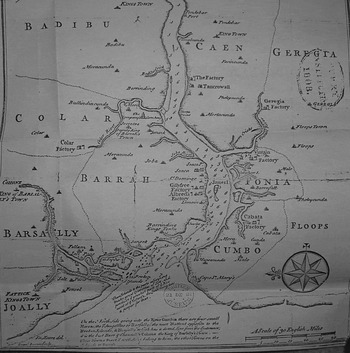
When Francis Moore came to write about his travels along the Gambia River in 1730, he drew a much more detailed picture. On the lower end of the river, Moore identified three small kingdoms on the south bank that appear on the accompanying map: Kombo, Fogny (or ‘Fonia), and Kiang (‘Caen’) (see Map 1). About Fogny, Moore commented, “Inland it is very large, and governed by two Emperors, who are of a Banyoon [Bainuk] Race, which is a sort of Floops, and have each their distinct Districts.”Footnote 30 This passage is significant because it suggests the Bainuk ruling houses had not been entirely displaced, but that they had also begun to merge into the “Floop” or Jola population. In the case of Kiang, Moore observed that it was governed by Mandinkas, as were those kingdoms further along the river, but he referred to ‘Banyoons’ at the trading town of Geregia.Footnote 31 Because Geregia had long been an important crossroads linking Gambia/Casamance river trade routes with European commerce, and because the Bainuk were reputed to be accomplished traders, this is unsurprising.Footnote 32
Section of Map Showing Mouth of the Gambia Accompanying Francis Moore's, Travels into the Inland Parts of Africa (1738).

Moore commented specifically upon distinct groups living along the banks of the Gambia River: “Mundingoes, Jolloifs [Wolofs], Pholeys [Fula/Fulbe], Floops [Jolas], and Portuguese [Creoles].”Footnote 33 On the map, the dotted lines designate kingdoms near the mouth of the river, but the other detail pinpoints populations that he presumably singled out because they stood in a problematic relationship to authority. Hence “Pholeykunda” points to the existence of a Fula settlement, while “Floops towns” similarly punctuate the cartographic landscape. This a representation of a world in which Mandinkas, Jolas, and Fulas lived very close to one another, but with the last two tending to resist centralizing tendencies on the part of those who called themselves mansas, or kings.
Moore's depiction of Fulbe agro-pastoralists is as positive as it is detailed, noting that they “are not subject to any Kings of the Country, tho’ they live in their Territories; for if they are ill-treated in one Nation, they break up their towns, and remove to another.”Footnote 34 But for our purposes, what is more revealing is his portrayal of an ethnic frontier between the Mandinka and the Jola (and Jola-ized Bainuk). This is worth quoting at length:
On the South-side of this River, over against James Fort, in the Empire of Fonia, and but a little Way inland are a Sort of People called Floops, who are in a manner wild: they border close to the Mundingoes and are bitter Enemies to each other. Their Country is of a vast Extent, but they have no King among them, each of their Towns being fortified with Sticks drove all round and filled up with Clay: They are independent of each other, and under the Government of no one Chief; notwithstanding which, they unite so firmly that all the force of the Mundingoes (tho’ so very numerous) cannot get the better of them.Footnote 35
This passage appears to contradict his earlier reference to “Banyoon Emperors,” but, presumably, the point Moore was seeking to make is that the reach of these supposed rulers over Jola villages was very limited. His depiction of fiercely independent communities, who could nevertheless combine against a common enemy, is replicated in reports about Jola society at the end of the nineteenth century. Moreover, Moore's depiction of Mandinka-“Floop” relations makes clear that there was a real dividing line characterized by latent conflict, and reinforced by culturally loaded differences. Whereas the Mandinkas traded freely with the Europeans, and sold slaves to them, the “wild” Jolas maintained a defensive posture against both groups. The fortifications they built were, at least in frontier regions, defenses against Mandinka raiders who sold Jolas into the slave trade.Footnote 36 Moreover, the Jola were reputed to actively avoid direct European contact, despite depending on trade for the acquisition of imported goods, notably the iron with which they tipped their long hoes (or kanyendo).Footnote 37 Although Roche claims that the Jola were not involved in the slave trade, there is good evidence that Jola groups did in fact sell many of their captives as slaves by the eighteenth century.Footnote 38 These would often have been the result of warring between villages. But crucially the Jola of Fogny and Buluf did not build a society based on slavery, unlike the Mandinka and the Fula. The second major difference was that the Jola were specialists in wetland rice cultivation. The productivity of their rice culture permitted relatively high population densities, while the investment in fields that needed to be desalinated presupposed a considerable measure of communal cooperation in the absence of a hierarchical political structure.Footnote 39 Hence, the supposedly anarchic nature of the Jola, as perceived by Mandinkas and Europeans alike, belied a high degree of social organization. Finally, although many Mandinka were nominal Muslims, there was a perceived correlation between the two. European travelers of the seventeenth and eighteenth centuries commented repeatedly on their encounters with Mandinka marabouts. By contrast, the Jolas were portrayed as untouched by Islam, which indeed they were until the end of the nineteenth century.
Moore's account is also tantalizing for what it reveals about ethnic stereotyping. The “wild Floops” were clearly a Mandinka construct, which partly reflected a Muslim disdain for “paganism.” But Moore also goes on to present a rather more qualified image of this group: “These Floops have the Character never to forgive, or let the least Injury go unrevenged; but then, to make amends, the least good Office done to them is always repaid by them with a grateful Acknowledgement.”Footnote 40 In this passage, “wildness” is compensated for by a simple, but fundamental, integrity. Again, it would seem most likely that the flip side came directly from the observations of Mandinka traders who necessarily dealt with the Jola. What is remarkable about this passage is the form of words that Moore chooses. One version of the etymology of the term “Jola”—which was not in use in the eighteenth century but became current in the nineteenth—was precisely that of the ‘people who pay back,’ both in the literal and figurative senses.Footnote 41 The dictum that Moore reproduces seems, therefore, to have been in usage for at least a century before finally giving rise to the ethnonym. This is an excellent illustration of the ways in which pre-colonial labels later became entrenched as colonial terminology. Right across Africa, the ethnonyms that came to be encoded in colonial discourse were of African origin—sometimes designating where a particular group lived or pointing to some aspect of their lifestyle that their neighbors found worthy of comment. What has yet to be fully appreciated is the extent to which European stereotypes of specific “tribes” were themselves second-hand representations.
Traders and Farmers, Ewe and Agotime
Turning to the second pairing of the Ewe and the Agotime, two differences in the quality of the data are worth noting. The first is that the information pertaining to the Volta River hinterland is much more limited than for the Gambia region. This is perhaps surprising because European traders came to this stretch of coastline not much later. Moreover, the volume of slaves exported from the Gold and Slave Coasts greatly exceeded that of the Senegambia, which meant that there was a steady flow of European visitors.Footnote 42 The difference is that the English, the Dutch, and the Danes tended to confine their trading operations to the coastline, working out of castles and forts (as along the Gold Coast) or more temporary factories east of Accra. The Volta River was an important conduit for trade coming down from what is now northern Ghana. Slaves also came from through ‘Krepi’ (roughly northern Eweland), while salt and imported goods were transported upriver.Footnote 43 But it was Africans who generally traveled to the European factories. The Danes attempted to control the Volta River trade at the expense of their European rivals. In addition to their castle adjoining those of the English and the Dutch at Accra, they established trading posts at Ada and Keta at the mouth of the river and the lagoon, respectively.Footnote 44 But these were never intended to provide a bridgehead for entry into the interior, which remained terra incognita from just a little way inland. Hence maps down to the early nineteenth century provide relatively accurate information about the location of the Akan polities of Awkamu and Akyem west of the Volta, and those of the coastline itself, but east of the Volta blank spaces are the order of the day until one reaches the western marches of Dahomey. Hence Labat's description of the coastline in the late 1720s comments at length on the coastal rivalries between “Coto or Lampi” (Keta/Ladoku), Popo, Whydah (‘Judah’), and its new overlord, Dahomey. But he says nothing about the peoples who lived less than a day's travel inland from Keta. On the maps that accompany the book, the mouth of the Volta is shown, but the text simply states: “We do not go up this river and its course is unknown to us.” (“On ne remonte pas dans cette rivière et sons cours nous est inconnu.”)Footnote 45 It would appear that the first detailed map of the interior, that of Thonning, dates from as late as 1802.Footnote 46
By contrast with the Senegambia, the European push along the Gold and Slave coasts was lateral. Hence whereas it was peoples of the coastline of the Casamance who were largely unfamiliar to the Europeans—such as the inhabitants of the islands of Karone—the position was reversed in the trans-Volta. Of course, African traders who came to the trading factories conveyed political information that Europeans valued, and the quality of this information improved in the nineteenth century, but information about ‘Krepi’ was patchy. To compound the problem for the historian, there has never been a systematic attempt to collect the oral traditions of the Ewe-speaking peoples and their neighbors. Early colonial officials put together some local histories that have survived, but there are significant gaps in the coverage.Footnote 47 As a result, what we can say with confidence about identities in the trans-Volta is much more tentative than for the Senegambia.
The second point is a more intriguing one. Whereas Europeans writing about the Senegambia deployed a language that translates very easily into the modern vocabulary of ethnicity, this was not the case along the coastline east of Accra. The referents here are kingdoms and chiefdoms, as they are in Moore's text, but what is lacking is a countervailing tendency to highlight cultural features that traversed political borders. It might be argued that this is an optical allusion, in that attributes were appended to the polities themselves—hence the “warlike Dahomeans” who stalk the pages of many eighteenth- and nineteenth-century accounts—which were construed as akin to European nations. But Europeans were quite capable of distinguishing political boundaries from ethnic markers. Hence, Mandinkas and Jolas inhabited different political units, but were routinely grouped as “Mandingos” and “Floops” with opposing characteristics attributed to each. Whereas Ewe-speaking and Twi-speaking peoples were equally separated into discrete political units, Europeans never referred to Akan or Ewe qualities, but rather to Akims, “Lampis,” Popos, and Krepis who might fare better at warfare or trade, but were otherwise not that dissimilar. It is true that the Danes sometimes described the “Krepi” as being the ideal slaves, but this was a vague designation for peoples of the trans-Volta. It referred to both northern Ewe-speakers and a much larger cluster of non-Ewe peoples. “Krepi” was never used with the particularity that “Mandingo” was. It is my contention here that different European usage reflects an underlying reality. Namely, whereas there were well-demarcated ethnic frontiers between Mandinka, Jola, and Fula that were reinforced by visible differences of economy, material culture and to some extent religion, differences were not mutually reinforcing in the case of the eastern Gold and Slave Coasts. In principle, littoral communities who fished and panned salt could be distinguished from those that farmed maize and yams further inland, but the networks of trade and settlement blurred the distinctions.
Bearing these points in mind, let us now turn to Ewe and Agotime relations in closer detail. The traditions of the Ewe-speaking peoples are fairly clear on many of the fundamentals of their history. They refer to successive migrations from the east, and place particular store by a tradition that they all once resided at the town of Notsie before dispersing to their present locations, where they divided into separate chieftaincies (duk  , sing. or duk wo, pl.). They typically refer to having encountered pre-existing inhabitants who were defeated and chased away. Some of the latter apparently survived as the Central Togo minorities that inhabit the Togoland hills.Footnote 48 Although the idea of a mass dispersal from Notsie is hardly credible, available evidence supports the steady westward drift of Ewe-speakers in the seventeenth century.Footnote 49 The Ewe duk wo that emerged were small chiefdoms, typically comprising only a collection of a few villages under a common head. The exceptions were coastal Anlo, which grew into a much larger entity, and Peki, both of which benefited by adopting aspects of Akan military tactics. Because the dominance of the Notsie meta-narrative may be of relatively recent origin, one should be cautious about reading a deeply rooted sense of Ewe identity into the past.Footnote 50 But, as with Mandinka migrations into Kombo, communities shared memories of connections between themselves, often embodied in stories of segmentation at some point in the migration process. In addition, temporary alliances were forged between Ewe polities. In 1833–1834, most (but not all) of the Krepi duk wo rallied together under the leadership of Peki, to cast off their subject status to Akwamu and hence Asante. Most subsequently resisted the Asante invasion of the trans-Volta in 1868–1871 that was intended to re-subjugate the trans-Volta. It would be making too great a claim to say that a common Ewe consciousness was born at this point. But these events certainly did leave a lasting imprint on the Ewe-speaking peoples and cooperation provided a template for Ewe nationalists in the twentieth century.
The northern Ewe polities had more powerful neighbors, but they also lived next to smaller collectivities. These included an Adangbe diaspora.Footnote 51 The latter seem to have come from the vicinity of Ada, but sought sanctuary from political violence in the late seventeenth century by relocating east of the Volta. Scattered across what is now the Volta Region of Ghana and southern Togo are small Adangbe groups who are mostly indistinguishable from their Ewe neighbors today. The largest is the Agotime who share borders with some of the larger Ewe-speaking duk wo, notably Ho and Adaklu in Ghana and Agu in Togo. The Agotime are better represented in the historical record than most. They make their first appearance in Danish sources in the first half of the eighteenth century.Footnote 52 A letter from the Danish factor at Keta in 1749 referred to Kwahu traders having arrived at Agotime in order to purchase slaves and ivory, and relayed their demands for more trade goods (including iron bars and knives) to be able to exchange for them.Footnote 53 The following year, an Agotime caboceer (roughly speaking, “chief”), Keteku, sent a message promising to settle some outstanding palavers with Anloga and Keta in order that his people could bring their trade goods southwards. He promised to come with traders from four or five Agotime towns and to bring thirty slaves and a supply of ivory with him.Footnote 54 A subsequent 1751 letter reported that the “Agotim Caboceer,” presumably the same Keteku, had indeed sold a quantity of slaves and ivory at Klikor.Footnote 55 A correspondence from 1754 on the subject of bad debts refers to credit having been extended to Agotime traders by the Danish factors. What this confirms is that the Agotime were never simply suppliers to the Akwamu and Anlo who dominated the trade in slaves, ivory, dried fish, coastal salt, and imported goods, but became significant players in their own right. Akwamu traders handled most of the salt trade towards the borders of Dahomey, but Agotimes also participated in this trade, which modern traditions attribute to a much deeper historical association with the salt making in their original coastal homeland.Footnote 56 Significantly, Agotimes today recall a historic association with other Adangbe settlements that were conveniently located on the main trade route linking the Volta River with Anécho and Dahomey. In short, the Agotime carved out a niche for themselves as traders, operating along both the north-south and east-west axes. By contrast, their northern Ewe neighbors were renowned more for their success as farmers. Part of what was traded down the Volta was agricultural surplus produced by these dedicated Ewe agriculturalists, such as yams, millet, and cotton. The Agotime, who had settled in an area that was reputed to be rather dry, seem to have taken a pride in not working the land.
In the eighteenth and nineteenth centuries, trading and warfare tended to be complementary. Slaves were one of the commodities that could be traded for the guns that were needed to maintain one's position in a regional system of power. But trade was always a risky business, as is reflected in the story of one Tete from Agotime-Kpetoe who ended up being one of Koelle's linguistic informants in Freetown in the mid-nineteenth century. Tete recalled that he had been enslaved by people from just south of Agu—presumably he was “panyarred” en route—in order to settle a debt owed by another Kpetoe man.Footnote 57 He was sold at the port of “Girefe,” almost certainly the Dahomean port of Whydah,Footnote 58 where the slave trade continued through to the mid-nineteenth century. Agotimes today are fond of the claim that they dominated most of their Ewe neighbors because of their pursuit of war as a vocation. This is plausible given that some of the slaves the Agotime traded would have been military captives. There is also evidence the Agotime reputation for martial prowess was credited by their neighbors. Hence the spark that ignited the Krepi rebellion against Akwamu in 1833 was a war between two Ewe duk wo in which the Agotime were recruited to fight.Footnote 59 The fundamental point here is that the combination of trade and warfare set the Agotime somewhat apart from their northern Ewe neighbors who took pride in their working of the soil. Nevertheless, this ethnic frontier was far more permeable than the Mandinka/Jola one, for reasons I will now elaborate upon.
Contemporary Agotime traditions tend to be rendered as if a single group of Adangbes migrated from their original homeland and then doubled back, leaving some of their peoples behind in the shape of scattered settlements that remain in Togo. The present Agotime head chief, Nene Noe Keteku, insists that his people fought the Agu-Ewe and the Adaklu-Ewe and thereby established the right to settle at their present location.Footnote 60 By contrast, Adaklu traditions recall that the Adangbe strangers requested land from them, and were told to settle at a place where a particular kind of palm tree, the fan palm or agoti, grew in profusion. Living amongst the palm trees (literally, “agoti-me”), the settlers came to be known as Agotime rather than as Adangbe (or Adampe). Whether this was a landlord-stranger relationship, of a kind that is standard across West Africa, or one that was based on conquest, is at the heart of a bitter dispute between the Agotime and the Adaklu to this day.Footnote 61 Keteku's account is one that takes pride in the military prowess of the Agotime, but it also accepts that they became mixed with various Ewe peoples as they established their locally dominant position. The traditions of particular settlements suggest that Agotime was a composite society made up of not just of an Adangbe core, but other fragments as well. Of the ten constituent units that Robert Cornevin identified in Togo—the towns of Adame, Ando, Amoussoukope, Agoudouvou, Adjakpa, Batome, Zukpe, Letsoukope, Nyitoe, and Kpodjahon—Ando and Nyitoe are typically described today as “not pure Agotime.”Footnote 62 The Andos were Ewes who seem to have been forced into a client status, while the Nyitoe apparently came from Adaklu. Although nobody is keen to advertise the fact today, Batome was a slave village belonging to a war-chief of Kpetoe (now in Ghana). The Agoue clan in Kpetoe is also allegedly made up of people who were originally captives from Agu, and at least one other village can tell a similar story.
Over the course of the twentieth century, there has been a bitter rivalry between Kpetoe and the village of Afegame (also in Ghana) that claims the headship for itself. The Afegames insist that they are “pure Adangbe” whereas the Kpetoes are a mélange of disparate peoples. Whereas this is intended as a damning criticism, Keteku's version of events takes pride in this depiction because it underlines the military success of the core Adangbe group from the time of their arrival in the area. In this interpretation, the Afegame are cast as losers in the distribution of the spoils. In Keteku's words: “The Ando and Atsi tribe remnants, mostly women and children were captured and sold into slavery. The beautiful women were forced to marry the Leh [Adangbe] men. Legend had it that the marriage of such women brought a lot of family misunderstandings and that was the reason for most clans leaving Wenuam [Afegame] to put up new villages and settlements.”Footnote 63
On this decidedly non-essentialist reading of history, non-Adangbes became Agotime through processes connected with slavery, marriage, or settlement. This chimes in quite nicely with way in which the people of Nyitoe today counter the insistence on the part of the inhabitants of the twin-town of Zukpe that they are not pure Agotimes and hence cannot enjoy rights to a substantive chief. Their riposte is that nobody can claim to be pure Agotime: the point is that the collective name of Agotime refers to people who ended up living ‘amongst the palm trees’ and says nothing about a single origin or culture. Such renditions of the past do make the best sense of Agotime history. Apart from anything else, they underscore the crucial point that while the Agotime distinguished themselves from their Ewe neighbors by virtue of their calling to trade and warfare, these same activities created tributaries, marital alliances, and slaves, inevitably converting Ewes into Agotimes. Hence, the border between was necessarily a permeable one in the eighteenth and nineteenth centuries. A similar process characterized the relations between Bainuks, on the one hand, and Mandinka and Jola on the other, whereas between Mandinka and Jola, it was absent.
THE SHIFTING CONTOURS OF IDENTITY C. 1870–1930
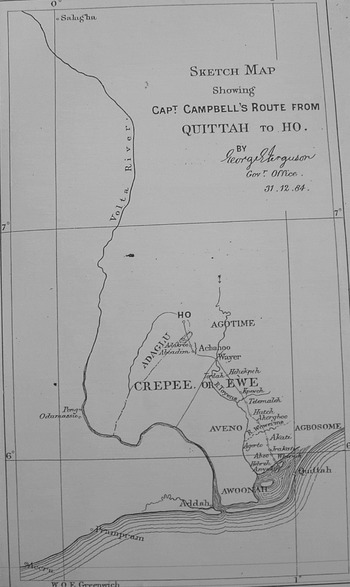
In both of the cases under consideration, the last decades of the nineteenth century were characterized by upheavals that provided some of the motive and much of the excuse for the imposition of European rule. Colonialism created a framework within which Africans had the occasion to think about themselves in relation to neighbors, some of whom were previously unknown to them. But it is the contention of this article that the element of radical transformation can be exaggerated. Whereas some writing within the ‘invention of tribes’ genre places emphasis on the hardening of previously permeable boundaries of identification—the colonial ‘tribe’—these two case studies exemplify the opposite: that is, where group boundaries were previously hard they were more easily breached and where they were already permeable they became yet more so. It is also worth underlining that two of the four names that became colonial ethnonyms—Mandinka and Agotime—were current in the eighteenth century, whereas a third—Jola—was in place by the nineteenth. Only the ‘Ewe’ ethnonym can be attributed to the colonial period proper. Map 2, which dates from 1884, represents one of the earliest usages of the term.
Map of Gold and Slave Coasts, With Mouth of Volta River Shown, Accompanying Père Labat, Voyage du Chevalier des Marchais en Guinée, isles voisines et Cayenne fait en 1725, 1726 et 1727 (1730).

Naturally, the meanings attached to these labels shifted over time. Indeed, what I wish to argue in the remainder of this article is that the term “invention” obscures precisely the ways in which colonial identities involved mutations of older forms of signification.Footnote 64 In this context, it is important not to take the colonial conceit at face value. Coercive force evidently had its limits, as European administrators were painfully aware. But to suggest that the battle was fought on a cultural plane merely displaces the underlying problem. While Europeans were militarily relatively strong, in every other respect they were vulnerable.Footnote 65 In order to tweak African societies in the desired directions, Europeans were forced to lean heavily on African informants in every sense of the word. Even the missionaries, who claimed to be wiping the slate clean, borrowed freely from African epistemologies, rather than introducing radically new ones.Footnote 66 In the turbulent years of the early twentieth century, Europeans therefore became captive to African ways of seeing. When they finally settled down in the interwar period to remake the African world in their own image, they drew on the writings and administrative files of an earlier generation of military officers and civil officials. What had been quietly forgotten was the African provenance of much of this collected wisdom. This was especially evident when it came to the question of “tribes” because attributes that were appended to the latter had a history in and of themselves. And that was a history largely made by Africans.
Islam and Ethnicity in the Gambia-Casamance Borderlands
In the western Senegambia, it is impossible to separate the imposition of European rule from a series of religious conflicts that brought devastating consequences from the mid-nineteenth century. These began as a struggle for power within the Mandinka kingdoms between Muslim reformers (the “marabouts”) and rulers who were either animists (“Soninkes”) or who were accused of backsliding. The proximity of Kombo to the British trading post at Cape St. Mary's meant that the latter came to hold the balance of power in a struggle between Soninke rulers and their Muslim subjects. This was eventually resolved in favor of the maraboutic cause in 1875, following which Kombo came under the control of one Fodé Sylla. In practical terms, the last barriers to conversion amongst the Mandinka had been removed in Kombo, if not in Narang and Fogny Jabangkunda to the south. Sylla proceeded to extend his jihad, attacking not merely the remaining Soninke outposts, but his Jola neighbors as well. On the face of things, the objective was still to bring about conversion, but in practice, Sylla's forces were engaged in raiding for slaves who could then be then sold eastwards.Footnote 67 Sylla justified his actions to the Europeans on the basis that the Jola “worshipping of idols” represented a religious affront and thus made them fair game. The havoc created by Sylla posed a threat to European commerce, with the eventual upshot that the British invaded Kombo and ousted him in 1894. The British and the French had already agreed to a paper partition in 1889. With the troublesome marabout finally out of the way, their western border could be demarcated.
The violence of the later nineteenth century further hardened the line of division between Mandinka and Jola communities. British and French officials repeatedly observed that the Jola were hostile both to the Mandinka and to Islam, associating each of them with violent enslavement. This opposition was, if anything, made that much sharper by the initial expedient of resorting to Mandinka chiefs to govern Jola populations. The French faced a constant struggle to secure compliance from Jola villages where demands for taxes repeatedly elicited a defiant response.Footnote 68 The reasoning was therefore that, however unpopular Mandinka chiefs might be, they might succeed in raising taxes and imposing law and order upon the “anarchic” Jola. But demands for tax, and later for military conscripts, simply confirmed the most negative Jola image of the Mandinka. Hence when the French grip faltered during the First World War, Mandinka chiefs were forcibly expelled by Jola villages seeking to restore their independence. When the French managed to restore order by military re-conquest, they rectified their earlier mistake by creating a new stratum of Jola chiefs.
British images of the Jola mirrored those of the French. In the words of one official: “There is only one name for the Jolah, ‘Savage’ and he must be treated as such; naturally it will take many years to work him up to the standard of other tribes.”Footnote 69 The British began by trying to use Mandinka chiefs to govern refractory Jola villagers and similarly bemoaned the failure of the experiment. British officials blamed many of their problems on Jolas who had crossed the border, carrying with them a penchant for thwarting European officers. A report from 1901 observed that the murder of Mandinka traders had become quite commonplace: “Crime in Fogni is excessive, the Jolahs they are continually committing murders & highway robberies. The hard part of a Commissioner's work in this District is his inability to make arrests, no Jolah will ever arrest another, & the Mandingos are afraid to; another point is that it is very hard indeed to get one Jolah to give evidence against another.”Footnote 70 Somewhat earlier than the French, the British realized that only Jola chiefs stood a chance of winning a modicum of acceptance.
Given that religion had defined the line of schism in the second half of the nineteenth century, the subsequent turn of events could hardly have been anticipated. While some French officials agreed that saving Jola ‘animists’ from the advance of Islam would be desirable, fervent anti-clericalism led to obstacles being placed in the way of the Catholic Church. The net result was that while some conversion to Christianity took place south of the Casamance river, most of the region was untouched by missionary activity. Instead, the Jola began to convert to Islam, so that by the 1930s the religious landscape had been completely transformed. This is not the place to fully account for this sudden embrace of Islam; suffice to say that it now came to be associated with the quest for peace and an alternative form of modernity.Footnote 71 New Muslim villages were founded, existing settlements changed their names to reflect their new religious identity, mosques sprung up throughout the Casamance, and new forms of dress and address were adopted. In the Gambia, where the impact of the Christian missions was scarcely felt outside of Banjul, the story was very similar.Footnote 72 In both cases, it is not coincidental that Mauritanian marabouts spearheaded conversion because they were devoid of the stigma that continued to be attached to the Mandinka. Cheikh Mahfoudz, a grandson of the founder of the Fadeliyya Sufi order in Mauritania, is synonymous with this rapid process of voluntary conversion. After traveling through Senegal, Mali, Guinea, and Guinea-Bissau he was given permission to settle in the Casamance in 1901.Footnote 73 Mahfoudz is remembered today as having spent time preaching in Jola villages, persuading people of the error of their ways, rather than aggressively attacking “idolatry.” By contrast, the memory of Fodé Sylla continues to be reviled by the Jola, even as it is venerated by many Mandinka.
By the Second World War, an adherence to Islam was no longer particular to the Mandinka. On the contrary, it increasingly provided a template for ethnic cooperation. Although the Jola were said to be less orthodox in their observance than Mandinka, European attempts to distinguish between them belied the reality of convergence. Crucially, adherence to Islam provided a charter for equality based not on place of origin, but on belief and practice. This was important because it was coupled with migration in the interwar period, as Jola farmers from high-density areas in Buluf went in search of farmland. Many crossed into the Gambia, where they were welcomed by the British as part of their efforts to boost groundnut production, while others settled just inside the Casamance border.Footnote 74 Jola incomers often built their new homes in existing Mandinka towns where they were accepted as fellow Muslims. At the same time, Mandinka marabouts went in search of converts in Jola areas that it would have been perilous even to have set foot in a matter of decades before. Their success was the cause of some bafflement to European officials who, rather lamely, invoked Jola gullibility.Footnote 75
The net result was that villages in northern Casamance and the Gambia became ethnically mixed to a degree that would have been unimaginable in the Gold Coast. Inevitably, there were some points of friction, particularly where the demographic balance shifted in favor of Jola immigrants coming to historically Mandinka towns. But what is remarkable is the extent to which the Mandinka felt able to accommodate immigrants on equal terms. Of course, the softening of the ethnic boundary did not amount to a total erasure. Perceptions of difference continued to be rooted in the preferred livelihood strategies of Mandinka and Jola, and reciprocated stereotypes. European officials embellished these well-worn images, but they certainly did not fabricate them. While the British and the French routinely complained about the laziness of Mandinka farmers, who produced groundnuts of poor quality and insufficient grain, the Jola were praised for—and evidently took pride in—their skill as wetland rice farmers. Although the sexual division of labor shifted somewhat with conversion, the Jola remained as wedded to rice cultivation as ever, producing very respectable yields per acre.Footnote 76 On the other side, the Jola tended not to value trade and left it to Lebanese merchants and Mandinka traders.Footnote 77 Jola Muslims retained their sense of being distinct from the Mandinka, even as they moved closer to the latter in both spatial and religious senses. In this situation, stereotyping and greater social proximity were natural bedfellows.
Amongst the Mandinka, the most salient identity tended to be that of the hometown. This was especially true where the town in question had a venerable history, such as that of Gunjur or Kabadio. The Jola who migrated freely for the first time in the twentieth century acquired a heightened sense of being “Jola” through the process of migration, although significant dialectical differences underlined cultural variations between the constituent subgroups. But the village of origin retained its importance as a marker of identity and, if anything became more salient with distance from home. Much the same could be said of the Igbo of Nigeria, the difference being that they were much slower in seeking to codify what it meant to be Jola.Footnote 78 In the first three decades of the twentieth century, a Jola identity remained meaningful in its relation to other categories—Mandinka, Fula/Fulbe, and European—much as before. But the center of gravity remained with lower-order identities, and amongst these was the identity associated with the chosen place of settlement.Footnote 79
Christianity and Ethnicity on the Ewe-Agotime Frontier
In the Ewe-Agotime case, the defining moment was the armed invasion of the trans-Volta by Asante, which was accompanied by the destruction of entire villages, enslavement, and mass flight into the Togoland hills. It created the germ of the idea that the duk wo had a common interest in uniting to defend their common interests. The largest of the northern Ewe chiefdoms, Peki, endeavored to establish itself as the leader of the Krepi as Europeans displayed heightened interest in the region following the successful British invasion of Asante in 1874 and the eastwards shift of the trade routes. The Asante wars also led to a significant reconfiguration of communities, as refugees returned to rebuild their lives, as new claimants on leadership emerged, and as politico-military structures were adapted in order to forestall a repeat of the disaster. In Agotime, the evidence would suggest that there had never been chiefly lines, but rather that ‘big men’ had risen to prominence at particular conjunctures. Before the Asante invasion, the Agotime had just such a leader (a war chief, or avafia), by the name Akoto, but in the early 1870s he ceded leadership to a younger figure, Agbovi, who led a relatively successful guerrilla campaign. The experience of the Asante occupation fostered alliances and generated lines of fracture between those who had fought the Asante and those who had collaborated. Hence the Agotime came to enjoy a close relationship with the Ewes of Ho, with whom they had resisted the Asante forces, whereas the Adaklu stood accused of having led the enemy directly to them. The question of ethnicity was not salient because the alliances and cleavages cut across Ewe/non-Ewe lines. Equally, the attempts by the rulers of Peki to speak for all the Krepi chiefdoms failed because most of the Ewe and non-Ewe duk wo jealously guarded their sovereignty.
After the proclamation of a German protectorate at the coast in 1884, the British and the Germans competed in signing treaties of protection in the trans-Volta.Footnote 80 Each of the duk wo struck a deal in accordance with its own perceived self-interest. When it became clear that they were stacking up claims to the same areas, the British and the Germans agreed to a negotiated settlement. Some confusion surrounded Peki's territorial limits, but the matter was resolved by the 1890 Heligoland Treaty. This drove a border through Eweland, with Peki proper placed in the Gold Coast, while the rest of northern Eweland passed to German control. All of the minorities, including the Agotime, were deposited in German Togo, while the Volta River henceforth defined the international boundary north of Peki.
On the face of things, the Ewe might appear to typify an invented tribe. Indeed, Claude Welch's classic study of the Ewe unification movement prefigures much of the writing in this vein. It makes the point that whereas the Ewe had never been united, colonial rule brought with it the socio-economic forces which helped the Ewe to conceive of themselves as a single people divided by artificial colonial borders.Footnote 81 In Welch's account, the Bremen Mission was instrumental because it created a single written version of the Ewe language, based on the coastal Anlo dialect, which could be disseminated through church and school.Footnote 82 The Mission played a crucial integrative role because it operated on the two sides of the Gold Coast/German Togo border. Birgit Meyer's study of the church in Peki adds something to Welch's account because it underlines the significance that the Ewe language held for the missionaries. According to the biblical story of the Tower of Babel, mankind lost its ability to freely communicate as divine retribution. In Eweland, the scattering was supposedly reflected in quite different dialectical forms of the Ewe language. The missionaries’ task was therefore to bring these dialects together to create a united Ewe language that could be used by to reestablish a bond with the creator.Footnote 83 This linguistic work presupposed a certain amount of codification to turn standard Ewe into a fitting receptacle for the word of God. Sandra Greene reveals that the missionaries did not stop with linguistic standardization, but also disseminated the story of a common origin at Notsie to build a sense of shared identity amongst the Ewe subgroups.Footnote 84 Those who took up the cause of Ewe unification after the Second World War were the products of a mission education. Welch's work also places importance on the commercial interaction between different parts of Eweland in the colonial period. The substantial German investment in road and railways certainly brought the constituent parts of Eweland closer together, a point that is elaborated upon in a new monograph by Benjamin Lawrence.Footnote 85
However, the Ewe turn out to be a rather poor example of an invented tribe. Attempts to promote the idea of a common Ewe ethnicity were certainly made in the interwar years, following the re-partition of German Togo between Britain and France as League of Nations mandatory powers.Footnote 86 The impetus came from French Togoland, but it gained little support from beyond the capital of Lomé. In the 1940s, a fully-fledged Ewe unification movement emerged, appealing to Ewe peoples across the Gold Coast, British Togoland, and French Togoland. But it singularly failed to win support from its target constituency. The reasons are complex and varied, but a fundamental one is that lower-order identities, based on the individual duk wo, turned out to be more salient than an overarching attachment to being Ewe. In the long run, the effects of missionary activity were actually to reinforce a sense of local pride as much as forging a pan-Ewe consciousness. From an early stage, converts sought to rebuild their villages as model Christian communities with churches, schools, and well-maintained public spaces. This contributed to the emergence of a tradition of competitive self-help for which the Ewe are renowned to this day. Also, that the leaders of the Ewe unification movement were predominantly Anlo rankled, in part because of the latter's support for the earlier Asante invasion. Moreover, being Ewe did not mean all that much when there was no other identity against which it was counter-posed. Ewe nationalists tried to turn the border itself into the external threat, but given that so many Ewes benefited from the contraband trade this proved an unrewarding strategy.Footnote 87 In a nutshell, when it comes to the matter of identity in Eweland, there was far more continuity than change.
Whereas the Ewe case is well documented, the Agotime have been pretty much written out of the historical record, being the greatest casualties of the colonial partition. Following the collapse of Asante power east of the Volta, Anlo traders settled and became Agotime in time-honored fashion. However, German governance changed many of the rules of the game. They created a head chief who was not drawn from one of the war leaders. The acquisition of fresh supplies of slaves was cut off, and some of the peoples who would previously have held a tributary status were hived off. Although the eastern Agotime were close to the railhead at Amoussoukope, colonial trade accorded greater importance to the Ewe language, thereby reinforcing the policy of the Bremen Mission. Although Adangbe remained a spoken language, it enjoyed no currency in the marketplace or the church.Footnote 88 In the long run, this culminated in the decline of spoken Adangbe, so that only three small villages still speak it today. The final insult came with the partition of German Togo in 1919, which split Agotime into two unequal halves. Whereas Kpetoe and Afegame were placed in British Togoland, most of the Agotimes were deposited in French Togoland. The latter were not administered together, but rather split up and placed under Ewe canton chiefs, while across the border the British policy of amalgamation forced the Kpetoe head chief to accept the paramountcy of Ho. By the 1930s, Agotime had effectively been wiped off the map. Of course, ordinary Agotimes went about their business as before—marrying and trading as if borders did not much matter—but there was no longer a space in which it was possible to express or perform Agotime identity. In the long run, this made a difference because the Agotime were reduced to being a kind of proxy Ewe group. It was only in the 1990s that local actors, led by Nene Keteku himself, sought to restore a pride in being Agotime through a cross-border festival intended to rekindle an interest in a shared history and membership of an Adangbe diaspora.
CONCLUSION
Debates about African ethnicity have tended to bear more than a passing resemblance to those surrounding the origins of nationalism. Colonial administrators, missionaries, and early anthropologists were definitely of a primordialist persuasion, whereas academic writing over the last three decades has tended to assume variations on a constructivist position. Although there is now a growing consensus that African ethnicities were neither rooted in a timeless past nor simply colonial fabrications, there is relatively little work that seeks to map the historical trajectories of contemporary identities. This article has deployed a comparison of the Mandinka/Jola and Ewe/Agotime cases in order to reveal how it is possible to trace the shifting contours of identity back to at least the early eighteenth century. In the former case, a distinction between Mandinka and Jola (or Floop) was relayed by European writers, who were evidently relying on their African informants rather than giving vent to the figments of their imaginations. But this expression of identity was evidently situational, and in most respects lower-order identities were more salient. In the first three decades of the twentieth century, Mandinka and Jola came to share a religion and the same community spaces, which would previously have been unthinkable. Although the edge was taken off their relationship, a sense of difference remained ingrained, as did the identification with village/town of origin. In the Ewe/Agotime case, there had always been much greater interaction. The Agotime were allied with some Ewe duk wo, while waging war and taking slaves from others. Indeed, their polity prospered by assimilating Ewe slaves and adding tributary villages. One might say that the Agotime had all the makings of a colonial tribe, but partition ultimately made this impossible, reducing them to the status of being proxy Ewes. Insofar as the focus of Ewe identity remained the duk , the Agotime conformed to a broader pattern. In none of this history does it make sense to talk of a colonial invention of tribes: some of the dimensions of twentieth-century identities can be traced back much further, while in other instances the consolidation of ethnic identities failed to take proper shape before the 1940s.