In the United States, a range of natural disasters has been identified; however, they vary across geographic regions.1 Between 2006 and 2010, an optional module that assesses the general preparedness for emergencies was included in the annual Behavioral Risk Factor Surveillance System (BRFSS).2 During this period, the general preparedness module was administered in a total of 14 states.3 However, to our knowledge, no comparisons have been done in emergency preparedness between regions that experience different kinds of natural disasters.
In 2010, the general preparedness module was administered in 2 states: North Carolina and Montana.4 North Carolina, a southeastern state with a population of approximately 9 850 000, covers an area of 140 000 km2. One of its main geographic features is an eastern coastline on the Atlantic Ocean. Furthermore, this state has 17 major river basins, and its western region is part of the Appalachian Mountain range.5 In terms of types of natural disasters, North Carolina experiences hurricanes, floods, and occasional heavy snow storms.6
Montana, on the other hand, is the largest landlocked state in the United States. It has a population of approximately 1 000 000 inhabitants, and covers an area of 380 850 km2. The state's geography is characterized by the Continental Divide through the Rocky Mountains, which separates the geographic area into 2 divergent regions: Eastern Montana and Western Montana.7 Extreme weather conditions in Montana include heavy snow and winter ice storms and blizzards8 (Figure).
Geographic Location of North Carolina (NC) and Montana (MT) Within the United States.

Another increasingly important aspect in public health emergency preparedness is the concept of resilience. Disaster resilience has been defined as the capability of a community or society to resist and recover from a disaster and to adapt and function in the face of disturbance.Reference Castleden, McKee, Murray and Leonardi9 The goal of research on human resilience has been to identify individuals with sufficient capacity to withstand the impact of an emergency as well as those who are the most vulnerable.Reference Amlôt and Carter10 In this way, public health preparedness includes an estimation of community strengths aside from defining susceptibility.Reference Plough, Fielding and Chandra11
Given that both North Carolina and Montana experience distinct and potentially debilitating weather conditions, the aim of this study was to compare the emergency preparedness of residents in North Carolina and Montana and assess the factors associated with it.
Methods
Data were collected from the BRFSS database for 2010. An annual statewide survey, the BRFSS was conducted using telephone interviews to monitor behaviors and health conditions of adult US residents.2 A state-level random sampling was used to obtain a representative sample of the general population in households with telephones in each state. The BRFSS consisted of core modules, optional modules, and state-added questions. The general preparedness module was optional and was not assessed in all states.
The dataset in our survey included only residents of North Carolina and Montana based on availability and application of the optional general preparedness module across the United States. Information regarding demographic characteristics was taken from the core module. General preparedness was evaluated using responses to 4 questions related to the household's 3-day supply of water, 3-day supply of nonperishable food, a battery-operated radio with working batteries, and a flashlight with working batteries. Each positive answer was awarded 1 point to create an emergency preparedness score. The score ranged from 0 as the minimum to 4 as the maximum level of emergency preparedness.
The statistical analysis included descriptive measures, and a t test was used to assess the difference between emergency preparedness scores. Linear regression was performed to define factors associated with the higher preparedness score. The dependent variable in this regression model was the value of preparedness score. The independent variables were demographic characteristics, self-perceived health (categorized as poor/fair in 1 group and good/very good/excellent in the other), and presence of disability. Disability was denoted by a positive response to the question asking if the subject was limited in any way in any activities due to physical, mental, or emotional problems. The statistical analysis was performed with the SAS software package, version 9.1, which allowed for an adjustment to the complex sample design of the BRFSS.
Results
A total of 18 542 respondents (11 628 in North Carolina and 6914 in Montana) completed the optional general preparedness module in 2010. Most respondents in both states were white, non-Hispanic, attended some college or were college graduates, were married, reported no children in their household, had a household income of $35 000 or greater, were in good health, and were not disabled.
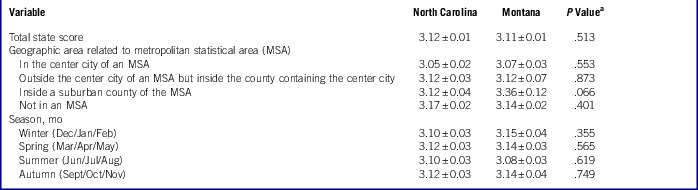
The average emergency preparedness score was 3.12 of 4 for North Carolina and 3.11 of 4 for Montana (Table 1). No statistical difference was found between the total emergency preparedness score in the 2 states (F = 0.43; P = .513). In addition, this score did not differ across metropolitan areas or across seasons (Table 1).
Emergency Preparedness Score According to the State, Metropolitan Area, and Season (Mean ± SE)
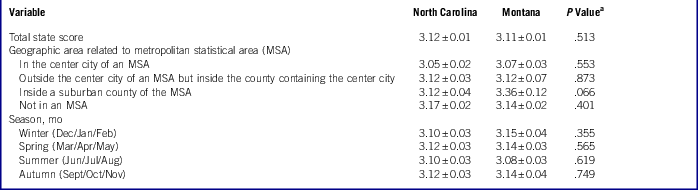
aProbability levels for t test.
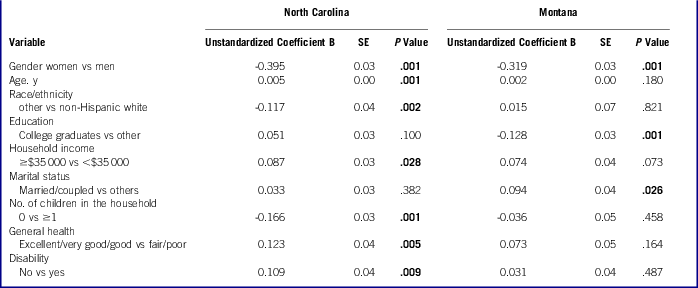
However, discrepancies in factors associated with higher emergency preparedness in the 2 states were observed (Table 2). Factors influencing higher preparedness in North Carolina were being male, older age, a race/ethnicity other than white, non-Hispanic, having a household income of $35 000 or greater, having children in the household, better (excellent/very good/good) self-reported health, and not being disabled. Factors influencing higher emergency preparedness in Montana were being male, having a college degree, and being married or partnered.
Multivariate Linear Regression: Factors Influencing a Higher Emergency Preparedness Score in the States of North Carolina and Montana
Bold values assume statistical significance at p<0.05 level.
Discussion
The findings from the BRFSS survey in 2010 found no difference in emergency preparedness among residents in North Carolina and Montana. These data suggested that the type of natural disaster is not likely associated with the level of emergency preparedness. On average, the score of 3.1 of a maximum 4 in both states indicated a fairly high level of preparedness.
Furthermore, the preparedness score was similar among persons living in urban, suburban, and rural areas. Geographically, Montana covers an area 3 times larger than that of North Carolina, yet there is a 30-fold difference in population density (77.5/km2 in North Carolina vs 2.6/km2 in Montana).12 Consequently, more remote and sparsely inhabited areas are in Montana, where households tend to be self-sufficient. Although rural emergency management represents a challenge in terms of remoteness, population density, and communication,13 our findings did not support the notion that emergency preparedness in rural areas differs from that in urban areas or that a different seasonal pattern exists.
It is interesting that in our analysis different demographic variables were associated with a higher level of disaster preparedness in the 2 states. Specifically, being male was a common influencing factor for both states. Other factors observed in the North Carolina population that were not noted for Montana included older age, race/ethnicity other than white, non-Hispanic, and having a higher income, children in the household, and better self-perceived health. These findings were consistent with those in the study by Murphy etalReference Murphy, Cody, Frank, Glik and Ang14 in California, where factors such as being male, older, wealthier, and having children were predictors of better emergency preparedness.
It was also interesting that a relatively small number of variables were associated with higher preparedness among residents of Montana. Moreover, the factors that were associated with a higher preparedness in Montana were, for the most part, the opposite of those in North Carolina. Being male, married or partnered, and having a college degree influenced the level of disaster preparedness in Montana. These factors could be explained by personal experience with earlier emergencies and relying on household sufficiency, given the population density and the size of geographic area.
Although the multistate analysis in 2006 indicated that Hispanic ethnicity was associated with a lower likelihood of disaster preparedness,Reference Ablah, Konda and Kelley15 a study in Los Angeles County pointed out that being African American and Hispanic was associated with higher chances of having emergency supplies.Reference Eisenman, Wold and Fielding16 In our study, ethnicities other than white, non-Hispanic, in North Carolina were a statistically significant predictor of better preparedness, while in Montana the coefficient in regression indicated an association with being white, non-Hispanic, was not statistically significant. The demographics of the 2 analyzed states reflected a difference in racial/ethnic composition due to more African Americans and Hispanics in North Carolina and more Native Americans in Montana.
With regard to emergency preparedness, data on the Hispanic population has been studied.Reference Ablah, Konda and Kelley15 However, little is known about aspects of disaster preparedness among Native Americans, although it has been reported that training targeting Native American populations in Arizona increased their public health emergency preparedness capability.Reference Hites, Granillo and Garrison17 To acquire better insight in disaster preparedness, future research should focus on this particular population group.
Limitations
Certain limitations in our analysis needed to be considered. The BRFSS survey in 2010 was limited to adults living in households with landline telephones in the 2 states, consequently the households without landlines were omitted. Also, because the BRFSS has been based on self-reported data, it may have included some misclassifications of preparedness levels and disability status that may have resulted in an overestimation or underestimation of the number of respondents who were actually prepared for an emergency. Finally, the same measures of preparedness were used for different types of disasters, as based on the available data.
Our analysis indicated that even though North Carolina and Montana experience different types of natural disasters and emergencies, the overall level of disaster preparedness is similar. However, the divergence in factors influencing the likelihood of being prepared was likely a result of different sociodemographic and geographic characteristics between the 2 states. It appeared that vulnerability to an emergency reflects a complex interplay of social, economic, health, and cultural circumstances.
Although the effect of extreme weather conditions may have a greater impact on vulnerable groups, the communities represent the cornerstone of adaptation, prevention, and support in response to disasters and recovery efforts. In addition, resilience at the community level should be encouraged. Promotion of safety and health-related actions in terms of organizing shelters, evacuation routes, sanitation, and hygiene could be helpful to raise awareness of the sudden and unexpected nature of hazards. Future research should focus on assessment of disaster preparedness in other states and among more vulnerable population groups.