Empathy is a widely studied variable across several disciplinary domains, and is currently considered as a multidimensional psychological process that enables prosocial behavior by recruiting an interpersonal affective component (Eisenberg, Reference Eisenberg2000) and a cognitive domain oriented to accurately infer mental states in other people (Ickes, Marangoni, & Garcia, Reference Ickes, Marangoni, Garcia and Ickes1997). In the field of psychotherapy, Rogers’ initial contributions to the study of empathy defined it as the therapeutic attitude of being sensitive to the phenomenological inner world of the client in a receptive and warm way (Rogers, Reference Rogers1957). Later, he emphasized the experiential quality of the therapeutic accompaniment, manifested in the therapist’s explicit expressions pointing to the felt meanings involved in the client’s actual experiencing. Empathy is nowadays widely considered as a main variable related to treatment efficacy in psychotherapy research (Elliot, Bohart, Watson, & Greenberg, Reference Elliot, Bohart, Watson, Greenberg and Norcross2011; Orlinsky, Grawe, & Parks, Reference Orlinsky, Grawe, Parks, Bergin and Garfield1994) and is thought to be a common change factor, providing benefits to the clients independently of the theoretical bases of the interventions (Lambert & Ogles, Reference Lambert, Ogles and Lambert2004). In clinical research, the therapist’s empathic attitude is commonly assessed from the perspective of the client or by external judges rating session recordings. These two sources of assessment are more reliable than the therapist’s judgment about his/her own empathy, but the client´s assessment is the best predictor of psychotherapy outcomes (Elliot et al., Reference Elliot, Bohart, Watson, Greenberg and Norcross2011; Kurtz & Grummon, Reference Kurtz and Grummon1972).
Nonetheless, past research has paid little attention to immediate changes in the person who receives empathic understanding, which may account for the longer-term treatment outcomes. Some scholars have proposed that empathy fosters experiential depth, which is a self-explorative attitude toward one’s current feelings and personal meanings (Hendricks, 2001). In turn, extant studies indicate that improvements in experiential depth across sessions predict positive outcomes in psychotherapies conducted under varied theoretical orientations (e.g., Castonguay, Goldfried, Wiser, Raue, & Hayes, Reference Castonguay, Goldfried, Wiser, Raue and Hayes1996; Goldman, Greenberg, & Pos, Reference Goldman, Greenberg and Pos2005). Theoretically, then, a major benefit of being a recipient of an empathic attitude is an increase in one’s experiencing level.
In a similar vein, clinicians have stated that an empathic attitude may foster the recipient’s experiencing by diminishing his/her defensiveness and anxiety (Barrett-Lennard, 1999; Rogers, Reference Rogers1975). Some studies have observed better treatment outcomes in clients displaying more open and less defensive attitudes toward the psychotherapy process (see Sachse & Elliott, Reference Sachse, Elliott and Cain2002 for a review). However, as far as we know, there is no direct evidence examining individual dispositions linked to interpersonal anxiety or defensiveness as potential moderators of the effectiveness of empathic interventions. Nonetheless, previous evidence does suggest that interpersonal dispositions are related to psychotherapy processes and outcomes. For instance, secure attachment predicts a better treatment outcome (Meredith, Strong & Feeney, Reference Meredith, Strong and Feeney2007) and prosociality predicts a stronger working alliance (Luborsky, Reference Luborsky, Horvath and Greenberg1994). On the negative side, anxious attachment predicts weaker working alliance and outcome (Goldman & Anderson, Reference Goldman and Anderson2007) as do hostility and social anxiety (Muran, Segal, Samstag, & Crawford, Reference Muran, Segal, Samstag and Crawford1994). This evidence suggests that individual variations in interpersonal and prosocial abilities can make people prone to respond differentially to empathic cues in social interactions, leading to different psychological outcomes at the end of such interactions.
In a different but complementary line of research, social neuroscience has theoretically and empirically addressed the empathic phenomenon, stressing its major importance for social adjustment and interpersonal tuning (Decety & Meyer, Reference Decety and Meyer2008). According to this perspective, empathy activates a social linkage mechanism rooted in neurophysiological processes that enable favorable states for interpersonal approach, reciprocity and collaboration, provided that the social environment is perceived to be safe (Carter, Harris, & Porges, Reference Carter, Harris, Porges, Decety and Ickes2009). When the prosocial engagement system is activated, bodily states are regulated in order to promote growing, restoration and visceral homeostasis through parasympathetic nervous system recruitment (Porges, Reference Porges2003; Reference Porges2011). Particularly, within a perceived secure context parasympathetic cardiovagal pathways have a phasic inhibitory effect on heart rate by increasing heart rate variability, which is often indexed by cardiovagal tone. Thus, increments in cardiovagal tone can be understood as individuals having a higher perception of a safe ambient, which is a prediction that has been confirmed in many studies by linking higher vagal tone to better emotional, cognitive and social regulation (Beauchaine, Reference Beauchaine2001; Geisler, Kubiak, Siewert, & Weber, Reference Geisler, Kubiak, Siewert and Weber2013). How vagal tone variations are displayed at the face of an empathic interaction in its receiver, and how those variations may be related to beneficial changes in psychological states (e.g., the experiencing process) are still matters of inquiry.
According to this background, the present research explores the immediate effects of empathy on recipients. Specifically, we conducted an experiment to test the effects of an empathic conversation against a neutral, impersonal conversation. Our major goal was to examine the impact of empathy on the experiencing. Based on our literature review above, we hypothesized that an empathic context induces short-term increases in the target person’s experiencing, whereas a more impersonal, superficial conversation does not. We also explored whether the effect of empathy on experiencing is moderated by personality variables reflecting social competence or better interpersonal functioning, namely, dispositional empathy, attachment security, aggressiveness, and social anxiety. Our hypothesis behind this goal was that individuals with better interpersonal dispositions (i.e., higher in empathy or secure attachment or lower in aggression or social anxiety) are more likely to positively interact with the empathic cues, reaching higher experiencing levels in the empathic context than those less socially competent. Secondary goals were to examine the effect of empathy on perceived empathic understanding, and vagal tone, under the hypothesis that both variables would achieve higher levels in the empathic context than the neutral one. Finally, we also explored possible gender differences in the psychological variables. There is a large body of evidence showing gender differences in interpersonal behavior, with women displaying higher levels of dispositional empathy and lower aggression when compared to men (e.g., Archer, Reference Archer2004; Davis, Reference Davis1983, Reference Davis1996; Toussaint & Webb, Reference Toussaint and Webb2005). Hence, we expected to find gender differences in these variables, but given the lack of previous research addressing the immediate effects of received empathy on experiencing, we did not advance any hypothesis regarding gender as a moderator of this link.
The relevance of this study relies on the fact that it addresses the phenomenon of empathy from the standpoint of recipients - which would be consistent with the reviewed evidence showing that the client’s perception of empathy is a better predictor of therapy outcomes when compared to empathy as perceived by the therapist or external judges (Elliot et al., Reference Elliot, Bohart, Watson, Greenberg and Norcross2011; Kurtz & Grummon, Reference Kurtz and Grummon1972). This reveals the specific effects that may emerge from empathic interactions as the clients experience them. An additional strength of this study is the inclusion of a psychophysiological measure (i.e., vagal tone) along with an experimental design. The psychophysiological approach to psychotherapy research is not new (e.g., Malmo, Boag, & Smith, Reference Malmo, Boag and Smith1956; Marci, Ham, Moran, & Orr, Reference Marci, Ham, Moran and Orr2007). It has also shown to be helpful in exploring the specific effects of independent measures related to psychotherapy under controlled conditions (e.g., Oliveira-Silva & Gonçalves, Reference Oliveira-Silva and Gonçalves2011), adding objectivity to the findings by offering a comparison point to self-report instruments (perceived empathy and personality measures in our study) or external judgments (coders’ rating of participants’ experiencing levels in our study). Thus, the current investigation may also contribute to enlighten the psychophysiological correlates of the psychological variations in the receivers of empathic interactions.
Method
Participants
People were invited to participate in this study via flyers posted throughout the campus in a major public university in Santiago, Chile. Twenty-seven subjects were finally recruited: 14 men and 13 women, between 18 and 32 years old (M = 22.6, SD = 4.0). They were all healthy people, not involved in psychiatric, psychological or neurological treatment at the moment of the study. Before getting involved in the study, they read and signed a consent form, according to the Declaration of Helsinki and ethical standards established by the authors’ Institutional Review Board. In turn, this work also involved the participation of a female interviewer: a clinical psychologist with formal training and 15-years of professional practice in experiential psychotherapy, who interacted with each participant throughout both the empathic and neutral conversations described below.
Design
An experimental within-subject design was implemented in which each individual participated in two different interpersonal contexts: an empathic conversation (EC) and a neutral conversation (NC). The main strength of our design was to maximize the control of external influences on EC and NC comparisons. Thus, the order of administration of these experimental conditions was randomly counterbalanced across subjects, and they took place one week apart to minimize carryover effects. The EC and NC were differentiated based on the kind of interventions, expressions and responses provided by the interviewer. In the EC the interviewer intended to grasp explicit and implicit meanings from the present experience of the empathized person, and kept a receptive and resonating attitude, trying to express as accurately as possible the captured meanings by way of simple verbalizations. Such empathic responses have been described in the literature (Watson, Goldman, & Vanaershot, Reference Watson, Goldman, Vanaershot, S.Greenberg, Watson and Lietaer1998) and are basically simple reflections of feelings and questions oriented to explore present feelings and meanings (i.e., “How do you feel about this situation?”; “It seems that changing your career would be a great relief for you”). On the other hand, in the NC the interviewer avoided making any expression that could facilitate an experiential deepening in the interlocutor, trying to keep the conversation at a descriptive level and adopting a neutral stance devoid of any emotional gesture. Interventions were informative questions, requests about descriptions of facts and impersonal comments (i.e., “What are your plans for the next year?”; “Many people think that pets should not sleep in the house”).
Psychological measures
Empathic Understanding Scale from the Relationship Inventory OS-M-64 version (Barrett-Lennard, Reference Barrett-Lennard, Greenberg and Pinsof1986)
In this scale perceived empathy is rated by the patient/client (in this study, the interviewees) using a Likert-type scale ranging from -3 (“No, I strongly feel that it is not true”) to +3 (“Yes, I strongly feel that it is true”), indicating the extent to which responses from the therapist (or interviewer) are pointing at his/her current experiences and personal meanings. Total scores may range from -48 to +48. The adapted Chilean version of this scale was applied (Celis, Reference Celis1999), obtaining Cronbach’s alphas of .90 (NC) and .81 (EC) for the current study.
Experiencing Scale (Klein, Mathieu, Gendlin, & Kiesler, Reference Klein, Mathieu, Gendlin and Kiesler1969)
This scale assesses the depth of the experiencing process (EXP), corresponding to the degree of inner contact with the experiencing flow in any given moment, which is revealed by verbal and non-verbal communications. EXP may range from 1 (the lowest level, implying an impersonal, superficial, abstract and intellectual way of self-reference) to 7 (the highest level, indicating that the person is proactively exploring his/her current feelings with a fluid and spontaneous emergence of new personal meanings). In this study the scale was independently applied by two judges blind to research objectives who had to assign a unique modal experiencing level to every two minutes of each conversational session (in total, ten two-minute segments for each 20-minute conversation). For that purpose, the interviews were videotaped and standardized instructions for assessments were given to the raters. When discrepancies of two or more points in the experiencing scale were found in any two-minute segment, judges had to reach an agreement on their ratings for that period. Scale reliability was determined by an intra-class correlation index (ICC), which is a measure of inter-judge agreement for each rated segment. In this study ICC indices varied from .76 to .91. Data analyses were performed considering the mean of both judges’ ratings for segment.
Interpersonal Reactivity Index (IRI; Davis, Reference Davis1983)
The IRI has two scales that measure affective empathy (i.e., affective reactions toward others’ misfortune). The Empathic Concern subscale measures compassionate feelings oriented toward alleviating others’ suffering (current α = .74), whereas the Personal Distress subscale measures more self-centered anxious feelings facing others’ misfortune (current α = .75). Items are answered using a Likert-type scale ranging from 0 (doesn’t describe me at all) to 4 (describes me very well). These measures were positively correlated (r = .46, p = .017), as is usual, although it is the former type of empathy that mainly predicts actual helping behavior (see Eisenberg, Reference Eisenberg2000). Therefore, to obtain a more refined measure of empathy as a truly selfless orientation toward others’ suffering, we regressed the scores of the empathic concern subscale onto the scores of the personal distress subscale (higher residual scores indicating stronger net empathic concern). In the current study we used the locally adapted version of the IRI (Fernández, Dufey, & Kramp, 2012).
Adult Attachment Scale Revised (Collins, Reference Collins1996)
This is a self-report scale that assesses three attachment dimensions: closeness (feeling comfortable with intimacy); dependency (perceived availability of others when needed); and anxiety (worries about being unloved or left alone). In this Likert-type scale scores may range from 1 (“not at all characteristic of me”) to 5 (“very characteristic of me”). We computed a global index of attachment security (current α = .87 for the Chilean adapted version; Fernández & Dufey, Reference Fernández and Dufey2015).
Buss & Perry Aggression Questionnaire (Buss & Perry, Reference Buss and Perry1992)
This questionnaire assesses four dimensions of dispositional aggression: physical aggression, verbal aggression, anger and hostility. Items are responded to in a Likert-type scale from 1 (“Extremely uncharacteristic of me”) to 5 (“Extremely characteristic of me”). In this study we computed a global index of aggression (α = .88) from the application of the Chilean-adapted version of this instrument (Figueroa, Ramírez, & Santis, Reference Figueroa, Ramírez and Santis2005).
Social Avoidance and Distress Scale (Watson & Friend, Reference Watson and Friend1969)
This is a self-report measure of the individual tendency to experience social anxiety and avoid social interactions. Mean scores may range from 0 to 1, with higher scores indicating stronger social anxiety and avoidance. Current Crombach’s alpha of the locally adapted version of this scale (Pérez & Sepúlveda, Reference Pérez and Sepúlveda1991) was .90.
Vagal Tone
The electrocardiogram (ECG) of participants was registered continuously and digitized on-line by a PowerLab 16/30 series amplifier and the LabChartPro v.7.3.7 software (ADInstruments, 1994–2014) using a Lead I configuration for electrode placement. Sample frequency was set at 1000 Hz and on-line filters were applied (highpass: 0.3 Hz, lowpass: 200 Hz, with an additional lowpass filter of 60 Hz) in order to optimize the quality of the recorded signal. Data files of experimental sessions were off-line segmented every two minutes, giving a total of 12 segments for each file, which were exported to the QRSTool v.1.2.2. Software (Allen, Chambers, & Towers, Reference Allen, Chambers and Towers2007, available at www.psychofizz.org). This software derives IBI interval series from consecutive R-R intervals of the PQRST cardiac complex, which are manually corrected by QRSTool when artifacts are detected in the cardiac signal. Vagal tone was estimated from respiratory sinus arrhythmia (RSA). For this, heart period variability in the high frequency band (0.12–0.4 Hz) is extracted from the IBI edited series using CMetX software (Allen et al., Reference Allen, Chambers and Towers2007). CMetX converts the IBI series to a time series sampled at 10 Hz, filters the series using a 241-point optimal finite impulse response filter (from FWTGEN V3.8; Cook & Miller, Reference Cook and Miller1992) with half-amplitude frequencies of 0.12 and 0.40 Hz and then takes the natural log of the variance of the filtered waveform as the estimate of respiratory sinus arrhythmia (RSA), a measure of Cardiac Vagal Control. Values of RSA from CMetX correlate almost perfectly (r = 0.992) with those from Porges’ MXEdit program and also with natural log spectral power (r = 0.986) and natural log spectral amplitude (r = 0.984; Allen et al., Reference Allen, Chambers and Towers2007).
Procedure
Participants voluntarily agreed to attend two individual experimental sessions (set one week apart at the same time of day for each subject), wherein they would be talking about two freely chosen personal topics that they considered positive and meaningful. Once in the lab, a participation protocol was read and the informed consent was obtained from participants. Then electrodes for ECG activity were installed. After checking that the electrophysiological recording was properly running, one of the two selected conversation topics was randomly chosen for the current experimental session and subjects had to complete the Self-Assessment Manikin (Bradley & Lang, Reference Bradley and Lang1994). This instrument assesses individual affectivity for conversation themes in two dimensions: valence (ranging from very pleasant to very displeasing) and arousal (ranging from very excited/alert to very calm/relaxed), with nine response options for each one. This procedure allowed the affective equivalence of the two selected topics to be determined, which proved equivalent for valence (NC: M = 7.07, S.D. = 1.30, EC: M = 7.81, S.D. = 1.24; t(26) = –0.35, n.s.) and arousal ratings (NC: M = 4.67, S.D. = 2.24, EC: M = 5.48, S.D. = 2.44; t(26) = –1.30, n.s.). The experimental order of the EC and NC was also randomly assigned to determine which one would take place in this first lab session. An audiovisual recording of the conversation was then initiated by means of a webcam diagonally situated 60 cm away from participants. This was used for the EXP assessments as well as for a video recall task (Gottman & Levenson, Reference Gottman and Levenson1985) in which participants had to watch the video of the conversation in a relatively calm state (quietly seated and silent), under the instruction to recall as well as possible how they felt while talking. This was done because one of the cardiac variables (RSA) is affected by changes in respiratory parameters due to speech effects that might introduce differences between experimental conditions and that cannot be attributed to the manipulation of the independent variable (conversation type: empathic or neutral). Once the audiovisual recording started, subjects were instructed to remain quietly seated for two minutes in order to obtain an initial resting condition for baseline cardiac measures. This period was immediately followed by a 20-minute talk about the selected theme. Lastly, a final two-minute resting period was performed and audiovisual and electrophysiological recordings were stopped. Subjects were then asked to sit in front of a monitor and the electrophysiological recording was restarted to begin the video recall task. Audio recording was listened to with headphones and when the video was finished all recordings were stopped again and the electrodes were detached from the participants. Subjects were then asked to complete all psychological measures. In the second lab session the same procedure was repeated for the pending topic of conversation. After the experimental task, however, participants did not have to complete all the psychological questionnaires once again, but only the Empathic Understanding Scale to report perceived empathy for this current conversation. Finally, subjects were debriefed and paid 5,000 Chilean pesos for their participation in the study.
Data analysis
Two ANOVA tests for totally repeated measures were performed to examine the main and interactive effects of the experimental condition and conversation time factors on EXP and vagal tone, respectively. The experimental condition factor corresponded to the type of conversation: neutral versus empathic. In turn, the conversation time factor corresponded to periods of conversation that were obtained by segmenting each 20-minute conversation into ten 2-minute intervals. The first, fifth and tenth conversational periods were entered into the ANOVA when EXP was the dependent variable (T1, T5 and T10, respectively). For the ANOVA when vagal tone was the dependent variable, the two-minute resting condition just prior to the video recall task and the first, fifth, and tenth temporal segments of this video recall task period were taken into account (T0, T1, T5 and T10, respectively). The experimental order of conversations (from empathic to neutral and from neutral to empathic) was entered as a covariate in the ANOVAs to control for its possible effects on the dependent variables, which are only reported when significant. Perceived empathy was analyzed with a mixed ANOVA for repeated measures, with gender as a between-subject factor, and experimental condition as a within-subject factor. Bonferroni corrections in post-hoc analysis for mean comparisons were applied when appropriate to decrease Type I error probability. Finally, regression analyses were performed to determine the predictive value of interpersonal dispositions and vagal tone upon EXP changes throughout both conversations. All analyses were performed on SPSS v. 20. Before proceeding to run those parametric analyses, all variables were examined to check if they were normally distributed. Only the social anxiety variable showed deviation from normality (skewness = 1.513; kurtosis = 1.930), which was then successfully corrected by using log.10 transformation (skewness = .042; kurtosis = –.605).
Results
Descriptive Results
Table 1 shows the means and standard deviations for experimental measures (psychological and cardiac) for analyzed moments. Since differences between men and women were found for perceived empathic understanding in both conversational settings, results are shown separately by gender for that variable. Values for the complete sample are presented for the remaining variables, as they did not show any gender discrepancies.
Means and standard deviations for psychological and cardiac experimental measures

Note: Each cell shows the mean above and the SD below. Emp = Perceived Empathic Understanding; EXP = Experiential Level; VT = Vagal Tone; M = Men; W = Women; T0 = Baseline Temporal Segment; T1 = First Temporal Segment; T5 = Fifth Temporal Segment 5; T10 = Tenth Temporal Segment; E-N = Experimental Order from Empathic to Neutral; N-E = Experimental Order from Neutral to Empathic; NC = Neutral Conversation; EC = Empathic Conversation.
Experiential level
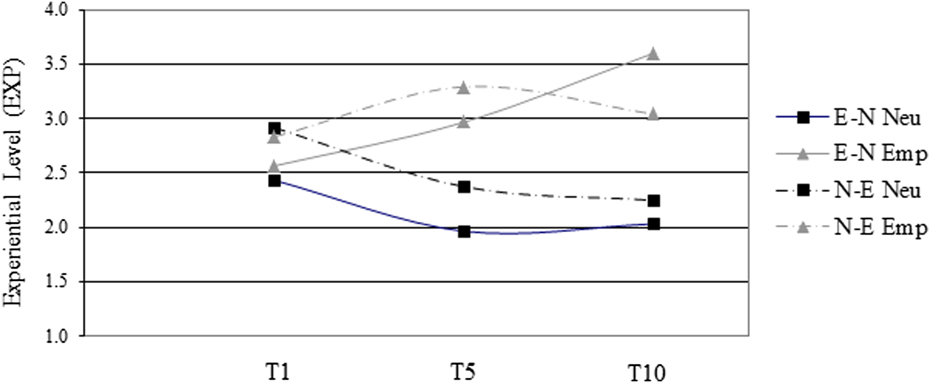
A main effect for Condition (F(1, 25) = 21.04; p < .001, η p 2 = .457) and an interaction between Condition x Time (F(2, 24) = 10.86; p < .001, η p 2 = .475) were obtained for EXP. Also, a marginally significant main effect for Time (F(2, 24) = 3.35; p = .053, η p 2 = .218), as well as an interaction between Experimental Order and Time (F(2, 24) = 3.59; p = .043, η p 2 = .230) were observed. Post-hoc comparisons showed that at T1 both conversational conditions showed similar experiential levels that became significantly higher at T5 (p < .001) and T10 (p < .001) for the EC when compared to the NC. Within the NC, the experiential level decreased significantly at T5 (p = .002) and T10 (p < .001) regarding T1, with similar values at T5 and T10. In the EC, different increasing patterns were observed according to the experimental order of conversations: when it went from empathic to neutral it became significantly higher at T5 (p = .08) and T10 when compared to T1 and marginally superior at T10 in relation to T5 (p = .075). When the experimental order went from neutral to empathic, the experiential level was significantly higher at T5 regarding T1 at a marginal level (p = .07) and no statistical differences were seen between T5 and T10, or T1 and T10 (see Figure 1).
Experiential level at different time moments of experimental conditions.
Note: E-N Neu = From empathic to neutral conversation in neutral condition; E-N Emp = From empathic to neutral conversation in empathic condition; N-E Neu = From neutral to empathic conversation in neutral condition; N-E Emp = From neutral to empathic conversation in empathic condition; T1 = first time segment; T5 = fifth time segment; T10 = tenth time segment.

Perceived empathic understanding
A main effect for Condition was observed (F(1, 25) = 14.63; p = .001, η p 2 = .369), as well as an interaction between Condition and Gender (F(1, 25) = 9.42; p = .005, η p 2 = .264) on perceived empathy (see Figure 2). This implies a higher level of perceived empathy for the empathic conversation (EC) when compared to the neutral one (NC), which was only significant for women (t(20, 46) = –3.27; p = .004).
Empathic understanding for each experimental condition in men and women.
Note: Vertical bars represent +/-1 standard errors

Vagal tone
A main Time effect was obtained for vagal tone (F(3, 22) = 5.13; p = .008, η p 2 = .411). The NC post-hoc comparisons revealed a significant decrease in vagal tone at T1 (p = .001) and T5 (p = .021) when compared to T0 and a marginally lower level at T10 regarding T0 (p = .077). For the EC, vagal tone was significantly lower at T1 (p = .028), T5 (p = .033) and T10 (p = .022) with respect to T0 (see Fig. 3). No other differences were observed among the remaining temporal segments. Additionally, a marginal main effect for Condition (F(1, 24) = 4.27; p = .05, η p 2 = .151) was observed; however, when performing post-hoc analysis no significant or marginally significant differences between experimental conditions were found for the different temporal segments.
Vagal tone at different time moments of experimental conditions.
Note: Neutral = Neutral condition; Empathic = Empathic condition; T0 = baseline time segment; T1 = first time segment; T5 = fifth time segment; T10 = tenth time segment.

Predicting individual gains in experiential depth across conversations
The next analyses focus on individual gains in EXP across both conversations, as a function of personality variables and perceived empathic understanding. EXP gains correspond to a positive change (i.e., increase) in experiencing depth from the early period (i.e., onset phase) to the late period (i.e., final phase) of a given conversation. Thus, we first calculated measures of early and late EXP using the mean scores over the first three and final three 2-minute conversation intervals respectively (Cronbach’s α for the neutral and empathic conversations’ early and late EXP were .68, .79, .80, and .85, respectively). Afterwards, gains in EXP through time were calculated as standardized residuals of late EXP by regressing its scores onto early EXP scores (thus, getting rid of the portion of late EXP variance that was shared with early EXP). Therefore, the higher the EXP gains scores, the greater the increases in experiencing across a given conversation.
Individual EXP gains during the Neutral Conversation (NC)
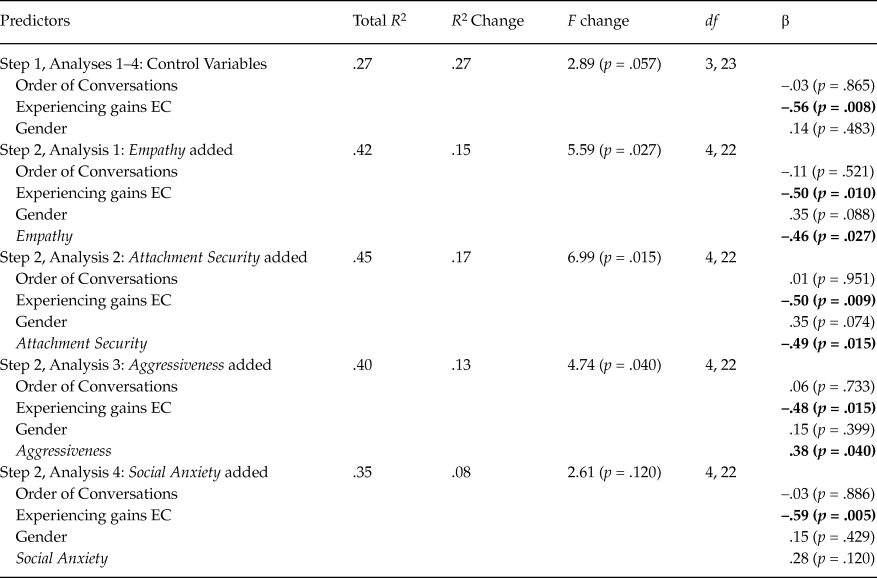
In a multiple regression analysis predicting NC EXP gains, we introduced the experimental order of conversations, gender and EC EXP gains as the main predictor. This analysis showed that neither conversation order nor participants’ gender were significant predictors (p > .05), but EC EXP gains made a unique contribution to the prediction of NC EXP gains (β = –.56, p = .008). We next examined whether perceived empathic understanding, as related to either conversation, could uniquely predict NC EXP gains. Neither gender nor experimental order of conditions nor perceived empathy for the NC showed significance (p > .05), whereas perceived empathy for the EC did (β = –.45, p = .027). Also, EC EXP gains remained a significant unique predictor (β = –.73, p = .001) in this analysis. In sum, these results indicate that EXP gains during the NC were independently predicted by two different aspects of the EC, namely EXP and perceived empathy. Both predictors showed a negative association with the criterion, suggesting that individuals who retreat more from examining their experiences during a neutral, impersonal conversation, tend to be those who accrue greater benefits from an empathic conversation in terms of higher perceived empathic understanding and also greater depth in their experiencing as this conversation unfolds. Next, we examined the effects of vagal tone gains during the NC on NC EXP gains. Vagal tone gains were calculated as residual scores for the late conversation period (the mean for the last three 2-minute intervals) by removing its shared variance with early conversation scores (the mean for the first three 2-minute intervals). In a multiple regression analysis we introduced this predictor along with gender, order of conversation and EC EXP gains as control variables. Even after controlling for this set of variables, vagal tone gains came out as a significant predictor (β = .40, p = .024). In other words, gains in vagal tone during the neutral conversation predicted gains in experiencing during this same conversation.
Finally, we examined the effects on NC EXP gains of four widely researched personality constructs regarding social competence/interpersonal functioning: attachment security, aggressiveness, social anxiety and empathy. Table 2 shows the results of multiple regression analyses for these four personality variables predicting NC EXP gains. We did not choose to enter all these main predictors together in the same regression analysis because they were fairly well correlated to each other (correlations running in absolute values from .35 to .68) and so would have produced multicollinearity problems. Control variables were entered in Step 1 of each regression: experimental order of conversations, EXP gains during the EC and gender. As can be seen in Table 2, this set of control variables explained 27% of the variance in EXP gains during the NC. Within this set, however, only EXP gains during the NC made a unique contribution to the prediction (β = –.56, p < .05), as mentioned before. The negative sign of this coefficient indicates that individuals with greater improvements in EXP across the EC were likely to be those with lower EXP improvements during the NC. In Step 2 of each analysis we included one of the personality variables as the main predictor. Empathy was added in Step 2 of the first regression analysis, predicting less EXP gains during the NC and accounting for an additional 15% of the variance in this criterion (β = –.46, F change = 5.59, p = .027). Likewise, Attachment Security, introduced in Step 2 of the second regression analysis, predicted less EXP gains during the NC, accounting for an additional 17% of the variance in this criterion variable (β = –.49, F change = 6.99, p = .015). Aggressiveness, introduced in Step 2 of the third regression analysis, predicted greater EXP gains during the neutral conversation, explaining an additional 13% of the variance in this criterion (β = .38, F change = 4.74, p = .040). Finally, Social Anxiety was entered in Step 2 of the last, fourth regression analysis. This variable did not make a unique contribution to the prediction of the dependent variable (β = .28, F change = 2.61, p = .120). So, heightened social anxiety did not forecast EXP increases across the NC over and above the contribution of the control variables. As a whole, these findings suggest that people holding more positive social/interpersonal orientations (i.e., high empathy and attachment security and low aggressiveness) tend to show decreases in their experiencing from the early stage to the late stage of a neutral conversation. Low social anxiety followed this pattern of results, but it did not reach statistical significance as an independent predictor of NC EXP.
Multiple regression analyses of personality variables predicting gains in experiencing depth during the neutral conversation

Note: n = 27; EC = Empathic Conversation; NC = Neutral Conversation. Words in italics are main predictors added in Step 2 of each analysis. Standardized Beta coefficients being statistically significant (p < .05) appear in bold numbers. Step 1 for analyses 2–4 has been omitted in the table for the sake of simplicity, since the estimated parameters for this step are the same in each case.
Individual EXP gains during the Empathic Conversation (EC)
We submitted EXP gains during the EC to multiple regressions analyses equivalent to those detailed above. We have already presented results indicating that individuals with lower improvements in EXP across the NC were likely to be those with higher EXP improvements during the EC. So, we proceeded further by examining if EC EXP gains could be predicted uniquely by perceived empathic understanding related to either conversation, after controlling for NC EXP gains, gender and order of conversations. Perceived empathy during the EC was not a unique significant predictor (β = –.26, p = .169). Perceived empathy during the NC, however, did predict independently the criterion variable (β = –.42, p = .010), along with NC EXP gains, which remained significant (β = –.58, p = .001). Both predictors together explained an additional 42% of the variance in EC EXP gains (F change = 10.74, p = .001), over and above the 16% accounted for by gender and order of conversations (F change = 2.26, p = .126), indicating that both low perceived empathy and decreases in EXP during the NC contribute to forecasting increases in EXP during the EC. In turn, personality variables or gains in vagal tone during this conversation did not make a unique contribution to the prediction of EC EXP gains (i.e., all coefficients at p > .05).
Discussion
Although empathy has been frequently linked to positive psychotherapy outcomes (Elliot et al., Reference Elliot, Bohart, Watson, Greenberg and Norcross2011; Orlinsky et al., Reference Orlinsky, Grawe, Parks, Bergin and Garfield1994), its immediate effects on the recipients, which may account for such long-term outcomes, are poorly understood. Thus, we conducted an experiment to test some proximate potential benefits of being the subject of an empathic conversation, with a focus on improvements in experiencing depth and the moderating role of individual differences in social competence.
A first main result was that experiencing levels improved significantly during the empathic conversation compared to the neutral conversation, confirming our first hypothesis. More specifically, whereas a significant increase in experiencing depth occurred as the empathic conversation went on, a significant decrease in experiencing took place as the neutral conversation evolved. This suggests that the interviewer’s empathic attitude was effective in promoting a self-explorative process into the current feelings and meanings of the participants (Gendlin, Reference Gendlin, Lietaer, Rombauts and Van Balen1990). However, this effect was more pronounced among those who received the empathic interview before the neutral one, which underscores the benefit of empathic interactions happening at the very beginning of helping relationships, as they do in psychotherapy (Castonguay et al., Reference Castonguay, Goldfried, Wiser, Raue and Hayes1996; Goldman et al., Reference Goldman, Greenberg and Pos2005). We would like to note that since early experiential levels (at T1) were similar between experimental conditions, late experiencing variations can actually be attributed to the kind of interventions intended for each conversational context.
Experiencing depth variations across conditions have significant theoretical and practical implications. They may suggest that for people in general it becomes easier to embrace the experiencing process as an empathic interaction progresses, whereas it becomes harder to engage as a more neutral conversation unfolds. In other words, an empathic context seems to encourage experiencing disinhibition or facilitation over time, whereas a neutral context seems to lead to experiencing inhibition. This finding is also consistent with the diverse literature linking varied expressions of empathy (e.g., an empathic attitude or atmosphere, or even an empathic way of being) to a variety of healing conditions that range from facilitating a caring, accepting relationship that may dissolve the intimacy gap between people in everyday life (Rogers, Reference Rogers1975), to enabling and maintaining a safe therapeutic bond and alliance (Orlinsky et al., Reference Orlinsky, Grawe, Parks, Bergin and Garfield1994) that can actually predict constructive personality change (Elliot et al., Reference Elliot, Bohart, Watson, Greenberg and Norcross2011). It is worth noting that the self-explorative attitude the empathic ambient promotes can be achieved in such a short time period as we saw in this study (within 20 minutes).
Secondly and confirming our hypothesis regarding perceived empathy, we found higher levels of perceived empathy for the empathic conversation when compared to the neutral one, although this effect was only significant for women. As far as we know, this constitutes a novel finding since no gender-differences in perceived empathic understanding have previously been reported. However, these discrepancies can be explained by the fact that women and men have consistently shown differences in the way they interact with empathic-evoking contexts, which are reflected both in divergent empathic dispositions -women displaying more empathic abilities than men (e.g., Toussaint & Webb, Reference Toussaint and Webb2005) and in structural and functional differences in brain areas relevant to empathic behavior and intersubjectivity (Cheng et al., Reference Cheng, Chou, Decety, Chen, Hung, Tzeng and Lin2009). Thus, it is possible that females and males also vary in the way they are sensitive to and process the interpersonal empathic cues that are present in the empathic context (or absent in the neutral context), because of shared central mechanisms behind the expression and reception of empathy.
Lastly, we found that both the empathic and neutral contexts promoted a progressive and similar withdrawal of vagal activity. Although this result was surprising at first glance, as it did not confirm our hypothesis regarding vagal tone, there is some evidence that may help to interpret it. For example, Newman and Waldstein (2001) have seen an augmented cardiac frequency in an experimental context of emotional induction (through a three-minute verbal task of emotional recall), regardless of the emotional content of the talk. Other studies have also revealed an increased cardiac frequency in emotionally evoking scenarios across different affective conditions (i.e., sadness, happiness and rage; Rainville, Bechara, Naqvi, & Damasio, Reference Rainville, Bechara, Naqvi and Damasio2006). Newman and Waldstein (2001) attribute this effect in their study to a vagal withdrawal since they did not find evidence of sympathetic activation in other cardiac parameters (pre-ejection period). Considering these antecedents we speculate that, in our case, vagal withdrawal may reflect an emotional activation that was similar across experimental conditions. That is to say, emotional engagement might prevail when talking about a significant personal topic even though it has a positive affective content, at least in a short-term temporal window. This possibility is also consistent with the equivalent affective ratings that participants gave to the personal topics shared in both conversations in the valence and arousal dimensions. Hence, based on our evidence, we cannot say that as an empathic talk unfolds the vagal/social engagement system is recruited, at least not under the conditions that we set for the empathic context of this study. In any case, we did observe a significant correlation between changes in vagal activity and experiencing depth throughout the neutral conversation, as we will discuss in the next section.
We also explored individual differences in experiencing gains during the conversations as a function of several variables that are sensitive to interpersonal attunement, such as perceived empathy and vagal tone gains, as well as dispositional empathy, attachment, aggression and social anxiety. Findings showed that individuals expressing higher experiencing gains in the empathic context perceived less empathy in the neutral context and were also less likely to undergo experiencing gains across the neutral context. In turn, lower experiencing gains during the neutral conversation were related to higher perceived empathy during the empathic conversation. Our reasoning behind these results is that people who are more sensitive and receptive to empathic cues present in the empathic conversation (and thus benefit more from such accompaniment in terms of perceived empathy and experiencing disinhibition or improvement), are also more sensitive to the lack of empathy in the neutral conversation, and therefore feel less understood and experience greater experiencing inhibition within that impersonal context.
Experiencing inhibition during the neutral talk was also predicted by an analogue decrease in vagal tone in this very condition, implying that a greater sensitivity to a distant attitude from a counterpart is coupled with a withdrawal from this social engagement system, which in turn fosters a more superficial way of self-reference. In the light of our vagal tone background, we could speculate that individual differences in vagal withdrawal within the neutral talk are a psychophysiological correlate of the sensitivity that people manifest when they do not perceive empathic cues in their interpersonal environment. Thus, when facing such impersonal interactions, some people will regulate their autonomic states in a way that is consistent with a more defensive or self-protective reaction (Carter et al., Reference Carter, Harris, Porges, Decety and Ickes2009; Porges, Reference Porges2003; Reference Porges2011). This idea is consistent with our finding that social competence traits (excepting social anxiety) were significant predictors of experiencing inhibition during the neutral conversation, suggesting that more empathic and secure attached individuals, as well as less aggressive people, are more prone to react with experiencing inhibition when exposed to a non-empathic conversation.
Previous findings showing positive associations among facilitative interpersonal abilities and successful achievement of the working alliance and treatment outcomes (Goldman & Anderson, Reference Goldman and Anderson2007; Luborsky, Reference Luborsky, Horvath and Greenberg1994; Meredith et al., Reference Meredith, Strong and Feeney2007; Muran et al., Reference Muran, Segal, Samstag and Crawford1994) may indirectly help to interpret our results. Our findings indicate that the more individuals deepen their experiencing in the empathic interaction, the more likely they are to withdraw from such self-explorative attitudes during a neutral, impersonal conversation. Also, those who express better interpersonal competence retract more from experiencing deepening in the neutral interaction. Hence, we speculate that contexts lacking in empathic signals would particularly differentiate people’s responses to other’s interventions according to their interpersonal skills. Thus, people with better interpersonal skills will be more sensitive at detecting the lack of empathy in such impersonal contexts, distancing themselves from a spontaneous self-explorative attitude (and probably protecting themselves from self-disclosing deep personal experiences when there is no guarantee of a warm receptivity from the conversational partner). On the other hand, individuals expressing poorer interpersonal competence will “misread” the lack of empathy, tending to self-disclose regardless of an impersonal receptivity. This idea can find some support in the fact that people with an elusive attachment orientation improve their treatment outcome when assisted by therapists expressing less personal involvement (Fonagy et al., Reference Fonagy, Leigh, Steele, Steele, Kennedy, Mattoon and Gerber1996).
On the other hand, there were two unexpected results. Firstly, experiencing during the empathic conversation per se was not predicted by any of the above dispositional differences in interpersonal functioning. It may be that an empathic context tends to compensate for dispositional difficulties in self-exploration, especially if they are rather mild. This is consistent with clinical theorizing and research linking clients’ personal growth to the therapists’ empathic attitude (Orlinsky et al., Reference Orlinsky, Grawe, Parks, Bergin and Garfield1994; Rogers, Reference Rogers1975). Secondly, it is remarkable that empathy promoted experiencing independently of the gender discrepancies in perceived empathic understanding, a finding that might be due to different psychological dynamics among women and men in the face of empathic interactions.
Finally, we would like to mention some shortcomings of this study. Firstly, we addressed received empathy through an experimental approach, favoring internal over external validity. Future studies might seek to replicate our results in actual therapeutic relationships, or other types of meaningful extra therapeutic interpersonal exchanges. Secondly, gender differences in perceived empathy deserve further examination, a need that is reinforced by the fact that the interviewer was always a woman and therefore we could not assess any possible bias by the gender of the interviewer. Thirdly, our limited sample size could increase the likelihood of committing a Type I error. However, since our effect sizes were in general large (>.25), according to Cohen’s rule of thumb, we can fairly attribute the observed variance on our dependent variables to the main effect of experimental conditions and their interaction. Finally, although the conversations were about personally meaningful topics, these were always emotionally positive, so we do not know what the results might have been for themes with a negative valence. There were three reasons why we decided to restrict the conversations to positive topics. Firstly, negative topics may activate strong negative emotions in some participants, particularly in the empathic talk condition due to its focus on fomenting self-exploration and going deeper into feelings and personal meanings. Indeed, our findings depict this kind of significant personal attunement to inner emotional experiences during the empathic conversation. Although previous psychotherapy research has suggested that the exploration of negative topics throughout sessions promotes positive outcomes (e.g., Greenberg, Reference Greenberg2002), those are long-term results probably due to a gradual and cumulative process of experiential growth or development of self-examination skills, whereas inquiring about the impact of a brief empathic approach on others’ immediate negative experiences is still a matter of interest for future research. There are also previous experimental studies that have included conflictive personal topics in imagined scenarios (e.g., Kross, Ayduk, & Mischel, Reference Kross, Ayduk and Mischel2005) or actual conversations (e.g., Messina et al., Reference Messina, Palmieri, Sambin, Kleinbub, Voci and Calvo2013). But, as far as we know, no reports have examined the potential negative emotional effects on the participants due to the experimental manipulation. In any case, provisions should be made in advance to help participants deal with such negative effects should they arise (e.g., by allowing them opportunities for receiving psychotherapy). Secondly, the exclusion of negative topics facilitated experimental control over the duration of the conversations, because it is probably less disruptive being asked to stop talking about a positive theme than a negative one. Finally, positive and negative emotions do actually differ in their psychophysiological activation patterns (Bradley et al., Reference Bradley, Codispoti, Cuthbert and Lang2001), so the mixed inclusion of negative and positive topics, or (most likely) ample individual differences in the severity of the negative issue chosen to be disclosed, would have introduced uncontrolled variations in our psychophysiological measure. In any case, it seems to us that obtaining knowledge about the impact of an empathic attitude over the experiencing level of a person who is talking about a personal meaningful issue is worthy in its own sake, because psychotherapy (and certainly, meaningful social exchanges outside psychotherapy as well) is not just about negative experiences. Moreover, feeling understood while sharing positive experiences with the therapist may provide a secure base that encourages more in-depth examination and expression of negative emotions afterwards.
From our findings we can state that being empathically accompanied by another person has the main benefit of allowing an immediate self-explorative attitude, named “experiencing depth”, which has been largely related to psychological healthy functioning and psychotherapy outcomes (Castonguay et al., Reference Castonguay, Goldfried, Wiser, Raue and Hayes1996; Goldman et al., Reference Goldman, Greenberg and Pos2005; Hendricks, 2001). Conversely, a more neutral or impersonal approach to others’ experiences promotes a distant way of self-reference, which may be detrimental to the development of interpersonal relationships (Sandell et al., Reference Sandell, Lazar, Grant, Carlsson, Schubert and Broberg2007). This idea is supported by the fact that individuals reluctant to self-disclose in this latter context expressed a better social adjustment as well as an inhibition of the vagal prosocial system. These results might contribute to an understanding of how a two-sided coin of interpersonal proximity (being empathic to another’s experience or the lack of this attitude) might either promote or thwart healthy functioning. We hope the present findings advance our comprehension of the immediate psychological and psychophysiological effects of empathy on the recipients. As our study comprises a set of variables that have previously been involved in psychotherapy research or psychotherapy related contexts, its findings may orient future research on the link between empathy and psychotherapeutic change.
This study is part of the doctoral dissertation of the first author, which was supported by the CONICYT grant for doctoral studies from the Chilean Government, and the grant additional support form Universidad Diego Portales, Chile.