1. Introduction
Institutional arrangementsFootnote 1 characterizing common-pool resources (CPRs) have been the subject of an extensive literature in social sciences, particularly in the context of the research agenda of the Bloomington School of Institutional Economics (Janssen and Anderies, Reference Janssen and Anderies2013; Ostrom, Reference Ostrom2010). This literature challenged economists' binary assumption about the management of resource systemsFootnote 2: if resource systems are subtractableFootnote 3 and excludable, then their management falls under the scope of the market; it falls under that of the State if they are non-subtractable and non-excludable (Musgrave, Reference Musgrave1959; Samuelson, Reference Samuelson1954). Ostrom et al. (Reference Ostrom, Gardner and Walker1994) and Ostrom (Reference Ostrom2003, Reference Ostrom2010) proposed an updated typology of goodsFootnote 4 taking into account CPRs, defined as resource systems that are subtractable and share a difficulty of exclusion. The nature of resource systems relates to their degrees of excludability and subtractability and drives the most suitable institutional arrangement for their sustainable management (Aligica and Boettke, Reference Aligica and Boettke2009).
Aligica and Boettke (Reference Aligica and Boettke2009) further argue that the nature of goods is not an ‘ontological given’ and that technological change and institutions can influence their nature. This assumption opens the way for a reinterpretation of the typology of goods in economics. Rayamajhee and Paniagua (Reference Rayamajhee and Paniagua2021) take up this assumption and argue that the nature of goods is context dependent and is driven by institutional choices, for example a punctual crisis transforming food provision from the private to the CPR or public sphere. Their analysis paves the way for a wider reflection on the nature of goods as it recognizes the constructed nature of a resource system beyond its inherent characteristics.
However, few studies have engaged in an empirical investigation regarding the thesis on the dynamic nature of goodsFootnote 5, specifically how institutional arrangements designed for their management can lead to a reconfiguration of their nature. To help fill this research gap, this paper investigates the evolution of the characteristics of goods, particularly that of the excludability degrees of private goods resulting from the institutional arrangement designed for their management. Excludability is defined as the ability to preclude non-members from accessing a resource system (McGinnis, Reference McGinnis2011; Ostrom, Reference Ostrom2010). ‘Accessing’ encompasses multiple forms: using a resource system, participating in decision-making processes, enjoying the benefits of a resource system. That is, the degrees of excludability cover both the levels of operational and collective choice levels, i.e. the rules that define the rights and organization of users for the management of a resource system (Ostrom, Reference Ostrom1990).
To assess the outcomes of institutional arrangements on the excludability degrees of resource systems, we investigate the particular setting of four collective projects on farmland in the Isère department, France. Farmland is a resource system as it represents the environment where food resources are produced and where environmental resources are located. The projects are designed to overcome inadequacies perceived by citizensFootnote 6 and/or local authoritiesFootnote 7 in traditional farmland management – that of plot enlargement, monoculture, and industrial food production – and are based on collective actionFootnote 8 for their implementation. An institutional mismatch characterizes the management of farmland and triggers institutional arrangements aimed at reducing it by proposing alternative models for farmland management. Institutional mismatches represent situations in which the rules defined to solve a collective action problem are poorly suited to do so. These rules are thus ‘inferior to a feasible alternative set of rules’ (Furton and Martin, Reference Furton and Martin2019). These arrangements share the particularity of developing on a private resource system whose characteristics are excludability and rivalry – farmland. Consequently, the projects studied inform us about possible evolution of the excludability degrees of farmland. Our research question can be expressed as follows: How can institutional arrangements designed to overcome an institutional mismatch in the management of resource systems (farmland) modify the characteristics of these systems, particularly their excludability degreesFootnote 9?
To investigate the interactions between institutional arrangements and the evolution of the excludability degrees of farmland in the four projects studied, we collected data via semi-structured interviews and drew on the tool of property as a bundle of rights (Schlager and Ostrom, Reference Schlager and Ostrom1992). We propose an adapted grid of the bundle of rights that reflects the particularities of the French case, specifically that of a wider panel of stakeholders participating in farmland management such as local authorities and citizens.
The tool of property as a bundle of rights has been little used for the analysis of institutional arrangements with some notable exceptions (Galik and Jagger, Reference Galik and Jagger2015; Sikor et al., Reference Sikor, He and Lestrelin2017). Other frameworks have taken the lead for their analysis, particularly the institutional analysis and development framework as well as the socio-ecological framework (McGinnis and Ostrom, Reference McGinnis and Ostrom2014; Ostrom, Reference Ostrom2011). However, we defend the analytical capacity of the bundle of rights tool to lay the foundations for the analysis of institutional arrangements: the rules guiding the design and distribution of land rights, the holders of these rights, and the obligations resulting from them. It is useful in illustrating the diversity of the projects studied and thus in identifying criteria leading to an evolution in the degrees of farmland excludability. Reflecting on this evolution is of interest as it can guide public policies, by opening the way for alternative arrangements for the management of farmland.
This paper is structured as follows. In section 2, we introduce a brief overview of farmland tenure in France. In section 3, we present our research methodology. In section 4, we describe the debates related to the typology of goods in economics and provide an adapted tool of property as bundle of rights. In section 5, we present the results of our analysis based on the application of this tool to the projects studied. In section 6, we discuss these results in the light of their impact on public policy-making. The final section concludes with a reflection about the theoretical implications of this research. This paper contributes to the literature of the Bloomington School of Institutional Economics; it provides insights into the evolution of excludability degrees of private resource systems based on the institutional arrangements shaping their management.
2. The regulations defining farmland tenure in France
Farmland tenure is the result of a lengthy process of design, modification, and accumulation of farmland regulations. In contrast to farmland tenure in neighbouring countries, the French law defended a unitary vision of property where owners were sovereigns over their (farm)land. However, the progressive development of farmland regulations since the end of the Second World War challenged this vision of property, as State intervention in farmland management became more prevalent.
These interventions aimed at recovering national food autonomy. Farm leases protecting the activity of farmers and the definition of farmland threshold values to develop medium-sized farms were elaborated to this end (Boinon, Reference Boinon2011). The fabric of land intervention also became more complex: land development and rural establishment societies (SAFER) aiming at controlling the farmland market were created in 1962. Farmland management issues were no longer the responsibility of farmers and landowners but were shared with State authorities, SAFERs, and farmers' representatives.
The mid-1990s witnessed two important evolutions in farmland management. State authorities delegated farmland rights to local authorities to deal with the issue of urban sprawl. Planning documents aimed to control farmland loss by including farmland preservation in planning objectives (with varying degrees of success). In addition, the role of farmland in environmental conservation was put forward. Thus, farmland management was no longer only about agricultural issues but also about urban planning. Government intervention in farmland management was no longer based on national policies: incentive schemes for its preservation were to be put forward by local authorities (Kassis and Bertrand, Reference Kassis and Bertrand2022).
At present, State authorities continuously modify their interventions, sometimes giving more freedom to local authorities and sometimes being more coercive. The continuous modification of farmland regulations reveals an institutional mismatch in terms of mapping collective action problems (farmland-associated challenges) to the appropriate nature and levels of organizations able to overcome them. This mismatch is about developing a farmland management model able to meet the demands of citizens for farmland management, particularly developing local food provision and production. Perhaps the most telling example of this mismatch is the difficulty farmers have in accessing farmland to produce local food. They generally do not need large tracts of land. Yet the subsidies given to farmers by the European Common Agricultural Policy are based on the amount of land they farm. The criteria for land allocation by SAFER are also problematic. Although SAFER is beginning to consider local food issues, the main criterion for land allocation is the economic viability of the farm, which might prioritize projects that are not necessarily for local food production. These regulations, which stem from different levels, favour certain types of crops or production methods that are not in line with the objective of local food production. State interventions aim to rectify this mismatch by developing farmland regulations to accommodate evolving collective challenges, but their intervention is not always able to meet citizens' demand. Citizens or local authorities are engaging in collective projects to reduce this mismatch. These projects interact with pre-existing land rights resulting from national regulations, especially those for farmers and farmland.
In practice, public authoritiesFootnote 10, along with landowners, hold land rights and can constrain farmland management. Farmland is thus managed at two interwoven levels: the contractual relation between landowners and farmers, and public authorities framing this relationship. Farmland control by public authorities challenges farmland excludability as it limits the range of options available for farmland management. These constraints have initiated the process of farmland excludability decrease but they do not translate into an institutional arrangement proposing an alternative farmland management model unlike the projects of interest in this research.
In this context, the case of the Isère department is of particular interest. Since the 1970s, local authorities have promoted farmland preservation in their planning documents, developed local projects for environmental conservation and recently local food provision. However, their interventions remain insufficient to address the challenge of local food provision and production.
3. Research methodology and study sites
As Skarbek (Reference Skarbek2020) points out, qualitative evidence is needed to understand the mechanisms leading to particular institutional outcomes. In this respect, the qualitative method of comparative case studies is relevant to our investigation, namely the various institutional arrangements for the management of farmland, as it allows identifying the mechanisms underlying the reconfiguration of farmland excludability degrees.
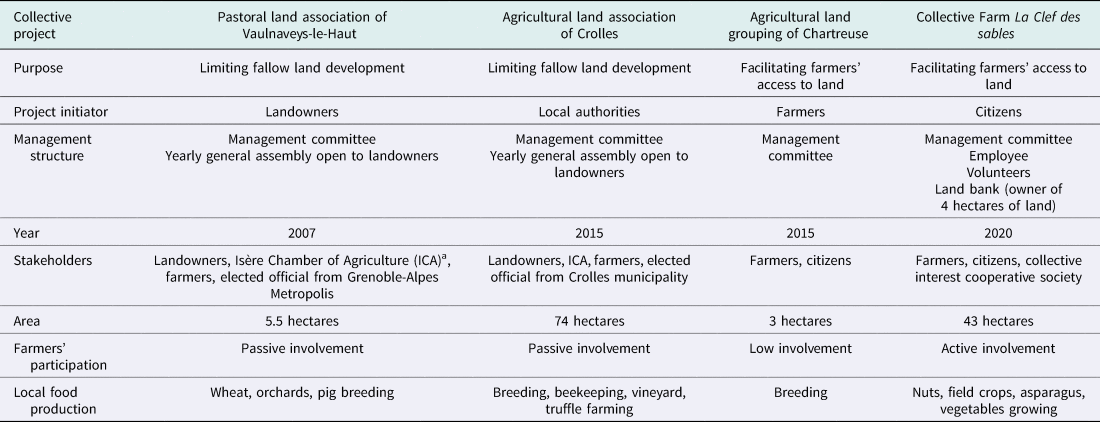
We selected four collective projects representative of the farmland management structures identified in the Isère department, each initiated by different stakeholders (Table 1). The selected case studies have in common institutional arrangements that differ from the sole contractual relation between landowners and farmers as they are based on collective action. The unit of analysis is that of the individual farms which are part of the collective projects. It facilitates comparison with prevailing institutional arrangements regarding farmland.
Case studies

a Public institution placed under State supervision for the improvement of the economic, social, and environmental performance of farmland.
We studied the pastoral land association of Vaulnaveys-le-Haut (PLAV) for the project initiated by landowners. Landowners are themselves farmers and many farms are part of the project. Its objective is twofold: land consolidation to create coherent grazing paths for cattle and agricultural fallow land reduction.
We examined the agricultural land association of the Crolles municipality (ALAC) for the project initiated by local authoritiesFootnote 11. It aims to reduce agricultural fallow land in order to increase local food production. Farmers either rent the land from a private landowner, rent it from the municipality when it owns the land, or are a private owner.
We studied the agricultural land grouping of Chartreuse (ALGC) for the project initiated by farmers. It is a civil land company created to facilitate farmers' access to land. It guarantees farmland use on the long run. Citizens finance land acquisition by buying shares in the ALGC, which rents the acquired land to a farmer.
We investigated the collective farm La Clef des sables (CF) for the project initiated by citizens. It is a cooperative society of collective interest created in order to facilitate the access to land for farmers aiming to produce local food. Its status is justified by the possibility of collecting citizens' funding to acquire land or develop projects on the farm. It dedicates a part of its farmland to a farm incubator project. Citizens can organize recreational activities on the farm such as concerts. It employs a project coordinator who manages the farm's different activities.
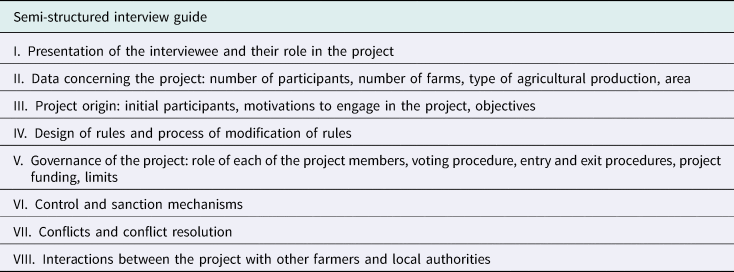
We based our fieldwork on primary and secondary sources of information. We conducted 15 in-depth semi-structured interviews of approximately an hour and a half with a variety of stakeholders: managers, technicians, participants (citizens), farmers, and local authorities when applicable. The interview protocol was designed in a way that allowed us to collect data concerning the project management at the operational and collective choice levels. The interview guide consisted of a list of questions covering the themes mentioned in Table 2.
Main themes covered by the interview guides

We recorded each interview with the consent of the participants. We then transcribed and coded them according to the adapted bundle of rights grid (Figure 2) which allowed us to cross check our findings. Additional information was collected from secondary sources such as published literature, particularly websites of these projects and articles in the local press. The analysed data helped us have an in-depth understanding of the institutional arrangements characterizing the projects studied, which allowed us rethinking their impact on the degrees of excludability of farmland.
4. Conceptual framework: studying the interaction between the nature of goods and institutional arrangements through the bundle of land rights
4.1 Rethinking the excludability degrees of resource systems in the light of the dynamic nature of goods thesis
In economic literature, the nature of goods depends on both their characteristics of excludability and subtractability (Ostrom, Reference Ostrom2010). As defined in the Introduction, excludability means individuals can be excluded from using, managing, or enjoying the benefits of goods. Subtractability represents the ability of individuals to make use of goods at the same time. The chief driver of institutional arrangements for the provision of goods is dictated by their excludability and subtractability, as their nature has different impacts on the problems individuals face for their management (Aligica and Boettke, Reference Aligica and Boettke2009; Ostrom, Reference Ostrom2010).
When economists began to take an interest in the nature of goods, they wanted to identify goods for which provision by the market can be optimal. A twofold classification of goods was put forward to this end, distinguishing private from public goods. The barriers between the categories of this typology have since been questioned: demonstrating that the boundaries between the categories can be blurred (Demsetz, Reference Demsetz1970) and adding new types of goods to this classification (Buchanan, Reference Buchanan1965; Ostrom et al., Reference Ostrom, Gardner and Walker1994).
Bloomington scholars updated this classification in two directions: first, introducing a fourth category of goods that are difficult to exclude and subtractable, namely CPRs; second, considering that goods can have various degrees of excludability and subtractabilityFootnote 12 (Ostrom, Reference Ostrom2003, Reference Ostrom2010) (Figure 1). An important shift in Ostrom's approaches is considering goods that challenge this typology as they share the characteristics of public goods but the institutional arrangement suitable for their provision is that of CPRs, specifically knowledge commons (Hess and Ostrom, Reference Hess and Ostrom2007). The issue at stake is that knowledge commons are non-subtractable and universally accessible. Knowledge commons highlight the efficiency of collective action arrangements beyond CPR.
From degrees in the conventional typology of goods in economics to the dynamic typology of goods.

There has been a recent revival of interest in the literature pertaining to the typology of goods in economics (e.g. Candela and Geloso, Reference Candela and Geloso2018)Footnote 13 .One of the main contributions of this literature is that public goods can be provided by the private sector if bundled up with other private goods. This approach differs from that of this paper as it focuses on the role of government intervention in the provision of public goods. Nevertheless, we explore a similar mechanism throughout this paper, namely that of the analysis of the impact of the provision of goods by actors who are not their traditional or expected providers, in our case the management, provision and production of private goods through institutional arrangements based on collective action.
Moreover, Rayamajhee and Paniagua (Reference Rayamajhee and Paniagua2021) have further challenged this typology by considering that the nature of goods is not inherent and is contingent to their institutional context. The dynamic typology of goods thesis considers that the nature of goods is a function of the continuum excludability – subtractability (Figure 1). Institutional contingency characterizes the nature of goods. The nature of goods can follow different directions of change according to its institutional context. The authors identified four mechanisms explaining the potential shift in the nature of some goods: technological and geographical factors, co-production, re-bundling of related goods and services, and regime shifts.
The dynamic typology of goods paves the way for the analysis of the link between institutional arrangements characterizing the management of goods and their nature since it demonstrates that the nature of a good can be altered under specific institutional contexts. To contribute to the academic debates on the dynamic typology of goods, we explore an additional mechanism that can alter the nature of goods: that of institutional mismatches characterizing the public or private management of goods and triggering alternative institutional arrangements for their management. In particular, we investigate the impact of these arrangements on the excludability degrees of private resource systems. To do so, we adapt the organizational tool of property as a bundle of rights as it provides a deeper understanding of the processes underlying institutional arrangements, and helps illustrating the link between these processes and the reconfiguration of the nature of goods.
4.2 Adapting the bundle of rights to analyse the interactions between institutional arrangements and the nature of goods
There is no consensus on the definition of property and property rights in the literature (Cole, Reference Cole, Daniel H. and Elinor2012). The ontologies of ‘property’ are not agreed upon; whether property is based on rights or on custom is a matter of debate (Wilson, Reference Wilson2023). Wilson (Reference Wilson2023) defends the primacy of property as a custom on property rights. In this paper, we argue that property rights rule over property – both considered as social constructs (Murtazashvili, Reference Murtazashvili2023) –, especially in institutional arrangements where property rights over a resource system are shared between multiple stakeholders. The bundle of rights recognizes the institutional and political role of property rights, which this work further expresses in their influence on reconfiguring the nature of resource systems.
In this light, we define property rights as the authority given to individuals to carry out actions related to specific objects, beyond their private ownership (Commons, Reference Commons1995; Schlager and Ostrom, Reference Schlager and Ostrom1992). Property rights bear distributive and allocative functions (Colin, Reference Colin2008). Property rights cannot be reduced to a relationship individual-object but are interwoven in complex institutional settings that can shape their design and distribution. As Hodgson (Reference Hodgson2015) points out, neglecting the interactions between property rights and the legal system leads to a failure in understanding the role of property rights in practice. In other words, a complete definition of property rights should embrace the relationships between individuals concerning specific objects (Sikor et al., Reference Sikor, He and Lestrelin2017). For a complete analysis of the impact of institutional arrangements on the excludability degrees of farmland, one must also consider the rules from which land rights stem as Schlager and Ostrom (Reference Schlager and Ostrom1992) identify rights as the products of rules.
Based on this definition, the bundle of rights, operationalized by Schlager and Ostrom (Reference Schlager and Ostrom1992) for CPR, allows analysing how institutional arrangements operate in practice. Five rights form this tool: access, withdrawal, management, exclusion, and alienation (Figure 2). This tool has been revisited to study more complex management structures of natural resources (e.g. Galik and Jagger, Reference Galik and Jagger2015) and was further enriched to study the distribution of land rights in Southern countries (Colin, Reference Colin2008). Nevertheless, to our knowledge only a few studies have worked on land rights in Northern countries (e.g. Cai et al., Reference Cai, Murtazashvili and Murtazashvili2020). The challenge related to Northern countries like France is that of resource system management being framed by national regulations (Section 2). We consider it essential to examine the design and distribution of property rights in the light of these regulations, especially when these regulations can encourage collective action (Kassis and Bertrand, Reference Kassis and Bertrand2022).
Adapted tool of property as a bundle of rights.

To study farmland in Northern countries, specifically in France, we therefore propose an adapted grid of property as a bundle of rights inspired by the work of Sikor et al. (Reference Sikor, He and Lestrelin2017). They expand the scope of the bundle of rights by including a larger set of stakeholders and taking into account the intersecting legal systems for forest management in Southern countries. Their revisited conceptual analysis is of particular interest for our research as it allows characterizing the growing complexity of resource system management.
Nevertheless, the institutional context characterizing farmland in France largely differs from that of forests in Southern countries. Figure 2 contrasts the grid of Sikor et al. (Reference Sikor, He and Lestrelin2017) with ours, which we adapted in three directions: access, inclusion, and alteration rights. We chose to adapt the tool developed by Sikor et al. (Reference Sikor, He and Lestrelin2017) as it breaks down collective-choice rights into more specific rights, as does our tool (Figure 2). Some authors may use a two-entry grid separating operational and authoritative rights (Colin, Reference Colin2008), but it does not allow capturing the evolution in farmland management in France. For this reason, we chose the three entry-grid developed by Sikor et al. (Reference Sikor, He and Lestrelin2017) as our point of departure as it sheds light on the distribution of control rights.
Use rights
Our category of use rights corresponds to the category of operational level rights of Schlager and Ostrom (Reference Schlager and Ostrom1992). Sikor et al. (Reference Sikor, He and Lestrelin2017) drop access rights as they reduce it to physical access. However, we suggest reconsidering these rights as they can discriminate between different users of a resource system. Access is defined as the right to access the utilities of a physical property (Ribot and Peluso, Reference Ribot and Peluso2003). Access cannot be limited to physical access, especially when national regulations frame resource system access.
Sikor et al. (Reference Sikor, He and Lestrelin2017) subdivided withdrawal rights into two distinct rights in order to distinguish direct use rights from indirect use rights. We apply this distinction in our category of use rights. Direct use rights are the rights to obtain benefits directly derived from using a resource system, e.g. resource units from harvesting activities. The users of a resource system can hold access rights without holding direct use rights, but the reverse is not true. Indirect use rights are the rights to obtain indirect benefits from a resource system, e.g. farmer grants from agri-environmental schemes. Indirect benefits also concern indirect users of farmland. By indirect users, we mean users that are not active in farmland management. For example, associations defending local food provision indirectly benefit from the local food use that farmers prioritize.
Control rights
Our category of control rights resembles that of Sikor et al. (Reference Sikor, He and Lestrelin2017). Control rights determine the scope of use rights and their users. Use rights are not sufficient to allow communities to self-organize. In other words, control rights embody the modalities for managing resource systems. Unlike use rights, control rights allow transforming resource systems whereas use rights represent an operational implementation of the management mode defined by holders of control rights.
Management rights relate to the regulation and transformation of the uses of a resource system; e.g. the right to choose whether a plot of land will be farmed organically. Exclusion rights determine who holds use rights. We revisit exclusion rights as inclusion rights, as in the projects studied the institutional arrangements attribute land-use rights to new categories of users. Inclusion rights are defined as the right to determine the holders of use rights.
We maintain monitoring rights, which consist of resource system surveillance, and transaction rights related to the identification of the activities necessary to realize benefits (Sikor et al., Reference Sikor, He and Lestrelin2017).
We expand control rights by adding alteration rights as defined by Galik and Jagger (Reference Galik and Jagger2015), corresponding to the right to sustainably modify the use of a resource system. Unlike management, alteration rights consist of a perennial transformation of a resource system, e.g. a land-use change from agricultural activity to another land use.
Authoritative rights
We follow the definition given by Sikor et al. (Reference Sikor, He and Lestrelin2017) of authoritative rights, which consists of determining control rights applicable to resource systems. Definition rights establish the discretionary space for the exercise of control rights; planners hold definition rights on farmland. Allocation rights are rights to assign and transfer control rights to particular actors; e.g. a farmer's commitment to an environmental lease conditions the exercise of control and use rights to a minimum of environmental standards, constraining the farmer's transaction and use rights.
It is worth noting that the categories of land rights are nested, meaning obtaining control rights depends on the distribution of authoritative rights.
5. Results: from the distribution of land rights in institutional arrangements to a reconfiguration of excludability degrees of farmland
5.1. Arraying land rights in collective projects designed to reduce the institutional mismatch with traditional farmland management
Section 2 shows that institutional changes in farmland management are linked to a mismatch between the goals of citizens for farmland management and traditional farmland management. To reduce this mismatch, citizens or local authorities develop and engage in collective projects. This first result allows us to identify the commonalities and differences between the four projects examined in the light of land rights distribution, in order to subsequently determine their impact on the degrees of excludability of farmland.
Use rights
We identify two patterns in the distribution of access and direct use rights. First, in the pastoral and agricultural land associations (PLAV and ALAC) and the collective farm (CF), the access and direct use rights of farmers are extended to the project perimeter. In the PLAV, farmers can define grazing paths wider than their own farm. Farmers are sharing harvesting and withdrawal rights with other stakeholders. The PLAV and ALAC hold access rights to conduct projects on their perimeter.
Second, in the case of the agricultural land grouping (ALGC), farmers' use rights are conditioned by their inability to become farmland owners as the ALGC is the landowner. The management committee aims to preserve farmland use on the long run and considers the structure as a lever to do so. Farmers' allocation rights are limited in this case.
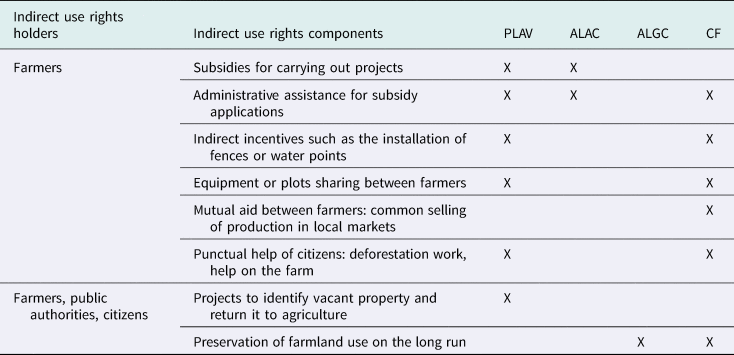
Indirect use rights represent the social benefits of farmland (Table 3). Indirect use rights can be attributed to indirect users not necessarily active in the project. For example, the maintenance of open landscapes benefits village inhabitants in the PLAV case study. On the contrary, citizens are active in the CF and ALGC case studies.
Distribution of indirect use rights in the projects studied

Control rights
We identified three tendencies in the distribution of control rights. First, management committees holding exclusively control rights. This is the case of the PLAV. Farm leases formalize their interactions with farmers. Regarding transaction rights, the PLAV shares them with landowners: the rents paid by farmers are redistributed to the owners. The PLAV may decide not to pay rents to landowners depending on the available funds for their action plan. The PLAV bureau defines control modalities such as farm visits. The same applies to the ALAC. Rights transfer to the ALAC management committee is here due to the municipality's decision to create the ALAC. However, in this case, management and alteration rights are subject to the landowners' consent. Land-clearing projects, which fall under the mobilization of alteration rights, require prior agreement of landowners, bearing in mind that due to the creation of the ALAC by the municipality, landowners have not necessarily been identified. This point has been particularly problematic for the development of projects, which have only been possible in cases where a farmer or the municipality owned the land. In addition, the legal framework constrains the ALAC's transaction rights; it does not allow signing farm leases with farmers. The ALAC can only rent land through multi-year agreements, which makes it difficult to develop long-term partnerships with farmers.
Second, we observed that some control rights are shared with users external to the project. This is the case for the ALGC. Control rights were shared with the regional park of Chartreuse, which participated in the identification of a relevant mechanism for land acquisition, as well as the Isère chamber of agriculture, which provided legal support for its creation. The regional park does not have direct transaction rights within the ALGC, but participates in raising awareness on the levers that the ALGC could activate to use this right. The SAFER does not participate in the management committee; however, it transfers sales information to the ALGC thus allowing the latter to exercise transaction rights. Citizens can have dividends related to the shares they bought. However, the ALGC does not yet pay dividends to citizens; their membership is more about holding indirect use rights. The ALGC holds supervision rights on agricultural projects formalized by the farm lease act linking it to the farmers. It also holds inclusion rights, e.g. type of lease. The ALGC controls alteration rights by preserving farmland use on the long run.
Third, we noted situations where control rights are equally distributed between project stakeholders, creating flexibility in the project as land rights are easily modifiable. In the CF, farmers can punctually delegate part of their control rights to the CF employee, who, for example, responds to commercial offers made to farmers. Management rights are evolving as the management structure of the CF is developing. For example, a new decision-making process will be collectively defined, whereas initially decisions were made by consensus. The objective is to dissociate transaction rights related to agricultural activity from those related to broader CF projects. For transaction rights, the CF draws rents linked to the 4 hectares it owns as well as the participation of farmers in its expenses. For supervision rights, in order to ensure that the time invested by each farmer in the CF is identical to that of his peers, a table of mutual aid hours is filled in throughout the year with the possibility of catching up on hours. Access to certain farm benefits is subject to certain obligations, which is an indirect sanctionFootnote 14. Inclusion rights are also shared between the CF employee and farmers. The former assists in pairing up farmers to ensure the coherence between farm activities, e.g. the establishment of a breeder whose animals can graze under walnut trees in the farm. Alteration rights are also held collectively. For example, the CF runs the project of the construction of a processing building.
Authoritative rights
Definition rights were assigned upstream of the project by landowners or public authorities: the farms' perimeters pre-dated the project.
For allocation rights, two tendencies were observed. First, the management committee holds full allocation rights. It is the case for the ALGC, as it buys land to allow farmers' access to land. Second, allocation rights are shared with landowners, as the projects aim to control land uses. For example, we observed a transfer of rights from landowners to the PLAV management committee due to the landowners' decision to create the PLAV. Moreover, the ALAC allows constraining landowners' allocation rights, even of those who have not given their consent to the project. Authoritative rights are not identified as a lever for project development except in the case of the ALGC.
Mapping the distribution of land rights also pointed out to an evolution in the nature of the stakeholders participating in farmland management, particularly citizens holding control rights. In addition, even though farmers' use rights are similar to those arising from farm leases, the management structures also hold use rights, contrary to landowners in the traditional model, where they delegate part of their rights to farmers and withdraw from farmland management. Moreover, the participation of public authorities in the projects is different: they can define rules for land rights sharing (PLAV and ALAC), participate in the project (ALAC), provide guidance for projects stakeholders (ALGC), or not participate in the project (CF). One of the main findings stemming from this result is that farmland management is mainly shaped by the design and distribution of control rights.
5.2. The reconfiguration of excludability degrees of farmland resulting from the distribution of land rights
Land rights distribution in the collective projects initiated a trajectory of change of farmland excludability degrees that can be expressed on the continuum of excludability–subtractabilityFootnote 15 (Figure 1). Based on the mapping of land rights presented above, we identified explanatory criteria that move farmland along the continuum, the specific direction of change being variable from one project to another.
One first criterion identified as transforming farmland excludability is that of direct users (farmers) holding control rights within the projects. In the collective farm (CF) and agricultural land grouping (ALGC), farmers have access to control rights as they participate in management bodies. In the ALAC and PLAV, farmers do not access control rights. Therefore, they do not have the possibility to participate in the project's management, despite the fact that they benefit from participating in the project (Table 3). In this context, collective projects constrain farmers' management just like a national regulation. Allowing use rights holders to have control rights reduces farmland excludability as these holders actively participate in the definition of objectives related to farmland.
Another criterion indicating the impact of collective projects on the excludability degrees of farmland is that of citizens holding control rights (CF and ALGC). They hold management and transaction rights allowing them to influence decisions on land use. Citizens' control rights allow bridging the gap between the objective of local food provision and the management of farmland. In the ALAC and PLAV, citizens hold indirect use rights and are passive in farmland management. When citizens hold control rights and are active participants in farmland management, farmland excludability is reduced.
Third, we observed that local authorities holding control rights might also influence the degrees of excludability of farmland. The PLAV and ALAC remain largely dominated by public intervention at three levels, namely project funding, definition of rules, and stakeholder participation. In these cases, local authorities often drive decision-making processes. For example, the distribution of control rights in the ALAC is intended to be participatory, but in practice, the municipality mainly holds control rights, particularly transaction rights. In the CF, project stakeholders made control rights evolve according to difficulties encountered. When public authorities do not impose a particular distribution of control rights, and when project stakeholders hold the possibility of modifying control rights, farmland excludability decreases.
This being said, the institutional arrangements characterizing the projects studied do not systematically lead to the decrease of farmland excludability (Table 4), as it is contingent on the distribution of control rights and on the holders of these rights. The impact of the rules framing control rights on farmland excludability will be further clarified below.
Evolutions in farmland excludability degrees within the collective projects studieda

a The evolutions highlighted in this table are compared with the traditional farmland management model where farmland is a private resource system.
5.3. The reconfiguration of farmland excludability degrees resulting from the design of rules framing land rights distribution
A seen in the subsection 4.2, a complete examination of the process of farmland excludability evolution encompasses the analysis of rules used for designing farmland rights. Control rights stem from these rules.
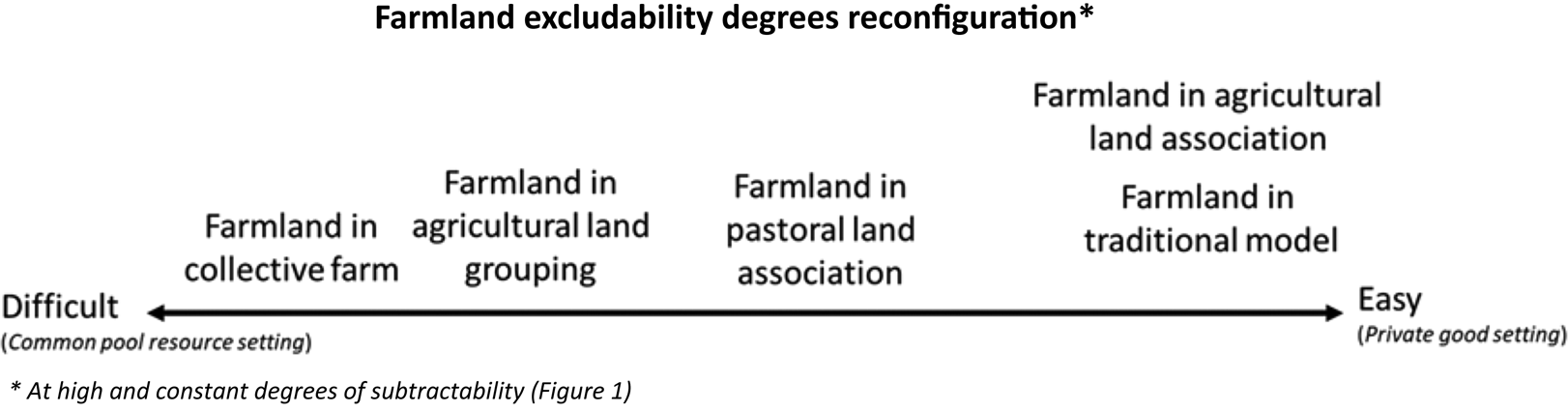
Two processes of rules definition were identified. First, national regulations shape collective projects whose design of control rights is determined at this level. They constrain traditional farmland management but do not modify its excludability degrees. This is the case of the ALAC where the bundle of rights is the product of a regulatory framework. Project stakeholders do not have control over who can manage farmland under which terms. The conditions for managing farmland are similar to that of traditional farmland management where excludability degrees are high (Figure 3). In addition, local authorities controlled the processes of rules implementation; other stakeholders did not embrace the project. In the ALAC, farmers' access to the project is not voluntary: because the farm lies within the project perimeter, the farmer is included. Thus, farmers participate neither in the process of designing rules nor in that of distributing land rights. The institutional arrangement does not modify the rules framing farmers' activity nor does it provide them with the possibility to define more inclusive rules for farmland management. Nevertheless, the ALAC can solve land-related issues, but its institutional arrangement does not result in an evolution of the excludability degrees of farmland (Figure 3).
Reconfiguration of farmland excludability degrees.

Second, project stakeholders design their rules-in-use. Excludability degrees of farmland diminish when project stakeholders are involved in the process of defining rules as they have more flexibility in defining inclusive rules for farmland management meaning they can choose to make farmland more accessible to a diversity of users through the distribution of land rights. In the ALGC and CF projects, farmers' access to land requires their participation in the instances where rules are defined and land rights distributed. Farmland excludability decreases when partnerships are forged to design the rules-in-use. In these two cases, farmland is more accessible to a diversity of users at the collective and operational choice levels compared to the traditional model (Figure 3). The process of defining and implementing rules is less excludable as they include farmers and citizens, which is different from cases characterized by situations of minimum interaction between users framed by rules defined by public authorities (ALAC). Farmland excludability decreases when the design of rules includes rights for land users to self-organize. In this setting, cooperation is required to manage farmland as it involves sharing resources, knowledge, and time; this leads to a decrease in its excludability degrees.
Our results show that the decrease in farmland excludability, whether it relates to the distribution of land rights or the design of rules, is neither homogenous across projects nor across the levels within one project. Figure 3 illustrates the trajectories of the evolution of farmland excludability in the projects studied. The institutional arrangement of the agricultural land association does not lead to a decrease in farmland excludability and does not make the nature of farmland evolve. In the agricultural land grouping and the collective farm, farmland excludability decreases and the institutional arrangement characterizing them gets closer to that of common pool resources, especially in the case of the collective farm. In the pastoral land association, the outcome is more mitigated.
Our analysis did not aim to identify rigid categories of farmland nature in collective projects, but rather to explore if institutional arrangements shaped by the processes of distributing land rights and designing rules lead to a reconfiguration of farmland excludability degrees.
6. Discussion: public policy-making in the light of the reconfiguration of the excludability degrees of resource systems
The starting point of our empirical investigation was that of the institutional mismatch between the traditional farmland management model in France and the demand of citizens for local food provision and production. To reduce this mismatch, citizens and local authorities engage in collective projects aiming at introducing alternative institutional arrangements for farmland management. One potential outcome, apart from providing efficient solutions for local food provision, is to reduce farmland excludability.
A decrease in the excludability of farmland is thus a possible institutional response to the mismatch observed. The mismatch between private or public provision of farmland resources is alleviated by institutional arrangements involving civic participation to reduce it. This result questions the patterns of organization of public authorities regarding their ability to adapt public policy-making to this evolution. Public authorities can take different paths to resolve land-related issues, one of which is to build on these collective initiatives. Public policy-making should develop an institutional framework within which citizens can create and alter rules framing their actions.
The decrease of the excludability of resource systems, more globally the dynamic nature of goods thesis, has a direct implication on the governance of resource systems. As discussed by Rayamajhee and Paniagua (Reference Rayamajhee and Paniagua2021), the dynamic nature of goods calls for a polycentric governance for the management of resource systems. Polycentric governance is about multiple decision-making centers that are formally independent and work towards the achievement of a common objective (Aligica and Tarko, Reference Aligica and Tarko2012; Ostrom et al., Reference Ostrom, Tiebout and Warren1961). Polycentric governance is the political counterpart of the dynamic nature of goods thesis as the provision, production, or management of resource systems is being achieved by a multitude of actors including citizens. We empirically observed that the collective projects benefit stakeholders not directly participating in farmland management, particularly public authorities as the latter and the collective projects aim at the same goal. That justifies the need for a polycentric governance for the management of resource systems characterized by decreasing excludability degrees. In our investigation, the role of public authorities would no longer be that of creating additional tools for farmland management and thus distributing or constraining land rights for farmland users, but that of securing the property rights of the stakeholders of collective projects. The challenge for public authorities is that these property rights are more subtle to secure as they are not exclusively about ownership, but about the management of resource systems.
In this polycentric governance, public authorities should particularly rethink their interaction with citizens engaging in collective projects as it allows defining the appropriate levels of intervention of each stakeholder to better achieve specific objectives. Citizens need to be recognized as a ‘new’ decision-making centre in polycentric governance. This point echoes the literature on co-productionFootnote 16 and questions whether governance of resource systems should partly rely on the involvement and inputs of citizens to improve their management, especially when citizens' participation reshapes their excludability degrees. Our empirical investigation highlighted the institutional changes brought about by citizens' participation in farmland governance, namely the catalyst role they played in the reduction of the aforementioned mismatch. However, this process is in its early stages and needs to be more assertive. Recent empirical literature related to the COVID-19 pandemic highlights that co-production is essential to the design of cognitive institutions as it acknowledges the central role of citizens in polycentric governance, whether they advance or undermine its goals (Frolov, Reference Frolov2022; Rayamajhee and Paniagua, Reference Rayamajhee and Paniagua2022). In our empirical investigation, citizens are catalysts for institutional arrangements. In the same vein, our investigation raises the question whether farmland management for local food provision and production should encompass higher degrees of co-production. A polycentric governance is a lever to further develop this process as it allows considering citizens as a decision-making center, and by this means provide them with appropriate tools to secure their property rights over farmland.
Moreover, the main economic mechanism put forward by public authorities for farmland management is that of incentive schemes, specifically access to funding. Our results suggest that indirect use rights could be an integral part of benefits distribution. This requires the definition of more flexible incentive schemes that are adapted to the projects being developed and questions the efficiency of generalized incentive schemes, when users' engagement in collective projects goes one step further than the traditional farmland management model. The efficiency of incentive schemes is challenged by collective projects where the involvement of users is more about accessing indirect benefits.
The observed evolutions are conditional on the possibility of maintaining collective projects over time; hence, the importance of finding levers for their perpetuation that might stem from the intervention of public authorities. The question of how they should interact in a polycentric governance remains open.
7. Conclusion
The aim of this paper was to investigate how institutional arrangements can alter the excludability of private resource systems. We shed light on this process by studying collective farmland projects in France using the bundle of land rights. Our main finding is about the impact of institutional arrangements on farmland excludability: these arrangements do not systematically lead to a decrease of excludability and are dependent on the distribution of land rights and the design of rules. More specifically, excludability decreases when direct users (farmers) hold control rights and/or when citizens participate in the projects, as the process of defining and attributing control rights is more inclusive than in projects managed by local authorities. The way rules are defined and implemented, the inclusion of all project stakeholders in this process and its flexibility are all aspects that influence the excludability degrees of farmland.
This paper raises two points of interest for the research agenda of Bloomington scholars. First, drawing trajectories of change in the nature of resource systems avoids the trap of mistakenly identifying a CPR based exclusively on collective action or holders of indirect use rights (McGinnis, Reference McGinnis2011). Collective action can characterize private resource systems, but this does not systematically lead to a decrease in their excludability degrees, and thus to a change in their nature. Second, unpacking the bundle of land rights made it possible to illustrate how institutional arrangements can decrease the excludability degrees of resource systems. One should see the adapted grid as exploratory, allowing to study the links between institutional arrangements and the nature of resource systems. The boundaries between different components of the bundle of property rights might be blurred. However, their heuristic power is worth highlighting. Despite the institutional diversity of the cases studied, the bundle of land rights has made it possible to start from a common ground – that of the distribution of rights – to analyse the evolution of excludability degrees. The analytical power of the bundle of land rights should be emphasized: its ability to highlight renewed ways of managing resource systems with their impact on the excludability of these systems.
On a concluding note, studying the relation between the excludability degrees of resource systems and institutional arrangements enriches the theoretical debates on the typology of goods in economics. Two theoretical investigations need to be further explored: whether new categories of goods are to be defined according to the growing diversity of institutional arrangements characterizing resource systems, or whether new characteristics of goods should be added to the typology of goods in economics, beyond excludability and subtractability.
Acknowledgements
I am very grateful for the valuable feedback from the anonymous reviewers of this paper. I would also like to thank my Ph.D. supervisors Nathalie Bertrand and Tina Rambonilaza for their guidance throughout the design of this work. Finally, I would like to thank Jean-Philippe Colin and Frederic Wallet for their comments on earlier versions of this paper.