

%20--%3e%3c!DOCTYPE%20svg%20PUBLIC%20'-//W3C//DTD%20SVG%201.0//EN'%20'http://www.w3.org/TR/2001/REC-SVG-20010904/DTD/svg10.dtd'%3e%3csvg%20version='1.0'%20id='Layer_1'%20xmlns='http://www.w3.org/2000/svg'%20xmlns:xlink='http://www.w3.org/1999/xlink'%20x='0px'%20y='0px'%20width='64px'%20height='64px'%20viewBox='5.5%20-3.5%2064%2064'%20enable-background='new%205.5%20-3.5%2064%2064'%20xml:space='preserve'%3e%3cg%3e%3ccircle%20fill='%23FFFFFF'%20fill-opacity='0'%20cx='37.785'%20cy='28.501'%20r='28.836'/%3e%3cpath%20fill='%23595959'%20d='M37.441-3.5c8.951,0,16.572,3.125,22.857,9.372c3.008,3.009,5.295,6.448,6.857,10.314%20c1.561,3.867,2.344,7.971,2.344,12.314c0,4.381-0.773,8.486-2.314,12.313c-1.543,3.828-3.82,7.21-6.828,10.143%20c-3.123,3.085-6.666,5.448-10.629,7.086c-3.961,1.638-8.057,2.457-12.285,2.457s-8.276-0.808-12.143-2.429%20c-3.866-1.618-7.333-3.961-10.4-7.027c-3.067-3.066-5.4-6.524-7-10.372S5.5,32.767,5.5,28.5c0-4.229,0.809-8.295,2.428-12.2%20c1.619-3.905,3.972-7.4,7.057-10.486C21.08-0.394,28.565-3.5,37.441-3.5z%20M37.557,2.272c-7.314,0-13.467,2.553-18.458,7.657%20c-2.515,2.553-4.448,5.419-5.8,8.6c-1.354,3.181-2.029,6.505-2.029,9.972c0,3.429,0.675,6.734,2.029,9.913%20c1.353,3.183,3.285,6.021,5.8,8.516c2.514,2.496,5.351,4.399,8.515,5.715c3.161,1.314,6.476,1.971,9.943,1.971%20c3.428,0,6.75-0.665,9.973-1.999c3.219-1.335,6.121-3.257,8.713-5.771c4.99-4.876,7.484-10.99,7.484-18.344%20c0-3.543-0.648-6.895-1.943-10.057c-1.293-3.162-3.18-5.98-5.654-8.458C50.984,4.844,44.795,2.272,37.557,2.272z%20M37.156,23.187%20l-4.287,2.229c-0.458-0.951-1.019-1.619-1.685-2c-0.667-0.38-1.286-0.571-1.858-0.571c-2.856,0-4.286,1.885-4.286,5.657%20c0,1.714,0.362,3.084,1.085,4.113c0.724,1.029,1.791,1.544,3.201,1.544c1.867,0,3.181-0.915,3.944-2.743l3.942,2%20c-0.838,1.563-2,2.791-3.486,3.686c-1.484,0.896-3.123,1.343-4.914,1.343c-2.857,0-5.163-0.875-6.915-2.629%20c-1.752-1.752-2.628-4.19-2.628-7.313c0-3.048,0.886-5.466,2.657-7.257c1.771-1.79,4.009-2.686,6.715-2.686%20C32.604,18.558,35.441,20.101,37.156,23.187z%20M55.613,23.187l-4.229,2.229c-0.457-0.951-1.02-1.619-1.686-2%20c-0.668-0.38-1.307-0.571-1.914-0.571c-2.857,0-4.287,1.885-4.287,5.657c0,1.714,0.363,3.084,1.086,4.113%20c0.723,1.029,1.789,1.544,3.201,1.544c1.865,0,3.18-0.915,3.941-2.743l4,2c-0.875,1.563-2.057,2.791-3.541,3.686%20c-1.486,0.896-3.105,1.343-4.857,1.343c-2.896,0-5.209-0.875-6.941-2.629c-1.736-1.752-2.602-4.19-2.602-7.313%20c0-3.048,0.885-5.466,2.658-7.257c1.77-1.79,4.008-2.686,6.713-2.686C51.117,18.558,53.938,20.101,55.613,23.187z'/%3e%3c/g%3e%3c/svg%3e)
%20--%3e%3c!DOCTYPE%20svg%20PUBLIC%20'-//W3C//DTD%20SVG%201.0//EN'%20'http://www.w3.org/TR/2001/REC-SVG-20010904/DTD/svg10.dtd'%3e%3csvg%20version='1.0'%20id='Layer_1'%20xmlns='http://www.w3.org/2000/svg'%20xmlns:xlink='http://www.w3.org/1999/xlink'%20x='0px'%20y='0px'%20width='64px'%20height='64px'%20viewBox='5.5%20-3.5%2064%2064'%20enable-background='new%205.5%20-3.5%2064%2064'%20xml:space='preserve'%3e%3cg%3e%3ccircle%20fill='%23FFFFFF'%20fill-opacity='0'%20cx='37.637'%20cy='28.806'%20r='28.276'/%3e%3cg%3e%3cpath%20fill='%23595959'%20d='M37.443-3.5c8.988,0,16.57,3.085,22.742,9.257C66.393,11.967,69.5,19.548,69.5,28.5c0,8.991-3.049,16.476-9.145,22.456%20C53.879,57.319,46.242,60.5,37.443,60.5c-8.649,0-16.153-3.144-22.514-9.43C8.644,44.784,5.5,37.262,5.5,28.5%20c0-8.761,3.144-16.342,9.429-22.742C21.101-0.415,28.604-3.5,37.443-3.5z%20M37.557,2.272c-7.276,0-13.428,2.553-18.457,7.657%20c-5.22,5.334-7.829,11.525-7.829,18.572c0,7.086,2.59,13.22,7.77,18.398c5.181,5.182,11.352,7.771,18.514,7.771%20c7.123,0,13.334-2.607,18.629-7.828c5.029-4.838,7.543-10.952,7.543-18.343c0-7.276-2.553-13.465-7.656-18.571%20C50.967,4.824,44.795,2.272,37.557,2.272z%20M46.129,20.557v13.085h-3.656v15.542h-9.944V33.643h-3.656V20.557%20c0-0.572,0.2-1.057,0.599-1.457c0.401-0.399,0.887-0.6,1.457-0.6h13.144c0.533,0,1.01,0.2,1.428,0.6%20C45.918,19.5,46.129,19.986,46.129,20.557z%20M33.042,12.329c0-3.008,1.485-4.514,4.458-4.514s4.457,1.504,4.457,4.514%20c0,2.971-1.486,4.457-4.457,4.457S33.042,15.3,33.042,12.329z'/%3e%3c/g%3e%3c/g%3e%3c/svg%3e)
%20--%3e%3c!DOCTYPE%20svg%20PUBLIC%20'-//W3C//DTD%20SVG%201.0//EN'%20'http://www.w3.org/TR/2001/REC-SVG-20010904/DTD/svg10.dtd'%3e%3csvg%20version='1.0'%20id='Layer_1'%20xmlns='http://www.w3.org/2000/svg'%20xmlns:xlink='http://www.w3.org/1999/xlink'%20x='0px'%20y='0px'%20width='64px'%20height='64px'%20viewBox='5.5%20-3.5%2064%2064'%20enable-background='new%205.5%20-3.5%2064%2064'%20xml:space='preserve'%3e%3cg%3e%3ccircle%20fill='%23FFFFFF'%20fill-opacity='0'%20cx='36.924'%20cy='28.403'%20r='28.895'/%3e%3cpath%20fill='%23595959'%20d='M37.442-3.5c8.99,0,16.571,3.085,22.743,9.256C66.393,11.928,69.5,19.509,69.5,28.5c0,8.992-3.048,16.476-9.145,22.458%20C53.88,57.32,46.241,60.5,37.442,60.5c-8.686,0-16.19-3.162-22.513-9.485C8.644,44.728,5.5,37.225,5.5,28.5%20c0-8.762,3.144-16.343,9.429-22.743C21.1-0.414,28.604-3.5,37.442-3.5z%20M12.7,19.872c-0.952,2.628-1.429,5.505-1.429,8.629%20c0,7.086,2.59,13.22,7.77,18.4c5.219,5.144,11.391,7.715,18.514,7.715c7.201,0,13.409-2.608,18.63-7.829%20c1.867-1.79,3.332-3.657,4.398-5.602l-12.056-5.371c-0.421,2.02-1.439,3.667-3.057,4.942c-1.622,1.276-3.535,2.011-5.744,2.2%20v4.915h-3.714v-4.915c-3.543-0.036-6.782-1.312-9.714-3.827l4.4-4.457c2.094,1.942,4.476,2.913,7.143,2.913%20c1.104,0,2.048-0.246,2.83-0.743c0.78-0.494,1.172-1.312,1.172-2.457c0-0.801-0.287-1.448-0.858-1.943l-3.085-1.315l-3.771-1.715%20l-5.086-2.229L12.7,19.872z%20M37.557,2.214c-7.276,0-13.428,2.571-18.457,7.714c-1.258,1.258-2.439,2.686-3.543,4.287L27.786,19.7%20c0.533-1.676,1.542-3.019,3.029-4.028c1.484-1.009,3.218-1.571,5.2-1.686V9.071h3.715v4.915c2.934,0.153,5.6,1.143,8,2.971%20l-4.172,4.286c-1.793-1.257-3.619-1.885-5.486-1.885c-0.991,0-1.876,0.191-2.656,0.571c-0.781,0.381-1.172,1.029-1.172,1.943%20c0,0.267,0.095,0.533,0.285,0.8l4.057,1.83l2.8,1.257l5.144,2.285l16.397,7.314c0.535-2.248,0.801-4.533,0.801-6.857%20c0-7.353-2.552-13.543-7.656-18.573C51.005,4.785,44.831,2.214,37.557,2.214z'/%3e%3c/g%3e%3c/svg%3e)
%20--%3e%3c!DOCTYPE%20svg%20PUBLIC%20'-//W3C//DTD%20SVG%201.1//EN'%20'http://www.w3.org/Graphics/SVG/1.1/DTD/svg11.dtd'%3e%3csvg%20version='1.1'%20id='Layer_1'%20xmlns='http://www.w3.org/2000/svg'%20xmlns:xlink='http://www.w3.org/1999/xlink'%20x='0px'%20y='0px'%20width='64.000977px'%20height='64px'%20viewBox='0%200%2064.000977%2064'%20enable-background='new%200%200%2064.000977%2064'%20xml:space='preserve'%3e%3cg%3e%3ccircle%20fill='%23FFFFFF'%20fill-opacity='0'%20cx='32.064453'%20cy='31.788086'%20r='29.012695'/%3e%3cg%3e%3cpath%20fill='%23595959'%20d='M31.943848,0C40.896484,0,48.476562,3.105469,54.6875,9.314453C60.894531,15.486328,64.000977,23.045898,64.000977,32%20s-3.048828,16.457031-9.145508,22.513672C48.417969,60.837891,40.779297,64,31.942871,64%20c-8.648926,0-16.152832-3.142578-22.513672-9.429688C3.144043,48.286133,0,40.761719,0,32.000977%20c0-8.723633,3.144043-16.285156,9.429199-22.68457C15.640137,3.105469,23.14502,0,31.943848,0z%20M32.060547,5.771484%20c-7.275391,0-13.429688,2.570312-18.458496,7.714844C8.381836,18.783203,5.772949,24.954102,5.772949,32%20c0,7.125,2.589844,13.256836,7.77002,18.400391c5.181152,5.181641,11.352051,7.770508,18.515625,7.770508%20c7.123047,0,13.332031-2.608398,18.626953-7.828125C55.713867,45.466797,58.228516,39.353516,58.228516,32%20c0-7.3125-2.553711-13.484375-7.65625-18.513672C45.504883,8.341797,39.333984,5.771484,32.060547,5.771484z%20M44.117188,24.456055%20v5.485352H20.859863v-5.485352H44.117188z%20M44.117188,34.743164v5.481445H20.859863v-5.481445H44.117188z'/%3e%3c/g%3e%3c/g%3e%3c/svg%3e)
Limited expenditures and cost-cutting were overriding concerns for British colonial officials with respect to social welfare and health in Palestine. London required British colonies to “pay their own way” by extracting resources from indigenous populations and encouraging private enterprises, especially British ones. London facilitated such enterprises as long as they did not threaten stability in the colonies (Reference BuntonBunton 2007, 25; Reference ConstantineConstantine 1984, 17–18, 23). Imperial authorities were most willing to assist colonial governments in building “the railways, roads or other facilities needed to attract investment and stimulate exports” and expected local taxes and laborers to meet maintenance costs, including for municipal infrastructures such as sanitation systems (Reference ConstantineConstantine 1984, 22–23; Palestine Local Councils Ordinance 1921, 1922). The British logic of “efficiencies and economies” also ruled healthcare provision for Palestinians during the Mandate. Zionist institutions provided for Jewish healthcare and Palestinians largely relied on Christian missionary institutions and fee-based medical services.
British colonial welfare ideology was committed to the “march of civilisation” for metropolitan gain, even when some officials recognized the damage done to indigenous health. “Arabs and Yeminite Jews,” as well as “Bedouins” (“in many ways a race apart”), had little immunity to tuberculosis, for example, as contact increased “between urban and rural communities,” infected poor Jewish settlers immigrated from “Russia and Eastern and Central Europe,” and infected Palestinian migrants returned from the Americas, according to a 1935 report by Norman M. MacLennan, the Jerusalem SMO (Reference MacLennanMacLennan 1935, 22, 102). MacLennan notably did not mention that colonial extraction and austerity contributed to poverty and hunger, which made people more likely to become ill and less likely to recover. Even when British health officials in Palestine recognized these connections and privately argued for more resources for Palestinians, they usually deployed civilizational rhetoric that articulated themselves as culturally superior to backward natives.
Gendered-racialized dynamics and material tensions were prominent in the archives as colonial authorities governed and minutely regulated Palestinian-serving IWC nurses and midwives but provided little money for healthcare. A conflict between Superintendent Rogers and nurse Insaf Ali recorded in a folder spanning 1934 to 1947 illustrates these dynamics and offers insights on the municipality of El-Bireh’s ultimately fruitless battle with the Department of Health to acquire first permission and later financial support for a clinic that included an IWC.Footnote 1 The colonial government repeatedly insisted that El-Bireh should not establish a clinic, the government could not afford to pay the salary of a nurse, and residents should instead travel to the IWC in Ramallah. The president of the municipal council, `Abdullah Judeh, responded that the distance between El-Bireh and Ramallah was far, transportation was expensive, and long waits ensued for patients in Ramallah, where medical treatment was in any case limited. El-Bireh leaders continually made the case that women, infants, and schoolchildren had enormous medical needs, residents were highly taxed and poor, and the council could not complete many urgent projects because of budgetary limitations. Ultimately the municipal council established an independent clinic and a health insurance system (10 mils per head per month) that it could not sustain.
The El-Bireh folder contains details of a lengthy conflict between June 1944 and May 1945 involving an unruly Egyptian nurse, Insaf Mahmoud Ali, who said she had “graduated from the Egyptian College of Medicine” with “diplomas in Nursing and Midwifery with Distinction,” and was finally fired by the El-Bireh Municipal Council after enraging Vena Rogers with her “insolence” and “insubordination.” Rogers claimed that the Egyptian nurse did not seem to “know the true purpose of the center,” which was baby care and educating mothers. Nurse Insaf was more interested in “showy matters and in midwifery work in the town.” Rogers demanded the nurse only attend to “midwifery cases” in “emergencies” and insisted she was not permitted to “charge fees for such services.” Upon visiting the El-Bireh IWC while Nurse Insaf was attending a home delivery, Rogers reported seeing “a vaginal speculum, a scalpel, hypodermic needles, etc.,” which she ordered “be immediately removed” since only medical officers, by definition male, were allowed to use them. Rogers accused Nurse Insaf of being more interested in working “in hospitals” and complained of her arrogance in asking the medical officer in Ramallah for “Neo Salvarsan” (a syphilis treatment) because she had a “positive case.”
Rogers cited Nurse Insaf for wearing “an Army Sister’s Cap,” “jewelry” (deemed unclean and not making “a good impression”), a “fancy dress,” and “overalls” with “large fancy glass buttons,” instead of the regulation uniform. In her own letter in the file, Nurse Insaf responded that the government did not provide a uniform and should pay her to wear one. (It did not pay her salary either.) The president of the El-Bireh Municipal Council described Rogers as coming to “our centre” in “a furious state,” “cursing the Nurse before the women and beat[ing] her.” The council viewed this as part of (colonial?) “intrigues against the Centre.” Rogers denied beating Nurse Insaf but admitted to grabbing her arm and pulling her out of a treatment room when the nurse refused to pay obeisance to Rogers and went so far as to ask her to instead pay “for the necessary things” in the clinic.
The El-Bireh Municipal Council eventually fired Nurse Insaf and the colonial government continued to refuse to pay a salary for a nurse or midwife in El-Bireh through the Mandate period.Footnote 2 Like Nurse Butros in the previous chapter, Nurse Insaf was expected to spend a good portion of her time providing “practical training” to teenage “schoolgirls” and mothers about health and hygiene rather than treating patients.Footnote 3 Actual treatment of non-acute conditions was the responsibility of the Palestinian medical officer who attended to patients in a clinic he held in the Ramallah IWC once per week.
Efficiencies and Economies in Colonial Health
As in other colonies, fiscal austerity policies limited provision of healthcare in Palestine. Expanding services for Palestinians always “depended on the generation of adequate [local] revenue” (Reference MillerMiller 1985, 71). The British colonial project in Palestine was expected to pay for itself, with Zionist, missionary, and philanthropic institutions – and especially Palestinians themselves – picking up the tab. In response to a 1929 query from the Permanent Mandates Commission regarding the limited “hospital facilities” in Palestine, the Department of Health reiterated a 1922 colonial policy statement of priorities:
(a) To concentrate on public health and sanitation, and the prevention of disease;
(b) To provide hospital accommodation for infectious and communicable diseases and for the insane;
(c) To limit as far as possible the hospital accommodation provided by the Government for the treatment of general diseases to the requirements of Government officers and employees, members of the Police Force, prisoners, medico-legal cases and accidents, and the very poor [my italics];
(d) To provide hospitals, or, to aid Municipalities to provide hospitals, for the needs of the general population where no provision or inadequate provision is made by voluntary organizations [my italics].Footnote 4
A notice on March 2, 1922, marked “strictly confidential,” from the civil secretary of the Government House in Jerusalem to “all British high officials in Palestine,” highlighted “the urgent necessity of economy in expenditure” and instructed that “any programme of cultural and economic development must be postponed for the present” (Adm. No. 981). An item dated May 1, 1922, from the Colonial Office, labeled “Urgent Confidential,” notified the departments of “Public Health and Education” to ask “persons who are in a financial position to do so, [to] repay a larger proportion of the cost of the medical and educational facilities which they receive.” A May 10, 1922, confidential memo from the director of health expressed resistance to increased austerity in a complaint he sent to the civil secretary and the treasurer. He explained the department had already cut expenditures in “relief” by “more than half” compared to the previous year. He added that the fee rate for “3rd class treatment” at all government hospitals had already been “doubled” by the Colonial Office, although “it must be understood that a considerable proportion of the latter are infectious diseases, medico-legal cases, and indigents who are certified by Governors as unable to pay” (per item c in the aforementioned statement of priorities). Nevertheless, a May 17, 1922, confidential memo on “Budget Estimates 1922–23” indicates the director of health made “additional economies.” Among other things, the Department of Health closed Ramallah Hospital entirely, accruing a savings of almost one thousand pounds, and reduced the number of third-class “diet strength” rations at the Gaza, Haifa, and Jerusalem hospitals.Footnote 5
Halfway through thirty years of British colonial rule in Palestine, the Department of Health Annual Report for Year 1935 reiterated healthcare austerity for Palestinians: “Treatment at Government clinics is restricted to Government employees and the very poor.” As illustrated by the case of the infant Yasmin, however, free care for Palestinian indigents in such hospitals was the exception, not the rule. The poor were required to pay the third-class fee, which was not affordable to most. In a critical academic article published in 1932, Israel Jacob Kligler, then the director of the Hadassah Straus Health Centre in Jerusalem and a professor of hygiene and bacteriology at the Hebrew University, found that “the Government provides 10 PT. or less than 50 cents per capita per annum for hospital and public health purposes” in Palestine (Reference KliglerKligler 1932, 169). Despite frequent references to paying “the closest attention to measures for safeguarding the health of the population,” the government invested as little as possible to improve health conditions.
British colonial rhetoric, moreover, understated Ottoman investments in public health in Palestine in the same breath it exaggerated British commitments. According to a 1921 report of the Civil Administration of Palestine presented to the British Parliament, for example, “Before the British Occupation there were no government hospitals or dispensaries for the civilian population.”Footnote 6 However, according to Palestinian physician Tawfik Canaan, there were:
five [Ottoman] government or municipal hospitals (in Jerusalem, Jaffa, Nablus, Tul-Karm and Gaza). They were small and inadequately equipped. The hospital in Nablus was built by voluntary contributions of the Arab inhabitants. Later on it was taken over by the municipality and is now run by the [British] P.H.D. All other hospitals were either missionary (Christian) or philanthropic (Jewish). The first predominated and they treated equally Arabs and Jews.
Of the twenty-five “non-Jewish” (and nongovernment) hospitals in Palestine before 1914, nine were in Jerusalem and all except a Greek Orthodox (mission) hospital and a Russian hospital were sponsored by (Northern) European Christian missions (Reference CanaanCanaan 1946, 2).
From the 1840s to the 1860s, according to Philippe Bourmaud, there were four hospitals in Ottoman Bilad ash-sham (Greater Syria). Similar to Canaan, Bourmaud estimates that by 1914 there were about “thirty such institutions … unevenly dispersed in the main population centres and on both sides of the Jordan; most were established after the French-Prussian war in 1870–1871 as part of national competition between the main European powers,” largely in the small town of Bethlehem “with its biblical background,” which had “no less than three hospitals” by 1909 and was “indisputably over-medicalised” (Reference Bourmaud, Harrison, Jones and SweetBourmaud 2009, 277, 278).
In 1921 the British colonial government in Palestine reported to Parliament that it ran “13 hospitals, 21 dispensaries, 8 clinics and 5 epidemic posts.”Footnote 7 By 1922 the Department of Health reported sponsoring eleven hospitals (two less than in 1921), one of which was quickly closed for lack of funds (Ramallah), and one of which served Palestinian laborers at the Kantara Railway,Footnote 8 as well as a mental hospital in Bethlehem.Footnote 9 In “clinics,” a 1921 report explained, a medical officer saw patients once “weekly or fortnightly” “during their periodic tours” of some villages, but assured the London Treasury that such services were not free: “The revenue derived from the village clinics was sufficient to cover the cost of the drugs and dressings expended. This form of medical relief was so much appreciated by the villagers that Governments of Districts made numerous requests for new clinics to be started but limitations of staff usually prevented this.”Footnote 10 By 1929, “for financial reasons,” there were no “adequate hospital facilities” for Palestinians in large areas that included “Tulkarem, Ramleh, Majdal, Ramallah and Hebron.”Footnote 11 In the early 1930s the medical officers in the large cities of Jerusalem, Haifa, Jaffa, and Nablus were each responsible for visiting as many as “thirty to forty villages about once a month” (Reference KliglerKligler 1932, 168), making the 1921 claim of weekly or fortnightly visits rather impossible.
The Colonial Office in London reported their spending on health services in the 1920s in British pounds to the Council of the League of Nations on the Administration of Palestine and Trans-Jordan.Among other things, the report shows that total spending on healthcare in absolute terms went down from the highest amount in 1921–1922 (146,500), to a much lower plateau in 1928 (73,800), rose in 1929 (101,800) and 1930 (105,400) in relation to spending from 1923 through 1928, but remained lower than spending in 1921–1922.Footnote 12
To give a comparative sense, the 1926–1927 Hadassah annual budget, which served the healthcare needs of a much smaller Jewish population in Palestine, totaled 132,032 British pounds (Reference Rosenau, Wilinsky and MelchettRosenau and Wilinsky 1928, 660), 44 percent higher than the 91,676 British pounds the colonial government reported spending on the health of its forces and Palestinians in the same year. Substantially dependent on external funding from the United States, Hadassah did experience funding shortages, for example, in the early 1930s. At that point, it transferred most of its “various health services to the local Jewish Communities,” whose health services were “supported for the most part by the Jewish community in Palestine itself” (Reference SimoniSimoni 2000, 57). Transferring Hadassah health institutions to local Zionist communities allowed the hospitals to apply for and receive government grants-in-aid (58). With this shift, the Department of Health eagerly took the opportunity to recommend “economies” in the Tel Aviv municipal hospital, according to the Department of Health annual report for 1933 (pub. 1934).
Despite a global economic depression, fiscal years 1932–1936 saw budget surpluses in Palestine; indeed the colonial government called it a “boom period” (GOP 1938, Report by the Treasurer, 3). Deficits in fiscal years 1931–1932 (−22,900) and for two years beginning in 1936 (−1,432,600 and −2,434,200) were the result of increased military spending to address Arab “disturbances” (Reference El-EiniEl-Eini 1997, 573, and table 1, 574). Surpluses in 1932–1933 (+499,500), 1933–1934 (+1,280,600), 1934–1935 (+2,222,600), and 1935–1936 (+1,534,200) were the result of parsimonious government spending and the influx of Jewish capital as more Germans emigrated to and invested in Palestine with the rise of Adolf Hitler.
Colonial health officials on the ground were well aware that the Palestine government was held to the British imperial principle of “making the country pay for itself” (quoted in Reference El-EiniEl-Eini 1997, 571). British spending on Palestinian healthcare was miserly as a proportion of the colonial budget and was further reduced over time (Anglo-American Committee of Inquiry 1946, Vol. II, 630, table 2). A five-year snapshot of the spending priorities of the Government of Palestine is presented in an “Ordinary Expenditure” table in the Report by the Treasurer on the Financial Transactions of the Palestine Government for the Year 1938–1939 (GOP 1939, 19). It illustrates a continued low proportion of spending on healthcare services in the 1930s that ranges from 4.0 to 5.9 percent (rounded) of annual total budgets. I extracted the “Health” and “Law and Order” rows to calculate comparative percentages (see Table 2.1).
| Year | Total Budget (British pounds) | Law and Order (percent) | Health (percent) |
|---|---|---|---|
| 1934–1935 | 2,834,841 | 32.4 | 5.9 |
| 1935–1936 | 3,315,531 | 28.6 | 5.9 |
| 1936–1937 | 5,159,799 | 45.4 | 4.0 |
| 1937–1938 | 4,796,808 | 43.3 | 4.5 |
| 1938–1939 | 4,613,611 | 41.4 | 5.1 |
These amounts include health services of a higher grade for colonial and military personnel and their families and grants to Jewish healthcare institutions in Palestine. Higher proportions of spending on health occurred in years of lower gross spending. Spending on law and order increased substantially, taking almost half the budget, during the first year of the Palestinian Revolt, and remained high through 1938–1939. Taking a wider historical lens, Department of Health expenditures in Palestine averaged 4.13 percent of the total budget from the years 1923–1924 through 1945–1946, according to my calculation of a yearly table of health services spending in colonized Palestine (Anglo-American Committee of Inquiry 1946, Vol. II, 630, table 2).
I analyzed files of Department of Health correspondences involving multiple medical administrators and colonial officials discussing collecting, suing for, or writing off hospital fees in situations where male Palestinian patients absconded without paying, as well as for European indigents such as nuns and nurses working in Palestine. Most patients who used government hospitals were required to pay the first-, second-, or third-class fees. Yasmin’s mother was required to pay the daily third-class fee for the Arab section of the Jerusalem government hospital when she tried to get care for her daughter in 1933. Notably, Yasmin was repeatedly refused treatment because her mother could not pay rather than being charged after the child was treated. Indeed, I found no billing arrears cases involving Palestinian women and children.
Government employees injured not through their own “negligence,” including British members of the Palestine police, were required to pay the hospital diet fee only. Many patients who worked in British government offices or labor projects left hospitals without paying even this fee, the majority of them impoverished Palestinian village men who owed very little, according to an Arabic letter written on behalf of a former (likely illiterate) patient and a list of the names of absconding patients from the Jaffa government hospital. Hospitals quickly learned to “settle accounts” before a patient left, even in “medico-legal cases,” and the government only sued for payment when administrators thought a suit would be successful; it did not sue when costs in staff and money would easily exceed the small amounts owed.Footnote 13
A June 7, 1923, circular (No. 153) lists the per diem first-, second-, and third-class fees for “maternity cases admitted to Government Hospitals,” which were PT (“piastre tariff”; the Egyptian colonial pound, tied to the sterling, was in common and official use in Palestine until 1927) 75, 50, and 30, respectively. These fees rose substantially by the late 1920s. In the 1930s and 1940s maternity hospitalization was broken down into three parts: the “surgeon’s fee,” which was paid directly to him (usually a man, although there were a few women obstetricians working in institutions that served Palestinians in the 1940s) and was unnecessary if the birth was only attended by a nurse-midwife; a per diem fee of 230 mils for subsequent “treatment” that did not appear to be differentiated by “class”; and a per diem “maintenance” rate, which covered “diet” (120 mils for second class), for a total of 350 mils per day for second-class maternity care. For comparison, the per diem maternity fees excluding the surgeon cost totaled 450–500 mils in the Princess Mary Maternity Ward of the government hospital in Jerusalem, likely the first-class rate, “where the nursing staff is composed of British Nursing Sisters.”Footnote 14
Multiple correspondences in the late 1920s and early 1930s related to the costs of childbirth and postpartum care for the wives of white British Palestine police constables in the Jerusalem and Haifa government hospitals, which each had “special accommodations” designed for the “European maternity patient.” The second-class rate and the debate about who should carry the costs of “family,” reproductivity, and healthcare illustrate the continuing relevance of class among white subjects in the empire. In January 1929, in response to long-standing entreaties from the police inspector-general in Palestine, the Colonial Office in London agreed to pay for “medical and dental treatment,” but not for hospital stays or maternity care, for wives and children of British constables if family members were “resident in Palestine.” Although no wives and children of other British colonial “officers” in Palestine were reportedly provided medical and dental treatment, the stated principle for agreeing to do so for constables was to be consistent with the policy for the wives and children of “British Army and Air Force” members serving abroad. Correspondence from 1933 indicates there were ninety-seven married British constables in Palestine remunerated with an average monthly pay of eleven Palestinian pounds and government provision of housing.Footnote 15
Maternity coverage for the wives of British police constables remained a source of tension. In 1929 “Mrs. Dove” stayed in the second-class ward of the British section of the government hospital in Jerusalem. Her husband owed twenty-seven Palestinian pounds for this stay, “approximately, two months’ pay to the Constable.” Based on a ruling by the secretary of state, colonial officials repeatedly refused to provide free maternity treatment for Mrs. Dove and other constables’ wives and “prohibit[ed] the grant of a free diet.” In a late 1933 letter to the police inspector-general (likely) from the treasurer, he stated he was “reluctant” to ask the secretary of state to reconsider government coverage of maternity hospital per diems for British police wives, emphatically reminding him of class-based reproductive ideology in England: “I would point out that very few of us can hope to finance an increase of family strictly from income: it is usually a question either of drawing on capital or borrowing. There seems no particular reason why the British Constable should be relieved of a similar necessity at public cost.”
In the same letter, the author noted that Director of Health Colonel George W. Heron (whom he seemingly had reapproached, contrary to his reluctance) had offered a “reasonable compromise” and “alternative”: a constable would be responsible for fees accumulated in the “first ten days of his wife’s stay in hospital but that if complications arise requiring her to remain in hospital after that period then no [additional] charge should be made for medical treatment.” Each constable would continue to be responsible for the second-class per diem maintenance (diet) fee after the ten days as well. This directive, which ultimately came from High Commissioner A. G. Wauchope and the secretary of state, was implemented beginning January 1934 and remained in place through the 1940s. If British constables found it difficult to pay the cost of maternity treatment and hospital stays for their wives, which the police inspector-general described as imposing a “severe strain on the resources of the average constable,” most Palestinians could certainly not afford such care.Footnote 16
Government-sponsored IWCs that served Palestinians were always limited in number and remained underfunded during the Mandate. Palestinian municipal leaders repeatedly requested that British health officials open or support IWCs. Infant Welfare Centres serving Palestinians closed or opened year to year depending on financial support and staffing by a nurse-midwife, who was required to be licensed by and under British supervision whether or not the government funded an IWC, as was the case with Nurses Butros and Insaf. According to annual Department of Health reports, by the end of 1927 the government ran five IWCs, the Palestinian municipalities of Ramallah, Bethlehem, and Nablus sponsored one each, Hadassah sponsored seventeen, the Women’s International Zionist Organization sponsored three, and one each was sponsored by the Committee of Jaffa Ladies, the Haifa Social Services and Infant Welfare Committee, and the American Colony Aid Association. By the end of 1934 the government sponsored eight IWCs (in Jerusalem, Ramleh, Nablus, `Acca, Gaza, Jenin, Jericho, and Kfar Kama) and provided minor support to Palestinian communities that ran an additional eleven. By the end of 1935 the government sponsored only five IWCs, dropping responsibility for Jenin, Jericho, and Kfar Kama, and provided some assistance to Palestinian municipalities that sponsored an additional seventeen IWCs. In 1934 and 1935 the municipalities of Bethlehem and Ramallah continued to sponsor their own IWCs, as they had since 1925 and 1926, respectively, but were persistently asking the government to take them over financially because of lack of funds. Jewish mothers and babies continued to be primarily served by Hadassah and WIZO health centers, which in the mid-1930s had increased to twenty and four, respectively. Two other IWCs were “maintained by voluntary committees,” likely including the American Colony Aid Association.Footnote 17
By mid-1946, according to my careful tally of registered government midwives who listed their address as a “Government Infant Welfare Centre” in a particular locality (by definition serving Palestinians), only 23 IWCs sponsored to any degree by the British government operated in Palestine (GOP, List of Medical Practitioners, 1946). The Department of Health Report for the Year 1946, in contrast, states that the government “maintains 39 Infant Welfare Centres in towns and villages and participates in the administrative support of 8 others.” Palestinian “local voluntary committees” ran an additional “7 Arab centres.” The government also provided £P. 6,000 “towards the maintenance of the infant welfare centres and school medical services administered by various Jewish medical organisations.” Of 61 total IWCs “maintained for Jewish children,” 7 were “conducted by the Tel-Aviv Municipal Council, 37 by the Hadassah Medical Organisation, and 17 by the Sick Fund of the Jewish Federation of Labour.”Footnote 18
Hundreds of memos from the 1930s and 1940s focused on building permissions, inspections, and costs related to IWCs, clinics, and staffing. The documents included Palestinian voices from all over Palestine – nurses, physicians, municipal officials, midwives – begging for resources, advocating for their communities, themselves, or local nurses and midwives, and complaining of broken government promises. For example, a folder on the IWC in the village of Beit Sahur indicated that the SMO promised in March 1934 to provide a nurse for the IWC provided locals found a “suitable” location and furnished it, which they apparently did with “heavy furniture.” In September nurse `Afifeh Najjar wrote to say the government had not, as promised, paid a cleaner who had worked for two months, so the “municipal road sweeper” was now cleaning the IWC, which looked “very dirty.” The authorities responded they made no such promise, but by 1935 paid a cleaner six LP per year because the Beit Sahur “Local Council” had “no funds.” In addition to the loved Nurse Najjar, whom the villagers fought to keep when the government tried to transfer her, registered nurse-midwife Katrina Shomali treated and helped “poor women” in Beit Sahur without charge. The government denied Shomali’s repeated requests for a government grant or to be issued drugs without cost.Footnote 19 In a typical response from the Department of Health to Palestinian entreaties for resources, a February 13, 1935, memo from Colonel G. W. Heron expressed his belief that Palestinian municipal contributions in Bethlehem, Hebron, and Ramallah for IWCs were “insufficient.” He expected them to contribute more since the Department of Health was not provisioned to pay for anything, not even the salaries of nurses.Footnote 20
In the 1940s the government’s closure of Italian, Austrian, and German-affiliated missionary hospitals and the prisoner of war status of their foreign staff because their governments were part of the Axis Powers led to an “acute” crisis, particularly in “hospital accommodation for the Arab population of the country,” to use the words of MacQueen in a January 1942 letter to the chief secretary in Jerusalem. He noted, at the same time, “the steadily growing appreciation of the value of hospital treatment by the Arabs,” including villagers.Footnote 21 Lack of hospital beds for Palestinians remained a crisis, with health authorities noting that Arab tuberculosis and mental patients circulated in their communities: “many patients in the earlier stages of progressive disease are unable to obtain appropriate treatment until irreparable damage has taken place.”Footnote 22
Mid-1940s correspondence in a secret file labeled “Rural Health Centres” illustrates British recognition of the resource basis for dramatic disparities in mortality and morbidity rates between Palestinians and Jewish settlers despite pro forma disavowal that blamed Arab cultural backwardness. Sir John Valentine Wistar Shaw, “Officer Administering the Government,” forcefully outlined the disparities in a fourteen-page letter (“secret”) dated November 12, 1945, to G. H. Hall, a member of the British Parliament and His Majesty’s Principal Secretary for the Colonies from August 1935 until October 1936. The letter requested permission to submit a grant application under the Colonial Development and Welfare Act “amounting to LP 1,090,000” to build a “National Health Service” in Palestine. Shaw argued that hospital facilities were completely inadequate in Palestine, “especially for Arabs.” Limited government investments in health, he appealed, would encourage “self-government.” He presented an ambitious ten-year proposal to build eighty-six “rural health centres,” establish a nurses’ training school to accommodate sixty students, increase hospital bed strength for infectious diseases, and increase hospital beds “for general and maternity cases from 3,148 to 8,500.” More radically, Shaw advocated for an excellent health system accessible to all in Palestine and delinked from ability to pay. Laying out the separate and unequal health system set up by British colonial policy, he pointed to the dilemmas produced by generous Zionist capital investment and institution-building in healthcare:
The Jews are insistent on health services to the standard appropriate to their way of living. They are equally insistent that the services provided by Government fall short of the minimum. Accordingly, while Government tries to provide for both communities without discrimination, for as long as the Jewish services are so extensive and of such high standard, Jews will continue to use them exclusively. In seeking to improve its own health services, therefore, Government must have the appearance of contriving to benefit the Arabs at the expense of the Jews, while depriving Jewish services of their due allocation of public funds.
This tension, Shaw argued, would not exist if the government: “had secured within the last quarter of a century the raising of Arab standards of existence to the level of Jewish standards,” although Zionist health investments and standards in Palestine “need not and, I think, should not be regarded as the appropriate norm. The objective of Government should be, I would urge, the achievement of a standard equally appropriate to both communities … The only standard of general application should be of efficiency and modernity.”
Correspondence through November 1947 shows how the grant proposal Shaw ultimately submitted was cut by two-thirds to build only twenty-four rural health centers and one training center between 1948 and 1952. London officials insisted that loans and “local contributions” instead of grants finance the project. Member of Parliament Arthur Creech Jones, who was His Majesty’s Principal Secretary for the Colonies (October 1946 through February 1950), supposedly supported the application. But in his May 23, 1947, dispatch to High Commissioner for Palestine Sir Alan Cunningham, he partly framed the health disparities between Jews and Palestinians, reflected most dramatically in infant mortality rates, in terms of a “primitive outlook” and “cultural deficiencies”: “The marked difference in the health standards of the Arab and Jewish population in Palestine at the present time is very largely due to a lack of understanding on the part of the former community of the simple principles of hygiene, and this, in turn, is due in no small extent, to a lack of education.”
By November 24, 1947, British authorities cancelled all such plans given financing disputes and conditions of war in Palestine. A letter from Maurice H. Dorman, the principal assistant secretary to High Commissioner Cunningham, to Sir John Gutch, the joint head of the Middle East Department in the London Colonial Office, explained: “We have reluctantly decided to abandon the whole project. Not only is there the difficulty of financing the scheme, but it is now unlikely that there will be time in which to complete even buildings. We could not expect a scheme of this nature to function in the future unless we could leave it as a well established going concern. This is now quite impracticable.”Footnote 23 The following section investigates the coexistence of austerity and racializing logic with welfarist discourse on nutrition, hunger, and illness in Palestine.
Nutrition, Hunger, and Illness
British health officials recognized that “under-nourished children” who contract a disease such as whooping cough or measles have lower resistance to tuberculosis and that hunger decreases a child’s resistance to pneumonia and enterica (Reference MacLennanMacLennan 1935, 10, 17, 18). Norman MacLennan “confidently” assumed in a mid-1930s report on tuberculosis in Palestine that hunger extended beyond children: “many of the villagers are suffering from malnutrition, have a low resistance to disease generally and are incapable of sustained effort” because they are “living in conditions of poverty, aggravated in recent years by a series of partial crop failures and poor harvests” (17, 18, 9). Indeed, “During the winter of 1933–34 conditions bordering on starvation were observed in some districts and organised relief by Government was considered essential” (10, 6).Footnote 24
MacLennan’s report used a racialized imperial frame to call for government investment in the colonial health system, whose lacks included no tuberculosis service for Palestinians (100–101). Despite acknowledging the structural production of hunger, poverty, and disease, MacLennan justified his call for health investments by culturally condemning Palestinians, saying that the “masses of the population are living in appalling ignorance of the first principles of maternal care, and where parental inefficiency is so manifest” (101, 110). On the nutritional front, he criticized widespread consumption of olive oil, which “contains practically no vitamins,” and noted the low consumption of meat and milk, especially among children (15). Palestinians, he wrote, depended on “wells, cisterns or springs, usually grossly contaminated by manure and refuse,” and “Arab village sanitation is deplorable.”Footnote 25 He inveighed against the “confined life” of “the Moslem woman” in towns (who rarely left “her frequently ill-ventilated house”), as well as “promiscuous spitting,” “communal feeding,” shared coffee cups, “unhygienic” food preparation, and lack of bathing and clothes washing (11, 12). MacLennan reminded readers that Palestine was part of the British imperial “march of civilization” when he quoted from a 1935 article by Lyle Cummins, “Studies in Tuberculosis among Africans”: “It may be urged that an imperial race such as our own, owes at least this debt to our subject populations, that even if we do introduce our infections along with our culture, we offer at the same time the full fruits of our more advanced civilisation in the provision of facilities for prevention and treatment” (109).
While providing some support to the Jewish Agency for Jewish healthcare in Palestine, it was verboten for “private” organizations such as missionary hospitals, which primarily served Palestinians, to receive British grants-in-aid or other government support. Palestine Department of Health archived correspondence includes desperate requests from missionary health institutions for water, tinned milk, and other supplies for infants and children. In October 1932 the mother superior (Mary Mayaud) of the Sante Famille Hôpital in Bethlehem (a French hospital) wrote to the district commissioner in Bethlehem and the SMO in Jerusalem asking not to be charged for water since the institution was a “hospital, an orphanage and a home for abandoned children.” She continued, using the typical language of European racist contempt. “It is next to impossible to contend with the prevalent diseases and the absence of the most elementary cleanliness among the natives if we have to stint the water.” The records do not indicate how the water matter was resolved, but given other evidence in a file focused on the French hospital in Bethlehem, it is unlikely the authorities approved the request.Footnote 26
In late May 1935 Vena Rogers wrote a letter marked “confidential” to the Department of Health SMO in Jerusalem that she “occasionally” went to the French hospital in Bethlehem “to help them in the feeding of children, at their own request.” Rogers added that she had visited “Sister Mary” because she had “left a telephone message” saying she believed two cases of British powdered milk from Cow and Gate, likely purchased by the hospital, were “impure, which was not the case, but while there I saw the [foundling] babies 41 in all, nearly all suffering from Marasmus [severe undernourishment] and Rickets, the ward was a mass of flies and the air foul, the fact that one child was dying was unpleasantly evident. Certainly there were mosquito nets but none fitted the cots, the children were in a sad and pitiable state. These children are sent from all over Palestine and belong to each faith, some are sent by Government.”
These communications from the mother superior to Rogers appear to have been savvy attempts to encourage Rogers to come and see the situation in the Bethlehem hospital and advocate for resources, which worked. Given the institution’s poverty and that most patients and residents were indigent, wrote Rogers, Mayaud had asked her to “enquire as to whether Government could help them with milk, no matter if only to a small extent. On an average £10 is spent monthly for milk, this sum they find it hard to find. Is it possible for some help to be given here, and one feels that a regular inspection should be made regarding the conditions of these children.” In early June 1935 the SMO in Jerusalem firmly responded to Rogers: “I disagree to the supply of milk to private institutions for distribution. I suggest that deserving cases should be referred to the Infant Welfare Centre, Bethlehem, for the supply of milk.” In his direct response to the mother superior at the French hospital a day later, he tersely wrote: “I have to inform you that milk cannot be supplied to Private or Voluntary institutions.” Even in IWCs partially or wholly funded by the colonial government, British Department of Health documents from the 1920s and 1930s expressed concern that free portions of milk not be given out promiscuously to Palestinians in order to avoid making them dependent – only the “destitute” who turned to these centers were eligible.
In a February 1936 memo titled “Foundlings Cared for by the French Hospital. Bethlehem,” Rogers once again asked whether it was possible “for milk to the value of £1 pound to be given to them monthly or a case of tinned milk such as Cow and Gate.” The foundlings, she repeated, came from “all over Palestine and are of all creeds and usually tiny babies. At present the number is 30 but it is usually 40. The hospital authorities have great difficulty in providing for these babies, they have no special grants or funds.” “Help is badly needed,” she insisted. “Dr. Maloof,” the Bethlehem medical officer, had informed Rogers that the “majority of deaths among these foundlings are due to Marasmus.” Rather than denying the request directly, the short memo from the SMO referred her to his response from June 1935 that denied the request based on a “ruling of the Director of Medical Services.” Six years later, in March 1942, a new mother superior (Soeur Gravier) from the same hospital asked for “20 large tins of Cow and Gate milk having 18 babies under one year” in its “baby-home” for orphans and foundlings. The SMO responded using different reasoning. “I regret very much that I am unable to supply Cow and Gate milk as we have insufficient supply.”
Consistent with long-standing Western state, imperial, and colonial practices, British medical researchers and health and welfare practitioners in Palestine frequently folded together racialized and classed value judgments about food with concerns for efficiency and economy – or how to determine the minimum nutrition necessary for the least expenditure. From the late nineteenth century, scientists in the United States focused on making “precise comparisons between the diets of different social classes and nations” (Reference CullatherCullather 2007, 341). The guiding logic of what I would term nutritional governmentality constituted food as “uniform and comparable between nations and time periods” in order to determine the least amount needed by a person to live (342, 361). Nutritional science sited in multiple countries quickly became central to the mechanics of efficient colonization and imperialism. By the late 1920s, Nick Cullather argues, health practitioners and scientists increasingly believed that “physical differences identified as eugenic might in fact be nutritional” (355). Such science nevertheless always seemed to have in mind what Chikako Reference TakeshitaTakeshita’s (2011) research on reproductive technologies terms “implicated bodies” – a hierarchical, usually socio-biological, understanding of groups based on “culture,” “race,” gender, and class.
Kligler illustrated the “national diet” concerns of Zionist public health researchers in a 1931 study focused on the nutrition of Jews in Palestine. Kligler studied from “six months to a year” the dietary practices of 74 Jewish families of “Ashkenazic,” “Sephardic,” and “Yemenite” or other “Oriental” backgrounds, or 389 people (Reference KliglerKligler 1931, 391, 390). For comparison, his “faithful Arab assistant Ahmed abd el Ganni was responsible for gathering diet data [on 24 families] in the Arab villages,” or 157 people (389, 394). Assuming that “nutrition plays an important part in the national economy” (389), Kligler’s goal was to “gather and evaluate the data relating to nutrition with the ultimate purpose of developing a rational Palestinian diet” for Jews (391). Although “milk and butter are known to be ideal foods,” he found that most Jewish settlers did not consume enough because they were unaffordable (391).
I encountered similar corporate and medical promotion of “pure milk” for building “energy” (Reference CullatherCullather 2007, 346, 359) in Palestine Department of Health folders, which included film advertisements, some marketing a product and the film and others touting educational health films only.Footnote 27 The distributor Educational Motion Picture Films in Mooresville, Indiana, for example, sent a 1933 solicitation letter and brochure for the film Milk: The Master Builder, which promoted drinking cow’s milk and demonstrated the methods of pasteurization and cleanliness used in its production. Usually US-made, health propaganda films were mostly shown to Jewish settlers and English-speaking communities in Palestine.Footnote 28
W. J. Vickers, an SMO in the Palestine Department of Health, published the results of a major nutritional “economic survey” of fourteen hundred Arab and Jewish (divided between “Oriental” and “European”) “family units” in urban and rural Palestine that began in April 1942 and extended over eighteen months (Reference VickersVickers 1944).Footnote 29 The study was motivated by bad press (“public attention”) about Palestinian starvation (“undernourishment”) (4, 6). While colonial officials framed such criticisms as unwarranted, preliminary survey results led to immediate interventions for Palestinian communities in 1943, before the study was completed.
The study’s detailed “nutritional and somametric analysis” of children found “Arab children were clearly far below the Jewish in general condition from every angle. This was due to the school meals in the case of the Jews in 1942, and was corrected to some extent in 1943 after local Arab subscription and subsequent Government grants had provided meals for the undernourished in urban Arab schools” (Heron quoted in Reference VickersVickers 1944, 2). To emphasize, the emergency school feeding program was implemented because “interim reports” from the Vickers study showed widespread hunger among Palestinians exacerbated by a controlled low wage, wartime food-rationing schemes, and inflation. The preliminary survey results also forced the colonial government to implement “supplementary feeding” in towns and food rations for villages.Footnote 30
In comparison to the mere 9.3 percent of Palestinian schoolchildren fed by colonial interventions in 1943, in 1942, “44% of Oriental and 29% of the European Jewish school children received school meals, but practically none of the Arab children” (28). The report noted the “considerably” higher “nutritional state of the people in general” since 1939 in sleights of language that did not address improvement resulting from the implementation of substantial feeding interventions for Palestinians in 1943, before the study was completed (4).
In keeping with the venerable colonial tradition of disavowing structural responsibility and blaming mothers, Vickers claimed to have found “bad cooking” in “both Arab and Jewish houses in all expenditure groups,” or lack of economy. He found “a saving of over 25% in a food budget in the case of a good housekeeper in families of the same social level” (28, 53). Such “ignorance” in “house-keeping and cookery” required “organised guidance to mothers … just as we try to provide for it in regard to the feeding of infants at Infant Welfare Centres” (52, 53). The report also expressed the colonial obsession with “long-continued breast feeding indulged in by the Oriental mother.” It claimed that this practice “continues to adversely affect infantile mortality and general physique” (47, 15). In one place the report defined extended nursing by Palestinian women as continuing for “up to two years” (71). Paradoxically, elsewhere the report criticized “the European Jewish mother” because she did “not indulge in sufficient breast feeding. This should not completely cease until the end of the first year of life” (63). In the same vein, Vickers wrote that in villages, “Racial custom and habit deprive the infant of sufficient sunlight, fruit juices are never given except at Infant Welfare Clinics, and prolonged breast feeding deprives the baby of many essentials” (71). The next section delineates the British regulatory approach to Palestinian traditional and licensed midwives, and analyzes occasional moments in the archives when they speak back to their colonizers.
Governing Palestinian Midwives
An early report from the Palestine Women’s Council, led by the Zionist British high commissioner’s wife, Lady Samuel, stated plainly that after two years of effort the council had failed to fulfill a government request to reign in indigenous women healers and midwives because “the present mentality of the women of the country was such that they do not seek professional skill” (Palestine Women’s Council 1922, 5). The Women’s Council recommended that the government instead establish “Infant Welfare Centres” and disseminate “simple pamphlets on the subject of health and hygiene to the people of Palestine in Arabic and Hebrew.”Footnote 31
A 1922 government report complained in a similar vein about the “most unsatisfactory” quality of midwifery in Palestine, noting “no less than 884 untrained, and, in most cases, grossly ignorant, practising midwives registered in the District Health Offices.” This type of early framing of Palestinian midwives emerged repeatedly but with nastier valences in private correspondence. The report discussed the “urgent” problem of establishing “centres for the teaching of midwifery and infant management,” but noted that “Government funds are not yet forthcoming” and colonial health officials were trying to “obtain voluntary subscriptions to effect this end.”Footnote 32
The underlying logic of the few British-sponsored IWCs eventually established was to teach Palestinian girls and mothers British health, hygiene, and mothering principles rather than serve their healthcare needs. Similarly, curriculum for girls in the limited number of government schools in Palestine stressed “the value of a good home where cleanliness, sanitation and above all care of the children are to be regarded as the main aim of every woman” (Reference MillerMiller 1985, 103). English colonial women working, living (usually spouses), or visiting in Palestine frequently represented Palestinian women as dirty, wretched, neglectful, and ignorant in childrearing, housekeeping, and mothering (Reference FleischmannFleischmann 2003, 32, 33, 37; Reference StockdaleStockdale 2007, 123, 128, 129). Similarly, British colonial authorities seeking to reduce indigenous infant mortality in African colonies from the 1920s onward focused on “educational measures” rather than “costly investments in a large expansion of health services” (Reference LindnerLindner 2014, 220). Nigerian and other African mothers not surprisingly demanded treatment rather than “education” and advice on their mothering skills (Reference Von TolVon Tol 2007, 118, 120–122, 124; Reference LindnerLindner 2014, 220, 229).
Healthcare austerity and a racialized pedagogical orientation to health went hand in hand with energetic regulation in Palestine. The Department of Health was full of “technical supervisors.” I read hundreds of communications between superintendents of midwifery matrons, SMOs, and directors of the Department of Health with Palestinian midwives, nurses, physicians, and municipal officials about drains, doors, disinfectants, vacations, pay, milk and food rations, and hours of work at clinics and IWCs. Many of these scribbled or typed notes related to policing the boundaries of registered Palestinian midwives who dared to use specula to examine pregnant women, give injections to the ill, or independently set up shop. Licensing and regulation in health domains in Palestine were the responsibilities of a matrix of offices that employed hundreds of military and civilian British men (most) and women health professionals, bookkeepers, and statisticians. They moved from London, Dublin, or Edinburgh, or more typically from colony to colony, as opportunities arose. It is naive to accept at face value claims that health-related regulations and requirements were primarily or even secondarily attached to improving the health of the colonized population or the quality of care.
The 1918 Public Health Ordinance No. 1 set up a regulatory framework for midwifery in Palestine: “No person shall exercise the profession or calling of a physician, surgeon, dentist, midwife, pharmacist, or druggist, unless he has previously obtained a license to be granted by the Public Health Department.” The ordinance required a midwife to pay PT 25 for issuance of said license but made no mention of training and did not use the terms “unqualified” or “dayah.” Article 26 stated that exercising the profession or calling of midwife “in contravention of this Part” would lead to a fine of up to a half English pound or “imprisonment … not exceeding one month.”
By the end of 1921 most licensed doctors (274), pharmacists (99), dentists (43), and midwives (51) in Palestine were Jewish and working for “voluntary” health organizations that served Jews.Footnote 33 In 1927, according to the annual British government report to the League of Nations, 221 “trained and licensed midwives” were working in Palestine, but colonial health officials complained they were “reluctant to settle in villages to practise among the peasantry, where their attendance is a crying need.”Footnote 34 Although unremarked upon, the vast majority of these were Jewish women of European or US origin, with a few additional European women affiliated with the colonial government or missionary institutions. A limited number of them were Palestinian women of Christian background, disproportionately Arab Armenian.
In 1928 this group of “trained and licensed” midwives coexisted with “over 1,300 women” registered as “dayahs,” “with very few of them being able to read or write,” according to the Zionist Boston health professionals sent primarily to assess the health situation for Jews in Palestine (Reference Rosenau, Wilinsky and MelchettRosenau and Wilinsky 1928, 637). Traditional Palestinian midwives “learned their trade predominantly through oral transmission and hands-on experience” (Reference YoungYoung 2011, 106), with a daughter occasionally following in a mother’s footsteps. Rather than reducing their number, licensing requirements restricted the domains of work for “unqualified” and “qualified” Palestinian women healers and midwives over time.
To further this end, the high commissioner of Palestine imposed the April 1929 “Ordinance to Regulate the Practice of Midwifery,” also called “Midwives Ordinance, 1929.”Footnote 35 The ordinance authorized who could and could not practice midwifery, defined as “being prepared to examine, diagnose, prescribe for, treat or deliver any woman in connexion with child-birth.” It made clear that “the practise of midwifery by a licensed medical practitioner” was unrestricted. However, even licensed midwives were excluded from “gynnecology [sic] or any other branch of medicine” and from granting any “certificate of death or stillbirth.” The ordinance even distinguished a licensed midwife from a “licensed medical practitioner,” the latter physicians. To become licensed, the 1929 ordinance required candidates of “good character” to be “Palestinian citizens” or have permission to remain permanently and to have studied midwifery for at least six months at an “approved institution.” In 1932 Harkness banned from midwifery training women not “of Palestinian nationality” (or “citizenship”), at least partly because lectures were given by Arabic-speaking medical officers. Nevertheless, some Jewish women tried to sign up for training in Jerusalem, Jaffa, “Quarantine & Haifa,” and “Samaria & Galilee.”Footnote 36 With limited exceptions, the licensing fee for midwifery was 230 mils.Footnote 37
To assure that the government had information on birthing practitioners – and cognizant of its inability to pay for or to train women to provide such healthcare – the 1929 ordinance did allow the “practise of midwifery” by “unqualified persons practising Midwifery” whose names “have been entered in the Register,” on condition they did not practice in “prescribed” towns without the director of the Department of Health’s explicit permission. A 1929 Colonial Office report to the League of Nations explained that based on the ordinance, “27 Municipal and Local Council areas” are “prescribed, and henceforth only fully trained or qualified midwives may apply for licences to practise therein.”Footnote 38 Registered “unqualified” persons practicing midwifery paid 250 mils for a permit with free annual renewals, but were not allowed to use the term “midwife” to describe themselves and were not permitted to be registered if a medical officer deemed “sufficient numbers of persons registered” in an area. They were only allowed to call themselves “Registered dayah,” pinpointing the discursive legal point when one of the Arabic terms for midwife, daya, signifies unqualified, Arab, and backward. The 1929 Colonial Office report made clear that the ordinance was enacted to give “powers of inspection and control to officers of the Department of Health.”Footnote 39 Indeed, item 17 of the ordinance gave an “officer of the Department of Health authorized for the purpose” the right to “enter at any reasonable hour upon the premises” of a licensed midwife or registered “unqualified dayah” “for the purpose of inspection and supervision.” This system presumably required keeping track of all midwives, Jewish and Palestinian, which was impossible.Footnote 40
Implementation and enforcement of the 1929 ordinance, largely the bailiwick of women “Superintendents of Midwifery and British Nursing Sisters,” remained difficult and frustrating for British authorities (Reference BrownsonBrownson 2000, 73n150, 76, 78n164; Reference FleischmannFleischmann 2003, 54–55). Through 1935, there were four district-level superintendents of midwifery (also called infant welfare supervisors), based in Jerusalem, Haifa, Jaffa, and Nablus, each a British civilian nurse-midwife such as Vena Rogers, who worked for the Department of Health. Superintendents were responsible to “supervise and organize Government Infant Welfare and ante-natal work” as well as “assist and supervise the work of practicing midwives and dayas in the towns and villages of their respective districts.” In 1936 a superintendent of midwifery was appointed for the Gaza District.Footnote 41 In 1946 a sixth superintendent of midwifery was appointed for the “newly-formed Galilee District.”Footnote 42
Scholarship by Ellen Fleischmann and Elizabeth Brownson, as well as my analysis of primary sources, indicates that “unqualified” dayat, whether in “prescribed” areas or not, worked around restrictions, including by having a “father [of a newborn] or village leader” inform the Department of Health of a birth and “collect the birth certificate” (Reference FleischmannFleischmann 2003, 55; Reference BrownsonBrownson 2000, 77–80, 80n169). These “unqualified” women, after all, served the large majority of Palestinian women, infants, and children. While British regulation was certainly a mechanism of control over traditional healers and midwives (Reference BrownsonBrownson 2017, 27–28), Palestinian healthcare workers had substantial leeway because providing healthcare to Palestinians was never a colonial priority.
A 1934 article published in a nursing journal by Rogers illustrates both the high social status of Palestinian women expert at delivering babies and negative colonial judgment toward them. Rogers writes that the daya was powerful in Palestine, “her word was law,” and her “equipment was of the simplest, often consisting merely of the famous chair, on which the patient sat for her delivery. Some midwives carried a pair of shears, a ball of string for ligatures, and a basin of filthy oil for lubricating” (see Figure 2.1). Rogers describes birthing rooms full of women and children honored to be invited, noting: “only two years ago a woman complained of our cleanliness and quietness, saying she was not used to it” (Reference RogersRogers 1934, 103).
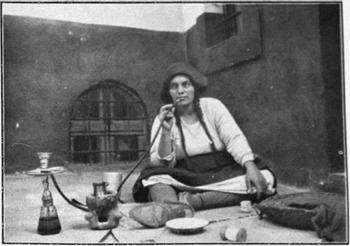
Hilma Granqvist, a Finnish anthropologist who lived in Palestine twice between 1925 and 1931 for a total of about three years, studied birth, childhood, and death in the Bethlehem village of Artas.Footnote 43 She describes with less judgment the great honor accorded Palestinian midwives, who had to be paid for their work, otherwise a person was “indebted to them for all eternity” (Reference GranqvistGranqvist 1947, 103). Invited women surrounded a woman in labor in her home, replacing each other as needed, although they could not be menstruating and must have bathed if they had had sex in order to protect the woman and baby from the many dangers perceived to abound from the spirit world. In cities, midwives brought with them a “birth chair” that had been forbidden “since the English came into the country.” British nurse-midwives instead expected women in labor to lie down (58, 62). Rogers’s account and my interviews with elderly women who gave birth in the 1940s indicate that many Palestinian dayat continued to use such a chair. Women also described perching over large rocks in courtyards and fields during labor.
British-licensed nurse-midwives represented the minority of women delivering Palestinian babies throughout the Mandate period and were not evenly distributed throughout the country. According to annual Department of Health and British government reports to the League of Nations, the number of licensed midwives increased from 221 in 1927 to 332 by the end of 1929. By the middle of 1930, when the ordinance was fully in effect, they numbered 211.Footnote 44 My analysis of the names of these licensed midwives, which were published in a July 1930 register, indicates that more than 80 percent were Jewish and a few were English; the remainder were predominantly Christian-origin Armenian and Arab Palestinian women.Footnote 45 By the end of 1931 the number of licensed midwives was 355, of whom 205 were denoted as “Jews” and the remainder as “Others.” Among the 1,185 “Unqualified Midwives” enumerated through 1931, 10 were categorized as “Jews” and the remainder as “Others,” that is, Arab or Armenian Palestinians.Footnote 46 By the end of 1935, according to the annual Department of Health report, 445 midwives were licensed to work in Palestine. By the end of 1938, according to the annual Department of Health report, the total was 532 licensed midwives. In 1946 there were 504 licensed midwives in Palestine, of whom 236 were categorized as Christian, 79 as Muslim, and 189 as Jewish.Footnote 47 More Muslim women’s names appeared on published British lists of licensed midwives in the late 1930s and 1940s in comparison to earlier, although Jewish women’s names comprised well over half of the total until the mid-1940s. When I tabulated and organized by location and institutional affiliation the approximately 257 total Palestinian (including Armenian) licensed midwife names on the 1940 and 1946 Palestine Department of Health lists of medical professionals, the largest number worked in Jerusalem or its villages (68 women) and the second largest worked in Haifa or its villages (47 women).
Participants in a six-month government-sponsored midwifery training course were required to pay for it and speak, read, and write Arabic or English. According to a 1932 handout, they were also required to “supply themselves with six white calico overalls with short sleeves and 4 kerchief caps. Shoes – black in winter and white in summer – with rubber heels must be worn.” In 1935, an Armenian Palestinian (who signed in English) and three Arab Palestinian (who signed in Arabic) midwifery students sent an English-language letter asking for a partial refund of the ration (boarding and laundry) fees they had paid to the government hospital in Jerusalem after the price had been reduced by the director of health.Footnote 48
Government midwifery training largely consisted of Arabic lectures by Palestinian male physicians and English lectures by British matrons.Footnote 49 The lectures in Jerusalem relied on a biomedical English-language curriculum, including the book A Short Practice of Midwifery for Nurses, originally published in 1901 and written by Irish-born gynecologist Henry Jellett (1872–1948), who moved to New Zealand in the 1920s.Footnote 50 The text was issued in thirteen editions over the course of the first half of the twentieth century.Footnote 51 Chapter VI, titled “Ante-Natal Care,” begins by delimiting the “General Duties of the Midwife” to being “entirely responsible” for a pregnant woman only as long as her “condition” “remains normal” (Reference Jellett and Bernard DawsonJellett and Dawson 1948, 87). Any “abnormal” condition made it incumbent on the midwife to “insist on her patient obtaining medical advice [from an obstetrician].” The text stresses that “the midwife must remember that she is not allowed to make vaginal examinations during pregnancy” (88). While antenatal care was central to “lessening the dangers of childbirth,” it “must be supervised by a medical practitioner whenever possible” (89). Notably, the curriculum lectures and midwifery text did not address contraception or abortion methods or care.
Licensed midwives in Palestine remained on a tight leash by colonial policy, irrespective of their talents, experiences, and who paid them. British nurse matrons long complained of Palestinian midwives who “appear to have the idea that they are entitled to do gynaecological work. For instance they install themselves in a sort of clinic, use specula, make vaginal examinations, give douches and insert medicated tampons.” The “worst offenders are those who are not trained nurses,” according to a 1935 letter to Department of Health Director Heron from Jerusalem SMO J. MacQueen.Footnote 52 A November 1934 letter from an outraged Vena Rogers raised similar concerns about Jewish nurse-midwives who, with permission from Jewish male physicians, sutured women’s torn perinea, inserted tampons, and advertised their services in Jewish newspapers, “contrary to all rules and regulations.” Rogers also accused such women of having “unspeakably filthy” homes where they delivered babies, judgments that cannot be taken at face value, as is the case when colonial authorities lodged them against Palestinians. British treatment of Jewish midwives, whether they worked independently or were affiliated with Zionist health institutions, nevertheless did not parallel the treatment of Palestinian women health providers.
In a 1939–1941 case discussed in the archives, British authorities suspended for one year the midwifery license of twenty-four-year-old “Bahiya Affify,” a single Palestinian woman from the Jerusalem village of Wadi al-Joz whose wages supported a household that included her mother and brother, according to an August 22, 1941, self-defense letter she originally wrote in Arabic. She acquired the license on November 25, 1938, and worked independently rather than in a government hospital or clinic, a Palestinian IWC, or a Palestinian physician’s private office.Footnote 53 The lists of registered licensed midwives for 1940 and 1946 render her full name as “Bahia Afifi El-Jaby.” An August 19, 1941, letter from “Dr. D. Boulos” on behalf of the SMO in Jerusalem informed Midwife Bahiya of the government’s plan to suspend her license “on account of your unprofessional conduct as a midwife and grossly negligent performance of your duties.” The letter began with a chronological list of grievances and warnings that dated back to April 26, 1939, when Rogers informed the SMO that Bahiya was “practising Gynaecology, you use a speculum, tampons, and you call yourself a trained nurse. I was also told you give injections.” The assistant SMO warned Bahiya against these practices in May of the same year.
In November 1940 Rogers repeated to the SMO in Jerusalem the charges she had levied against Bahiya. You “openly state[d] you give injections and that you were seen by Dayah Khadijeh Asfourah at a delivery case giving an injection. You also refused to call a Doctor for a case of Eclampsia, stating it was all due to the ‘evil eye.’” Midwife Bahiya received a second warning as a result of this complaint from the assistant SMO. In May 1941 Bahiya was for the third time reported to Rogers for giving “an injection to Im Daud Fedi of Wad el Joz, a woman four months pregnant and bleeding.” Bahiya was also accused of “attending” a woman admitted to the Jerusalem government hospital with “Puerperal Sepsis” without notifying her own “liability to be a source of infection” or following “the rules regarding disinfection.” She was warned that any additional “such offence” would lead to her “license being withdrawn.” On July 17, 1941, Rogers reported Bahiya for the fourth time to the SMO for giving “an injection to Muhadieh Mussa el Imshaasha of Akabat Suwani, the woman later aborted and bled profusely,” leading to the August letter transmitted by Dr. Boulos threatening her with suspension.
Bahiya was advised to submit a defense of herself before September 15, 1941. In a short letter dated August 21, 1941 (translated from Arabic) to the high commissioner, Bahiya conceded, presumably with very little choice in the matter: “I contravened the Midwives Regulations of the Government of Palestine.” She asked for “pardon” and “kindly request your Excellency to permit me to take a refresher course at the Maternity and Infant Welfare Centre in the Old City Jerusalem and to return to me the licence at the end of the year.” On the following day, August 22, she submitted a less concessionary detailed letter to the SMO in Jerusalem (translated into English) asking him to reconsider her situation. Since the time she acquired her certification as a midwife, she explained,
there is an old midwife over 50 years old, named Zahya El Bastiya, always urging the other midwifes to submit reports against me, this is due to the fact, that I am now a well known [sic] to all the inhabitants of Jerusalem, that I am well practiced better than the old midwives who are over 50 years old, such as Zahiyeh Khalil, Zafiyeh Sandowa and [Khadija] Assfoura, they are hating me too much, and always stir up the supervisor in charge of all the midwives in Jerusalem District, that I am breaking the midwife’s law (Ordinance). Such as miscarrying the women or using the injections or enema to them, etc., I never did such things to any lady, but by the order of the doctors Barnaba and Dajani who trained me how to give an injection to a lady [who] was sick [and] unable to leave her house to take the injections by a nurse. Anyhow, sir, if you forbid to give injections by the order of a doctor, I will not do it again. I like to draw your kind notice that I am so poor that the Arab ladies society in Jerusalem paid the sum of £P.9. – to the Health Department when I took Midwife’s course as a fee.
In a September 4, 1941, letter to the chief secretary of the government in Jerusalem, the director of medical services deemed Bahiya’s claim of being the “victim of jealousy and persecution on the part of other midwives” as “hardly worthy of any consideration.” I have run into this exact dismissive British phrase in other correspondence involving Rogers and the SMO of Jerusalem in relation to obstreperous Palestinian midwives. Nevertheless, Bahiya’s appeal may have influenced the fact that her license was not permanently revoked as the SMO had threatened, although it was suspended for a year: “Bahia Afifi El-Jaby” remained listed as a licensed and working midwife in Jerusalem in the 1946 Government of Palestine Department of Health list.
Delimiting the treatment practices of licensed and unlicensed midwives was based on the logic that the British authorities controlled “technical” aspects of healthcare and locals were responsible for “administrative” dimensions, irrespective of how much or how little the colonial government materially contributed. Colonial authorities assured that unlicensed Palestinian midwives would remain numerous given the limited and expensive nature of government-sponsored healthcare. Despite colonial restrictions, Palestinian nurses, midwives, and healers worked and collected fees independently of government-sponsored clinics, since officials complained to each other about these practices. Indexing how often Palestinian women healthcare providers violated the rules, they were frequently warned of the limits, as in a June 10, 1933 circular (No. 884) from SMO J. W. Harness titled the “Functions of Infant Welfare Centres.” The notice reminded Palestinian midwives to “confine themselves to incidental treatment of simple ailments.” Only the (Palestinian) medical officer may “see” and “treat” “any sick children brought to him” (underlining in document). He insisted that IWC nurses were only allowed to educate mothers and maintain the health of children until they got to school, when they would “normally come under the supervision of a school medical service.” Adding insult to injury, the circular instructed licensed midwives that their “supervision” of children was designed “to prevent ailments and defects in early years which are likely to retard development and which are in a large degree attributable to an insufficient knowledge of simple rules of health on the part of the mothers.”Footnote 54
Harkness must have recognized the speciousness of the claim that “children” eventually came under the care of “a school medical service” since most Palestinian children lived in villages and did not have access to government schools. In 1934, 63 such schools were operating in Palestinian towns, with about 15,000 girls and boys (almost even) attending, and 257 were operating in villages, serving 15,281 boys and 852 girls, according to the annual Department of Health report. A year later, 10,044 boys and 7,123 girls were enrolled in 67 government town schools, and 17,693 boys and 1,145 girls were enrolled in 283 government village schools, according to the 1935 Department of Health annual report. The estimated population of all residents of Mandate Palestine at the time was a little over 1 million people. Without breaking out Jewish children (who largely attended Jewish schools) from the total of about 36,000 children in government schools, if 50 percent of the total population was composed of Palestinian children 5–17 years of age, only 7.2 percent of them would have had access to annual school medical exams.Footnote 55
The conflicts with and about nurse-midwives presented in the available Department of Health documents invite a few observations. First, we see multilayered but porous surveillance of Palestinian midwives and healers as well as a gendered and racialized colonial decision-making structure. Rogers, a never-married British nurse matron, was subordinate to higher-level colonial officials in Palestine, all male, who left to her and the limited number of Palestinian male physicians employed by the government the dirty business of “fieldwork” with women and children. But she was high in relation to Palestinian midwives, whether licensed or unlicensed, because the colonial system required they recognize her as their teacher, surveyor, and gatekeeper.
Second, while we cannot know the full situations or experiences of each patient referenced, any British rendering of the story will be self-serving and ultimately distorted by a colonial lens structured by their racial and gendered assumptions and priorities.
Third and related, the triggering event in the Bahiya case illustrates one of the issues that made Rogers and other British health officials apoplectic: she violated colonial racial and gendered boundaries of scientific knowing and health practice. Under no circumstances was she to represent herself as a “nurse.” Bahiya admitted to giving injections with the permission of two Palestinian physicians and was accused of using a speculum and tampons on women, likely by competing midwives who recognized well the colonial red lines that would force a response. The inside of women’s bodies, however, was the “territory,” to use Reference TakeshitaTakeshita’s (2011) evocative phrasing with respect to the global development of the IUD, of male gynecologists who wanted to know better and control access to this inner terrain. Injections, specula, enemas, and examining hands were prized expert tools of bodily penetration allowed only to European and non-European men physicians and to a lesser degree British nurses in Palestine. David Arnold argues it is difficult to understate the centrality of “the body as a site of colonizing power” despite colonial medicine’s inability to erase multiple “readings” of the somatic in indigenous epistemologies and cosmologies (Reference ArnoldArnold 1993, 7, 10). The corollary is that Western medicine “cannot be regarded as merely a matter of scientific interest” or “abstracted from the broader character of the colonial order.” Rather, it was “intimately bound up with the nature and aspirations of the colonial state itself” (8–9). “Modern medicine” seeks “monopolistic rights over the body” through professionalization and “exclusion of ‘folk’ practitioners” (9). In light of the these observations, the differences between licensed Alice or Bahiya and unlicensed traditional midwives were likely not dramatic in the eyes of colonial officials, who considered all of them inferior subjects, although Bahiya was literate in Arabic and Alice in Arabic and English.
This brings me to the fourth observation: We should not be surprised that licensed or unlicensed Palestinian women healthcare providers competed with each other, motivated first and foremost by a desire to sustain an independent livelihood.
~~~~~~~~~~
For all their finger wagging and stated concerns with the health of women and children, British colonial authorities determined early on that healthcare for Palestinians was not a worthy investment. They occasionally took note of poverty and even “starvation” of the “Arab fallah,” to use language from the annual health report for 1933, but funding or policy changes rarely followed. More often than not, evaluations of hunger and disease were filtered through a racialized and gendered logic of cultural and civilizational backwardness. The burden of remaining alive and healthy was almost entirely on the colonized. Colonial priorities, rationalized by the repetitively brutal language of “economies” and “efficiencies,” were devastating in their health outcomes when combined with lack of capital and substantive restrictions on Palestinian political agency. The fact that austerity decisions were channeled through multiple layers of colonial bureaucracy that distanced decision makers from implementers does not lessen the significance of the underlying calculus or its consequences. The next chapter examines racial and demographic anxieties in colonial Palestine, placing them within a longer eugenicist genealogy and comparative colonial frame.


 Open access