


Introduction
Anxiety disorders are common in youth, affecting about 1 in 10 children (Kendall, Hedtke and Aschenbrand, 2006) and often resulting in marked social impairment. Without proper treatment, affected individuals also carry a heightened risk for anxiety and mood disorders in adulthood (Kendall et al., Reference Kendall, Hedtke, Aschenbrand, Wolfe and Mash2006). Over the last two decades considerable research energy has been devoted to investigating the maintaining factors of social anxiety disorder, the most common of the anxiety disorders. Research based on information processing theories of social anxiety (e.g. Clark and Wells, Reference Clark, Wells, Heimberg, Liebowitz, Hope and Schneier1995; Rapee and Heimberg, Reference Rapee and Heimberg1997) has suggested that socially anxious individuals are prone to various interpretation and judgmental biases. One way to examine interpretation biases in social anxiety is to develop questionnaires comprising hypothetical, ambiguous vignettes followed by possible interpretations (e.g. Constans, Penn, Ihen and Hope, Reference Constans, Penn, Ihen and Hope1999; Foa, Franklin, Perry and Herbert, 1996; Bögels, Snieder and Kindt, Reference Bögels, Snieder and Kindt2003; Miers, Blöte, Bögels and Westenberg, Reference Miers, Blöte, Bögels and Westenberg2008). Studies using the vignette method have consistently found that both adults and youths with social anxiety disorder or high levels of social anxiety make less positive and/or more negative interpretations of ambiguous social events than socially confident individuals. Furthermore, it has been shown that highly socially anxious individuals tend to assign higher emotional impact to hypothetical social events (Foa et al., Reference Foa, Franklin, Perry and Herbert1996). Together, these studies suggest – but do not in themselves demonstrate – that a negative interpretational and judgmental style for social events may be causally associated with vulnerability to social anxiety.
More direct evidence for the notion that interpretation biases play a causal role in anxiety vulnerability has been provided by research attempting to induce cognitive bias in the laboratory. In interpretation training, tasks originally developed to assess biases in the interpretation of ambiguous events are modified in a way to induce either a negative or a positive interpretation bias. For example, in a seminal experiment, Mathews and Mackintosh (Reference Mathews and Mackintosh2000) instructed participants to read and imagine event descriptions that remain ambiguous until the final word, presented as a to-be-completed fragment (i.e. a word with letters missing). The final word resolves the ambiguity in either a positive or a negative way. Participants are instructed to solve the fragment as quickly as possible and are subsequently asked a comprehension question intended to reinforce the forced interpretation. Compared to a group who were reinforced for making negative resolutions, participants who were reinforced for making positive resolutions made more positive interpretations of new ambiguous situations. Participants in the negative resolution group also reported feeling more anxious after training. Recognizing the exciting therapeutic application of these new techniques, a number of studies have demonstrated that interpretation biases can be experimentally altered in healthy and anxious individuals and that induced changes influence subsequent emotional reactivity (see Beard, Reference Beard2011, for a review).
Although most of the relevant research has been conducted with adult samples, increasing evidence suggests that anxiety-related interpretations can be successfully modified in children as well (Muris, Huijding, Mayer and Hameetman, 2008; Muris, Huijding, Mayer, Remmerswaal and Vreden, 2009; Vassilopoulos, Banerjee and Prantzalou, 2009; Vassilopoulos, Blackwell, Moberly and Karahaliou, 2012). Muris et al. (2008, 2009) reported two studies in which non-referred children aged 8–13 years completed either a positive or negative interpretation induction involving an imaginary space journey before being presented with a series of ambiguous events. Results indicated that children's perceptions of situational threat and avoidance tendencies were affected by a single session of interpretation training, although no mood measures were included and the imaginary and unrealistic nature of their modification task limited its ecological validity.
Vassilopoulos et al. (Reference Vassilopoulos, Banerjee and Prantzalou2009) addressed these issues by examining multi-session modification of anxiety-related interpretations in children with social anxiety symptoms. They trained a sample of socially anxious children aged 10–11 years to endorse benign rather than negative interpretations of ambiguous realistic vignettes. After completing three sessions over one week, this group was subsequently less likely to endorse negative interpretations of new ambiguous social situations than children who did not receive any training. Children who received interpretation training also showed reduced trait social anxiety and anticipated feeling less anxious during an interpersonal interaction, compared with children in the control group. Vassilopoulos et al. (Reference Vassilopoulos, Blackwell, Moberly and Karahaliou2012) replicated these results and also found that instructing participants to focus on the verbal meaning of the vignettes proved to be more effective in modifying biased interpretations and emotional impact estimates than instructing them to imagine themselves in each situation. Finally, similar modification-congruent effects on interpretation bias have been reported for pubertal samples (Lothmann, Holmes, Chan and Lau, 2011; Salemink and Wiers, Reference Salemink and Wiers2011), although the effects on mood were mixed. Taken together, these findings suggest that it is possible to modify interpretation and judgmental bias in healthy and anxious youths using experimental interpretation training procedures.
In most of the training tasks developed to modify interpretation bias in adults and children (e.g. Mathews and Mackintosh, Reference Mathews and Mackintosh2000; Vassilopoulos et al., Reference Vassilopoulos, Banerjee and Prantzalou2009), participants are presented with a series of ambiguous situations and are trained to resolve the ambiguity in either a neutral or a negative way. However, social interactions involve not only ambiguous, but also clearly negative and positive cues, and socially anxious individuals may evaluate positive or negative feedback more negatively than do nonanxious individuals. Evidence supporting this notion has been provided by other studies, which showed that socially anxious individuals show biased interpretation and judgments of emotional impact for positive and negative social information (Alden, Taylor, Mellings and Laposa, Reference Alden, Taylor, Mellings and Laposa2008; Vassilopoulos, Reference Vassilopoulos2006; Vassilopoulos and Banerjee, Reference Vassilopoulos and Banerjee2008; Voncken, Bögels and de Vries, Reference Voncken, Bögels and de Vries2003). For example, Vassilopoulos and Banerjee (Reference Vassilopoulos and Banerjee2008) presented primary school children with various positive and (mildly) negative social scenarios. They found that childhood social anxiety is associated with children's tendency to make catastrophic interpretations of mildly negative social events and to discount positive social information. Nevertheless, it is not clear to what extent existing cognitive bias modification paradigms (e.g. Vassilopoulos et al., Reference Vassilopoulos, Banerjee and Prantzalou2009) are effective in modifying interpretations for clearly valenced social situations. To our knowledge, no published study has employed an interpretation training procedure in an attempt to alter participants’ catastrophic and discounting interpretations of such situations. Therefore, the objective of the present study was to examine whether such training can modify interpretations and judgmental biases for clearly valenced events in children. Preadolescent children are a particularly important target for intervention given that many anxiety disorders have an onset during this time (Wittchen, Lieb, Schuster and Oldehinkel, Reference Wittchen, Lieb, Schuster, Oldehinkel and Rapoport2000). Further, past research has demonstrated that childhood social anxiety is highly positively correlated with estimates of negative emotional reactions to negative events (Vassilopoulos and Banerjee, Reference Vassilopoulos and Banerjee2008). Thus, a second goal was to investigate whether the interpretation training procedure would have an effect on children's anticipated emotional reactions to positive and negative social events (judgmental bias).
In the present study, we addressed these issues by adjusting the training material originally developed by Vassilopoulos et al. (Reference Vassilopoulos, Banerjee and Prantzalou2009). This original material consisted of a series of descriptions of ambiguous social situations that could be interpreted in either a negative or benign manner. To study whether interpretations and emotional judgments for clearly valenced social events are modifiable, positive and negative social scenarios were developed and presented in a form requiring participants to endorse the more benign of two possible interpretations. To assess interpretation bias for each type of scenario, participants were asked to rate the ease with which each of two possible interpretations would come to mind if they found themselves in a similar situation: (i) catastrophic and neutral interpretations for negative events, and (ii) discounting and positive interpretations for positive events. To assess emotional reaction judgments, we asked children how they would feel if such an event really happened. We hypothesized that, following training with clearly valenced material, children would interpret (i) negative events in a less catastrophic and more neutral way, and (ii) positive events in a less discounting and more positive way, compared to children in a no-training control condition. It was also hypothesized that, following training, children trained to make benign interpretations would anticipate less negative and more positive emotional reactions to negative and positive events respectively, relative to children in the no-training control condition. We also tested whether the strength of the predicted effects of training would be moderated by baseline levels of social anxiety due to possible floor effects for healthy children. Finally, although this prediction was speculative given mixed evidence from previous studies, we hypothesized that children trained to make benign interpretations would show reductions in trait social anxiety after training, compared to children in the control condition.
Method
Participants
Participants were 156 primary school children enrolled in 5th and 6th grade classes from five mainstream primary schools in the southwest of Greece, who were predominantly from a middle-class SES background. Some of the schools were chosen on a convenience basis and some on a random basis. The majority of students (97%) had a Caucasian ethnic background. Only two of the students who were approached declined to participate. All participants were fluent in Greek and ranged in age from 10 to 13 years (M = 10.9, SD = 0.8; 92 girls, 61 boys). This age group was selected because evidence suggests that the median age of onset for any anxiety disorder is about 11 years old (Kessler et al., 2005). Before starting, teachers were asked whether the children had a severe reading problem, or a current or past mood disorder. One child was excluded from the study due to severely impaired reading ability, and two were excluded due to incomplete data, resulting in a final sample of 153. We obtained verbal permission to perform the study from the principal of the school and each child's teacher. All children had normal or corrected-to-normal vision and were informed that they were free to withdraw or not participate in the study at any time without giving a reason.
Interpretation training
We used a similar procedure to that described by Vassilopoulos et al. (Reference Vassilopoulos, Banerjee and Prantzalou2009). Participants in the training condition read 48 descriptions of hypothetical social events across three sessions (16 descriptions in each session). Each training session consisted of four blocks, with each block including two positive and two negative events. Prior to data collection, 10 adult judges rated each hypothetical scenario for valence on a scale ranging from 1 (not negative/positive at all) to 10 (clearly negative/positive). Scenarios for which 70% or more of the raters gave a rating of 6 or above were retained in the vignette pool. Next, the same 10 adult judges rated each of the negative vignettes for degree of intensity on a 10-point scale from 1 (mildly negative) to 10 (profoundly negative). The vignettes retained for the final pool were those that fit the criteria by (a) depicting clearly positive and negative social events, and (b) for negative events, being relatively mild (receiving an intensity rating of 5 or below from at least 70% of the raters).
Each of the 48 descriptions was presented on a different laminated card in a form requiring participants to endorse a benign interpretation rather than a negative interpretation. At the beginning of each training session, participants were informed that they would read some hypothetical event descriptions and should imagine themselves as the central character in each description, irrespective of whether they thought such a situation could ever actually happen to them. Then, each child received a pack of 16 cards with the event descriptions printed on them and was asked to read one description at a time and answer the question that followed, which was designed to elicit the required response. Participants circled one of the two alternative interpretations following each description. For example, one (positive) item read as follows:
During the school break, your classmates are playing a game. When they see you, they call you and ask you to play with them.
What would you think if this happened to you?
(a) They don't want to play with me, but they ask me to play with them so I won't be alone (discounting interpretation)
(b) My classmates like to play with me (benign interpretation)
After circling their chosen response, participants turned the card over and saw the required response (benign interpretation) printed on the back with a “correct” feedback message above it. No explanation for the correct response was provided. Before turning to the next card, children were asked to spend a few seconds comparing their response with the required response and reflecting on how the latter (always benign) interpretation could explain what had happened in the vignette. They then repeated this procedure for the rest of the cards.
Measures
Social Anxiety Scale for Children-Revised (SASC-R). Before and after training, social anxiety was measured with the Greek version of the Social Anxiety Scale for Children-Revised (SASC-R; La Greca and Stone, Reference La Greca and Stone1993). The SASC-R is a 22-item scale that assesses children's subjective feelings of social anxiety and its correlates, including avoidance and inhibition, during various social situations. In the present study a 3-point scale (0 = never true, 1 = sometimes true, 2 = always true) was used instead of the original 5-point scale to make it more straightforward for the children. Cronbach's alphas were .84 at pre-assessment and .85 at post-assessment.
Children's Depression Inventory (CDI)
Before and after training, depressive symptoms were measured with the Greek version of the Children's Depression Inventory-Short Form (CDI; Kovacs, Reference Kovacs1992). The CDI is a 10-item questionnaire designed to assess the presence of depressive symptoms during the last 2 weeks in children and adolescents aged between 7 and 17. The standard response scale (1 = absence of symptom, 2 = mild symptom, 3 = definite symptom) was used. Cronbach's alphas were .77 at pre-assessment and .85 at post-assessment.
Negative Social Events Catastrophization Questionnaire (NSECQ)
The NSECQ (Vassilopoulos and Banerjee, Reference Vassilopoulos and Banerjee2008) was developed to investigate whether participants would endorse catastrophic interpretations of mildly negative social events. It features 12 descriptions of mildly negative social events (e.g. “You have invited one of your schoolmates to come and play at your house. The phone rings and he tells you that he will not come over”). Each description was followed by two thoughts that sometimes occur to people in these situations. One interpretation always involved an extreme negative judgment about oneself and/or one's future (catastrophizing), and the other interpretation involved a neutral judgment about oneself or the situation. For example, the interpretations in response to the situation described above could be: a) “He does not like me anymore and he would rather hang out with other children” (catastrophizing); and b) “Something has happened that made him change his plans” (neutral judgment). Participants rated the explanations in terms of the extent to which each would be likely to come to their mind if they found themselves in a similar situation, using a 5-point Likert-type scale ranging from 1 (I would not think of it at all) to 5 (I would think of it immediately). Participants also answered the following question: “How bad would it be for you if such an event had really happened?” Children rated their emotional reaction to the event using a 5-point Likert-type scale ranging from 1 (not at all bad) to 5 (very bad). Half the event descriptions were presented at pre-assessment and the other half were presented at post-assessment. Cronbach's alphas were .54, .50, .79 (for negative interpretations, neutral interpretations, and emotional reactions, respectively) at pre-assessment, and .67, .63, .82 at post-assessment.
Positive Social Events Discounting Questionnaire (PSEDQ)
The PSEDQ (Vassilopoulos and Banerjee, Reference Vassilopoulos and Banerjee2008) was designed to measure positive event discount interpretations. It features 12 brief descriptions of positive social events (e.g. “At school, you perform a part in a theatrical play in front of an audience comprising of students, and when the play is over you are applauded”). Like the NSECQ, each description is followed by two possible explanations. One always involves a positive judgment about oneself and the other involves a neutral or negative judgment of oneself or a devaluing of the positive outcome (discounting). For example, for the scenario above the two interpretations could be: “My performance was good and satisfied them” (positive judgment) and “All children are applauded, even if they did not perform well” (discounting). Participants rated each interpretation using the same 5-point scale they had used in the NSECQ ranging from 1 (I would not think of it at all) to 5 (I would think of it immediately). They also rated their emotional reaction to the event (“How good would it be for you if such an event had really happened?”) using a 5-point Likert-type scale ranging from 1 (not at all good) to 5 (very good). Half the event descriptions were presented at pre-assessment and the other half were presented at post-assessment. Cronbach's alphas were .68, .57 and .70 (for positive interpretations, discounting interpretations, and emotional reactions, respectively) at pre-assessment, and .77, .58 and .82 at post-assessment.
Procedure
Children were tested in small groups of 4–7 participants in each group, in a quiet, well-lit room at their school. They were first randomly assigned to either interpretation training (n = 77) or to a no-training control condition (n = 76). They were then administered the SASC-R, the CDI, and the measures of interpretation and judgmental biases. Participants in the training condition were visited by the experimenter (a postgraduate counselling psychology trainee who was blind to the study hypotheses) after one week and received the first training session, which involved the participant working through the cards in self-paced fashion. Two subsequent visits were then arranged with the class teacher and the participants. Visits were spread as evenly as possible over the next 2 weeks, with no more than 4 days elapsing from one session to the next. Each training session lasted approximately 30 minutes. The re-administration of the SASC-R, CDI, and the measures of interpretation and judgmental biases took place immediately after the final training session, using a new set of items for the interpretation and judgmental bias ratings, with set order counterbalanced over participants within groups.
Results
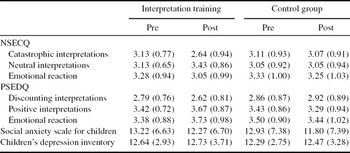
Descriptive statistics for study variables are shown in Table 1. To check random assignment, participants were compared across conditions using independent sample t-tests. No significant difference between the training and control groups emerged for trait social anxiety and depressive symptoms, or for pre-training ratings of interpretation bias or emotional reactions (all ts < 1). Gender ratio did not differ significantly between conditions (interpretation training: 31 boys, 46 girls; control: 30 boys, 46 girls), χ 2 < 1. Although girls reported significantly greater social anxiety symptoms than boys at baseline, t(151) = 2.64, p = .009, d = 1.1, no significant effects of gender emerged in any of the following analyses and we do not consider this variable further.
Means (SDs) of study variables for each condition on each occasion

Note: NSECQ = Negative Social Events Catastrophization Questionnaire, PSEDQ = Positive Social Events Discounting Questionnaire.
Effects of training on interpretation bias and emotional reactions for negative events
Changes in interpretation ratings for mildly negative social events from pre-training to post-training were examined using a mixed ANOVA with between-subjects factors of Condition (interpretation training vs. control) and Order (vignettes 1–6 before vignettes 7–12 vs. vice versa) and a repeated-measures factor of Time (pre vs. post). For catastrophic interpretations of mildly negative events, there was a significant main effect of Time, F(1, 149) = 13.41, p < .001, partial η2 = .08, qualified by a significant Time by Condition interaction, F(1, 149) = 9.57, p = .002, partial η2 = .06. No other effects attained significance. Decomposing the significant Time by Condition interaction, tests of simple effects revealed that catastrophic interpretation ratings of mildly negative events reduced significantly in the interpretation training condition, F(1, 76) = 21.97, p < .001, partial η2 = .22, but not in the control condition, F < 1.
A similar analysis of neutral interpretation ratings for mildly negative events revealed a significant main effect of Time, F(1, 149) = 5.00, p = .03, partial η2 = .03, qualified by a significant Time by Condition interaction, F(1, 149) = 5.57, p = .02, partial η2 = .04. There was also a marginally significant main effect of Condition, F(1, 149) = 3.21, p = .08, partial η2 = .02, but no other significant effects. Tests of simple effects to decompose the significant interaction revealed that neutral interpretation ratings of mildly negative events increased significantly in the interpretation training condition, F(1, 76) = 10.11, p = .002, partial η2 = .12, but not in the control condition, F < 1.
Finally, ratings of negative emotional reactions associated with mildly negative events were submitted to a similar mixed ANOVA. There was a significant main effect of Time, F(1, 149) = 4.44, p = .04, partial η2 = .03, reflecting a decrease in negative emotional reactions over time, but no significant Time by Condition interaction, F(1, 149) = 2.22, p = .14, partial η2 = .01. The Condition by Order interaction was the only other significant effect, F(1, 149) = 4.31, p = .04, partial η2 = .03. Decomposition of the Condition by Order interaction using post-hoc tests revealed that there was no effect of vignette order on negative emotional reactions in the training condition, t < 1, but that in the control condition, participants who received vignettes 1–6 before vignettes 7–12 gave higher negative emotional reactions than participants who received the vignettes in the reverse order, t(74) = 2.18, p = .03.
Overall, participants in the interpretation training condition (but not those in the control condition) showed both a significant reduction in catastrophic interpretations and a significant increase in neutral interpretations, but training did not affect estimations of the negative emotional impact associated with mildly negative events.
Effects of training on interpretation bias and emotional reactions for positive events
A similar mixed ANOVA was used to examine changes in interpretation ratings for hypothetical positive social events. For positive interpretations of positive events, there was no significant main effect of Time or Condition, Fs < 1.8. However, there was a significant Time by Condition interaction, F(1, 148) = 7.74, p = .006, partial η2 = .05, and no other significant effects. Tests of simple effects revealed that positive interpretation ratings of positive events increased significantly in the interpretation training condition, F(1, 76) = 10.20, p = .002, partial η2 = .12, but showed a non-significant decrease in the control condition, F(1, 74) = 2.52, p = .12, partial η2 = .03.
A similar mixed ANOVA on discounting interpretations of positive events revealed no significant main effect of either Time or Condition, Fs < 1.7, a marginally significant Time by Condition interaction, F(1, 148) = 3.44, p = .07, partial η2 = .02, and no other significant effects. Tests of simple effects revealed a marginally significant reduction in discounting interpretation ratings of positive events in the interpretation training condition, F(1, 76) = 3.38, p = .07, partial η2 = .04, but not in the control condition, F < 1.
Finally, a similar mixed ANOVA on participants’ ratings of positive emotional reactions associated with mildly positive events revealed a marginally significant effect of Time, F(1, 148) = 3.24, p = .07, partial η2 = .02, reflecting a trend for more positive emotional reaction ratings over time. However there was no significant effect of Condition and no significant Time by Condition interaction, Fs < 1.1. The only other significant effect was the Time by Order interaction, F(1, 148) = 39.83, p < .001, partial η2 = .21, indicating that vignettes 7–12 were intrinsically more positive than vignettes 1–6. Reflecting this imbalance, tests of simple effects revealed that ratings of positive emotional reactions increased significantly over time in Order 1, F(1, 76) = 33.08, p < .001, partial η2 = .30, but decreased significantly over time in Order 2, F(1, 74) = 13.48, p < .001, partial η2 = .15.
In summary, interpretation training was associated with a significant increase in positive interpretations of mildly positive events and a marginal decrease in discounting interpretations for such events. However, interpretation training had no effect on estimates of positive emotional impact associated with these mildly positive events.
Moderation of training-induced change on interpretation bias by trait social anxiety
The following analyses tested whether the effects of condition on change in interpretation bias were moderated by baseline levels of social anxiety. We regressed change in the relevant outcome variable on condition and social anxiety in the first step, before adding the interaction between condition and social anxiety in a second step.
For negative events, the first step explained significant variance in both negative, F(2, 150) = 9.86, p < .001, adjusted R 2 = .10, and neutral interpretation change, F(2, 150) = 3.47, p = .03, adjusted R 2 = .03. Training condition was associated with the extent of change in both negative and neutral interpretations (as described above). Higher social anxiety at baseline was significantly associated with smaller reductions in catastrophic interpretations of negative events, β = .22, t(150) = 2.81, p = .006, but not with change in neutral interpretations of these events, β = –.10, t < 1.2. However, the entry of the social anxiety by condition interaction in the second step did not explain significant additional change in either negative or neutral interpretations, ∆Fs < 1.5.
For positive events, the first step explained significant variance in positive interpretation change, F(2, 149) = 5.38, p = .006, adjusted R 2 = .05, but not in discounting interpretation change, F(2, 149) = 1.68, p = .19, adjusted R 2 = .01. Training condition was significantly associated with change in positive interpretations, but only marginally with change in discounting interpretations (as described above). Baseline social anxiety was not significantly associated with change in either positive or discounting interpretations, ts < 1. The baseline social anxiety by condition interaction did not explain significant additional variance in positive interpretations, ∆F = 2.34, p = .13, although it did explain significant additional variance in discounting interpretations, ∆F = 8.16, p = .005, change in adjusted R 2 = .05. Simple slopes tests revealed that baseline social anxiety predicted greater reduction in discounting interpretations in the training condition, β = .25, t(75) = 2.24, p = .03, but only showed a trend towards predicting greater increases in discounting interpretations in the control condition, β = –.20, t(73) = 1.78, p = .08.
Thus, the only variable for which baseline levels of social anxiety moderated the effects of training condition was discounting interpretations of mildly positive events, such that more socially anxious participants showed greater reductions in discounting interpretations after being trained to make benign interpretations.
Effects of training on trait social anxiety and depressive symptoms
Changes in social anxiety and depressive symptoms were analysed using similar mixed ANOVAs. For social anxiety, there was a significant main effect of Time, F(1, 149) = 9.42, p = .003, partial η2 = .06, reflecting a decrease over time, but no other significant effects emerged, Fs < 1.1. No significant effects emerged for depressive symptoms, all Fs < 1.8. Thus, training condition did not differentially influence trait social anxiety or depressive symptoms.
Discussion
The current study was designed to experimentally test whether an interpretation training procedure designed to modify interpretative bias for negative and positive social scenarios affects interpretation biases, emotional reaction judgments and social anxiety in children. Results showed that it is possible to modify interpretations for clearly valenced social situations in a non-clinical sample of children. Compared to pre-training assessments, participants who received three sessions of benign interpretation training for clearly valenced hypothetical situations interpreted mildly negative social events in a less catastrophic and more neutral fashion. After training, this group also interpreted positive events more positively and showed a trend towards making less discounting interpretations. Preliminary evidence of a moderation effect emerged such that higher baseline social anxiety predicted greater reduction in discounting interpretations in the training condition. However, no training effects were observed on judgments of emotional reactions for positive and negative scenarios or on trait social anxiety.
Findings from the current study replicate past research with unselected adults (Mathews and Mackintosh, Reference Mathews and Mackintosh2000) and youth (Lothmann et al., Reference Lothmann, Holmes, Chan and Lau2011; Muris et al., Reference Muris, Huijding, Mayer and Hameetman2008, Reference Muris, Huijding, Mayer, Remmerswaal and Vreden2009; Salemink and Wiers, Reference Salemink and Wiers2011; Vassilopoulos et al., Reference Vassilopoulos, Banerjee and Prantzalou2009, Reference Vassilopoulos, Blackwell, Moberly and Karahaliou2012) demonstrating that interpretation training techniques are effective in modifying cognitive bias regarding ambiguous information. Importantly, our findings extend previous results by demonstrating that the training paradigm used in the current study is effective in modifying participants’ tendency to discount positive social information and to catastrophize in response to mildly negative social events. Therefore, interpretation training procedures appear to be effective in modifying interpretations not only for ambiguous events, but also for clearly valenced situations. These results might have useful clinical repercussions. In his pioneering cognitive model, Beck (Reference Beck1976) described the thinking errors of “catastrophizing” (interpreting an event or a situation in the worst possible manner) and “discounting the positive” as two of several cognitive distortions associated with the development and maintenance of emotional disorders. Since then, clinical interventions have sought ways to address both these thinking errors through therapy. The current findings highlight the therapeutic promise of cognitive bias modification techniques as an adjunct to more conventional forms of psychological intervention (MacLeod, Koster and Fox, Reference MacLeod, Koster and Fox2009).
We found no evidence that the interpretation training paradigm was effective in modifying children's estimated emotional reactions to negative and positive social information. It is difficult to account for our failure to replicate the modification effect on children's emotional cost estimates reported in the Vassilopoulos et al. (Reference Vassilopoulos, Blackwell, Moberly and Karahaliou2012) study. However, the vignettes employed for the measurement of interpretations and judgmental biases were rather variable in their perceived positivity or negativity. Although we took every care to counterbalance the two sets of vignettes across participants in each condition, participants responded more positively to one of the sets than the other. This may have obscured any effects of the training procedure on emotional judgments for both positive and mildly negative events.
Our finding that the interpretation training paradigm was unsuccessful in changing trait social anxiety contradicts results from previous studies, in which children in the training condition showed reductions in negative mood (Vassilopoulos et al., Reference Vassilopoulos, Banerjee and Prantzalou2009, Reference Vassilopoulos, Blackwell, Moberly and Karahaliou2012). However, at least two studies failed to observe the training effects on state anxiety in unselected youth (Lester, Field and Muris, Reference Lester, Field and Muris2011; Salemink and Wiers, Reference Salemink and Wiers2011). A few possible factors may explain the limited effects of training on trait social anxiety. One is that this study included an unselected sample of children and it is possible that only trait social anxiety levels for more vulnerable (i.e. highly anxious) individuals are responsive to the modification procedure (cf. Muris et al., Reference Muris, Huijding, Mayer and Hameetman2008; Vassilopoulos et al., Reference Vassilopoulos, Banerjee and Prantzalou2009). However, this explanation seems less likely in view of the fact that the training was no more effective in reducing interpretation bias for more socially anxious children (with the exception of discounting interpretations for positive events). Alternatively, it may be that the test-retest design of the current study may have obscured the results, because participants may have guessed the true purpose of the study or tried to appear consistent in social anxiety across measurement points. Furthermore, the use of a trait measure to detect training-induced change in social anxiety over 3 weeks provides a tough test of the hypothesis. Nevertheless, this design enabled us to draw strong conclusions about whether the interpretation training produced changes in interpretation and judgmental bias, which otherwise could have gone undetected. Another possibility concerns the modified training material employed in the present study, which included various vignettes, some of which were overtly positive (e.g. “You hear a friend of yours saying nice things about you to a group of children”) and others overtly negative (e.g. “Yesterday you had an argument with your schoolmate and this morning s/he did not say hello to you”). If these clearly valenced situations appeared to be rather extreme and incompatible with participants’ own feelings or real life experiences, this might have reduced the extent to which children engaged in the material. Therefore, introducing positive material in a more graded fashion along the course of the sessions (from mildly to extremely positive) and using personalized material may help to optimize the modification task (see also Mathews, Ridgeway, Cook and Yiend, Reference Mathews, Ridgeway, Cook and Yiend2007). Finally, the absence of training effects on trait social anxiety could simply indicate that the relationship between interpretative bias and socially anxious symptoms in childhood is far from being a causal one (see Muris et al., 2009, for a similar argument).
One more finding warrants further attention. The trend found in the present study for a training-induced reduction in discounting interpretations for positive social events replicated the findings of a previous training study (Vassilopoulos et al., Reference Vassilopoulos, Blackwell, Moberly and Karahaliou2012). We also found that the extent to which interpretation training reduced discounting interpretations was more pronounced for persons with higher baseline levels of trait social anxiety. Because discounting interpretations of positive situations were generally lower than the other ratings (see Table 1), and because less socially anxious persons tended to give lower ratings of discounting interpretations, this significant moderation effect may simply reflect the fact that persons low in trait social anxiety were already using the bottom end of the rating scale before training and could not drop much further (a floor effect). This may explain why the moderation effect merged for only one type of rating.
Taken together, these findings provide further evidence suggesting that interpretation biases can be modified in children via a relatively easy, brief, positive and cost-effective procedure. However, more research is needed to ascertain whether individuals maintain improvement at follow-up. Nevertheless, the text-based training used in the current study could be easily disseminated via school workbooks, online programs or self-help books. It could also be used in conjunction with adjunctive, infrequent therapist visits to reinforce the material (see also Abramowitz, Moore, Braddock and Harrington, 2009). This seems particularly important given that socially anxious individuals often avoid treatment (Wittchen, Stein and Kessler, Reference Wittchen, Stein and Kessler1999) for fear of being humiliated, criticized and stigmatized. Thus, providing a rigorously tested (and cost-effective) minimal therapist contact treatment program (Abramowitz et al., Reference Abramowitz, Moore, Braddock and Harrington2009) may be effective for those with milder forms of social anxiety who are opposed to or cannot afford talking therapy.
Although our findings are encouraging, they should be considered preliminary due to the following limitations. First, the study exclusively used self-report measures and hypothetical scenarios so that generalizability to real life events is not guaranteed. Second, this study included a no-training control group that did not involve repeated exposure to the training material. Salemink, van den Hout and Kindt (Reference Salemink, van den Hout and Kindt2010) found that changes in state anxiety can be mediated by exposure to the training material only. Thus, future studies should also expose the control group to the same training scenarios, without exposing them to possible interpretations.
An important avenue for future research would be to examine whether manipulating interpretation bias affects vulnerability following stressful experiences in children, potentially reducing the risk for onset of an anxiety disorder. Findings from an attention modification study showed that training attentional bias toward threat modified children's emotional vulnerability to a subsequent stressful event, although it did not directly affect state anxiety (Eldar, Ricon and Bar-Haim, Reference Eldar, Ricon and Bar-Haim2008). Future work with children should also examine the possibility of combining interpretation and attention bias modification procedures for maximizing the potential therapeutic gains (see also Brosan, Hoppitt, Shelfer, Sillence and Mackintosh, Reference Brosan, Hoppitt, Shelfer, Sillence and Mackintosh2011).
In summary, this study extended previous research by demonstrating that an interpretation training procedure is effective in reducing catastrophic interpretations for mildly negative social scenarios and discounting interpretations for positive social scenarios. The finding that healthy preadolescent students appear to benefit from the interpretation training procedure constitutes a particularly strong test of the effectiveness of the training. However, more research is required to examine whether there are circumstances in which training-induced changes in interpretation bias translate into reductions in social anxiety symptoms.



Comments
No Comments have been published for this article.