INTRODUCTION
The genus Metachromadora, which belongs to the subfamily Spiriniinae Gerlach & Murphy, 1965, is classified within the family Desmodoridae Filipjev, Reference Filipjev1918, superfamily Desmodoroidea Filipjev, 1922. The superfamily Desmodoroidea is characterized by the apomorphy of a single anterior testis in the male and two antidromously reflexed ovaries in the female. However, no apomorphy is known for the family Desmodoridae (Lorenzen, Reference Lorenzen and Platt1994).
Metachromadora Filipjev, Reference Filipjev1918 is a heterogeneous and poorly defined group (Vincx, Reference Vincx1987) that has been extensively studied since the early 20th Century (Filipjev, Reference Filipjev1918; Cobb, Reference Cobb1933; Gerlach, Reference Gerlach1951; Timm, Reference Timm1961; Wieser & Hopper, Reference Wieser and Hopper1967; Gerlach & Riemann, Reference Gerlach and Riemann1973/1974; Furstenberg & Vincx, Reference Furstenberg and Vincx1988; Lorenzen, Reference Lorenzen and Platt1994; Verschelde et al., Reference Verschelde, Muthumbi and Vincx1995). It is characterized by a round head with unispiral amphidial fovea generally surrounded by cuticle striations; a narrow, slightly cuticularized buccal cavity bearing a large dorsal tooth; a short pharynx with a pronounced subdivided bulb and precloacal supplements of various forms.
This genus possesses five subgenera (Gerlach, Reference Gerlach1951): Bradylaimus Stekhoven, 1931 (lateral wings absent and tubular supplements not easily detected); Metachromadora Filipjev, Reference Filipjev1918 (longitudinal striations well pronounced on the head); Metachromadoroides Timm, Reference Timm1961 (cuticle heavily striated without longitudinal striations on the head, lateral ridges present, amphidial fovea on a plaque, tubular supplements present or absent); Metonyx Chitwood, Reference Chitwood1936 (somatic setae arranged in 10 longitudinal rows); and Neonyx Cobb, Reference Cobb1933 (lateral wings present).
Two new species of the genus Metachromadora, subgenus Bradylaimus, were found during an ecological and taxonomic survey of marine nematodes from sandy beaches of Guanabara Bay (Maria et al., Reference Maria, Paiva, Vanreusel and Esteves2013). Here we present a description of these species and propose a new dichotomous key for all valid species of Metachromadora.
MATERIALs AND METHODS
Specimens were collected on the shore of Ilha do Governador, Rio de Janeiro, Praia do Bananal (Bananal Beach: 22°47′24.13″S 43°09′47.72″W) and Praia da Bica (Bica Beach: 22°49′37.9″S 43°11′15.9″W) during January and June 2000. Bananal Beach is characterized by medium and coarse sediment ranging from 400 to 940 µm median grain size; Bica Beach is characterized by coarse and very coarse sand with sediment ranging from 570 µm to 2800 µm. Sediment samples were taken using a corer of 10 cm2 surface area in the upper and lower intertidal levels, and were fixed with 4% formaldehyde (Maria et al., Reference Maria, Paiva, Vanreusel and Esteves2013).
In the laboratory, nematode specimens were processed according to the methodology described by Warwick et al. (Reference Warwick, Howard and Somerfield1998). Measurements and drawings were done using an Olympus CX31 (Phillipines) microscope provided with a camera lucida. Photographs were taken with a digital camera connected to a Olympus BX50 (Phillipines) optical microscope.
Type specimens of Metachromadora prepapillata sp. nov. and Metachromadora verae sp. nov are deposited in the Museu Nacional do Rio de Janeiro (National Museum of Rio de Janeiro) under the identification numbers MNRJ369, MNRJ370, MNRJ371 and MNRJ372.
Illustrated dichotomous identification key
The key is based on the list of valid species of Metachromadora provided by Gerlach & Riemann (Reference Gerlach and Riemann1973/1974) and on species described subsequently.
Abbreviations used in the text
- a:
total body length/maximum body diameter
- abd:
anal body diameter
- All:
allotype
- amph:
amphidial fovea length
- amph%:
diameter of the amphidial fovea as percentage of the corresponding body diameter
- aw:
width of amphidial fovea
- b:
total body length/pharynx length
- bda:
body diameter at amphidial fovea level
- bdp:
body diameter at widest pharyngeal bulb level
- bl:
bulb length
- bw:
bulb width
- c:
total body length/tail length
- c':
tail length/abd
- ls:
length of outer labial sensilla
- cs:
length of cephalic sensilla
- gub:
length of gubernaculum
- Hol:
holotype
- L:
total body length
- ols:
outer labial setae
- ph:
pharynx length
- Par:
paratype
- spic:
length of spicules measured along the arc
- sup:
number of supplements
- t:
tail length
- tna:
smooth tail portion
- v:
distance from anterior end to vulva
- V%:
position of the vulva as a percentage of the total body length from the anterior end.
RESULTS
SYSTEMATICS
Order DESMODORIDA De Coninck, 1965
Suborder DESMODORINA De Coninck, 1965
Superfamily DESMODOROIDEA Filipjev, 1922
Family DESMODORIDAE Filipjev, 1922
Subfamily SPIRINIINAE Gerlach & Murpy, 1965
Genus Metachromadora Filipjev Reference Filipjev1918
EMENDED DIAGNOSIS FROM ORIGINAL DESCRIPTION OF THE GENUS METACHROMADORA FILIPJEV, 1918
Desmodoridae. Spiriniinae. Cuticle finely or coarsely striated, extreme anterior end of the head unstriated, but not forming a cephalic capsule, cryptospiral amphidial fovea partly surrounded by cuticle striations, or not surrounded by striations; outer labial sensilla usually setiform, buccal cavity with large dorsal tooth and two smaller subventral teeth in most of the species (exceptions: several subventral teeth in M. zaixsi and presence of denticles in M. setosa); pharynx with well-developed posterior bulb with a thick cuticular lining and partitioned into two or three sections; male with one testis at left of the intestine; spicules with well developed velum and capitulum; precloacal supplements of various forms; tail conical.
RELATIONSHIPS
Metachromadora resembles Chromaspirina by the shape of the amphidial fovea and tail shape, but differs from it by the well-developed and subdivided pharyngeal bulb with a distinct cuticular lining of the lumen of the pharynx. This genus is also similar to Sigmophoranema in the shape of the dorsal tooth and the subdivided pharyngeal bulb; however, it differs from the latter genus by the small size of the spicules and the absence of S-shaped precloacal supplements.
LIST OF VALID SPECIES (25)
Metachromadora (Neonyx) alata (Cobb, Reference Cobb1933) Gerlach, Reference Gerlach1951
Syn. Neonyx alatus Cobb, 1933?
Metachromadora (Bradylaimus) asupplementa (Crites, 1961) Gerlach, Reference Gerlach1951
Syn. Neonyx asupplementa Crites, 1961
Metachromadora (Neonyx) campycoma (Cobb, Reference Cobb1933) Gerlach, Reference Gerlach1951
Syn. Neonyx campycoma Cobb, Reference Cobb1933
Metachromadora (Neonyx) cancellata (Cobb, Reference Cobb1933) Gerlach, Reference Gerlach1951
Syn. Neonyx cancellata Cobb, Reference Cobb1933
Metachromadora (Metachromadora) chandleri (Chitwood, 1951) Gerlach, 1955
Syn. Ichtyodesmodora chandleri Chitwood, 1951
Metachromadora parasitifera Timm, Reference Timm1952
Metachromadora (Metachromadoroides) complexa Timm, Reference Timm1961
Metachromadora (Bradylaimus) gerlachi Wieser & Hopper, Reference Wieser and Hopper1967
Metachromadora (Metonyx) horrida Chitwood, Reference Chitwood1936
Metachromadora (Metachromadora) itoi Kito, 1978
Metachromadora (Metachromadora) macroteura Filipjev, Reference Filipjev1918
Metachormadora (Metachromadoroides) minor Gagarin & Nguyen Vu Thanh, 2010
Metachromadora (Neonyx) meridiana Wieser & Hopper, Reference Wieser and Hopper1967
Metachromadora (Bradylaimus) nyalli Verschelde & Vincx, 1996
Metachromadora (Neonyx) obesa Chitwood, Reference Chitwood1936
Metachromadora (Bradylaimus) onyxoides Chitwood, Reference Chitwood1936
Metachromadora (Bradylaimus) pneumatica Gerlach, 1954
Metachromadora (Neonyx) pseudocampycoma Hopper, 1961
Metachromadora (Metachromadoroides) pulvinata Wieser & Hopper, Reference Wieser and Hopper1967
Metachromadora (Metachromadoroides) remanei (Gerlach, Reference Gerlach1951) Timm, Reference Timm1961
Syn. Metachromadora (Metachromadora) remanei Gerlach, Reference Gerlach1951
Metachromadora (Bradylaimus) scotlandica Warwick & Platt, 1973
Metachromadora (Bradylaimus) setosa Hopper, 1961
Metachromadora (Bradylaimus) spectans Gerlach, 1957
Metachromadora (Bradylaimus) suecica (Allgén, 1929) Gerlach, 1955
Syn. Oistolaimus suecicus Allgén, 1929
Metachromadora (Metachromadoroides) vulgaris Timm, Reference Timm1961
Metachromadora (Metachromadoroides) zaixsi Pastor de Ward, Reference De Ward2004
LIST OF INVALID SPECIES
Metachromadora benepapillata Timm, Reference Timm1961 transferred to Pseudochromadora by Gerlach (Reference Gerlach1963)
Metachromadora clavata Gerlach, 1957 transferred to Papillonema by Verschelde et al. (Reference Verschelde, Muthumbi and Vincx1995)
Metachromadora cystoseriae Filipjev, Reference Filipjev1918 based upon only one female
Metachromadora longilaima Schuurmans-Stekhoven, 1950 transferred to Pseudometachromadora by Timm (Reference Timm1952)
Metachromadora pacifica Murphy, 1966 transferred to Chromadoropsis by Furstenberg & Vincx (Reference Furstenberg and Vincx1988)
Metachromadora papillata Schuurmans-Stekhoven, 1950 transferred to Pseudometachromadora by Wieser (1954)
Metachromadora quadribulba Gerlach, 1956 re-established as Chromadoropsis by Furstenberg & Vincx (Reference Furstenberg and Vincx1988)
Metachromadora serrata Gerlach, Reference Gerlach1963incertae sedis
Metachromadora spiralis Gerlach, 1955 incertae sedis
Metachromadora vivipara (De Man, 1907) re-established as Chromadoropsis by Furstenberg & Vincx (Reference Furstenberg and Vincx1988).
Metachromadora prepapillata sp. nov
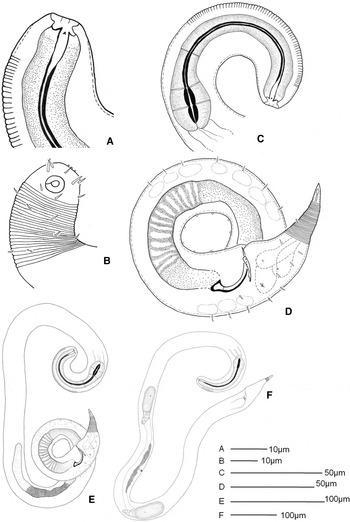
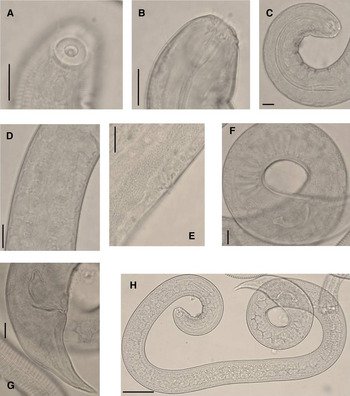
(Figures 1 & 2)
Metachromadora prepapillata sp. nov.: (A–E) holotype male. (A) head region at midbody level; (B) head region, surface view; (C) pharynx region; (D) tail region and copulatory apparatus, (E) habitus. (F) Allotype female, habitus.

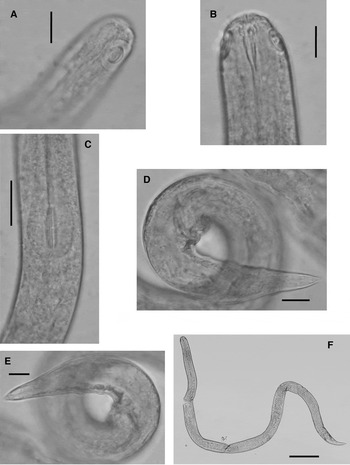
Photomicrographs of the holotype and allotype of Metachromadora prepapillata sp. nov. (A) surface view of head region, showing outer labial setae and unispiral amphidial fovea; (B) head region, showing buccal cavity; (C) pharyngeal region; (D) porids; (E) germinal zone of testis showing granular cells; (F) vas deferens showing lighter cells; (G) copulatory apparatus and tail; (H) habitus. Scale bars: A–G, 10 μm; H, 100 µm.

TYPE MATERIAL
Holotype and allotype deposited in the Museu Nacional do Rio de Janeiro (National Museum of Rio de Janeiro – MNRJ) and paratypes in the Laboratório Meiofauna do Departamento de Zoologia da UFPE (NM-LMZOO UFPE). Holotype male (MNRJ369), seven paratype males (361 NM-LMZOO UFPE), allotype female (MNRJ370), six paratype females (362 NM-LMZOO UFPE).
TYPE LOCALITY
Bananal Beach (22°49′37.9″S 43°11′15.9″W), Guanabara Bay, Rio de Janeiro, Brazil.
TYPE HABITAT
Intertidal zone of Bananal Beach.
ETYMOLOGY
The species name prepapillata sp. nov. refers to the presence of papilliform precloacal supplements.
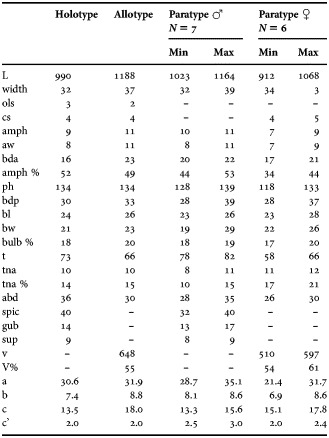
MEASUREMENTS
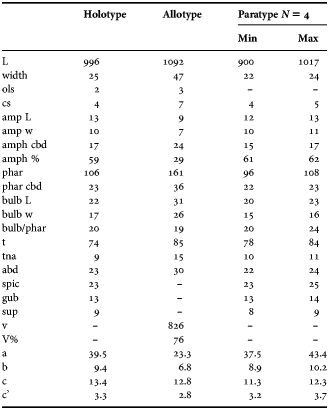
See Table 1.
Measurements of Metachromadora prepapillata sp. nov.

–, not applicable.
Males
Body long, cylindrical and relatively slender with blunt rounded head and conical tail. Cuticle golden, with very fine transverse striations starting after posterior edge of amphidial fovea and without ornamentations. Minute somatic setae arranged in eight longitudinal rows (four sub-lateral, two sub-dorsal and two sub-ventral) extending to tail region. These setae are connected to prominent oval epidermal gland cells, called porids.
Non-annulated head region with three separate circles of anterior sensilla: six inner minute conical labial papillae, six outer labial setae 3 µm long, and four cephalic setae 4–5 µm long, located immediately in front of amphidial fovea and eight subcephalic setae (four sub-lateral, two sub-dorsal and two sub-ventral) immediately after posterior edge of amphidial fovea. Amphidial fovea ventrally wound, unispiral, not surrounded by striations, its diameter 41–51% of corresponding body diameter. Buccal cavity cyathiform with cheilorhabdia, with one large dorsal tooth and two small ventrosublateral teeth. Pharynx largely cylindrical, posterior widened and forming small bulb less than 2/5 of pharyngeal length; bulb subdivided into two well-demarcated regions through constrictions of lumen of entire pharynx, which is covered by thick sclerotization. Nerve ring and cardia not observed.
Tail conical and twice anal body diameter; three caudal glands restricted to tail and opening through a spinneret. Terminal part of tail smooth, 10 µm long, 11–14% of total tail length.
Reproductive system monorchic, with outstretched testis lying on left side of intestine. Testis characterized by short germinal zone followed by opaque cells packed with dark granules leading to lighter cells and narrow ejaculatory duct. Two equal spicules, slender, ventrally curved with thick sclerotized lamina and well-cephalated capitulum with internal shaft. Gubernaculum canoe-shaped, oriented parallel to spicula, without apophyses. Eight to nine delicate conoid precloacal papillae protruding from cuticle at regular intervals, first supplement 91 µm from cloaca.
Females
Similar to male in most respects, except for: triangular cardia evident, shorter outer labial setae (2 µm long) and large non-annulated tail region, 10 µm long. Reproductive system didelphic–amphidelphic with short reflexed ovaries; both branches lying to left of intestine; spacious uterus. Vulva a transverse slit, situated at 54–60% from anterior end, vagina with evident muscular sphincter and well-sclerotized vagina vera and vagina uterina tubular.
DIAGNOSIS
Metachromadora prepapillata sp. nov. is characterized by pharynx with sclerotized lumen, small bipartite bulb, eight longitudinal rows of somatic setae, and conical tail corresponding to twice abd in both sexes. Males characterized by spicule shape with sclerotized capitulum and lamina, and presence of eight or nine precloacal papillar supplements. Females characterized by both ovaries situated to left of intestine.
DIFFERENTIAL DIAGNOSIS
Metachromadora prepapillata sp. nov. most closely resembles M. pneumatica in the pharynx design, bulb dimensions and spicule shape, but differs from it in the design of the cuticle, in which the ornamentation of small dots between the striae is absent in M. prepapillata; in tail length, which is four times the anal body diameter in the latter species; and in the presence of precloacal supplements, which are not clearly described in M. pneumatica. In the latter species, the author suggests that the supplements are present in the form of very small inconspicuous pores.
Metachromadora verae sp. nov.
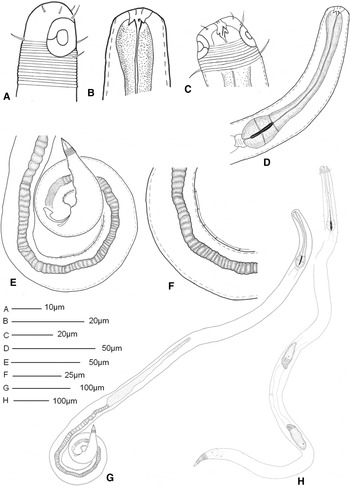
Figures 3 & 4
Metachromadora verae sp. nov.: (A, B, D–F) holotype male. (A) head region in surface view; (B) buccal cavity; (C) head region of allotype female; (D) pharynx region; (E) tail and copulatory apparatus; (F) ventral alae in the region of the precloacal supplements; (G) male habitus; (H) allotype female, habitus.

Photomicrographs of the holotype and allotype of Metachromadora verae sp. nov. (A) Surface view of head region showing outer unispiral amphidial fovea of male; (B) head region, showing buccal cavity of female; (C) pharyngeal region; (D) copulatory apparatus and tail; (E) tail showing postcloacal elevations; (F) habitus of female. Scale bars: A–E, 10 μm; F, 100 µm.

TYPE MATERIAL
Holotype and allotype deposited in the Museu Nacional do Rio de Janeiro (National Museum of Rio de Janeiro—MNRJ) and paratypes in the Laboratório Meiofauna do Departamento de Zoologia da UFPE (NM-LMZOO UFPE). Holotype male (MNRJ 371), four paratype males (NM-LMZOO UFPE), allotype female (MNRJ 372).
TYPE LOCALITY
Bica Beach (22°49′37.9″S and 43°11′15.9″W), Guanabara Bay, Rio de Janeiro, Brazil.
TYPE HABITAT
Intertidal zone of Bica Beach.
ETYMOLOGY
The species name verae honours Professor Vera Abud, who introduced meiofauna studies in Rio de Janeiro State, Brazil.
MEASUREMENTS
See Table 2.
Measurements of Metachromadora verae sp. nov
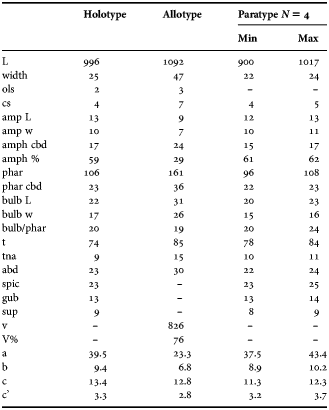
–, not applicable.
Males
Body long and relatively slender, with blunt rounded head and conical tail. Cuticle golden, with very fine transverse striations starting in middle of amphidial fovea and without ornamentations. Few and scattered minute somatic setae along body, more evident in pharynx region, without a pattern of organization.
Non-annulated head region with anterior sensilla in three circles: inner labial sensilla not visible, six outer labial setae 2 µm long and four cephalic setae 4–5 µm long, located immediately in front of amphidial fovea. Amphidial fovea oval, ventrally wound and unispiral partly surrounded by striations, its diameter 59–62% of corresponding body diameter. Buccal cavity cyathiform with cheilorhabdia, rather large dorsal tooth, and two small ventrosublateral teeth. Pharynx largely cylindrical, posteriorly widened forming small bulb, less than 2/5 of pharyngeal length; bulb subdivided into two well-demarcated regions, lumen of pharyngeal bulb covered by thick rod-shaped sclerotization, lumen of rest of pharynx less sclerotized. Cardia not evident. Nerve ring not observed.
Tail conical and more than three times anal body diameter; caudal glands not visible, but spinneret evident at tail tip. Terminal part of tail smooth, corresponding to 9–10% of total tail length.
Reproductive system monorchic with outstretched testis lying on left side of intestine. Testis characterized by short germinal zone followed by large region of lighter cells leading to opaque cells packed with dark granules and a narrow ejaculatory duct. Two equal spicules, slender, ventrally curved with a relatively thin lamina and well-cephalated capitulum. Gubernaculum canoe-shaped, oriented parallel to spicula, without apophyses. Eight to nine delicate tubular precloacal supplements protruding from cuticle at regular intervals and covered by ventral alae, first supplement 160 µm distant from the cloaca; three postcloacal elevations.
Females
Similar to male in most respects, except for rounded amphidial fovea occupying 29% of head diameter. Reproductive system didelphic–amphidelphic with short reflexed ovaries, both branches lying to left of intestine. Vulva a transverse slit situated at 75% from anterior end, vagina vera and vagina uterina tubular evident, but not very sclerotized.
DIAGNOSIS
Metachromadora verae sp. nov. is characterized by the sexual dimorphism of the amphidial fovea, pharynx with bipartite terminal bulb and strong sclerotization restricted to the elongated bulb, somatic setae with no pattern of organization, conical tail shape corresponding to more than three times abd in males. Males characterized by presence of eight to nine precloacal tubular supplements and three postcloacal papilliform supplements.
DIFFERENTIAL DIAGNOSIS
Metachromadora verae sp. nov. most closely resembles M. suecica in the pharynx design, spicule shape, and tail length, but differs from it by the sexual dimorphism of the amphidial fovea, the number of precloacal supplements, and the presence of postcloacal papilliform supplements.
KEY TO VALID SPECIES OF THE GENUS METACHROMADORA FILIPJEV, 1918
Key to subgenera
1 Somatic setae arranged in 10 longitudinal rows………subgenus Metonyx
— Somatic setae not arranged in 10 longitudinal rows………2
2 Head with pronounced longitudinal striation………subgenus Metachromadora
— Head without pronounced longitudinal striation………3
3 Cephalic setae absent or short and stout; amphidial fovea (at least in males) on thick cuticularized plate………subgenus Metachromadoroides
— Cephalic setae slender; amphidial fovea not on thick cuticularized plate………4
4 Lateral alae (wings) present………subgenus Neonyx
— Lateral alae (wings) absent………subgenus Bradylaimus
Subgenus Metonyx
Only species: M. horrida
Key to subgenus Metachromadora
1 Amphidial fovea equal in both sexes………M. macroteura
— Sexual dimorphism in shape of amphidal fovea………2
2 Males with 12–14 precloacal supplements………M. chandleri
— Males with 21–25 precloacal supplements………M. itoi
Key to subgenus Metachromadoroides
1 Bulb bipartite………M. remanei
— Bulb tripartite………2
2 Precloacal supplements absent………3
— Precloacal supplements present………4
3 Anterior non-striated part equal to two amphidial fovea lengths………M. vulgaris
— Anterior non-striated part equal to one amphidial fovea length………M. zaisxi
4 Cephalic setae absent………M. complexa
— Cephalic setae present………5
5 Body length less than 1 mm long, spicules 35 µm long and 12–14 precloacal supplements………M. minor
— Body length more than 1 mm long, spicules 55 µm long and 23 precloacal supplements………M. pulvinata
Key to subgenus Neonyx
1 Subcephalic setae at same level of cephalic setae………2
— Subcephalic setae and cephalic setae in different crown………3
2 Buccal cavity with denticles………M. cancelata
— Buccal cavity without denticles………M. meridiana
3 Subcephalic and cervical setae longer than cephalic setae………4
— Subcephalic and cervical setae shorter than cephalic setae………5
4 Males with 10 precloacal supplements………M. alata
— Males with 12 precloacal supplements………M. campycoma
5 Obese nematode (a: 16–24 in ♂; a: 9–20 in ♀), 8 precloacal supplements………M. obesa
— Thin nematode (a: 45 in ♂; a: 35 in ♀), 12 precloacal supplements………M. pseudocampycoma
Key to subgenus Bradylaimus
1 Bulb tripartite………2
— Bulb bipartite………3
2 Buccal cavity with denticles………M. setosa
— Buccal cavity without denticles………4
3 Terminal bulb elongate, its length more than twice width………5
— Terminal bulb oval, its length less than twice width………6
4 Male without supplements………M. asupplementa
— Male with 9–12 precloacal supplements………M. onyxoides
5 Amphideal fovea small (7.5–9 µm wide), less than or equal to 1/3 cbd………7
— Amphideal fovea large (15 µm wide), more than 2/3 cbd………M. spectans
6 Head capsule present………8
— Head capsule absent………9
7 Cephalic setae 14 µm long………M. scotlandica
— Cephalic setae longer than 15 µm………M. gerlachi
8 Tail long, four times abd; precloacal supplements absent………M. pneumatica
— Tail short, twice abd; precloacal supplements present………M. prepapillata sp. nov.
9 Cuticle without any special ornamentation………M. verae sp. nov.
— Annuli with ornamentations of dots or vacuoles………10
10 Tail short, less than three times abd………M. suecica
— Tail long, more than three times abd………M. nyali
DISCUSSION
Metachromadora is a very complicated genus which has undergone several taxonomic rearrangements since its description. It was first divided into five subgenera: Bradylaimus, Chromadoropsis, Metonyx, Metachromadora, and Neonyx by Gerlach (Reference Gerlach1951) based on the presence, type and distribution of somatic setae over the body, presence of precloacal supplements, presence of lateral fields called wings (alae), presence and shape of precloacal supplements. All these subgenera, except the type subgenus, were eventually established as genera and subsequently relegated to subgeneric status. Subsequently, a sixth subgenus, Metachromadoroides, was erected by Timm (Reference Timm1961), who distinguished it from the previous subgenera by the amphidial fovea placed on a thick cuticular plate. Timm (Reference Timm1961) also suggested that all subgenera would be regarded as distinct genera in any other family of nematodes, because of the dissimilarity of most of them.
In order to reduce this ambiguity, the subgenus Chromadoropsis was reinstated to the category of genus (Furstenberg & Vincx, Reference Furstenberg and Vincx1988) and a new genus Papillonema was established by Verschelde et al. (Reference Verschelde, Muthumbi and Vincx1995). However, Metachromadora is still a large genus in terms of species; at present, 27 species are considered valid (including the two new species), as listed here. The subgeneric division is adopted following the criteria of Wieser & Hopper (Reference Wieser and Hopper1967). We agree with Timm (Reference Timm1961) that the subdivision must stand until enough material becomes available for an appropriate revision of the genus.
In this paper, two species are described. They are assigned to the subgenus Bradylaimus because both of them lack lateral alae, which is the distinctive feature of this subgenus according to Gerlach (Reference Gerlach1951). An updated and emended key to the species of Metachromadora is also proposed. In this key, two species (M. serrata and M. spiralis) are not included in any of the five subgenera that are presently considered valid. In the key provided by Wieser & Hopper (Reference Wieser and Hopper1967), these two species together with M. clavata were not grouped in any of the six adopted subgenera at that time, and the authors stated that these three species belong to a doubtful genus. Later, the three species were included in the subgenus Metachromadora by Gerlach & Riemann (Reference Gerlach and Riemann1973/1974). Subsequently, Furstenberg & Vincx (Reference Furstenberg and Vincx1988) transferred M. clavata to the genus Chromadoropsis. However, when Verschelde et al. (Reference Verschelde, Muthumbi and Vincx1995) erected the genus Papillonema, which is characterized by prominent papilliform labial sensilla, an elongate muscular terminal bulb partitioned into three regions, and the presence of three papilliform precloacal supplements, M. clavata was transferred to it because of the possession of all these three features. Concerning the other two species (M. serrata and M. spiralis), we do not agree that they belong to the subgenus Metachromadora since they lack its most distinct feature, the longitudinal striations of the head. In fact, these two species possess a smooth cuticle, which makes them too different from the other 27 species. Therefore, we consider these two species as incertae sedis.
Even though Wieser & Hopper (Reference Wieser and Hopper1967) regarded M. alata as a species inquirendae based on the study by Chitwood (Reference Chitwood1936), who stated that its original description is insufficient, we fully support the opinion that the original description gives enough information to place this species in the subgenus Neonyx. It is clearly mentioned in the original description that the lateral alae (wings) start at the cardia level, and also the presence of ten precloacal supplements. This latter feature distinguishes M. alata from M. campycoma.
Wieser & Hopper (Reference Wieser and Hopper1967) suggested that M. asupplementa is a possible synonym of M. onyxoides; however, there is a step in their key that makes a distinction between the two species. Therefore, we are not fully convinced of the synonymy, since the two species differ from each other in the presence versus absence of precloacal supplements.
The two new species are placed in Bradylaimus mainly because of the absence of lateral alae. Metachromadora verae sp. nov. is a typical species of this subgenus, since all the characters entirely agree with the distinct features of Bradylaimus (in addition to the cuticle, tubular precloacal supplements occur in this subgenus); while M. prepapillata sp. nov. diverges only in the presence of papilliform precloacal supplements. These papilliform supplements place M. prepapillata sp. nov. close to Papillonema; nevertheless, this species should not be placed in Papillonema due to the shape of the outer labial sensilla, which are papilliform in all of the described species; the relative length of terminal bulb (more than 47% in Papillonema spp. versus less than 20% in M. prepapillata sp. nov.); and the number of precloacal supplements (3–4 in Papillonema spp. and −9 in M. prepapillata sp. nov.). The kind of supplement present in both M. prepapillata sp. nov. and Papillonema spp. may suggest a possible phylogenetic relationship between the two genera.
The two newly described species can be distinguished from each other by the following set of characteristics: (1) presence of three postcloacal papillae in the male of M. verae; (2) sexual dimorphism of the amphidial fovea in M. verae; and (3) presence of well-sclerotized structures of the vagina in M. prepapillata.
ACKNOWLEDGEMENTS
Thanks to Dr Alessandra Botelho (UFPE) for the help with photographs. Dr Janet W. Reid, JWR Associates, is acknowledged for her critical revision of the English. The authors acknowledge the two referees by their fruitful comments.
FINANCIAL SUPPORT
We express gratitude to PETROBRAS, which supported the project ‘Biomonitoring of sandy beaches of Guanabara Bay after the oil spill occurred in January 2000’.