Introduction
Antarctic volcanic activity was a constant phenomenon during the Cenozoic period. Currently geothermal activity has been found in a number of circumpolar islands (South Sandwich Islands, Deception Island) and in few geographical sites on the continent (Mount Erebus, Mount Melbourne and Mount Rittmann).
Measurements on Mount Erebus, Mount Melbourne and Mount Rittmann indicate that in these sites temperatures range from 50°C to 75°C. With extremely low concentrations of N and P and high concentrations of metals (Cu, Zn, Cd, Pb and Hg) the microbial life in these soils is probably constrained not only by the high temperatures but also by low nutrients and high concentrations of toxic metals (Logan & Allan Reference Logan and Allan2007). Our current microbiological knowledge strongly suggests a correlation between the presence of microbial diversity and the geochemical composition of a geographical site.
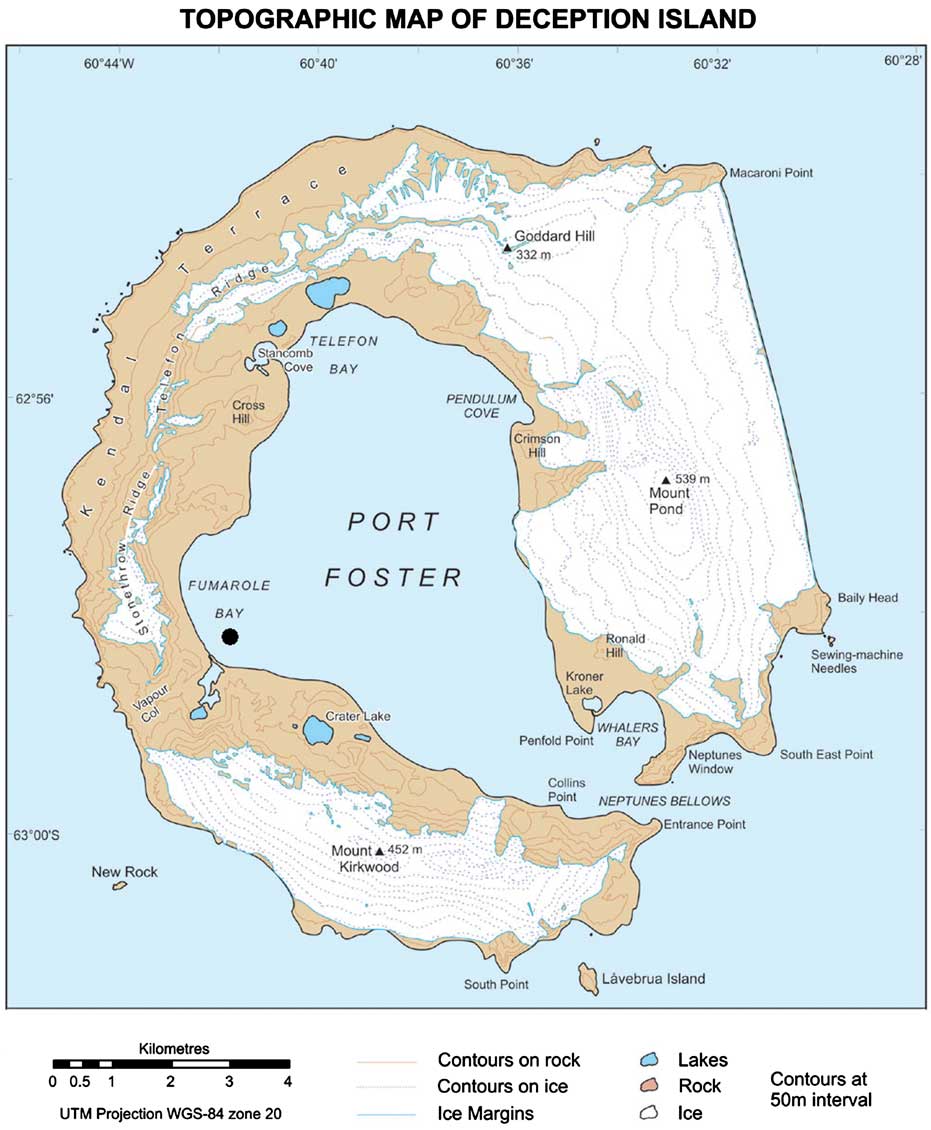
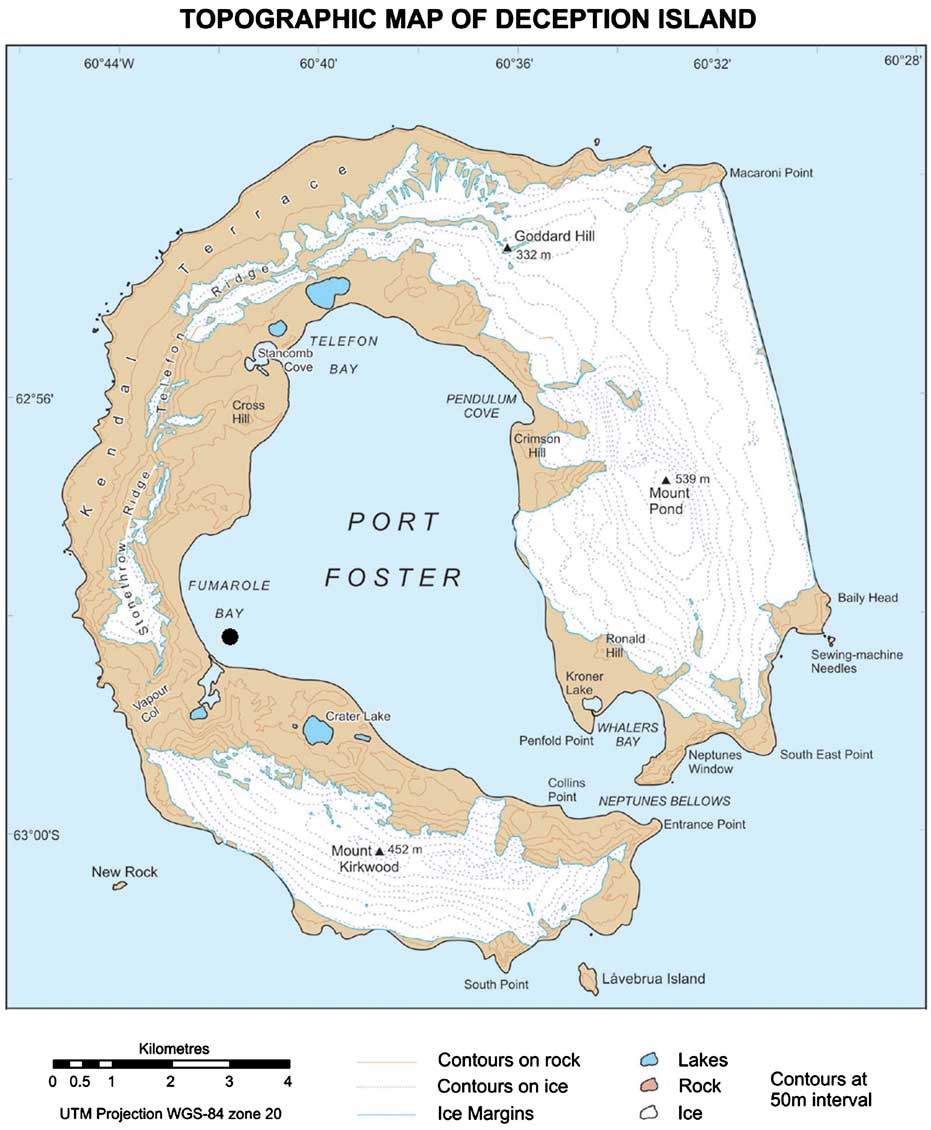
Deception Island (South Shetland Islands, Antarctica) is a complex stratovolcano with a “horseshoe” shape whose central part has a caldera structure (Fig. 1). This volcanic island has been very active during the last century: fumarolic emissions, thermal springs and hot soils are evidence of Deception Island's continuing activity (Caselli et al. Reference Caselli, dos Santos Afonso and Agusto2004). Geothermal anomalies are mainly found from Fumarole Bay to Pendulum Cove. The temperatures of emissions range from 90–110°C at the fumaroles of Fumarole Bay. The soil temperature is highly variable, reaching values between 40–60°C at Whalers Bay, and more than 70°C at Pendulum Cove (Ortiz et al. Reference Ortiz, Vila, Garcia, Camacho, Diez, Aparicio, Soto, Viramonte, Risso, Menegatti and Petrinovic1992).
Map of Deception Island (South Shetland Islands, Antarctica). The black dot indicates the sampling site selected in the present work. Courtesy of British Antarctic Survey.
Geothermal sites are widely distributed throughout the world and provide ideal environments for the development of thermophilic microorganisms. Currently, a number of thermophilic and hyperthermophilic microorganisms have been isolated from terrestrial and marine hot environments, including shallow and deep marine hydrothermal vents, solfataric fields, hot springs and volcanoes (Barns et al. Reference Barns, Fundyga, Jeffries and Pace1994, Sako et al. Reference Sako, Nomura, Uchida, Ishida, Morii, Koga, Hoakii and Maruyama1996, Reysenbach et al. Reference Reysenbach, Longnecker and Kirshtein2000, Casamayor et al. Reference Casamayor, Muyzer and Pedrós-Alió2001). Thermophilic and hyperthermophilic microorganisms grow optimally at temperatures of 50°C to 80°C and above 80°C, respectively (Turner et al. Reference Turner, Mamo and Karlsson2007). Culture dependent analysis of geothermal soils from McMurdo volcanic sites indicates the presence of aerobic and facultative anaerobic thermophilic species of the genera Bacillus, Brevibacillus, Anoxybacillus, Aneurinibacillus and Alicyclobacillus among others (Nicolaus et al. Reference Nicolaus, Improta, Manca, Lama, Esposito and Gambacorta1998, Reference Nicolaus, Lama, Esposito, Belliti, Improta, Panico and Gambacorta2000, Logan et al. Reference Logan, Lebbe, Hoste, Goris, Forsyth, Heyndrickx, Murray, Syme, Wynn-Williams and de Vos2000, Allan et al. Reference Allan, Lebbe, Heyrman, de Vos, Buchanan and Logan2005, Poli et al. Reference Poli, Esposito, Lama, Orlando, Nicolaus, de Appolonia, Gambacorta and Nicolaus2006) and anaerobic thermophiles related to the genus Clostridium (Hudson & Daniel Reference Hudson and Daniel1988). On the other hand only six thermophilic, Gram-positive, aerobic rods have been described and isolated from geothermal areas of Deception Island (Llarch et al. Reference Llarch, Logan, Castellí, Prieto and Guinea1997), but none of them from Fumarole Bay.
It has been recognized that only a small fraction of microorganisms found in natural habitats is revealed by using culture-dependent techniques. Cultivating bacteria from thermal sites was often unsuccessful due to difficulties in reproducing the complex geochemical composition of the environment in the growth media, resulting in limited knowledge of real microbial diversity (Muyzer Reference Muyzer1999). Currently, culture-independent methods are considered an important tool in identifying a larger part of the microbial community composition, revealing the existence of a high number of as-yet-uncultured microorganisms (Maugeri et al. Reference Maugeri, Lentini, Gugliandolo, Italiano, Cousin and Stackebrandt2009).
Molecular methods based on 16S ribosomal DNA (rDNA) are widely used to study intrinsic genetic diversity. Denaturing Gradient Gel Electrophoresis (DGGE) of 16S rDNA amplified by PCR is used to obtain insights into the bacterial and/or archaeal community diversity. This technique has been used in different geothermal environments, including hydrothermal vents of Panarea Island, Italy (Maugeri et al. Reference Maugeri, Lentini, Gugliandolo, Italiano, Cousin and Stackebrandt2009), hot springs from Yellowstone National Park, USA (Barns et al. Reference Barns, Fundyga, Jeffries and Pace1994), and Uzon Caldera, Kamchatka, Russia (Kublanov et al. Reference Kublanov, Perevalova, Slobodkina, Lebedinsky, Bidzhieva, Kolganova, Kaliberda, Rumsh, Haertle and Bonch-Osmolovskaya2009) to provide more information about the diversity of those sites.
In this study DGGE fingerprinting of 16S rDNA was used to investigate the diversity of thermophilic bacteria in Fumarole Bay, Deception Island.
Materials and methods
Sample collection
A sample of c. 10.0 g of soil was taken from the fumarole with the highest temperature at Fumarole Bay, Deception Island during the Chilean Antarctic Scientific Expedition ECA44. Samples consisting of mixtures of sediment, pyroclast and marine water were collected at 40 cm depth in a fumarolic emission. The temperature of the site ranged from 75°C to 95°C and pH was 6.0. The sample was collected aseptically using metal spoons and Whirl-Pak bags (8 x 8 inch) and was transferred to a sterile vial. Approximately 4.0 g of soil we re-stored at -20°C for the genomic DNA extraction. Triplicate samples were collected to assess consistency of DNA extraction, amplification and DGGE methods.
Enrichment of environmental sample
Three different soil samples of 2.0 g were inoculated into 20 ml of enrichment medium. Enrichment medium (EM) contained (g/l) 5.0 maltose, 5.0 tryptone, 5.0 yeast extract, 1.2 NH4Cl, 14.0 NaCl, 2.0 MgSO4, 3.5 MgCl2, 0.35 KCl, 0.3 CaCl2, 0.3 KH2PO4, 0.06 NaBr, 0.015 H3BO3, 0.02 SrCl2, 0.06 sodium citrate, 0.02 KI and 10 ml of trace elements solution (Freier et al. Reference Freier, Mothershed and Wiegel1988). The pH was adjusted to 8.5, 7.0 and 5.5 with H2SO4 or NaOH and the cultures were named PCHOC1, PCHOC2 and PCHOC3, respectively. All cultures were incubated aerobically at 65°C for 24 hours.
From the three cultures, one of the enriched samples was transferred to a liquid modified basal (MB) medium containing (g/l) 5.0 peptone, 1.0 yeast extract, 6.0 K2HPO4, 2.0 KH2PO4, 0.5 MgSO4 and 10 ml of trace elements solution. pH was adjusted to 6.5 with H2SO4. A thermophilic bacterium was isolated from the inoculated 20 ml MB medium using serial dilutions, and inoculation on solid MB medium followed by transfer to a liquid MB medium. Incubations were at 65°C and the purity of the isolate was tested microscopically and confirmed by DGGE.
Denaturing Gradient Gel Electrophoresis (DGGE)
Genomic DNA was extracted directly from soil sample, mixed enriched cultures and pure cultures by PowerSoil™ DNA isolation kit (Mo Bio). Total DNA was used to amplify the 16S rDNA. PCR amplification was performed using universal primer 907R (Muyzer et al. Reference Muyzer, Brinkhoff, Nübel, Santegoeds, Schäfer and Wawer1998) and bacterial specific primer 358F (Muyzer et al. Reference Muyzer, de Waal and Uitterlinden1993). A 40-bp GC clamp (5′-CGCCCGCCGCGCCCCGCGCCCGTCCCGCCGCCCCCGCCCG-3′) was attached to the 5′ end of primer 358F (Muyzer et al. Reference Muyzer, de Waal and Uitterlinden1993). The reaction mix consisted of 2.5 U of Taq DNA polymerase, 200 μM of each deoxy (d) nucleotide (dATP, dCTP, dGTP and dTTP), 1X of reaction buffer, 0.75 mM of MgCl2 and 0.5 μM of each primer.
Touchdown PCR was performed on the amplification reaction mix. The following thermal conditions were applied: 95°C for 45 s, 65°C-55°C for 45 s at the ramp of 0.5°C per cycle, 72°C for 45 s, then twenty cycles were carried out at 95°C for 45 s, 55°C for 45 s, 72°C for 45 s; and a final elongation step of 72°C for 5 min. Amplification reactions were carried out using a Palm Gradient Cycler (Corbett).
PCR products were resuspended in 5 μl of sterile distilled water and 5 μl of DGGE loading dye (10 mM Tris-acetate pH 7.8; 1 mM EDTA; 0.1% bromophenol blue). The mixture was loaded on an 8% polyacrylamide gel with a 20% to 80% denaturant gradient (100% denaturant corresponded to 6 M urea and 40% formamide). Electrophoresis was performed for 10 min at 200 V and subsequently for 16 h at a constant voltage of 65 V at 60°C. Gel was stained with ethidium bromide (0.5 μg/ml in Tris-acetate-EDTA pH 8.3) for 25 min and visualized on an UV transilluminator. Most representative bands were cut, amplified and sequenced using the set of primers described above.
Phylogenetic analysis
Clustal W software was used to align the partial sequence of 16S rDNA (∼350 bp) from the most representative bands in DGGE with selected sequences retrieved from GenBank. Accession number of the retrieved sequences are indicated in parenthesis: Geobacillus jurassicus (FN428697), Geobacillus stearothermophilus (FN428694), Geobacillus thermoleovorans (Z26923), Bacillus thermantarcticus (AJ493665), Bacillus fumarioli (AJ250059), Bacillus licheniformis (AY052767), Bacillus bataviensis (EU334358), Thermus thermophilus (X07998), Thermus aquaticus (L09663), Thermus scotoductus (AF020205), Thermus sp (Z15061), Desulfocapsa sulfoexigens (Y13672), Brevibacillus agri (AB112716), Brevibacillus brevis (AB271756), Brevibacillus borstelensis (AB116134), Brevibacillus thermoruber (AB112722) and uncultured bacteria (AB294274, EF540443, AF050536, EF667749, DQ677861). Thermotoga sp. (AF355615) was used as outgroup. The software package MEGA 4.0 (Tamura et al. Reference Tamura, Dudley, Nei and Kumar2007) was used for a phylogenetic analysis and a tree was constructed by using the Neighbor-Joining method with a bootstrap analysis of 1000.
Nucleotide sequence accession numbers
The partial 16S rDNA gene sequences generated from the DGGE and microbial culture analysis have been deposited in the GenBank nucleotide sequences databank under accession numbers: HM449942–HM449950 and GU366067.
Results and discussion
The wide microbiological biodiversity found in thermal environments has been consistently underestimated, due to limited experimental procedures and methodologies to correctly handle samples from extreme environments either from culture dependent or independent approaches (Casamayor et al. Reference Casamayor, Muyzer and Pedrós-Alió2001, Christner et al. Reference Christner, Mosley-Thompson, Thompson and Reeve2001). Additionally, the selectivity of the cultures enrichment fails to emulate the conditions that particular microorganisms require for their proliferation in their own natural habitats.
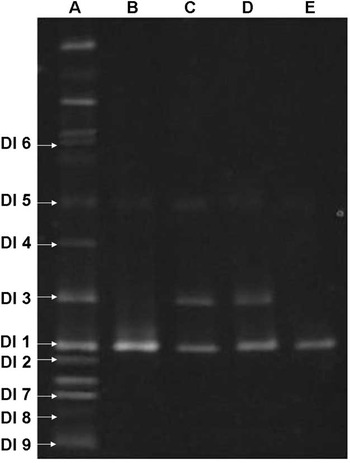
In this study, the fact that cultured bacteria represent less than 1% of environmental species produced meant that a further bacterial diversity analysis (from Fumarole Bay) was conducted by DGGE (Sing & Sing Reference Sing and Sing2010). Generated DGGE profile using bacterial primers is presented in Fig. 2. The number of bands obtained in our DGGE analysis is similar to the number of bands amplified from samples of other geothermal sites (Casamayor et al. Reference Casamayor, Muyzer and Pedrós-Alió2001, Maugeri et al. Reference Maugeri, Lentini, Gugliandolo, Italiano, Cousin and Stackebrandt2009). All bands from the DGGE analysis were excised and sequenced. Lane A shows bacterial thermophiles in a soil sample from Fumarole Bay. However, when sequences were analysed by BlastN, only nine bands (named DI 1–9, Fig. 2) matched with hits of 16S rDNA sequences stored in GenBank (Table I). Remaining bands amplified from the soil sample did not give matches in BlastN. DGGE fingerprint represents the cultured and non-cultured bacteria of samples from Fumarole Bay. We have been able to obtain three different enriched cultures, containing species represented in bands DI1, DI3 and DI5 (Lane B–D, Fig. 2).
DGGE profile of PCR amplified 16S rDNA gene of a soil sample (lane A), enriched cultures PCHOC1 (lane B), PCHOC2 (lane C), PCHOC3 (lane D), and pure culture of G. jurassicus (Lane E) obtained from Fumarole Bay, Deception Island. All bands were excised and sequenced. The unmarked unnumbered bands did not produce readable sequence data.

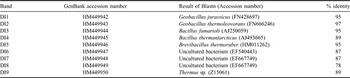
Affiliation of 16S rDNA gene from thermophilic bacteria with sequenced bands from DGGE.

We used the enrichment medium EM because it has proved to be an excellent medium to obtain different high-density thermophilic heterotrophic microorganisms. In fact, we were able to obtain three mixed cultures using this medium at three different pH values. DGGE analysis indicated that under alkaline conditions (PCHOC1, lane B Fig. 2) it was possible to cultivate G. jurassicus and B. thermoruber. Additionally, G. jurassicus, B. thermoruber and B. fumarioli were able to grow under neutral (PCHOC2, lane C Fig. 2) and acidic pH (PCHOC3, lane D Fig. 2). Brevibacillus thermoruber and B. fumarioli have a maximum temperature for growth under 60°C. This indicates that bacteria obtained from these mixed cultures corresponded to more thermophilic strains, and we were able to cultivate the most thermophilic bacterium G. jurassicus. The characterization of the bacterium (not shown) indicates that our strain has a range of temperature between 50–72°C. Due to its resistance to high temperatures G. jurassicus is a good model for future studies of thermal adaptations of thermophilic Antarctic microorganisms.
Table I shows the nine DGGE bands that match with sequences from GenBank. BlastN analysis indicates that the nine bands match with the 16S rDNA sequences that belong to the Bacteria domain. We used Dinsdale et al. (Reference Dinsdale, Halket, Coorevits, van Landschoot, Busse, de Vos and Logan2010) to apply the latest nomenclature for Geobacillus. Our results indicate a high likelihood of identity for five bands with thermophilic members of the genera Geobacillus (DI1 and DI2), Bacillus (DI3 and DI4) and Brevibacillus (DI5). The sequence of DI9 band matched with Thermus sp. and showed 89% identity with this thermophilic bacterium. Three bands of DGGE (DI6 to DI8) correspond to uncultured sulphate reducing bacteria with a range of identity between 78–87%.
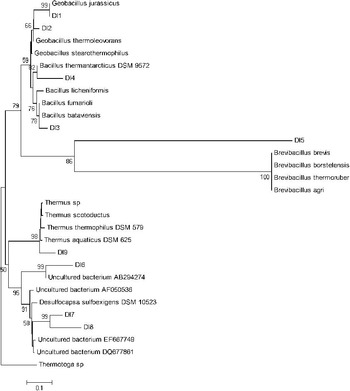
Phylogenetic analysis by using Neighbor-Joining method for the partial 16S rDNA sequences of thermophilic bacteria from Fumarole Bay showed three main clades (Fig. 3). These clades include thermophilic members of the order Bacillales, Thermus and uncultured sulphate reducing bacteria. Thermophilic members of the order Bacillales clade can be divided into three groups composed by the genera Geobacillus, Bacillus and Brevibacillus. Members of this clade are closely related, but they show a variety of phenotypically heterogeneous species exhibiting a wide range of nutritional requirements, physiology, metabolic diversity and DNA base composition (Xu & Côté 2003). Several species of this clade have been isolated from geothermal sites in Antarctica including thermophilic members of the genera Bacillus, Alicyclobacillus, Brevibacillus, Aneurinibacillus and Anoxybacillus (Nicolaus et al. Reference Nicolaus, Improta, Manca, Lama, Esposito and Gambacorta1998, Bargagli et al. Reference Bargagli, Skotnicki, Pepi, Mackenzie and Agnorelli2004, Allan et al. Reference Allan, Lebbe, Heyrman, de Vos, Buchanan and Logan2005, Poli et al. Reference Poli, Esposito, Lama, Orlando, Nicolaus, de Appolonia, Gambacorta and Nicolaus2006). The sequences of DI3 and DI4 showed a high percentage of identity with thermophilic rods previously isolated from Mount Melbourne, Bacillus fumarioli and Bacillus thermantarcticus, respectively (Table I), indicating that these bacteria are also present in Fumarole Bay.
Phylogenetic position of DGGE bands sequences analysed. The sequenced bands were compared to 16S rDNA gene of species from the genus Geobacillus, Bacillus, Brevibacillus, Thermus and uncultured bacteria. Thermotoga sp. was used as outgroup. Phylogenetic tree was inferred by using the Neighbor-joining method with a bootstrap test of 1000.

DI9 band clustered within the Thermus clade indicating the presence of this type of thermophilic bacterium in Deception Island. The presence of Thermus has been previously reported in the McMurdo Dry Valleys. The analysis of the small subunit of rDNA gene and the sequences obtained form an independent clade within the Thermus/Deinococcus bacterial group (de la Torre et al. Reference De La Torre, Goebe, Friedmann and Pace2003). Additionally, Thermus phylogeny based on 16S rDNA sequence analysis displays a geographic clustering (Saul et al. Reference Saul, Rodrigo, Reeves, Williams, Borges, Morgan and Bergquist1993). In this way, distant geothermal sites can be considered as isolated sites with barriers for the dispersal of microorganisms, providing the opportunity to study speciation of Thermus species in Antarctica.
Three different bands (DI6–DI8) obtained in DGGE analysis from soil samples of Fumarole Bay shore correspond to uncultured sulphate reducing bacteria. Thermophilic sulphate reducing bacteria have been previously reported to belong to the genus Desulfotomaculum. Thermophilic members of this genus like Desulfotomaculum geothermicum and Desulfotomaculum hydrothermale have been isolated from geothermal sites (Daumas et al. Reference Daumas, Cord-Ruwish and Garcia1988, Haouari et al. Reference Haouari, Fardeau, Cayol, Casiot, Elbaz-Poulichet, Hamdi, Joseph and Ollivier2008). These bacteria are probably implicated in the mineralization of organic carbon derived from primary production by the benthic community. Organic mineralization in sediments is carried out by a joint activity of aerobic bacteria and sulphate reducing bacteria. The contribution of sulphate reduction to aerobic mineralization is greater in coastal sediments and declines in deeper water (Walker Reference Walker2005). The existence of sulphate reducing bacteria at the seashore of Fumarole Bay might have been expected but thermophilic sulphate reducing bacteria have not been previously described from Deception Island.
In this work a culture-independent method was used to identify the diversity of thermophilic bacteria in soil samples. Additionally, we were able to isolate a thermophilic bacterium using a modified basal medium. Blastn analysis of the 16S rDNA sequence in GenBank revealed that the isolated bacterium showed a high correlation with G. jurassicus (FN428697). The thermophilic bacterium obtained was a pure culture as indicated by DGGE where a single band correlation (Lane E, Fig. 2), indicated the purity of the isolate. Geobacilli are widely distributed and have been successfully isolated from several geothermal areas. In addition, Geobacillus species have also been recovered from artificial hot environments. Members of this genus are good examples for studies of thermal metabolic adaptations. In fact, the isolation of G. jurassicus could let us understand mechanisms for growth at high temperatures.
In conclusion, the thermophilic bacterial diversity found at Fumarole Bay is at least composed of members of the genera Geobacillus, Bacillus, Brevibacillus, Thermus and uncultured sulphate reducing bacteria. However, thermophilic members of these bacterial genera are widely distributed in Antarctica, and the natural barriers that separate geothermal sites in this continent make this area an ideal scenario to study how thermophilic bacteria evolve in different and distant Antarctic sites.
Acknowledgements
We would like to thank Instituto Antártico Chileno for its support. This work was founded by project Gabinete G01-07 from Instituto Antártico Chileno. We thank British Antarctic Survey for providing us with the map of Deception Island. We thank the reviewers and the editor for their helpful and constructive comments.