INTRODUCTION
Generally, the concept of endophenotypes is a promising research target that could help to decode etiopathology and genetic determinants of serious mental illnesses (Allen, Griss, Folley, Hawkins, & Pearlson, Reference Allen, Griss, Folley, Hawkins and Pearlson2009; Braff, Reference Braff2015). An endophenotype is characterized by being a reliably measurable, heritable, and state-independent marker that can be found in both patients as well as their unaffected family members (Gottesman & Gould, Reference Gottesman and Gould2003). Next to neurophysiological markers, such as prepulse inhibition or P50 gating, several neurocognitive (Seidman et al., Reference Seidman, Hellemann, Nuechterlein, Greenwood, Braff, Cadenhead and Green2015) measures have been suggested to qualify as endophenotypes for schizophrenia. Moreover, previous studies have shown social cognitive deficits in unaffected siblings of schizophrenia patients (Bediou et al., Reference Bediou, Asri, Brunelin, Krolak-Salmon, D’Amato, Saoud and Tazi2007; Ho et al., Reference Ho, Lui, Hung, Wang, Li, Cheung and Chan2015; Kee, Horan, Mintz, & Green, Reference Kee, Horan, Mintz and Green2004; Lavoie et al., Reference Lavoie, Plana, Bedard Lacroix, Godmaire-Duhaime, Jackson and Achim2013; Leppänen et al., Reference Leppänen, Niehaus, Koen, Du Toit, Schoeman and Emsley2008; Montag et al., Reference Montag, Neuhaus, Lehmann, Krüger, Dziobek, Heekeren and Gallinat2011). These impairments lie on a continuum between patients and healthy control subjects and affect different domains of social cognition, for example, Theory of Mind (Ho et al., Reference Ho, Lui, Hung, Wang, Li, Cheung and Chan2015; Montag et al., Reference Montag, Neuhaus, Lehmann, Krüger, Dziobek, Heekeren and Gallinat2011), social perception (Baas, van’t Wout, Aleman, & Kahn, Reference Baas, van’t Wout, Aleman and Kahn2008; Toomey, Seidman, Lyons, Faraone, & Tsuang, Reference Toomey, Seidman, Lyons, Faraone and Tsuang1999), and emotional processing (Allott et al., Reference Allott, Rice, Bartholomeusz, Klier, Schlogelhofer, Schafer and Amminger2015; Leppänen et al., Reference Leppänen, Niehaus, Koen, Du Toit, Schoeman and Emsley2008; Surguladze et al., Reference Surguladze, Chkonia, Kezeli, Roinishvili, Stahl and David2012).
These findings led to the hypothesis, that social cognitive deficits could represent a potential trait marker for a vulnerability for schizophrenia and reflect functional aberrations in relatively specialized neural systems (Habel et al., Reference Habel, Klein, Shah, Toni, Zilles, Falkai and Schneider2004). However, the scientific literature dealing with this topic is not consistent: some studies resulted in conflicting findings of intact social cognitive performance in first degree relatives (Fett & Maat, Reference Fett and Maat2013; Goghari, Macdonald, & Sponheim, Reference Goghari, Macdonald and Sponheim2011; Tucker, Farhall, Thomas, Groot, & Rossell, Reference Tucker, Farhall, Thomas, Groot and Rossell2013) and further research is needed to clarify the role of social cognitive impairments as potential endophenotypes for schizophrenia.
The current study focuses on the emotion processing part of social cognition. We assessed emotional intelligence (EI) levels in schizophrenia patients, unaffected siblings of patients, and healthy control subjects by using the Mayer-Salovey-Caruso Emotional Intelligence Test (MSCEIT) to investigate whether EI may represent a marker of risk for schizophrenia. Albacete and co-workers have recently reported on significantly lower “perceiving emotions” abilities in first-degree relatives of patients suffering from schizophrenia compared to control subjects and concluded that these findings support the endophenotypic role of social cognition in schizophrenia (Albacete et al., Reference Albacete, Bosque, Custal, Crespo, Gilabert, Albiach and Contreras2016). The present investigation aimed to re-evaluate this finding in a larger sample consisting exclusively of unaffected siblings of patients suffering from schizophrenia.
METHODS
All procedures contributing to this work complied with the standards of the local Ethics Committee and were conducted according to Good Clinical Practice standards on human experimentation and the Helsinki Declaration of 1975, as revised in 2008. Study procedures were performed by a trained research team consisting of psychiatrists and master-level clinical psychologists.
Participants
Schizophrenia patients were recruited at a specialized outpatient unit of the Department for Psychiatry, Psychotherapy, and Psychosomatics of the Medical University Innsbruck. All of them met DSM-IV criteria for schizophrenia as assessed by the Mini Mental Neuropsychiatric Interview (MINI) (Sheehan et al., Reference Sheehan, Lecrubier, Sheehan, Amorim, Janavs, Weiller and Dunbar1998). Patients had to be clinically stable without hospitalization for at least 6 months and without any change in psychopharmacological treatment within 3 months before study inclusion. Psychopathology was assessed by means of the Positive and Negative Syndrome Scale (PANSS) (Kay, Fiszbein, & Opler, Reference Kay, Fiszbein and Opler1987). Exclusion criteria included any other axis I disorder as well as axis II disorders as assessed by the Structured Clinical Interview for Axis-II-Disorders according to DSM-IV (SCID II) (Wittchen, Wunderlich, Gruschwitz, & Zaudig, Reference Wittchen, Wunderlich, Gruschwitz and Zaudig1996).
Unaffected siblings were recruited through the outpatient unit and advertisements in local newspapers. Eighteen siblings were relatives of participating patients; the others were not related to the patients enrolled in the study. The diagnosis of their affected relatives had to be confirmed through written documentation of a licensed psychiatrist. Healthy control subjects were also recruited through advertisements in local newspapers. They had to have a negative personal or family history of any DSM-IV psychotic disorder.
A brief medical screening interview was used in all groups to exclude subjects with any physical or neurological illness or any condition affecting neural or cerebrovascular function. All participants signed informed consent forms.
Emotional Intelligence
To assess EI, the German pencil-and-paper version (Steinmayr, Schütz, Hertel, & Schröder-Abé, Reference Steinmayr, Schütz, Hertel and Schröder-Abé2011) of the MSCEIT (Mayer, Salovey, & Caruso, Reference Mayer, Salovey and Caruso2002a, Reference Mayer, Salovey and Caruso2002b) was used. This instrument consists of 141 items and provides eight task scores that measure the four branches of EI: perceiving, using, understanding, and managing emotions. Whereas the “perceiving emotions” part measures the ability to recognize emotions accurately, the “using emotions” part is about using emotions to enhance cognitive processes. The “understanding emotions” part tests the knowledge how emotions interact with each other and change over time, and the “managing emotions” part measures the ability to deal with and regulate emotions. These branches cover all aspects of EI and can be assigned to the areas of emotional experiencing (perceiving + using emotions) and emotional reasoning (“strategic” EI; understanding + managing emotions). Similar to other intelligence tests, the average score is 100 with a standard deviation of 15.
The MSCEIT is both content and structurally valid (overall reliability r=0.93), showing discriminate validity from measures of analytic intelligence and many personality constructs (Brackett & Salovey, Reference Brackett and Salovey2006).
Non-social Cognition
Non-social cognition was measured with the Brief Assessment of Cognition in Schizophrenia (BACS) (Keefe et al., Reference Keefe, Goldberg, Harvey, Gold, Poe and Coughenour2004). Neurocognitive functions which are covered by this battery are: verbal memory, working memory, motor speed, attention and processing speed, executive functioning, and verbal fluency. The composite score is calculated by standardizing the average of those six measures by dividing that average by the standard deviation of the average in the normative sample.
Statistical Methods and Data Analysis
Metric variables were checked for significant deviations from normality by means of the Shapiro-Wilk test. Non-normally distributed metric variables were transformed to approximate normality by an appropriate transformation, for example, square root transformation. As the three groups (schizophrenia patients, unaffected siblings, and healthy control subjects) consisted of partially dependent and partially independent samples, the analysis was based on models allowing for correlated (patient-sibling pairs) as well as unpaired (healthy control subjects) observations. Hence, linear mixed models with compound symmetric correlation structure were used for comparison of the three groups with respect to metric variables, in particular EI and non-social cognition. As the three groups differed significantly in the distribution of age and sex, these variables were entered as covariates into the model. Generalized estimation equation models with compound symmetric correlation structure were applied for group comparisons with regard to binary variables.
Post hoc comparisons of pairs of groups were performed by means of the least significant difference method provided that the overall comparison of the three groups had yielded statistical significance (p<.05). In the case of three groups, this sequential procedure yields valid p-values without further adjustment (Levin, Serlin, & Seaman, Reference Levin, Serlin and Seaman1994). To account for multiple testing regarding the test instruments used (the MSCEIT consists of four subscales, the BACS of six), Bonferroni corrected p-values are reported beside the uncorrected ones.
In addition to these test statistical methods, mean group differences were quantified on a descriptive level by means of effect sizes (Cohen’s d).
RESULTS
Sample Characteristics
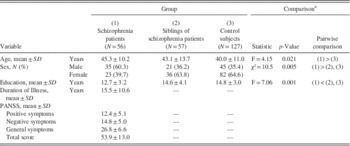
Fifty-six schizophrenia patients, 57 unaffected siblings of schizophrenia patients, as well as 127 healthy control subjects were included into the study. None of the unaffected siblings and healthy control subjects met criteria for any DSM-IV axis I or axis II disorder as assessed by MINI or SCID II. Demographic and clinical characteristics are summarized in Table 1. Unaffected siblings and healthy control subjects were comparable with respect to age, sex, and education, whereas schizophrenia patients differed significantly from the other groups in all three parameters. To account for these differences, we statistically adjusted for age, sex, and education which left the results unchanged.
Sample characteristics

a Analysis by linear mixed models (age, education) or by generalized estimation equation models (sex).
b PANSS=Positive and Negative Syndrome Scale.
Emotional Intelligence
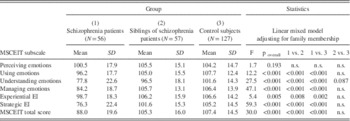
Compared to unaffected siblings and control subjects schizophrenia patients achieved significantly lower MSCEIT total scores and performed significantly worse in three out of four branches of EI (using, understanding, and managing emotions). In contrast, unaffected siblings of schizophrenia patients and control subjects had comparable EI levels. Merely the difference in the understanding emotions branch showed a tendency toward statistical significance (p=.087) pointing to a lower level in siblings. In terms of effect sizes, the mean difference in MSCEIT total score between unaffected siblings and control subjects amounted to d=0.13 as compared to d=1.13 for the difference between schizophrenia patients and control subjects (Table 2).
Comparison of schizophrenia patients, unaffected siblings of schizophrenia patients, and healthy control subjects with respect to emotional intelligence

n.s=not significant (p>0.10).
MSCEIT=Mayer-Salovey-Caruso Emotional Intelligence Test; EI=Emotional Intelligence.
Adjustment for age and sex left these findings virtually unchanged. Additional adjustment for education yielded slightly increased significance levels (p<.005 rather than p<.001 for several of the pairwise comparisons, p<.05 rather than p<.01 for pairwise comparisons regarding experiential EI) but did not affect the principal findings. Following Bonferroni correction for multiple testing by reducing the general threshold for significance to 0.05/4=0.0125 all statistically significant differences in Table 2 were retained. Only when additionally adjusting for education, significance of the differences involving experiential EI was lost.
Non-social Cognition
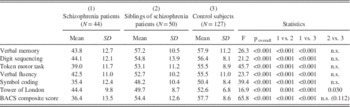
Data on non-social cognitive functions were available for 44 schizophrenia patients, 50 siblings, and 127 control subjects. A comparison of the three groups is given in Table 3. Schizophrenia patients showed significantly poorer performance in all subtests compared to both unaffected siblings and control subjects. Siblings and healthy control subjects did not differ significantly in BACS performance except in the Tower of London test where siblings exhibited lower scores (p=.030). Adjustment for age, sex, and education did not change these findings in terms of significance levels. Following Bonferroni correction (adjusted significance level: 0.05/6=0.0083), all significances were retained except for the above-mentioned difference between siblings and control subjects in the Tower of London test.
Comparison of schizophrenia patients, unaffected siblings of schizophrenia patients, and healthy control subjects with respect to non-social cognition

n.s=not significant (p>0.10).
BACS=Brief Assessment of Cognition in Schizophrenia.
In terms of effect sizes mean differences between schizophrenia patients and healthy controls were by far larger than those between siblings and control subjects. For the BACS composite score the corresponding values were d=1.88 for patients versus control subjects and d=0.30 for siblings versus control subjects.
DISCUSSION
The present study addressed the question, whether Emotional Intelligence measured with the MSCEIT is impaired in unaffected siblings of patients suffering from schizophrenia and whether it may constitute a potential endophenotype for schizophrenia. Based on the findings of previous studies (Lavoie et al., Reference Lavoie, Plana, Bedard Lacroix, Godmaire-Duhaime, Jackson and Achim2013) that had reported on emotion processing deficits in unaffected relatives of schizophrenia patients, we hypothesized that MSCEIT performance of relatives lies between that of patients and healthy control subjects.
Against our expectations, task performance of siblings and control subjects did not differ in the four branches of EI and the MSCEIT total score, thereby indicating intact EI in non-affected relatives of schizophrenia patients. By contrast, emotion perception deficits have previously been shown in relatives when the displayed emotions were rather subtle and of low intensity (Phillips & Seidman, Reference Phillips and Seidman2008). The “perceiving emotions” branch of the MSCEIT requires not only the identification of emotions in faces and pictures but also a rating on the intensity of these emotions. However, it does not measure the effects of different intensities on the perception of emotions. Accordingly, these studies are not entirely comparable. On the other hand, using the MSCEIT, Albacete and co-workers found significantly lower “perceiving emotions” abilities in relatives compared to control subjects (Albacete et al., Reference Albacete, Bosque, Custal, Crespo, Gilabert, Albiach and Contreras2016). However, the sample of relatives included into that study was comparably small (n=37) and consisted of both parents and siblings of patients with schizophrenia and, therefore, clearly differs from ours.
The “managing emotions” branch of the MSCEIT assesses emotion regulation abilities. Our results do not point to impaired emotion regulation in siblings compared to control subjects, whereas a functional magnetic resonance imaging study by van der Meer et al. found reduced levels of emotion regulation processing in both schizophrenia patients and, to a lesser extent, in siblings (van der Meer et al., Reference van der Meer, Swart, van der Velde, Pijnenborg, Wiersma, Bruggeman and Aleman2014). Further studies are needed to clarify this issue.
In line with previous studies (Dawson, Kettler, Burton, & Galletly, Reference Dawson, Kettler, Burton and Galletly2012; Eack et al., Reference Eack, Greeno, Pogue-Geile, Newhill, Hogarty and Keshavan2010; Frajo-Apor, Pardeller, Kemmler, Welte, & Hofer, Reference Frajo-Apor, Pardeller, Kemmler, Welte and Hofer2016; Green et al., Reference Green, Bearden, Cannon, Fiske, Hellemann, Horan and Nuechterlein2012; Horan et al., Reference Horan, Green, Degroot, Fiske, Hellemann, Kee and Nuechterlein2012; Kee et al., Reference Kee, Horan, Salovey, Kern, Sergi, Fiske and Green2009), patients scored significantly lower in most MSCEIT branches. A very similar pattern was observed in terms of non-social cognitive performance. Patients achieved significantly lower BACS (sub)scores than both unaffected siblings and control subjects, which corroborates previous findings (Heinrichs & Zakzanis, Reference Heinrichs and Zakzanis1998; Kalkstein, Hurford, & Gur, Reference Kalkstein, Hurford and Gur2010). Surprisingly and contrary to the results of previous meta-analyses (Sitskoorn, Aleman, Ebisch, Appels, & Kahn, Reference Sitskoorn, Aleman, Ebisch, Appels and Kahn2004; Snitz, Macdonald, & Carter, Reference Snitz, Macdonald and Carter2006), overall non-social cognitive performance was comparable between unaffected siblings of schizophrenia patients and control subjects. This may be due to the relatively small sample size in our study, which may also have impacted the missing differences in EI levels.
On the other hand, the significantly lower executive functioning levels in siblings of schizophrenia patients as measured by the “Tower of London” test support earlier studies (Birkett et al., Reference Birkett, Sigmundsson, Sharma, Toulopoulou, Griffiths, Reveley and Murray2008; Schulze-Rauschenbach et al., Reference Schulze-Rauschenbach, Lennertz, Ruhrmann, Petrovsky, Ettinger, Pukrop and Wagner2015; Snitz et al., Reference Snitz, Macdonald and Carter2006) and underscore that impaired executive functioning may be an endophenotype for schizophrenia. Schulze-Rauschenbach et al. have recently demonstrated that the extent of the “genetic load” is an important determinant regarding cognitive deficits in relatives of schizophrenia patients (Schulze-Rauschenbach et al., Reference Schulze-Rauschenbach, Lennertz, Ruhrmann, Petrovsky, Ettinger, Pukrop and Wagner2015). Clearly, such a differentiation cannot be made on the basis of our data but may have influenced our results, both with respect to social and non-social cognitive performance.
The MSCEIT is a widely used tool to measure so-called “ability based” EI, a concept which operationalizes EI as a matter of emotion specific abilities and individual performance. In contrast, the “trait model” of EI proposes that EI is based on self-perceptions of one’s emotional abilities, which are grounded in an individual’s personality and are assessed with self-report measures. In the context of this debate on the conceptualization of emotional intelligence, several issues which may have had an impact on our findings have to be considered. Essentially, the MSCEIT has been criticized for measuring social knowledge rather than the ability to use this knowledge and for not being sufficiently valid and independent from personality traits or general intelligence (Brody, Reference Brody2004). In this context, our group has recently reported that MSCEIT performance in patients suffering from serious mental illnesses is largely influenced by non-social cognition (Frajo-Apor et al., Reference Frajo-Apor, Pardeller, Kemmler, Welte and Hofer2016; Frajo-Apor et al., Reference Frajo-Apor, Kemmler, Pardeller, Plass, Muehlbacher, Welte and Hofer2017).
On the other hand, results from previous studies indicate that this instrument can reliably assess social cognition in schizophrenia patients (Eack et al., Reference Eack, Greeno, Pogue-Geile, Newhill, Hogarty and Keshavan2010) and that the test is both content and structurally valid next to showing discriminate validity from measures of analytic intelligence and many personality constructs (Brackett & Salovey, Reference Brackett and Salovey2006). Hence, the subscale assessing “managing emotions” found its way in the Matrics Consensus Cognitive Battery (MCCB) (Nuechterlein et al., Reference Nuechterlein, Green, Kern, Baade, Barch, Cohen and Marder2008) as a measure of social cognition and has been shown to relate to social functioning levels in schizophrenia patients (August, Kiwanuka, McMahon, & Gold, Reference August, Kiwanuka, McMahon and Gold2012; Shamsi et al., Reference Shamsi, Lau, Lencz, Burdick, DeRosse, Brenner and Malhotra2011).
It has to be considered that both siblings’ and control subjects’ EI scores lay within general population norms and we cannot rule out that the MSCEIT was not sufficiently sensitive to detect differences in this performance range, which could be another explanation for the missing differences between siblings and control subjects in our study. This has also been suggested by Fiori and coworkers, who stated that: “the MSCEIT is best suited to discriminate persons at the low end of the trait” and “fails to detect differences among individuals that score average and above average” (Fiori et al., Reference Fiori, Antonietti, Mikolajczak, Luminet, Hansenne and Rossier2014).
Moreover, intact task performance in relatives of patients may also be a sign of compensatory mechanisms. For example, a recent functional magnetic resonance imaging study has shown that unaffected siblings of schizophrenia patients have abnormal activation in brain regions linked to emotion processing albeit showing intact performance in behavioral emotion processing tasks (Li et al., Reference Li, Chan, Gong, Liu, Liu, Shum and Ma2012). This suggests that siblings need a higher effort to complete those tasks and that some kinds of compensatory mechanisms come into play. Future neuroimaging studies are needed to clarify whether our finding of unremarkable MSCEIT performance in siblings of patients suffering from schizophrenia may be a result of such compensatory mechanisms.
Beyond these issues, the current study has some further limitations. To begin with, the cross sectional design clearly only provides snap-shots of intellectual abilities. Moreover, further studies using additional instruments which assess both ability-based as well as trait based self-reported EI are needed to investigate EI from other perspectives and to do justice to the debate about conceptualization of EI.
To conclude, EI as measured with the MSCEIT does not seem to represent a genetic marker of risk for schizophrenia. However, as it can be expected that the concept of EI will be developed further and new instruments for its measurement will come up in the future, the potential role of impairments in EI as an endophenotype for schizophrenia has to be re-evaluated.
acknowledgments
This work was supported by the Austrian Science Fund (grant number KLI 366). A.H. & B.F.A. designed the study and wrote the protocol. The recruitment was performed by B.F.A., S.P., M.H., C.M., & A.W. G.K. undertook the statistical analysis and BFA wrote the first draft of the manuscript. All authors contributed to and have approved the final manuscript. Financial Disclosures: Beatrice Frajo-Apor has received travel reimbursements from AOP Orphan, Lundbeck, Eli Lilly, and Janssen-Cilag. Anna-Sophia Welte has received travel reimbursements from AOP Orphan, Astra Zeneca, and Pfizer. Alex Hofer has received a research grant from Janssen-Cilag; he has received speaker’s or consultancy fees from AOP Orphan, BMS, Janssen-Cilag, and Lundbeck as well as reimbursements for travel and meeting expenses from AOP Orphan, Janssen-Cilag, Lundbeck, Pfizer, and Roche. Georg Kemmler, Silvia Pardeller, Markus Huber & Christian Macina have no conflicts of interest. The authors thank Prof. W. Wolfgang Fleischhacker, Head of the Department of Psychiatry, Psychotherapy and Psychosomatics of the Medical University Innsbruck, for his thoughtful comments.