

INTRODUCTION
The macadamia nut is the only important commercial food crop indigenous to Australia, originating along the fringes of rainforests in coastal south-east Queensland and north-east New South Wales, between latitudes 25.5 and 29 °S. For thousands of years before European settlement, the aborigines ate the native nut (edible kernelsFootnote 1) that grew as an understorey species in the rainforests of eastern Australia. The first commercial orchard of macadamia trees was planted in the early 1880s in New South Wales, but it was not until the 1970s that the industry began to develop rapidly in Australia (Quinlan and Wilk, Reference Quinlan and Wilk2005). Macadamia was introduced into Hawai'i in 1892, where it was developed as a commercial crop from the 1920s (Pope, Reference Pope1929). Beyond Australia and Hawai'i, macadamia is now produced commercially in South Africa, Brazil, Kenya, Guatemala and Malawi, as well as China, Thailand and Vietnam. All these countries are within latitudes 0–32 °S and 0–34 °N. Australia is the world's largest producer, with over 15,000 ha yielding about 40% of the estimated 90–100,000 tonnes of nut in shell (10% water content) produced globally each year.
The main sources of advice to growers are derived from research in Hawai'i, South Africa and, in particular, Australia. The physiology of Macadamia spp. has been the subject of a great deal of research, but little has been reported on crop–water relations. This paper attempts to synthesise what is known, and to do this in practically useful ways. It follows the format used in previous reviews in this series, including other fruit crops, notably, banana (Carr, Reference Carr2009), coconut (Carr, Reference Carr2011), citrus (Carr, Reference Carr2012a) and pineapple (Carr, Reference Carr2012b). The paper begins with a description of the stages of crop development (including roots) in relation to water availability, followed by reviews of plant–water relations, water requirements, water productivity and irrigation systems.
Stephenson and Trochoulias (Reference Stephenson, Trochoulias, Schaffer and Andersen1994) have reviewed aspects of the environmental physiology of Macadamia, with an emphasis on irradiance, temperature and water stress. Huett (Reference Huett2004) reported on a field study in Australia of the impact of pruning and hedge management strategies on canopy photosynthetic performance, and reviewed the literature on physiological factors influencing orchard productivity. A basic guide for macadamia production and research, with a focus on Malawi, was prepared by Hancock (Reference Hancock1991). More recently, Hardner et al. (Reference Hardner, Peace, Lowe, Neal, Pisanu, Powell, Schmidt, Spain and Williams2009) have reviewed the genetic resources and domestication of macadamia and Nagao (Reference Nagao and Elevitch2011) has compiled a useful review of macadamia production, processing and marketing practices.
CROP DEVELOPMENT
Only two of the three Macadamia species are edible: the smooth-shelled M. integrifolia Maiden and Betche, and the rough-shelled M. tetraphylla L. Of these two, M. integrifolia is commercially the more important. It is distributed to the north of the zone (25.5–27.6 °S) in Australia where it originated, and within 24 km of the coast. Both species overlap in southern Queensland, where interspecific hybrids occur naturally (Nagao, Reference Nagao and Elevitch2011). M. integrifolia produces nuts with a ‘unique delicate flavour, a fine crunchy texture, and rich creamy colour’ (75–79% oil; 4.6% total sugar). They are marketed as raw in-shell nuts or as processed products (Stephenson and Trochoulias, Reference Stephenson, Trochoulias, Schaffer and Andersen1994). Although macadamia is adapted to the fringes of the subtropical rain forests, its commercial development (and cultivar selection, including interspecific hybrids) has occurred in the more equitable climate associated with the islands of Hawai'i (20 °N; Pope, Reference Pope1929). Species allocation has until recently been based on morphological traits, but it was not possible with this approach to quantify the proportional contributions of each species to an individual hybrid genotype. This is now possible using DNA marker technologies. Many of the hybrids tested in this way have been found to contain a higher proportion of M. tetraphylla than was originally thought. Individual cultivars can now also be identified (Peace et al., Reference Peace, Vithanage, Turnbull and Carroll2002, Reference Peace, Vithanage, Neal, Turnbull and Carroll2004).
Despite macadamia being native to Australia, most of the commercial varieties grown in Australia (and elsewhere) have been (re)imported from Hawai'i. In order to facilitate future genetic improvement, it is important that existing wild populations of the species (under threat from land clearance) are conserved (Hardner et al., Reference Hardner, Peace, Lowe, Neal, Pisanu, Powell, Schmidt, Spain and Williams2009). Stephenson (Reference Stephenson, Bose and Mitra1990) has summarised the attributes of the principal Hawai'ian (usually with an HAES label) and Australian (e.g. Hinde, Own Choice, Renown and Maroochy) selections, whilst the aim of a current breeding research programme is to produce top performing Australian cultivars that are suited to local growing conditions (Wayne Hancock, personal communication).
Vegetative growth
The macadamia tree is usually propagated by grafting M. integrifolia onto seedling rootstocks of M. integrifolia or M. tetraphylla. Seedlings of hybrids and cuttings are also used. Economic yields are not produced until six or seven years after transplanting into the orchard, but once established, M. integrifolia may continue bearing fruit for over 100 years. The macadamia tree is evergreen and can reach a height of up to 20 m. Growth occurs in a series of vegetative flushes. M. integrifolia leaves are arranged in whorls of three, with three buds in the axil of each leaf. Multiple branches (and inflorescences) may therefore be produced from each node (Stephenson and Trochoulias, Reference Stephenson, Trochoulias, Schaffer and Andersen1994). Pruning and training are needed during the first three years after planting in order to produce a conical shaped tree with a strong vertical central leader and scaffold branches. Cultivars differ considerably in the shape and structure of the tree canopy, making some susceptible to wind damage (Nagao, Reference Nagao and Elevitch2011; Stephenson, Reference Stephenson, Bose and Mitra1990).
Macadamia trees grow at relatively low light levels. For example, 20% of full daylight is sufficient to support large numbers of new vegetative shoots, whilst 50% of flowers and fruit are produced in areas of the tree that receive less than 9% of full daylight (McFadyen, Reference McFadyen2011). Variation in light distribution within the canopy leads to an uneven distribution of leaf and fruit and to a heavily shaded void in the middle of the tree. As a macadamia orchard matures, the nut yield to canopy ratio declines (this ratio is a measure of canopy efficiency) but, by delaying the time of pruning from the spring to early summer, nut yield can be increased by up to 15%. This is because the leaf flush cycle that follows a prune in the spring reduces fruit set. It also hastens the development of hardened wood on which the flowers form (Huett, Reference Huett2004).
The response of macadamia to temperature has been the subject of detailed research in Australia. It appears to be the most important climatic variable affecting growth rates and productivity (Stephenson et al., Reference Stephenson, Cull and Stock1986). The optimum air temperature for growth is within the range 20–25 °C, with a base temperature between 10 and 15 °C. High temperatures (>30 °C) cause chlorosis of new leaves, and multiple buds break followed by callusing and dieback of new growth (Trochoulias and Lahav, Reference Trochoulias and Lahav1983). The crop can withstand mild frost (as low as −6 °C) for short periods (Stephenson, 1995).
In a detailed lysimeter-based study in Queensland, Stephenson et al. (Reference Stephenson, Gallagher and Doogan2003) found that mild water stress (see below for details) suppressed vegetative growth/flushing, but upon re-watering there was a massive burst of leaf growth (recorded as a percentage of the total canopy surface). This flush can be delayed by several months. At the end of the experiment, stressed trees [cv. Keauhou (HAES 246), 10-year-old] had a similar dry mass of foliage (26.5 kg tree−1) to that of unstressed trees (24.5 kg tree−1).
Flowering
In south-east Queensland, floral initiation occurs during the shortening days (day length 10 h 40–50 minutes) of early May (late autumn). The flower buds are then dormant for 60–96 days (depending on location and cultivar). Dormancy ends after a rise in temperature and some rain, with flowering concentrated in August and September (the following spring), 137–153 days after floral initiation (Landsberg, Reference Landsberg, Trochoulias and Skinner1988; Moncur et al., Reference Moncur, Stephensen and Trochoulias1985; Stephenson and Trochoulias, Reference Stephenson, Trochoulias, Schaffer and Andersen1994).
In this region of Australia, differentiation of the inflorescence buds occurs when the night temperatures are in the range of 11–15 °C. This is about 4–5 °C cooler than those experienced in Hawai'i. Warm nights at this stage of flower bud development (15–20 °C), when followed by low ambient night temperatures prior to anthesis (10–11 °C), extend the period of floral bud initiation to up to six months. In Hawai'i this is from late November to May. There can then be as many as three discernible flowering peaks (Nagao, Reference Nagao and Elevitch2011; Stephenson and Gallagher, Reference Stephenson and Gallagher1986a). This response to temperature increases the number of flowers, but not necessarily the number of nuts per tree. In Malawi (16 °S), there can be two flowering peaks, depending on altitude and season, with nuts at different stages of development during much of the year (Wayne Hancock, personal communication). In Brazil (21 °S), flowering (white buds) begins (on six-year-old trees) during May, with anthesis in August and September (Sacramento and Pereira, Reference Sacramento and Pereira2003).
A single tree produces in excess of 10 000 inflorescences (pendulous racemes). These are borne on hardened wood within the leaf canopy. Each inflorescence has 200–300 flowers, of which only 5–10% set fruit. Nut set is enhanced by cross-pollination. Water stress during flowering can cause the perianth (the outer part of the flower, containing stamens and carpels) to become desiccated, and pollination may then fail (Stephenson and Trochoulias, Reference Stephenson, Trochoulias, Schaffer and Andersen1994, citing others). In one study, the timing, severity or duration of water stress during floral initiation had no consistent adverse effect on flowering intensity (except when it lasted for 60–70 days), although damage to the flower parts was observed (Stephenson et al., Reference Stephenson, Gallagher and Doogan2003).
It is considered to be likely that macadamia flowers (through the sepals that are initially heavily pubescent but glabrous at anthesis) contribute substantially to water loss during anthesis (Stephenson and Trochoulias, Reference Stephenson, Trochoulias, Schaffer and Andersen1994).
Fruiting
In Hawai'i, the first period of abscission occurs during the two weeks following anthesis. This can mean the loss of 90% of the pollinated but unfertilized flowers. The second period occurs three to eight weeks after anthesis and commonly involves the shedding of over 80% of the initial small fruit. The third period of abscission begins nine weeks after anthesis and lasts until the nuts mature about 30 weeks after flowering (Sakai and Nagao, Reference Sakai and Nagao1985). Although between 6 and 35%Footnote 2 of the 300 or so flowers on each raceme set fruit, only 0.3% may reach maturity (Nagao, Reference Nagao and Elevitch2011). High temperatures induce premature ‘nut drop’ in the spring. The critical temperature, above which unacceptable yield losses occur, is about 30 °C. The duration of temperatures like this, if they are to cause damage, has not been specified. However, a considerable decline in nut retention was recorded within less than one and a half weeks of pot-grown trees being exposed to constant air temperatures of 25, 30 or 35 °C (beginning one week after nut set) especially at low atmospheric humidity (Stephenson and Gallagher, Reference Stephenson and Gallagher1986b, Reference Stephenson and Gallagher1987). Climate change could make this worse, especially at low altitudes.
The macadamia fruit is botanically classified as a follicle (it is not strictly a nut) in which only one of the two ovules develops. It takes six months to mature, after which the fruits are shed naturally. The quality of a fruit is related to its oil content (principally unsaturated fatty acids) and composition. It should contain at least 72% oil and have a specific gravity less than 1.0 (the higher the specific gravity the lower is the oil content). Oil accumulation in the kernels is reduced if daytime temperatures exceed 25–30 °C during the latter stages of nut development. Individual kernel weight may also be reduced if daytime temperatures exceed about 30 °C (Stephenson and Gallagher, Reference Stephenson and Gallagher1986c). Once-over harvesting is not possible due to the protracted flowering season and the extended maturation period. Harvesting occurs at approximately monthly intervals (Stephenson, Reference Stephenson, Bose and Mitra1990). According to Wayne Hancock (personal communication), water stress seems to affect the following years crop more than current year, except in years when there is a very serious drought.
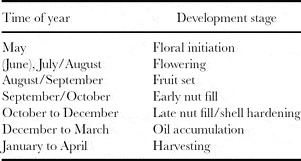
As an example, the sequence of nut development stages in Malawi (16 °S; altitude 600 m) is shown in Table 1. The rains last from November to May (Carr, Reference Carr1989).
The sequence of nut development stages in Malawi (16 °S; altitude 600 m).

In a preliminary study in Queensland, a linear relationship between nut yield per tree and the surface area of the leaf canopy was established (sample size: 39 trees; r = 0.90) (Bell and Bell, Reference Bell, Bell, Stephenson and Gallagher1983; Russell, Reference Russell1985).
In South Africa, Allan (Reference Allan1972, Reference Allan, Stephenson and Gallagher1983) used thermal time or day-degrees, summed above a mean daily base air temperature of 12.8 °C, to identify regions suitable for macadamia production. He compared the seasonal (and growth stage) totals with those calculated for the areas of the world where macadamia originated and/or is successfully grown, namely Australia (NSW, 2400 °C day and Queensland, 2900 °C day), Hawai'i (Kona, 2700 °C day and Kau, 3400 °C day) and Malawi (Naming'omba, 2800 °C day and Bvumbe 2400 °C day). This method of calculating day-degrees does not allow for the adverse effects of excessively high temperatures (say, >25 °C). It is not known if this approach to the siting of macadamia orchards is widely used.
Roots
Whole tree excavations, root core sampling and mini-rhizotrons were used by Firth et al. (Reference Firth, Whalley and Johns2003) to quantify, in a very detailed study, the distribution and density of the root systems of macadamia trees at two sites in New South Wales. They described the root systems as being ‘relatively shallow and spreading’. Grafted 12-year-old orchard trees [cv. Keauhou (HAES 246) on M. tetraphylla rootstock] had a truncated taproot (only 0.6 m in length, probably due to damage when transplanted) with the lateral root framework and most of the fibrous roots all found within 0.40 m of the soil surface. By contrast, the taproot of seven-year-old, ungrafted M. tetraphylla seedlings was 1.2 m long with branches at depth. The density of fibrous roots, which were ‘hardened and non-fleshy’, declined with depth and with distance from the trunk [for example, from 5.0 (±0.43) cm cm−3 at 0–10 cm depth to 1.7 (±0.45) cm cm−3 at 10–20 cm depth at 0.5 m from the trunk, and from 2.3 to 1.1 cm cm−3 respectively at 1.0 m distance]. These values were similar to those obtained in earlier work in the same study area. Roots grew predominantly in the autumn but new fibrous roots were produced in early winter and in the spring.
Dense clusters of rootlets, called proteoid or cluster roots, increase the surface area of the root system, enhancing nutrient and water absorption (Stephenson and Trochoulias, Reference Stephenson, Trochoulias, Schaffer and Andersen1994). At the same two sites in New South Wales, proteoid roots were observed at 0.40 m depth (the limit of measurement) and appeared to retain their function for more than a year, even in relatively dry conditions. The presence of an established legume groundcover was associated with a higher proteoid root length density than that recorded under bare soil (Firth et al., Reference Firth, Whalley and Johns2003).
In Australia, large 15-year-old trees had roots extending to depths of at least 1.60 m in a deep sandy soil, whilst medium-sized trees had an effective root depth of 0.8–1.0 m in a clay loam (Newett, Reference Newett, Trochoulias and Skinner1988). In Queensland, Stephenson et al. (Reference Stephenson, Gallagher and Doogan2003) found that roots accounted for 28% of the total tree biomass of both stressed and unstressed trees [cv. Keauhou (HAES 246)].
Summary: crop development
1. Vegetative growth occurs in a series of flushes.
2. Variation of light intensity within a leaf canopy can lead to uneven distribution of the fruit: 50% of flowers are produced in areas of the canopy exposed to only 9% of full sunlight.
3. Mild water stress suppresses vegetative growth but after re-watering a large flush can compensate for any previous loss.
4. Daytime temperatures in excess of about 30 °C can be damaging. The minimum mean air temperature for growth is about 12–13 °C; the optimum air temperature is about 25 °C.
5. Less is known about the response of macadamia trees to atmospheric humidity (saturation deficit): no threshold value has been specified.
6. Floral initiation occurs in late autumn (but has been observed to occur earlier than this), with flowering in the following spring.
7. Depending on location, there can be up to three discernible flowering peaks.
8. Although a single tree can produce more than 10 000 inflorescences, only 5–10% of the flowers may set fruit, with as few as 0.3% reaching maturity.
9. The root system is ‘relatively shallow and spreading’. An undamaged taproot can extend to a depth of >1.2 m whilst a dense mat of fibrous roots occupies the top 0.40 m of soil.
10. Clusters of rootlets, known as proteoid roots, increase the surface area of the root system.
11. Roots can represent 28% of the total plant biomass.
PLANT–WATER RELATIONS
Stomata are found only on the abaxial (lower) surface of the leaf, at densities of 360–500 mm−2. The xeromorphic leaves have sclerified bundle sheath tissues, which are an adaptation for locations where there is periodic drought. The leaves do not have a wax coating and there is no pubescence (Stephenson et al., Reference Stephenson, Ko and Gallagher1989; Stephenson and Trochoulias, Reference Stephenson, Trochoulias, Schaffer and Andersen1994).
Diurnal changes in stomatal conductance and leaf water potential (ΨL) were monitored by Lloyd et al. (Reference Lloyd, Trochoulias and Ensbey1991) in irrigated and unirrigated macadamia trees in New South Wales. Conductance was low early in the morning, and reached a peak by 1200 h before declining during the afternoon. On a second occasion, when leaf temperatures reached 30 °C, partial stomatal closure was observed during the middle of the day, followed by reopening, and then progressive closure from 1600 h onwards. On the first occasion, minimum ΨL values were reached by 1000 h and by 0800 h on the second occasion (about −1.1 MPa in irrigated trees and −1.2 MPa for unirrigated trees). After 0800 h, ΨL remained relatively constant in both treatments until 1600 h, before increasing.
By contrast, in a lysimeter-based study in Queensland, stomatal conductances declined progressively from high values at 0800 h to low values at 1500 h, in both stressed and frequently irrigated trees [cv. Keauhou (HAES 246)], before recovering. This diurnal pattern was matched by changes in rates of photosynthesis. In well-watered trees, ΨL reached minimum values of −1.1 MPa but declined to −1.5 MPa in water-stressed trees. During the day, ambient air temperatures and saturation deficits increased from 15 to 18.5 °C and from 0.2 to 1.0 kPa, respectively (Stephenson et al., Reference Stephenson, Gallagher and Doogan2003).
In a series of glasshouse experiments in Queensland with young potted trees under controlled conditions (day/night temperatures 28/21 °C; daytime saturation deficit of the air 0.85 kPa), Stephenson et al. (Reference Stephenson, Ko, Gallagher, Stephenson and Gallagher1983, Reference Stephenson, Ko and Gallagher1989) and Stephenson and Gallagher (Reference Stephenson and Gallagher1990) attempted to quantify the responses of three cultivars [Keauhou (HAES 246), Kau (HAES 344) and Keaau (HAES 660)] to water stress. Virtually complete stomatal closure occurred at a ΨL of about −1.8 to −2 MPa, which corresponded to a relative water content of 86%. Xero turgor occurred when ΨL reached −3.8 MPa, whilst mature leaves were permanently damaged at −5.0 MPa. Soft young leaves wilted at ΨL = −2.4 MPa. Stomatal closure helped to maintain a favourable plant–water status. The rapid rate of stress development, which is an unavoidable component of pot-grown trees, meant that there was no time for osmotic adjustment.
Field measurements taken over a dry season in New South Wales showed how stomatal conductance in unirrigated trees only began to decline, relative to irrigated trees, about three weeks after the rains had ended (Lloyd et al., Reference Lloyd, Trochoulias and Ensbey1991). Subsequently, it took about 30 days after the rains began for these values to return to those of the well-watered trees. By contrast, daytime ΨL remained the same for about eight weeks after the rains had ended and as the soil dried, before declining, but it recovered very quickly when the rains recommenced.
As part of the same project, Lloyd (Reference Lloyd1991), using data obtained under controlled laboratory conditions, developed a model to describe the changes in stomatal conductance and gas exchange of leaves of M. integrifolia that occur in response to changes in ambient weather conditions. According to this model, for a given temperature, the stomatal conductance declined exponentially as the dryness of the air increased (conductance was proportional to the inverse of the square root of the saturation deficit of the air). For a given irradiance level, conductance increased linearly with leaf temperature up to 30 °C and then declined. There was a very good linear relationship (r 2 = 0.87) between the conductance predicted by the model and 17 sets of field measurements taken over three days on five- to six-year-old irrigated trees. Incorporating leaf water potential measurements failed to improve the precision of the estimate (Lloyd et al., Reference Lloyd, Trochoulias and Ensbey1991). There was however a strong relationship between ΨL and the instantaneous transpiration rate. As a consequence, having used the model to estimate the stomatal conductance, Lloyd et al. (Reference Lloyd, Trochoulias and Ensbey1991) developed an equation to predict the leaf water potential.
The hydraulic conductivity of the whole tree could then be calculated. Its value was found to be much higher than those reported for other horticultural tree crops. As stomatal closure also occurred without concurrent changes in ΨL, Lloyd et al. (Reference Lloyd, Trochoulias and Ensbey1991) argued that both these attributes would give the macadamia tree a competitive advantage in its native habitat. In addition, a high pre-dawn leaf water potential, even after four months without rain, suggested an efficient system for extracting water from the soil and its transfer through the root. All these processes could help to explain the apparent tolerance of macadamia to periodic dry conditions.
Photosynthesis in macadamia is depressed at high air temperatures (30–35 °C). For example, measurements reported by Huett (Reference Huett2004) showed how on a sunny day in New South Wales photosynthesis (and stomatal conductance) declined when the leaf temperature exceeded 36 °C and virtually ceased at 41 °C. The ambient air temperature was 32.5 °C.
In South Africa, intermittent sprinkling of macadamia alleviated heat stress through evaporative cooling of the leaf surface (by 5–8 °C) in hot environments (>30 °C), increased ΨL and, for sun-exposed leaves, reduced stomatal conductances. Stem circumference and tree height were both increased despite problems with the sprinkler control system, which prevented a season of treatments from being completed (Allan, Reference Allan, Stephenson and Gallagher1983; Allan et al., Reference Allan, van Vloten and Savage1982; Stephenson and Trochoulias, Reference Stephenson, Trochoulias, Schaffer and Andersen1994). Improvements in the control system, and further examples of the effect of leaf cooling on macadamia (a greater proportion of grade 1 kernels), were subsequently reported by Allan et al. (Reference Allan, Cullis, Savage and Lightbody1994).
Summary: plant–water relations
1. Stomata only occur on the abaxial leaf surface.
2. Diurnal changes in stomatal conductance are matched by changes in rates of photosynthesis.
3. Stomatal closure occurs without concurrent changes in leaf water potential.
4. Full stomatal closure occurs at a leaf water potential of about −1.8 to −2.0 MPa.
5. Photosynthesis is depressed at air temperatures >30 °C.
6. Macadamia has several physiological and morphological attributes that help to explain its apparent tolerance to periodic dry conditions, as found in its native habitat.
CROP WATER REQUIREMENTS
According to Stephenson and Trochoulias (Reference Stephenson, Trochoulias, Schaffer and Andersen1994), drought often limits tree growth, as well as the set, retention, growth and quality of the nuts. The flowering and oil accumulation stages are particularly sensitive to water stress. Yields tend to be enhanced by irrigation in areas where relatively dry periods coincide with flowering and early nut development stages. However, as yield responses to irrigation are inconsistent, it is difficult to find published reports of experiments (with the exception of one by Stephenson et al., Reference Stephenson, Gallagher and Doogan2003), to support these views.
The minimum annual rainfall for successful macadamia production is considered to be about 1000 mm, although high yields in Hawai'i were correlated with well-distributed rainfall often exceeding 2000 mm (Stephenson and Trochoulias, Reference Stephenson, Trochoulias, Schaffer and Andersen1994, citing others). There is only one example of measurements of the actual water use (ET) of macadamia, which was undertaken in Queensland and described by Stephenson et al. (Reference Stephenson, Gallagher and Doogan2003).
Large drainage lysimeters, measuring 3 m in diameter by 1.6 m deep, were used to monitor ET over a 12-year period from transplanting in 1983–1995. The trees [cv. Keauhou (HAES 246)], grown from cuttings to reduce genetic variability, were irrigated frequently until 1989, two years after coming into production, after which differential watering treatments were imposed (these are described below). Initially there were 24 lysimeters (some had to be excluded during the course of the experiment), each with one tree. The soil was described as sandy. Observations indicated that the growth of the trees, including roots, in the lysimeters was ‘normal’.
Over a season, ET averaged 75 l tree−1 day−1 (ranging between 52 l tree−1 day−1 in the winter up to 80 l tree−1 day−1 in the summer). In water-stressed trees, water was extracted from soil depths >1.3 m, the limit of measurement, compared with 0.70 m for the unstressed (frequently irrigated) trees.
Summary: crop water requirements
1. Few attempts to measure the water use of macadamia trees have been reported.
2. In Nambour, Queensland, the best estimates of daily ET rates are between 52 l tree−1 (winter) and 80 l tree−1 (summer).
3. Water is extracted from depths of >1.3 m.
WATER PRODUCTIVITY
In Malawi, where there is an annual five-month-long dry season, Hancock and Banda (Reference Hancock and Banda1991) commented on the difficulty and cost of macadamia irrigation experiments when the outcomes are often inconclusive. Whilst recognising that irrigation is necessary in the first few years after planting, they advocated for mature trees an analytical approach, using climatic and soils data, to assess the likely need for irrigation. For this purpose, they recommended, where weather data are incomplete, the Blaney–Criddle equation to estimate ETo, a crop factor (Kc) = 0.65, 75% confidence limits for ET and rainfall (based on a minimum of 10 years of weather data), an effective rooting depth of 1.5 m, and easily available water equivalent to 75% of the total available water. They concluded that at sites in Malawi with an annual rainfall of over 1200 mm, at an altitude greater than 600 m, and with deep soils, irrigation of macadamia was unlikely to be justified. This work also indicated that a four-month-long dry season did not have a detrimental effect on yield. However, as the altitude decreased, with a corresponding increase in temperature, and as the length of the dry season increased, the impact of water stress was seen in premature shell hardening, leading to an increase in small nuts (variety 660) and leaf discolouration in some clones (508 and 333).
The cyclical and highly variable nature of macadamia yields [especially cv. Kau (HAES 344)] makes it difficult to establish cause and effect, and to quantify yield responses to water. According to Huett (Reference Huett2004), a minimum of five years is needed to demonstrate a response, even in well-designed and well-managed field experiments. Huett (Reference Huett2004) was particularly critical of a two-year irrigation trial in Australia, which failed to include a rainfall-only control treatment (Searle and Lu, Reference Searle and Lu2002).
Only a few long-term experiments have been reported. In northern New South Wales (29 °S), an irrigation experiment (duration eight years) failed to show any consistent effects of irrigation on yields (Trochoulias, Reference Trochoulias, Trochoulias and Skinner1988b). Varying depths of water were applied to single tree plots (there were four replications) of 8- to 16-year-old trees [cv. Keauhou (HAES 246)] from 1979 to 1987. The soil was a deep free-draining clay loam with an estimated available water capacity of 150 mm m−1. Annual rainfall totals ranged between 1232 and 2283 mm. When evapotranspiration exceeded rainfall over a week, irrigation was applied with microsprinklers at five different rates (30 l h−1 up to 234 l h−1) from flowering (August) to harvest (May). In addition, there was an unirrigated control treatment. Potential evapotranspiration was calculated as 0.75 × E pan (screened USWB class A evaporation pan). A simple water balance was maintained from which the amount of water to apply was determined: two treatments received less water than needed, two received excess, and one was close to the expected optimum. Annual quantities applied varied from as little as 213 mm up to 770 mm, applied in 9–24 irrigation events.
After allowing for the initial size of each tree, irrigation was found to have no significant effect on tree size or on nut-in-shell yield (which had reached 35 kg tree−1 by 1987). As Huett (Reference Huett2004) has pointed out, the trees were grown at very low density (11 m × 11 m; 83 trees ha−1) and, by the end of the experiment, the crop cover was still only 37%. The roots probably extended beyond the limits of the crop canopy, thus increasing the volume of soil water available to each tree. Although irrigation reduced the individual nut-in-shell weight by up to 7%, the kernel weight as a percentage of this figure remained the same regardless of treatment (approximately 35%). Kernel quality as measured by the proportion of ‘floaters’ in tap water was slightly reduced by irrigation (3% fewer grade 1). Yields across all treatments averaged 900 g m−2 of leaf canopy (a measure of efficiency). The weather conditions experienced over the eight years were considered to be representative of long-term expectations. As a result of these findings, irrigation of macadamia was not recommended at this location (Trochoulias, Reference Trochoulias, Trochoulias and Skinner1988b; Trochoulias and Johns, Reference Trochoulias and Johns1992). Further north in the Gympie and Bundaberg regions of Queensland, Australia, where it is less wet but warmer, irrigation is needed to support productivity (Wayne Hancock, personal communication). Irrigation is also needed in new macadamia growing areas like Emerald in Central Queensland (R. A. Stephenson, personal communication).
In the lysimeter-based study in Queensland reported by Stephenson et al. (Reference Stephenson, Gallagher and Doogan2003), and referred to above, water was withheld until the leaf water potential (pre-dawn) declined from −1.5 to −2.0 MPa at various growth stages. This value was maintained by partial water replenishment at two-day intervals. Yield responses to the stress treatments were variable from year to year (1991–1995). In one year, some of the stressed treatments gave yields more than or similar to the well-irrigated control treatment. When totalled over the five years, yields from trees stressed during floral development and, in particular, during the premature nut drop and nut maturation stages, tended to be lower (approximately 40–53 kg tree−1) than the control treatment (approximately 73 kg tree−1). With the exception of one year, stress during floral initiation had no effect on yield. Larger yields were generally, but not entirely, related to higher nut numbers. Water stress during the nut maturation stage, in particular, reduced the quality (kernel recovery) of the nuts. Reduced rates of photosynthesis at this time coincided with the critical oil accumulation stage.
Yield forecasting
In Hawai'i, Yamaguchi (Reference Yamaguchi and Nagao2005) developed three linear crop models to predict yields at two contrasting sites. These were based on adjusted rainfall totals over selected time periods linked to growth stages, crop age and degree-days. Yield estimates were reasonable, but the models failed to account for the influence of extreme events such as flooding and poor pollination due to excess rain during the flowering stage.
In Queensland, researchers are developing a crop forecasting system for the Australian macadamia industry (Stephenson, Reference Stephenson2010). It is based on two approaches. First, long-term tree census data are used to forecast yields over a 10-year period. Second, using weather data for the preceding year, the most likely average annual yield in the current year is predicted. Over the first eight years of forecasting, annual estimates were within about 10% of the actual national nut production.
Salinity
According to Bittenbender and Hue (Reference Bittenbender and Hue1990), there are many areas in Hawai'i with the potential for growing macadamia, but which lack sufficient rainfall. Groundwater in these places is generally brackish due to sea water intrusion. An experiment to determine the response of young macadamia trees (cv. Kau, HAES 344) to salinity under irrigated field conditions was undertaken. The treatments were rainfall only, together with irrigation using freshwater or, to simulate the ground water conditions, with salt contents of 500 and 1200 ppm (diluted sea water). The trees were irrigated twice weekly to replace water lost by ET (based on a USWB class A pan) during the previous week. There was no leaching fraction. After five years, yields from the three irrigated treatments were similar, as were trunk diameters and soil and tissue nutrient contents. Trees in the rain-only treatment yielded less than those that were well irrigated.
Although adverse effects of salinity have been noted in the field, there are few data to indicate critical levels (Stephenson and Trochoulias, Reference Stephenson, Trochoulias, Schaffer and Andersen1994). The results of the experiments in Hawai'i suggested that macadamia seedlings are moderately sensitive to soil salinity (Hue and McCall, Reference Hue and McCall1989). A reduction in growth rates of 50% occurred at an electrical conductivity of the extract (ECe) of 5 dS m−1. In New South Wales, Quinlan and Wilk (Reference Quinlan and Wilk2005) recommend using irrigation water with a salinity level below 1.2 dS m−1.
Summary: water productivity
1. Macadamia yields are cyclical and highly variable, making it difficult to establish cause and effect.
2. Most irrigation experiments have been poorly planned and/or inconclusive.
3. Yields tend to be reduced more if water stress occurs during the premature nut drop and nut maturation stages of growth than at other times.
4. There are no recommendations based on sound experimental evidence of where irrigation is likely to be worthwhile, or of the yield responses to be expected from water applied.
5. Macadamia is relatively resistant to drought. Drought/high temperatures may influence yields in the following season (yet to be proved).
6. Attempts have been made to develop simple yield forecasting systems.
IRRIGATION SYSTEMS
Water management
Run-off is an important component of water management in macadamia orchards. In northern New South Wales, the macadamia industry has expanded rapidly on the north coast and now occupies over 7000 ha of land. Most of the orchards are located on red basaltic (Krasnozem) soil, in high-rainfall (over 1400 mm year−1) areas (Quinlan and Wilk, Reference Quinlan and Wilk2005). Where there is bare soil, water flowing down the macadamia tree trunk (known as stem-flow) has been shown to contribute to soil erosion at the base of the tree with up to 28% of a rainfall event (by volume) being redistributed in this way. The average stem-flow over the 16-month monitoring period was 7% (Keen et al., Reference Keen, Cox, Morris and Dalby2010).
Appropriate soil management practices are essential to protect the orchard from erosion. Traditionally, a grass sward is left between rows, and a bare soil strip is maintained along the tree row by regular use of herbicides. This practice makes harvesting easier but contributes to soil loss and degradation in many orchards (Firth, Reference Firth2003).
In New South Wales, the creation of so-called mounded tree rows and associated drains that run directly downhill is recommended for run-off control in macadamia orchards (Firth, Reference Firth2003). It is necessary to ensure that there is groundcover in the inter-rows and drains. As the profile across the inter-row area is not pronounced, cultural operations with machinery are not affected. The other important component of run-off control is the retention of grassed watercourses of sufficient capacity to contain the run-off. Trees should not be planted in or immediately next to these areas. Run-off from the rest of the orchard can then be directed into these watercourses. Full details can be found in Firth (Reference Firth2003).
Irrigation
In both northern New South Wales and southern Queensland, irrigation is considered to be essential, despite the lack of experimental evidence, during the first four years after planting to supplement rainfall, beginning with 40 l tree−1 week−1 in year 1. However, where the annual rainfall exceeds 1300 mm, irrigation of more mature trees normally has no net yield benefit, an increase in nut number being balanced by a reduction in nut size (Quinlan and Wilk, Reference Quinlan and Wilk2005).
In Hawai'i, irrigation of mature macadamia trees is only practised in areas with less than 1250 mm of annual rainfall (Trochoulias, Reference Trochoulias1988a). For comparison, macadamia orchards in Queensland are generally irrigated in areas where the average annual rainfall is 1140 mm, for example in the Bundaberg region. By contrast, in northern New South Wales, where the annual rainfall averages 1600 mm, most of the orchards are rain-fed. Indeed, adverse effects of irrigation have been observed there (Hardner et al., Reference Hardner, Wilkie and McConchie2004). Nevertheless, yields still fluctuate less in the irrigated areas of Bundaberg than they do in these rain-fed orchards.
The following guidelines for irrigators in Australia have been proposed by Stephenson (Reference Stephenson, Bose and Mitra1990):
• To aid tree establishment apply 20–30 l tree−1 twice a week for the first two months.
• During the remainder of the first year irrigate weekly, unless rain occurs.
• Apply up to 130–150 l tree−1 each week in the summer and 30–40 l tree−1 in the winter.
• In each successive year, up to year 10, increase the maximum weekly rate by these amounts, so that in year 5 a maximum of 750 l tree−1 week−1 is applied in mid-summer and by year10, 1500 l tree−1 week−1.
These figures were intended to act as a guide only and should be adjusted to meet local conditions, including tree size and spacing, which can be vary between 10 m × 10 m (100 trees ha−1) and 7 m × 4 m (357 trees ha−1). Unfortunately, the planting density to which these guidelines apply was not specified.
Both drip and microsprinklers are suitable methods for applying water to macadamia trees. There may be practical benefits from keeping the microsprinklers and dripper lines away from the ground, in order to avoid the risks of damage during weed control and at harvest. Drip irrigation was first used in mature macadamia orchards in Hawai'i in 1975, and in new plantings in 1979. By 1985, 1800 ha were being irrigated by this method (Young, Reference Young1985). The current area irrigated in this way is not known.
Summary: irrigation systems
1. Run-off is an important component of water management in macadamia orchards, and must be controlled.
2. Irrigation is considered to be desirable, despite the lack of experimental evidence, during the first four years after planting.
3. Irrigation of mature trees is practised in areas where the average annual rainfall is less than 1300 mm.
4. Guidelines are available for macadamia producers on the quantity of water and the frequency of its application, but these have to be interpreted for local conditions.
5. Both drip and microsprinklers are suitable methods for applying water to macadamia trees.
CONCLUSIONS
Macadamia is unusual in that it is a crop where the centre of production is very close to its centre of origin in south-east Queensland and north-east New South Wales. It is also in Australia where most of the research on the physiology of macadamia has been undertaken, following earlier work in Hawai'i. The focus for much of this research has been to understand how temperature affects growth and development, particularly the impact of high temperature on the development and retention of the nut. Research has also been directed at how to manage a large self-shading tree so as to make best use of light, and to minimise premature nut shedding. Research is clearly made more difficult by the cyclical and highly variable nature of macadamia yields. It is not easy to establish cause and effect, especially as it takes about 12 months from floral initiation to the completion of nut harvest. Clearly, macadamia has many attributes that make it tolerant of long dry seasons. This also means that mature trees appear to be unresponsive to supplementary irrigation in the areas where it has been evaluated. With a minimum of five years needed to demonstrate a yield response, it is questionable whether the experiments that have been reported have been sufficiently robust to answer the questions posed, namely where and when is irrigation justified, and what is the minimum quantity of water needed. It is difficult to convince sponsors to fund such lengthy research projects of that duration for a specialist (minor) crop, especially when the benefits are uncertain. However, this is what is needed for macadamia if the potential of the crop is to be fully exploited.
Acknowledgments
Dr Russ Stephenson and Dr Rob Lockwood kindly provided copies of papers, and Dr Wayne Hancock commented on a draft of this paper. An anonymous referee was particularly helpful. I thank them all.