Introduction
Epidemiological data indicate that metabolic syndrome is associated with increased mortality from cardiovascular diseases by 30–400%, depending on the metabolic syndrome definition adopted, the population studied and the type of study.Reference Kahn, Buse, Ferrannini and Stern 1 It is estimated that around 25–29% of adults and 50–60% of the population above 60 years of age have metabolic syndrome in the United States. In the year 2000, nearly 47 million residents of this country had metabolic syndrome.Reference Ford, Giles and Dietz 2 The prevalence of metabolic syndrome, in the developing countries, varies from 13% in China to 30% in Iran.Reference Mohan and Deepa 3 In these countries, the prevalence of metabolic syndrome has increased, especially with the progressive increase in the number of overweight and obese adolescents.Reference Gupta, Shah, Nayyar and Misra 4 It is estimated that the prevalence of metabolic syndrome in the worldwide adult population is 20–25%, and compared with people without the syndrome they are twice as likely to die from and three times as likely to have a stroke or heart attack. 5
The excessive intake of fructose in modern diets has stimulated the interest of researchers in the field of health. Clinical and epidemiological evidence suggests that there is a positive correlation between the consumption of fructose, which is commonly used as a sweetener in soft drinks and other processed foods, and the development of metabolic syndrome,Reference Elliott, Keim, Stern, Teff and Havel 6 – Reference Nakagawa, Tuttle, Short and Johnson 8 especially due to alterations in the lipid profile. The HFCS (high fructose corn syrup) is one of the fructose sources that is most commonly used by American industries. The HFCS contains between 55 and 90% fructose and its consumption has increased by 1000% between 1970 and 1990.Reference Basciano, Federico and Khosrow 9 In addition, soft drinks are introduced to the diet of children from an early age.
Thus, markers of metabolic syndrome were triggered in immature and adult rodents fed a fructose-rich diet. These markers included hypertriglyceridemia, hyperinsulinemia, insulin resistance and hypertension.Reference Hwang, Ho, Hoffman and Reaven 10 – Reference Ghezzi, Cambri, Ribeiro, Botezelli and Mello 15 Furthermore, other studies found that aging is an isolated determinant of the development of markers of metabolic syndrome in rats.Reference Ghezzi, Cambri, Ribeiro, Botezelli and Mello 16
Recently, Cambri et al. Reference Cambri, Ghezzi, Ribeiro, Dalia and Mello 13 found that rats fed a fructose-rich diet since the neonatal period had impaired somatic growth, with a reduction in the weight of adipose tissue in some regions and in overall body weight gain. In addition, they observed elevated serum triglyceride and total cholesterol levels, which are indicators of the development of metabolic syndrome. In another previous experiment, Cambri et al.Reference Cambri, De Araujo, Ghezzi, Botezelli and Mello 14 showed that rats fed on a fructose-rich diet until young age (60-days old) presented the same changes in body weight and in lipid profile [total cholesterol and low density lipoprotein (LDL) cholesterol].
In addition, it has been shown that fructose transporter levels (Glut5) are very low during the suckling phase of rat development.Reference Douard and Ferraris 17 The ability to absorb fructose in early life significantly improves with age. Therefore, the significant effect of age on fructose malabsorption may represent the normal course of maturation of fructose transport in developing children.Reference Jones, Burt and Dowling 18 In these cases, restriction of fructose in the diet is advisable, which consequently reduces its adverse symptoms. However, apart from the studies from our laboratory,Reference Cambri, Ghezzi, Ribeiro, Dalia and Mello 13 , Reference Cambri, De Araujo, Ghezzi, Botezelli and Mello 14 there are no data on growth impairment in animals, probably because studies usually administer fructose-rich diets after weaningReference Girard, Madani and Boukortt 19 and in adulthoodReference Botezelli, Mora and Dalia 11 , Reference Botezelli, Cambri and Ghezzi 12 , Reference Jürgens, Haass and Castañeda 20 and not from the neonatal period as in our previous studies.Reference Cambri, Ghezzi, Ribeiro, Dalia and Mello 13 , Reference Cambri, De Araujo, Ghezzi, Botezelli and Mello 14 This lack reinforces the need for additional studies in this regard.
The alterations to the various markers of metabolic syndrome are associated with greater risks of developing type 2 diabetes, atherosclerosis and other cardiovascular diseases.Reference Reaven 21 , Reference Sanchez-Lozada, Tapia and Jimenez 22 Among the forms of treatment for metabolic syndrome and/or its markers are medicines, diet and regular physical exercises.
We hypothesized that a short-term standard diet ameliorates lipid profiles altered by fructose-rich diet in rats. Thus, the purpose of this research was to determine whether the administration of a standard diet in an experimental model using rats is able to reverse the lipid profile altered by a fructose-rich diet.
Method
Animals
Ten pregnant Wistar rats (90 days) and their pups were kept in a climate-controlled room (22±1°C) with a photoperiod of 12 h of light and 12 h of darkness, with lights on from 06:00 am to 6:00 pm and with free access to water and food during the entire experimental period. All the experimental procedures adopted for the animals were approved by the Ethics Committee on Animal Experimentation of the State University of Campinas (UNICAMP), under Protocol No. 1487-1.
Diets
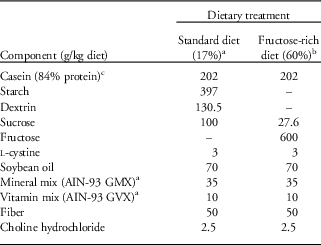
An isocaloric standard and a fructose-rich diet were used as per the compositions described in Table 1. The fructose-rich diet had the same macronutrients except for the carbohydrate composition, the starch and dextrin were replaced by fructose. The estimate of caloric content was based on the standard physiological fuel mean values for carbohydrates, proteins and fat of 4, 4 and 9 kcal, respectively. Therefore, the diets had ∼3.766 kcal/g, with 66.1% carbohydrates, 17.7% proteins and 16.2% lipids.
Dietary treatment

a According to the American Institute of Nutrition (AIN-93G).Reference Reeves, Nielsen and Fahey-JR 23 For detailed composition, see Reeves et al.Reference Reeves, Nielsen and Fahey-JR 23
b According to Cambri et al. Reference Cambri, Ghezzi, Ribeiro, Dalia and Mello 13
c Values corrected due to the amount of protein in the casein.
Experimental groups
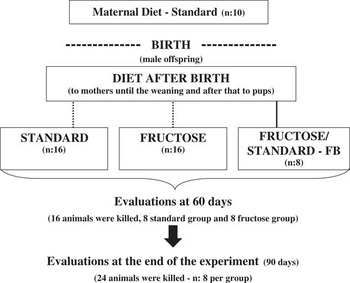
The male pups of mothers fed a standard diet during pregnancy were divided into three groups, immediately after birth, according to the diet adopted for 90 days of life. The experimental design is shown in Fig. 1. The litters were adjusted so that every mother fed only eight offspring. Therefore, the diet after birth was given to mothers until weaning (21 days after birth) and after that to the pups. Rats were maintained in collective plastic cages (five rats/cage). The three experimental groups were as follows:
-
(1) Standard: the mothers were fed a standard diet during lactation and the pups were fed the same after weaning until 90 days (n: 16).
-
(2) Fructose: the mothers were fed a fructose-rich diet during lactation and the pups were fed the same after weaning until 90 days (n: 16).
-
(3) Fructose/standard (FS): the mothers were fed a fructose-rich diet during lactation and the pups were fed the same after weaning until 60 days and a standard diet from 60 to 90 days (n: 8).
Experimental design.

All animals had their body weights recorded once a week from birth. With this data, the total body weight gain was calculated (body weight gain: final body weight−body weight at birth). In addition, the body weight gain in the recovery period was calculated (body weight gain: final body weight−body weight at 60 days).
Samples of biological material
On day 60 (16 animals, n: 8 standard group and n: 8 fructose group) and at the end of the experiment (90 days) (24 animals, n: 8 per group), the rats were killed by decapitation after euthanasia with CO2, 48 h after the last in vivo evaluation.
Blood was collected immediately after death for serum separation to analyze levels of glucose, triglycerides, total cholesterol, LDL cholesterol, high density lipoprotein (HDL) cholesterol, total protein and albumin through colorimetric enzymatic methods in a spectrophotometer after incubation at 37°C using specific commercial kits (Laborlab®, Guarulhos, São Paulo/Brazil) for each variable. In addition, the very low density lipoprotein (VLDL) was calculated from the equation VLDL=triglycerides/5.Reference Friedewald, Levy and Fredrickson 24
The regions of the epididymal, mesenteric, retroperitoneal and posterior subcutaneous adipose tissue were removed for weighing. Different adipose depots were excised according to the description by Cinti.Reference Cinti 25
Samples of the heart (200–250 mg) and liver (450–500 mg) were excised in order to determine lipid concentrations through the colorimetric method using a spectrophotometer.Reference Nogueira, Strufaldi, Hirata, Abdalla and Hirata 26 Samples of the heart (200–250 mg) were digested in 0.5 ml of KOH for 20 min. Subsequently, 20 µl saturated solution of Na2SO4 was added and glycogen was precipitated using two washes of 2.5 ml boiling ethanol followed by centrifugation. The colorimetric determination was carried out with the addition of 20 µl of phenol (80%) and 2.0 ml of sulfuric acid, after boiling for 15 min. The absorbance was measured in a spectrophotometer.Reference Dubois, Gilles, Hamilton and Rebers 27
Statistical analysis
The variables were subjected to normality test using the test of Shapiro–Wilk. All analyses were carried out with a statistical software package (SPSS, version 20.0) and data are presented as mean±standard deviation. For comparisons between animals on day 60, Student’s t-test was used for parametric data and the Mann–Whitney U test for nonparametric data. For comparisons between animals at the end of the experiment (90 days), one-way ANOVA was used for parametric data followed by the post-hoc Bonferroni test when necessary, and the Kruskal–Wallis test was used for nonparametric data followed by post-hoc Dunn’s test when necessary. The Pearson’s Correlation was used to correlate variables. A 5% (P<0.05) level of significance was accepted.
Results
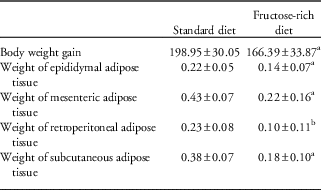
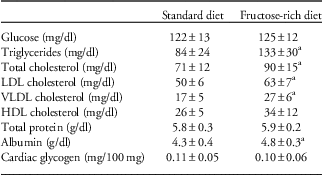
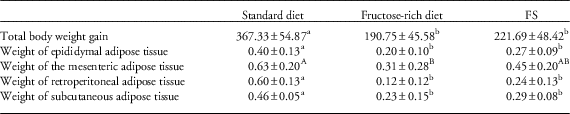
Rats fed a fructose-rich diet since the neonatal period up to 60 days of age had body weight gain, and the weight of adipose tissues in the epididymal, mesenteric, retroperitoneal and posterior subcutaneous regions reduced – P<0.05 (Table 2). In addition, the lipid profile (Table 3) was altered (P<0.05) by a fructose-rich diet from the neonatal period to 60 days, thus increasing the levels of triglycerides, total cholesterol as well as LDL cholesterol and VLDL cholesterol.
Body weight gain (g) and weight (mg/100 mg) of adipose tissue from different anatomical regions at 60 days

Results are expressed as mean±standard deviation of eight animals per group.
a Statistically significant difference by Student’s t-test for parametric data (P<0.05).
b Statistically significant difference by Mann–Whitney U test for nonparametric data (P<0.05).
Serum and tissue variables on day 60

LDL, low density lipoprotein; VLDL, very low density lipoprotein; HDL, high density lipoprotein.
Results are expressed as mean±standard deviation of eight animals per group.
a Statistically significant difference according to Student’s t-test for parametric data (P<0.05).
The values of cardiac glycogen, regardless of the diet administered, were similar (P=0.81) at 60 days of age (Table 3).
A standard diet after the fructose-rich diet partially improved the total body weight gain, as the weight of the adipose tissues was higher in the FS diet animals than in animals fed a fructose-rich diet in all the regions analyzed (the epididymal mesenteric, retroperitoneal and posterior subcutaneous regions); however, the differences were not significant (Table 4). On other hand, when the body weight gain was calculated in the recovery period (body weight gain 60–90 days), there were significant differences among the three groups (standard: 155.45±33.57; fructose: −15.40±28.67; and FS: 54.48±63.54 g; P<0.05). In addition, it was observed that the FS group continued to gain body weight, whereas most rats fed the fructose-rich diet lost body weight. There were significant correlations (P<0.05) between body weight gain from 60 to 90 days and in the levels of triglycerides (r=−0.69), total cholesterol (r=−0.58) and VLDL (r=−0.69).
Body weight gain (g) and weight of adipose tissue (mg/100 mg) from different anatomical regions at the end of the experiment

Results are expressed as mean±standard deviation of eight animals per group.
FS: standard diet after fructose-rich diet.
Different letters indicate a significant difference among groups. One-way ANOVA and Bonferroni post-hoc for parametric data (P<0.05).
Different capital letters indicate a significant difference among groups. KrusKal–Wallis and Dunn’s test post-hoc for nonparametric data (P<0.05).
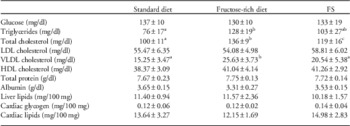
The fructose-rich diet resulted in high values and the FS diet resulted in moderate values compared with those of the control group (standard diet) with respect to lipid profiles. A standard diet administered after a fructose-rich diet was able to partially reverse alterations in lipid levels (Table 5), as total cholesterol was significantly different in all groups (P<0.05) and triglycerides and VLDL cholesterol levels were similar between the control group and the FS group, but the values were smaller compared with the group fed a fructose-rich diet (P<0.05).
Serum and tissue variables at the end of the experiment

LDL, low density lipoprotein; VLDL, very low density lipoprotein; HDL, high density lipoprotein.
Results are expressed as mean±standard deviation of eight animals per group.
FS: standard diet after fructose-rich diet.
Different letters indicate significant difference among groups. One-way ANOVA and Bonferroni post-hoc, for parametric data (P<0.05).
At the end of the experiment, the total protein (P=0.72), serum albumin (P=0.15), lipid concentrations of heart (P=0.13) and liver (P=0.18), as well as that of cardiac glycogen (P=0.41), were similar, regardless of the diet administered (Table 5).
Discussion
This research aimed to examine whether the administration of a short-term standard diet reduced the negative effects of a fructose-rich diet, which is associated with lipid profile alterations, in an experimental model using rats. As already mentioned, the prevalence of metabolic syndrome in adolescents in developing countries has increased enormously, with progressive increase in overweight and obese adolescents.Reference Gupta, Shah, Nayyar and Misra 4 Therefore, this study evaluated markers of metabolic syndrome in young animals, because even in humans there are few studies with this focus.
A fructose-rich diet from the neonatal period to 60 days of life reduced weight gain, as well as the weight of adipose tissue in the all regions examined (the epididymal, mesenteric, retroperitoneal and posterior subcutaneous regions). This reduced weight of adipose tissue and the consequent reduction in the rate of weight gain may be due to fructose intolerance, which itself is due to the excess of this nutrient in the diet when it was administered from the neonatal period onwards.Reference Douard and Ferraris 17 The physiological mechanism that explains this phenomenon is that Glut5 is expressed at very low levels in the suckling (0–14 days of age) and weaning (14–28 days) periods in neonatal rats. However, precocious introduction of fructose substantially improved Glut5 expression and activity before the weaning period was completed, but only after 14 days of age, showing developmental limits in regulation.Reference Douard, Choi, Elshenawy, Lagunoff and Ferraris 28 These data confirm previous results obtained by our research group with rats fed a fructose-rich diet since the fetalReference Cambri, Ghezzi, Ribeiro, Dalia and Mello 13 and neonatal periods up to 60Reference Cambri, De Araujo, Ghezzi, Botezelli and Mello 14 or 90 daysReference Cambri, Ghezzi, Ribeiro, Dalia and Mello 13 of age. It is important to emphasize that at 60 and 90 days of age (end of the experiment), it was observed that the animals with great impairment in weight gain had dilated intestines and stomach, which appeared to contain significant amount of gas. In addition, there were negative correlations between body weight gain from 60 to 90 days of age and serum triglycerides, total cholesterol and VLDL levels; thus, animals with greatly impaired weight gain in the recovery period had worse lipid profiles. For these reasons, the weight loss cannot be considered a positive effect.
In Glut5-knockout mice (Glut5−/−) fed a fructose-rich diet, massive dilatation of the intestinal tract was observed, and its contents appeared to contain both fluid and gas, consistent with severe malabsorption. Body weight and food intake were decreased in Glut5−/− mice fed a fructose-rich diet relative to Glut5+/+ mice. Therefore, along with malabsorption, another contributing factor for weight loss in Glut5−/− mice fed a high fructose diet was decreased food intake. However, Glut5+/+ mice fed a restricted fructose-rich diet did not develop bowel dilatation and did not display as much weight loss as Glut5−/− mice, indicating that the intestinal phenotype in Glut5−/− mice fed a fructose-rich diet was not due to reduced food intake.Reference Barone, Fussell and Singh 29 Many studies do not show changes in food intake in rats fed a fructose-rich diet.Reference Botezelli, Mora and Dalia 11 – Reference Cambri, Ghezzi, Ribeiro, Dalia and Mello 13 , Reference Ghezzi, Cambri, Ribeiro, Botezelli and Mello 15 , Reference Jürgens, Haass and Castañeda 20
Despite this, the total protein and serum albumin concentrations were not different among the groups, indicating that diets did not cause malnutrition. Therefore, removing fructose from the diet is necessary to reduce the damage it has caused. This was observed in the present study, because the weight gain was higher in the group that consumed a standard diet after a fructose-rich diet compared with the animals fed a fructose-rich diet throughout the study period.
No changes in serum glucose levels were found at either of the two measurement times of this experiment (60 or 90 days). The changes in the blood glucose levels due to excess of fructose are quite divergent in the literature; in many experiments, this variable did not change,Reference Botezelli, Mora and Dalia 11 , Reference Cambri, Ghezzi, Ribeiro, Dalia and Mello 13 , Reference Cambri, De Araujo, Ghezzi, Botezelli and Mello 14 , Reference Jürgens, Haass and Castañeda 20 , Reference Sanchez-Lozada, Tapia and Jimenez 22 , Reference Joyeux-Faure, Rossini, Ribuot and Faure 30 , Reference Roglans, Vila and Farré 31 whereas in some interventions it was higher.Reference Botezelli, Cambri and Ghezzi 12 , Reference Kelley, Allan and Azhar 32 , Reference Sharabi, Oron-Herman and Kamari 33 These differences may have occurred as a result of other factors such as different animal lineages, age and time of administration of the diet, as well as the interaction of these factors.
The lipid profile was altered in rats fed a fructose-rich diet since the neonatal period up to 60 days of life and continued to be altered in animals fed a fructose-rich diet until 90 days. It is known that fructose is more lipogenic than glucose;Reference Botezelli, Cambri and Ghezzi 12 , Reference Sanchez-Lozada, Tapia and Jimenez 22 therefore, its high intake is accepted as being responsible for the high levels of plasma lipids.Reference Hwang, Ho, Hoffman and Reaven 10 , Reference Botezelli, Cambri and Ghezzi 12 , Reference Cambri, Ghezzi, Ribeiro, Dalia and Mello 13 , Reference Girard, Madani and Boukortt 19 , Reference Kelley, Allan and Azhar 32 , Reference Rajasekar and Anuradha 34 In some of these researches, the triglyceride concentrations in the liver was also increased.Reference Hwang, Ho, Hoffman and Reaven 10 , Reference Douard and Ferraris 17 , Reference Kelley, Allan and Azhar 32 – Reference Rajasekar and Anuradha 34 Some mechanisms have been proposed to explain this event, among which are increased hepatic lipogenesisReference Botezelli, Cambri and Ghezzi 12 and high production of VLDL.Reference Gupta, Shah, Nayyar and Misra 4
Another possible cause for dyslipidemia is that fructose metabolism in the liver exceeds the regulatory step in glycolysis, catalyzed by the phosphofructokinase. Thus, fructose continuously enters the glycolytic pathway at the intermediate level during the synthesis of triglycerides, glyceraldehyde-3-phosphate and dihydroxyacetone phosphate.Reference Kelley, Allan and Azhar 32 , Reference Rajasekar and Anuradha 34 In contrast, the effects of fructose in the metabolism of cholesterol are contradictory: some studies showed an increase in total cholesterolReference Cambri, Ghezzi, Ribeiro, Dalia and Mello 13 , Reference Cambri, De Araujo, Ghezzi, Botezelli and Mello 14 , Reference Girard, Madani and Boukortt 19 , Reference Kelley, Allan and Azhar 32 while others did not.Reference Dhingra, Sullivan and Jacques 7 , Reference Botezelli, Cambri and Ghezzi 12 The difference between the previous studies and the present study results might be due to the different periods (between 2 and 13 weeks) during which the fructose-rich diet was administered.
The changes in serum triglyceride concentrations are the first and perhaps the main mechanism of hepatic steatosis induction and higher reactive oxidative species production.Reference Basciano, Federico and Khosrow 9 , Reference Botezelli, Mora and Dalia 11 , Reference Botezelli, Cambri and Ghezzi 12 Maintaining high levels of triglycerides in circulation can generate insulin resistance that may later develop into central obesity, dyslipidemia and type 2 diabetes.Reference Basciano, Federico and Khosrow 9 , Reference Botezelli, Mora and Dalia 11 Therefore, if our study was conducted for a long period of time, other metabolic disorders could be observed.
An increase in fructose consumption has coincided with the increasing prevalence of obesity and metabolic syndrome over the last few decades.Reference Elliott, Keim, Stern, Teff and Havel 6 This dietary pattern causes a stress response in the liver and other tissues, which respond with insulin resistance and dysregulation of lipid metabolism.Reference Botezelli, Cambri and Ghezzi 12 , Reference Barone, Fussell and Singh 29 Some studies show a direct relationship between the increased caloric intake from fructose and the worsening in the characteristics of metabolic syndrome.Reference Sanchez-Lozada, Tapia and Jimenez 22 Thus, the risk of developing type 2 diabetes, atherosclerosis and other cardiovascular diseases is higher with the increase in various components of the metabolic syndrome.Reference Reaven 21 , Reference Sanchez-Lozada, Tapia and Jimenez 22 In the present study, the standard diet was able to partially reverse changes to lipid levels caused by the fructose-rich diet: total cholesterol was significantly different in all the groups and triglycerides and VLDL levels were similar between the control group and the FS group. The fructose-rich diet was found to have higher values, and the FS diet was found to have moderate values. Perhaps, if the animals had been maintained on a standard diet for a longer period of time, the reversal of the situation would have been bigger (the rats fed the standard diet for only 30 days after 60 days of fructose-rich diet).
High concentrations of total cholesterol and LDL cholesterol are associated with an increased risk for cardiovascular disease, unlike the concentrations of HDL cholesterol, which acts as a protective factor against these diseases.Reference Williams 35 – Reference Krauss 37 LDL cholesterol is able to pass through the endothelial wall to penetrate the arterial wall and undergo oxidation in the intima thereof. The result is the development of cardiovascular diseases.Reference Dâmaso 38 In general, a 1% decrease in LDL cholesterol is associated with a 2–3% reduction in the risk of developing heart diseases.Reference Leon and Sanchez 39 Based on the results found and cited here, the experimental model used seems useful for the study of changes in the lipid profile, as well as the effects of changes in diet for the treatment of this condition. However, it should be noted that, in the present study, changes to the diet included only different proportions of complex carbohydrates (starch) and simple carbohydrates (fructose), because the diets were isocaloric, with equal amounts of protein, lipids, vitamins and salt minerals.
The standard diet used in the present study is recommended to rodents during the growth period (AIN93G) due to its higher energetic value. Therefore, if the diet was exchanged for the adult diet (AIN93) in a determined period – that is, 60 days – maybe different results would have been observed in all the groups. In addition, the animals were not maintained on a standard diet after a fructose-rich diet for the same amount of time as that of the fructose-rich diet, and this could have injured the reversal of parameters affected by the fructose-rich diet. Thus, these are some limitations of this study.
In summary, a fructose-rich diet administered in early life impairs somatic growth. In addition, a fructose-rich diet alters lipid profile, and a standard diet, in short term, partially improves the parameters affected.
Acknowledgments
The authors thank Eduardo Custódio and José Roberto R. Silva for technical assistance. All the authors read and agreed with the final format. This manuscript was edited by a native speaker.
Financial Support
This research was supported by the Coordenação de Aperfeiçoamento de Ensino Superior (CAPES), the Conselho Nacional de Desenvolvimento Científico e Tecnológico (CNPq) and the Fundação de Amparo a Pesquisa do Estado de São Paulo (FAPESP – Grant no. 08/53255-8).
Conflicts of Interest
None.
Ethical Standards
The authors assert that all procedures contributing to this work comply with the ethical standards of the relevant national guides on the care and use of rats and has been approved by the Ethics Committee on Animal Experimentation of the State University of Campinas (UNICAMP), Brazil, under Protocol No. 1487-1.