1 Introduction
Formation and evolution of localized nonlinear structures such as vortices and solitons play a crucial role in the physics of continuous media (Saffman Reference Saffman1993; Nettel Reference Nettel2009). For instance, drift wave dynamics in tokamak plasmas can be described within the framework of the Hasegawa–Mima (HM) equation (Hasegawa & Mima Reference Hasegawa and Mima1978), which has a well-known point-vortex solution. The vortices may affect energy and particle transport significantly (Nycander & Isichenko Reference Nycander and Isichenko1990; Hobson Reference Hobson1991; Kono & Horton Reference Kono and Horton1991; Krasheninnikov Reference Krasheninnikov2016; Zhang & Krasheninnikov Reference Zhang and Krasheninnikov2016). The formation of finite-radius relativistic electron vortex structures associated with quasistatic magnetic field generation provides one of the pathways for the electromagnetic field energy depletion in laser plasmas (Bulanov et al. Reference Bulanov, Lontano, Esirkepov, Pegoraro and Pukhov1996). The late stage of the vortex evolution resulting in strong plasma density modulations has been revealed in experiments (Romagnani et al. Reference Romagnani, Bigongiari, Kar, Bulanov, Cecchetti, Galimberti, Esirkepov, Jung, Liseykina and Macchi2010; Sylla et al. Reference Sylla, Flacco, Kahaly, Veltcheva, Lifschitz, Sanchez-Arriaga, Lefebvre and Malka2012) using proton radiography. Electron vortex pairs are also observed in simulations of relativistic shocks, being responsible for electron energization in the upstream region (Naseri et al. Reference Naseri, Bochkarev, Ruan, Bychenkov, Khudik and Shvets2018). Understanding the dynamics of vortex structures in plasmas is important for developing the theory of relativistic plasma turbulence (Bulanov et al. Reference Bulanov, Esirkepov, Lontano and Pegoraro1997; Kuvshinov & Schep Reference Kuvshinov and Schep2016). Relativistic electron vortex dynamics may also be a significant factor in the late stages of the relativistic Weibel-like instability (Califano, Pegoraro & Bulanov Reference Califano, Pegoraro and Bulanov1997), which can arise in superstrong laser–plasma interactions (Wei et al. Reference Wei, Beg, Clark, Dangor, Evans, Gopal, Ledingham, McKenna, Norreys and Tatarakis2004), as well as in colliding astrophysical flows of electron–positron plasmas (Kazimura et al. Reference Kazimura, Sakai, Neubert and Bulanov1998).
In contrast to hydrodynamical vortices, which are sustained by fluids comprised of neutral particles, vortices in plasmas are sustained by the rotational motion of charged particles, leading to a non-zero circular electric current, which forms a magnetic field inside the vortex (Lezhnin et al. Reference Lezhnin, Kamenets, Esirkepov, Bulanov, Gu, Weber and Korn2016). In the case of small radius vortices, which correspond to the point-vortex solution of the HM equation, the vortex internal energy is conserved during the interaction process. However, in the case of finite-radius vortices, we expect the finite-radius and electromagnetic interaction effects to become prominent, leading to a fast vortex energy dissipation with its transformation into the energy of fast particles. Below, using two-dimensional (2-D) particle-in-cell (PIC) simulations with the code REMP (Esirkepov Reference Esirkepov2001), we demonstrate how pairs of vortices interact beyond the point-vortex approximation. We reveal the effect of relativistic annihilation of the binary electron vortices’ magnetic field that leads to vortex pair dampening.
2 Simulation set-up
In order to consider an interaction of initially isolated stationary electron vortices, we take advantage of the well-known property of the finite-radius vortex motion in a medium with a density gradient – vortices in such a medium tend to drift with constant velocity perpendicular to the density gradient due to conservation of Ertel’s invariant (Ertel Reference Ertel1942), or due to conservation of a generalized magnetohydrodynamic version of Ertel’s invariant, Hide’s invariant (Hide Reference Hide1983; Pegoraro Reference Pegoraro2018). After initializing two stationary electron vortices far away from each other, their drift motion will slowly bring them close enough for interaction to happen.
The simulation parameters are as follows. For the clarity and reproducibility of our numerical simulations, we describe the simulation set-up in terms of an arbitrary spatial scale parameter,
 $\unicode[STIX]{x1D706}$
, and then immediately rescale the model to the physically relevant units. We set a slab of electron plasma (assuming immobile ions) with a constant density gradient along the
 $x$
axis, so the electron plasma density equals
 $n_{e}/n_{\text{max}}=0.1$
at
 $x=55\unicode[STIX]{x1D706}$
and
 $n_{e}/n_{\text{max}}=1$
at
 $x=95\unicode[STIX]{x1D706}$
, with width
 $40\unicode[STIX]{x1D706}$
and zero temperature for the electrons. We measure spatial parameters in
 $\unicode[STIX]{x1D706}$
, temporal – in
 $2\unicode[STIX]{x03C0}/\unicode[STIX]{x1D714}_{0}=\unicode[STIX]{x1D706}/c$
, densities – in
 $n_{0}=m_{e}\unicode[STIX]{x1D714}_{0}^{2}/4\unicode[STIX]{x03C0}e^{2}$
, electromagnetic fields – in
 $E_{0}=m_{e}\unicode[STIX]{x1D714}_{0}c/e$
, where
 $m_{e}$
is electron mass,
 $e$
is the absolute value of electron charge,
 $c$
is the speed of light in a vacuum. For the sake of simplicity, we introduce circularly symmetric electron vortices. They are initiated by accumulating the localized magnetic field during a number of time steps at the beginning of the simulation (Bulanov et al.
Reference Bulanov, Esirkepov, Kamenets and Pegoraro2006; Lezhnin et al.
Reference Lezhnin, Kamenets, Esirkepov, Bulanov, Gu, Weber and Korn2016). For the simulations presented, electron vortices are formed with various maximum magnetic fields:
 $B_{\text{max}}=0.5,1,2,4,6.5,35$
in plasmas with
 $n_{\text{max}}=0.16,0.36,0.64,1,4,16$
, respectively. Hereafter, we will refer to the simulation parameters by the magnetic field amplitude
 $B_{\text{max}}$
. The vortex centres are located around points
 $x=75\unicode[STIX]{x1D706}$
and
 $y=-4\unicode[STIX]{x1D706},4\unicode[STIX]{x1D706}$
. We choose our parameters in such a way that the condition
 $\unicode[STIX]{x1D714}_{\text{pe}}^{2}\ll \unicode[STIX]{x1D714}_{B}^{2}$
holds (Gordeev Reference Gordeev2010), so the electrons can be considered magnetized. Here
 $\unicode[STIX]{x1D714}_{\text{pe}}^{2}=4\unicode[STIX]{x03C0}n_{e}e^{2}/m_{e}$
is the plasma frequency and
 $\unicode[STIX]{x1D714}_{B}=eB/m_{e}c$
is the electron gyrofrequency. The computational grid is
 $150\unicode[STIX]{x1D706}\times 120\unicode[STIX]{x1D706}$
with 32 nodes per
 $\unicode[STIX]{x1D706}$
, and the boundary conditions are periodic. We have also qualitatively verified the results of our simulations with a larger domain resolution (64 and 128 nodes per
 $\unicode[STIX]{x1D706}$
). The initial particle-in-cell number corresponding to the maximum electron density is equal to 100. The total number of particles is approximately
 $10^{8}$
. The integration time step is 0.0155. The total time of the simulations is 500 time units. We have also verified our results for similar simulation parameters with the code EPOCH (Ridgers et al.
Reference Ridgers, Kirk, Duclous, Blackburn, Brady, Bennett, Arber and Bell2014).
For the sake of clarity, we further rescale our numerical model to physically relevant units appearing from the simple electron vortex model. It can be formulated as follows. Let us assume that the electron moves in a circular orbit around the uniformly distributed immobile and positively charged ions. Then, the electric field experienced by the electron is
 $E=2\unicode[STIX]{x03C0}enR$
, where
 $R$
is the radius of the electron vortex and
 $n$
is the ion density. Assuming the electron to have a speed
 $v_{e}\approx v_{E\times B}=cE\times B/B^{2}\sim c$
, yields
 $B\sim E=2\unicode[STIX]{x03C0}enR$
. Radial force balance for the electron can be written as
 $v_{e}p_{e}/R=-eE$
, which gives an expression connecting the electron vortex radius and electron momentum,
 $R=(p_{e}c/2\unicode[STIX]{x03C0}ne^{2})^{1/2}\approx d_{e}\sqrt{2\unicode[STIX]{x1D6FE}_{e}}$
. Thus, we fix
 $\unicode[STIX]{x1D706}=(4\unicode[STIX]{x03C0}^{2}n_{\text{max}}/n_{0}\cdot m_{e}c/p_{e})^{1/2}R$
, normalizing all spatial quantities by
 $R$
, temporal frequencies by crossing frequency
 $\unicode[STIX]{x1D714}_{cr}=c/R$
, fields by
 $E_{0}^{\prime }=m_{e}\unicode[STIX]{x1D714}_{cr}c/e$
, densities by
 $n_{0}^{\prime }=m_{e}\unicode[STIX]{x1D714}_{cr}^{2}/4\unicode[STIX]{x03C0}e^{2}$
. It is also worth noting that the vortex size in terms of local electron skin depth,
 $R/d_{e}$
, in our simulations is proportional to
 $B_{\text{max}}/n_{\text{max}}^{1/2}$
, so larger
 $B_{\text{max}}$
correspond to larger vortices with respect to
 $d_{e}$
.
3 PIC simulation results and theoretical estimates
In our simulations, we expect to observe the following scenario: first, when two vortices are far away from each other (
 ${>}5R$
), they would be stationary unless we were to take into account the effects of a finite vortex radius. In the latter case, we can expect that the vortices will move perpendicularly to the density gradient (parallel to the
 $y$
-axis), due to the conservation of Ertel’s invariant
 $I=\unicode[STIX]{x1D6FA}/n$
, where
 $\unicode[STIX]{x1D6FA}$
is the vorticity and
 $n$
is the plasma density (Ertel Reference Ertel1942). The velocity of such motion is estimated as
 $\unicode[STIX]{x1D6FA}R^{2}|\unicode[STIX]{x1D735}n/n|$
, which is
 $\lessapprox c/80$
and has turned out to be fairly consistent with the simulation results presented below. On the other hand, Hide’s invariant,
 $I_{\text{H}}=B/n$
, will lead to the following drift velocity:
 $\unicode[STIX]{x1D714}_{B}R^{2}|\unicode[STIX]{x1D735}n/n|$
. Comparison of the electron gyrofrequency with the electron vorticity in the case of a relativistic plasma will give
 $|\unicode[STIX]{x1D714}_{B}|/|\unicode[STIX]{x1D6FA}|=\unicode[STIX]{x1D714}_{B}/|\unicode[STIX]{x1D735}\times p_{e}/m_{e}|\approx \unicode[STIX]{x1D714}_{B}/|\unicode[STIX]{x1D735}\times c\unicode[STIX]{x1D6FD}_{e}\unicode[STIX]{x1D6FE}_{e}|\approx \unicode[STIX]{x1D714}_{B}R/c\unicode[STIX]{x1D6FE}_{e}\approx \unicode[STIX]{x1D714}_{B}/\unicode[STIX]{x1D6FE}_{e}\unicode[STIX]{x1D714}_{\text{cr}}\sim 1$
in the case of our simulations. The same can be shown from our analytical estimates by inserting expressions for
 $B$
and
 $R$
into the
 $|\unicode[STIX]{x1D714}_{B}|/|\unicode[STIX]{x1D6FA}|$
ratio. Thus, the Ertel and Hide invariants lead to approximately equal electron vortex drift velocities, but, in principle, a more sophisticated theory is required to accurately describe a finite-radius electron vortex drift motion with finite charge separation in the vortex core and relativistic electron energies.
Then, when the vortex interaction becomes significant (it scales as
 $\text{K}_{0}(|\unicode[STIX]{x0394}y/d_{e}|)$
with the vortex separation
 $\unicode[STIX]{x0394}y$
, where
 $\text{K}_{0}$
is the modified Bessel function of the second kind, see e.g. Kono & Horton (Reference Kono and Horton1991)), we expect the binary vortex to start moving along the
 $x$
axis and possibly follow one of the complicated trajectories discussed in Kono & Horton (Reference Kono and Horton1991). The typical velocities of such motion are
 $V_{\text{bin}}\approx 0.2{-}0.5c$
. Eventually, the vortex binary tightening until
 ${\sim}R$
will lead to the finite-radius effects coming into play, which are beyond the scope of applicability of the point-vortex theory described in Kono & Horton (Reference Kono and Horton1991). To reveal the finite vortex radius effects and the effects of magnetic interaction we perform the PIC simulations.
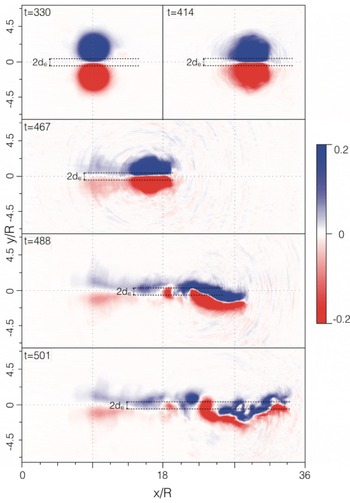
Sketch of the binary vortex evolution –
 $z$
component of the magnetic field: approaching each other
 $(t=330)$
, formation of the dipole vortex structure
 $(t=414)$
, radiation of electromagnetic waves and formation of a dipole magnetic field structure in the wake of the dipole vortex
 $(t=467)$
, decay of the dipole vortex into smaller electron vortices, which form von Kármán vortex rows
 $(t=488)$
, and the magnetic field annihilation, leading to electron heating
 $(t=501)$
. The
 $2d_{e}$
width scale, tightly connected to the annihilation process, is demonstrated.

Figure 1 illustrates the typical evolution of the
 $B_{z}$
component of the magnetic field observed during the simulation (for
 $B_{\text{max}}=2$
). When the binary vortex system is tight enough (i.e. distance between the closest points of the vortices is
 ${\sim}d_{e}$
, where
 $d_{e}=c/\unicode[STIX]{x1D714}_{\text{pe}}$
is the electron skin depth, figure 1,
 $t=330$
), the point-vortex approximation breaks down. The electron currents of the two vortices, both directed along the
 $x$
axis at the closest point of approach, attract each other and form a magnetic-dipole vortex structure (figure 1,
 $t=414$
) (Naumova et al.
Reference Naumova, Koga, Nakajima, Tajima, Esirkepov, Bulanov and Pegoraro2001; Nakamura & Mima Reference Nakamura and Mima2008). The structure observed has an analogue in hydrodynamics, which is known as the Larichev–Reznik dipole vortex solution (Larichev & Reznik Reference Larichev and Reznik1976). This type of structure is believed to be stable in the hydrodynamic case (McWilliams et al.
Reference McWilliams, Flierl, Larichev and Reznik1981). However, in our case, the magnetic structure moves along the
 $+x$
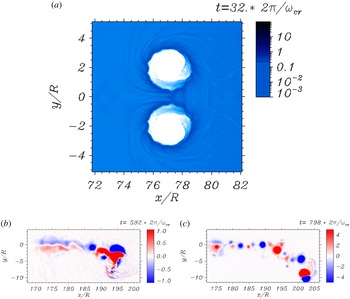
direction, losing the majority of its magnetic energy by turning it into electromagnetic waves (figure 1,
 $t=467$
; figure 3
b), accelerated electrons and the formation of von Kármán-like streets of secondary vortices (figure 1,
 $t=488$
, 501; figure 3
b,c), although secondary vortex formation does not decrease the total magnetic energy of the system significantly. The direction of the binary vortex motion may be deflected from straight propagation along the
 $x$
axis, as the binary components disintegrate unequally on the secondary vortices, and the resulting binary vortex with unequal components deflects in the direction of the larger vortex component, in agreement with Kono & Horton (Reference Kono and Horton1991). The rapidly accelerated electrons are a sign of the relativistic magnetic field annihilation. The annihilation of the magnetic field was observed in PIC simulations previously in a different geometry (Gu et al.
Reference Gu, Klimo, Kumar, Liu, Singh, Esirkepov, Bulanov, Weber and Korn2016) between the azimuthal magnetic fields formed by two parallel laser pulses propagating in a non-uniform underdense plasma and leads to electron heating. Although the overall physics of Ampere’s law is the same in both cases, as well as the signature of rapid electron energization, in Gu et al. (Reference Gu, Klimo, Kumar, Liu, Singh, Esirkepov, Bulanov, Weber and Korn2016) the displacement current arose as a result of the magnetic fields expanding towards each other due to the negative density gradient along the propagation axis of the laser pulses. In our case, the two vortices are pushed towards each other by the finite-radius effect of the vortex drift motion and continue to squeeze after the dipole vortex formation (see figure 1), so the gradient in the magnetic field cannot be compensated solely by increase of the electron current between the dipole vortex components. Still, in both cases, the dynamics of the magnetic fields is guided by the conservation of Ertel’s invariant. The process of secondary vortex formation may be caused by vortex boundary bending, observed in simulations previously (Lezhnin et al.
Reference Lezhnin, Kamenets, Esirkepov, Bulanov, Gu, Weber and Korn2016). Secondary vortices are not subject to the vortex film instability (Bulanov et al.
Reference Bulanov, Lontano, Esirkepov, Pegoraro and Pukhov1996), as the finite vortex radius effects dominate the motion of the vortices which are separated by a few
 $d_{e}$
. The role of the relativistic effects is demonstrated using auxiliary simulations with
 $n_{\text{max}}=0.36$
with a large range of
 $B_{\text{max}}$
from 0.1 to 2, with
 $R/d_{e}$
here being
 ${\leqslant}1$
. It was demonstrated that the magnetic field damping in the non-relativistic case is at least three times longer, and the electric fields coming from the displacement current term in Ampere’s law are negligible, see Wang et al. (Reference Wang, Li, Chen, Weng, Lu, Dong, Sheng and Zhang2016).
A simple model of the magnetic field annihilation of electron vortices may be written as follows. The radius of a vortex is connected to the electron momentum by the relation
 $R/d_{e}=(2p_{e}/m_{e}c)^{1/2}$
. Thus, the non-relativistic vortices have radius
 $R\leqslant d_{e}$
and the ultrarelativistic vortices have
 $R\gg d_{e}$
. Ampere’s law is generally stated as
 $\unicode[STIX]{x1D735}\times \boldsymbol{B}=4\unicode[STIX]{x03C0}/c\boldsymbol{\cdot }\boldsymbol{J}+1/c\boldsymbol{\cdot }\unicode[STIX]{x2202}\boldsymbol{E}/\unicode[STIX]{x2202}t$
. It may be rewritten as an order-of-magnitude estimate, using
 $|\unicode[STIX]{x1D735}\times \boldsymbol{B}|\approx |\unicode[STIX]{x2202}B/\unicode[STIX]{x2202}y|\sim |B/d|$
, where
 $d$
is the typical spatial gradient scale length,
 $|\boldsymbol{J}|\approx en_{e}c$
for the limit when
 $v_{e}\sim c$
,
 $|\unicode[STIX]{x2202}\boldsymbol{E}/\unicode[STIX]{x2202}t|\sim E/\unicode[STIX]{x1D70F}$
, where
 $\unicode[STIX]{x1D70F}$
is the typical temporal scale. Finally, this yields
 $d/d_{e}=\hat{B}/(1+\hat{E}/\unicode[STIX]{x1D714}_{\text{pe}}\unicode[STIX]{x1D70F})$
(
 $\hat{B}$
and
 $\hat{E}$
are dimensionless). Thus, it is clear from this equation that reaching
 $d_{e}$
scale (
 $d\leqslant d_{e}$
) is necessary for the magnetic field annihilation through the displacement current term (see, e.g. Gu et al.
Reference Gu, Klimo, Kumar, Liu, Singh, Esirkepov, Bulanov, Weber and Korn2016; Wang et al.
Reference Wang, Li, Chen, Weng, Lu, Dong, Sheng and Zhang2016). In the case of our simulations, the ratio of the
 $\unicode[STIX]{x1D735}\times B$
term to the current term with the increased density can be written as (by an order of magnitude):
 $|\unicode[STIX]{x1D735}\times \boldsymbol{B}|/|4\unicode[STIX]{x03C0}/c\boldsymbol{\cdot }\boldsymbol{J}|\sim |B/d|/|4\unicode[STIX]{x03C0}\unicode[STIX]{x1D6FC}n_{e}e|\sim \hat{B}\cdot (d_{e}/d)\cdot (1/\unicode[STIX]{x1D6FC})$
, where
 $\unicode[STIX]{x1D6FC}$
accounts for possible increase of the current due to the increase in electron density with
 $\unicode[STIX]{x1D6FC}\leqslant 2$
in our simulations. This parameter is
 ${>}5$
in our small
 $B_{\text{max}}$
simulations (as, for instance, shown at figure 1 for
 $B_{\text{max}}=2$
case) and
 ${\sim}1$
in large
 $B_{\text{max}}$
simulations (as in the
 $B_{\text{max}}=35$
case). Thus, the more relativistic the vortex is (in terms of the
 $p_{e}/m_{e}c\approx \unicode[STIX]{x1D6FE}$
parameter), the harder it is to squeeze the dipole vortex down to a
 $d_{e}$
scale. That being said, large vortices (in terms of
 $d_{e}$
scale) are harder to damp via the magnetic field annihilation.
Normalized magnetic field energy evolution over time for various cases – drifting single vortices (dashed black line), merging vortices (dashed brown line), dissipating vortices for
 $B_{\text{max}}=1.0$
(blue),
 $B_{\text{max}}=2.0$
(green),
 $B_{\text{max}}=4.0$
(red),
 $B_{\text{max}}=6.5$
(aqua) and
 $B_{\text{max}}=35$
(purple). In the case of smaller vortices (in terms of
 $R/d_{e}\propto B_{\text{max}}$
) the magnetic field annihilation dominates the vortex damping, in the case of larger density values – secondary vortex formation mitigates the total magnetic energy dissipation.

(a) Electron density distribution for
 $t=32$
(simulation with
 $B_{\text{max}}=0.5$
). Spiral density waves, which possibly correspond to the electromagnetic energy dissipation mechanism at the early stages of vortex evolution, are seen; (b)
 $B_{z}$
component of the magnetic field for
 $t=592$
(simulation with
 $B_{\text{max}}=6.5$
). Around
 $x=193$
and
 $y=-8$
we observe the emission of the electromagnetic wave. (c)
 $B_{z}$
component of the magnetic field for
 $t=798$
(simulation with
 $B_{\text{max}}=35.0$
). The von Kármán-like street of secondary vortices is observed in the wake region of the dipole vortex.

Electron density distribution at (a)
 $t=112$
and (b)
 $t=167$
(
 $B_{\text{max}}=4$
simulation). The annihilation of the magnetic field leads to the formation of an electron bunch with an energy allowing escape of the plasma into the vacuum.

Let us compare two types of simulations with the same parameters except for the signs of the magnetic fields in the vortices. Thus, in one case the vortices move towards each other and interact (figure 2, blue line), in the other case they move away from each other and do not decay on the time scale of the simulations (figure 2, dashed black line). Figure 2 shows the rate of magnetic energy dissipation in both simulations. Here, we can distinguish at least two mechanisms of vortex dissipation – slow (dashed lines, dissipation time is larger than
 $10^{3}\unicode[STIX]{x1D714}_{cr}^{-1}$
) and fast (solid lines, typically less or much less than
 $10^{3}\unicode[STIX]{x1D714}_{cr}^{-1}$
). The first mechanism can probably be attributed to the formation of electrostatic spiral density waves in the electron plasma, which are seen in the early stages of the simulations (e.g. see spiral perturbations of electron density in figures 3
a and 4
a). In our simulations, this mechanism gives us the rate of dissipation which dissipates no more than 20 % of the magnetic energy during the simulation time, so it will not impact the characteristic lifetime of the electron vortex, or at least will make a contribution on a longer time scale than the fast dissipation, which will be discussed below. In turn, fast vortex dissipation can destroy the vortex pair on a much shorter time scale. Synchrotron losses, in contrast to electromagnetic solitons, are also negligible in the electron vortex case (Esirkepov et al.
Reference Esirkepov, Bulanov, Nishihara and Tajima2004). Using two-dimensional EPOCH simulations that include synchrotron radiation with single vortex drift in the plasma density gradient, we have shown that for a
 $B_{0}\sim 10$
vortex with a given set of parameters, the synchrotron damping of vortex energy is no more than
 $0.1\,\%$
of total vortex energy for 500 crossing times.
As a result of the magnetic energy dissipation, we observe a bunch of electrons being accelerated approximately in the
 $+x$
direction, adding up to
 ${\sim}60m_{e}c$
to the electron momentum in comparison to the maximum electron momentum of the stationary electron vortices in the case of
 $B_{\text{max}}=35$
. Figure 4 demonstrates the effect of the electron acceleration. The energy of the electrons is large enough for the bunch to escape the plasma region. According to figure 2, we see that the more relativistic vortices, with larger
 $\unicode[STIX]{x1D6FE}$
factors, are harder to annihilate, in agreement with our theoretical model. Secondary vortices, which are more prominent in the simulations with higher
 $\unicode[STIX]{x1D6FE}$
factors of the initial vortices, are also more stable against magnetic field annihilation, which results in the saturation of the magnetic field energy in the system (see figure 2, aqua and purple lines).
It is also important to note that the immobile ion approach is justified only if
 $\unicode[STIX]{x1D714}_{\text{pi}}/\unicode[STIX]{x1D714}_{\text{pe}}\ll 1$
and
 $2\unicode[STIX]{x03C0}/\unicode[STIX]{x1D714}_{\text{pi}}$
is greater than the total simulation time. Besides, the binary vortex motion should be fast enough so that we could ignore the ion motion:
 $V_{\text{bin}}/R\gg \unicode[STIX]{x1D714}_{\text{pi}}$
, where
 $R$
is the typical radius of the vortex. Otherwise, the binary system of vortices does not move according to the HM equation, and the vortices evolve independently (Lezhnin et al.
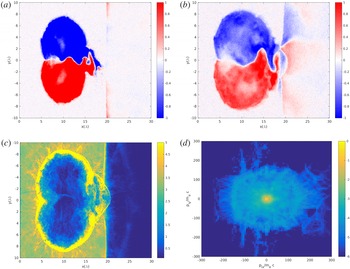
Reference Lezhnin, Kamenets, Esirkepov, Bulanov, Gu, Weber and Korn2016) until two vortex boundaries collide. Figure 5 shows the ion acceleration from the interaction of two exploding relativistic electron vortices in our EPOCH simulations with mobile protons. Here, we take
 $n_{e}=4\cdot n_{\text{cr}}$
,
 $B_{\text{max}}\sim 10$
, the simulation box is
 $800\times 400$
grid nodes, corresponding to
 $40\unicode[STIX]{x1D706}\times 20\unicode[STIX]{x1D706}$
physical size
 $(\unicode[STIX]{x1D706}=1~\unicode[STIX]{x03BC}\text{m})$
, with 200 particles per cell, and we keep the plasma in the left side of the simulation box, while forming vortices at
 $x=10\unicode[STIX]{x1D706}$
and
 $y=-3\unicode[STIX]{x1D706},+3\unicode[STIX]{x1D706}$
with opposite signs of the magnetic field. Two vortices with the initial field amplitude of
 $B_{\text{max}}\sim 10$
approach each other during the explosion, and some sort of dipole structure is separated from the vortex pair, moving to the plasma boundary and damping its magnetic energy into particles. Asymmetry of magnetic field distributions demonstrates the role of the dipole vortex, which leads to higher energies of protons from the right side, as shown in the phase plot, figure 5(d), in comparison to the contribution of the Coulomb explosion, which is seen as a circular structure in the phase plot. This mechanism is similar to the so-called magnetic vortex acceleration (MVA) (Fukuda et al.
Reference Fukuda, Faenov, Tampo, Pikuz, Nakamura, Kando, Hayashi, Yogo, Sakaki and Kameshima2009; Bulanov et al.
Reference Bulanov, Bychenkov, Chvykov, Kalinchenko, Litzenberg, Matsuoka, Thomas, Willingale, Yanovsky and Krushelnick2010; Nakamura et al.
Reference Nakamura, Bulanov, Esirkepov and Kando2010). An alternative mechanism of ion acceleration from relativistic electron vortex pairs was recently considered in Yi et al. (Reference Yi, Pukhov, Shen, Pusztai and Fülöp2018).
Ion acceleration in a vortex pair interaction: magnetic field distribution at (a)
 $t=300~\text{fs}$
, (b)
 $t=600~\text{fs}$
, (c) proton density distribution at
 $t=600~\text{fs}$
and (d)
 $p_{\text{ix}}{-}p_{\text{iy}}$
phase plot at
 $t=600~\text{fs}$
.

The simulation set-up used in the problem, such as a plasma density gradient, is implemented in order to consider the adiabatic switching on of the vortex interaction effects. Thus, we may observe the same effect of vortex damping in homogeneous plasmas when forming tight binary systems of vortices using our numerical scheme. However, in order to exclude the effect of the initial generation process, which inevitably will cause strong coupling between the vortex pair, and to demonstrate the stability of single electron vortices, we decided to form vortices far away from each other, making sure that the vortex generation process does not impact their interaction and the magnetic field energy is almost constant over the simulation time (for non-interacting vortices). The dashed black line in figure 2 demonstrates the evolution of the magnetic energy in the single vortex drift case. In general, the lifetime of electron vortex binaries in a homogeneous plasma appears to be longer than in the non-zero density gradient case.
It is also natural to discuss a system of binary vortices with the same polarization of magnetic field. In the point-vortex approximation, they will simply rotate around each other in the case of a homogeneous plasma (Kono & Horton Reference Kono and Horton1991). However, it turns out that the finite-radius vortices are subject to a merger process, which may also lead to minor electromagnetic energy dissipation (figure 2, dashed brown line) via spiral density wave formation by the resulting ellipsoidal vortex (Lezhnin et al. Reference Lezhnin, Kniazev, Soloviev, Kamenets, Weber, Korn, Esirkepov and Bulanov2017), which turned out to be in principle agreement with the results of the hydrodynamical simulations of the 2-D vortex merger process (Overman II & Zabusky Reference Overman and Zabusky1982).
4 Conclusions
In conclusion, we presented the computer simulation results on the interaction of electron vortex binaries. These structures are often seen in 2-D PIC simulations of various laser–plasma configurations and are crucial for understanding the superstrong magnetic field evolution and turbulence in relativistic plasmas. If the binary vortex system is tight enough, the point-vortex approximation breaks down, and the binary vortex is subject to fast annihilation. The vortex annihilation leads to acceleration of the electron bunches, which in its turn leads to propagating electrostatic waves. In the case of larger
 $\unicode[STIX]{x1D6FE}$
factor of the initial vortices (i.e. for simulations with
 $B_{\text{max}}=4$
and above), we also observe formation of von Kármán streets of secondary vortices, the motion of which is stabilized by the drift motion due to the finite-radius effects. Mildly relativistic electron vortex pairs damp mainly through the annihilation of the magnetic field, while ultrarelativistic electron vortex pairs decay via the secondary vortex formation. We also show that in the mobile proton simulations that magnetic field annihilation contributes to the ion acceleration in the exploding vortex pair set-up. We believe that the results obtained will be useful for the development of a theory describing electromagnetic turbulence in relativistic plasmas (Bulanov et al.
Reference Bulanov, Esirkepov, Lontano and Pegoraro1997; Kuvshinov & Schep Reference Kuvshinov and Schep2016; Naseri et al.
Reference Naseri, Bochkarev, Ruan, Bychenkov, Khudik and Shvets2018).
Acknowledgements
This work utilized the MIPT-60 cluster, hosted by the Moscow Institute of Physics and Technology (we thank I. Seleznev for running it smoothly for us). S.V.B. acknowledges support at the ELI-BL by the project High Field Initiative (CZ.02.1.01/0.0/0.0/15_003/0000449) from the European Regional Development Fund. K.V.L. is grateful to the ELI-Beamlines project for hospitality during the final stages of this work. K.V.L. thanks V. Blinov for fruitful discussions.