The Fontan operation creates direct continuity between the superior and inferior caval veins and the proximal pulmonary arteries, Reference Fontan and Baudet1 thereby separating the deoxygenated venous circulation from the oxygenated systemic circulation in patients with functional single ventricle CHD. This results in normal or near normal arterial saturations and a lesser volume load on the single ventricle. Inherent with this post-surgical physiology are high systemic venous pressures, increased circulatory volume, and a state of perpetual systemic congestion. These features resemble congestive right heart failure and similarly produce liver congestion and enlargement, and indolent yet ubiquitous liver fibrosis and eventual cirrhosis. This entity in the Fontan patients has become known as Fontan-associated liver disease. Reference Rychik, Atz and Celermajer2,Reference Goldberg, Surrey and Glatz3
The liver is normally able to act as a “sump” in the circulation, regulating the intravascular volume as required for physiologic needs, in concert with varying levels of venous tone. In the early phases of venous congestion, liver volume is expected to be large, and as time progresses and fibrosis becomes dominant, Reference Kiesewetter, Sheron and Vettukattill4 the liver may shrink in size. Hepatomegaly is commonly encountered in Fontan patients, but its prognostic value is not currently delineated in the spectrum of Fontan-associated liver disease. The purpose of this work is the address this gap in knowledge by examining liver volume in patients with a Fontan circulation and evaluating the prognostic impact with respect to liver function and longer-term outcomes. We hypothesised that smaller liver volumes will indicate a worse prognosis.
Methods
Study design and patient selection
We analysed data from a large tertiary referral centre (Prince Sultan Cardiac Centre) for CHD in Riyadh, Saudi Arabia. Four hundred and fifty-eight patients underwent Fontan surgery from 1986 to 2015 at our institution and were previously reported as part of late outcomes study. Reference Al Najashi, Farouk and Atiyah5 This current study is a cross-sectional study conducted in 199 (43.4%) of the 458 patients, who had liver ultrasound as part of longer-term screening and follow-up for Fontan-associated liver disease. A subgroup had additional CT imaging of the abdomen and were used to validate ultrasound-based liver volume estimation. Baseline patient anatomic and surgical characteristics and demographic data were extracted from the previously identified database. Liver biochemistry measured in closest temporal proximity to the liver ultrasound scan was recorded.
Outcomes
Outcomes in this study included in the first instance mortality or transplantation (cardiac or cardiac and liver), or a composite of either death, protein-losing enteropathy, arrhythmia, or transplantation. Arrhythmia was defined as the need for drug therapy or intervention such as ablation, or automatic cardio-defibrillator implant. Non-sustained arrhythmia lasting less than 30 seconds, or atrial or ventricular ectopic activity that did not warrant treatment, were not considered significant arrhythmia for the purposes of this study. Protein enteropathy was defined as a clinical syndrome of effusions and or oedema in association with a low albumin in combination with an elevated random stool alpha-antitrypsin level.
Abdominal ultrasound and liver volumetry
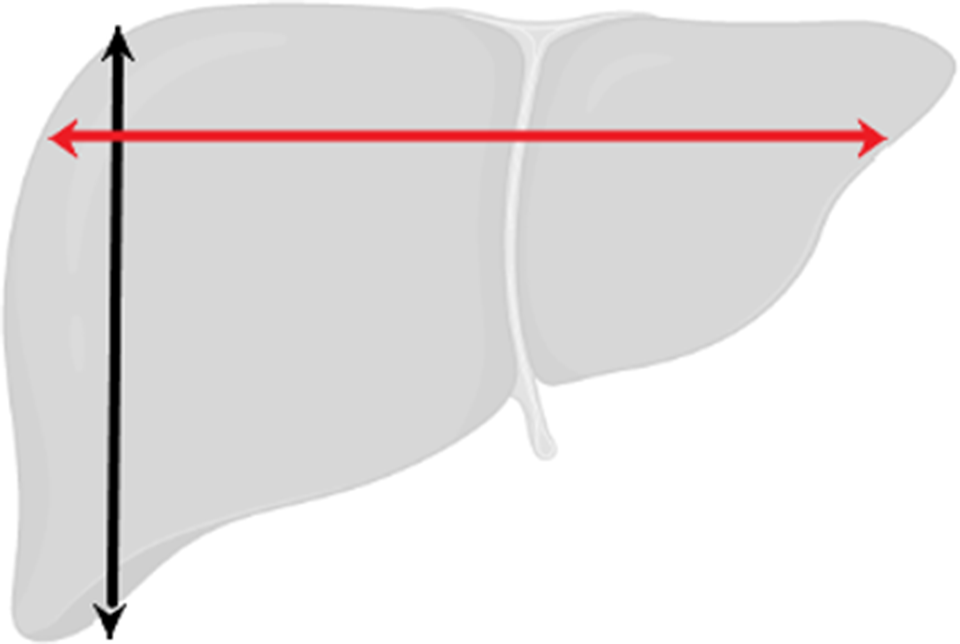
Liver ultrasound was performed using GE Logiq 9, Philips Epiq, Philips Affinity70 and Phillips iU22 ultrasound machines. Using a C5-1 transducer, common to all machines, the probe was placed in the subcostal space to visualise the liver structures whilst scanning from left to right and in the longitudinal, sagittal, and transverse planes. Volumetry was done in a standard fashion obtaining measurements of the liver craniocaudal height and transverse dimensions as follows: liver volume = liver craniocaudal height × liver transverse length × 0.52 cc2. See Figure 1. Reference Izranov, Ermakov and M.6 When the liver was not visible in its entirety, a panoramic approach and additionally as is necessary, multiple windows to secure adequate information were obtained. This includes views from Morrison’s pouch, from the left costal margin, and along the epigastrium, utilising all available windows.
Demonstration of how liver volume measurements were made.

Abdominal CT
Abdominal CT was performed using SOMATOM Definition AS, 64 slice light speed, Revolution HD 2000, Discovery CT750 HD. With the patient in the supine position, a scout image was initially performed followed by sequential imaging from diaphragm dome to symphysis pubis. Generally, CT was performed without intravenous contrast material. It is not our current practice to do routine abdominal CT nor MRI in patients with a Fontan operation.
Assessment of liver function
Three standardised models for assessing liver function were derived from liver, renal, and general biochemistry proximate to the liver ultrasound. The derivative formulas for each are summarised below.
-
1. Model for End-stage Liver Disease excluding INR (MELD-XI) score formula: The MELD-XI score was calculated as follows: MELD-XI = 5.11 Ln(B) + 11.76 Ln (Cr) + 9.44, where Ln is natural logarithm (base e), B is bilirubin in mg/dL, Cr is creatinine in mg/dL. https://sasl.unibas.ch/11calculators-MELD-XI.php Reference Assenza, Graham and Landzberg7
-
2. Fibrosis-4 (FIB-4 index): FIB-4 = Age (years)×AST (U/L)/[Platelets(109/L) × ALT1/2 (U/L)]. Reference Vallet-Pichard, Mallet and Nalpas8
-
3. AST to Platelet Ratio (APRI) Index: [(AST/upper limit of the normal AST range) × 100]/Platelet Count. Reference Lin, Xin and Dong9
Statistical analysis
Patient characteristics were presented using descriptive statistics. Continuous data were described by mean ± standard deviation if normally distrusted, median with the 25th and 75th percentile if skewed. Categorical variables were presented as counts and percentages. Shapiro–Wilk test was used to determine normal distribution of continuous data. Independent sample t-test was used to assess the difference of liver volumes relative to outcomes. The 33rd and 66th percentile of the liver volumes was used to determine cut-off points to group the patients according to tertiles. One-way analysis of variance test or Kruskal–Wallis test was used to compare continuous data of the three independent groups. Pearson’s chi-square test was used to compare the differences of categorical variables. Survival analyses were performed using Kaplan–Meier survival curves with the log-rank test to compare differences among the groups. SPSS version 25.0 was used for all data analysis (Armonk, New York: IBM Corp). A p-value of <0.05 was considered statistically. A receiver operating curve was constructed to assess the diagnostic sensitivity and specificity of indexed liver volumes relative to the combined endpoint defined below.
Results
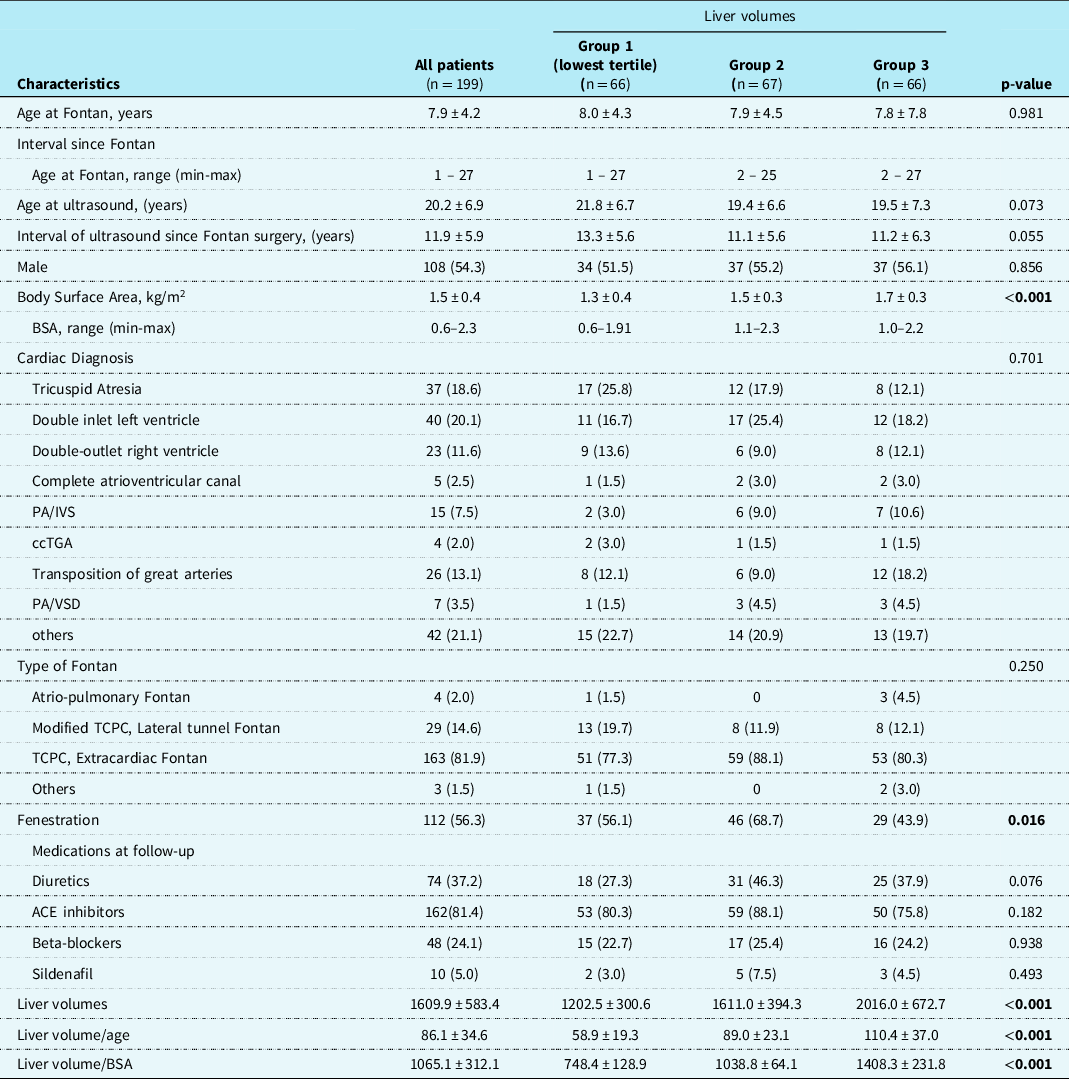
Patient characteristics
Baseline demographic, anatomic, and surgical characteristics are summarised in Table 1, and survival is depicted in Supplemental Figure 1. During a mean follow-up interval of 29.6 ± 26 months from liver ultrasound date (interquartile range 8–43), three patients (1.5%) underwent transplantation including two orthotopic heart transplantations and one heart–liver transplant. A total of 10 patients (5%) reached the combined endpoint of either transplantation or death. See Supplemental Figure 1.
Patient characteristics. Groups are defined by indexed liver volume tertiles.

Statistically significant p-values are highlighted in bold.
Ultrasound-determined liver volumes
Twenty patients had both CT and ultrasound of the liver within a mean period of 19.6 (standard deviation 38.5 months, interquartile range 2.3–55.3 months). The two techniques were highly correlated, R = 0.965, p < 0.0001.
Mean liver volumes for the entire cohort (n = 199) were 1609.9 ± 583.4 ml (range 408.4–4131), interquartile range 1199.3 to 1934.0). Threshold values for tertiles were 931.1 mL/m2 (33.3%), 1158.0 ml/m2 (66.6%) and >1158.0 ml/m2. Patients with the largest liver volumes indexed to body surface area (BSA) were less likely to have a functioning fenestration (44% versus 56% in the smallest indexed liver volume tertile, p = 0.016. See Table 1.
Values are reported as mean ± standard deviation or counts with percentages.
Relationship between ultrasound-determined liver volume and laboratory data
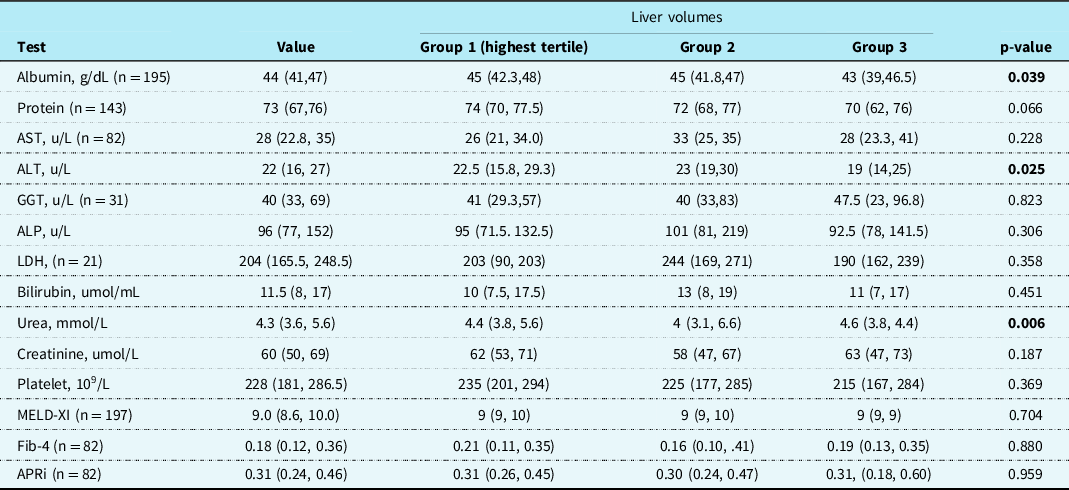
The mean interval between liver function tests and ultrasound was 15.6 ± 20.5 months (median, 8 months interquartile range (0, 26) months). Albumin was lower, whereas urea was higher in those with the largest indexed liver volumes (Table 2). Liver and renal function as well as fibrosis scores are summarised in Table 2. Liver fibrosis scores were not significantly correlated with indexed liver volumes.
Summary of laboratory data relevant to liver (including fibrosis scores) and kidney function.
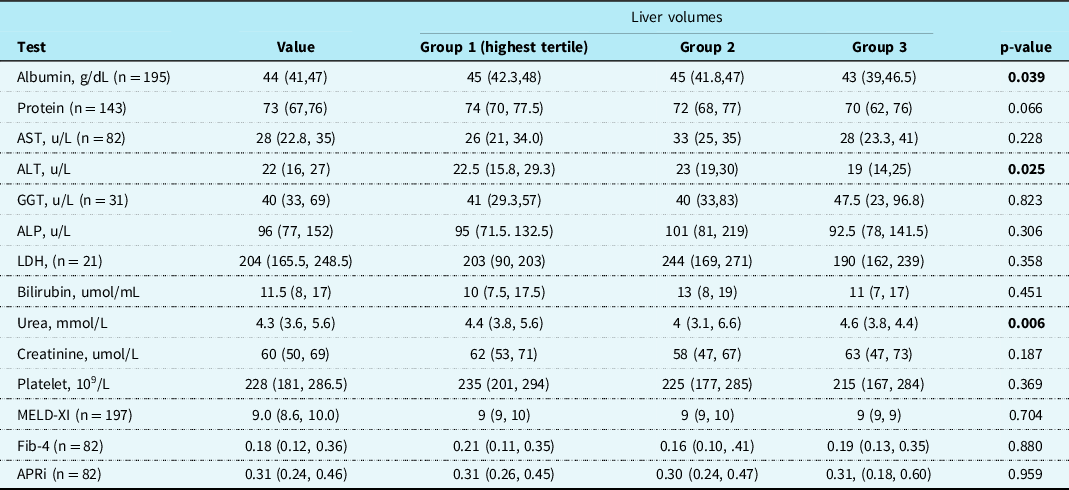
AST Aspartate Aminotransferase, ALT Alanine Aminotransferase, GGT Gamma-Glutamyl Transferase, ALP Alkaline Phosphatase, LDH Lactate Dehydrogenase.
Statistically significant p-values are indicated in bold.
Relationship between liver volume, liver function and outcomes
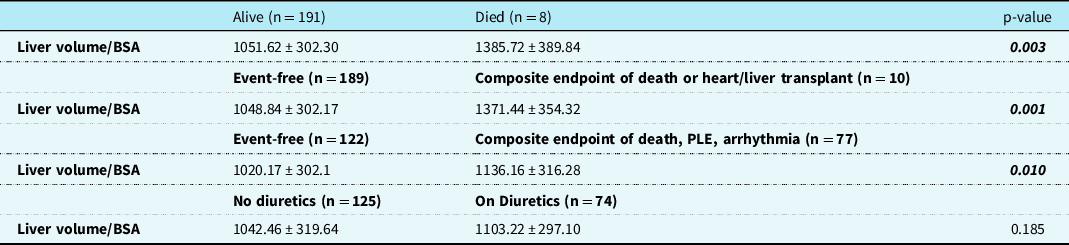
Of the 10 patients that either died or were transplanted during follow-up, their indexed liver volumes were significantly larger than those who were alive (n = 191) at latest follow-up (1385.72 ± 389.84 versus 1051.62 ± 302.3 ml/m2, p = 0.001). See Table 3 for characteristics of patients who died versus those that did not. Patients reaching the composite endpoint of death, arrhythmia, protein losing enteropathy (PLE), or transplant (n = 77) had significantly larger liver volumes 1136.16 ± 316.28 ml/m2, as compared to those (n = 122) who did not reach the endpoint, 1020.17 ± 302.1 ml/m2, p = 0.01. Those patients requiring diuretic therapy (n = 74) did not have bigger livers, that is, 1103.22 ± 297.10 ml/m2 than those (n = 125) not on diuretic therapy, that is, 1042.46 ± 319.64 ml/m2. No significant correlations were demonstrable between ultrasound liver volumes and MELD-XI score (R = −0.055, p = 0.445), Fib-4 score (R = 0.088, p = 0.432) as well APRindex (R = −0.432, p = 0.772).
Characteristics between dead and alive patients.

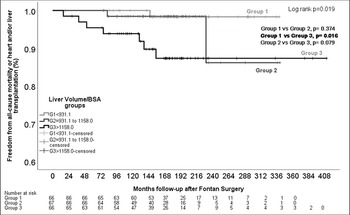
Freedom from all-cause mortality or heart/liver transplant at 18 years was significantly different among the tertiles of indexed liver volumes groups: 1 = 98.3 ± 1.7%, group 2 = 88.9 ± 10.5 and group 3 = 84.9 ± 5.1 (log-rank < 0.001) (Table 4, Fig 2). Pairwise comparison shows significantly higher event-free survival in Group 1 versus Group 2 p = 0.007 and Group 2 versus Group 3, p = 0.002.
Outcomes by liver volume/BSA tertiles

Freedom from all-cause mortality or transplantation by liver volume/BSA tertiles.

Receiver operating curve characteristics
Indexed liver volumes had an overall predictive accuracy for the combined outcome of 61%, (CI 53%, 67%, p = 0.009). At a cut-off value of 780 ml/m2, liver volumes were able to predict the combined outcome with a 90% sensitivity and a 78% specificity. See Supplemental Figure 2.
Discussion
Fontan-associated liver disease is universally present in patients with univentricular physiology who have been palliated with total cavo-pulmonary connections. Reference Rychik, Atz and Celermajer2,Reference Rychik, Veldtman and Rand10 Though imaging such as ultrasound and cross-sectional advanced imaging are now commonly used for screening for Fontan-associated liver disease, the significance of hepatomegaly in such patients has hitherto not been defined. In this retrospective, single-centre cohort study of 199 Fontan patients, we demonstrate significant variation in liver volumes ranging from approximately 500 to 4000 ml. For the first time to our knowledge, we were able to demonstrate an association between liver volumes and mortality or transplantation, and late morbidity including PLE and arrhythmia, those having the largest livers carrying the greatest burden of mortality and morbidity.
Liver volumetry and 3D-modeling of liver morphometry are increasingly being used to plan liver resection and liver transplantation surgery. Reference Ludwig and Elveback11 In this context, liver volumes are used to estimate functional liver mass and are used to predict post-operative outcomes and anatomic space permutations for graft implant. Reference Yamanaka, Saito and Iimuro12 In cirrhosis, the volumetry data are highly variable-dependent on the specific disease process underlying the cirrhosis. Normal absolute adult liver volumes range from approximately 1100 to 1500 ml, Reference Suzuki, Epstein and Kohlbrenner13 or when indexed to body surface area are approximately 707-12 cc/m2, Reference Heinemann, Wischhusen, Puschel and Rogiers14,Reference Urata, Hashikura, Ikegami, Terada and Kawasaki15 and are dependent on age, gender, BSA, height, and weight. We used a combination of absolute as well as age and BSA-indexed liver volumes to accurately reflect the potential effects of growth, ageing, and body size on liver volumes. In the current cohort, more than 50% of Fontan patients had liver volumes in excess of 1500 ml, irrespective of age, suggesting very significantly increased liver volumes. Data on liver volumes in congestive heart failure are lacking, and this paper represents an endeavour to address this gap in knowledge in patient congestion associated with a Fontan circulation.
Immediately following Fontan surgery, there is an abrupt rise in central venous pressures, resulting in acute liver congestion and high liver stiffness, which persists during late follow-up. Reference DiPaola, Schumacher, Goldberg, Friedland-Little, Parameswaran and Dillman16 Histologically, this is marked by sinusoidal dilation and varying degrees of fine sinusoidal fibrosis. Reference Rathgeber, Guttman and Lee17 By the 2nd decade, up to 40% of Fontan patients will have significantly higher grades of fibrosis or frank histologic cirrhotic changes. Reference Munsterman, Duijnhouwer and Kendall18 In this relatively small series, we demonstrated that larger liver volumes were associated with the poorest outcomes. This is somewhat counterintuitive and contrary to our initial hypothesis that those with the smallest livers will have the worst outcomes.
Recently, Egbe et al. Reference Egbe, Miranda, Anderson and Borlaug19 demonstrated that diminished pulmonary vascular reserve correlates strongly with liver congestion and liver stiffness. Reference Colman, Alsaied and Lubert20,Reference Possner, Chaudhry and Dillman21 This diminished pulmonary vascular reserve was highly correlated with invasive central venous pressures and suggests that high venous pressure is indeed an important mechanism by which congestion and liver stiffness is mediated. In the present dataset, although not demonstrated directly, patients with the biggest livers likely reflect those with the greatest degree of liver congestion and systemic venous hypertension. Presumably, such hepatomegaly reflects those with the worst haemodynamics, specifically in terms of central venous pressure and pulmonary vascular reserve. These haemodynamic associations have recently been confirmed by Lubert et al in a Fontan population. Reference Lubert, Opotowsky and Palermo22 Additionally, we show that patients with a decompressive capacity through a Fontan fenestration had smaller liver volumes by contrast. The mediation of worse outcomes, including mortality, does not appear to be via liver functional decompensation, as liver function and liver fibrosis scores were generally preserved across the spectrum of liver size, despite the worse outcomes in those with larger liver volumes. We believe the worse outcomes occurring in those with larger liver volumes is more likely mediated via the adverse haemodynamics, for which the larger liver volumes are a surrogate of. At a cut-off of 780 ml/m2, there was a modest degree of sensitivity and specificity for predicting a poor outcome. These preliminary observations need further confirmation in larger series, including populations in which heart failure is due to other causes such as acquired heart disease. Patients who developed late complications of mortality, transplantation, PLE, and arrhythmia in the present series were more likely to have had bigger liver volumes indexed to body surface area. Indeed, we documented a significant difference in outcomes when comparing those in the smallest tertile with those in the largest tertiles of liver volumes. The difference between the second and third tertile tended towards significance and likely reflect our relatively smaller numbers with outcomes.
We found no correlation between liver fibrosis scores and liver volumes. This is perhaps not surprising as liver histology is not expected to dictate degrees of congestion, until very late when there is near total fibrotic replacement of the liver parenchyma. Further, liver fibrosis scores have largely been developed for end-stage liver disease and are simply not sensitive enough to detect indolent early changes in liver function associated with the Fontan circulation. Our group also demonstrated uncoupling between liver function and structure in the Fontan circulation, Reference Guha, Bokhandi and Ahmad23 which makes simple correlations between structural alteration and physiology not nuanced enough to accurately represent the interaction between liver volume and fibrosis.
Limitations
This study suffers from several limitations. This includes the retrospective observational nature of the study, the relatively small overall numbers, and relatively limited mortality outcomes. We were thus restricted in the number of meaningful analyses we could conduct. Further, laboratory data and ultrasound studies were not done at the same time and may have biased the results away from a positive correlation between the two. The generalisability of these findings will need to be verified in larger and more heterogeneous populations.
Conclusions
This study documents for the first time an association between liver volume and mortality outcomes in patients with univentricular physiology after the Fontan operation. We demonstrate that larger liver volumes are indeed an important marker of late adverse Fontan outcomes including death, transplantation, PLE, and arrhythmia.
Supplementary material
To view supplementary material for this article, please visit https://doi.org/10.1017/S1047951122002992
Financial support
This research received no specific grant from any funding agency, commercial, or not-for-profit sectors.
Conflicts of interest
None.