Introduction
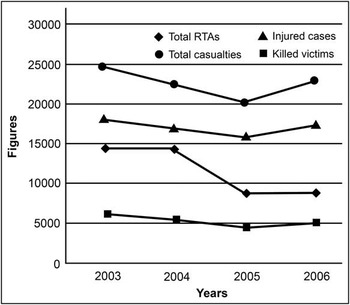
The number of road traffic crashes in Nigeria over the past three decades has been alarming. Most interventions to reduce the number of crashes have been unproductive. Between 2003 and 2006, 46,814 traffic crashes occurred, with 21,266 deaths reported (Figure 1). Current reports from the Federal Road Safety Corps (FRSC) show that road traffic accident deaths in Nigeria have reached a total of 24,850 (1.46% of all deaths in the country), with a crude death rate of 162 deaths and an age-adjusted death rate of 21.55 deaths/100,000 population respectively.1 Currently, Nigeria is ranked number 191 out of 192 countries in terms of deadliest roads.1 Due to this increasing number of road traffic crashes on Nigerian roads, experts believe death rates actually could be higher than estimated; several requests have been made to the government to include tackling this increasing public health burden in its priority list.Reference Labinjo, Juillard, Kobusingye and Hyder2
Road Traffic Fatality Profile in Nigeria in the Years 2003 to 20061 Abbreviation: RTA, road traffic accident.

Nigeria has no national prehospital system, no national ambulance service, and no policy supporting a prehospital system. The National Emergency Management Agency (NEMA) is the main national emergency body in Nigeria. It tackles only general disasters in the country and does not necessarily offer prehospital care. Hospitals within Nigeria do have accidents and emergency units, but these have not been coordinated to offer prehospital services. The FRSC is the major body that has contributed to emergency and prehospital response in Nigeria. But, the FRSC still needs professional inputs to significantly reduce traffic morbidities and mortalities. A prehospital trauma care system incorporated into emergency medical services could play a key role in reducing these high morbidities and mortalities. Basic prehospital trauma services offered in some low- and middle-income countries have been effective in reducing traffic fatalities;Reference Mock, Arreola-Risa and Quansah3 this fact is corroborated by the Cochrane reviews.Reference Bunn, Kwan and Roberts4
A prehospital trauma care system is an integral part of Emergency Medical Services involved in instituting immediate care of injured victims at the scene of the incident through their arrival at health care facilities. This involves activities rendered by rescuers (first responders), paramedics and medics, and ambulance providers. The 2005 World Health Organization (WHO) publication on prehospital systems highlights three tiers of prehospital care: (1) care provided by laypersons in the community; (2) care provided by those who have received some level of prehospital care training; and (3) advanced prehospital trauma care provided by individuals highly skilled in the use of sophisticated life-support equipment and other emergency interventions.Reference Sasser, Varghese and Kellermann5 Trunkey's tri-modal distribution of trauma deathsReference Trunkey6 notes that 50% of the associated deaths occur in the first hour of sustaining fatal injuries. Therefore, prehospital care should be instituted within this first hour in order to reduce fatal outcomes. This is referred to as the “Golden Hour.”Reference Lockey7
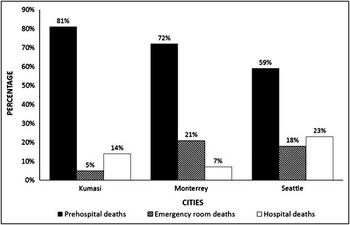
Globally, an estimated 1.2 million people are killed and 50 million additional people are injured annually from road traffic accidents. Due to the lack of functional prehospital medical services and other preventive options in low- and middle-income countries, these figures could increase by as much as 80% over the next decade.Reference Peden, Scurfield and Sleet8 Studies show that in developing countries the majority of traffic-accident-related deaths occur during the prehospital phase, further emphasizing the need for an established prehospital response in Nigeria.Reference Mock, Arreola-Risa and Quansah3 A substantially greater percentage of deaths occur during the prehospital phase in Kumasi, Ghana compared with developed cities such as Monterrey, Mexico and Seattle, California USA (Figure 2). Another study estimated that one-third of prehospital deaths from traffic crashes are preventable.Reference Coats and Davies9 This suggests that appropriate intervention during the prehospital phase would be helpful in reducing traffic accident fatalities.
Distribution of Trauma Death Sites in Three CitiesReference Mock, Tiska, Adu-Ampofo and Boyakye25

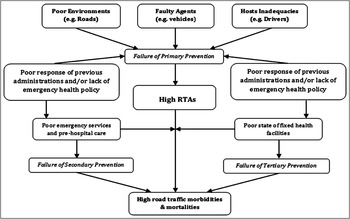
It is widely believed that efforts to prevent traffic crashes (primary intervention) are more appropriate interventions. Specific interventions focusing on the observation of road safety codes, road maintenance strategies, the use of motorcycle helmets, and checking the blood alcohol concentration of drivers, etc., are good primary preventive strategies. However, in Nigeria, provision of primary preventative measures has not impacted the number of road traffic deaths. This failure includes flawed management of the agent (vehicles), the environment (roads), and the hosts (humans), with previous administrations poorly responding to help prevent the occurrence of traffic crashes in the country (Figure 3). A composite review and adoption of secondary preventative interventions (early diagnosis and treatment) could be beneficial and complementary to the existing primary measures. In view of this, the role of prehospital trauma care systems (a component of early diagnosis and treatment) in reducing the current morbidities and mortalities from road traffic injuries in Nigeria is the focus of this review. The aim of this review, therefore, is to compare and identify best prehospital trauma care practices in Nigeria and some other African countries in which the prehospital services operate, and to provide recommendations based on the findings.
Analysis of Causes of Road Traffic Accidents and Attendant Fatalities Abbreviation: RTA, road traffic accident.

Methods
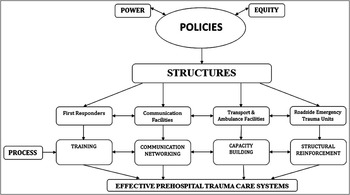
The methodology comprised a review of secondary, published articles, and grey literature obtained from various sources in Nigeria, some African countries (mainly Ghana, South Africa, Zambia, and Kenya), and databases of international organizations (World Health Organization, United Nations, World Bank). The rationale behind this methodology is due to the lack of data on prehospital systems. Nigerians are relatively new to this concept, which could make the collation of primary data difficult. However, data obtained from the review were ordered into a logical sequence using a conceptual framework specifically developed for this study. This framework included policies and structures related to prehospital care, first responders, communication facilities, transport facilities, and roadside emergency trauma units (Figure 4). An option appraisal is employed in the results analysis to identify strategies and determine the best delivery option by technically appraising some sets of criteria considered to be fundamental to any successful project.Reference Walley and Wright10
Conceptual Framework for a Prehospital Trauma Care System

Results
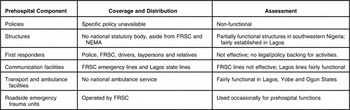
Prehospital services in Nigeria are summarized in Table 1 and discussed in detail below.
Policies
Nigeria has no specific policy related to the establishment and operation of a prehospital trauma care system. The Nigerian National Health Policy adopted in 1988 was commended; but some health issues, including a national emergency and disaster management system, were not included in the policy.Reference Aliyu11 This policy has been reviewed by past administrations, but with no clear inclusion of prehospital system guidelines.
In contrast, the 1994 South African National Health Plan, the South African Health Sector Strategic Framework (1999-2000), and Strategic Priorities for the National Health System (2004-2009) clearly included emergency medical services and a prehospital trauma system in its targeted priorities.12, 13 These strategies have helped to reinforce prehospital services in South Africa.
The National Health Policy of Ghana, which has a 5-year strategic plan, entails some prehospital services guidelines.14 Interestingly, the Ministry of Health also has its own transport policy that deals specifically with some issues of prehospital care.15 These policies have been complemented by the National Road Safety Policy and Strategy, which includes guidelines for on-the-scene management of road crashes and ways to maintain safety on highways.16
Structures
Structures in place for prehospital services in African countries are not very specific; some are incorporated into existing national emergency services, while others regard some components of the prehospital system as its main structure.
The Nigerian FRSC, a paramilitary structure responsible for road safety activities in the country, was created in 1988 through Decree No. 45 of 1988 as amended by Decree 35 of 1992. For some years, its functions also have involved the rendering of emergency services to accident victims. The Act 12, as amended by Act 50 of 1999, brought the National Emergency Management Agency (NEMA) into existence. The NEMA mainly manages general disasters in Nigeria; it does not offer prehospital care.17
The Lagos State Government, of the 36 states in Nigeria, has a functional prehospital system. This prehospital service, also called the Lagos State Ambulance Services (LASAMBUS), was established in 2001, and works in concert with the state emergency services. To an extent, it has improved the emergency response time and quality of care provided to accident victims in the state (Table 2).18
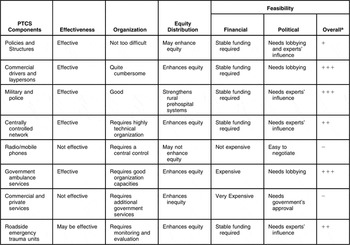
Prehospital Trauma Care System Options Appraisal

aKey: +, mildly feasible; ++, highly feasible; +++, moderately feasible; –, not feasible.
Abbreviation: PTCS, prehospital trauma care system.
South Africa is the only country on the African continent with an organized, statutory system of prehospital care.19 The prehospital system in South Africa works with private emergency companies to provide standard prehospital care to its citizens.19
The Zambian government has a Specialty Emergency Service that has been in operation since 1991 as an advanced life support and ambulance evacuation service; it complements the Zambian police emergency response in rendering prehospital care.20
The National Road Safety Council of Kenya (NRSCK) is responsible for safety on its highways.Reference Chitere and Kibua21 The success of NRSCK is based upon the strong backing it receives from the government and Ministry of Health.Reference Odero, Khayesi and Heda22
All of the above are structures that have helped prehospital care in the various contexts.
First Responders
The term “first responders” refers to laypersons, passersby, and police; it includes drivers present immediately after an accident/injury occurs. First responders’ activities in Nigeria have not been effective in providing prehospital care, probably because their efficacy in this regard had been disputed by past administrations, and existing laws in the country require that a rescuer/responder file some form of police report when helping crash victims.Reference Oluwadiya, Olakulehin and Olatoke23 Generally, the average Nigerian does not want to have any relationship with the police; this invariably limits the first responder's involvement in providing emergency care.
Save Accident Victims Association of Nigeria (SAVAN) is a nongovernmental organization (NGO) established in 1996 and based at the University of Benin Teaching Hospital, Benin, Nigeria. The SAVAN organization has been involved in first responders’ activities across the country by providing immediate help for crash victims until their relatives arrive. The government has not acknowledged the response efforts of SAVAN or other NGOs involved in crash scene management, which has limited their activities.
In a study conducted in Kenya, unknown persons were reported to be involved in the prehospital care of 76.1% of the injured victims, while the police and military personnel were responsible for prehospital care in 6.1% of the cases.24 In South Africa, studies have demonstrated that 47.6% of accident victims were transported to hospitals by commercial and private means.19 The options appraisal focus, therefore, compares the capacity of commercial drivers and laypersons versus the capacity of military and police in offering prehospital care (Table 2).
In Ghana, 335 commercial taxi and minibus drivers were trained in providing basic first-aid skills to accident victims. In a 6-month follow-up interview, 61% of the trained drivers indicated that they had provided some form of first aid to accident victims after the course, and the corresponding report indicated marked improvement in the provision of various first-aid activities including crash scene management, external bleeding control, airway management, and splinting of the extremities.Reference Mock, Tiska, Adu-Ampofo and Boyakye25, 26 In Uganda and South Sudan, the police and military paramedics also were used effectively in reinforcing their rural prehospital systems.Reference Peden, Scurfield and Sleet8, Reference Vanrooyen, Erickson and Cruz27
Communication Facilities
No stable emergency communication system exists in Nigeria. With the introduction of mobile telecommunication services in 1999, widespread communications in Nigeria have improved; however, this has not been translated into improved emergency services. The Federal Road Safety Commission (FRSC) has emergency call numbers on its Web site: 0700-CALL-FRSC, 0700-2255-3772, and 08077690362; however, the long numbers, and reduced public access to the Internet and media do not make this method of communication very effective. Recently a toll-free emergency number (122) was introduced.28
Today, developed countries employ sophisticated means of emergency communication, digitally controlled from a central source, while some developing countries still use only radio/mobile-phones for their emergency communication.Reference Schopper, Lormand and Waxweiler29 The options appraisal compares the centrally controlled communication network with the use of radio/mobile-phones (Table 2).
The centrally controlled communication network employs enhanced prehospital communication such that all emergency calls are received through a central line, from which each call is forwarded to the nearest prehospital services. Zambian Specialty Emergency Services have a central communication network with seven emergency 24-hour landlines, 24-hour monitored high-frequency radios, fax lines, regularly checked electronic mail, satellite phones, and vehicle radios. The Zambian communication networks operate at a very high technical level.20
South Africa also uses this model; a fixed central emergency call-line (112) receives all incoming calls in a control center in the Johannesburg metropolis.19
The use of radiophones and/or mobile phones as the means of connecting to prehospital services was applied in Lagos, Nigeria at the initial stages of the Lagos State Ambulance Services. The phone system was not very effective because there was no central control. However, with the introduction of a central control source, the services improved.18
Transport and Ambulance Facilities
Ambulance services have been provided by fixed health care facilities within the country; however, ambulances have been widely used by inpatients for hospital referrals and transfers, but have been used scarcely for prehospital services. A study in Kaduna, north-central Nigeria, revealed that there was no formal prehospital transport system for injured victims brought to the hospital.30 Passersby, police, FRSC, and commercial drivers have been the main providers of emergency transportation at the scene of most traffic crashes, with 48.2% of accident victims being transported within the Golden Hour of trauma and others arriving at the emergency department within six hours of injury.Reference Oluwadiya, Olakulehin and Olatoke23, Reference Solagberu, Adekanye and Ofoegbu31, Reference Solagberu, Ofoegbu and Abdur-Rahman32 In Lagos state, however, the state-owned ambulance service, LASAMBUS, operates and has been regarded as the most effective in the country.
In Kenya, ambulances accounted for 1.4% of the transported cases, with 51.9% reaching fixed health facilities within 30 minutes of accidents, and medical care instituted to 66.2% of victims within one hour of injury.24 In South Africa, private and commercial transport services coexist with government ambulance services, and together they have improved the average prehospital transport time.19 These examples reflect two broad delivery models of prehospital transport: government ambulance services versus commercial and private services (Table 2).
Ghana Ambulance Service, a government ambulance service that procured 50 new ambulances in 2005, has begun training the paramedics and ambulance staff in a move to strengthen its prehospital transportation service.33 This capacity building helped to achieve an increase in the number of ambulances placed at strategic locations with a consequent improvement in the average Ghanaian prehospital transport time.
In Namibia, the main functional prehospital transport system is privately owned, and the prehospital transport times have not improved there.Reference Tintinalli, Lisse, Begley and Campbell34 In contrast to Namibia, the South African commercial and privately owned ambulance services have improved prehospital transport time; this can be attributed to government ambulance services that also operate in the country.Reference Brysiewicz and Bruce35
Roadside Emergency Trauma Units
Roadside emergency trauma units have not been widely incorporated into global prehospital settings. Nigeria, uniquely, has several trauma units that are operated by the FRSC, but for the most part, they have not been used effectively for prehospital services. Public health experts opined that if these units were well-equipped, they effectively could serve as first points of call for accident victims prior to transfer to fixed health facilities.
Discussion
As highlighted in the Results section, Nigeria does not have a national prehospital trauma care system (PTCS); however, limited PTCS structures exist in some parts of the country. The discussion here, based on the options appraisal (Table 2), entails the applicability to the Nigerian context of prehospital services available in other countries.
Appropriate policies are essential in implementing a prehospital system. The World Health Organization has recognized this, and has spelled out basic guidelines through its Department of Injuries and Violence Prevention. These guidelines include involving trained bystanders, community volunteers, and some medical professionals in the provision of sustainable prehospital trauma care.Reference Sasser, Varghese and Kellermann5
Specific policies on prehospital and emergency services have been beneficial in South Africa and Ghana. In view of the close contextual similarities of these two countries with Nigeria, the Nigerian government could learn much toward developing an emergency health care policy.
The WHO emphasized that there must be structures (relevant bodies) in place to take care of core administrative elements to ensure that prehospital trauma care system is sustainable and effective in any country.Reference Sasser, Varghese and Kellermann5 A specific and functional prehospital structure with branches within the various Nigerian states can effectively complement the existing FRSC structure.
The utilization of commercial drivers and laypersons as first responders could be effective in Nigeria, as evidenced in Ghana, but it requires good organization, standard training programs, and financial commitment. The contributions of the police and military in offering prehospital care in Africa centers on their presence on highways while mounting roadblocks and checkpoints.26 The use of the military and police could be effective in prehospital care in Nigeria also, and may not be difficult to organize, since the police already form an integral part of Nigeria's limited prehospital care. However, strong political and financial commitments may be needed.
A centrally controlled communication network could be very effective in Nigeria, but will require highly technical organization and steady financial backing. The use of radio/mobile phones has been ineffective, and thus is not advised.
A government ambulance service could be effective in Nigeria and may be available for the poor, women, and children. It also requires sound organization, financial commitment, and political backing.Reference Kobusingye, Hyder and Bishai36, Reference Kobusingye, Hyder, Bishai, Hicks, Mock and Joshipura37 Commercial and private ambulance services are profit-oriented and expensive, and may not be readily available for those less privileged.
Roadside emergency trauma units already exist in Nigeria. If properly integrated into prehospital services, they can reinforce the emergency care system. This is an area for future research.
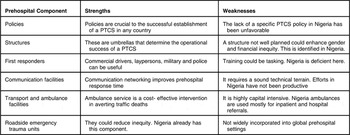
Overall, the use of commercial drivers and laypersons, military and police, a centrally controlled communication network, and government ambulance services, in a background of a favorable policy and structure, could be feasible delivery models for prehospital services in Nigeria (Tables 1 and 3).
Prehospital Services in Nigeria

Abbreviations: FRSC, (Nigerian) Federal Road Safety Commission; NEMA, (Nigerian) National Emergency Management Agency.
Summary of Strengths and Weaknesses Identified in the Analysis of the Components of Prehospital Care in Nigeria

Abbreviation: PTCS, prehospital trauma care system.
Conclusion
An established prehospital trauma care system could play a significant role in reducing morbidities and mortalities from road traffic accidents in Nigeria. A national emergency health policy may be fundamental to the establishment of a formal PTCS in Nigeria, aimed at reducing attendant fatalities and the overall public health burden from RTIs in the country.
Acknowledgements
The author thanks the entire staff, Nuffield Centre for International Health and Development, University of Leeds, UK; Professors Harry Campbell and Igor Rudan, Centre for Population Health Sciences, University of Edinburgh, UK; Dr. Charles Mock, Department of Injuries and Violence Prevention, WHO, Geneva, Switzerland; Dr. Olive C. Kobusingye, Emergency Medicine Expert, Kampala, Uganda; Liew Li Yen, University of Edinburgh, UK; and Funke Davies-Adeloye, Faculty Officer, College of Health Sciences, Bowen University, Iwo, Nigeria.
Abbreviations
- FRSC:
(Nigerian) Federal Road Safety Corps
- LASAMBUS:
Lagos State Ambulance Services
- NEMA:
(Nigerian) National Emergency Management Agency
- NGO:
nongovernmental organization
- NRSCK:
National Road Safety Council of Kenya
- PTCS:
prehospital trauma care system
- RTI:
road traffic injury
- SAVAN:
Save Accident Victims Association of Nigeria
- WHO:
World Health Organization