How can interpersonal trust be cultivated among policy elites engaged in long-term face-to-face negotiations? This article seeks to identify the precursors of interpersonal trust in high-stakes disputes where opposing sides have long histories of animosity and differ on fundamental values and perceptions. What are the beliefs and personal circumstances that predispose one policy actor to trust another? What are the institutional arrangements that foster trust during protracted multiparty policy deliberations? How can policymakers break the vicious cycle of distrust and noncooperative behavior and initiate a “virtuous cycle” of trust and cooperation (Putnam 2000)?
Understanding how policy elites build mutually trusting relationships is crucial in several contexts, with a unifying theme being that all politics is personal. Resolving conflicts through political means usually boils down to cooperation among two or more individual persons who, though they are political adversaries, must eventually achieve a rough consensus on disputes over policy or procedure. These face-to-face negotiations can last many months or years, such that personal relationships are likely to evolve over the course of negotiations, and can have a major influence on whether an agreement is achieved. In legislatures, for example, harmonious interpersonal relationships help members work across party lines to move legislation through multiple veto points (Price 2004, Reingold 1996). Distrust, especially if unfounded, can result in gridlock in which legislators fail to achieve agreements or compromises that could benefit the constituents of both political parties. Interpersonal relationships also come into play during regulatory negotiations (Weber 1998) in which agencies work with interested parties to avoid protracted litigation, and during litigation itself, when parties usually prefer to negotiate out-of-court settlements rather than risk the expense and uncertainty of trial. In the context of international peace negotiations, distrust between negotiators can have particularly stark consequences in terms of life and death (Tyler 2000).
Although interpersonal trust is not always essential for achieving cooperation or collective action, it is an important catalyst in a wide range of policymaking contexts (Cook, Hardin, and Levi 2005). In an age where Congress is more partisan than ever (Hetherington 2001, 622) and where views on moral issues are increasingly polarized among those citizens who self-identify as political partisans (Evans 2003), understanding how trust arises among political actors is as important as ever.
Previous attempts to explain interpersonal trust have generally been guided by one of two prominent traditions in political science: institutional rational choice and social psychology. Both traditions view trust as a precursor to consensus building and collective action, but they diverge on how trust arises. Simply put, institutional rational choice views trust as resulting from recent evidence of the trustworthiness of other parties and from institutional rules that encourage trustworthiness; social psychology views distrust as arising from belief conflict, cognitive limitations, and misgivings about the legitimacy of the policymaking process. The roots of each tradition's differing predictions lie in their distinct models of individual behavior, to be outlined in the following.
On the premise that science progresses best by comparing and integrating the explanatory power of multiple theories rather than testing hypotheses drawn from a single theory alone (Allison 1969; Platt 1964; Stinchcombe 1968), this article considers both traditions simultaneously. Our goal is not to discard one theory or the other, or to rehash the well-documented limitations of rational choice (Green and Shapiro 1994); rather, it is to integrate insights from both traditions and to work toward defining the range of political situations where rationality drives trust versus those where social psychology dominates.
We consistently employ an inclusive and multidimensional definition of trust, as is advocated in much of the literature (e.g., Braithwaite 1998, 51–52; McKnight and Chervany 1996; Tonkiss and Passey 1999). As elaborated in the following, trust involves faith or confidence in another's propensity to keep promises, to negotiate honestly, to show respect for other points of view, and to express some level of concern for the welfare of others.
INSTITUTIONAL RATIONAL CHOICE
In its simplest form, the rational choice model of the individual assumes a self-interested welfare maximizer whose ability to make optimal choices is curtailed mainly by imperfect information. The choice in question is whether to trust the other parties to the dispute—for example, whether to accept at face value the declarations or proposals they offer during the course of the negotiation. The decision to trust is made largely on the basis of information about the parties' past behavior in similar circumstances, and information about their incentives going forward that might influence whether they continue to negotiate in good faith and keep their promises or ultimately defect. Naturally, trust is higher among parties that have a history of reaching agreements and implementing their provisions. Agreements among adversaries demonstrate willingness to negotiate in good faith and to accept reasonable compromises. Successful implementation demonstrates a propensity to honor commitments and an ability to work competently. Trust ought to be correlated with the length, depth, and recency of past collaboration.
The decision to trust a policy adversary also involves assessing their incentives to cooperate or defect in the future. Institutional rational choice scholars view these incentives as being shaped largely by the presence of rules governing the negotiation, monitoring, and enforcement of consensual agreements (Hardin 2002, 127; Rothstein 2000; Ruscio 1999; Williamson 1993). The presence of such institutions enhances each individual's ability to make a credible commitment (Ostrom 1992, 302). Formalized collective choice rules specify how deliberations are to be conducted and decisions made. Such rules reduce opportunities for misunderstandings regarding the terms of an agreement or whether an agreement was reached. Monitoring rules provide confidence that people who break agreements will be detected. Enforcement rules increase the probability that detected defectors will be punished. Taken together, such institutional rules ought to promote trust by discouraging antisocial behavior.
Several rational choice scholars have attempted to soften the assumption of self-interest by allowing for the possibility that cultural norms predispose individuals to trust others and behave in a trustworthy manner. For example, Ostrom's (1998; 13; 1999) work on common pool resources subsumes many of the hypotheses from social capital theory (Putnam 1993) regarding the positive feedback among specific interpersonal trust, generalized trust, and horizontal social networks. Generalized trust refers to perceptions about people at large, whereas interpersonal (a.k.a. specific) trust describes one's perceptions about specific individuals. One locks the door when leaving home for lack of generalized trust in passers by; one leaves a spare key with a neighbor as an expression of specific trust. Individuals with strong norms of generalized trust are more likely to place confidence in specific individuals (Putnam 2000).
Social networks build trust by providing opportunities for successful collective action. The strength of each interpersonal relationship ought to increase with the frequency of contact and with the cumulative number of interactions over time. Experimental evidence shows that face-to-face communication can lead to social capital, including trust (Ostrom, Gardner, and Walker 1994). Correlational evidence suggests that trust learned in one social circle often spills over to one's relationships beyond that circle (Putnam 1993, 174; 2000). If so, then policy elites who participate in a soccer team, sorority, and service club might be expected to express higher levels of trust toward their policy adversaries. Individuals should express stronger trust in their policymaking opponents if they interact with them frequently, if they have done so for many months, and if they themselves participate in a large number of unrelated voluntary associations.
Assessing the trustworthiness of others is more feasible when the number of parties to a policy dispute is relatively small and stable (Olson 1965). Likewise, the higher levels of surveillance and lack of anonymity that characterize small and stable communities encourage trustworthy behavior, leading to a reputation for trustworthiness. A good reputation is important because it gives others the confidence to speak openly and to provide favors with the expectation that a comparable gesture will be returned at some point in the future. Community stability also reduces each individual's discount rate, increasing their willingness to incur immediate costs to achieve delayed or long-term benefits of collaboration (Ostrom 1990, 35). People who plan to exit a policy arena in the near future have less incentive to invest in building constructive working relationships.
Softening the rationality assumptions can confound or even reverse certain hypotheses regarding institutions and trust. When a society with strong norms of trust and cooperation is subjected to a strict enforcement regime, the norms can weaken, resulting in diminished cooperation overall (Lubell and Scholz 2001). Similarly, in cooperative games, trust and trustworthiness can be highest when enforcement is weak (Bohnet, Frey, and Huck 2001). When enforcement is strong, players trust the legal system to deter breaches of contracts, but they don't necessarily trust each other. When enforcement is virtually absent, players alter their behavior and become more trustworthy to attract lucrative contract offers.
Another confounding factor is the reciprocal nature of cause and effect between institutions and trust. Institutional rational choice theory predicts that trust should follow the adoption of suitable institutions, but social capital theorists reason that societies adopt these institutions only after trust is found to be insufficient to spur cooperation.1
Putnam (2000, 145) charts the explosive growth in the per capita number of police, security guards, lawyers, and judges over the last 40 years, and concludes that Americans have increasingly invested in “the rule of law” to compensate for declining social capital.
If institutions can be viewed as both a precursor to trust and a societal response to distrust, then institutions and trust might correlate either positively or negatively in a cross-sectional study. A positive correlation would indicate that the rational-choice mechanism dominates. A negative correlation would indicate that the social capital mechanism is stronger. A null correlation would be ambiguous; either both effects are absent or both are equal in magnitude and cancel out.
SOCIAL PSYCHOLOGY
Political scientists have long been interested in models of individual behavior that depart from the economist's assumptions of self-interested rationality. The fields of cognitive and social psychology, in particular, have generated several useful insights related to cognitive dissonance (Festinger 1957), biased assimilation (Lord, Ross, and Lepper 1979; Munro and Ditto 1997), computational constraints (Simon 1985), risk aversion (Quattrone and Tversky 1988; Tversky and Kahneman 1981), and belief system hierarchies (Converse 1964; Lakatose 1971). Rarely, however, have scholars attempted to spell out what these assumptions imply for the dynamics of trust among political elites engaged in policy negotiations. Two exceptions are the Advocacy Coalition Framework developed by political scientists Sabatier and Jenkins-Smith (1993, 1999) and the literature on interest-based negotiation, which grew out of scholarship in law and business administration (e.g., Fisher and Ury 1981).
Both the Advocacy Coalition Framework and the interest-based negotiation literature assume that an individual's policy-relevant beliefs are nested in a hierarchy. At the highest level are “core beliefs” or “underlying interests,” which are relatively general in scope and difficult to change. At a lower level are “secondary beliefs” or “policy positions,” which are relatively narrow in scope and malleable.
The fundamental insight from the interest-based negotiation literature is that the classic horse-trading model of negotiation, in which each party concedes one or more policy positions to achieve a compromise agreement, frequently leads to socially suboptimal solutions that serve the fundamental interests of neither party. An interest-based approach, by contrast, employs a Tocquevillian notion of enlightened self-interest in which the parties agree to invest time and energy inventing novel policy proposals that address not only one's own underlying interests but also those of one's adversaries. Thus, interest-based negotiation requires the parties to publicly reveal sufficient information about their own core interests to allow the other parties to work toward policy proposals that might satisfy them. To pursue an interest-based negotiated settlement is an inherently trusting act. It requires the parties to recognize that, although they might not share the same underlying interests as their policy adversaries, their adversaries' interests are still legitimate and worthy of being satisfied. Interest-based negotiation requires faith in the willingness of others to negotiate honestly and without malice. It also requires faith in the basic fairness of the collaborative policymaking process. Each individual's level of interpersonal trust should therefore correlate with both their enthusiasm for consensus-based decision making and the perceived fairness of a given collaborative process.
The Advocacy Coalition Framework employs a belief hierarchy to help explain how individuals assess the trustworthiness of other parties. Specifically, the framework suggests that individuals assess trustworthiness by comparing their own core beliefs to those of other parties. Relative to secondary beliefs, core beliefs ought to be the most efficient guides to the trustworthiness of others because they are more general in scope than secondary beliefs. Within the core, the Framework discriminates between deep core2
Deep core beliefs are fundamental, normative, and ontological axioms that operate across all policy sectors. Examples include the prioritization of competing values (e.g., freedom vs. security), the proper scope of government authority, and the relationship between people and nature.
and policy core
3 Policy core beliefs identify the welfare tradeoffs deemed appropriate for achieving deep core values within a policy sector. Examples include judgments about the relative importance of competing social groups (e.g., tribal vs. commercial fishermen), and the relative importance of competing problems (e.g., scarcity of water for environmental vs. agricultural uses).
beliefs. Because policy core beliefs are more directly salient to specific policy disputes than are deep core beliefs, the Framework hypothesizes that “the policy core provides the principle glue of coalitions” (Zafonte and Sabatier
1998), and the principle foundation of trust. Reliance on heuristic indicators of trustworthiness is necessary because each individual's ability to process and analyze information is assumed to be limited by time and computational constraints (Simon
1985), making it unfeasible to systematically evaluate the other parties' past behavior and institutional incentives (the focus of institutional rational choice theory).
Consistent with the literature on cognitive dissonance and biased assimilation, the Advocacy Coalition Framework assumes that preexisting beliefs strongly influence the filtering of new information, especially at the policy core level (Lord, Ross, and Lepper 1979; Munro and Ditto 1997). Individuals who differ on core beliefs see the world through different lenses and often interpret a given piece of evidence in different ways. This produces distrust because people who reach opposite conclusions on factual issues tend to question each other's motives or reasonableness. Even on policy topics where the scientific evidence is relatively clear, policy elites who lack a common set of perceptual filters will tend to view their adversaries as backward, ignorant, or malevolent. The problem is exacerbated when the relevant data are ambiguous.
If belief conflict is a major source of distrust, then building trust requires a convergence of beliefs over time. Sabatier and Zafonte (2001) suggest that such a convergence (termed “policy-oriented learning across coalitions”) is only feasible for disputes that are analytically tractable (meaning accepted quantitative data and theory exist) and when the conflict is mediated through a “professional forum” in which a neutral facilitator forces scientific experts from competing coalitions to justify their claims before their peers using accepted standards of data quality and inference. Achieving agreement on empirical issues should enhance trust by demonstrating that opponents are in fact reasonable people who can be convinced by sound evidence.
The Advocacy Coalition Framework borrows prospect theory's assumption of risk aversion, meaning people weigh losses more heavily than gains (Quattrone and Tversky 1988; Tversky and Kahneman 1981). Risk aversion in combination with the filtering of new information implies that policy elites will remember their political defeats more vividly than their victories. As a result, policy actors tend to view their opponents as being more powerful than they actually are, a phenomenon termed “devilshift” (Sabatier, Hunter, and McLaughlin 1987). Individuals experiencing devil shift distrust their opponents even more because they perceive their opponents as having the means to cause harm—not just the will. Moreover, people who are risk averse probably approach new interpersonal relationships with great caution and skepticism, not unconditional trust. Trust should be inversely related to devil shift.
Finally, the interest-based negotiation literature predicts that a political stalemate is a necessary condition for a policy dispute to be ripe for negotiation (Fisher 1997; Kriesberg 1998). In other words, the parties must mutually perceive that their best alternative to negotiation (usually litigation, lobbying, or the status quo) is unlikely to produce satisfactory results. If none of the parties can successfully pursue their agenda in an alternate venue such as the courts or legislature, then they need not worry about other parties defecting from the negotiations by appealing to external authorities. A mutual stalemate would bolster each party's confidence that the other parties will respect the consensus-based process rather than switch venues.
STAKEHOLDER PARTNERSHIPS AS POLICYMAKING VENUES
Stakeholder partnerships are one type of collaborative policymaking forum in which trust is thought to be critical for success, and where building trust is often an explicit, instrumental goal (Leach and Pelkey 2001). Stakeholder partnerships consist of policy elites who convene about once a month to discuss or negotiate public policy within a broadly defined issue area. Most partnerships include representatives from private advocacy groups, local governments, and state and federal agencies. The primary goal is to achieve consensus regarding formal agency rulemaking, discretionary agency actions, or voluntary commitments from the private sector. Unlike other forms of consensus-oriented policymaking, partnerships are intended to last several years as they address multiple interrelated issues of concern to various stakeholders (Leach, Pelkey, and Sabatier 2002).
Stakeholder partnerships are increasingly common, particularly in the field of natural resource and environmental policymaking. Since the late 1980s, partnerships have formed throughout the United States to address disputes over water quality and related land use issues (Kenney 1999). The U.S. Environmental Protection Agency (EPA) has catalogued 3,500 partnerships and other watershed groups nationwide (EPA 2002).
Given their popularity and potential influence on environmental outcomes, stakeholder partnerships are an excellent setting for studying the evolution of interpersonal trust among policy elites engaged in long-term, face-to-face negotiations. Understanding how they function is a worthy task for political scientists interested in institutional design, regulation, devolution, interest groups, or environmental policy.
METHODS
The study examines 76 stakeholder partnerships dealing with local watershed policy and implementation, randomly sampled from the states of California and Washington. Quantitative case studies of the 76 partnerships were compiled between 1999 and 2003. The field research began by identifying all partnerships in California that were active at any point between 1995 and 2000, including partnerships defunct at the time of the study. To be included in the sampling frame, a partnership needed to meet at least four times per year and focus on managing one or more streams, rivers, or watersheds. To ensure adequate diversity of stakeholders, each partnership needed to include (1) at least one state or federal official; (2) at least one representative of local government—either a general-purpose city or county, or a special district (such as water or school district); and (3) at least two opposing interests, such as a resource user and either a regulatory agency or an environmental group.
The search revealed a population of 150 partnerships in California, from which 47 were randomly sampled with geographic stratification, such that no more than two partnerships were selected from a single watershed.4
We partitioned California using Hydrologic Unit Code watersheds defined by the U.S. Geological Survey. There are 160 watersheds in the state, ranging from 35 to 9,000 square miles.
In Washington we randomly selected 20 watersheds and sampled 1 to 2 partnerships from each.
5 We partitioned Washington using the 62 Water Resource Inventory Areas, which range from 140 to 3,000 square miles.
Because the selection process was random and the sample size is relatively large, the overall results should be representative of watershed partnerships in the two states.
The sample includes 12 partnerships that had disbanded by the time of the study. In three cases, they had achieved their main objectives. The other nine disbanded after their negotiations ended in stalemate.
For each selected partnership, we first interviewed three to six key participants including the partnership's coordinator/facilitator plus at least one key participant from a pro-environment perspective and at least one participant from a pro-development perspective. Second, we analyzed relevant documents such as watershed plans and meeting minutes. Finally, we mailed a survey to all participants in the partnership plus several stakeholders who were knowledgeable about the partnership but were not members.
For the survey, names of participants and nonparticipant stakeholders were obtained during the interviews. The smallest partnership had six survey recipients, and the largest had 76. Of 2,498 surveys, 1,625 were returned at least partially completed, yielding a response rate of 65%.6
Assuming response rate definition, RR2 (The American Association for Public Opinion Research 2000, 36).
Response rates for individual partnerships ranged from 45% to 88%.
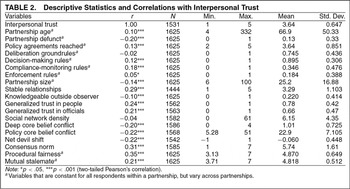
Throughout the paper, the unit of analysis is the individual survey respondent. The models of interpersonal trust presented in the following section include individual-level variables from the survey (e.g., respondent's social network density) and partnership-level variables gleaned from the interviews and documents (e.g., the number of participants). The construction of each variable is described briefly in the following section. Details are given in Appendix B. Appendix A (Table 2) presents descriptive statistics for each variable.
Measuring the Dependent Variable: Interpersonal Trust
The survey measures interpersonal trust by asking each respondent, with respect to their own partnership, “How many of the participants (a) are honest, forthright, and true to their word? (b) have reasonable motives and concerns? (c) are willing to listen, and sincerely try to understand other points of view? (d) reciprocate acts of good will or generosity? (e) propose solutions that are compatible with the needs of other members of the partnership?” Respondents answer each question by indicating: 1 = none, 2 = few, 3 = half, 4 = most, 5 = all. The five questions are averaged to generate a composite measure of trust. As such, the scale measures the breadth, rather than the intensity, of each respondent's trust in other members of the partnership. Focusing on breadth of trust is appropriate in the context of consensus-based policymaking, where distrust of any single participant can derail agreements or other forms of collective action by the partnership as a whole.
The composite scale is reliable and consistent as indicated by a high Chronbach's alpha (0.87) and the high Pearson's correlations between each question and the scale (respectively, 0.78, 0.77, 0.84, 0.84, and 0.80). The high interitem correlations lend empirical support to our decision to employ a composite, multidimensional measure of trust rather than define trust more narrowly.7
In the regression model presented below, substituting any one of the five variables for the full trust scale yields results similar to those for the full scale, although the model fit is not as strong, as would be expected considering that scales generally reduce measurement error, and considering that the scale in question has high internal reliability (Chronbach's alpha 0.87).
The data on interpersonal trust are normally distributed with a mean of 3.6 and a standard deviation of 0.65. In other words, two thirds of respondents believe that at least half—but less than all—of the participants are trustworthy.
Measuring Rational Choice Explanatory Variables
Measures for each variable are detailed under Appendix B. In the following, is an overview of how each variable is operationalized.
Three variables capture aspects of the stakeholders' breadth and success of past collaboration. First, each stakeholder is characterized as pertaining to a defunct partnership or an active one, as of the time of the study. Second, the partnership age is measured in months from inception to the time of the study, or to disbandment in the case of defunct partnerships. Third, to quantify partnership agreements, we use interview data and documents to devise an ordinal 5-point index where the top score indicates agreement on a comprehensive watershed management plan.
To characterize each partnership's institutional rules, interview data are coded to generate qualitative variables indicating the presence or absence of deliberation groundrules, decision-making rules, compliance monitoring rules, and enforcement rules (see Appendix B).
Three variables related to the likelihood of reputation for trustworthiness include (1) partnership size, the number of participants in the respondent's partnership, gleaned from interview data and documents; (2) stable relationships, the proportion of the other stakeholders with whom the respondent expects to continue interacting over the next five years; and (3) nonparticipant observers, who are distinguished from active partnership participants by asking survey respondents to self-identify into either category.
Generalized trust in people and generalized trust in public officials are measured using questions replicated from the General Social Survey.
The social network density of each respondent is measured as a count of the number of voluntary associations the respondent affiliates with, patterned after a question from the General Social Survey.
Measuring Social Psychology Explanatory Variables
Each respondent's enthusiasm for the consensus-building process is measured with two variables. First, the respondent's consensus norm is assessed by asking whether “consensus-based negotiation among stakeholders, including agencies,” is a valuable approach for resolving disputes, when juxtaposed with three alternatives: agency purview, landowner purview, or tradable permits. Second, respondents are asked to assess the procedural fairness of the process in terms of whether it “treats all parties fairly and consistently.”
Deep core belief conflict and policy core belief conflict compare the respondent's beliefs to the average beliefs within the partnership. The greater the difference, the higher the respondent will score on each belief conflict variable. Deep core beliefs are measured using a five-question scale regarding the respondent's laissez-faire conservatism. Policy core beliefs are measured by asking respondents to evaluate the relative seriousness of 13 problems in the watershed, ranging from degraded water quality to weakened property rights.
Net devil shift (devil shift minus angel shift) is measured by asking respondents to name the three most powerful or influential members of the partnership, the three members they consider their closest allies, and their three main opponents. Devil shift is the proportion of powerful members who are opponents. Angel shift is the proportion who are allies.
Mutual stalemate is proxied by asking each respondent whether they lack alternate venues outside the partnership, suitable for pursuing their interests. Responses from within each partnership are averaged to create a partnership-level variable measuring the extent to which parties mutually perceive that their alternatives to negotiation are limited.
RESULTS AND DISCUSSION
What are the institutional and psychological factors that bolster trust among policy adversaries, and what is the relative importance of each? Table 1 presents three linear regression models of interpersonal trust; one using rational choice variables, one using social psychology variables, and one combined model. Each model employs ordinary least-squares regression8
Multicollinearity was checked three ways. First, variance inflation factors in all models are low, never exceeding 2.1. Second, no model exhibits both a high condition index (i.e., >15) plus two or more variables with high variance proportions (i.e., >0.8). Finally, randomly sampling 50% of the observations and rerunning the analysis yields similar results.
with robust Huber–White standard errors.
9 In the event that the errors are correlated for respondents within a partnership, ordinary least-squares regression would underestimate the error variance. The Huber–White standard errors, when clustered on a variable identifying the partnership each respondent belongs to, are consistent even if the errors are not identically distributed (Moulton, 1986).
All three models fit the data reasonably well, with adjusted
R2 statistics of 0.21 for the rational choice model, 0.25 for the social psychology model, and 0.34 for the combined model. Of the 1,625 total observations, the proportion dropped due to listwise deletion for missing data in the three models is 16%, 13%, and 20%, respectively.
The Rational Choice Model of Trust
In the institutional rational choice model, seven of the 13 coefficients are both statistically significant and correlated with trust in the predicted direction.10
Dropping nonsignificant variables from the model generates little impact on the remaining coefficients or the R2.
One coefficient (that for social network density) is statistically significant (
p = 0.03), but
inversely related to trust, contrary to the prediction. When the social psychology variables are added to the model, the coefficient becomes insignificant (
p = 0.43). A related finding is that social network density, which was measured as a count of the voluntary associations in which the respondent participates, is unrelated to
generalized trust in people (
r = 0.02) or public officials (
r = 0.01) among the sampled policy elites. These results are puzzling in light of several studies that found strong correlations between membership in voluntary associations and trust among the general public (e.g., Brehm and Rahn
1997; Putnam
2000; Putnam, Leonardi, and Nanetti,
1993).
Other studies, however, failed to find any relationship, or found nonlinear relationships between trust and voluntary associations (National Commission on Civic Renewal 1998; Sullivan and Transue 1999). In their review of this literature, Hibbing and Theiss-Morse (2002, 186) conclude that voluntary groups “all too often do nothing to help people learn to come to a democratic solution on divisive issues” because most groups are too homogenous (Peel 1998) or shun controversial issues (Eliasoph 1998) or promote “trust of those you know or distrust of those you do not” (Levi 1996, 49).
We speculate that another mechanism is operating in our own study, which looks exclusively at policy elites, whose social networks are quite dense relative to the general public.11
Respondents in the present study reported membership in an average of 6.2 voluntary associations (median = 5), whereas the general public reports an average of 1.8 associations (median = 1), as reflected by the General Social Survey, Question 328, survey years 1974–1994.
If most stakeholders are extremely well networked, then joining a few more voluntary associations would presumably add little additional capacity for trust. That is, the positive effect of networks on generalized trust may eventually plateau. To explain the inverse relationship, we speculate that at very high levels, network density reflects social capital that is spread too thin, leaving individuals with insufficient time or energy to develop strong trusting relationships with other members of the partnership,
on average. In other words, once generalized trust plateaus, adding additional nodes to one's social network simply reduces the proportion of individuals whom one trusts highly.
Judging by the relative size of the standardized coefficients, the most important correlates of trust in the rational choice model are the number of participants in the partnership (inversely related to trust), stable interpersonal relationships, and generalized trust in people and government. The importance of generalized trust suggests that some stakeholders were already predisposed to be trusting when they first joined the partnership. This baseline generalized trust seems to influence the eventual formation of specific trust among partnership members. Causation in the opposite direction is less likely because one's specific experiences within the partnership should have only a marginal effect on general attitudes, which are shaped by the sum of all experience. For example, Hetherington's (1998) reciprocal model of trust in elected officials suggests that general attitudes affect specific ones “much more powerfully than the reverse.”
Of the four categories of institutional rules examined (deliberation groundrules, decision-making rules, compliance-monitoring rules, and enforcement rules), only the presence (vs. absence) of decision-making rules is statistically significant. Specifically, interpersonal trust is lower in partnerships that have not yet determined the rules for making collective choices (e.g., simple majority vote, unanimity, and informed consent) or where the participants expressed confusion about whether such rules were in place. This result lends support to the rational choice hypothesis that clear decision rules bolster confidence in the ability of the other participants to make credible commitments.
The insignificance of monitoring and enforcement rules is difficult to interpret because rational choice theorists view such rules as precursors to trust, whereas social capital theorists view the adoption of such rules as a societal response to low trust. The null correlations might indicate that both mechanisms are equal in magnitude and cancel out in a cross-sectional analysis. Alternatively, both mechanisms might actually be absent, especially considering that consensus-based policy negotiations, like international courts, involve parties that participate on their own volition. In such arrangements where participants voluntarily submit to the authority of the collective body, moral suasion typically plays as large a role in enforcing agreements as does the threat of formal sanctions (Rieke and Kenney 1997, 51). Moreover, legal impediments prevent many of the parties in watershed partnerships, such as public agencies and sovereign tribes, from formally subordinating themselves to the partnership. Accordingly, monitoring and enforcement rules occurred with relatively low frequency among the partnerships sampled (32% and 18%, respectively).
The model includes three variables that capture aspects of the partnerships' breadth and success of past collaboration: the partnership's age, its status as active or defunct, and the level of agreement achieved to date. Only active status correlates with trust in the rational-choice model, but it is insignificant in the combined model. The age of the partnership and the level of agreement achieved are significant in neither model. These results imply that incremental gradations of success are not predictive of trust, but the abject failures and severed relationships represented by defunct partnerships do predict distrust, at least prior to controlling for the social psychology variables.
The model also includes a binary variable distinguishing partnership participants from other local stakeholders who did not self-identify as participants. The variable is statistically significant, indicating that participants in partnerships display more trust than do knowledgeable outside observers.12
We designed the study to include relevant non-participant stakeholders partly to guard against selection bias. For example, the absence of effective institutional rules conceivably could have caused such a loss of trust that these potential participants selected out of the partnership (Tyler and McGraw 1986). To test whether the institutional factors affected nonparticipants differently than participants, we added variables for the interaction effect between participant status and each of the partnership-level variables (those denoted by superscript “a” in Table 1). In the resulting model (not shown) none of the 10 interaction terms are statistically significant, and the direct effects of each variable are essentially unchanged from those in the simple models of Table 1. In conclusion, we find little evidence that the institutional variables affect participants and nonparticipants differently. However, a remaining question is whether the suppressed levels of trust among nonparticipants caused them to select out, or whether selecting out buffered them from the trust-building effects of the collaborative process, or both. Nonparticipants tend to have slightly weaker consensus norms (5.6 vs. 5.8 for participants, on a 7-point scale, p<0.01) and slightly less positive perceptions of the fairness of particular partnerships (4.5 vs. 5.0, p<0.01), but again it is unclear whether these views caused or resulted from non-participation.
The Social Psychology Model of Trust
Each of the six social psychology variables correlates significantly with trust in the predicted manner in both the reduced and the combined models. The two strongest correlates of trust in both the reduced and the combined models are the stakeholders' general confidence in the legitimacy of consensus-based decision making, and their confidence in the fairness of their specific collaborative process.
The analysis shows that trust is inversely related to belief conflict on representative measures of both deep core ideology (laissez-faire conservatism) and policy core beliefs (judgments about the relative seriousness of various problems within a policy sector). The Advocacy Coalition Framework had predicted that policy core conflict should impair trust more so than deep core conflict. The coefficients for each variable are consistent with this prediction in both the reduced and the combined models, but the difference between coefficients is not statistically significant in the reduced model (p = 0.12). In summary, the models suggest that disagreement over the relative importance of various problems is at least as important as disagreement over whether government should play a liberal or conservative role in regulating economic activity.
Both the reduced and the combined models support the importance of two of the more innovative variables from the social psychology literature. First, net devil shift correlates negatively with the degree of trust. The more one views opponents as being more powerful than allies, the lower the degree of trust in partnership participants. Second, both the reduced and combined models indicate that stakeholders trust one another more when they collectively lack opportunities to undercut the partnership by shopping for alternate venues.
PRACTICAL IMPLICATIONS FOR COLLABORATIVE POLICYMAKING
What are the implications for policy elites engaged in collaborative policymaking? Some of the variables identified previously are more easily manipulated than others. For example, core beliefs and generalized trust are probably very difficult to change over the short term. The best that a mediator or facilitator can do is call attention to their importance and hope that participants will muster their most productive attitudes. The alternative—limiting participation to those who hold moderate policy views and endorse consensus decision making—would have the added benefit of reducing group size, but could undermine trust by damaging the perceived legitimacy of the process (Leach and Pelkey 2001). The importance of procedural fairness suggests that facilitators should periodically assess whether participants feel respected and perceive themselves as having an appropriate degree of control over the outcomes of the negotiations (Tyler and Blader 2000). The mere presence of procedural groundrules—a statistically insignificant variable from the rational choice model—is apparently not sufficient to bolster trust.
One of the clearest findings is that trust is higher among participants who plan to interact with the other members of the partnership over the next 5 years. Partnership conveners could bolster trust by making it clear at the outset that the process is designed to last several years into the future. Watershed partnerships typically take about 48 months to reach formal agreements and to implement restoration, education, or monitoring projects (Leach, Pelkey, and Sabatier 2002).
This analysis may be the first to empirically link trust to devil shift—the perception that one's opponents are more powerful than one's allies. Devil shift appears to be an important facet of the syndrome of distrust among policy elites. The implication of this finding depends on whether the perceived power imbalance is accurate or exaggerated. If the perception is accurate, facilitators should pay particular attention to bolstering trust among politically weaker parties. If the power imbalance is imaginary, facilitators could design exercises to lead stakeholders toward accurate assessments of their relative power within the partnership by exploring each party's best available alternative to negotiation. One of the purposes of adopting a consensus-based decision rule, as most partnerships do, is to help level the balance of power within the partnership itself.
The importance of policy core belief conflict also has implications for how negotiations are structured. If distrust stems from disagreement over which problems are most serious, then deliberations should begin with a period of “joint fact finding” and consensus building on the basic dimensions of the various problems. Partnerships can also pursue empathy-building exercises, such as field trips to the local businesses or environmental sites affected by the partnership's actions. Over the long term, partnerships can commission scientific investigations to settle disputed facts.
Another finding with potential implications for institutional design is the association between trust and mutual political stalemate, measured as a collective lack of alternatives to negotiation. In a political system like that of the United States where legal authority is diffuse, alternative venues will always be present. What counts, however, is the extent to which participants in the partnership view them as viable (Baumgartner and Jones 1993). Although partnerships have little ability to curtail their members' rights to appeal decisions through the legal system, legislators and agency administrators can help limit routes of appeal by signaling their commitment to respect decisions reached through consensus within a partnership.
METHODOLOGICAL AND THEORETICAL IMPLICATIONS: INTEGRATING SOCIAL PSYCHOLOGY AND RATIONAL CHOICE
This study illustrates the utility of testing two or more models at a time, and where appropriate, seeking to integrate models under one unified framework. Because data are often consistent with multiple theories, testing hypotheses from a single theory often leads to overconfidence (Stinchcombe 1968). By testing multiple models, one can ascertain which fits the data best, or whether two or more models are complementary, each contributing predictive power. Testing multiple models also helps researchers avoid two common biases: confirmation bias (a tendency to seek confirming evidence) and theory tenacity (persistent belief in a theory despite contrary evidence; Loehle 1987). By investing professional and emotional energy in at least two theories, researchers buffer themselves against the inevitable psychological stress that occurs when empirical results contradict the predictions of any one theory.
Another argument for multiple models is their necessity for strong inference, the term Platt (1964) coined for conclusions drawn from experimental studies that conclusively discriminate between two or more competing hypotheses. Platt argued persuasively that strong inference is the most efficient path to progress in science. However, the comparative strategy cannot produce strong inference until theory is relatively mature, with clear and precise predictions (Loehle 1987, 399). In fields where theory is relatively imprecise or phenomena are especially complex or studies are difficult to devise, strong inference remains a laudable yet unattainable ideal. Even so, comparative studies are valuable when they demonstrate that emerging models perform comparably to more mainstream models and deserve to be cultivated further.
Over the last 20 years, political scientists have predominately pursued single-theory studies and have often grounded their models of the individual in micro-economics and its rationality assumptions. The results presented earlier suggest the discipline should renew its ties to other traditions such as social and cognitive psychology. The Institutional Analysis and Development framework (Ostrom 1999) represents one such attempt to relax the assumption of rationality by allowing for cultural norms and other community characteristics that predispose individuals to behave in socially desirable ways. In fact, our findings suggest that the classic rational choice variables (i.e., institutional incentives and evidence of past trustworthiness) have relatively little influence on interpersonal trust in the context of long-term policy negotiations. Only one of the four institutional rules variables in the model is significantly correlated with trust.
In this data set, the bulk of explanatory power from the rational choice variables comes from those variables borrowed from social capital theory. Specifically, interpersonal trust is highest among individuals in small groups with stable relationships and strong norms of generalized trust in people and government. Similarly, the significance of stakeholders' perceptions of procedural fairness and consensus norms, when juxtaposed with the statistical insignificance of institutional groundrules, lends support to Ostrom's (1999) increasing emphasis on norms over rules. We hasten to add that institutional rules might contribute to perceptions of fairness, but evidence of such a mechanism is mixed at best in this dataset.13
Individual-level variation in perceived procedural fairness correlates moderately well with several institutional variables: partnership age (r = .22), partnership defunct (r = −.28), policy agreements reached (r = .28), decision-making rules (r = .18), and compliance monitoring rules (r = .24). On the other hand, none of these institutional variables is statistically significant if procedural fairness is substituted for trust as the dependent variable in the rational choice model. Instead, perceived fairness is correlated with stable relationships and generalized trust, and inversely related to nonparticipant observer status and social network density (N = 1310, adjusted R2 = 0.14).
By taking rationality assumptions as the starting point for modeling individual behavior, political scientists may overemphasize the importance of institutional rules.
Social capital theory makes important contributions to the rational choice model, but the results also firmly contradict the social capital hypothesis that trust results from network density. At least within the realm of policy elites in watershed partnerships, the number of voluntary associations participants belong to correlates with trust inversely or not at all, depending on how the model is specified.
By contrast, all six hypotheses derived from social psychology are supported. The paramount importance of stakeholders' perceptions of the fairness and legitimacy of the process (the variables consensus norms and procedural fairness) parallels the finding of Hibbing and Theiss-Morse (2001, 2002) that people's attitudes toward government are driven primarily by their satisfaction with how government operates, not by its track record of producing agreeable policies. Just as policy space (the distance between citizen's preferred policies and those the government actually produces) explains trust in government to a lesser extent than process space, so too are stakeholders' perceptions of procedural fairness and legitimacy better predictors of interpersonal trust than is the partnership's track record of producing policy agreements. Policy space does come into play in our model of interpersonal trust, but only at the level of policy-related values (the variable policy core beliefs), not the partnership's success in actually forging policy agreements. Specifically, trust declines with the distance between each individual's policy-related values and the average values of other members of the partnership. In sum, the social psychological emphasis on process norms and core values explains trust better than the rational emphasis on hard evidence of trustworthiness, as revealed by the parties' ability to compromise and reach formal agreements on policy.
With the social psychology model performing comparably or better than the rational choice model in terms of individual hypotheses and overall fit, the social psychology model clearly merits attention in future research. Nonetheless, the goal is not necessarily to discard one framework or the other. After many years of trying, the authors have never identified any truly opposing hypotheses between the two frameworks, where one predicts a positive correlation between two variables, and the other predicts a negative correlation. Instead, when explaining the development of trust or collective action, each framework emphasizes a distinct and sometimes overlapping set of explanatory variables. Although the two frameworks are rooted in separate branches of the social sciences and are built around strikingly different assumptions, they are not incompatible. Political actors are at once rational and psychological creatures. Ideally, models of political behavior would integrate these two human faces.
One strategy for pursuing such an integrated framework is to further define the scope of the two underlying models (Loehle 1987, 401). For example, scholars could seek to identify the range of political situations where rationality dominates human behavior, and those that call forth the psyche. The findings of this study suggest that a more complex model incorporating insights from social psychology is particularly useful when:
- the policymaking process is being conducted through prolonged face-to-face deliberations
- the format of the process is relatively novel (such as collaborative, consensus-based processes)
- the relative influence of various actors is ambiguous (thus feeding the devil shift)
- stakeholders disagree over fundamental values and norms
- the issues are scientifically complex, such that policy actors also disagree on the relative severity and causes of different problems
- monitoring and enforcement mechanisms are difficult or impossible to establish (such as negotiations among autonomous and highly heterogeneous stakeholders, as in the present study)
We speculate that rationality may dominate in situations where it is easier to calculate the probability of defection, or where the stakeholders have more direct financial stakes in the outcome of negotiations. If true, this would parallel the well-documented observation that self-interest drives citizens' policy preferences only when the personal costs and benefits of a policy are highlighted (Young et al. 1991) or are especially clear (Chong, Citrin, and Conley 2001) or substantial (Green and Gerken 1989). Further research would be required to test these propositions about rational and psychological roots of trust.
Given the prospect of profitable collaboration on the one hand, and costly betrayal on the other, to trust a political adversary is a weighty and complex decision. Trust is an elusive phenomenon—part emotion and part rational calculation—part reflex and part deliberate act. Social scientists seeking to identify the determinants of trust in political contexts will meet with greater success if they are willing to consider multiple theoretical frameworks and employ models of human behavior that are suitably elaborate.
APPENDIX A. DESCRIPTIVE STATISTICS
APPENDIX B: VARIABLE DEFINITION AND SURVEY QUESTIONS
Data are drawn from the survey unless noted otherwise. Wording of survey questions is indicated by quotation marks. Unless noted, questions are close-ended 7-point scales where 1 = strongly disagree, 7 = strongly agree; and 9 = no opinion.
Partnership age. Months from inception to the time the interviews were conducted, or until disbandment in the case of defunct partnerships.
Policy agreements reached. Coded by the research team from interviews and partnership documents. (1 = no agreement, 2 = agree on which issues to discuss, 3 = agree on general goals or principles, 4 = agree on one or more restoration projects, 5 = agree on a comprehensive watershed management plan.)
Deliberation groundrules. Dummy variable coded by the research team from interviews and partnership documents. Codeform wording: “Were formal process or groundrules established?”
Decision-making rules. Dummy variable coded by the research team from interviews and partnership documents. Codeform wording: “Decision rules: None or decision rules haven't been settled yet.”
Compliance monitoring rules. Dummy variable coded by the research team from interviews and partnership documents. Codeform wording: “Did the partnership monitor compliance with agreements?”
Enforcement rules. Dummy variable coded by the research team from interviews and partnership documents. Codeform wording: “Were sanctions used in cases of noncompliance?”
Partnership size. The average number of people in attendance at partnership meetings. Coded by the research team from interviews and partnership documents.
Stable relationships. “Please indicate whether the following statements apply to none, few, half, most, or all of the participants in the partnership. How many of the participants…do you expect to keep interacting with over the next five years?” (5-point scale: 1 = none, 2 = few, 3 = half, 4 = most, 5 = all).
Knowledgeable outside observer. “Do you consider yourself a participant in the Partnership?” (1 = Yes, 0 = No. Recoded to 1 = outsider, 0 = participant.)
Generalized trust in people. “Do you think most people would try to take advantage of you if they got a chance, or would they try to be fair?” (1 = Would take advantage, 2 = Would try to be fair, 3 = Other. Recoded to: 1 = Would try to be fair, 0 = Would take advantage or Other.)
Generalized trust in public officials. “Most public officials (people in public office) are not really interested in the problems of the average person.” (1 = Agree, 2 = Disagree, 3 = Other. Recoded to 1 = Agree, 0 = Disagree or Other.)
Social network density. Modeled after the 1987 General Social Survey (questions 328–356), this variable tallies the responses to the following 11-part question. “For each category below, please tell us how many different groups you participate in. For example, if you are a member of a softball team and a chess club, write ‘2’ on the first line. (a) Recreational clubs: sports teams, hobby clubs, birding groups, etc. (b) Religion-affiliated groups or congregations. (c) Youth groups. (d) Culture or ethnicity groups. (e) Service organizations. (f) Fraternity or sorority. (g) Veterans groups. (h) Business or professional associations, or labor unions. (i) Property rights groups. (j) Environmental advocacy groups. (k) Other organizations.”
Deep core belief conflict. The absolute value of the difference between the respondent's laissez-faire conservatism and the mean level of laissez-faire conservatism within the respondent's partnership. Laissez-faire conservatism is a scale calculated as the mean of the following five questions “(a) The best government is the one that governs the least. (b) A first consideration of any good political system is the protection of private property rights. (c) Government laws and regulations should primarily ensure the prosperity of business because the health of the nation is dependent upon the well-being of business. (d) Government planning almost inevitably results in the loss of essential liberties and freedoms. (e) Decisions about development are best left to the economic market.” (Chronbach's alpha 0.82; Spearman's correlations between each question and the scale: 0.78, 0.81, 0.76, 0.79, 0.65, respectively).
Policy core belief conflict. Using respondents' perceptions of the relative seriousness of 13 problems in the watershed, this variable is an index of the (absolute value) difference between the respondent's perceptions and the average perception of all members of the partnership. Formally:
where Xi = Respondent's perceived seriousness of Problem i. Yi = Mean perceived seriousness of Problem i within the respondent's partnership.
“Please indicate the current seriousness of the following problems for your watershed. Using the thermometer scale below, a score of 100 indicates an extremely serious problem, while a score of 0 indicates the issue is not a problem at all. Impaired water quality, Inadequate water supply, Lack of open space, Threats to species or habitat, Risk of catastrophic fire, Risk of damaging floods, Excessive gov't regulation or taxes, Threats to private property or water rights, Threats to tribal or treaty rights, Excessive population growth or urban development, Lack of economic prosperity, Conflict among stakeholders, Other key issue:” (optional write-in).
Allies. “Please identify up to three organizations/interests that you regard as allies on issues important to the partnership.”
Opponents. “Please indicate up to three organizations/interests that you disagree with most frequently on issues important to the partnership.”
Powerful. “Please indicate the three organizations/interests that are most important or influential regarding partnership issues.”
Devil shift. The proportion of powerful stakeholders who are opponents.
Angel shift. The proportion of powerful stakeholders who are allies.
Net devil shift. Devil shift minus angel shift.
Consensus norm. Subquestion A of the following: “Listed below are four alternative approaches for managing watersheds. For each alternative, please circle the response that best reflects your opinion. ‘The best strategies for resolving watershed issues include…(a) consensus-based negotiations among stakeholders, including agencies. (b) reliance on each agency's legal mandate and court review. (c) reliance on tradable permits for water, fish catch, development, etc. (d) allowing private property owners to manage their land as they see fit.”
Procedural fairness. “The partnership process treats all parties fairly and consistently.” Responses from each partnership are averaged to create a partnership-level indicator.
Mutual stalemate. “If the partnership fails to adopt workable solutions, my concerns could probably be satisfied by appealing directly to the legislature, courts, or individual agencies.” The scale is reversed, and then responses from each partnership are averaged to create a partnership-level variable.
We thank Mark Lubell and Chris Weible for suggesting several improvements to the manuscript, and Neil Pelkey for alerting us to the literature on interest-based negotiation and its relevance to the Advocacy Coalition Framework. The research was carried out by the authors and other members of the Watershed Partnerships Project at UC Davis: Maryann Hulsman, Steve Kropp, Tamara LaFramboise, Christal Love, Neil Pelkey, Jim Quinn, Kate Reza, Martha Turner, and Chris Weible. Funding was provided by the National Science Foundation's “Decision Making and Valuation for Environmental Policy” program (Grant 9815471), the United States Environmental Protection Agency's “Science to Achieve Results” (STAR) program (Grant R82-7145), the David and Lucile Packard Foundation's “Conserving California Landscapes Initiative,” and the William and Flora Hewlett Foundation's Conflict Resolution Program.






Comments
No Comments have been published for this article.