Introduction
Weed management is a major concern for all farmers and especially organic farmers who often struggle with greater weed abundance compared with conventional farmers (Wortman et al., Reference Wortman, Lindquist, Haar and Francis2010; Baker and Mohler, Reference Baker and Mohler2015; Jerkins and Ory, Reference Jerkins and Ory2016). In the absence of conventional chemical control options, organic farmers depend on a diverse mix of cultural and mechanical approaches to weed management. Crop rotation, cover crops and increased crop planting densities are popular cultural approaches, while tillage, mowing, flaming and hand weeding are common mechanical weed control methods (Baker and Mohler, Reference Baker and Mohler2015). Despite recent advances in non-chemical weed control, hand weeding remains a necessary weed control tactic for many organic farmers, especially fruit and vegetable growers.
In the absence of herbicides, time spent on hand weeding crops has been estimated at 12 h ha−1 for soybean (Glycine max) and maize (plus four to six cultivations) (though hand weeding is uncommon in grain crops), 37–92 h ha−1 for tomato (plus six to eight cultivations), 75 h ha−1 for cucumber (Cucumis sativus; plus three cultivations), 149 h ha−1 for pepper, and 158 h ha−1 for onion (Allium cepa; plus two cultivations) (Klonsky et al., Reference Klonsky, Tourte and Chaney1993, Reference Klonsky, Tourte, Chaney, Livingston and Smith1994; Dartt and Schwab, Reference Dartt and Schwab2001; Gianessi and Reigner, Reference Gianessi and Reigner2007). Increased labor for hand weeding means that many organic farmers can spend hundreds of dollars per hectare on weed control. Indeed, Klonsky (Reference Klonsky2012) estimated that hand weeding labor costs on organic vegetable farms are two to three times greater than on conventional farms and range from an estimated US$541 ha−1 in organic lettuce (Lactuca sativa) to US$862 ha−1 in organic tomato production. Given price premiums for organic crops, especially organic specialty crops, labor costs may account for less than 2% of gross crop revenue (Fennimore and Doohan, Reference Fennimore and Doohan2008). However, farm labor is increasingly difficult to source, retain and afford in the USA. (Escalante and Luo, Reference Escalante and Luo2017) and mechanization of weed control and other farming practices may be critical to the long-term viability of the organic farming industry (Fennimore and Doohan, Reference Fennimore and Doohan2008).
Recent research efforts to mechanize organic weed control and reduce hand weeding costs include the use of flaming, steaming, robotics and machine vision cultivation. Flame-weeding is an effective organic weed control method and can be more profitable than hand weeding, tillage and organic herbicides alone (Nemming, Reference Nemming1994; Granatstein et al., Reference Granatstein, Andrews and Groff2014). Nemming (Reference Nemming1994) found that hand weeding labor in onion could be reduced by 31–72% with one or two flaming applications, respectively. Similarly, one flaming pass in beet (Beta vulgaris) reduced hand weeding time by 47% (Nemming, Reference Nemming1994). Sørensen et al. (Reference Sørensen, Madsen and Jacobsen2005) estimated that steaming and robotic weeding platforms can reduce total farm labor (through reductions in hand weeding) by 60–85% for farmers growing carrots (Daucus carota subsp. sativus) and beets, respectively.
Cultivation is essential for most organic farmers and is most often used to control weeds between rows; however, machine vision technology can improve precision to allow for the cultivation of in-row weeds. Fennimore et al. (Reference Fennimore, Smith, Tourte, LeStrange and Rachuy2014) demonstrated that a rotating cultivator guided by machine vision was more effective for weed control than inter-row cultivation alone and reduced hand weeding time by up to 64% in lettuce. Despite the labor savings, the profitability of machine vision cultivation was not different from hand weeding. With any mechanized alternative to hand weeding, the capital costs of equipment can limit profitability; however, this cost can be minimized by increasing the scale of production or by hiring custom applicators on an hourly or area basis (Melander, Reference Melander, Foguelman and Lockeretz1998; Sørensen et al., Reference Sørensen, Madsen and Jacobsen2005). Even when profitability is comparable with hand weeding, mechanical weed control solutions can offer farmers flexibility in when they weed and for how long (e.g., machines can weed at night and do not tire over the course of the day) (Fennimore et al., Reference Fennimore, Smith, Tourte, LeStrange and Rachuy2014).
Abrasive weeding is a mechanical weed control tactic with the potential to reduce hand weeding on organic farms. Abrasive grits are propelled with compressed air and banded at the base of crop plants to defoliate and snap stems of small weed seedlings growing within the crop row. Successful abrasive weeding depends on a distinct size difference between the crop (larger and more tolerant) and weeds (smaller and more susceptible) to ensure weeds are destroyed while crop plants sustain only minimal stem or leaf tissue damage. Two grit applications can reduce in-row weed biomass by 69–97% in tomato, pepper and maize, and compared with a weedy check, abrasive weeding has been shown to increase crop yield by 33–66% (Wortman, Reference Wortman2015; Braun, Reference Braun2017; Erazo-Barradas et al., Reference Erazo-Barradas, Friedrichsen, Forcella, Humburg and Clay2019). Despite the demonstrated effectiveness of abrasive weeding in organic crops, the profitability of this mechanical option has not been evaluated. The objective of this study was to estimate the profitability of abrasive weeding compared with hand weeding in organic grain and vegetable crops.
Materials and methods
A partial budget for abrasive weeding was calculated as the difference of returns less costs per hectare after the intervention during the production of maize, tomato, green pepper and red pepper. Returns were estimated from empirical yield data from recent abrasive weeding studies in maize (cvs. Viking 79-96N and Blue River 33L90; Erazo-Barradas et al., Reference Erazo-Barradas, Friedrichsen, Forcella, Humburg and Clay2019), tomato (cv. Big Beef; Wortman, Reference Wortman2015), green pepper (cv. Revolution; Wortman, Reference Wortman2015) and red pepper (cv. Carmen; Braun, Reference Braun2017). For each study, the most effective abrasive weeding treatments were compared with weedy and weed-free controls. In maize, the weedy control and all abrasive weeding treatments included inter-row cultivation or flame-weeding at the V5 growth stage. In tomato and pepper, plastic mulch film was used in all treatments, including the weedy-checks. In maize (Erazo-Barradas et al., Reference Erazo-Barradas, Friedrichsen, Forcella, Humburg and Clay2019), grits were applied one (2014) or two (2013) times between the V1 and V5 maize growth stage, and weed density prior to application ranged from 30–60 plants m−2 (predominantly Amaranthus retroflexus L. and Chenopodium album L.). In tomato, green pepper and red pepper, grits were applied approximately 2 and 4 weeks after transplanting crops into plastic mulch film. In tomato and green pepper (Wortman, Reference Wortman2015), weeds were between 2 cm (pepper) and 7 cm (tomato) tall at the time of grit application and weed density ranged from 1 (pepper) to 6 (tomato) plants m−2 (predominantly Amaranthus retroflexus L., Chenopodium album L., and Setaria viridis (L.) P. Beauv.). In red pepper (Braun, Reference Braun2017), weeds were less than 5 cm tall and density was approximately 55 plants m−2 (predominantly Amaranthus spp.).
Yield gains following abrasive weeding or hand weeding relative to the weedy check in each study (±15%) were combined with organic crop price estimates to determine gross revenue potential. Prices for maize (US$0.26–0.40 kg−1), tomato (US2.20–8.82 kg−1), green pepper (US$1.32–6.61 kg−1), and red pepper (US$2.20–9.92 kg−1) were estimated from the USDA Economic Research Service (2018) and price reports from University of Vermont Extension (2018). Tomato and pepper price estimates included a range of wholesale, retail and farmers’ market prices. Increased crop yield is likely accompanied by increased expenses associated with managing, harvesting, storing, transporting, or marketing the extra grain or produce; however, these potential costs will vary greatly among farmers, business models and the degree of yield gain so we did not attempt to estimate these expenses in this partial budget analysis.
Expenses considered in the analysis included hourly wages, and costs of ownership for the grit applicator, tractor use, fuel and abrasive grits. Wages were determined as the mean wage (including payroll taxes and social security) for hired field workers ± US$2 hr−1 (USDA National Agricultural Statistics Service, 2018). Across all crops, hand weeding took an average of 25.3 s m−1 of crop row (bare soil not covered by the plastic film), and we included a range of ±15% to account for variability in weeding rates among fields and individuals. The cost of ownership for the four-row (maize) and single-nozzle (tomato and pepper) grit applicators used in the analyzed studies was determined using the Iowa State University Ag Decision Maker (Edwards, Reference Edwards2015). We assumed an interest rate (financed) or opportunity cost (cash) range of 2–5%, a tax/insurance/storage rate of 1%, a useful life of 20 yr, a salvage value of 29% after 20 yr, and a purchase price range from US$1200 (parts) to US$3500 (retail) for the single-nozzle applicator and US$10,500 (parts) to US$18,500 (retail) for the four-row applicator. ‘Parts’ applicator prices were estimated based on the cost of parts alone and assumes that the farmer would assemble the applicator without any labor costs or consideration of opportunity costs. Retail applicator prices assume a fully-assembled applicator and were estimated based on the cost of parts, labor, and a profit margin of 20%. A tractor was required for the four-row applicator (whereas, the single-nozzle applicator was hand-pulled on a garden cart) and tractor use costs were estimated based on a 65 horsepower tractor (±US$2 hr−1) requiring 1.02 h use per ha to make one grit application (University of Illinois FarmDoc, 2018). The abrasive grit cost estimate range accounted for variability in order size and material (>10 Mg order of maize cob grit was US$0.11 kg−1 whereas a 22.7 kg bag of soybean meal was US$1.76 kg−1). Based on calibrations in each study analyzed, a grit application rate of 480 kg ha−1 was used for maize, 66 kg ha−1 for green and red pepper and 50 kg ha−1 for tomato. Grit application rates per hectare were reduced in vegetable crops due to wider row spacing and because grits were only applied to the planting hole area (10 × 15 cm2 area where crop seedlings were transplanted into plastic mulch film). The maize grit applicator was PTO-driven and did not require additional fuel, but in the case of peppers and tomato, grit application fuel use was estimated using a fuel consumption rate of 7.6 ± 1.9 L hr−1 and a 10-yr mean for regular grade gasoline in the USA of US$0.77 L−1 (U.S. Energy Information Administration, 2018). Using estimates for revenues and expenses, we calculated the upper range of net income potential by subtracting the lowest expense estimates for each category from the highest revenue estimate. Similarly, we calculated the lower range of net income potential by subtracting the highest expense estimates from the lowest revenue estimate. Lastly, the mean net income potential was determined based on upper and lower income estimates.
For each of the four crops analyzed, we compared four possible profitability scenarios. Two scenarios were based on empirical yield data from weed-free, weedy and grit-treated plots in each study. Two additional hypothetical scenarios were considered, including: (1) time spent hand weeding was halved, resulting in weed control and yield gains comparable with the empirical abrasive grit application data and (2) the number of grit applications was increased from two to four per season, resulting in weed control and yield gains comparable with the empirical weed-free data. The first hypothetical scenario reflects a common on-farm reality where annual weeding demands exceed labor or time available to hand weed. The second hypothetical scenario explores the question of whether abrasive grit application could be an economically viable alternative to hand-weeded, weed-free conditions if 100% in-row weed control could be achieved without any yield-limiting crop damage (note, this is an untested assumption).
Results and discussion
Maize
Abrasive weeding in organic maize was not profitable (Table 1), except when considering the most optimistic assumptions and weed-free conditions (i.e., greatest possible crop yield increase and price, and lowest possible input costs). However, hand weeding to achieve weed-free conditions doubled net losses compared with abrasive weeding. Hand weeding in-row weeds is rarely profitable in grain crops given the narrow row spacing and low commodity prices, even for organic crops (Pimentel et al., Reference Pimentel, Hepperly, Hanson, Douds and Seidel2005). While abrasive weeding and hand weeding both resulted in net income loss, many organic farmers practice ecological weed management and aim to mitigate weed seed rain and seedbank abundance that can rapidly accumulate over the long-term (Wortman et al., Reference Wortman, Lindquist, Haar and Francis2010). When a ‘zero seed rain’ weed management strategy is employed by the farmer (Brown and Gallandt, Reference Brown and Gallandt2019), abrasive weeding may be used, at least in combination with hand weeding, to eliminate in-row weeds. It is also important to note that net income from abrasive weeding in maize increased with the scale of production to an upper limit of approximately 100 ha; whereas, there was no economic incentive to scale production with hand weeding (data not shown). The cost of ownership for the abrasive grit applicator was fixed, therefore increasing the number of hectares of production decreased the per hectare cost of abrasive weeding. This finding is consistent with flaming and other mechanized approaches to organic weed management that require significant equipment purchases. For example, Nemming (Reference Nemming1994) found that flaming was most profitable when onion and sugar beet production area was greater than 20 ha.
Partial budgets for two different levels of weed control and yield benefits resulting from hand weeding or abrasive grit application (via eight-nozzle, four-row applicator) within the in-row area of organic maize. Values in parentheses indicate a net loss of income

a Based on empirical yield data from Erazo-Barradas et al. (Reference Erazo-Barradas, Friedrichsen, Forcella, Humburg and Clay2019).
b Hypothetical scenarios.
The four-row applicator used in maize in Erazo-Barradas et al., (Reference Erazo-Barradas, Friedrichsen, Forcella, Humburg and Clay2019) is relatively expensive (approximately US$18,500 retail), but the value of this larger applicator is that: (1) it can cover more than 3 m width in one field pass, (2) it can be moved faster through the field because there is one nozzle applying grits on each side of the crop row, and (3) it is power take-off driven and requires no additional fuel. Given the advantages of the four-row grit applicator and its proven efficacy (Erazo-Barradas et al., Reference Erazo-Barradas, Friedrichsen, Forcella, Humburg and Clay2019), it may be worth exploring applications in alternative row crops with greater gross revenue potential (e.g., organic dry edible beans or sweet maize) as a means to increase profitability. Another factor limiting the potential for profitability in commodity-scale crops is the cost of abrasive grits, which ranged from US$53 to 846 ha−1 depending on grit type and source (i.e., wholesale bulk versus retail). If abrasive weeding is to be deployed in production-scale organic grain crops, it will be essential to explore approaches for reducing the cost of abrasive grits. Because nearly any small, gritty material can be used to successfully kill weeds via abrasive weeding (Wortman, Reference Wortman2014; Perez-Ruiz et al., Reference Perez-Ruiz, Brenes, Urbano, Slaughter, Forcella and Rodríguez-Lizana2018), there may be opportunities for farmers to use on farm resources (e.g., sand) or agricultural byproducts (e.g., maize cobs) as a free source of grits or grit parent material (less costs of collecting, grinding, or sieving).
Tomato and peppers
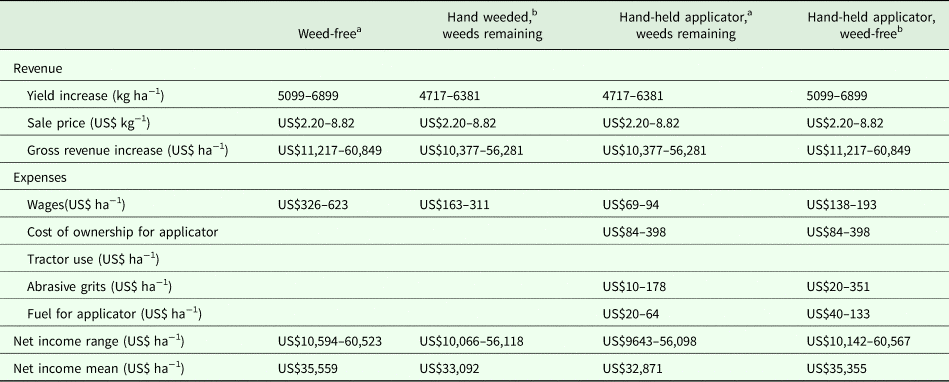
Abrasive weeding and hand weeding were both effective for increasing yield, gross revenue and net income of organic tomato and green and red pepper (Tables 2–4). However, hand weeding for 100% weed control was slightly more profitable than abrasive weeding in tomato and green pepper, and more than twice as profitable in red pepper. If abrasive weeding efficacy could be increased to 100% by doubling the number of grit applications (an untested hypothesis), net income potential would be comparable with hand weeding. Similarly, if hand weeding was not 100% effective (and comparable with results of abrasive weeding where in-row weed density is reduced approximately 90%), net income potential for the two methods would be similar.
Partial budgets for two different levels of weed control and yield benefits resulting from hand weeding or abrasive grit application (via single-nozzle, hand-held applicator) within plastic mulch film planting holes of organic slicing tomatoes

a Based on empirical yield data from Wortman (Reference Wortman2015).
b Hypothetical scenarios.
Partial budgets for two different levels of weed control and yield benefits resulting from hand weeding or abrasive-grit application (via single-nozzle, hand-held applicator) within plastic mulch film planting holes of organic green bell peppers

a Based on empirical yield data from Wortman (Reference Wortman2015).
b Hypothetical scenarios.
Partial budgets for two different levels of weed control and yield benefits resulting from hand weeding or abrasive-grit application (via single-nozzle, hand-held applicator) within plastic mulch film planting holes of organic sweet red peppers

a Based on empirical yield data from Braun (Reference Braun2017).
b Hypothetical scenarios.
Abrasive weeding increased yield by as much as 33–66% compared with the non-treated, weedy controls in tomato and pepper crops (Wortman, Reference Wortman2015; Braun, Reference Braun2017). The magnitude of weed-related yield loss was surprising because all of these crops were grown in plastic or bioplastic mulch films; thus, weed emergence and the competition were limited to the planting hole area immediately surrounding each plant (approximately 10 × 15 cm2). While these weeds are left unmanaged on many farms (personal observation), this profitability analysis highlights the financial urgency of eliminating weed growth in the planting hole of organic, plasticulture vegetable systems. Net income potential of managing weeds in the planting hole (via hand or abrasive weeding) increased with the value of the crop (red pepper > tomato > green pepper) and the intensity of weed competition (red pepper > tomato > green pepper); thus, regardless of the method, organic farmers growing high-value specialty crops should aim for 100% control of planting hole weeds.
If a farmer aims for 100% weed control, abrasive weeding may be used to replace some hand weeding labor and time. While abrasive weeding was not more profitable than hand weeding, it did reduce labor time and costs by 66% (Tables 2–4). Reducing labor demand in organic vegetable production through mechanization of crop management is increasingly important given uncertainty related to immigration and minimum wage policies (Fennimore and Doohan, Reference Fennimore and Doohan2008). It is also important to note that the labor required to conduct abrasive weeding is less physically demanding than hand weeding. Depending on the applicator platform, abrasive weeding requires only a tractor driver (Erazo-Barradas et al., Reference Erazo-Barradas, Friedrichsen, Forcella, Humburg and Clay2019) or an individual to pull a garden cart and apply grits with a hand-held wand (Forcella et al., Reference Forcella, Humburg, Wortman and Clay2017). In the near future, it may be possible to apply grits via autonomous, GPS-guided robotic platforms which would almost entirely eliminate the need for human labor (Sørensen et al., Reference Sørensen, Nørremark, Jørgensen, Jensen, Maagaard and Jensen2007).
A single-nozzle grit applicator used for abrasive weeding in vegetable crops would be less expensive to own than the eight-nozzle applicator used in maize (Tables 2–4), nonetheless, profitability of abrasive weeding in tomato and pepper increased with the scale of production up to approximately 2 ha (Fig. 1). Abrasive weeding costs could be further reduced by sourcing grits on-farm (as discussed with maize), or by using grits with fertilizer value. Organic fertilizers, including corn gluten meal, soybean meal, greensand and composted turkey manure, have all been used successfully as grits for abrasive weeding (Forcella et al., Reference Forcella, James and Rahman2011; Wortman, Reference Wortman2014; Braun, Reference Braun2017; Carlson et al., Reference Carlson, Forcella, Wortman and Clay2018; Perez-Ruiz et al., Reference Perez-Ruiz, Brenes, Urbano, Slaughter, Forcella and Rodríguez-Lizana2018). When applied to soil under controlled conditions at rates typical for abrasive weeding, nitrate is mineralized from organic fertilizers within a 1 month and can increase crop yield (Braun, Reference Braun2017; Carlson, Reference Carlson2018). Under field conditions, organic fertilizer grits can increase soil and plant tissue nitrogen but have rarely increased crop yields relative to walnut shell grits (Braun, Reference Braun2017; Carlson et al., Reference Carlson, Forcella, Wortman and Clay2018). Because organic fertilizer grits were applied during the juvenile phase of crop growth (when soil nitrogen is already in high demand), nitrogen mineralized from the fertilizer may not have been entirely plant available during the first growing season. Perhaps a nutrient credit could be carried forward to the next crop, but that potential value has yet to be quantified and could not be accounted for in this profitability analysis.
Partial budgets across a range of production scales (ha) for two observed (Wortman, Reference Wortman2015) and two hypothetical in-row weed control interventions in tomato, including: (1) hand weeded, weed-free, (2) hand weeded, weeds remaining, (3) hand-held applicator, weeds remaining and (4) hand-held applicator, weed-free.

Conclusions
In-row weed competition is a significant yield-limiting factor in organic cropping systems. Abrasive weeding has the potential to mitigate this yield loss, and results of this analysis suggest abrasive weeding is profitable in vegetable, but not grain crops. Abrasive weeding was often less profitable than hand weeding due to incomplete weed control and the cost of the grit applicator. If abrasive weeding is to be included as part of a broader strategy to mechanize weed management and reduce manual labor required in organic farming, future research efforts should focus on ways to increase efficacy (e.g., grit type, application velocity and timing, frequency, or spray pattern) and to reduce costs of grits (e.g., methods for collecting, grinding and sieving on-farm materials) and application (e.g., autonomous, robotic applicators).
Acknowledgements
Project work was supported by the National Institute of Food and Agriculture, US Department of Agriculture, Organic Agriculture Research and Extension Initiative under award number 2014-51300-22233.