Throughout the colonial period, indentured servitude was an important form of white migration to the New World. Abbot Emerson Smith and Farley Grubb suggested that roughly half of the white immigrants who arrived to the American colonies used indentured servitude contracts.1
Smith, Colonists; and Grubb, “Incidence.”
We focus on servitude migration and examine whether the mainland and the West Indian colonies attracted migrants with different endowments of human capital as early as the seventeenth and eighteenth centuries. Although the literature looks at the characteristics of servants bound for various colonies as they appear in the surviving records, most aspects of servants' human capital such as education, experience, health, and physical strength are not currently observable and, thus, were not analyzed.2
Galenson, White Servitude, pp. 91–96. Servants' ability or inability to sign his contract was recorded, but this is a rough measure of education.
More specifically, migrants who were expected by the European merchants to be more productive received shorter terms of servitude.3
Galenson, “Market Evaluation” and White Servitude; and Grubb, “Auction.”
On the self selection of migrants, see, for example, Borjas, “Self Selection” and “Economics”; and Chiswick, “Is the New Imigration” and “Are Immigrants.”
Following David Galenson, we restrict our sample to nonadult servants because of uncertainty over the role that unrecorded cash payments may have played in altering adult servant contract duration.5
According to Galenson, White Servitude, the full conditions of the contract for young servants were recorded and the duration of servitude appears to be the main variable. For adult servants, cash payments at the end of the term were an important contractual clause, but they were rarely recorded.
We employ a switching regression model (type five tobit) and estimate the length of servitude expected by an individual with certain characteristics in both the mainland and the West Indian islands, taking into account the endogeneity of that individual's migration decision.6
The colonial destination was a major choice variable of prospective servants, Pitman, Development; Smith, Colonists; Galenson, “Market Evaluation” and White Servitude; and Sheridan, Sugar.
We find that servants bound to the West Indies were negatively selected in the sense that, ceteris paribus, they served half a year more than predicted by their observable characteristics. Conversely, servants migrating to the mainland were positively selected in the sense that they had to serve over half a year less than predicted by their observable characteristics. Notably, the regression analysis suggests that servants' characteristics that are currently unobservable were more important determinants of servitude duration than observable characteristics such as occupation, literacy, and gender.
The nature of human capital selection of immigrants to the Caribbean islands and to what later became the United States may suggest the importance of human capital in their subsequent distinct economic development. Despite a higher initial income per capita in the islands compared to the mainland, by the nineteenth century the United States was well on its trajectory of sustained economic growth while the Caribbean islands lagged far behind. Economists and economic historians have explored the role of factor endowments and initial distinct institutions in explaining this divergence.7
For example, Engerman and Sokoloff, How Latin America and “Colonialism”; Acemoglu, Johnson, and Robinson, “Colonial Origins” and “Reversal”; and Acemoglu, Johnson, Robinson and Thaicharoen, “Institutional Causes.”
For the impact of human capital on economic growth, see, for example, Becker, Murphy, and Tamura, “Human Capital”; Galor and Weil. “Population”; Lucas, “On the Mechanism”; and Mankiw, Romer and Weil, “Contribution.” Schultz, “Value,” emphasizes the role of human capital in the efficiency of reallocation of resources after economic shocks. Shastry and Weil, “How Much”; and Weil, “Accounting for the Effect,” show the importance of health in the cross country variation of income. Becker, Murphy, and Tamura, “Human Capital.”
Glaeser, La Porta, Lopez-de-Silanes and Shleifer, “Do Institutions.”
“UNOBSERVABLE” DETERMINANTS OF SERVITUDE DURATION
Our main argument relies on the presence of servants' characteristics unobservable to researchers now but observable to and rewarded by the European merchants who shipped the servants to the New World and sold their contracts once there. In what follows, we describe these characteristics and outline their potential importance in determining servitude duration.
First, healthier and stronger servants may have received shorter terms of servitude, as they were better suited to the physically demanding work of growing, processing, and transporting the sugar, tobacco, or rice; packing and shipping the staple; building houses and farm sheds; and so on. Besides, the stronger and healthier were more likely to survive the long and exhausting trip to the Americas. Thus, servants determined by the merchants to be healthy and strong are expected to have received a shorter length of servitude in the colonies.
Health and physical strength are not observable to us today but were to some extent observable by European merchants and American planters. Grubb considers convict servants and constructs a proxy of physical strength and health by using servants' heights.10
Grubb, “Market Evaluation.” Data on servants' heights are not indicated in the available information on voluntary servants used in this work.
Grubb defines exceptionally tall servants as those servants whose height was one standard deviation above the average height of male British convict servants in Maryland between 1767 and 1775. The secular and cross-sectional differences in human heights have been used by economic historians as measures of nutritional quality, physical strength, and well-being of individuals. See Steckel, “Stature.”
Lauson, Felon's Account, p. 8.
Ibid.
Some felt our hands other our legs and feet,
And made us walk to see were compleat
Some view'd out Teeth to see if they was good,
And fit to Chaw our hard and homely food
the dominant concern is clear in the pages of the merchants' letter books. The seller [of servants] were haunted, above all else, by the fear of disease. Everything depended on the health of their charges, which was unpredictable and uncontrollable.14
Bailyn, Voyagers, p. 330.
the first concern, at the receiving end of the process as at the sending, was thus always health: the best markets were for the “young, healthy, and not deformed”—a concern reflected in innumerable newspaper advertisements announcing the recent arrival and pending sale of “healthy servants—men, women, and boys.” Only slightly less weighty was the stress on occupations and skills.15
Bailyn, Voyagers, pp. 330–31.
Second, correspondence between merchants and planters suggest that planters were looking for servants who were laborious and industrious men, characteristics which merchants could potentially detect but are unobservable to the econometrician.16
Christopher Jeaffreson writing to his London merchant in 1677; quoted in Galenson, White Servitude, p. 134.
Quoted in Galenson, White Servitude, p. 135.
Quoted in Galenson, White Servitude, p. 136.
Whether a servant was indeed skilled in his profession could be easily detected by planters, thus it made sense for the merchant to verify servants' qualities as best as he could. A planter from Virginia who found out that he was misled by a servant, wrote in his diary in 1758:19
Quoted in Galenson, White Servitude, p. 137.
Sent home the fellow sent here for a gardiner. He knows nothing of the matter. Plowman … I keep. He seems a workman and willing fellow.
Third, characteristics such as education, skill, ability, entrepreneurial and managerial skills are important determinants of individuals' productivity, and thus potentially important determinants of servitude duration. These characteristics probably gained importance over time. By the late seventeenth century, the demand for skilled servants increased and servants were often employed as slave supervisors, which meant that servant's qualities such as high ability, ambition, and managerial skills must have been sought for and rewarded by shorter length of servitude. Once again, merchants who dealt with the trade of servants had an incentive to identify such qualities.
Even the observable surviving measures of skill and experience are rough and incomplete. The merchants, by inspecting, examining and interviewing prospective servants, must have had a better sense of the education of a prospective servant than indicated by his ability to sign. Similarly, work experience must have been conveyed better from servants to merchants than is captured by a servant's age, which is the only indication for experience available in the registrations. A servant's occupation, observable to us today, may indicate his skill, but we cannot see how good a carpenter, or cooper, or shoemaker he was. We also cannot observe how motivated and ambitious he was, and we cannot asses from the surviving data his ability to supervise slaves. The merchants must have been able to evaluate a servant's productivity better.
A MODEL OF DESTINATION CHOICE
Unlike African slaves, many Europeans migrated voluntarily in the hope of improving their lives. For those who financed the trip using the indentured contract, a main contractual clause was the colonial destination. Abott Smith noted that:
… most striking of all evidences is that which shows servants preferring one colony over another … in one way or another, whether by published literature or by word of mouth, a certain amount of sound knowledge and honest opinion got about among prospective emigrants concerning the relative excellencies of various colonies.20
Smith, Colonists, pp. 57–58.
A second specifications allow servants to have three choices, namely mainland southern colonies, mainland northern colonies, and the West Indies. Because the results are very similar and for ease of presentation, we present here only the binary choice model. Results from the three-choice specification are available from the authors upon request.
Formally, we employ a switching regression model (type five tobit) that allows for two regimes (in our case migrate to the American mainland or migrate to the West Indies), a criterion function (a migration rule that determines the regime) and two regression equations describing the length of the servitude determination in the mainland and in the West Indies. This framework has been used to study migration, returns to schooling, and the way joining unions effects wages.22
On migration, see Robinson and Tomes, “Self-Selection”; and Ferrie, Yankeys. On returns to schooling, see Willis and Rosen, “Education.” On unions and wages, see Lee, “Unionism.”
Assume that an individual chooses his colonial destination, Di*, based on the difference between the servitude length in the mainland and the West Indies, LiA – LiWI, as well as other individual characteristics that may affect one's taste for location, Zi

here E(ui) = 0 and var(ui) is normalized to one without loss of generality. For every person, we either observe the length of the servitude in the mainland LiA if the servant migrated to the American mainland or the length of servitude in the West Indies LiWI if he migrated to the West Indies. We do not observe the counterfactual length of term that a migrant to, say, the mainland would have served had he chosen the West Indies colonies instead. Note, however, that the length of the servitude reflects a servant's expected productivity, which can be written as a function of his observable personal characteristics Xi affecting expected productivity

here j = WI,A and E(εij) = 0∀j, var(εiA) = σ22, var(εiWI) =σ32.
Thus, if we can estimate the parameters βA′ and βWI′, then given a servant's set of characteristics Xi, we can predict the length of the servitude in the mainland (West Indies) for actual migrants to the mainland (West Indies) as well the counterfactual length of servitude in the mainland (West Indies) for those who migrated to the West Indies (mainland).
An important fact to note is that actual migrants may not constitute a random sample, so that E(LA ‖ D = 1) = βA′ Xi + E (εiA ‖ D = 1) and E (LWI ‖ D = 0) = βWI′ Xi + E (εiWI ‖ D = 0) and an OLS regression might produce biased estimators. The terms E(εiA D = 1) and E(εiWI D = 0) captures migrants' characteristics unobservable to the econometrician that are persistently correlated with the length of servitude. For instance, stronger and healthier individuals could choose to migrate to the mainland, and merchants potentially rewarded their strength and health with a shorter term of servitude. The econometrician, not being able to observe strength and health, will omit an important variable from his OLS regression and produce biased estimators. To properly estimate the model requires correcting the estimation for possible self-selection.
Intuitively, the econometrician can check whether servants' unobservable characteristics from their migration decision are correlated with the duration of servitude. If the unobservable characteristics from the migration decision are consistently associated with a longer duration of servitude, then migrants are negatively selected (e.g., they are weaker and less healthy). If, on the other hand, the unobservable characteristics from the migration decision are consistently associated with a shorter duration of servitude, then migrants are positively selected (e.g., they are stronger and healthier).
Formally, the servant's decision ruleDi* is unobservable, but his choice between the mainland, D = 1, and the West Indies, D = 0, is observable

here Wi is observable and contains all the elements of X and Z.
23We are presenting a switching regression model, with endogenous switch, Maddala, Limited Dependent and Qualitative Variables, p. 223. Although the distributional assumptions used in the analysis are standard, they are strong and might have substantial effect on the estimation. Heckman, “Varieties”; Manski, “Nonparametric Bounds”; and Newey, Powell, and Walker, “Semiparametric Estimation.”
(εi, εiA, εiWI) are assumed to have the following covariance matrix


here ϕ is the Normal pdf, Φ represents the Normal cdf, and

is the inverse mill ratio.
25We are adopting here an identification assumption traditionally used in the literature of self selection (see Heckman and Sedlaceck, “Heterogeneity”): the proportionality assumption. Differences in the evaluation of unobservable characteristics between locations are captured in the constant term of the regression. Therefore, the coefficient on the inverse mill ratio just captures a pure supply effects determined by the relative capabilities of servants arriving to the colonies, and does not reflect different evaluation of unobservable characteristics in different markets.

is the magnitude of the self-selection of migrants to the West Indies, i.e., it is the magnitude of the effect of unobservable (to us today) characteristics of migrants to the West Indies on their servitude duration.
26In the same way, the expected length of servitude in the mainland is

represents the magnitude of the self selection of migrants to the mainland.
Notice the difference between compensating differentials across colonies and servants' selection to the different colonies. The compensating differentials reflect differences in the quality of various colonies and are captured by the difference in the constants (between the mainland and West Indies) of regression. The servants' selection reflects differences in the quality of servants bound to the different colonies and is captured by the term

for the West Indies and

for the mainland.
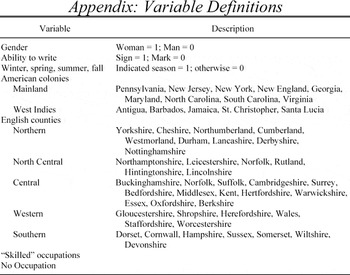
The vector X includes individual characteristics thought to influence the length of servitude in the colonies: age, ability to sign, gender, occupation and the season when the contract was signed. The elements of Z include age, ability to sign, gender and the servants' county of origin (see Appendix 1 for the definitions of counties). The parameters are identified under the restrictions imposed by the model.27
Note that the reduced form Probit (column 1 of Table 1 and Table 2) and the servitude duration equations (columns 3 and 4 in Table 1 and Table 2) are not affected by the exclusion restrictions of X and Z. However, the estimation of the structural Probit (column 2 of Table 1 and Table 2) does depend on the exclusion restrictions, which are required for identification. Under the exclusion restriction, a variable in X that is not in Z, such as the occupation variable, is interpreted as having an effect on the destination choice only through its effect on the servitude duration, but no direct effect on the destination choice.
Bailyn, Voyagers; and Horn, “`To Parts”' and Adapting to a New World.
Grubb and Stitt, “Liverpool Emigrant Servant Trade,” computed correlations between colonial destinations and month of departure and did not find any clear pattern.
Smith, Colonists; and Galenson, White Servitude.
The structural parameters of the binomial model were estimated via a three-step procedure.
31See Maddala, Limited Dependent and Qualitative Variables, pp. 223–28; and Amemiya, Advanced Econometrics, pp. 399–402.

. Then, using
, we obtain the Inverse Mill Ratio for each observation:

. Second, equation (for both the West Indies and the mainland) is estimated by OLS. That is, we run an OLS regression of LiA on Xi and

and get

and

. Third, equipped with
and

, we estimate the structural decision equation to find the determinants of colonial choice, and determine whether or not migrants were expecting shorter servitude in their destination choice.
32The standard errors of the η coefficients have been corrected (using bootstrap method with 1,000 repetitions) for the fact that the regressor is an estimated, rather than observed, value.
THE DATA SETS
Our data sources are the two most important and informative surviving lists of servants registrations from the seventeenth and eighteenth centuries.33
Four other collections of servants recorded in Bristol (1654–1686), London (1683–1686, 1773–1775), and Liverpool (1697–1707) survived, but they lack information that is crucial to our analysis, as variables such as age, literacy, occupation, and the servitude duration were often not recorded. The Bristol Collection is transcribed in Coldham, Bristol Registers. The London collection is reported by Ghirelli, List; and the Liverpool register is reported by French, List.
The data on servants who left from the port of the Middlesex county, 1682–1684, were retrieved from microfilms of the original indenture records entitled Plantation Indentures and created by the London Metropolitan Archives. The original records can be found in the Middlesex Guildhall, in the United Kingdom, and they are also reported in Nicholson, Some Early Emigrants; and Wareing, “Some Early Emigrants.”
The data used for servants who departed from London, 1718–1759 come from microfilms of the original records, entitled Agreements to Serve in America and can be found at the Guildhall, London. This source was transcribed by Kaminkow and Kaminkow, List; and Galenson, “Agreements.”
Our analysis is more meaningful when the full terms of the contract were recorded and when the length of servitude, rather than cash payments, was the main contractual clause. According to Galenson, this was not the case for adult servants, i.e., those over 21 years old, but was the case for minor servants.36
Galenson, White Servitude.
Galenson, White Servitude, found that for minors, cash payments were recorded when made (in fewer than 6 percent of the contracts) and were almost always made to servants bound for four years. Because most adults were bound to serve for four years and because adults rarely appear to have served less than four years, Galenson concluded that for adults cash payments substituted for reduction of servitude below four years.
There is substantial amount of missing information in these records, most of which is occupation information. More than half of the minors did not have a recorded occupation. There is a debate regarding the interpretation of missing recorded occupations.38
See Galenson, White Servitude, pp. 39–64, for a detailed discussion.
Campbell, “Social Origins.”
Results from the second specification are available from the authors upon request.
ESTIMATION RESULTS
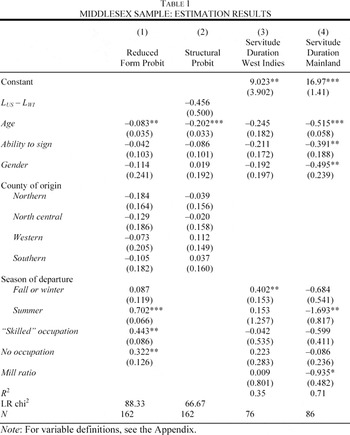
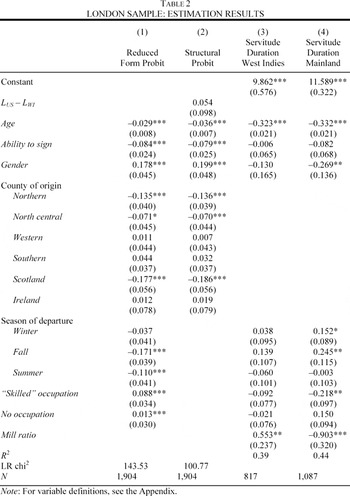
Our estimation results are presented in Table 1 for the Middlesex sample of 1682–1684 and in Table 2 for the London sample of 1718–1759. The estimation results of the determinants-of-migration equations are presented in the first and second columns of both tables.41
Description of the variables is reported in the Appendix.


Migrants' Selection to Colonial America
John Riley was nineteen years old when he left Britain in the summer of 1722 to St. Christopher in the West Indies. He signed his indentured contract with a merchant named Christopher Veale from Shoreditch, Middlesex. Riley did not have a recorded occupation, but he could sign his indenture contract. Given Riley's observable characteristics (gender, age, occupation, literacy, and season of departure), our model predicts that he should have served in the West Indies for a little over three and a half years. However, Riley's indentured contract assigned him five years of servitude, indicating that some factors that are unobservable to us prolonged his period of servitude.
Had Riley gone to the mainland, our model predicts that he would have served an even longer term, which reflects compensating differentials between the mainland and the West Indies. At the same time, William Tayler possessed the same observable characteristics as Riley, and he left Britain in the same summer as Riley and even signed his contract with the same merchant (Christopher Veale). Tayler headed to Maryland and was assigned to serve there for only four years. Although Tayler and Riley possessed the same observable characteristics, Tayler had unobservable characteristics such as health or physical strength that shortened his servitude whereas Riley had unobservable characteristics that prolonged his servitude.
We now turn to the regression analysis that formalizes and generalizes these examples. As shown in the third and fourth columns of both samples, the coefficients on the inverse Mill ratio are positive and big for servants bound to the West Indies in the latter sample and negative and big for servants bound to the mainland in both samples. These results indicate that servants migrating to the West Indies were negatively selected and servants migrating to mainland colonies were positively selected.42
When allowing a servant to choose between northern and southern colonies in the mainland, positive selection of servants to southern colonies such as Virginia and Maryland appears to be stronger compared to northern colonies. Moreover, the results are robust to the inclusion of the price of sugar in England.
Moreover, we find that the unobservable characteristics varied with gender and literacy. In particular, the unobservable qualities of men were better than those of women (i.e., the term

is, on average, bigger for men than for women) in both the United States and the West Indies. For example, whereas an average men served in the mainland seven months less than his observable characteristics indicate, women only served four months less than suggested by their characteristics. In the West Indies, men served five months longer than suggested by their observable characteristics, compared to seven months for women. Similarly, literate individuals seem to have brought with them better unobservable qualities than illiterate individuals.
The difference in the constant terms suggests that, when abstracting from personal characteristics, servitude was shorter in the West Indies than in the mainland. This reflects the higher general desirability of the mainland over the West Indies. The positive and negative coefficients on the Mill ratios (columns 3 and 4) imply that, abstracting from the compensating differentials, there was a negative selection of servants to the West Indies and a positive selection to the mainland.44
The result is robust to the inclusion of year of departure, and birth cohort of the servant (constructed as year of departure minus age of the servant). On the distinction between selection and compensating differentials, see, for instance, Goddeeris, “Compensating Differentials.”
The strong selection effects imply that in the seventeenth and eighteenth centuries, people who were of higher quality—as observed by their contemporaries but not by us—preferred mainland destinations over the West Indies colonies and that those who had lower unobservable qualities were more likely to migrate to the West Indies. These findings are consistent with the historical evidence, which highlighted the fact that migrants to the West Indies were “lazy useless sort of people …,” and that mainland colonies offered more attractive opportunities for talented servants than did West Indies destinations.45
Pitman, Development, p. 52. Continental colonies are believed to have provided better opportunities than West Indies for talented individuals. Smith noted that in continental colonies: “there was always a scarcity of labor; always land to be had; always a decent livelihood to be won by those who had the qualities necessary to win it. Thus the freed servant with his new clothes and his small stock of corn need never have lacked for employment. If he desired land and independence he could acquire them in time, even if not immediately on his freedom” (Colonists, p. 293).
Hector St. John de Crevecoeur, in his Letters from American Farmer published in 1782, writes that: “there is room for every body, in America. Has he any particular talent, or industry? he exerts it in order to procure a livelihood, and it succeeds … Is he a laborer, sober and industrious? he need not go many miles, nor receive many informations before he will be hired, well fed at the table of his employer, and paid four or five times more than he can get in Europe” (Smith, Colonists, p. 292).
According to Smith, West Indian colonies “presented no such satisfactory prospects. Excepting Jamaica they were all of small size, and it was not long before the land was taken up.” Servants to the West Indies were described as “Artificers and Laborers that come from Europe, that soon grow lazy and Indolent.” They were “Runagadoes and a loose sort of people” (Pitman, Development, p. 54). The English governor commented that a servant arriving to the West Indies were “a lazy useless sort of people who come cheap and serve for deficiencies and their hearts are not with us” (Pitman, Development, p. 54). Smith asserts that “it is plain that no intelligent and informed man or woman would emigrate to the West Indies as a servant after the first years of settlements were over … No doubt there were some good servants, and some successful careers even in the eighteenth century, but we must look upon the white servant in the West Indies generally as being unfortunate individual, prized mainly for the color of his skin, unable to find work, apt even to conspire with slaves, a tragic outcast in the colonial world” (Smith, Colonists, p. 295).
In terms of selection patterns over observable characteristics, our analysis shows (as reported in Tables 1 and 2, column 1) that servants who were more skilled (defined as carpenters, blacksmiths, spinsters, weavers, and shoemakers) were more likely to move to America's mainland. In the case of the London sample this result is in contrast with that reported by Galenson: according to his analysis skilled servants were more likely to migrate to the West Indies.46
Galenson, White Servitude, pp. 91–95.
However, both Galenson's analysis and ours suggest that individuals who could sign their names were more likely to migrate to the West Indies rather than to the mainland.47
Galenson, White Servitude.
It is interesting to notice that the selection over unobservable characteristics had a larger effect on the length of servitude than the ability to sign or occupation.48
The results of the probit estimation are robust to the inclusion of year of departure and birth cohort.
Returns to Human Capital
Galenson estimates returns to human capital in the seventeenth and eighteenth centuries by joining observations for the West Indies and the American mainland.49
Galenson, White Servitude, pp. 104–05.
Galenson suggests two possible reasons for the wage premium received by women. The first is that the demand for them was higher due to shortage of wives for colonists (women constituted less than 6 percent of emigrants in this sample), and the second is that women might have been more productive in certain household jobs (such as nursing and cooking) that were demanded by colonists.
Our results are consistent across the seventeenth- and eighteenth-century samples. In both samples we find compensating differentials such that, abstracting from personal characteristics, servitude was longer in the mainland compared to the West Indies. Women received a shorter period of servitude in the mainland in both the seventeenth and eighteenth centuries. In the seventeenth century, age was more valued in the mainland colonies than in the West Indies, but in the eighteenth century this gap disappeared.
Notice that our estimators of the determinants of servitude duration are not directly comparable with Galenson's.51
Galenson, White Servitude, pp. 104–05.
The subdivision that Galenson makes of colonial destinations is the following: Antigua, Barbados, Jamaica, Other West Indies, Maryland, Virginia, Other mainland.
In another specification, we divide American mainland between Northern colonies and Southern colonies. Our results are robust to this specification.
DISCUSSION AND CONCLUSIONS
During the seventeenth century, the West Indian colonies were considered the richest regions of the Americas. At the beginning of the eighteenth century, Barbados's per capita income was 50 percent higher than the per capita income of the American mainland.54
Engerman and Sokoloff, “Institutions.”
The current research attempting to explain this different patterns of economic development has focused on the role of factor endowments and institutions. The debate has concentrated on which of the two factors has played a more important role. One perspective emphasizes that geography is the principal factor determining economic development.55
Diamond, “Guns”; Gallup, Sachs, and Mellinger, “Geography”; and Sachs, “Tropical Underdevelopment.”
North, Structure; North, Summerhill, and Weingast, “Order”; Hall and Jones, “Why Do Some Countries”; Acemoglu, Johnson and Robinson, “Colonial Origins” and “Reversal”; Acemoglu, Johnson, Robinson and Thaicharoen, “Institutional Causes”; and Rodrick, Subramaniam and Trebbi, “Institution Rule.”
Engerman and Sokoloff, “Factor Endowment,” “Institutions,” and “Colonialism.” Acemoglu, Robinson, Johnson, “Colonial Origins” and “Reversal,” also account for the effects of geography on institutions.
In contrast, by emphasizing the different quality of human capital arriving in various colonies, this article points out the possible importance of migrants' human capital in explaining the different patterns of economic development in the two regions.58
Our analysis does not reveal whether good servants may have been attracted to the mainland because of its geography and natural endowment or because the mainland already had better institutions early on. Nevertheless, given our findings, the various explanations of the divergence of the two regions should take into account the divergence in the quality of human capital these regions attracted.
Glaeser, La Porta, Lopez-de-Silanes, and Shleifer, “Do Institutions.”
Although the extent and size of the importance of human capital in explaining the different patterns of economic development in the two regions is a topic for future research, we suggest here three possible channels through which human capital may have affected the divergence between the economic development of the mainland and the West Indies.
First, human capital and education have a direct impact on economic growth and an indirect impact on economic development through their effect on institutions.60
For the direct impact, see Becker, Murphy, and Tamura, “Human Capital”; Galor and Weil. “Population”; Lucas, “On the Mechanism”; and Mankiw, Romer, and Weil, “Contribution.” For the indirect impact, see Glaeser, La Porta, Lopez-de-Silanes, and Shleifer, “Do Institutions.”
Second, as already discussed, health may be an important part of the unobservable characteristics in our analysis. Recent research suggests that between 10 percent and 29 percent of the share of the actual cross country variance in log-income per workers is explained by variation of health.61
Shastry and Weil, “How Much”; and Weil, “Accounting for the Effect.”
Third, the unobservable characteristics may consist of servants' entrepreneurial skills, which can contribute to facilitate the adoption of new technologies and the construction of good institutions. Starting from the work of Lowell Ragatz, an important stream of historiography on the British Caribbean colonies depicts the West Indies as a technologically conservative environment.62
Ragatz, Fall.
Bridenbaugh and Bridenbaugh, No Peace; and Dunn, “Sugar.”
For a re-evaluation of the role of the planters in the West Indies see Green, “Planter”; Sheridan, Sugar; and Ward, “Profitability.”
In contrast, American mainland colonies had an environment more receptive of technology adoption. Alan Olmstead and Paul Rhode, for instance, show how cotton planters in the early nineteenth century were actively engaged in matching the technology and the environment.65
Olmstead and Rhode, “Wait a Cotton Pickin' Minute!”
Notice, however, that this example may be a consequence of the good people arriving a century earlier, or simply another outcome of whatever it was that made good people want to go to the mainland.
Appendix: Variable Definitions

We are grateful to Martin Bodenstein, Timothy Bresnahan, Marco Da Rin, Adeline Delavande, Joe Ferrie, Avner Greif, Nisan Langberg, Joel Mokyr, Kathy Spier, Luis Vasconcelos and Gavin Wright for their helpful discussions and suggestions. We would like to thank Jeremy Atack and two anonymous referees for their comments and suggestions. All remaining errors are ours.