




No CrossRef data available.
Article contents
Difficulties in screening for adjustment disorder, Part II: An attempt to develop a novel self-report screening instrument in cancer patients undergoing bone marrow transplantation
Published online by Cambridge University Press: 01 March 2004
Abstract
Objective: Screening for adjustment disorder (AD) in cancer patients presents a significant clinical challenge. As seen in Part I of this research, conventional, existing measures are rather poor at detecting this most common of psychiatric diagnoses. Bone marrow transplantation (BMT) has a high level of morbidity that can cause significant stress for patients faced with the procedure.
Methods: A sample of 95 BMT patients completed a semistructured interview and a novel self-report instrument, the Coping Flexibility Scale for Cancer (C-Flex), to determine if it could identify patients with adjustment disorder in need of further assessment and intervention.
Results: The screen yielded four factors but was not predictive of AD. However, the C-Flex was significantly related to the presence of any disorder (r = −0.44, p < 0.001) in this sample. In addition, Factor I of the screen was found to be correlated to the presence of any diagnosis (r = −0.44, p < 0.001) and to have adequate sensitivity (81.63%) and specificity (76.09%).
Significance of results: Either because of problems with the scale or the amorphous nature of the AD category, or both, rapid identification of patients with this common problem has proven to be elusive.
Information
- Type
- Research Article
- Information
- Copyright
- © 2004 Cambridge University Press
INTRODUCTION
Cancer is a disruptive, chronic, life-threatening illness associated with tremendous stress. Not surprisingly then, adjustment disorder (AD) is the most prevalent psychiatric diagnosis in people with cancer, affecting 25–30% of all patients (Derogatis et al., 1983; Dugan et al., 1998) and should be equal if not higher in prevalence in those undergoing bone marrow transplantation (BMT). Despite this high prevalence, most efforts at screening for mental problems in cancer patients have focused on major depression rather than so-called minor depression, or adjustment disorder.
The underdiagnosis and undertreatment of psychological problems in those with cancer, and the subsequent negative impact on quality of life, remains a significant problem (Katon & Sullivan, 1990; Razavi et al., 1990). It is clear that patients with psychological distress in general and adjustment disorder in particular are not being diagnosed or recognized by oncology professionals (Zabora, 1998). Unfortunately, very little research has attempted to examine adjustment disorder in this population. Moreover, to our knowledge, no screens exist currently for the identification of AD for use with any population. Our research that specifically attempted to identify AD within the cancer population (see Part I, this issue), was unsuccessful in using existing scales measuring related disorders (anxiety and depression). Clearly, there is a need to develop a screen specific to AD for use with persons with cancer.
Hypothesized Component of Adjustment Disorder
It is hypothesized that one of the personality factors that may lead to problems of adjustment is a lack of coping flexibility on the part of the patient regarding illness and illness-related treatment (Rogers & LeUnes, 1979; Carson et al., 1989). Those who develop adjustment disorder may be more likely to be overly rigid in their choices of coping strategies, attempting to address new problems in the manner they used prior to the onset of illness, without regard for necessary illness-based adaptations. If the prior coping and problem-solving strategies fail, the person may begin to exhibit the emotional reactions (depressed mood and anxiety) associated with adjustment disorder. In contrast, those who succeed in making the adjustments to living fully with cancer typically have an adaptive style that focuses on coping flexibility (Lee, 1983). Moreover, there is increasing recognition that a lack of effective, flexible coping is prevalent in cancer patients in distress and that this lack of flexible coping is not being recognized (American Society of Psychosocial and Behavioral Oncology/AIDS, 1999). However, the concept of coping flexibility has never been formally operationalized for use in the assessment and detection of adjustment disorder in cancer patients.
Utility of Adjustment Disorder as a Diagnosis
The purpose of screening for patients with adjustment disorder is to identify those who may be in need of intervention but who do not meet full criteria for DSM-IV diagnoses such as major depression or generalized anxiety disorder. Persons with adjustment disorder have been shown to have positive outcomes when they are treated with brief psychotherapy (Sifneos, 1989), the usual form of psychotherapy employed by psycho-oncologists. Thus, screening for AD allows for the possibility of early treatment using counselors, nurses, and other staff before a problem worsens to the point of requiring more intensive care. The rapid identification of adjustment disorder can prompt early psychological intervention that can help to promote the patient's quality of life or, at the very least, may prevent the further erosion of the patient's ability to function (Strain, 1998).
Quality of Life and Adjustment Disorder
A higher level of quality of life (QOL) is related to better adjustment to illness. In addition to our interest in identifying a screen for adjustment disorder, we also were interested in exploring the relationship between quality of life, adjustment disorder, and coping flexibility. We hypothesized that those exhibiting coping flexibility would be less likely to have AD and more likely to report higher QOL. Moreover, we hypothesized that poor coping flexibility would predict lower self-reported QOL over and above the negative effects of having cancer and a comorbid psychiatric diagnosis.
The current study was an attempt to develop and pilot test a novel screen for the identification of adjustment disorder in BMT patients, a group we suspected would be highly symptomatic in overall distress levels. A pilot tool measuring coping flexibility was employed for the purpose of detecting patients in psychological distress as defined by a diagnosis of AD. Two critical issues were examined: whether or not the measure could identify AD (sensitivity of measurement) and secondarily differentiate among the DSM-IV diagnoses of major depression, generalized anxiety disorder, and adjustment disorder (specificity of measurement). Although there is inherent overlap of symptoms across these diagnoses, an attempt was made to differentiate AD from major depression and generalized anxiety disorder. Specifically, it was postulated that adjustment disorder would differ due to the necessity for the presence of a stressor and maladaptive reaction. Similarly, as outlined above, a hallmark of adjustment disorder may be a lack of coping flexibility in adapting to illness and treatment-related change. The central purpose of the study was to gather initial data and suggestions for items to be included on potential screening tools to undergo future full psychometric exploration.
METHODS
Participants
Patients at Indiana Bone and Marrow Transplantation in Indianapolis, Indiana, were identified at various stages of the transplant process, including pretransplant and posttransplant patients. Due to the length of time necessary to complete the interview and self-report measures, the potential participant pool was limited to an outpatient sample. It was felt that many inpatients would be too fatigued to complete the study during the active phase of inpatient treatment. The sample of convenience consisted of 95 successive patients visiting the clinic.
Procedures
Subjects were approached when they visited the clinic. Pretransplant patients were approached on the work-up day on which all of their preliminary laboratory tests were performed. Posttransplant patients were approached during their clinic follow-up appointments in which there was also ample time for them to be approached. Subjects were asked to participate and informed consent was obtained for this IRB-approved study. The entire process was conducted in the patient rooms at the clinic to ensure privacy. No clinic patients refused to participate.
Measures
A combination of a semistructured interview and self-report screens was used to assess the various components of interest in this study. The study design was cross-sectional and correlational. As stated earlier, the primary purpose was to determine the potential predictive utility of a novel screen for detecting AD. SCID-diagnosed major depression and generalized anxiety disorder also were collected to provide evidence of discriminant validity. In addition, self-report measures of depression and anxiety were included to determine their association with the pilot measure.
Demographics/Medical Information
A general information sheet, including demographic interview questions, was created for the study. The demographic questions asked for information on age, sex, race, marital status, and education level. Other questions focused on disease site, type of BMT, prior trauma and other medical treatments, and history of cancer treatment.
Structured Clinical Interview for DSM-IV (SCID)
The SCID is a semistructured clinical interview with separate modules to cover major diagnostic classes such as anxiety disorders, mood disorders, adjustment disorders, and psychotic disorders. The modules contain open-ended questions with follow-up questions regarding symptoms that are endorsed by the subject. Criterion items are scored with a question mark if there is insufficient information, 1 if the symptom is absent, 2 if the symptom is subthreshold, or 3 if the symptom is present (Steinberg, 1994). Prior work has shown high interrater reliability for portions of the SCID, especially for major depressive disorder (kappa 0.93) and generalized anxiety disorder (kappa 0.95), along with moderate agreement for diagnoses such as adjustment disorder (kappa 0.74; Segal et al., 1994; Skre et al., 1991). Overall, the SCID exhibits a weighted kappa of 0.61 for current disorders and 0.68 for lifetime disorders (Segal et al., 1994). For the current study, only the SCID modules measuring major depression, generalized anxiety disorder, and adjustment disorder were used. In addition, when administering the adjustment disorder module, data were collected regarding the source of any significant stressors to make sure they were related to BMT.
Zung Self-Rating Depression Scale (ZSDS)
The ZSDS (Zung, 1967a, 1967b) is a 20-item self-report measure of the symptoms of depression. Subjects use a 4-point Likert scale, with 4 representing the most unfavorable response, to rate each item regarding how they felt during the preceding week. After correcting for the 10 items that are reverse-scored, the items are summed to create a total score. Scores are not meant to offer strict diagnostic guidelines but rather denote levels of depressive symptomatology that may be of clinical significance. Overall, the ZSDS has been shown to be relatively valid and to have high internal consistency, exhibiting an alpha coefficient of 0.84 and test–retest reliability of 0.86 (Tate et al., 1993; Dugan et al., 1998). Gabrys and Peters (1985) reported that the ZSDS had an interrater reliability of 0.89, internal reliability, determined by Cronbach's alpha, of 0.88, mean item-total correlations of 0.85, split-half reliability of 0.94, and was able to discriminate between nondepressed and depressed clients (t = 30.85, p < 0.001).
Zung Self-Rating Anxiety Scale (ZSAS)
The ZSAS is a 20-item self-administered rating of the severity of anxiety and associated somatic symptoms (Zung, 1971; Maddock et al., 1998). Items are rated on a 4-point Likert scale ranging from 1 (none or a little of the time) to 4 (most or all of the time) based upon how the subject has felt during the past week. After correcting for reverse-scored items, the questions are summed to yield a total scale score, with higher scores indicative of greater levels of anxiety. The scale has been shown to have high internal consistency (coefficient alpha = 0.83), good split-half reliability (r = 0.83), and to modestly correlate with other measures of anxiety (r = 0.33; Zung, 1971; Brystritsky et al., 1990).
Functional Assessment of Cancer Therapy–General (FACT-G)
The FACT-G is a 27-item self-administered questionnaire covering the quality of life domains of physical, social and family, emotional, and functional well-being. Items are rated on a 5-point Likert scale, from 0 (not at all) to 4 (very much). Patients rate how true each statement has been for them during the past 7 days. After accounting for reverse-scored items, questions are summed to form scores for the four subscales and the total score. Higher scores indicate greater overall quality of life. The instrument is easy to use, brief, reliable, and valid (Cella et al., 1993; Winstead-Fry & Schultz, 1997). The FACT-G has been shown to yield adequate to high internal consistency, exhibiting coefficient alphas ranging from 0.63 to 0.86 on the subscales and 0.90 to 0.95 for the total scale (Cella et al., 1995; Brady et al., 1997). Yellen et al. (1997) report high test–retest reliability for the FACT-G (r = 0.87) as well as concurrent validity as shown by strong correlations with the Functional Living Index–Cancer (r = 0.80).
Coping Flexibility Scale for Cancer
A novel 20-item Coping Flexibility Scale for Cancer (C-Flex) was developed by the authors for the study. The C-Flex was intended to capture the ability of cancer patients to adapt to changes in roles and functioning in daily life with respect to limitations stemming from the illness. Specifically, the scale attempted to tap the DSM-IV criteria regarding impairment in adapting to social or occupational functioning (Criteria B; American Psychiatric Association, 1994). Patients rate each item using a Likert-type scale ranging from 1 (strongly disagree) to 5 (strongly agree). The items are summed to generate a total score, with higher scores indicating greater flexibility and adaptation. Several of the items are reverse-scored to help limit response set bias.
Data Analysis
Descriptive statistics were calculated on all data from the sample. Internal consistency was examined for the novel C-Flex scale. In addition, factor analysis was used to determine if the scale was unidimensional in nature. A series of regression analyses was conducted to determine the association between the predictor scales (described more fully in Part I, this issue) and the SCID diagnoses. Finally, sensitivity and specificity statistics were calculated for the C-Flex.
RESULTS
The average age of the sample was 45.76 years (SD = 11.72) and was comprised of 41 women (43.2%) and 54 men (56.8%). About a third of the participants had a high school education (33.7%, n = 32), 27.4% (n = 26) had some college course work, and 13.7% (n = 13) had a college degree. Most were currently married (68.4%, n = 65), 14.7% (n = 14) were single, and 10.5% (n = 10) were divorced. The vast majority (92.6%, n = 88) were Caucasian, whereas the remainder (7.4%, n = 7) were African-American. In addition, the majority (52.6%, n = 50) were disabled, although some were currently employed full-time (23.2%, n = 22) or were homemakers (8.4%, n = 8). The type of tumor varied across the sample, with acute myeloid leukemia (24.2%, n = 23), multiple myeloma (23.2%, n = 22), and chronic myeloid leukemia (15.8%, n = 15) being most prevalent. At the time of the interview, most of the participants were either preautologous transplant (32.6%, n = 31) or postallogeneic transplant (28.4%, n = 27).
Analyses were conducted to explore the relationship of the demographics/medical information variables to the study measures. None of the demographic variables were significantly related to SCID diagnosis or to the C-Flex.
Based on the SCID results, slightly more than half of the participants were suffering from a currently diagnosable mental illness, 34.7% (n = 33) received a diagnosis of adjustment disorder, 11.6% (n = 11) received a diagnosis of major depression, and an additional 5.3% (n = 5) met the criteria for the diagnosis of generalized anxiety disorder. The remaining 46 participants (48.4%) did not meet criteria for any of the disorders examined.
It was also of interest to explore the potential impact of stage and type of transplant on psychiatric diagnosis. A total of 31 patients (32.6%) were preautologous, 16 were postautologous (16.8%), 21 were preallogeneic (22.1%), and 27 were postallogeneic (28.4%) transplant. There were no significant differences in number or type of psychiatric diagnoses as a function of BMT type (χ1,32 = 0.64, n.s.), specific transplant status (χ1,32 = 2.02, n.s.), or a combination of both factors (χ1,92 = 3.05, n.s.).
Participants displayed considerable variation in their scores on the measures. Scores on the C-Flex ranged from 40 to 95 (mean = 69.33, SD = 11.12), accounting for nearly 70% of the possible range (20 to 100) on the instrument. In addition, the C-Flex exhibited adequate internal consistency as measured by a Cronbach's alpha of 0.88.
Internal Consistency, Item Analysis, and Factor Analysis of the C-Flex
The 20 items on the C-Flex were examined from three different approaches. First, item descriptive statistics were calculated, with attention paid to the item distributions, means, variance, skewness, range, and item-total correlations. The item distributions were examined to identify items with ceiling or floor effects, low variability, or small range, which would make the items suspect. All items were deemed acceptable for further analysis.
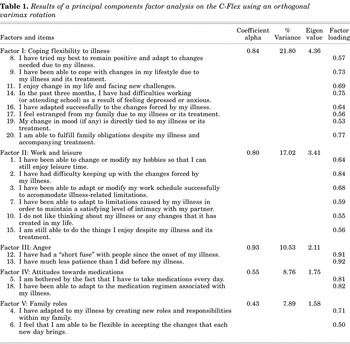
Second, a principal components factor analysis was completed. An orthogonal varimax rotation was used to help identify simple factor structure. The results of the factor analysis (see Table 1) revealed a 5-factor solution (the number of factors to retain was based upon factors with eigenvalues over 1.0 and a factor scree plot). Upon examination, the eight items from the first, and strongest, factor (items 8, 9, 11, 14, 16, 17, 19, and 20) seemed to best tap the construct that could be deemed as coping flexibility to illness and illness-related change. The second factor, consisting of items 1, 2, 3, 7, 10, and 15, seemed to be tapping interest in activities such as work, hobbies, and sex. The third factor (items 12 and 13) clearly measured anger. The fourth factor (items 5 and 18) assessed attitudes toward medications, and the final factor (items 4 and 6) focused on family roles. Because some authorities suggest using an oblique rotation for exploratory factor analysis (Pedhazur & Schmelkin, 1991), the factor analysis also was performed using an oblique rotation using the same criteria for factor retention as above (eigenvalues over 1.0 and analysis of a scree plot). The results of this second factor analysis identified the same factors although individual item factor weightings shifted somewhat.
Results of a principal components factor analysis on the C-Flex using an orthogonal varimax rotation

The two items loading on Factor III were tentatively deleted because they appeared to measure anger rather than coping flexibility. Although the deletion of Factor III can be justified from the standpoint of classical test construction, which focuses on scale development based on construct identification of latent variables, it is also possible to utilize an approach based on criterion-related validity. Even from this empirically keyed approach, however, Factor III would be marked for exclusion by its lack of significant correlation to SCID-adjustment disorder (r = −0.094, n.s.). Thus, it was deemed that Factor III offered no incremental value in predicting adjustment disorder and it was dropped from further consideration.
The third approach to exploring the items was to conduct a reliability analysis. Total scale internal consistency, when all 20 items were included in the analysis, yielded a coefficient alpha of 0.88. As mentioned above, based on results of the factor analysis, the reliability analysis also was completed after eliminating the two items of Factor III, because they did not seem to assess coping flexibility and were not correlated to the diagnosis of adjustment disorder on the SCID. Other items were also examined to see if their removal would increase overall alpha; however, none were identified. The remaining 18 items still exhibited a coefficient alpha of 0.88 for the total scale and all were retained for hypothesis testing analyses. Reliability of the four individual subscales also was examined. Alphas ranged from 0.43 to 0.93.
Correlations between Study Measures and SCID Diagnosis
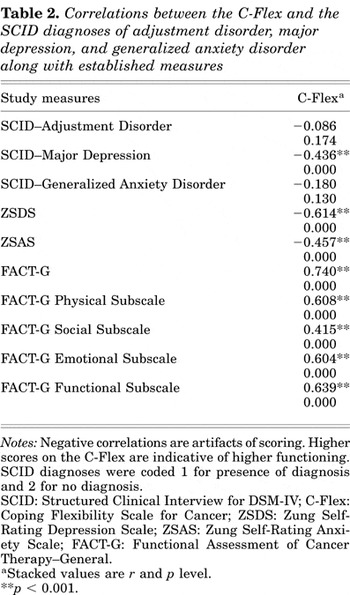
Table 2 displays the correlations between the C-Flex and the SCID diagnoses. It should be noted that negative correlations do not necessarily indicate an indirect relationship between constructs but may be artifacts of scoring. Higher scores on the C-Flex indicate higher functioning. As shown in the table, the C-Flex (r = −0.086, n.s.) was not a significant predictor of either adjustment disorder or generalized anxiety disorder. However, the C-Flex was significantly related to major depression (C-Flex: r = −0.436, p < 0.001).
Correlations between the C-Flex and the SCID diagnoses of adjustment disorder, major depression, and generalized anxiety disorder along with established measures

It was also of interest to determine whether the C-Flex was correlated with the established measures to determine an initial picture of both convergent and divergent validity. The C-Flex was significantly correlated to all of the other scales, indicating substantial overlap, and was especially strongly correlated with the ZSDS (r = 0.614, p < 0.000) and the FACT-G scale (r = 0.740, p < 0.000). As a test of divergent validity, the C-Flex was correlated with scores on the Physical Subscale of the FACT-G. The C-Flex exhibited poor divergent validity as evidenced by strong correlations with the subscale.
Sensitivity and Specificity Results
Given the nonsignificant correlations with AD, sensitivity and specificity statistics were not investigated for the C-Flex.
Quality of Life
It was also of interest to explore whether coping flexibility measured by the C-Flex was indicative of perception of enhanced quality of life. From the earlier correlations, it was evident that coping flexibility was significantly related to global quality of life as measured by the FACT-G (r = 0.74, p < 0.001). To further test this relationship, a multiple regression analysis was conducted. After controlling for the influence of psychiatric diagnosis (R2Δ = 0.37, F = 53.45, p < 0.001) and specific type of BMT (n.s.), coping flexibility was not found to be a significant predictor of quality of life.
Exploratory Analyses
Sensitivity and Specificity in Detecting Any SCID Diagnosis
Analyses were repeated for the ability of the C-Flex to identify a criterion defined as any of the SCID diagnoses (major depression, generalized anxiety disorder, or adjustment disorder). The C-Flex (r = −0.44, p < 0.001) was significantly correlated to the presence of any disorder. Sensitivity and specificity were then examined using the cutoff score that produced the greatest overall accuracy (total number of AD negatives correctly identified plus total number of AD positives correctly identified divided by total N). The C-Flex exhibited poor specificity (30.43%) and good sensitivity (91.84%) in detecting any diagnosis.
Predictive Utility of C-Flex Subscales
A further question concerned whether any of the four factor-analysis-derived subscales of the novel C-Flex scale could stand alone as predictors of either adjustment disorder or any diagnosis. To examine this question, a series of correlations was conducted between the C-Flex subscales and (1) any SCID diagnosis and (2) SCID adjustment disorder diagnosis. None of the C-Flex factors were significantly correlated to the SCID–adjustment disorder diagnosis. However Factor I (r = −0.44, p < 0.001) and Factor II (r = −0.49, p < 0.001) were significantly related to the presence of any SCID disorder. As a follow-up, sensitivity and specificity statistics were then calculated for Factors I and II using a cutoff of ≤30 and ≤20, respectively. Factor I showed the best overall predictive accuracy in predicting any diagnosis with a specificity of 76.09% and sensitivity of 81.63%.
DISCUSSION
This study was an attempt to develop a brief, rapid screen for the presence of adjustment disorder diagnosis in BMT patients. To this end, a novel screening instrument was developed to attempt to screen for adjustment disorder.
Although the study results were disappointing with regard to this primary aim, there were some potentially interesting findings. In terms of predictive validity, the C-Flex proved to be a very poor screening tool for adjustment disorder in this population. In contrast, the C-Flex displayed moderately high correlations with scales measuring depression, anxiety, and quality of life. Moreover, the scale appeared to be useful in predicting the presence of any disorder (not just AD). Overall, the C-Flex exhibited adequate reliability and yielded understandable but somewhat unreliable subscales based on the factor analysis. Also, the correlations with AD were in the expected direction and approached significance.
Although not useful in predicting AD, the C-Flex may be a useful tool in predicting psychological distress in general as it does not appear to tap a construct unique to adjustment disorder. Thus, poor perceived coping flexibility in addressing illness may be a general risk factor for psychological distress rather than a specific marker for adjustment disorder, and the C-Flex may be a better tool for detecting general psychological distress than adjustment disorder specifically. Indeed, there is some limited research to suggest that coping flexibility is beneficial in the reduction of symptomatology for schizophrenia, depression, and anxiety (Wheaton, 1985; Perry, 2000).
It is possible that other methods of scale development may have improved the results. The current study emphasized construct-based scale development. Criterion-based methods maximize predictability and likely would have produced higher levels of detection, although predictive correlations from tests developed in this way tend to be difficult to replicate in new samples (Nunnally, 1978). For example, in the case of the C-Flex, the instrument may have benefited from selecting items most highly related to AD. Alternately, specificity may have been enhanced by selecting only those items that were unrelated to SCID-identified major depression or generalized anxiety disorder to assure divergent validity. Future research may benefit from exploring these options or expanding both the item pool and number of participants.
Portions of the C-Flex may have some utility as screens for general psychological distress. Specifically, the eight items comprising Factor I of the C-Flex may prove useful as a very short screen. Overall, Factor I showed a specificity of 56.45% and sensitivity of 75.76% for detecting adjustment disorder and a specificity of 76.09% and sensitivity of 81.63% for detecting any psychiatric diagnosis. Therefore, it might be a useful stand-alone tool for identifying general malaise in this population.
The underlying rationale for the study was that a better understanding of AD and its detection could have a helpful impact on the delivery of services for cancer patients in the medical setting. As stated earlier, the usefulness of adjustment disorder as a diagnostic category for oncology is to identify those patients who may be in need of intervention but who do not meet full criteria for DSM-IV diagnoses such as major depression or generalized anxiety disorder. With early identification, persons with adjustment disorder can benefit greatly from brief psychotherapy and psychoeducation (Sifneos, 1989; Pollin & Holland, 1992; Wise, 1994; Strain, 1998). Unfortunately, a suitable means for screening for adjustment disorder remains elusive.
On a final note, we explored coping flexibility as measured by the C-Flex for its ability to predict perceptions about quality of life. It was felt that those patients with higher levels of coping flexibility would also be likely to maintain a higher level of quality of life. Although the two constructs were related (r = 0.74, p < 0.001), a multiple regression analysis controlling for psychiatric diagnosis and type of BMT failed to reach significance. Thus, although a relationship exists between the two, it was overshadowed by other variables in the study.
Limitations
There are several limitations to the current study. First, the sample was almost completely Caucasian, which may limit the generalizability of the findings. Second, the interrater reliability of the SCID diagnoses is not known. It may be problematic that only one rater performed the SCID diagnostic interviews. Third, the use of face-to-face SCID interviews may have biased the results. Although subjects seemed to be very forthcoming, the possibility exists that there was some underreporting of symptoms. There is some evidence that patients may answer questions on a self-report screening questionnaire in a more forthright and honest way than they might if questioned face to face (Zabora, 1998). Thus, future studies may want to consider alternative procedures for diagnosis such as computer-based diagnostic programs. Finally, the study utilized a cross-sectional design and therefore results cannot be interpreted causally. Subsequent research should use a longitudinal design that would allow for the collection of data on the natural progression of AD in patients with cancer as well as the opportunity to explore the predictive utility of the measures.
Conclusion
A clear problem was found in trying to develop a screen for adjustment disorder. The novel screen based on the idea of coping inflexibility was unable to detect adjustment disorder with any degree of reliability. Thus, the challenge is to continue work in the area to identify the core concept that can help identify these patients and lead to the creation of brief screening tools.
ACKNOWLEDGMENT
The authors would like to thank the Walther Cancer Institute for funding support.
References
REFERENCES
American Psychiatric Association.
(1994).
Diagnostic and Statistical Manual of Mental Disorders
(4th ed.).
Washington, DC:
Author.
American Society of Psychosocial and Behavioral
Oncology/AIDS.
(1999).
Standards of Care for the Management of Distress in Patients with
Cancer.
New York:
Author.
Brady, M.,
Cella, D.,
Mo, & F.,
et al.
(1997).
Reliability and validity of the functional assessment of cancer
therapy breast quality of life instrument.
Journal of Clinical Oncology,
15,
974–986.Google Scholar
Brystritsky, A.,
Linn, L., &
Ware, J.
(1990).
Development of a multidimensional scale of anxiety.
Journal of Anxiety Disorders,
4,
99–115.Google Scholar
Carson, D.,
Council, J., &
Volk, M.
(1989).
Temperament as a predictor of psychological adjustment in female
adult incest victims.
Journal of Clinical Psychology,
45,
330–335.Google Scholar
Cella, D.,
Bonomi, A.,
Lloyd, & S.,
et al.
(1995).
Reliability and validity of the functional assessment of cancer
therapy-lung (FACT-L) quality of life instrument.
Lung Cancer,
12,
199–220.Google Scholar
Cella, D.,
Tulsky, D.,
Gray, & G.,
et al.
(1993).
The functional assessment of cancer therapy scale: Development and
validation.
Journal of Clinical Oncology,
11,
570–579.Google Scholar
Derogatis, L.,
Morrow, G., &
Fetting, J.
(1983).
The prevalence of psychiatric disorders among cancer patients.
JAMA,
249,
751–757.Google Scholar
Dugan, W.,
McDonald, M.,
Passik, & S.,
et al.
(1998).
Use of the Zung Self-Rating Depression Scale in cancer patients:
Feasibility as a screening tool.
Psycho-Oncology,
7,
483–493.Google Scholar
Gabrys, J. &
Peters, K.
(1985).
Reliability, discriminant and predictive validity of the Zung
Self-Rating Depression Scale.
Psychology Reports,
57,
1091–1096.Google Scholar
Katon, W. &
Sullivan, M.
(1990).
Depression and chronic medical illness.
Journal of Clinical Psychology,
51,
3–11.Google Scholar
Lee, R.
(1983).
Returning to work: Potential problems for mid-career mothers.
Journal of Sex and Marital Therapy,
9,
219–232.Google Scholar
Maddock, R.,
Carter, C.,
Tavano-Hall, & L.,
et al.
(1998).
Hypocapnia associated with cardiac stress scintigraphy in chest
pain patients with panic disorder.
Psychosomatic Medicine,
60,
52–55.Google Scholar
Nunnally, J.C.
(1978).
Psychometric Theory,
2nd ed.
New York:
McGraw-Hill.
Pedhazur, E. &
Schmelkin, L.
(1991).
Measurement, Design, and Analysis: An Integrated Approach.
Hillsdale, NJ:
Lawrence Earlbaum Associates.
Perry, D.
(2000).
Appraising controllability and problem solving training with
homeless children.
Doctoral dissertation.
Case Western Reserve University,
Cleveland, OH,
Dissertation Abstracts International, 60, no. 09B (1999): p.
4902.
Pollin, I. &
Holland, J.
(1992).
A model for counseling the medically ill: The Linda Pollin
Foundation Approach.
General Hospital Psychiatry,
14,
11–24.Google Scholar
Razavi, D.,
Delvaux, N., &
Farvacques, C.
(1990).
Screening for adjustment disorders and major depressive disorders
in cancer patients.
British Journal of Psychology,
156,
79–83.Google Scholar
Rogers, S. &
LeUnes, A.
(1979).
A psychometric and behavioral comparison of delinquents who were
abused as children with their non-abused peers.
Journal of Clinical Psychology,
35,
470–472.Google Scholar
Segal, D.,
Hersen, M., &
Van Hasselt, V.
(1994).
Reliability of the structured clinical interview for DSM-III-R: An
evaluative review.
Comprehensive Psychiatry,
35,
316–327.Google Scholar
Sifneos, P.
(1989).
Brief dynamic and crisis therapy. In
Comprehensive Textbook of Psychiatry,
5th ed.,
Kaplan, H. &
Sadock, B. (eds.).
vol. 2, pp.
1562–1567.
Baltimore:
Williams & Wilkins.
Skre, I.,
Onstad, S.,
Torgersen, & S.,
et al.
(1991).
High interrater reliability for the structured clinical interview
for DSM-III-R axis I (SCID-I).
Acta Psychiatrica Scandinavica,
84,
167–173.Google Scholar
Steinberg, M.
(1994).
Interviewer's Guide to the Structured Clinical Interview for
DSM-IV Dissociative Disorders (SCID-D).
Washington, DC:
American Psychiatric Press, Inc.
Strain, J.
(1998).
Adjustment disorders. In
Psycho-oncology,
Holland, J. (ed.), pp.
509–517.
New York:
Oxford University Press.
Tate, D.,
Forchheimer, M.,
Maynard, & F.,
et al.
(1993).
Comparing two measures of depression in spinal cord injury.
Rehabilitation Psychology,
38,
53–61.Google Scholar
Wheaton, B.
(1985).
Personal resources and mental health: Can there be too much of a
good thing?
Research Communications in Mental Health,
5,
139–184.Google Scholar
Winstead-Fry, P. &
Schultz, A.
(1997).
Psychometric analysis of the functional assessment of cancer
therapy-general (FACT-G) scale in a rural sample.
Cancer,
79,
2446–2452.Google Scholar
Wise, M.
(1994).
Adjustment disorders and impulse disorders not otherwise
classified. In
The American Psychiatric Press Textbook of Psychiatry,
2nd ed.,
Talbot, J.,
Hales, R. &
Yudofsky, S. (eds.), pp.
460–484.
Washington DC:
American Psychiatric Press.
Yellen, S.,
Cella, D.,
Webster, & K.,
et al.
(1997).
Measuring fatigue and other anemia-related symptoms with the
functional assessment of cancer therapy (FACT-G) measurement
system.
Journal of Pain and Symptom Management,
13,
63–74.Google Scholar
Zabora, J.
(1998).
Screening procedures for psychosocial distress. In
Psycho-oncology,
Holland, J. (ed.), pp.
653–661.
New York:
Oxford University Press.
Zung, W.
(1967b).
Factors influencing the self-rating depression scale.
Archives of General Psychiatry,
16,
543–547.Google Scholar
Zung, W.
(1971).
A rating instrument for anxiety disorders.
Psychosomatics,
12,
371–379.Google Scholar
Results of a principal components factor analysis on the C-Flex using an orthogonal varimax rotation
Correlations between the C-Flex and the SCID diagnoses of adjustment disorder, major depression, and generalized anxiety disorder along with established measures
 You have
Access
- 8
- Cited by