Significant outcomes
Patients with MD exhibited reduced cardiac vagal control compared to healthy volunteers.
Depression severity was inversely correlated with cardiac vagal control.
The subgroup of MD with suicide ideation revealed more pronounced cardiac vagal withdrawal.
Limitations
Causality cannot be inferred from our cross-sectional data.
We fail to use non-linear techniques, which may be more sensitive to depression than linear techniques, to measure HRV.
Interpretation of LF as sympathetic activity should be made with caution in our study.
Introduction
Depression has a prevalence of between 8 and 12% worldwide and will be the second biggest disease burden by 2020 after cardiovascular disease (CVD) (Reference Murray and Lopez1). Depression, a major risk factor for CVD, has been shown to be associated with worse prognosis and mortality in patients with various CVDs (Reference Nicholson, Kuper and Hemingway2). The relationship between depression and cardiac mortality is, in part, mediated by reduction of heart rate variability (HRV) (Reference Thayer and Lane3), and HRV has been identified as providing the best measure for predicting fatal or near-fatal cardiac arrhythmia (Reference Huikuri, Raatikainen and Moerch-Joergensen4); however, research on HRV and depression has generally been conducted in cardiac patients. Thus, factors concomitant with CVD might be influenced by the observed relationship between major depression (MD) and HRV. We focus on depressed patients without CVD, to avoid overestimation of the association between MD and HRV.
In studying the autonomic nervous system (ANS), various techniques have been developed to detect the function of the sympathetic and parasympathetic systems. Frequency-domain analysis of HRV, with its standard procedure and interpretation first reported in 1996, is a sophisticated and non-invasive tool for detection of ANS regulation of the heart (5). Besides being a non-invasive study procedure, an important advantage of frequency-domain analysis of HRV is that it utilises spontaneous fluctuations in heart rate (HR) to estimate tonic ANS functions. However, it should be noted that a well-controlled condition is required for spontaneous ANS functional recordings. Furthermore, a review studying the effects of antidepressant treatment on HRV in MD patients revealed that the findings in studies with short recording intervals were strong and robust, whereas those in the longer recording studies were weaker and markedly inconsistent (Reference van Zyl, Hasegawa and Nagata6). In this study, we used spectral analysis of HRV while subjects were in supine rest in a quiet and relaxing atmosphere for 5-min short recording times (Reference Kuo, Lin, Yang, Li, Chen and Chou7).
Some studies have found reduced HRV levels, as measured by high-frequency (HF) measures reflecting reductions of parasympathetic activity at respiratory frequencies, in MD patients without CVD in comparison with healthy control subjects (Reference Udupa, Sathyaprabha and Thirthalli8,Reference Agelink, Boz, Ullrich and Andrich9). Udupa et al. (Reference Udupa, Sathyaprabha and Thirthalli8) also reported elevated low frequency (LF)/HF ratio in MD patients without CVD, suggesting an increase in sympathetic activity and a reciprocal decrease in parasympathetic activity. In addition, Rottenberg (Reference Rottenberg10) reported a modest reduction of HRV in patients with depression, with a small-to-medium cross-sectional effect size (d = 0.3) for an MD diagnosis. However, other studies on MD without CVD have reported no differences in HRV, as measured by time-domain measures (Reference Udupa, Sathyaprabha and Thirthalli8,Reference Agelink, Majewski and Wurthmann11), respiratory sinus arrhythmia (RSA) (Reference Lehofer, Moser and Hoehn-Saric12) and HF power (Reference Udupa, Sathyaprabha and Thirthalli8,Reference Agelink, Majewski and Wurthmann11,Reference Volkers, Tulen, van den Broek, Bruijn, Passchier and Pepplinkhuizen13). Some authors argued that low HRV is limited to patients with severe depression (Reference Udupa, Sathyaprabha and Thirthalli8) or to male patients (Reference Thayer, Smith, Rossy, Sollers and Friedman14). Furthermore, a recent study in a large sample of participants concluded that the association between lower HRV and MD is driven by the effect of antidepressants (Reference Licht, de Geus, Zitman, Hoogendijk, van Dyck and Penninx15). Some of the contradictory findings reported in the literature might be due to heterogeneity in relatively small samples, confounds from medication, physical health, habitual physical activity, smoking, psychiatric comorbidities and reporting of different HRV measures (Reference Rottenberg10). Importantly, a recent meta-analysis, comprising a total of 673 MD patients and 407 healthy comparison participants, showed that MD patients had lower HRV than healthy control subjects, and depression severity was negatively correlated with HRV (Reference Kemp, Quintana, Gray, Felmingham, Brown and Gatt16). However, the authors only used time-domain measures of HRV. Thus, efforts to replicate the effect of MD diagnosis on frequency-domain measures of HRV by analyses with larger sample sizes and control over possible confounds are clearly warranted.
Notably, some studies found that resting parasympathetic activity was inversely associated with suicide symptom (Reference Rottenberg, Wilhelm, Gross and Gotlib17), but was not associated with overall depression severity (Reference Udupa, Sathyaprabha and Thirthalli8,Reference Rottenberg, Wilhelm, Gross and Gotlib17). Rottenberg (Reference Rottenberg10) therefore proposed the possibility that low parasympathetic activity is related more closely to individual symptoms of MD (e.g. suicide symptom) than to the syndrome as a whole, and further, they considered that the relationship between suicidality and parasympathetic activity may be, in part, mediated by other proximal factors for suicide, including impulsivity (Reference Beauchaine18). Consistent with these findings, Booij et al. (Reference Booij, Swenne, Brosschot, Haffmans, Thayer and Van der Does19) reported that high-dose acute tryptophan depletion decreased HRV and increased impulsivity and anxiety, but only in remitted MD patients with a history of suicidal ideation (SI). The author used history of SI as an index for individual differences in impulse control and concluded that reduced HRV is more pronounced in a subtype of depression that is characterized by impulsive and aggressive behaviour (Reference Booij, Swenne, Brosschot, Haffmans, Thayer and Van der Does19). Thus, we speculated that MD patients, particularly those expressing SI, would have significantly adverse patterns of HRV than healthy control subjects. To test our hypothesis, this study further examined the patient subgroups with/without SI.
MD has a long course, a high tendency to relapse and adverse impacts on multiple dimensions of functioning. Assessment of the impact of MD on quality of life (QOL) is important in deciding how aggressively the disorders should be treated and for how long, measuring outcomes and assessing the health needs of patients. Previous research found that depressed patients have poorer subjective QOL than healthy control subjects (Reference Yen, Chen, Lee, Tang, Ko and Yen20). To our knowledge, no study has specifically investigated the impact of cardiac autonomic function on subjective QOL in MD patients to date. We also tried to address this issue in an exploratory way.
Objective
The aim of this study was to investigate the difference in HRV between a large sample of healthy control subjects and unmedicated, physically healthy patients with MD who were free of psychiatric comorbidity. We further carried on stratified analyses by suicide ideation.
Materials and methods
Subjects
This study was approved by the Institutional Review Board for the protection of human subjects at the Tri-Service General Hospital, a medical teaching hospital of the National Defence Medical Center in Taipei, Taiwan. We obtained written informed consent from all participants and fully explained the procedures of the study. Initial study entry criteria included age 18–65. Exclusion criteria included pregnancy, smoking, diabetes, cancer, neuropathy, hypertension, cardiac arrhythmia or other CVDs that affect HRV or engaging in regular physical training exceeding 10 h a week. Subjects who used psychotropic medication or any medication that has been reported to affect the ANS functioning for at least 2 weeks prior to beginning of the study evaluation were also excluded.
In total, we recruited 960 subjects. The patient group comprised 498 patients with MD, who were recruited from outpatient setting. On the basis of the same methodology in our previous study (Reference Chang, Lu and Chen21,Reference Chang, Lu and Lin22), each patient was initially evaluated by an attending psychiatrist (H.-A. C.) and then interviewed by a well-trained psychologist, using the Chinese version of the modified Schedule of Affective Disorder and Schizophrenia-Lifetime (SADSL) (Reference Endicott and Spitzer23) to arrive at the Diagnostic and Statistical Manual of Mental Disorders, Fourth Edition (DSM-IV) diagnosis. The inter-rater reliability kappa values of the Chinese version of the modified SADSL were as follows: MD, 0.79; bipolar disorder, 0.71; anxiety disorder, 0.86; schizophrenia, 0.95 and substance abuse and dependence, 0.82 (Reference Chang, Lu and Chen21,Reference Chang, Lu and Lin22). All study patients met the DSM-IV criteria for major depressive disorder on the basis of interviews and a best-estimate procedure that used all available information including clinical observations, medical records and family information. Here, we further excluded individuals with a history of actual suicide attempt that caused any neurological damage, substance dependence, organic brain disease or any concomitant major psychiatric disorders. They were recruited either in their first or recurrent major depressive episode (MDE). The severity of MDE was assessed with the 17-item version of the Hamilton Depression Rating Scale (HAM-D). Only subjects with a minimum score of 18 on the HAM-D entered the study. Two hundred eighty-nine patients had moderate MDE (HAM-D scores 18–24); the remaining 209 patients met the criteria for severe MDE (HAM-D scores >24). First-episode MD was diagnosed in 51.8% of patients. The patient group was further stratified according to SI [SI(+) subgroup vs. SI(−) subgroup]. SI was defined by a score of 1 and above on HAM-D item 3 (Reference Booij, Swenne, Brosschot, Haffmans, Thayer and Van der Does19,Reference Du, Bakish, Lapierre, Ravindran and Hrdina24).
The normal control group included 462 healthy volunteers, recruited from the community. They were selected to match patient's gender and age. We used the modified Chinese version of SADSL (Reference Endicott and Spitzer23) to exclude individuals with psychiatric conditions. Control subjects were considered free of past or present major or minor mental illnesses (affective disorder, schizophrenia, anxiety disorder, personality disorder, substance use disorders, etc.).
Assessment of severity of depression
All participants were interviewed by an attending psychiatrist (H.-A. C.) using the 17-item HAM-D, an objective scale to assess severity of depression. In addition, we used the Beck Depression Inventory (BDI) (Reference Beck, Ward, Mendelson, Mock and Erbaugh25), a 21-item questionnaire, to assess subjects' self-reported severity of depression (A.T. Beck and R.A. Steer, Manual for the Revised Beck Depression Inventory, Psychological Corp., San Antonio TX, USA, 1987). The results are scored by summing the responses to each of the items in order to obtain a total depression score (range, 0–63). Both the HAM-D and the BDI provide global indices of depression severity. To avoid multiple testing of the same hypothesis, the analysis of the relationship between HRV parameters and global depression severity was based on only one measure of depression severity, the HAM-D. (Not surprisingly, the two measures of depression severity were significantly correlated with each other, r = 0.94, p < 0.001.) The results were unchanged whether interviewer or self-reported measures of depression severity were used as an outcome.
Assessment of quality of life
We used the self-administered World Health Organization Questionnaire on Quality of Life: Short Form-Taiwan version (WHOQOL-BREF), which was developed by the World Health Organization (WHO) to evaluate health-related QOL and to make cross-cultural comparisons (26). It has been adapted for use in Taiwan (Reference Yao, Chung, Yu and Wang27). The WHOQOL-BREF Taiwan version contains 28 five-point items that assess general (2 items) and four specific domains of QOL, including 7 items in physical health (D1), 6 in psychological (D2), 4 in social relationships (D3) and 9 in environmental domains (D4), with well-established validity and reliability (Reference Yao, Chung, Yu and Wang27). The domain scores were calculated by multiplying the mean of all item scores by a factor of 4, thus scores ranged from 4 to 20. Higher scores on the WHOQOL-BREF Taiwan version indicate better QOL.
Measurements of heart rate variability
Detailed procedures for analysis of HRV have been reported previously (Reference Kuo, Lin, Yang, Li, Chen and Chou7). In short, after sitting quietly for 20 min, a lead I electrocardiogram was taken for 5 min while the subject lay quietly and breathed normally. An HRV analyzer (SSIC, Enjoy Research Inc., Taipei, Taiwan) acquired, stored and processed electrocardiogram signals. Under a sampling rate of 512 Hz, signals were recorded using an 8-bit analog-to-digital converter. Stationary RR interval values were resampled and interpolated at a rate of 7.11 Hz to produce the continuity in a time domain. Power spectral analysis was performed using a non-parametric method of fast Fourier transformation (FFT). The direct current component was deleted and a Hamming window was used to attenuate the leakage effect (Reference Kuo, Lin, Yang, Li, Chen and Chou28). The power spectrum was then quantified into standard frequency-domain measurements defined previously (5,Reference Kuo, Lin, Yang, Li, Chen and Chou7), which consisted of variance (variance of RR interval values), very low-frequency power (VLF, 0.003–0.04 Hz), LF (0.04–0.15 Hz), HF (0.15–0.40 Hz), the ratio of LF to HF (LF/HF), normalized HF (HF%) and LF (LF%). LF% was calculated from LF/(total power − VLF) × 100, and HF% from HF/(total power − VLF) × 100. Normalisation of spectral power components has been recommended because it takes account of variations in total power and shows clearer associations with directly measured autonomic nerve activity than non-normalized power (Reference Pagani, Montano and Porta29). All the measurements were logarithmically transformed to correct skewed distribution (Reference Kuo, Lin, Yang, Li, Chen and Chou7). Cardiac vagal control of HRV is represented by HF, whereas both vagal and sympathetic controls of HRV are jointly represented by LF. The LF/HF ratio is considered by some investigators to mirror sympathovagal balance or sympathetic modulations, with a larger LF/HF ratio indicating a greater predominance of sympathetic activity over cardiac vagal control (5).
Statistical analyses
We used SPSS (version 13.0; SPSS, Taipei, Taiwan) statistical software for all analyses. Discrete variables in patients and controls were compared using chi-square test, and continuous variables were compared with an independent samples t-test. Analyses of variances (ANOVAs) with post hoc test were used to compare the HRV indices and other continuous variables in group comparisons among MD subtypes and control group. Analysis of covariance adjusted for any significant difference in baseline characteristics. The associations between HRV measures and age, body mass index (BMI) and habitual physical activity were analysed with product-moment correlations, whereas point-biserial correlations were used to assess relationships with gender. Results of the point-biserial correlations were identical to those arising from comparisons using t-tests. We correlated scores of HAM-D, its individual items and specific domains of QOL with HRV measures using a Pearson's test. Linear regression analyses were used to primarily assess associations of scores of HAM-D and specific domains of QOL with HRV. To control the effect of confounding, we used multiple regression on the HRV indices, with gender, age, BMI and habitual physical activity as covariables. All results are two-tailed and a p value <0.05 was considered statistically significant.
Results
Demographics and clinical characteristics
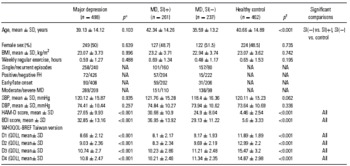
As shown in Table 1, MD and healthy control groups were similar with respect to demographic data, systolic blood pressure, diastolic blood pressure and habitual physical activity. Patients with MD had higher scores of HAM-D and BDI, and lower scores of four specific domains of QOL than controls. Group comparisons among MD subgroups and control group showed significant differences in mean age, scores of HAM-D and BDI and scores of four specific domains of QOL (Table 2). Post hoc test revealed younger age in the SI(−) subgroup than either the SI(+) subgroup or the control group. Moreover, post hoc test in scores of HAM-D, BDI and four specific domains of QOL consistently showed greatest scores in the SI(+) subgroup, lowest scores in the control group and intermediate scores in the SI(−) subgroup. There were no statistically significant differences in remaining demographic data and clinical characteristics in group comparisons among MD subgroups and control group.
Sample characteristics

D1, physical health domain; D2, psychological domain; D3, social relationship domain; D4, environmental domain; DBP, diastolic blood pressure; FH, family history; NA, not available; SBP, systolic blood pressure; SD, standard deviation.
Family history indicates bipolar disorder or major depression in a first-degree relative. First depressive episode developed before age 18 defined as early-onset, and the onset age 18 or later defined as late-onset. Severe MD indicates HAM-D score >24; moderate MD indicates HAM-D score 18–24.
* Compared with the healthy control group.
† ANOVAs used to compare continuous variables in group comparisons among MD subgroups and control group.
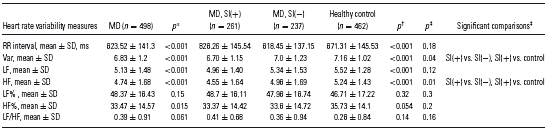
Comparison of mean RR intervals and all measures of HRV between MD patients or its subgroups and control subjects
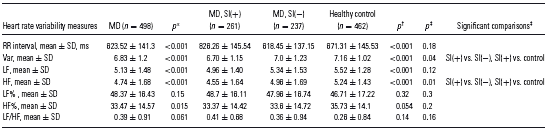
HF, high-frequency power [ln(ms2)]; HF%, normalized HF [in normalized units (nu)]; LF, low-frequency power [ln(ms2)]; LF%, normalized LF [in normalized units (nu)]; LF/HF, ratio of LF to HF [ln(ratio)]; Var, total variance [ln(ms2)].
* Compared with the healthy control group.
† ANOVAs used to compare continuous variables in group comparisons among MD subgroups and control group.
‡ Adjusted for age.
Heart rate variability parameters
Patients with MD exhibited reduced RR, variance, LF, HF and HF% as compared with controls.
Group comparisons among MD subgroups and control group showed significant differences in RR, variance, LF and HF. Analysis of covariance adjusted for age revealed differences in variance (F = 3.26, p = 0.039) and HF (F = 4.27, p = 0.014). Post hoc test revealed significantly lower variance and HF in the SI(+) subgroup compared with either the SI(−) subgroup or the control group. However, the difference for variance and HF failed to attain statistical significance for the SI(−) subgroup versus the control group.
Factors associated with HRV
Associations between HRV measures and those potentially confounding variables are summarized in Table 3. Men had significantly faster HRs (shorter RR interval) and lower variance, LF, HF and LF% than women. Older participants had reduced variance, LF, HF and HF%, and greater LF/HF ratio. Participants with higher BMI had lower variance, LF, HF and HF%, and greater LF% and LF/HF ratio. Participants who were habitually more physically active had significantly slower HRs (longer RR interval) and greater variance, LF and HF.
Factors associated with heart rate variability among all participants

* p < 0.05;
** p < 0.01;
*** p < 0.001.
† Point-biserial correlations; first category in parenthesis is the reference group.
‡ Product-moment correlations.
Association between depression severity and HRV
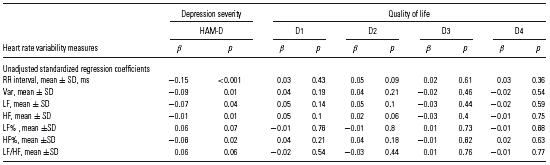
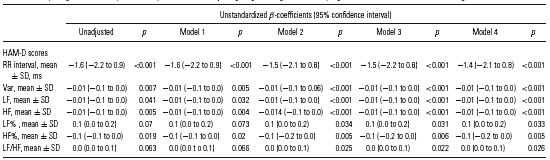
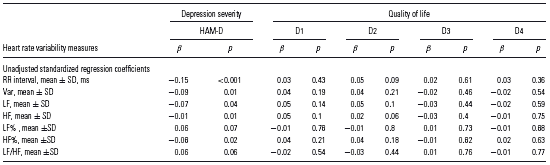
In linear regression analyses, HAM-D scores were inversely associated with RR, variance, LF, HF and HF% (Table 4). Further adjustment for gender, age, BMI and physical activity rendered all comparisons statistically significant (Table 5). Further evaluation of the correlation coefficient between the individual items of HAM-D and the HRV values revealed that HF was negatively correlated with eight individual items: suicide (r = −0.72, p < 0.001), early insomnia (r = −0.16, p < 0.001), middle insomnia (r = −0.19, p < 0.001), late insomnia (r = −0.13, p < 0.001), psychic anxiety (r = −0.1, p = 0.002), somatic anxiety (r = −0.15, p < 0.001), gastrointestinal somatic symptoms (r = −0.12, p < 0.001) and general somatic symptoms (r = −0.26, p < 0.001). Other HRV variables including RR, variance, LH, HF% and LF/HF ratio were also significantly related to the above-mentioned items (data not shown).
Linear regression of mean RR intervals and all measures of HRV by scores of HAM-D and specific domains of QOL among all participants
Multiple regression of HRV parameters by HAM-D scores, adjusting for gender, age, BMI, weekly regular exercise factors: unstandardized regression coefficients
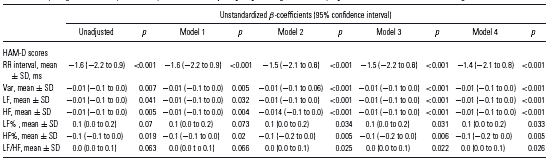
Model 1, controlling for gender; model 2, controlling for model 1 + age; model 3, controlling for model 1 + age + BMI; model 4, controlling for model 1 + age + BMI + weekly regular exercise.
Association between quality of life and HRV
We found that scores of four specific domains of QOL (D1–D4) were not associated with HRV parameters (Table 4). Further adjustment for gender, age, BMI and physical activity did not alter the regression analyses in a meaningful way (data not shown).
Discussion
To our knowledge, this is the first adequately powered study to date that examines the relationship between tonic ANS function and MD in a large sample of unmedicated and physically healthy participants by using frequency-domain measurements of HRV. The main results of our study may be summed as follows. First, as expected, MD patients had lower HRV compared with healthy control subjects. Our result corroborated previous work (Reference Rottenberg10,Reference Kemp, Quintana, Gray, Felmingham, Brown and Gatt16) suggesting that reduction in HRV is a psychophysiological marker of MD. As ethnic stratification among study samples may lead to resetting population HRV patterns (Reference Li, Snieder and Su30,Reference Martin, Doster and Critelli31), it might produce a false-positive or false-negative result by chance rather than reveal a direct relation, when we interpret the association between HRV and a disease. However, all our subjects were unrelated Han Chinese subjects, matched for age and sex, and drawn from a population pool in Taiwan that is known to be genetically homogeneous (Reference Chang, Lu and Chen21). All the biological grandparents of our recruited subjects were of Han Chinese ancestry. Therefore, it is less likely that ethnic stratification bias produced a false-positive result in our study. Further, the MD patients and healthy control subjects were interviewed with the modified Chinese version of SADSL (Reference Endicott and Spitzer23) to rule out psychiatric comorbidity and psychiatric disorders, respectively. Thus, a false-positive result due to inclusion of anxiety disorders or substance use disorder in our case group is also presently unlikely. Importantly, this study has a strength that all participants do not smoke or have a history of smoking. Current smoking clearly depresses HRV and, even among those who have recently quit, HRV remains lower compared with that of normal non-smokers (Reference Stein, Rottman and Kleiger32). Therefore, smoking must be taken into account in any study of the effect of depression on HRV because a substantial proportion of depressed patients smoke or have a history of smoking (Reference Carney, Rich and Tevelde33). Altogether, we believe that our positive result is reliable because we analysed with large sample sizes and also addressed the role of confounding factors that may suppress or magnify the true effects of depression on HRV, including medication, smoking, physical health, physical activity levels (e.g. regular exercise) and psychiatric comorbidity (Reference Rottenberg10).
Second, our study suggested that an overall reduction in HRV in MD patients was mainly derived from their lower parasympathetic activity (HF and HF%) as compared with controls, although we also observed that MD patients had lower LF than controls and LF was inversely correlated with HAM-D scores in all participants. Despite our expectation that MD patients would be associated with lower parasympathetic activity (HF) and greater sympathetic activity (LF), our data indicated opposite association for sympathetic branch: lower level of LF in MD patients. This unexpected finding warrants comment. Most studies (Reference Udupa, Sathyaprabha and Thirthalli8,Reference Agelink, Boz, Ullrich and Andrich9) and a recent meta-analysis (Reference Kemp, Quintana, Gray, Felmingham, Brown and Gatt16) have reported increased sympathetic activity in patients with depression. On the contrary, Moser et al. (Reference Moser, Lehofer and Hoehn-Saric34) and Yeragani et al. (Reference Yeragani, Pohl and Balon35) found decreased sympathetic activity in patients with depression. However, neither study used frequency-domain measures of HRV. Linear analysis of HRV reveals distinct LF oscillations with unclear physiological mechanisms. Although some studies attribute LF fluctuations (at least in part) to sympathetic modulation (5), recent studies found no significant correlation between LF range and cardiac norepinephrine spillover (Reference Baumert, Lambert and Dawood36). Thus, the LF spectral activity is likely to be a poor marker of sympathetic outflow (Reference Moak, Goldstein and Eldadah37) and conclusions regarding changes in sympathetic branch could not be drawn from the short-term HRV linear analysis. Correlations with other clearly sympathetic measures, such as skin conductance, skin temperature or muscle sympathetic nerve activity, should be investigated in the future.
Third, we observed an expected inverse association between HRV level and depression severity. That is, individuals with more severe depression are likely to have lower HRV than those with less severe depression. Several investigations have failed to find the inverse relationship between depression severity and RSA level in samples of currently depressed persons (Reference Udupa, Sathyaprabha and Thirthalli8,Reference Rottenberg, Wilhelm, Gross and Gotlib17). However, our result is in line with a recent critical meta-analysis, which revealed that depression severity was negatively correlated with HRV (Reference Kemp, Quintana, Gray, Felmingham, Brown and Gatt16). Further analysis revealed most HRV indices associated with the individual items of HAM-D, in particular, suicide and general somatic symptoms. For example, HF was negatively correlated with suicide (r = −0.72, p < 0.001) and general somatic symptoms (r = −0.26, p < 0.001). One possibility that might explain the observed significant relationship between depression severity and HRV is that suicide symptoms contributed to the association. This possibility is supported by our finding that the SI (+) subgroup had greater cardiac vagal withdrawal (thus an overall reduction in HRV) as compared with either the SI (−) subgroup or the control group. With regard to decreased resting parasympathetic activity in the SI+ subgroup, much evidence suggests a link between reduced cardiac vagal control and difficulties in emotion regulation, in particular impulsivity (Reference Allen, Matthews and Kenyon38–Reference Hansen, Johnsen and Thayer40). For example, parasuicidal adolescents, who are characterized by emotion dysregulation and impulsivity, exhibited reduced parasympathetic activity as compared with controls (Reference Crowell, Beauchaine, McCauley, Smith, Stevens and Sylvers41). Likewise, another study reported that resting parasympathetic activity was inversely associated with suicide symptom of depression (Reference Rottenberg10). Taken together, impulsivity may play an important role in establishing a link between suicidality and parasympathetic activity (Reference Beauchaine18). The SI(+) subgroup, as such, may represent a subtype of depression that is characterized by impulsivity (Reference Booij, Swenne, Brosschot, Haffmans, Thayer and Van der Does19,Reference Du, Bakish, Lapierre, Ravindran and Hrdina24). As the heterogeneity of depression can be seen both clinically and with respect to HRV findings (Reference Rottenberg10), it seems reasonable that the suicidal subtype of depression may be more clearly related to autonomic dysregulation, one of the putative core mechanisms of depression (Reference Rottenberg10,Reference Kemp, Quintana, Gray, Felmingham, Brown and Gatt16). Another possible explanation for the observed association between depression severity and HRV is the somatic symptoms, commonly observed in patients with more severe depression. Consistent with this explanation, de Jonge et al. (Reference de Jonge, Mangano and Whooley42) suggest that somatic symptoms of depression seem to be associated with greater reductions in HRV to a greater extent than cognitive symptoms of depression. In any case, this finding further complements our first main result regarding lower HRV level in MD.
Finally, we found that MD patients have poorer subjective QOL than healthy control subjects. This finding is in agreement with previous literature (Reference Yen, Chen, Lee, Tang, Ko and Yen20). However, we observed no evidence for a major role of HRV parameters in subjective QOL of all participants after statistically controlling for confounding factors. It is possible that we failed to establish a link between subjective QOL and tonic ANS activity because depressive symptoms may lead to a bias in subjective QOL measures. Previous research has shown that depressed patients tend to overestimate their difficulties and revise their estimation on recovery (Reference Atkinson, Zibin and Chuang43). Accordingly, this negative finding should be considered as preliminary; future studies necessitate the recruitment of remitted MD patients to determine whether such a link exists.
In short, our findings highlight altered cardiovascular autonomic functions in MD patients, particularly those expressing SI, and should serve to remind clinicians to consider increased risk of CVDs among currently depressed patients. Evidence indicated that most antidepressants did not resolve reductions in HRV, despite reduction in depressive symptoms (Reference Kemp, Quintana, Gray, Felmingham, Brown and Gatt16), suggesting that affective disorders might have residual effects on neurophysiological systems (Reference Post44). Moreover, tricyclic antidepressants (TCAs) could even lead to a reduction in HRV that are associated with an increased risk of mortality, as reported previously (Reference Licht, de Geus, Zitman, Hoogendijk, van Dyck and Penninx15). Our findings also reinforce prior reports urging caution in the prescription of TCAs in depressed patients with cardiovascular dysfunction (Reference van Zyl, Hasegawa and Nagata6,Reference Kemp, Quintana, Gray, Felmingham, Brown and Gatt16). Thus, for clinicians, paying attention to autonomic dysregulation when treating their depressed patients is a worthwhile effort. For instance, an autonomic function examination, such as HRV analysis, can be done to provide a rapid screening of systemic autonomic disturbance. Then, the treatment to restore the autonomic function such as repetitive transcranial magnetic stimulation can also be considered (Reference Udupa, Sathyaprabha, Thirthalli, Kishore, Raju and Gangadhar45).
This study has some limitations. First, the study utilised cross-sectional data only, and causality therefore cannot be inferred. Whether depressive symptoms are the outcome or the cause of the physiological variables under study still needs to be determined. Second, because of short-term HRV recording, we were unable to assess reliably ultra LF power measures for which strong links with depression have been reported (Reference Carney, Blumenthal and Stein46,Reference Lampert, Bremner and Su47). Third, we did not use non-linear techniques to measure HRV, and non-linear techniques may be more sensitive to depression than those used in our study (Reference Kemp, Quintana, Gray, Felmingham, Brown and Gatt16). Fourth, suicidality was evaluated retrospectively and mostly on the basis of self-reported information. However, information was obtained by standardized clinical interviews and checked in the medical records. Finally, interpretation of LF component of HRV as sympathetic activity should be made with caution, as the level of modulation of LF HRV by the sympathetic branch is still debated.
Acknowledgement
This study was supported by a grant (TSGH-C98-91) from the Tri-Service General Hospital (Dr Chang).