Since public election financing was first implemented during the wave of post-Watergate reforms, the burning question has been, “does it work?” Evaluations of public financing have focused on its primary objectives, which are designed to address familiar grievances: Elections are too expensive and not competitive enough. Corporate PACs and other “special interests” contribute disproportionately to incumbents because they are interested in purchasing influence. Candidates must devote so much time to fundraising that little is left for other campaign tasks. Lost in these considerations, however, is the fact that mandated financial parity changes the strategic environment candidates function in, altering their decision making and potentially changing the nature of elections. As fully subsidized elections gain increasing ubiquity in the United States, reformers must decide whether this is a cost worth bearing.Footnote 1
Given its status as the most generously funded system of public election finance, Arizona is an ideal location to look to for unintended consequences. Some states, such as Hawaii and Wisconsin, have long employed public financing schemes with subsidies that partially cover the cost of a campaign, but Arizona's Citizens' Clean Elections system fully funds eligible candidates. Passed as a public ballot initiative in 1998, the Citizens' Clean Elections Act was implemented in time for the 2000 election. As it is in all subsidized programs in the post-Buckley regulatory environment, participation in Clean Elections is voluntary. However, participating candidates agree to abide by strict spending limits. Legislative candidates are provided with a subsidy equal to the spending limit, so long as they are able to demonstrate viability by successfully soliciting at least 210 contributions of exactly five dollars.Footnote 2 In other words, by accepting public financing, candidates agree to forego any additional sources of finance and to spend only the sum of the grant.
Subsidies covering the entire cost of a campaign are themselves unique, but the availability of matching funds marks the Arizona system as a paragon of generosity. Matching funds allocations are grants given to participating candidates when they are outspent; the extra subsidies mandate financial parity even when not all actors participate in the program. In primary elections, matching funds are triggered when money is spent. In general elections, participating candidates are matched when either their opponent raises money or an independent expenditure is made.Footnote 3 In either instance, expenditures beyond the publicly financed candidate's subsidy amount are matched dollar for dollar to an aggregate limit of three times the original allocation. From the perspective of a non-participating candidate, once the original subsidy threshold is breached, a dollar spent is in effect a dollar contributed to the other side. The importance of matching funds is perhaps best understood by an example of publicly funded candidates in partially and fully funded states running against an opponent who raises and spends $75,000 (Table 1). In a system of partial funding, in which a candidate receives a subsidy equivalent to 45% of the spending limit (as is the case in Wisconsin), a publicly funded candidate would still be facing a spending deficit of nearly $64,000.Footnote 4 In Arizona's Clean Elections system, however, opponent's expenditures would trigger matching funds allocations, preserving funding equality.
Public Funding Scenarios

The elimination of the funding gap is the keystone of Clean Elections's promise. Arizona's program diverges from previous attempts at public financing, which have employed only partial subsidies and have been far from overwhelmingly successful. Partial subsidies have proven ineffective in slowing spending inflation in New York City municipal elections (Kraus Reference Kraus2006) and Minnesota state campaigns (Schultz Reference Schultz and Schultz2002), but have shown some promise in Wisconsin (Mayer and Wood Reference Mayer and Wood1995). In terms of enhanced competition, 13 years of gubernatorial elections from 1983 to 1996 yielded no measurable difference in competition levels of publicly-financed elections compared to those funded by private sources (Malbin and Gais Reference Malbin and Gais1998, 136). Two studies have found little change in competitiveness for legislative candidates in Wisconsin (Mayer and Wood Reference Mayer and Wood1995) or Minnesota (Jones and Borris Reference Jones and Borris1985). However, a subsequent examination of Minnesota races found significant relationships between public money receipts and challenger vote totals, indicating a positive relationship between subsidies and competitiveness (Donnay and Ramsden Reference Donnay and Ramsden1995). As to the effectiveness of public money in diminishing the role of special interests, an early look at Minnesota found that public funds had helped individual interests (private contributors) to gain an aggregate dollar advantage over special interests (Jones and Borris Reference Jones and Borris1985). Seventeen years later, however, Schultz (Reference Schultz and Schultz2002) found that Minnesota's PACs simply channeled their money through soft money and lobbyists, resulting in little net difference.
While it is unclear whether partial subsidies have had any real effect, it is worth noting that the basic candidate experience in those systems remains relatively unchanged. Candidates in partial funding systems still must raise money from external sources, and given the well-documented funding gap between challengers and incumbents (e.g., Herrnson Reference Herrnson2004, 160; Cassie and Breaux Reference Cassie, Breaux, Thompson and Moncrief1998), it should not be terribly surprising if the former still find themselves well behind on Election Day. Clean Elections, however, not only removes fundraising from the candidate experience with full subsidies, but the matching funds provision also means that participating candidates can be outspent in only the most exceptional cases. A guarantee of adequate funding, combined with mandated financial parity between participating and nonparticipating candidates, makes Clean Elections an entirely different policy. Compared to evaluations of its predecessors, studies of Clean Elections have been markedly positive, even if the program's youth has precluded broad study. A 2002 General Accounting Office study was cautiously optimistic as to the law's effectiveness (General Accounting Office 2003). Four years later, Mayer, Werner, and Williams (Reference Mayer, Werner, Williams, McDonald and Samples2006) concluded that Clean Elections has indeed enhanced competition. Francia and Herrnson (Reference Francia and Herrnson2003) found that candidates accepting full public subsidies devoted significantly less time to raising money than candidates in other states employing more traditional funding mechanisms, including partial public assistance.
For all the apparent success of the program to date, there is a vast potential for unintended consequences that must be considered. The enhanced availability of money alone is sufficient to change tactical considerations of candidate entry, but the generous matching funds provision leads to altered campaign strategy and spending patterns of Arizona's privately financed candidates. In short, nonparticipating candidates in Arizona are using matching funds to achieve maximum financial advantage, shifting traditional conceptions of campaign strategy as they modify their spending patterns to minimize the impact of “clean” money. The resulting environment may undermine the spirit of the law itself. While Clean Elections may well have achieved some of its stated objectives, for better or worse, the law has fundamentally changed campaign strategy in the Grand Canyon State. As an increasing number of states and municipalities move toward full funding, the experience of Arizona in this regard is worth noting.
Data and Methodology
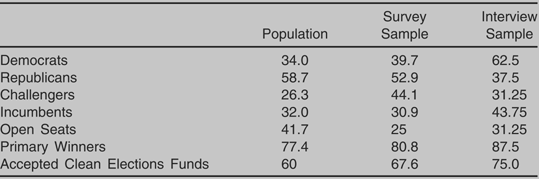
Arizona's liberal matching funds allocations make it the ideal case for analysis. If matching funds have resulted in a different sort of campaign, then it is reasonable to expect that the effect is most detectable there. I sent electronic and paper surveys to all registered primary candidates for legislative office in the 2006 Arizona election.Footnote 5 Of 186 registered candidates, I received 69 responses, for an overall response rate of 37.1%. This response rate is lower than the customary level for survey research, but it is consistent with previous surveys of elite candidate populations (e.g., Francia and Herrnson Reference Francia and Herrnson2003; Howell Reference Howell1982). Given the challenges of its relatively small size, the interview sample presents a reasonable approximation of the general candidate population with the exception of Democrats and Republicans being over- and under-represented, respectively (Table 2).
Representativeness of Candidate Sample

I designed the initial round of surveys to capture information regarding campaign time usage and overall candidate attitudes. However, a number of candidates wrote notes expressing concern that the original survey was not capturing unintended consequences of the Clean Elections law. I therefore re-solicited the respondent sample for personal interviews, and 16 of the original survey respondents agreed to move to the second phase of the study, discussing their experiences in recorded interviews collected in person at locations throughout Arizona.Footnote 6 I transcribed responses and coded for strategic and emotional concerns. I obtained data on matching funds distributions from the Citizens' Clean Elections Commission, Arizona's public funding regulatory agency.
Shifting Strategies
Nonparticipating (traditional) candidates must pay careful attention to expenditure levels so as not to benefit a publicly funded opponent. One traditional candidate described a campaign that was “very calculating in how much we sent out to keep spending as low as possible” in an effort to mitigate this effect. Another traditionally funded incumbent reached the same conclusion, saying, “If I raised $100,000 and he capped out at $69,000 that would give me a $30,000 advantage. I don't know that I could raise that much, so I think we would probably be equal. I would spend a lot of time and money raising that money … just (to) give it to him.” Still another incumbent clearly articulated the degree to which matching funds call for careful attention to spending:
I don't want to raise money and give my opponent money. If I can keep the spending down, me as an incumbent, I have a tremendous advantage … If I am a traditional candidate, and I raise $50,000, he's going to get that money, and he's going to use it to get more voters out. So I'm getting advice from both camps now. I'm getting advice that says “you need to raise $100,000, because you need to get your message out, you need to get your voters out,” and I hear the other people are saying “you need to go clean, because you don't need to be raising money for him, and in a low spending race, it's you as an incumbent that has the advantage.”
The desire for cost efficiency is present in all campaigns, but the effects of matching funds shift the spending calculus well beyond simple husbandry. While all traditional candidates interviewed expressed concern about the effect of matching funds on their opponents, some described conscious decisions to withhold expenditures for items that may have increased their performance at the polls:
Every dollar I spend over the threshold starts feeding the alligator trying to eat me. So I have to be very careful with how I spend money, which meant that I sent out a lot less mail and held a lot less events than I would have but for my hands feeling like they were tied under this system. That really irritated me, because I'd say “I'd love to rent a big tent, and we'll have an old-fashioned ice cream sundae thing in the park” or whatever, but I didn't want to do it unless everything was absolutely essential so that we didn't trigger more money to our opponent. Quite honestly, I would have sent probably twice as much mail.
Stories like this one were echoed by every candidate who had ever run traditionally against a Clean Elections opponent. One challenger who ran with public money observed that “those who want to go for the hundred thousand dollar campaign, they're not so sure they want to do it because they don't want to give me matching funds. I'm sure that they don't want a level playing field.” Another challenger noticed that her traditionally financed opponent had stopped spending in order to avoid triggering matching funds: “He spent just the amount in the general election to avoid having to give me matching money.”
While traditional candidates ponder the advantage of not spending, those who accept public subsidies care little if their opponents spend large sums because they are protected by matching funds. When asked whether he would take issue with his opponent spending $75,000 against him, a first time challenger in a long-shot race said, “That would be O.K., because I like the matching funds clause. If my opponent wants to go raise traditional funds so I can get more money to spend for my campaign, I think I'm fine with it.” However, there is a great deal of anxiety among participating candidates regarding the timing of opponent expenditures. One newly elected legislator, fresh from a tough fight in the general election, echoed the sentiments of the others, but added an important clause (emphasis added):
I think in some ways (my opponent) does think about (the effects of matching funds), and he limited his fundraising. I only got $2,500 in matching funds because of that. And he had a primary, and his one opponent was Clean Elections, and the other two were traditional, and the other two raised money like they were running a traditional campaign, not realizing that it impacted the Clean Elections candidate in huge ways. That Clean Elections candidate got huge amounts of money. But they wait until the last minute and spend it, to avoid that.
The belief in the existence of strategic expenditure timing is ubiquitous. According to every informant I interviewed, traditionally funded candidates try to maximize the competitive effect of the money that they do spend by releasing funds at the last moment, giving the Clean Elections candidate little time to react. Traditional candidates conceded that while the timing of expenditures was not an initial component of their strategy, by the end, it was crucial in maintaining control of the political message. So, while late spending “[was not] like a Manhattan plan or anything, [it] was part of our thinking … let's spend as little as possible early on, so that we could control the debate.” By releasing a mailing on the Friday before the election, traditional candidates are aware that even if their opponent is matched on the same day, it is prohibitively difficult to spend money over the final weekend in any meaningful fashion.
One experienced candidate described how traditional candidates maximize their strategic advantage: “You want to have a strategy and a plan of using those funds so that the matching funds are least beneficial to your opponent. In most cases you would think that that's at the last second, so they can't counter it. I think there's benefit to that. I think that's wise.” An incumbent who funded her campaign traditionally said, “We … think about [spending at the last minute], frankly. At least I do. Sometimes we may have planned what we're going to do, but we don't initiate anything, because the minute we sign a contract or the minute we initiate anything, we have to report.” Other candidates detailed how one can “really … work the system” by “spend[ing] money at the last minute if you're a traditional candidate … the clean candidate gets that money, that match, the day before the election.” An incumbent with multiple cycles of election experience described this phenomenon:
In terms of opponents incurring expenditures right before the elections, you know, the Friday before, that's happened both times that I've ran. And so you pick up a check from the Clean Elections department, you know, that Friday night, for the matching money, good luck trying to spend $5,000. So that has definitely played into most campaigns now, you know, people know that if you are going to go over the expenditure limit, you do it that weekend before.
Yet another legislator noted that campaign strategy has fundamentally changed as candidates play this game with ubiquity:
If a traditional candidate waits towards the end, and has some expenses that go over the limits, then the Clean Elections candidate gets matching funds, but if you do that farther down the road and the clean candidate doesn't know about it, then she's not going to have much time to plan how to spend that money, so there's some strategic advantages that a traditional candidate has. It would not be an exaggeration to say the Clean Elections is shifting strategic considerations.
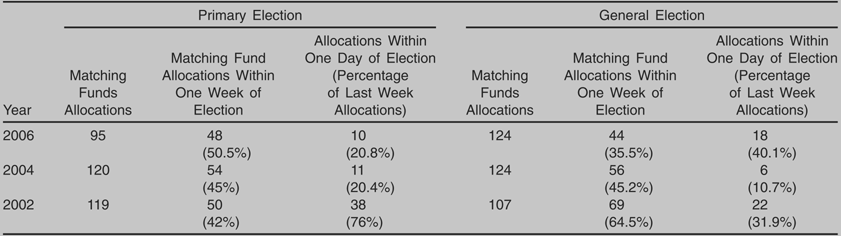
Available data supports the existence of this trend.Footnote 7 As Table 3 indicates, in no election since 2002 has the proportion of matching funds expenditures released in the last week of a cycle fallen below one-third. Some of this activity is attributable to the natural flow of campaign spending, but if the traditionally financed candidates who trigger matching funds allocations are as conscious of the effects of their spending as they seem to be, a substantial portion of late spending is delayed to maximize its strategic effect. Further, matching funds allocations within one day of the election generally comprise a substantial percentage of overall “last-minute” expenditures. In the 2006 general election, which the informants participated in, over 40% of expenditures occurring in the last week were released just hours before the polls opened. The majority of these matching funds allocations are no doubt resultant of strategic expenditure as traditional candidates and outside entities seek to gain favor with the electorate while leaving the publicly funded candidate little or no opportunity to respond.
Timing of Matching Funds Allocations, 2002–2006

Traditional candidates who purposely spend late have little sympathy for their publicly funded opponents, viewing a failure to adequately prepare for the expenditures on the final weekend as a lapse in proper planning. One legislator who had run as a traditional candidate described the importance of a prefabricated plan for publicly funded candidates to deal with late spending, saying, “I think I'm a good enough campaigner and strategist to figure that out.” Some Clean Elections candidates who actually faced this situation effectively anticipated late expenditures, and took steps to respond. One incumbent who had been the victim of last-minute attacks by traditionally funded candidates in the past behaved differently the next time, saying, “I got smarter the second time around … thinking that our opponent would probably spend, and (I) had a strategy ready to go on how we could spend that money quickly if we got matched.” Another experienced candidate said that when independent groups spent money against her in the closing weeks, she was ready to respond by hiring a group of people willing and able to walk on her behalf:
In my last race, every other day there was a hit piece. Every other day I would get matching funds. What do you do when you get $4,000 right before the election? If you're smart, you have a strategy, and you think, “O.K. if I get $4,000 two weeks out, I'm doing this.” If I get it right before the election, I'm doing something else. I'd already pre-planned that I would hire union people who were out of work to work on Election Day for me, because it was something that represented my values, and was a financially prudent thing to do.
The expectation of strategically timed spending was not limited to those with political experience. One first-time candidate in a crowded primary field had heard the stories of last-minute spending in other races, but had failed to assemble a formal response plan. However, the possibility of spending during the final weekend was present in the back of his mind, and he was able to mount an effective counterattack in the last moments of an ultimately unsuccessful campaign. In his case, it was an independent group, and not the opposition, that released funds with only days remaining before the election:
I was attacked by a group … they put out a hit piece. I was able to use that immediately to get myself qualified for another $3,000 worth of money to send out my own extra last minute piece, which was a really good one actually … I barely had time to respond. I had run out of money, because that's what happens. I really wanted to do another piece, but I just couldn't budget for it. So I had a couple of ideas sitting on the back burner, and then it just happened.
Despite the preparedness of some of their peers, many publicly funded candidates were not so savvy, and were caught unaware. Another first-time challenger described feelings of helplessness accompanying the realization that large amounts of money had been spent against him at the last minute, leaving him with matching funds but no time to spend them:
The last day, or the day before the election, they do all this stuff, and you don't really have time to plan real well. I could do better if I did it a second time. As a matter of fact, I gave some money back, because I got five or six thousand dollars the last day. The traditional people, they do that so well. Some people said “you should do something” and I said I can't use it effectively, and I'll give it back.
Another neophyte faced a similar situation, confronting feelings of disappointment with a system that was supposed to guarantee an even playing field. Outspent at the last minute, she was unable to respond, and faced the reality that despite her expectation of financial parity, she had been outflanked in the election's closing hours:
I believe [my opponent] spent a great deal of money in the time after the last reporting of expenses and income, so that I wouldn't have to balance, so that they wouldn't have to balance how much money I had with how much she had. You can't plan; you can't buy the media if you don't know what they're going to do. It would happen in a regular campaign anyway, but to be on the same playing field, we're not, because Clean Elections candidates are guaranteed this amount of money and the others are not, but if they get to this amount or higher, we'll raise the bar. And they can eventually outspend you. That's not fair.
Discussion
The allusion to fairness in the passage above is an important one. From the perspective of participating candidates, Arizona's Clean Elections system was supposed to move away from politics as usual to something better, empowering challengers with adequate resources while mandating financial equality among all contenders. However, while the matching funds provision has supposedly eliminated the financial gap between political haves and have-nots, an emotive gap remains. Traditional candidates view themselves as in control and on the offensive. They take a cool view of the shifting timing of campaign spending, describing strategic expenditures with such words as “smart,” “well-thought,” and “wise.” There is a universal recognition among them that when it comes to spending, later is almost always better.
Publicly funded candidates play defense, powerless to behave proactively and forced to guess when the opposition will make a move. Challengers in particular know that if they are to swing votes in their favor, they must be able to spend money. Withholding expenditures until the final days of an election cycle allows traditional candidates to effectively control the funding of their opponents, and given little time to respond, publicly funded candidates can be left holding the bag. These candidates, and particularly those running their first campaigns, report feelings of frustration and anxiety stemming from participation in a system that they believe falls short of its promised goal of “fairness.”
Despite an emotional difference between the two groups, when traditional candidates directly face participating candidates, neither is fully in control. Once they near the spending limit, nonparticipating candidates subvert their expenditure instinct to the realities of matching funds, suppressing spending and/or fundraising so as to avoid the issuance of a check to their opponent. While they may have the resources to hold an ice cream social, the benefit must be weighed against the cost of bolstering the opposition. Participating candidates wring their hands in anticipation of strategically timed last minute expenditures, often unable to preempt such moves with activity of their own because, in the last stages of an election, they themselves have reached the spending limit. Indeed, when the ability of outside groups to trigger matching funds allocations is considered, it can be said that even candidates running in elections in which all participants are publicly financed experience a great deal of strategic uncertainty.
Clean Elections may well be stimulating electoral competition in Arizona, but faced with shifting incentive structures, political costs, and opportunities, candidates there operate in a strategic environment that is fundamentally different from most of the rest of America. Public funding holds the potential to facilitate higher levels of financial equality among candidates, but while the money certainly helps, a subsidy alone is no panacea. In accepting financial assistance, candidates have given up control of their financial destiny and have acceded to conditions favoring both a flurry of last-minute campaigning and a depression in general campaign activity. These shifting strategies change not only the way in which candidates interact with each other, but also the manner in which they communicate with the electorate. If late activity becomes more ubiquitous, participating candidates are bound to catch on, and candidates on both sides of the public funding divide will hold money back to engage in last-minute point and counterpoint. Such a pattern may have broader impacts on voter perception and citizen mobilization as well.
The findings presented here have implications that reach well beyond Arizona's borders. Like Arizona, Maine implemented a voter-initiated program in the 2000 election, and has been offering full subsidies ever since. New Mexico opted for similar reforms for its Public Regulation Commission candidates in 2003, and the following year, North Carolina implemented full funding for judicial candidates. In 2008, Connecticut will begin offering full public subsidies in state elections, while New Jersey may expand its legislative program beyond a pilot stage. Public funding has also become a hot topic at the municipal level; Albuquerque and Portland have recently passed full funding laws and at least a dozen other cities are considering them. With the Democratic takeover of Congress in the 2006 midterm elections, discussion of public funding of congressional campaigns has also become more widespread in Washington. The trend in public funding is clear: full funding is the future. However, while the goals of public election funding are noble, they will not be implemented in a strategic vacuum. If matching funds provisions will be part of the next stage of campaign finance reforms, their practical ramifications on candidates and campaigns must be considered.