

INTRODUCTION
Crop production is affected by climate change through the alteration of important soil and plant processes such as crop development, photosynthesis and growth, as well as biological and chemical transformations of carbon (C) and nitrogen (N) in soils with associated leaching or gaseous losses (Olesen & Bindi Reference Olesen and Bindi2002). In Denmark, cereals represented 0·56 of the total agricultural area in 2011, of which winter wheat and spring barley were the most cultivated crops with 0·49 and 0·32 of total cereal surface, respectively (Statistics Denmark 2012). The proportion of the total land surface in Denmark that is under agricultural production exceeds 0·6, resulting in nutrient loading of freshwater and coastal ecosystems (Nielsen et al. Reference Nielsen, Trolle, Søndergaard, Lauridsen, Bjerring, Olesen and Jeppesen2012). To reduce these negative environmental consequences of agricultural activities, a number of regulations on agricultural land use have been put into place, including restrictions on N application rates and requirements for growing catch crops on a certain part of the farm area (Kronvang et al. Reference Kronvang, Andersen, Børgesen, Dalgaard, Larsen, Bøgestrand and Blicher-Mathiasen2008).
Projected temperature increases are expected to reduce grain yields by accelerating crop development and thus reducing the growing period. For winter wheat in Denmark, Kristensen et al. (Reference Kristensen, Schelde and Olesen2011) estimated the yield reduction to vary from c. 2 to 12% depending on the projection period and climate model considered, but location and soil type may also affect results (Patil et al. Reference Patil, Lægdsmand, Olesen and Porter2012). Cereals are usually grown within crop rotations that also include pulses, potatoes or root crops, depending on soil type and farmer interests and skills. The effect of temperature on these crops may be favourable, by allowing a longer growing season for crops such as sugar beets or by a warmer growing period as for potatoes (Olesen & Bindi Reference Olesen and Bindi2002).
In addition, a tendency for increased winter precipitation has been experienced in Denmark and the trend is predicted to continue in the future. This would elevate the risk of N losses through leaching (Patil et al. Reference Patil, Lægdsmand, Olesen and Porter2010a) or denitrification (Andersen et al. Reference Andersen, Kronvang, Larsen, Hoffmann, Jensen and Rasmussen2006), some of which would affect loading of N to surface waters (Jeppesen et al. Reference Jeppesen, Kronvang, Olesen, Audet, Søndergaard, Hoffmann, Andersen, Lauridsen, Liboriussen, Larsen, Beklioglu, Meerhoff, Özen and Özkan2011). Increased N leaching during winter and early spring might also reduce N availability to the succeeding crop. No significant effect of future precipitation on winter wheat growth and yield has been found in Denmark in previous studies (Patil et al. Reference Patil, Lægdsmand, Olesen and Porter2010b; Kristensen et al. Reference Kristensen, Schelde and Olesen2011). However, there may very well be a need for further measures to reduce nutrient runoff and leaching from agricultural soils. Some soil protection measures, such as tillage management, may be effective both under current and future climate change scenarios (Klik & Eitzinger Reference Klik and Eitzinger2010).
Increasing atmospheric CO2 concentration would enhance plant assimilation and biomass production by improving efficiencies of radiation, N and water use (Olesen & Bindi Reference Olesen and Bindi2002). These effects have been observed in experiments under controlled, semi-field and free air CO2 enrichment (FACE) field conditions (Kimball et al. Reference Kimball, Kobayahsi and Bindi2002; Ainsworth & Long Reference Ainsworth and Long2005).
The use of biophysical crop models for assessing impacts of climate on yields has the advantage of giving insights into and understanding of the responses of crops to changes in climatic parameters, which is not possible with the use of statistical models (Challinor et al. Reference Challinor, Ewert, Arnold, Simelton and Fraser2009). So far, most studies of climate change impacts on agricultural crop production have focused on individual crops or monocultures (Wolf et al. Reference Wolf, Evans, Semenov, Eckersten and Iglesias1996; Wolf & van Oijen Reference Wolf and Van Oijen2003; Børgesen & Olesen Reference Børgesen and Olesen2011; Patil et al. Reference Patil, Lægdsmand, Olesen and Porter2012).
The present study aims to assess the impact of projected future climate and CO2 concentration on the crop productivity and N leaching from arable crop rotations in Denmark through the use of a dynamic crop simulation model, where optimum yields are defined as the yields that can be achieved with adequate crop management in a given environment. Changes in management practices and adaptation strategies are discussed, focusing particularly on the need for irrigation to optimize yield and growing catch crops to reduce N leaching.
MATERIALS AND METHODS
Three characteristic crop rotations representative of sand and sandy loam soils in Denmark were analysed: two arable rotations and one from a pig farm (Table 1). The arable crop rotations were 2 years of spring barley (Hordeum vulgare L.), followed by potato (Solanum tuberosum L.) and winter wheat (Triticum aestivum L.), irrigated, on a coarse sand soil, and 2 years of winter wheat followed by sugar beet (Beta vulgaris L.) and spring barley, unirrigated, on a sandy loam soil. The pig farm rotation was composed of 2 years of winter wheat followed by spring barley, winter barley and winter oilseed rape (Brassica napus L.), non-irrigated and grown on a sandy loam soil. The management of all rotation systems, including and excluding catch crops, was defined according to common farmer practices. The catch crops were ryegrass (Lolium perenne L.), undersown in spring barley in spring, and fodder radish (Raphanus sativus L.), undersown 2 weeks before the harvest of winter wheat. Catch crops were only considered prior to spring-sown crops. This resulted in six different cropping systems being analysed for each particular climate scenario. An additional crop rotation was defined to represent adaptation to future climate (starting from 2040) in a pig farming system (Table 1). This adaptation consisted of growing grain maize (Zea mays L.) within a crop rotation composed of winter wheat followed by 2 years of grain maize, spring barley and winter rape. Soil types and properties were taken from Danish standards and corresponded to characteristic areas for the systems described (Madsen et al. Reference Madsen, Nørr and Holst1992). In brief, the coarse sand is representative of the washout plains of West and South Jutland, with the top 250 mm soil layer composed of 4·5% clay, 12·4% silt (2–20 μm particle diameter), 18% fine sand (20–200 μm) and 73·1% coarse sand (200–2000 μm) by dry weight and 20 g/kg organic matter, while the sandy loam soil is representative of the moraine deposits present on Zealand and the top 250 mm soil layer is composed of 12·7% clay, 30% silt and 57·3% sand by dry weight and 29 g/kg organic matter.
Crop rotations, catch crop species grown before the spring crop (for systems with catch crops only) and target N rates (kg N/ha) for individual crops. Rotations were defined to represent characteristic cropping systems in Denmark

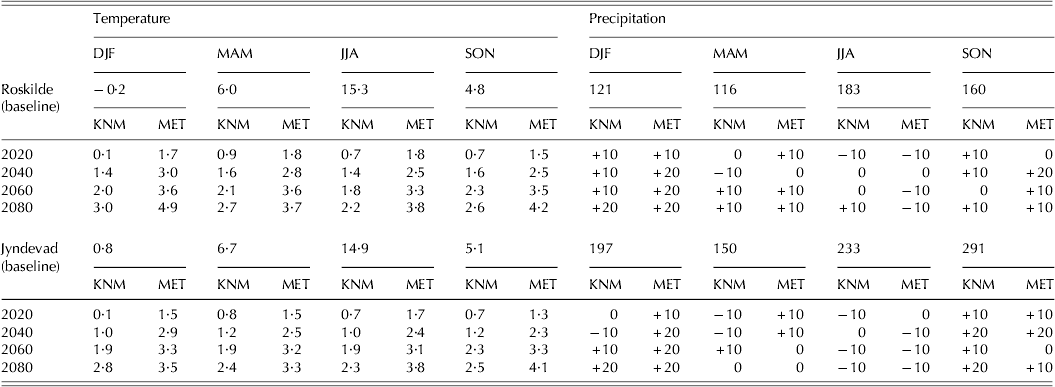
The climate change projections were provided by two regional climate models (RCM): Royal Netherlands Meteorological Institute, RACMO2 driven by the GCM ECHAM5 (KNMI) and Met-Office Hadley Centre, UK, driven by the GCM HadCM3Q0 (METO) derived from the ENSEMBLES project (van der Linden & Mitchell Reference van der Linden and Mitchell2009) and using the A1B emission scenario (Nakicenovic et al. Reference Nakicenovic, Alcamo, Davis, De Vries, Fenhann, Gaffin, Gregory, Grübler, Jung, Kram, Lebre La Rovere, Michaelis, Mori, Morita, Pepper, Pitcher, Price, Riahi, Roehrl, Rogner, Sankovski, Schlesinger, Shukla, Smith, Swart, Van Rooijen, Victor and Dadi2000). A series of 30 years (1961–90) of actual climatic data (from Roskilde, Zealand, 55°37′N, 12°08′E, 43 m asl for the sandy loam soil and Jyndevad, Jutland, 54°9′N, 9°13′E, 16 m asl for the coarse sandy soil) representing the baseline period were used to create the synthetic climatic data for the scenario analysis using the LARS weather generator (LARS-WG) (Semenov & Barrow Reference Semenov and Barrow1997). The generated data consisted of 100-year series for each of the five scenarios considered: the baseline climate for 1975 (1961–90), and four future climates for 2020 (2011–30), 2040 (2031–50), 2060 (2051–70) and 2080 (2071–90) according to the KNMI and METO RCMs. The estimated monthly changes in temperature, rainfall and solar radiation between the baseline and future periods for each climate model were applied in LARS-WG to generate synthetic daily weather series for baseline and future scenarios. Projected mean seasonal changes in temperature and precipitation according to both RCMs are presented in Table 2. Five atmospheric CO2 concentrations (350, 418, 483, 563 and 639 ppm), representing the values for the baseline and each projected time period, were considered for each particular climate scenario. This allowed the analysis of the effects of both factors, CO2 and climate, individually as well as their interactions.
Mean monthly seasonal (DJF, winter; MAM spring; JJA summer and SON autumn) change in temperature (T, °C) and precipitation (P, %) as projected with the KNMI and METO regional climate models for Roskilde (Zealand) and Jyndevad (South Jutland). Values for the baseline period (1961–90) (T, °C and P, mm) are given as a reference
The dynamic FASSET crop model (Berntsen et al. Reference Berntsen, Petersen, Jacobsen, Olesen and Hutchings2003) was used for assessing the effects of climate and CO2 on crop yields and selected environmental indicators. This model has been calibrated and tested for use in the environmental conditions of Denmark (Olesen et al. Reference Olesen, Petersen, Berntsen, Hansen, Jamieson and Thomsen2002; Berntsen et al. Reference Berntsen, Grant, Olesen, Kristensen, Vinther, Mølgaard and Petersen2006; Doltra et al. Reference Doltra, Lægdsmand and Olesen2011; Sapkota et al. Reference Sapkota, Askegaard, Lægdsmand and Olesen2012). Additional parameter adjustments were made to match average observed yields in farmer fields at current N fertilizer rates (Plantedirektoratet 2009) and of the duration of the growth stages based on observations (J. E. Olesen, personal communication). The model simulates crop growth and yield as affected by temperature, solar radiation, water and N availability, and CO2 concentration. For the latter effect on C3 crops, FASSET multiplies daily computed dry matter by an exponential function (exp{0·4537 − [170·97/CO2 (ppm)]}), and this response has been tested against FACE experiments (Jamieson et al. Reference Jamieson, Berntsen, Ewert, Kimball, Olesen, Pinter, Porter and Semenov2000). The model further assumes that higher CO2 concentrations reduce the crop canopy transpiration rates (Olesen et al. Reference Olesen, Petersen, Berntsen, Hansen, Jamieson and Thomsen2002), as observed in FACE experiments (Leakey et al. Reference Leakey, Ainsworth, Bernacchi, Rogers, Long and Ort2009).
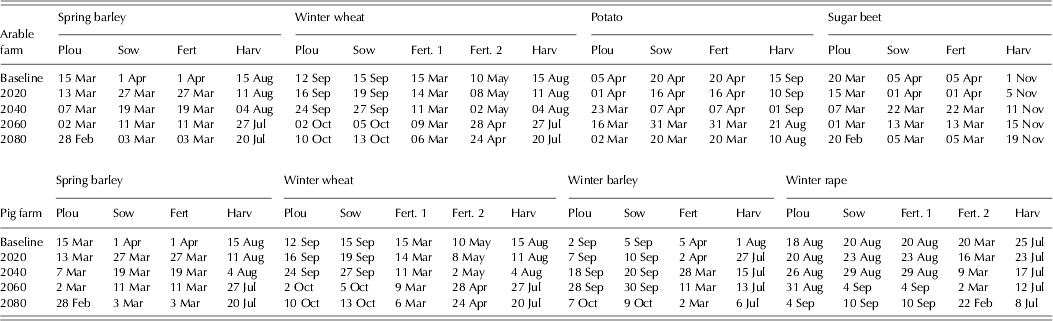
The model was run 30 times for each of the five climate scenarios considered, randomly using different initial years from the 100-year series. The crop rotation was repeated five times in each single model run and only outputs from the last repetition were used for the analysis of the results. This minimized the influence of the initial conditions on the model outcomes. The dates of the main field operations (ploughing, sowing, fertilization and harvest) were based on current farmer practices and assuming adjustments for future climate conditions based on experiences taken from current crop management practices for warmer sites in Europe (Table 3) (Henriksen et al. Reference Henriksen, Rosenbom, van der Keur, Olesen, Jørgensen, Kjær, Sonnenborg and Christensen2012). This information was obtained from surveys and interviews carried out with local experts and farmers in The Netherlands, Germany and France and scaled to the conditions in Denmark using local knowledge of farming systems. In the simulations, crop residues were always left in the field and ploughed into the soil. Fertilization amounts (Table 1) were based on current Danish recommendations (Plantedirektoratet 2009) and were not changed in the future climate scenarios. Two-thirds of the target N rate was considered to be supplied as pig slurry in the pig farm rotations. In the case of the irrigated rotation, irrigation was performed whenever soil moisture was below a specific threshold of plant water availability depending on the crop and growth stage according to established recommendations in Denmark (Plauborg & Olesen Reference Plauborg and Olesen1991).
Dates of ploughing, sowing, fertilization and harvest of crops in the modelled rotations for the baseline period and under projected climate change. Future dates were obtained from Henriksen et al. (Reference Henriksen, Rosenbom, van der Keur, Olesen, Jørgensen, Kjær, Sonnenborg and Christensen2012)
RESULTS
Crop yields on a sandy soil (arable farm system)
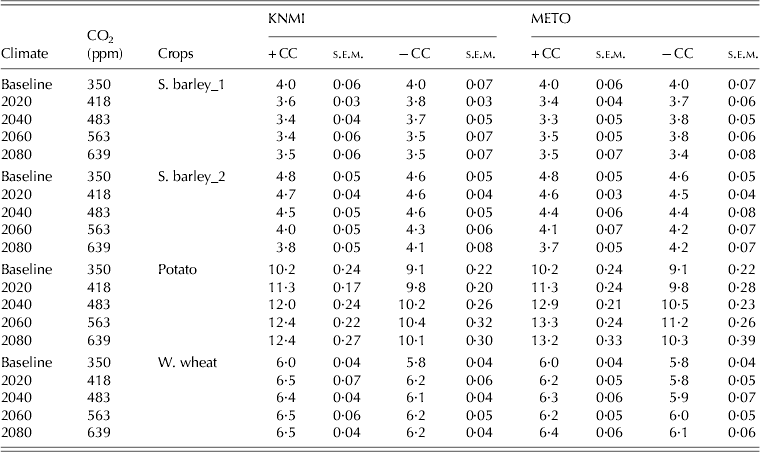
Under projected future climatic conditions increasing potato and winter wheat yields and decreasing spring barley yields (Table 4) are predicted. In the case of potato, this tendency is enhanced in the rotation with catch crops, resulting in a 22% yield increase by 2040 in comparison with a 14% increase when no catch crops are grown, taking the average of the KNMI and METO projections. Potato yields would be more stable in the second half of the century (further increase of 3% for a rotation with catch crops or no increase for a rotation without catch crops by the end of the century). The same pattern was simulated for winter wheat but with lower yield improvements, with the largest positive effect (7·5% yield increase) seen in the crop rotation with catch crop by 2080 in comparison with the baseline period. Spring barley yields would decrease more in the future in a rotation with catch crops (3–22%) than without (1–14%) and would be lower after winter wheat than spring barley. Generally, higher yield impacts in the future were predicted with METO than with KNMI, which is in agreement with the higher-temperature changes projected with the METO RCM.
Dry matter yield (t/ha) and s.e.m. of irrigated crops in a coarse sandy soil rotation with (+CC) and without catch crops (−CC) as predicted for the baseline climate and projected climate with the KNMI and METO regional climate models including effects of enhanced atmospheric CO2 concentration
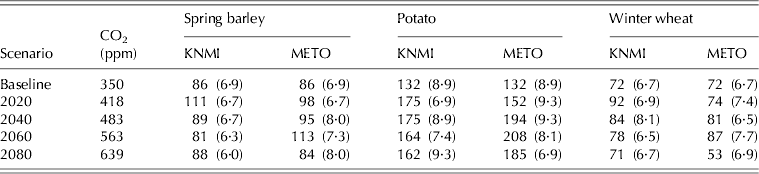
The simulated irrigation demand for the coarse sandy soil would increase until the middle of the century, although it varies with the crop and RCM considered (Table 5). The mean increase would be c. 15% for cereals and 40% for potato. A tendency to decrease in the second half of the century was predicted, reaching similar cereal irrigation requirements for 2080 as for the baseline period. In the case of potato, higher irrigation amounts would be still necessary in the distant future (31% on average), linked to the higher yield potential. The KNMI model results in the highest irrigation demand in the short-term scenario (2020), where projected spring precipitation is lower than with the METO model. In contrast, the METO model is associated with higher irrigation in the more distant future scenarios, resulting from higher temperatures and lower seasonal precipitation than KNMI (Table 2).
Irrigation requirements (±s.e.) of crops grown on a sandy soil arable rotation with catch crops simulated for the baseline climate and projected with the KNMI and METO RCMs and with increasing atmospheric CO2 concentration. Values (mm) represent averages for 30 years
Crop yields on a sandy loam soil (arable farm system)
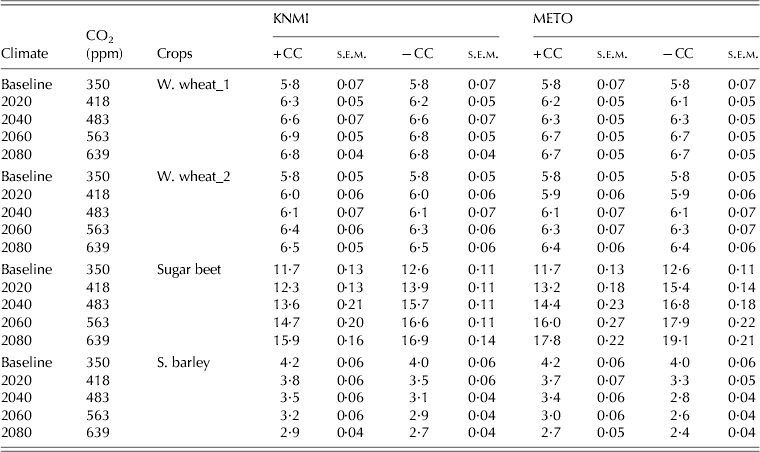
The effects of climate change and increasing atmospheric CO2 on the yield of crops grown in an arable rotation on a sandy loam soil were simulated to be favourable for winter wheat and sugar beet but unfavourable for spring barley (Table 6). Averaging the two RCM projections, the results indicate yield increases of 8·2 and 13·8% for winter wheat, and 24·5 and 43·4% for sugar beet, but reductions of 22 and 34·8% for spring barley, for the 2040 and 2080 projections, respectively. Growing fodder radish as a catch crop would affect yields of the succeeding crop, sugar beet, reducing it from 6 to 14%, with the highest impact for the mid-century scenarios. In contrast, the effects on the crop grown the second year after catch crops, spring barley, would be positive with yields up to 17% higher than in the rotation without catch crops. Winter wheat yields would remain unaffected by including the catch crop in the rotation. Winter wheat yield trends in the future would be dependent on the preceding crop in the rotation showing a better performance after spring barley than after winter wheat, with the highest differences predicted again by the mid-century. Yield changes predicted using the KNMI RCM are smaller compared with the METO RCM, as reflected in sugar beet yield increases (almost 2 t/ha lower with KNMI by 2080) and spring barley yield reductions. This is in accordance with the higher temperature increases and lower spring and summer precipitation predicted with the METO RCM (Table 3).
Dry matter yield (t/ha) and s.e.m. of crops in a sandy loam soil rotation (arable farm) with (+CC) and without catch crops (−CC) as predicted for the baseline climate and projected climate with the KNMI and METO regional climate models including effects of enhanced atmospheric CO2 concentration
Crop yields on a sandy loam soil (pig farming system)
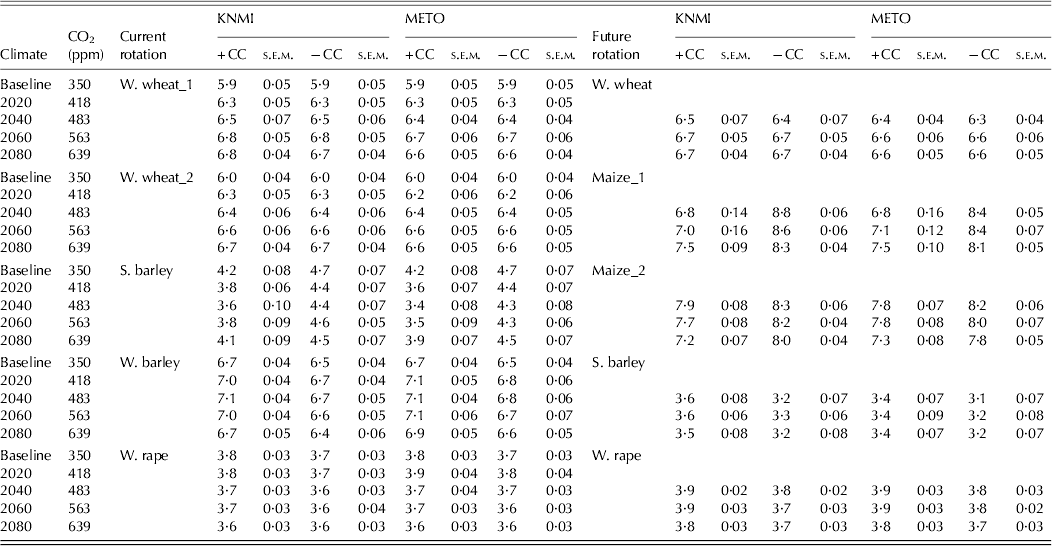
Simulated cereal yields in pig farming systems responded to changes in climate and CO2 in a similar way to arable farming systems, with increases in winter cereals (8 and 4·9% on average for winter wheat and winter barley, respectively) and decreases in spring barley (on average 11·8%) by the 2040 scenario (Table 7). The yield trend for spring barley is reversed in the second half of the century, which may be related to increased N availability from organic matter decomposition with the projected higher temperatures. However, spring barley yields would be 4–5% lower by 2080 in comparison with the baseline yields. Winter rape yield trends would be slightly decreased in the future (by 2 and 4% for 2040 and 2080, respectively).
Dry matter yield (t/ha) and s.e.m. of crops in a sandy loam soil current and ‘adapted future’ (from 2040) rotation (pig farm) with (+CC) and without catch crops (−CC) as predicted for the baseline climate and projected climate with the KNMI and METO regional climate models including effects of enhanced atmospheric CO2 concentration
The undersowing of a fodder radish catch crop before the harvest of the second year winter wheat would decrease the yields of the succeeding spring barley with increasing negative effect until the 2040 scenario (a yield reduction of c. 20%, averaging the KNMI and METO models). The effect in the second half of the century would be similar to that for the baseline period, with fodder radish reducing the yield of spring barley by c. 11%. The model results also suggest a benefit of catch crops in the second year after incorporation as indicated by higher winter barley yields with a slightly increasing benefit with the distant future scenarios (up to 6% by 2060). The other crops in the rotation would remain almost unaffected by growing a catch crop. These results suggest an earlier availability of N released from catch crops, possibly linked with enhanced decomposition at higher temperatures. The performance of winter wheat in the future would be slightly better (c. 0·1 t/ha) after winter rape than after winter wheat. Differences in yields from the KNMI and METO RCM were small, but as predicted in the arable rotation a larger impact on winter wheat and, especially, on spring barley was projected when applying the METO RCM.
Growing grain maize in two of the years in the pig farm rotation in the second half of the century as an adaptation to warmer climate would not substantially affect other crops in the rotation with the exception of spring barley. The higher productivity and longer growing season of grain maize affected barley grain yield negatively, which was reduced by 22%, on average, by 2080 compared with the rotation without maize. Future winter rape yields in the new rotation would remain close to that of the baseline period. The growing of catch crops in the new system would reduce grain maize yield due to crop competition from c. 9 to 21% in the first year and from 4 to 8% in the second year of maize, depending on the scenario considered when averaging the results obtained with the two RCMs. The lower grain maize yield reduction in the second year may be explained by a positive effect of 2 years of catch crops prior to maize that would improve soil N supply. This effect may also be reflected in the increase of 8–11% in average spring barley yields following the maize crop under projected climate change. The METO model projected generally lower yields in the new rotation when compared with the KNMI model.
Crop rotation productivity
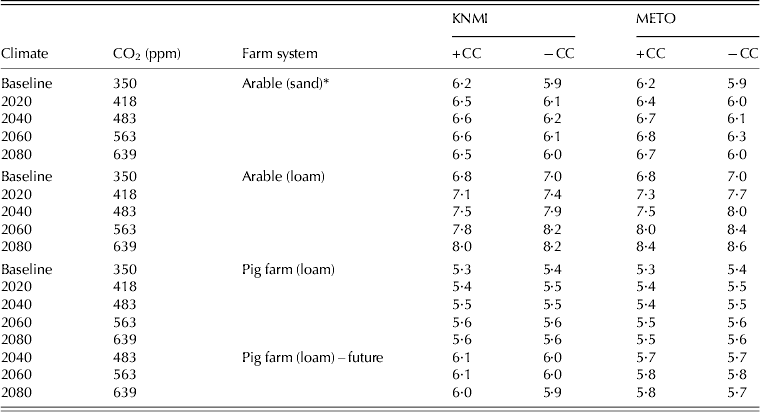
Simulated total productivity of the crop rotations increased under projected climate change in all the systems analysed (Table 8). The highest increase in productivity would be expected in the arable system on the sandy loam soil, with an increase of 20% in 2080 with respect to the baseline when pooling rotations with and without catch crops and the two RCM projections. In the irrigated rotation on coarse sandy soil, the average productivity of the rotation would be c. 7% higher in 2060. The smallest climate change impact on productivity was simulated for the pig farming system with a maximum increase of 4% with respect to the baseline period. Adapting the crop rotation to a warmer climate by introducing grain maize would improve crop productivity in the pig farming system by 9%. The effect of growing catch crops on crop rotation productivity varies with the type of rotation. In the case of the irrigated sandy soil, this effect would be positive with an average 8% increase in productivity when pooling scenarios across all time slices. For the arable rotation on a sandy loam, introduction of a catch crop would lead to a slight reduction (c. 3%) in crop rotation productivity, while productivity would remain almost unaltered in the pig farm rotation.
Average dry matter productivity (t/ha) of current and future crop rotations in arable and pig farming systems with (+CC) and without catch crops (−CC) as predicted for the baseline climate and projected climate with the KNMI and METO regional climate models, including effects of enhanced atmospheric CO2 concentration
* Irrigated rotation.
Nitrogen leaching
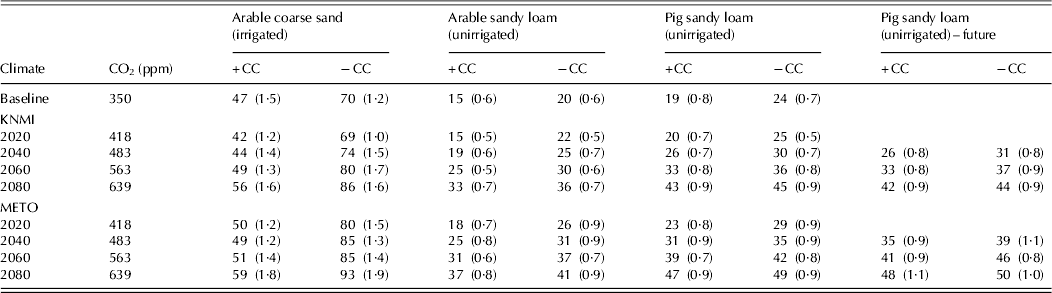
The results from the climate change projections show an increase of simulated N leaching in the future in all cropping systems, with larger annual leaching rates from the METO RCM compared with KMNI (Table 9). The maximum increase of N leaching was predicted for the sandy loam soil where N leaching would be approximately doubled by 2080 compared with the baseline situation. Including catch crops in the rotation substantially reduces the leaching on the coarse sandy soil but the simulated effect on the sandy loam soil was small. This is explained by the different proportion of catch crops in the rotations on these soils, which was considerably higher on the sandy than on the loam soil due to more spring-sown crops on the sandy soil. Nevertheless, growing catch crops would not avoid the increase of N leaching in the future, indicating needs for changes in crop management under climate change. N leaching would not increase with the future adapted rotation in pig farming compared with the current rotation.
Effect of growing catch crops on the annual N leaching (kg N/ha±s.e.) from irrigated and unirrigated arable crop rotations representative of arable and pig farming systems with baseline climate and projected climate with the KNMI and METO regional climate models including effects of enhanced atmospheric CO2 concentration. With catch crops, +CC; without catch crops, −CC
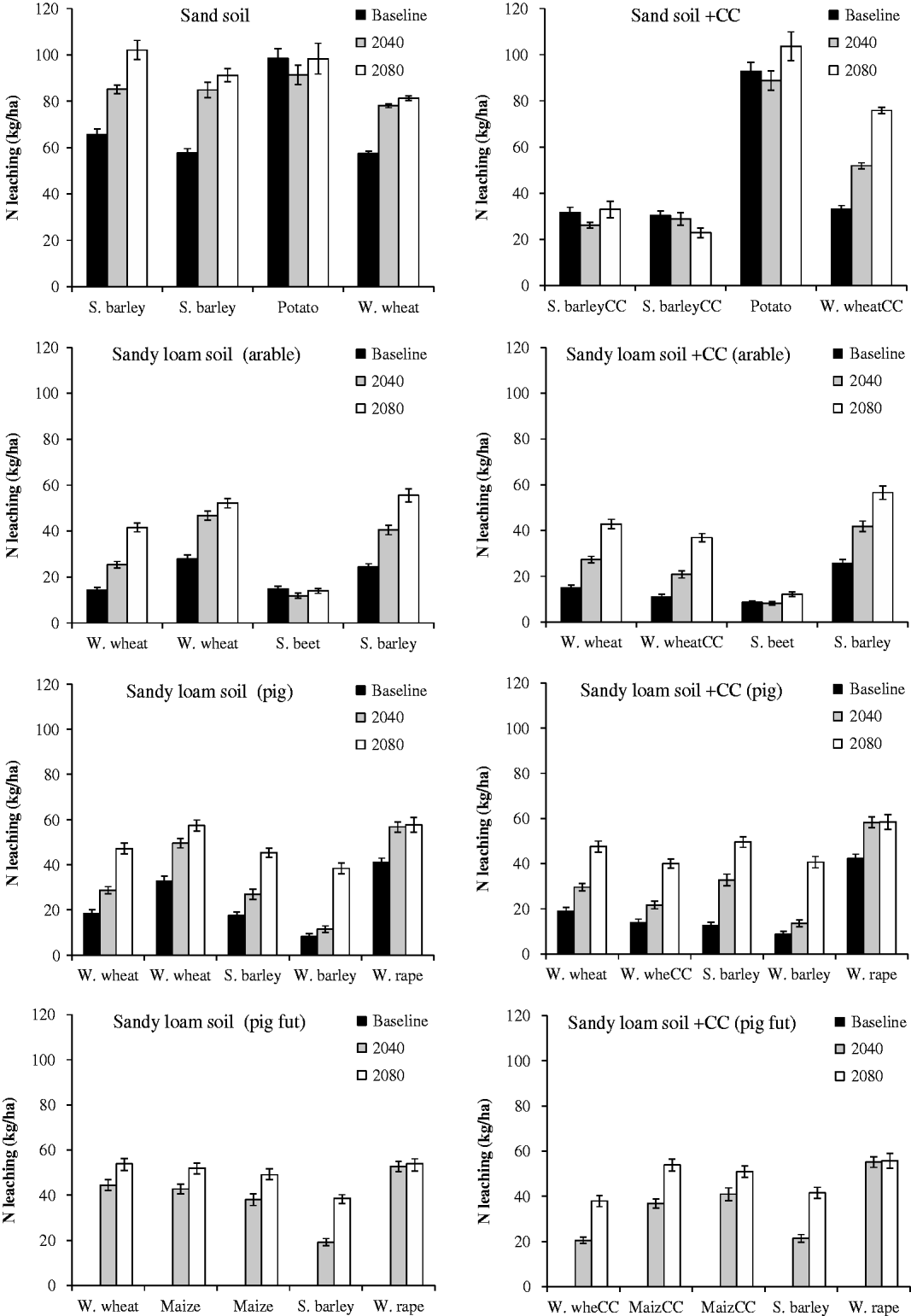
The contribution to N leaching of individual crops in the different crop rotations as derived from the METO model in terms of the annual leaching from the beginning of spring (1 April) to the end of winter (31 March) is represented in Fig. 1. Although potato on the sandy soil and winter rape on the sandy loam soil are the crops that contribute most to N leaching in the baseline situation, it is mostly the cereal crops that are estimated to be responsible for the increase of N leaching in the future. This increase would be in the range of 25–40 kg N/ha by 2080. The low N leaching under sugar beet relates to its long growing season and high capacity to capture N even during late growth phases. The graph also shows that the only case in which the increase of N leaching due to climate change is avoided with a proper management of catch crops is when ryegrass is sown together with spring barley on the sandy soil. In all other situations the present modelling results indicate a low efficiency of current catch crop management in reducing the impact on N leaching under future climate changes.
Annual nitrogen leaching (NO3-N + NH4-N) in individual crops of each crop rotation for the baseline period and two projected climate scenarios. Bars represent s.e. Indication is given for crops grown with a catch crop (CC). A potential future crop rotation (fut) is also included.
DISCUSSION
Factors affecting crop productivity under climate change
The simulated changes in crop productivity in Denmark under climate change result from changes in crop development and photosynthesis, soil mineralization and N leaching that interact with management factors such as crop rotation, cultivation method, sowing date, the presence of catch crops and N supply to crops. In all the scenarios analysed in the present work, yield losses due to current or future pests or diseases were not considered; it was assumed that farmers would have the capabilities to protect the crops. Predictions of the response of crop productivity to future climate change are dependent on rotation management, highlighting the importance of the rotation over the single crop approach.
Although the period from sowing to emergence would be little altered for cereals according to FASSET simulations, a decrease (winter cereals) or increase (spring barley) of the duration of the period from emergence to flowering and a reduction from this stage to the end of grain filling was predicted. Higher winter temperatures up to a certain threshold have been reported to affect winter wheat yields positively in Denmark (Kristensen et al. Reference Kristensen, Schelde and Olesen2011), which may be caused by better development of the root system allowing better soil exploration and thus reducing susceptibility to spring droughts. This could also be the case for winter barley. Indeed, Kristensen et al. (Reference Kristensen, Schelde and Olesen2011) found a limit of 4·4 °C for a positive effect of higher mean winter temperatures on grain yield. In the case of winter barley, the present study found a decrease in yields when the average projected winter temperature (December–February) exceeded 3·8 °C. It has been argued that faster development of the crop canopy and shorter duration of the grain filling period under higher temperatures are responsible for lower grain yields of winter cereals (Kristensen et al. Reference Kristensen, Schelde and Olesen2011). In the case of spring cereals, the simulated duration of the period to reach flowering would gradually increase with the future scenarios up to 10–12 days by 2080, caused by lower temperatures related to earlier sowing with higher spring temperatures under future climate change.
The reduction of the grain filling period at higher temperatures would produce a decrease in cereal yields, as previously reported (Wolf et al. Reference Wolf, Evans, Semenov, Eckersten and Iglesias1996; Kristensen et al. Reference Kristensen, Schelde and Olesen2011; Patil et al. Reference Patil, Lægdsmand, Olesen and Porter2012). In the present study, the simulations show a progressive decrease in the duration of grain filling over the century, being c. 1 week shorter by 2080 than for the baseline period, which is in accordance with other European studies (Semenov Reference Semenov2009). The shortening of the grain filling period leads to lower grain yield (Kristensen et al. Reference Kristensen, Schelde and Olesen2011). However, this may be partly compensated by the effect of enhanced CO2 concentrations on photosynthesis. The combined effect of higher temperatures and CO2 would, thus, result in better productivity of winter wheat and winter barley according to present simulations. The positive crop responses expected with higher CO2 are dependent on good nutrient supply (Olesen & Bindi Reference Olesen and Bindi2002; Leakey et al. Reference Leakey, Ainsworth, Bernacchi, Rogers, Long and Ort2009). Nevertheless, a sensitivity analysis of crop responses to increasing CO2 with the FASSET model (data not shown) showed that crop yields may decline under higher CO2 when N is limiting. This may be partly alleviated by earlier application of N to allow for greater biomass production with higher CO2 and warmer soil temperatures during spring (Patil et al. Reference Patil, Lægdsmand, Olesen and Porter2010a, Reference Patil, Lægdsmand, Olesen and Porterb), resulting in limitations in soil N supply at later stages if total N is not increased. The alteration of the N uptake pattern in combination with the shorter period for grain filling would explain the decrease of spring barley yield predicted by the model under future climate conditions. Although heat stress may be an important factor affecting cereal yields under climate change for sensitive cultivars (Semenov & Shewry Reference Semenov and Shewry2011; Rötter et al. Reference Rötter, Palosuo, Kersebaum, Angulo, Bindi, Ewert, Ferrise, Hlavinka, Moriondo, Nendel, Olesen, Patil, Ruget, Takáč and Trnka2012) critical temperatures around anthesis (>30 °C) were very rare in climate change projections in the present study, partly due to the earlier flowering dates with future changes in the climate. This is in agreement with the low probability of maximum temperature exceeding thresholds for wheat yield losses due to heat stress in Denmark reported by Semenov & Shewry (Reference Semenov and Shewry2011).
Tuber yield of irrigated potato substantially improved in the future simulations, probably due to extension of the growing period in the spring where solar radiation would be favourable for growth, and this would be further improved by higher CO2 concentration. Higher temperatures, solar radiation and evapotranspiration prior to tuber initiation have been found to relate to higher yields in Europe (Peltonen-Sainio et al. Reference Peltonen-Sainio, Jauhiainen, Trnka, Olesen, Calanca, Eckersten, Eitzinger, Gobin, Kersebaum, Kozyra, Kumar, Marta, Micale, Schaap, Seguin, Skjelvåg and Orlandini2010). Wolf & Van Oijen (Reference Wolf and Van Oijen2003) also found an increase of tuber yield with warmer temperatures in their simulation study for North Europe, but reported that the CO2 increase was the main factor for the positive response. The present model predictions also indicate that more irrigation would be required in the future in Denmark to obtain optimum yields, even if transpiration declines with increasing CO2 (Leakey et al. Reference Leakey, Ainsworth, Bernacchi, Rogers, Long and Ort2009). Sugar beet yields are also expected to increase due to the longer growing season favoured by the increase in spring and autumn temperatures. This is in agreement with observations on current relationships between climatic factors and yield of sugar beet in Europe (Peltonen-Sainio et al. Reference Peltonen-Sainio, Jauhiainen, Trnka, Olesen, Calanca, Eckersten, Eitzinger, Gobin, Kersebaum, Kozyra, Kumar, Marta, Micale, Schaap, Seguin, Skjelvåg and Orlandini2010). The effect of elevated CO2 on beet yield would be limited under high N supply due to increasing leaf senescence and reducing leaf area index at final harvest (Manderscheid et al. Reference Manderscheid, Pacholski and Weigel2010).
The present modelling study showed a small response of winter rape yields to changes in climate, in agreement with that reported by Olesen et al. (Reference Olesen, Trnka, Kersebaum, Skjelvåg, Seguin, Peltonen-Saino, Rossi, Kozyra and Micale2011). Contrary to the positive trends for Denmark reported by Supit et al. (Reference Supit, van Diepen, de Wit, Kabat, Baruth and Ludwig2010), the present work found that rapeseed yields would decrease slightly, mainly due to the shorter growing cycle under future climate change scenarios. This decrease can be compensated by introducing grain maize in the rotation, which would be possible with the predicted future temperatures increases in southern Scandinavia (Olesen et al. Reference Olesen, Trnka, Kersebaum, Skjelvåg, Seguin, Peltonen-Saino, Rossi, Kozyra and Micale2011; Elsgaard et al. Reference Elsgaard, Børgesen, Olesen, Siebert, Ewert, Peltonen-Sainio, Rötter and Skjelvåg2012).
Catch crops are management tools capable of improving the N economy of crop rotations and, hence, to increase crop productivity (Thorup-Kristensen et al. Reference Thorup-Kristensen, Magid and Jensen2003) as observed for cereals in Danish cropping systems (Doltra & Olesen Reference Doltra and Olesen2013). In the present modelling work, this was the case for the arable rotation on the sandy soil with a high proportion of catch crops in the rotation. According to the FASSET simulations, catch crops will grow better, with the projected climate change enhancing crop productivity on the sandy soil. The improved growth of catch crops at higher temperatures has also been found experimentally for winter conditions in Denmark (Thomsen et al. Reference Thomsen, Lægdsmand and Olesen2010). For the sandy loam soils, no increases in overall crop productivity in the future were predicted from growing catch crops. In the present simulations, growing fodder radish as a catch crop negatively affects yields of the succeeding sugar beet crop, which has the highest impact on the crop rotation productivity. This might be explained by the simulated dynamics of catch crop N release in the sandy soil resulting in less mineral N becoming available for the succeeding crop during the initial growth compared with the situation where no catch crops are grown and where soil mineral N levels may be higher, because the N has not been taken up by the catch crop (Thorup-Kristensen et al. Reference Thorup-Kristensen, Magid and Jensen2003). Crop yield on a sandy loam would in some cases be improved in the second year after the catch crop in comparison with the rotation without catch crop, although this effect was little influenced by climate change. This would affect spring barley after sugar beet in the arable rotation and winter barley after spring barley in the pig farm rotation. The short- and long-term fertility effects of catch crops have been shown to be dependent on a variety of factors such as catch crop type, soil or main crop (Doltra & Olesen Reference Doltra and Olesen2013). For a given soil type and crop rotation, the selection of the catch crop and its management would need to be adapted to the future climate in order to optimize rotation productivity.
Differences in climate change projections with the KNMI and METO RCMs were reflected in the simulated crop productivity, with stronger impact on the METO model. This is explained by the higher temperature increases projected with this model, as previously found in a study focused on winter wheat (Kristensen et al. Reference Kristensen, Schelde and Olesen2011). The variability in simulated yields under climate change increased considerably in the case of sugar beet and potato, but not for the other crops. Børgesen & Olesen (Reference Børgesen and Olesen2011) reported higher uncertainty in the projections in winter wheat yields on a sandy loam soil than on a sandy soil due to generally higher yields under the current climate for the better soils. This was something not shown in the present study, probably because of the interaction of other factors such as the rotation composition or the non-linear response to CO2 given by limited N availability as discussed above. However, for the sugar beet and potato crops, higher yields projected with the METO than with the KNMI model were also accompanied by higher yield variability.
Nitrogen leaching
The simulation results show an increase in N leaching with projected climate change for all crop rotations and soil types studied. This is in accordance with other studies of climate change impacts on N leaching from cereal cropping systems in Denmark (Børgesen & Olesen Reference Børgesen and Olesen2011; Patil et al. Reference Patil, Lægdsmand, Olesen and Porter2012). The increase in N leaching under climate change results from several factors: (a) a shorter growing season with later sowing (winter cereals) and earlier harvest leading to a longer duration in autumn of days without soil cover and thus with risk of N leaching (Askegaard et al. Reference Askegaard, Olesen, Rasmussen and Kristensen2011); (b) higher N mineralization at higher temperatures during autumn and winter leading to higher risks of N leaching if the soil is not covered (Thomsen et al. Reference Thomsen, Lægdsmand and Olesen2010); and (c) higher winter rainfall leading to greater leaching of any surplus soil mineral N, which thus is of particular relevance during seasons with little or no vegetation cover.
With the moderate N fertilizer rates applied currently in Denmark and in the present study, N leaching mostly stems from N that is mineralized from soil organic matter, rather than from surplus fertilizer N not taken up by the crop. The risk of N leaching therefore increased with increasing stocks of soil organic matter that, through mineralization, increases soil mineral N concentrations. At higher temperatures, soil organic matter turnover increases and this potentially reduces soil organic matter content and thus the basis for N mineralization. However, the present simulation study did not allow this effect to be explored, since similar initial soil organic matter contents were assumed in all simulation runs. To further explore this, simulation studies should consider transient scenarios of climate change with changes in soil organic matter.
Adaptation of agronomical practices and mitigation strategies
The crop rotation composition and the operation dates were adjusted in the present work to match the projected changes in temperature conditions. However, crop model parameters were not adjusted to reflect adaptation in the choice of varieties, even though some adaptation with respect to changes in crop phenology may be expected (Olesen et al. Reference Olesen, Børgesen, Elsgaard, Palosuo, Rötter, Skjelvåg, Peltonen-Sainio, Börjesson, Trnka, Ewert, Siebert, Brisson, Eitzinger, van Asselt, Oberforster and van der Fels-Klerx2012). For example, according to the FASSET simulations the period from flowering to maturity of winter wheat would be reduced by 9 days at the end of the century with respect to the baseline situation. However, it is expected that farmers would grow longer duration cultivars to adapt to the extended growing season in North Atlantic areas to increase the period for biomass accumulation (Olesen et al. Reference Olesen, Trnka, Kersebaum, Skjelvåg, Seguin, Peltonen-Saino, Rossi, Kozyra and Micale2011). Sugar beet and grain maize would be the crops that under climate change contribute most to enhancing productivity of the system among the crop rotations studied, and therefore it is expected that the cultivated area of these crops might increase in the future according to demand and market prices. It is also likely that farmers would adopt new technologies and methods (e.g. new varieties, crop protection or machinery), not accounted for in the present study, in order to obtain optimal crop yields in a given future scenario.
Fertilization and irrigation rates are likely to increase in the future to match crop requirements. In such a situation there is a risk of higher N losses through leaching or atmospheric emissions and this risk may be increased by climatic warming (Olesen et al. Reference Olesen, Rubæk, Heidmann, Hansen and Børgensen2004). In particular, higher temperatures and precipitation would result in faster decomposition of soil organic matter and soil transport of gases and solutes (Farquharson & Baldock Reference Farquharson and Baldock2008; Turner & Henry Reference Turner and Henry2010) and the shorter growing periods in shorter duration of crop cover. Higher below-ground crop residues with future improved productivity would contribute to sustain the soil organic matter, partly compensating for its decline due to higher mineralization rates in future climate conditions. The degree of compensation in the long term would be dependent on the cropping system. All these processes were predicted with FASSET and, therefore, the model may be considered suitable to evaluate effective measures to mitigate these negative impacts. Growing catch crops can reduce N leaching, but current common catch crop management schemes might not be sufficient to avoid the potential future increase of leaching. Proposed strategies are to increase the proportion of spring cereals in the rotation with undersowing of catch crops in spring for a faster autumn development, the use of deep-rooted species or intercropping and proper timing and ploughing of catch crops, which have been discussed in the literature as effective measures for reducing N losses (Thorup-Kristensen Reference Thorup-Kristensen1994; Olesen et al. Reference Olesen, Rubæk, Heidmann, Hansen and Børgensen2004; Thorup-Kristensen & Dresbøll Reference Thorup-Kristensen and Dresbøll2010; Askegaard et al. Reference Askegaard, Olesen, Rasmussen and Kristensen2011). The choice of the most convenient strategy would be site- and rotation-specific, and should be combined with an efficient schedule and application of water and fertilizers and manure handling according to the rotation requirements and farmers available technology and following the concepts of integrated soil management for sustainable agricultural production (Killham Reference Killham2011).
Modelling uncertainties
Differences in crop and climate models have been shown to affect crop yield predictions, resulting in a (often unknown) model uncertainty from applying only single scenarios, climate or crop models. As an example, Wolf & Van Oijen (Reference Wolf and Van Oijen2003) estimated an increase of 3–4 t/ha of potato tubers by 2050 in Denmark using the LPOTCO model in combination with two climate change scenarios, which is about twice the yield gain obtained in the present study. However, both modelling studies indicate the same trend of yield changes. Another example is the work of Palosuo et al. (Reference Palosuo, Kersebaum, Angulo, Hlavinka, Moriondo, Olesen, Patil, Ruget, Rumbaur, Takáč, Trnka, Bindi, Çaldağ, Ewert, Ferrise, Mirschel, Şaylan, Šiška and Rötter2011) showing great variation of crop models in terms of simulating current variability of winter wheat yields in Europe. Nevertheless, climate change projections have been pointed out as the main source of uncertainty in the predictions of winter wheat yield and N leaching in Denmark (Børgesen & Olesen Reference Børgesen and Olesen2011). The present work has also shown that predicted yield changes vary substantially according to the RCM used in the analysis, with yield differences between the predictions of KNMI and METO RCMs from only 0·1 t/ha in winter rape up to 2·2 t/ha for sugar beet. All these results highlight the importance of an ensemble modelling approach when projecting climate change and predicting crop yields, and research efforts in this area are likely to further increase (Olesen et al. Reference Olesen, Carter, Diaz-Ambrona, Fronzek, Heidmann, Hickler, Holt, Minguez, Morales, Palutikof, Quemada, Ruiz-Ramos, Rubæk, Sau, Smith and Sykes2007; Baigorria et al. Reference Baigorria, Jones and O'Brien2008; Challinor et al. Reference Challinor, Ewert, Arnold, Simelton and Fraser2009; Soussana et al. Reference Soussana, Graux and Tubiello2010; Palosuo et al. Reference Palosuo, Kersebaum, Angulo, Hlavinka, Moriondo, Olesen, Patil, Ruget, Rumbaur, Takáč, Trnka, Bindi, Çaldağ, Ewert, Ferrise, Mirschel, Şaylan, Šiška and Rötter2011; Rötter et al. Reference Rötter, Carter, Olesen and Porter2011). In spite of the inherent uncertainty of the single model approach and that some agronomical (e.g. crop diseases or pests) and socio-economic aspects (consumer demand or policy issues) are not modelled, the present work shows that well validated and robust single crop models are very valuable tools for estimating trends in crop productivity for particular cropping systems and agroclimatic areas as shown here for Denmark.
This work was funded by the Danish Ministry of Food, Agriculture and Fisheries through the project ‘Impacts and adaptation to climate change in cropping systems’.