The last two decades have witnessed the accumulation of a substantial body of evidence refuting the long-held belief that internalizing symptoms in young children are developmentally transient phenomena. In a series of studies, we have established that children as young as ages 5–6 are reliable reporters of depressed and anxious mood and that those self-reports are correlated with both concurrent and future social functioning in multiple domains (Edelsohn, Ialongo, Wethamer-Larsson, Crockett, & Kellam, Reference Edelsohn, Ialongo, Wethamer-Larsson, Crockett and Kellam1992; Ialongo, Edelsohn, Werthamer-Larsson, Crockett, & Kellam, Reference Ialongo, Edelsohn, Werthamer-Larsson, Crockett and Kellam1994, Reference Ialongo, Edelsohn, Werthamer-Larsson, Crockett and Kellam1995, Reference Ialongo, Edelsohn, Werthamer-Larsson, Crockett and Kellam1996; Ialongo, Poduska, Werthmer, & Kellam, Reference Ialongo, Poduska, Werthamer and Kellam2001). In addition, Ialongo et al. (Reference Ialongo, Poduska, Werthamer and Kellam2001) found that ages 5–6 reports of depressed mood were associated with increased use of mental health services as reported by teachers and parents in late elementary school and the prevalence of major depressive disorder (MDD) in early adolescence. Suggestive of the young child's susceptibility to the impact of highly distressed environments, first-grade children, particularly girls, living in neighborhoods characterized by high levels of community violence and poverty reported the highest levels of internalzing symptoms (Edelsohn et al., Reference Edelsohn, Ialongo, Wethamer-Larsson, Crockett and Kellam1992). An important finding by Luby and colleagues (Belden et al., in press; Luby, Reference Luby2010; Luby et al., Reference Luby, Belden, Botteron, Marrus, Harms and Babb2013; Luby, Gaffrey, Tillman, April, & Belden, in press) was complementary evidence of the significance of depressive symptomology among children as young as age 3. Moreover, they present evidence of neurobehavioral markers of the consequences of early childhood major depression, including changes in anterior insula volume, presumably associated with the experience of guilt (Belden et al., in press). This latter evidence suggests that preschool children are susceptible to guilt-inducing interactions in their caregiving environment. Taken to together with the findings of Edelsohn et al. (Reference Edelsohn, Ialongo, Wethamer-Larsson, Crockett and Kellam1992), it seems reasonable to assume that children as young as 3 are susceptible to distressed environments as reflected in internalizing symptoms and disorders. Consistent with Ialongo and Luby and colleagues’ findings among young children are those of Reuter, Scaramella, Wallace, and Conger (Reference Reuter, Scaramella, Wallace and Conger1999), which highlight the significance of internalizing symptoms in adolescence with respect to the subsequent development of first-onset depressive and anxiety disorders by young adulthood.
A Developmental Framework for Understanding the Development and Course of Internalizing Symptoms in Children and Adolescents
Our framework for understanding the development and course of internalizing symptoms in children and adolescents draws on multiple theories and frameworks of normal and pathological development. At the core are social–cognitive learning theory and its integration with Kellam and Rebok's (Reference Kellam, Rebok, McCord and Tremblay1992) life-course developmental epidemiological framework, which draws on the basic tenets of the organizational approach to development as elaborated by Cicchetti and Schneider-Rosen (Reference Cicchetti, Schneider-Rosen, Cicchetti and Schneider-Rosen1984). Within this developmental framework, the current study hopes to emphasize the role the social context has on internalizing symptoms as well as how that social context may interact with genetic factors. This is accomplished by exploring the role of early social contexts on the course of internalizing symptoms in childhood and adolescence as well as identifying how interactions between early social contexts and genetics may play a role in the course of symptomatology.
Consistent with life-course developmental theory, individuals are seen in the Kellam and Rebok (Reference Kellam, Rebok, McCord and Tremblay1992) model as facing various tasks and transitions across the life span within the relevant social fields or contexts that development unfolds. The prominent social fields early on in the life course and into adolescence include the family, school, and peer group. The salient transitions early on in the life course include entrance into school and the developmental tasks associated with that transition. These include negotiation of separation from parents and the demands parents and teachers place on children to learn and to behave appropriately. In line with the organizational approach to development (Cicchetti & Schneider-Rosen, Reference Cicchetti, Schneider-Rosen, Cicchetti and Schneider-Rosen1984), normal development is viewed within the life-course/social fields framework as marked by the integration of earlier competencies into later modes of functioning, with the earlier competencies remaining accessible, ready to be activated and utilized during times of stress, crisis, novelty, and creativity. It follows then that early successful social adaptation in the face of prominent developmental challenges tends to promote later adaptation as the individual traverses the life course and encounters new and different social task demands across the main social fields (Cicchetti & Schneider-Rosen, Reference Cicchetti, Schneider-Rosen, Cicchetti and Schneider-Rosen1984).
Within the life-course developmental framework outlined by Kellam and Rebok (Reference Kellam, Rebok, McCord and Tremblay1992), an important distinction is made between what is termed social adaptational status and psychological well-being. Psychological well-being refers to internal states such as depression and anxiety. By contrast, the term social adaptational status refers to the degree to which the individual's behavioral responses to specific social task demands are viewed as adequate by the person or persons empowered to define the tasks and judge the adequacy of responses in specific social fields. The demands and/or tasks are seen as varying across the social fields or contexts in which development unfolds. The judgment of the adequacy of performance of behavioral responses to these developmentally relevant tasks is made by important others in each of these social fields termed natural raters. Parents in the family, teachers in the classroom, and peers in the peer group are examples of natural raters in developmentally relevant social fields. Each of these has the role of defining tasks and rating adequacy of behavioral responses.
The Role of Social Adaptational Performance and Explanatory Style in the Development and Course of Internalizing Symptoms in Children and Adolescents
It is the ratings of what Kellam and Rebok (Reference Kellam, Rebok, McCord and Tremblay1992) term social adaptational performance that figures prominently in our model of the development of internalizing symptoms. Consistent with the reformulated learned helplessness theory of depression (Abramson, Seligman, & Teasdale, Reference Abramson, Seligman and Teasdale1978), it is hypothesized that children who fail to meet the social task demands of their natural raters and who attribute their failures to internal, stable, and global causes will be at greater risk to experience helplessness and decrements in self-worth. In turn, helplessness and poor self-worth are seen as antecedents to the development of internalizing symptoms. As pointed out earlier, parents’, teachers’, siblings’, and peers’ evaluative comments and labeling of the child's behavior may serve to shape his/her concept of self and attributions for success and failure (Radke-Yarrow, Belmont, Nttlemann, & Bottomly, Reference Radke-Yarrow, Belmont, Nottlemann, Bottomly, Cicchetti and Beeghly1990). Evaluative comments that emphasize external causes for a child's success and stable and internal causes for his or her failures may increase the likelihood that the child develops what Abramson et al. (Reference Abramson, Seligman and Teasdale1978) have termed a “pessimistic explanatory style.” In line with Cole and Rehm's (Reference Cole and Rehm1986) self-control model of depression, children may also internalize external controls placed upon them by their natural raters. Stringent or perfectionistic standards for a child's success may result in the child's establishing very strict criteria by which to evaluate himself and in setting unrealistic goals for himself. Consequently, such a child would administer low rates of self-reward and high rates of self-punishment.
Nonnormative Life Events in the Development and Course of Internalizing Symptoms in Children and Adolescents
While emphasizing the role of adaptation to normative developmental events in etiology of internalzing symptoms, our developmental framework can also accommodate nonnormative events, such as parental divorce or death. There is an extensive literature on the impact of parental divorce on child psychological well-being and/or social functioning (Adam & Chase-Lansdale, Reference Adam and Chase-Landsdale2002; Amato, Reference Amato2000; Booth, Ristenbach, & McHale, Reference Booth, Rustenbach and McHale2008; Vélez, Wolchik, Tein, & Sandler, Reference Vélez, Wolchik, Tein and Sandler2011), whereas Jaffee and colleagues (Reference Jaffee, Moffitt, Caspi, Fombonne, Poulton and Martin2002) reported that caregiver instability associated with the death, divorce, or separation of a parent before the age of 9 was the primary risk factor for adolescent onset depression. Moreover, Melhem, Walker, Mortiz, and Brent (Reference Melhem, Walker, Moritz and Brent2008) found that children and adolescents who experienced the death of a caregiver had higher levels of depressive symptoms, even after controlling for antecedent and concomitant risk factors. It is important that findings from randomized controlled trials of interventions designed to prevent the untoward effects of divorce and bereavement on children highlight the role of improved parenting as the primary mechanism for intervention effects on immediate and longer term child outcomes (Luecken et al., Reference Luecken, Hagan, Sandler, Tein, Ayers and Wolchik2014; Wolchik et al., Reference Wolchik, Sandler, Tein, Mahrer, Millsap and Winslow2013). These findings from both observational and experimental studies seem consistent with the hypothesis that due to the potentially disruptive effects of nonnormative stressors on parenting practices linked to cognitive and social development, such children may be less equipped to negotiate the cognitive and social demands they face over the course of development. Thus, they may be more likely to fail and to experience helplessness, hopelessness, and depressed and anxious mood. In addition, exposure to uncontrollable life events, centering around basic needs, such as nurturance, food, shelter, and safety, might serve to engender helplessness, hopelessness, and low self-worth, because the child may be unable to successfully deal with such events early on in the life course.
Genetic Influences on the Development and Course of Internalizing Symptoms in Children and Adolescents
There is ample evidence from quantitative genetic studies of the heritability of cognitive, language, and behavioral competencies (Bartels, Rietveld, van Baal, & Boomsma, Reference Bartels, Rietveld, Van Baal and Boomsma2002; Deary, Spinath, & Bates, Reference Deary, Spinath and Bates2006; Plomin & Spinath, Reference Plomin and Spinath2004; Thompson et al., Reference Thompson, Cannon, Narr, van Erp, Poutanen and Huttunen2001; Trouton, Spinath, & Plomin, Reference Trouton, Spinath and Plomin2002; Tucker-Drob, Briley, & Harden, Reference Tucker-Drob, Briley and Harden2013). Such competencies are critical to social adaptation across the life span. Thus, it seems reasonable to postulate genetic influences on internalizing symptoms and disorders in light of the role genetics play in social adaptation and the link between social adaptation and internalizing symptoms as demonstrated by Ialongo and colleagues (Edelsohn et al., Reference Edelsohn, Ialongo, Wethamer-Larsson, Crockett and Kellam1992; Ialongo et al., Reference Ialongo, Edelsohn, Werthamer-Larsson, Crockett and Kellam1994, Reference Ialongo, Edelsohn, Werthamer-Larsson, Crockett and Kellam1995, Reference Ialongo, Edelsohn, Werthamer-Larsson, Crockett and Kellam1996, Reference Ialongo, Poduska, Werthamer and Kellam2001). As an example of a potentially more direct pathway, there is evidence of genetic influences on emotion regulation (e.g., Wang & Saudino, Reference Wang and Saudino2013) and response to distress in early childhood (e.g., Ouellet-Morin et al., Reference Ouellet-Morin, Boivin, Dionne, Lupien, Arsenault and Barr2008), both of which are at the core of internalizing symptoms.
Serving to further support our contention of genetic influences on the development and course of internalizing symptoms is evidence from the quantitative and molecular genetic literatures. Regarding the former, there is general support from the quantitative genetics of genetic influences on internalizing symptoms in children as young as age 3 (Boomsma, Van Beijsterveldt, & Hudziak, Reference Boomsma, Van Beijsterveldt and Hudziak2005). As pointed out by Boomsma et al., the magnitude of the genetic effects do appear to vary as a function of the study design (e.g., classical twin vs. adoption), the reporter (e.g., mother vs. father, parent vs. child), the age of the child (conflicting findings as to the direction of the effects), and sample size (smaller samples yield less power). Nevertheless, Boomsma et al. (Reference Boomsma, Van Beijsterveldt and Hudziak2005), using the Netherlands twin registry of more than 9,000 + twin pairs followed longitudinally, found evidence of genetic influences on internalizing symptoms from ages 3 to 12, regardless of the reporter (mother vs. father). The genetic influences tended to decrease in magnitude over age, with shared environment playing a larger role in adolescence.
More recently, Benke et al. (in press) reported on the molecular genetic findings from three large population-based samples (including the Dutch twin registry) of preschool age children. Benke et al. used a genome-wide association (GWA) as opposed to a candidate gene approach and found evidence of genetic influences on internalizing symptoms consistent with Boomsma et al. (Reference Boomsma, Van Beijsterveldt and Hudziak2005). The advantage of the genome-wide approach utilized by Benke et al., in contrast to the candidate gene approach, is that the former reflects the prevailing belief in the molecular genetics literature that complex human behavior is influenced by multiple genes as opposed to a single gene (see Duncan, Pollastri, & Smoller, Reference Duncan, Pollastri and Smoller2014).
The Current Study
As reflected in Dunn et al.'s (Reference Dunn, Uddin, Subramanian, Smoller, Galea and Koenen2011) review, the last decade has witnessed a dramatic rise in the number of molecular genetic investigations of specific Gene × Environment interactions in the development of internalizing symptoms and disorders in children and adolescents. They suggest that this increased focus on specific Gene × Environment interactions appears consistent with the evidence of both genetic and environmental influences on internalizing symptoms from the quantitative and molecular genetic literatures. In terms of the former, Kendler et al. (Reference Kendler, Kessler, Walters, MacLean, Neale and Heath1995) provided some of the earliest evidence of a Gene × Environment interaction in the context of a female–female adult twin study. More specifically, the per month probability of MDD among monozygotic twins concordant for MDD and who had experienced a “severe” life event was more than twice that of monozygotic twins discordant for MDD. Similarly, within the context of a sample of adopted and biological children, Gheyara, Klump, McGue, Iacono, and Burt (Reference Gheyara, Klump, McGue, Iacono and Burt2011) reported a Gene × Environment interaction in terms of the risk of MDD, such that the effect of friends’ and family deaths on the risk of lifetime MDD was moderated by genetic influences.
Caspi et al. (Reference Caspi, Sugden, Moffitt, Taylor, Craig and Harrington2003) likely represents one of the earliest and most referenced example of a specific Gene × Environment interaction in the development of depression. They reported that the risk of depressive symptoms and disorder in young adulthood was greatest among those with a short form of the serotonin transporter linked polymorphic region polymorphism. As a result of numerous conflicting replications of the Caspi et al. (Reference Caspi, Sugden, Moffitt, Taylor, Craig and Harrington2003) work, several researchers, including Karg, Burmeister, Shedden, and Sen (Reference Karg, Burmeister, Shedden and Sen2011) and Risch and colleagues (Reference Risch, Herrell, Lehner, Liang, Eaves and Hoh2009), have worked to meta-analyze the findings. These two meta-analyses found differing results, with Risch et al. (Reference Risch, Herrell, Lehner, Liang, Eaves and Hoh2009) finding no evidence of a Gene × Environment interaction and Karg et al. (Reference Karg, Burmeister, Shedden and Sen2011) finding strong support for genetics moderating the relationship between stress and depression. Karg et al. (Reference Karg, Burmeister, Shedden and Sen2011) suggest that some of the variation in the relationship found could be due to the stressor type and stress assessment and further posit that future work designed to test these questions should focus on measurement similarity to improve replicability. This is consistent with the conclusions of Dunn et al. (Reference Dunn, Uddin, Subramanian, Smoller, Galea and Koenen2011), who identify variations in study design, measurement of the environment, and analysis as contributing to the “mixed findings” in the literature.
The current study represents an attempt to overcome some of the limitations of the prior molecular genetics literature with respect to the study of specific Gene × Environment interactions in the course of internalizing symptoms from late childhood through adolescence. First, we focus on two life events in early childhood (parental death and divorce) that have been shown to be significant predictors of child and adolescent internalizing symptoms (Adam & Chase-Lansdale, Reference Adam and Chase-Landsdale2002; Amato, Reference Amato2000; Booth et al., Reference Booth, Rustenbach and McHale2008; Jaffee et al., Reference Jaffee, Moffitt, Caspi, Fombonne, Poulton and Martin2002; Melhem et al., Reference Melhem, Walker, Moritz and Brent2008; Vélez et al., Reference Vélez, Wolchik, Tein and Sandler2011). Kendler, Neale, Kessler, Heath, and Eaves' (Reference Kendler, Neale, Kessler, Heath and Eaves1992) series of studies of twins showed that early trauma, including parent death and separation/divorce, exerts significant effects on the risk for internalizing disorders in adulthood after taking into account genetic contributions. O'Connor, Caspi, DeFries, and Plomin (Reference O'Connor, Caspi, DeFries and Plomin2000), utilizing an adoption design and D'Onofrio et al. (Reference D'Onofrio, Turkheimer, Emery, Slutske, Heath and Madden2005, Reference D'Onofrio, Turkheimer, Emery, Maes, Silberg and Eaves2007) employing a children of cotwins design, reported findings similar to those of Kendler et al. (Reference Kendler, Neale, Kessler, Heath and Eaves1992). That is, the effects of divorce/separation on child psychopathology were in addition to any genetic effects. This was also the case for parental death as reported in Battaglia et al. (Reference Battaglia, Pesenti-Gritti, Medland, Ogliari, Tambs and Spatola2009).
Second, another way we seek to overcome the limitations of the prior literature is by obtaining child as opposed to parent or teacher reports of internalizing symptoms. This in line with evidence from our own work (Ialongo et al., Reference Ialongo, Poduska, Werthamer and Kellam2001) that child reports of internalizing symptoms as early as first grade yield better prediction of later social functioning, mental health service utilization, and adolescent onset of MDD than do parent or teacher reports.
Third, we seek to improve on the prior literature with our prospective design and annual assessments of internalizing symptoms over a 7-year period from entrance into middle school through high school. The prospective nature of the study allows us to draw stronger causal inferences with respect to the contribution of early divorce and parental death to child and adolescent internalizing symptoms. The annual assessments also put us in a better position to study the course of internalizing symptoms.
Fourth, we utilize a polygenic score approach (described in more detail below), drawing on the findings of a mega-GWA study of nearly 20,000 individuals by the Psychiatric Genomics Consortium (PGC, 2013). The advantage of the polygenic score approach, as noted above, is that it allows us to capture genetic contributions across the genome as opposed to a single gene.
Fifth, the study sample is representative of the entire cohort of entering first graders in the nine participating elementary schools from which the original sample was drawn. As such, the selection biases associated with samples of convenience or volunteer samples are mitigated.
Sixth, we utilize a latent trait–state–occasion (LTSO) approach (Cole, Martin, & Steiger, Reference Cole, Martin and Steiger2005) to model the main and interaction effects of the polygenic score and parental divorce and/or death on the course of internalizing symptoms. The advantage of the LTSO model is that allows for the separation of trait and state variance components of longitudinally measured constructs. This is critical given our view elaborated above that genetic influences on the course of internalizing symptoms are mediated through psychological traits, such as competencies in the intellectual, language, and social domains, and more temperamental characteristics, such as emotion regulation and response to stress.
Seventh and finally, we will rely on the differential susceptibility hypothesis/framework (Belsky, Bakermans-Kranenburg, & van IJzendoorn, Reference Belsky, Bakermans-Kranenburg and van IJzendoorn2007; Belsky & Pleuss, Reference Belsky and Pluess2009) in guiding our analysis of Gene × Environment interactions. We do so given its emphasis on the plasticity of response to positive and negative environmental variation as opposed to the diathesis–stress framework and its exclusive focus on risk in terms of the characteristics of the individual and the environment. More specifically, the diathesis framework is focused solely on the untoward outcome in the presence of both the diathesis (genetic/biological propensity) and the environmental risk. In contrast, consistent with the concept of “for better or worse” (Belsky et al., Reference Belsky, Bakermans-Kranenburg and van IJzendoorn2007; Belsky & Pleus, Reference Belsky and Pluess2009), the differential susceptibility framework expands the focus to include plasticity in response to enriched as well as distressed environments.
Note that in the current paper we focus on internalizing symptoms in the aggregate. This is consistent with evidence of the substantial phenotypic overlap between anxious and depressive symptoms in children and adolescents (see reviews by Brady & Kendal, Reference Brady and Kendall1992; Garber & Weersing, Reference Garber and Weersing2010), evidence of common genetic influences (e.g., Rice, van den Bree, & Thapar, Reference Rice, van den Bree and Thapar2004; Silberg, Rutter, & Eaves, Reference Silberg, Rutter and Eaves2001; Waszczuk, Zavos, Gregory, & Eley, Reference Waszczuk, Zavos, Gregory and Eley2014) particularly in adolescence, and the factor analytic data from child and adolescent epidemiologic studies, which have consistently yielded a broad band factor made up of anxious/dysphoric/withdrawn symptoms and behaviors (e.g., Rescorla et al., Reference Rescorla, Ivanova, Achenbach, Begovac, Chahed and Druglo2012).
To summarize, the current paper explores the effects of interplay of genetic and early environment risk on the course of internalizing symptoms in late childhood and adolescence. It is hypothesized that the polygenic score and the early risk indicator (parental divorce and/or death) will be significantly related to the stable traitlike component of internalizing symptoms. In addition, we hypothesize a Polygenic Score × Early Risk Indicator interaction with respect to the stable traitlike component such that the higher the polygenic score for internalizing symptoms, the greater the level of trait internalizing symptoms in the presence of the early risk indicator: parental divorce and/or death by age 6. In line with the susceptibility hypothesis, we also posit that those with higher polygenic scores will manifest lower trait levels of internalizing symptoms than those at the lower end of the polygenic score in the absence of the early risk events.
Method
Sample and assessment
Data were gathered from a longitudinal study conducted by the Johns Hopkins Prevention Intervention Research Center. The original study population consisted of a total of 798 children and families, representative of students entering first grade in nine Baltimore City public elementary schools in 1993. The children were recruited for participation in two school-based, preventive, intervention trials targeting early learning and aggressive/disruptive behavior (Ialongo et al., Reference Ialongo, Werthamer, Kellam, Brown, Wang and Lin1999). Three first-grade classrooms in each of the nine elementary schools were randomly assigned to one of the two intervention conditions or a control condition. The interventions were provided over the first-grade year, following a pretest assessment in the early fall. For more information about the sample and intervention, please see Ialongo et al. (Reference Ialongo, Werthamer, Kellam, Brown, Wang and Lin1999)
Phenotypic data relevant to the purposes of this study were collected annually from Grades 6 through 12 (ages 11.88–17.81), whereas DNA data were obtained at ages ~20–21. Of the original population of 798 participants, 488 (61%) provided both phenotypic (at least one wave) and genetic data. In terms of demographic characteristics, 86.0% of the 488 were African American students and 14.0% were European American; 51.4% were male. Approximately 62.1% of the sample received free or reduced lunch, a proxy for socioeconomic status, upon entrance to elementary school (Ensminger et al., Reference Ensminger, Forrest, Riley, Kang, Green and Starfield2000).
Chi-square tests revealed no differences in terms of ethnicity, χ2 (1, N = 798) = 5.5, p = .064, free or reduced lunch status, χ2 (1, N = 798) = 1.45, p = .23, or design status, χ2 (3, N = 798) = 0.98, p = .81, between the 488 who provided both phenotypic and genetic data and those who did not. Gender did differ significantly between those who provided both phenotypic and genotypic data, χ2 (1, N = 798) = 3.86, p = .009, versus those who did not, wherein males were more likely to provide both phenotypic and genotypic data. The t tests revealed no differences between these groups in terms of age at entrance to first grade.
Missing data
To address missing data, the analysis was completed in Mplus 7.11 (Muthén & Muthén, Reference Muthén and Muthén1998–2012), using full-information maximum likelihood estimation, which assumes the data is missing at random (Muthén & Shedden, Reference Muthén and Shedden1999; Schafer & Graham, Reference Schafer and Graham2002). The number of waves of nonmissing data was not significantly related to design status (f = 1.158, p >.05) or socioeconomic status (f = 1.834, p >.05), reinforcing the missing at random assumption. In the present study, the bivariate coverage ranged from 0.702 to 0.875, whereas univariate coverage ranged from 0.698 to 0.833, well within the minimum requirement for the model to converge and calculate stable estimates. The bivariate coverage gives the proportion of values present for each pairwise combination of variables.
Measures
Baltimore How I Feel Questionnaire—Adolescent Report (BHIF-A)
Depression and anxiety symptoms were measured from Grades 6 to 12 using the BHIF-A (Lambert, McCreary, Joiner, Schmidt, & Ialongo, Reference Lambert, McCreary, Joiner, Schmidt and Ialongo2004), which is a youth self-report measure. The 45-item scale consists of questions about the frequency of the youth's depressive and anxious symptoms over the last 2 weeks. Youth's respond on a 4-point scale (1 = never, 4 = most times). Items were keyed for the most part to DSM-III-R (American Psychiatric Association, 1987) criteria for major depression, dysthymia, and the anxiety disorders. A pool of items was drawn from existing child self-report measures, including the Children's Depression Inventory (Kovacs, Reference Kovacs1983), the Depression Self-Rating Scale (Asarnow & Carlson, Reference Asarnow and Carlson1985), the Hopelessness Scale for Children (Kazdin, Rodgers, & Colbus, Reference Kazdin, Rodgers and Colbus1986), and the Revised Children's Manifest Anxiety Scale (Reynolds & Richmond, Reference Reynolds and Richmond1985). Of the 45 items in the measure, 21 assess depression and 24 assess anxiety. The αs for the BHIF-A depression and anxiety subscales ranged from 0.79 to 0.85 for Grades 6–12. Two-week test–retest reliability coefficients were 0.76 and 0.83 for anxiety and depression, respectively. In terms of concurrent validity, youth self-reports on the BHIF-A depression subscale in Grade 6 significantly predicted a diagnosis of MDD on the Diagnostic Interview Schedule for Children—IV (Shaffer, Fisher, Lucas, Dulcan, & Schwab-Stone, Reference Shaffer, Fisher, Lucas, Dulcan and Schwab-Stone2000), whereas Grade 6 BHIF-A anxiety subscale scores significantly predicted a diagnosis of generalized anxiety disorder on the Diagnostic Interview Schedule for Children—IV.
Twelve anxiety items and 15 depression items were chosen for use in the present study based on symptoms congruent with generalized anxiety disorder, social phobia, MDD, and dysthymia disorder. In order to handle the high frequency of zeros and the highly skewed nature of internalizing symptoms, items were recoded into dichotomous variables with those individuals endorsing the item with anything other than never coded as a 1 and those individuals not endorsing the item were coded as 0.
Items at each wave were parceled into four random parcels, containing anxiety and depression items in each parcel. Three of the parcels contained three depression items and four anxiety items, while the last parcel contained three depression and three anxiety items. Parcels were constructed with the same items in each parcel at each wave. Use of parcels is indicated when the item-level data contains lower reliability, a smaller ratio of common to unique factor variance, and a large likelihood of distribution violations (Little, Cunningham, Shahar, & Widaman, Reference Little, Cunningham, Shahar and Widaman2002; Little, Rhemtulla, Gibson, & Schoemann, in press). Proportion parcels, created as a random combination of items, were then transformed using natural log plus one in order to achieve a more normal distribution of the parcels.
Death and divorce
Items used to determine if the child had experienced a parental death or divorce by age 6 were taken from the Life Change Events subscale from the Health and Daily Living Form (Moos, Cronkite, Billings, & Finney, Reference Moos, Cronkite, Billings and Finney1987). This measure was administered to the living parent or caregiver residing with the child in the fall or spring of first grade. Items were collapsed across category and time, creating a single dichotomous variable indicating if the child had experienced death or divorce in their lifetime prior to the end of first grade.
DNA and genotyping
Blood or buccal samples were obtained in young adulthood. DNA was extracted and genotyped using Affymetrix 6.0 microarrays according to manufacturer's instructions (Persico, Bird, Gabbay, & Uhl, Reference Persico, Bird, Gabbay and Uhl1996). These GWA chips genotype approximately 1 million single nucleotide polymorphisms (SNPs) across the genome. Inclusion in the analysis required that each sample pass Affymetrix quality-control procedures (Anderson et al., Reference Anderson, Pettersson, Clarke, Cardon, Morris and Zondervan2010). A small number of samples collected initially failed to meet quality-control standards. When this occurred, new samples were collected from the participants and the assays were rerun. SNPs were removed when significant differences in the SNP call rate between cases and controls were observed, a minor allele frequency was < .01, or departures from Hardy–Weinberg equilibrium were identified at p < .0001.
Polygenic score generation
As noted above, we utilized a poygenic score based on a genome-wide assay as opposed to a candidate gene approach. GWA studies have the ability to examine millions of biallelic SNPs for their association with the diagnosis of mood or anxiety disorders. Generally, the lesson from GWA suggests that, for many complex phenotypes, there exist many predisposing common alleles, but these are often of very modest effect sizes, requiring large samples to be meta-analyzed to achieve adequate statistical power. However, the top ranked findings are thought to be enriched for true signals.
Polygenic risk scores were designed to leverage the information from the top ranking signals of a GWA scan (Purcell et al., Reference Purcell, Neale, Todd-Brown, Thomas, Ferreira and Bender2007), and provide support to the idea that the underlying genetic architecture of complex traits can come from small, additive effects of common alleles (Amin, van Duijin, & Janssens, Reference Amin, van Duijin and Janssens2009). Polygenic scores allow us to take individual GWA study hits and combine them that can lead to stronger predictive power compared to any one individual SNP. These scores, created from top hits of a disease-specific GWA study, can be said to be related to the underlying genetic burden for disease.
The Psychiatric Genetics Consortium (2013) recently conducted a GWA mega-analysis for MDD. This analysis included both a discovery and a replication analysis, with nearly 20,000 cases and controls. Though no SNPs reached genome-wide significance, the polygenic scores tabulated with the highly significant findings (SNPs with ps < .05) have been successfully linked to a number of depression-related outcomes (Ferentinos et al., Reference Ferentinos, Rivera, Ising, Spain, Cohen-Woods and Butler2013; Whalley et al., Reference Whalley, Sprooten, Hackett, Hall, Blackwood and Glahn2013).The polygenic scores used in the present study were created using the results from this mega-GWA study. We would have liked to have used a polygenic score that reflected the integration of results from a mega-GWA study of anxiety symptoms and disorders. However, to our knowledge, no such mega-GWA study data is readily available for anxiety symptoms and disorders in children and adolescence on a scale of the PGC's MDD mega-GWA study. Nonetheless, there is substantial evidence of a common genetic liability for anxiety and depression, which justifies our use of a polygenic score derived from a study of the molecular genetics of MDD.
The PGC offered a clumped file for MDD that includes 125,041 select SNPs that survived a filtering and pruning process based on the full set of SNP associations. Of these, 13,245 SNPs had a p value of less than .05 and 7,040 (53%) of those were represented on our Affymetrix panel. Scores, weighted by the log odds ratios provided in the PGC results and a thresholded at a p value of .05, were computed in PLINK, so that any missing genotype values for an individual were imputed based on the sample allele frequency. Of the 7,040 SNPs on the Affymetrix panel, 2,951 of them can be mapped to a gene. Of those 2,951 mapped genes, 1,872 are unique. The scores were standardized to provide an ease of interpretation in subsequent analyses.
Population stratification
When exploring genetic associations, population stratification, or genetic differences between subpopulations, is important to identify and control for so that any significant associations found are not confounded by ancestry. Previous studies have emphasized the importance of this control, particularly in admixed populations (e.g., African American; Montana & Pritchard, Reference Montana and Pritchard2004; Shankararaman, Sridhar, Kimmel, & Halperin, Reference Sankararaman, Sridhar, Kimmel and Halperin2008). We used multidimensional scaling (MDS) in PLINK to create the populations stratification control variables. This process extracts from genome-wide SNP data clusters of individuals based on their estimated identity by descent. Subjects are assigned a score on each of these clusters representing their membership in a given population cluster. We selected a set of 1 million SNPs randomly across the genome to test for the presence of stratification using the MDS approach. Although these were not a priori identified ancestry information markers, it has been shown that “randomly” selected SNPs perform equally well (Pritchard & Rosenberg, Reference Pritchard and Rosenberg1999). The results of the MDS were two continuous variables that accounted for a majority of the variance in population stratification.
Analytic plan
Rationale for a LTSO model
There are several analytic techniques that may be used to explore developmental phenotypes of internalizing symptoms. One of the most common techniques is a growth model, which identifies the rate of change of particular behaviors across a set period of time. Growth models capture individual variability in terms of the differences in the rate and shape of change within a person. In a different parameterization of individual variability, the LTSO (Cole et al., Reference Cole, Martin and Steiger2005) model allows researchers to decompose the variance–covariance structure of a particular construct over time, such as internalizing symptoms, into a stable traitlike latent variable, and time varying, occasion-specific latent variables. This model steps further than past trait–state models by having three main components: stable, time-invariant influences (traits), changing, time-invarying influences (occasions), and the combined effects of these influences at a given time point (states). A major benefit of the LTSO model is that it allows for the exploration of the association between stable aspects of development and genotypic variability.
Given the flexibility it afforded us in assessing trait variance separate from time and context specific variability, we used the LTSO model in our analysis of the main and interaction effects of our polygenic score and early environmental risk indicator on internalizing symptoms. Specifically, we use the LTSO model to decompose the variance–covariance structure of repeated measures of phenotypic outcomes into a stable traitlike latent variable and multiple occasion-specific latent variables. We assume the traitlike variability manifested in longitudinal internalizing symptomology reflects the underlying internalizing susceptibility that is constant at an individual level. Previous work utilizing the LTSO model has explored continuous and discontinuous processes of psychological functioning such as negative interpersonal behaviors (Hatton et al., Reference Hatton, Donnellan, Masyn, Feldman, Larsen-Rife and Conger2008), but few have applied these models to depressive or anxious symptoms (Cole et al., Reference Cole, Martin and Steiger2005; Olatunji & Cole, Reference Olatunji and Cole2009). Cole et al. (Reference Cole, Martin and Steiger2005) found that a greater proportion of variance in depressive symptoms could be accounted for by the stable trait variable in adolescence as compared to childhood. Similar results were found for general anxiety (Olatunji & Cole, Reference Olatunji and Cole2009). This suggests differences in terms of trait versus state across development. Once the LTSO model is established, the latent trait variable can be regressed on hypothesized predictors and correlates of the underlying susceptibility, including genotypic variables, in a larger structural equation modeling framework.
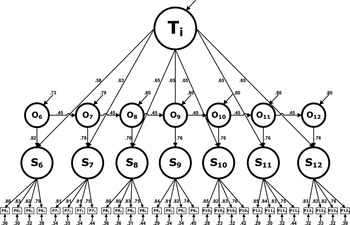
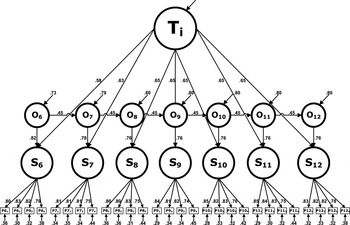
The LTSO model we employed was specified to explore the longitudinal structure of internalizing symptom parcels. In this model, a latent state factor for each wave is measured by four internalizing parcels at each wave (see Figure 1). The variability of each latent state factor (St) is explained fully by the latent trait variable (T), and corresponding latent occasion factors (Ot). The state factors, though not on the original scale of the measure, can be interpreted as levels of internalizing symptoms, with higher mean values of the latent variables indicating high internalizing symptoms. The arrowed paths connecting the occasion-specific latent variables represent the autoregression function. Their specification allows for the possibility that there is some stability and predictability in the time-dependent variability captured by the latent occasion factors Ot. There are some standard constraints in LTSO modeling, not required for model identification, but that are important for interpretation. These include constraining the factor loadings of parcels within as well as between waves to be equal and fixing the residual variables for the latent state variables at zero. Both were employed in our analyses and were tested using conventional measures of overall and relative model fit before imposing them in the final model (Cole et al., Reference Cole, Martin and Steiger2005).
A graphical depiction of the empirical model results from the latent trait–state–occasion model. T, The stable trait factor; Os, the changing occasion specific factors; Ss, the state factors. The manifest variables of internalizing symptoms are four random parcels at each time point. The arrows connecting the occasion specific latent variables represent the autoregression function in the latent trait–state–occasion model. The autoregressive paths were significant (p < .01). All factor loadings were statistically significant (p < .01). Full model estimates with unstandardized estimates are available upon request.
Several covariates were explored in terms of their influence on the trait variable in addition to the main and the interaction effects of the polygenic score and the risk events (parental divorce or death). These covariates include free/reduced lunch status, gender, and the first principal component from the genetic ancestry analyses.
Results
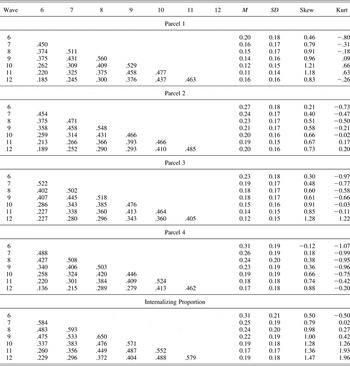
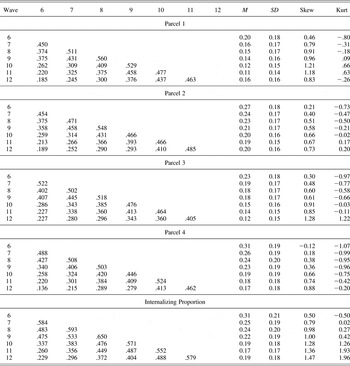
Univariate descriptive statistics (including means, standard deviations, skewness, and kurtosis) for the internalizing parcels from the BHIF-A scale can be found in Table 1. The overall means of the internalizing parcels decreased over time. Of the 488 participants who provided genetic data, 221 (45%) had experienced parent death and/or divorce.
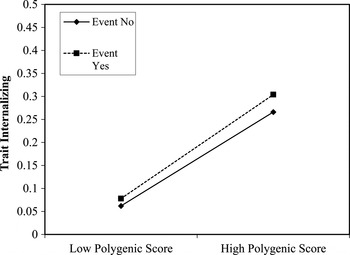
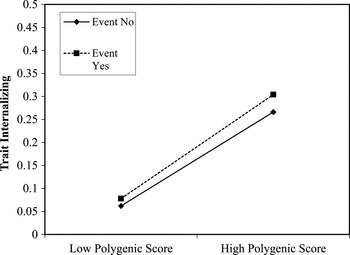
Graph of Polygenic Score × Early Risk Indicator interaction.
Correlations, means, and standard deviations for the externalizing behavior measure
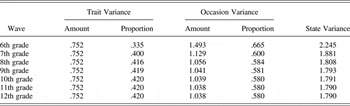
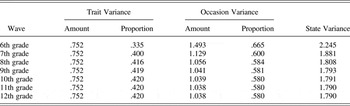
The χ2 for the final LTSO model was significant (χ2 = 928.95, df = 374, p < .05); however, the other goodness of fit indicators pointed to acceptable model fit: comparative fit index = 0.94, Tucker–Lewis index = 0.94, and root mean square error of approximation = 0.05. The autoregressive function has a regression coefficient of 0.45, which is statistically significant. Standardized parameter estimates can be found in Figure 1. The sum of the trait variance and the occasion variance is equal to the total state variance at that wave. The proportion of variance of the state factor accounted for by the trait factor increased from 6th grade to 9th grade, and remained relatively stable from 9th grade to 12th grade. The variance decomposition can be seen in Table 2.
Variance decomposition for the latent trait–state–occasion model of internalizing symptoms
Associations with the latent trait variable
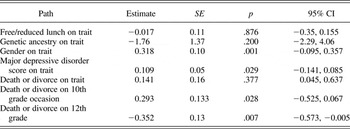
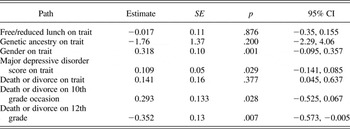
Neither free/reduced lunch status (estimated = −0.020, SE = 0.111, p = .856) nor the first component of genetic ancestry (estimate = −1.65, SE = 1.37, p = .230) were significantly related to the internalizing latent trait variable. Gender was significantly associated with the latent trait variable (estimated = 0.314, SE = 0.10, p = .002), with females more likely to have a higher mean trait internalizing level. The polygenic score was significantly associated with the latent trait variable (estimated = 0.106, SE = 0.05, p = .033), with the higher the polygenic score, the higher levels of trait internalizing symptoms. Death or divorce was not significantly associated with the latent trait variable (estimated = 0.027, SE = 0.101, p = .791). An interaction between the polygenic score and early risk indicator did not yield a significant estimate (estimated = 0.011, SE = 0.077, p = .14) at the conventional level of significance. However, a graphing of the interaction (see Figure 2) suggested that the highest trait internalizing scores were among those participants with the highest levels of the polygenic score in the presence of a parent divorce and/or death by age 6. For a summary of all regression results with 95% confidence intervals please see Table 3.
Regression estimates, standard errors, p values, and 95% confidence intervals for estimates paths of interest
Discussion
The present study sought to explore the effects of the interplay of genetic and early environment risk on the course of internalizing symptoms in late childhood and adolescence. Doing this not only advances our understanding of the etiology of internalizing symptoms within a developmental framework but also aides in overcoming a number of the limitations of the prior literature on specific Gene × Environment interactions with respect to the course of internalizing symptoms in children and adolescents. The prospective design featuring annual assessments of internalizing symptoms over a 7-year period, the use of a polygenic score, and the LTSO analytic approach represented some of the key advantages of our study design over the existing literature. The use of the LTSO model offered a novel way of modeling the link between genotype and phenotype by decomposing the variance in symptoms into two distinct and developmentally important components: trait and occasion. Although the LTSO model has been used to examine the structure of anxiety disorders as well as the structure of negative interpersonal behaviors (Hatton et al., Reference Hatton, Donnellan, Masyn, Feldman, Larsen-Rife and Conger2008; Olatunji & Cole, Reference Olatunji and Cole2009), no molecular genetics study of internalizing symptoms in children and adolescents to date has used this methodology to our knowledge, whether it be to study main or Gene × Environment interaction effects.
As hypothesized, the polygenic score was a significant predictor of trait-level internalizing symptoms. We offered two potential explanations for this finding in the Introduction. The most direct involved the evidence of genetic influences on emotional regulation and response to distress in early childhood that would appear central to the propensity to develop internalizing symptoms in childhood and adolescence (Ouellet-Morin et al., Reference Ouellet-Morin, Boivin, Dionne, Lupien, Arsenault and Barr2008; Wang & Saudino, Reference Wang and Saudino2013). A second explanation is consistent with a basic tenet of our life-course development model of social adaptation and psychological well-being (Kellam & Rebok, Reference Kellam, Rebok, McCord and Tremblay1992). That is, psychological well-being is integrally tied to success in meeting normative developmental challenges across the life course, such that failure to overcome these challenges increases the risk for experiencing internalizing symptoms. Given successful negotiation of these challenges is dependent in part on competencies in the intellectual, language, and social/behavioral domains which are heritable, we posited that genetic influences on psychological well-being may be mediated in part via their influence on social adaptation.
We also hypothesized a significant impact of the early risk indicator on the trait level of internalizing symptoms. The rationale, as elaborated earlier, was that parental divorce and/or death might have an enduring impact on the caregiving environment that would in turn affect social adaptation and consequently psychological well-being. We also suggested an epigenetic mechanism for the effect of parental divorce/death on psychological well-being, referencing Beach et al. (Reference Beach, Brody, Lei, Sangjin, Kui and Philibert2014) and their findings with regard to the effects of cumulative socioeconomic stress in early adolescence on methylation of depression pathway genes in young adulthood. However, we did not find evidence of an effect of parent divorce and/or death on the trait-level internalizing symptoms. Consistent with McCutcheon et al. (Reference McCutcheon, Heath, Nelson, Bucholz, Madden and Martin2009) and Beach and Brody (Beach at al., 2014; Brody, Yu, Breach, & Philibert, in press), a cumulative assessment of familial adversity over time may have yielded evidence of greater impact.
Whereas the hypothesized Genetic Score × Risk Event interaction did not reach conventional levels of significance at p ~ .14, a decomposition of the interaction yielded results that were consistent with the diathesis–stress model. That is, the level of trait-level internalizing symptoms was highest among those with the highest polygenic scores and a parental divorce and/or death by age 6. In contrast, there appeared to be little difference in trait levels of internalizing symptoms at the lower end of the score and in the absence of the risk events. The failure to detect an interaction at the p ≤ .05 level and the lack of support for the susceptibility hypothesis may simply be a function of the limitations of our indicator of early risk. It is clear that the absence of parental divorce and/or death cannot be equated with an enriched environment as described by Belsky (Belsky et al., Reference Belsky, Bakermans-Kranenburg and van IJzendoorn2007; Belsky & Pleuss, Reference Belsky and Pluess2009). Again, the use of a cumulative and more expansive index of adversity as described in Beach et al. (Reference Beach, Brody, Lei, Sangjin, Kui and Philibert2014) or Brody et al. (in press) may have yielded evidence of a significant interaction.
The fact the polygenic score was significantly predictive of the latent trait variable is consistent with the contention that the stable or trait components of complex psychiatric problems are heritable. In addition, given that the polygenic score utilized was generated based on MDD cases and controls, these results are consistent with the view that both depressive and anxious symptomotology share common genetic influences, particularly in adolescence and young adulthood (Waszczuk et al., Reference Waszczuk, Zavos, Gregory and Eley2014). However, consistent with Waszczuk et al. and others (e.g., Kendler, Heath, Martin, & Eaves, Reference Kendler, Heath, Martin and Eaves1987; Rice et al., Reference Rice, van den Bree and Thapar2004), there is evidence of unique as well as common genetic influences on internalizing symptoms and disorders. Future work should explore both the common and the unique genetic influences and their respective biological pathways and mechanisms.
Another area for future work should be the use of the LTSO model to include time- and/or context-specific predictors of the occasion variance. The current analyses focused on the early risk indicators of parental divorce and/or death, but it is possible to explore within the LTSO model the concurrent environment's influences on the occasion-specific variables after accounting for trait variance. The use of the LTSO model in this way would provide prevention researchers an important tool for identifying time-and/or context-specific targets for preventive interventions. In addition, the LTSO specification has the flexibility to be used with a wide range of symptoms, behaviors, and other manifest outcomes. For example, future work should focus on exploring how varying levels of trait-specific and occasion-specific internalizing symptoms predict outcomes later in life.
In terms of the limitations of the current study, besides those noted above, we relied on the use of a polygenic score based on a study of the molecular genetics of MDD. Although there is substantial evidence of a common genetic liability, the integration of results from a mega-GWA study of anxiety symptoms and disorders in childhood and adolescence would have significantly strengthened our study. However, to our knowledge, no such mega-GWA study is available for anxiety symptoms and disorders on a scale of the PGC's MDD mega-GWA study. In addition, owing to the unselected nature of the sample, the distribution of individual internalizing item scores was highly skewed, with a preponderance of structural zeros. We decided to deal with this issue by dichotomizing the scores at the item level. The drawbacks of our approach include loss of information and an increased chance of Type II error (DeCoster, Iselin, & Gallucci, Reference DeCoster, Iselin and Gallucci2009; Streiner, Reference Streiner2002).
A final limitation of the current study is that our sample was largely African American, whereas the polygenic score used was largely derived from individuals of European heritage. Much of the previous work exploring the genetics of internalizing symptoms in children and adolescents has focused primarily on Caucasian populations. In order to control for genetic ancestry, we included variables to account for the population stratification; however, recent work suggests that this may not be sufficient when dealing with an admixture population (Kang et al., Reference Kang, Larkin, Song, Barnholtz-Sloan, Baechle and Feng2009; Liu, Lewinger, Gilliland, Gauderman, & Conti, Reference Liu, Lewinger, Gilliland, Gauderman and Conti2013; Qin et al., Reference Qin, Morris, Kang, Li, Tayo and Lyon2010). Future work should focus on replicating these findings within other admixture populations as well as including other ways to control for population stratification such as local ancestry (Kang et al., Reference Kang, Larkin, Song, Barnholtz-Sloan, Baechle and Feng2009; Liu et al., Reference Liu, Lewinger, Gilliland, Gauderman and Conti2013; Qin et al., Reference Qin, Morris, Kang, Li, Tayo and Lyon2010).