Deliberate self-harm consists of a range of self-aggressive behaviours with or without suicidal intent (Guerreiro, Sampaio, Figueira, & Madge, Reference Guerreiro, Sampaio, Figueira and Madge2017; Hawton, Saunders, & O'Connor, Reference Hawton, Saunders and O'Connor2012; Madge et al., Reference Madge, Hewitt, Hawton, Wilde, Corcoran, Fekete and Ystgaard2008). In the past decades, deliberate self-harm has become more prevalent among adolescents (e.g., Hawton et al., Reference Hawton, Saunders and O'Connor2012). In Portugal, the prevalence rates range from 7.3% to 28% (Gonçalves, Martins, Rosendo, Machado, & Silva, Reference Gonçalves, Martins, Rosendo, Machado and Silva2012; Guerreiro et al., Reference Guerreiro, Sampaio, Figueira and Madge2017; Gouveia-Pereira, Gomes, Santos, Frazão, & Sampaio, Reference Gouveia-Pereira, Gomes, Santos, Frazão and Sampaio2016), which is identical to other international studies (Brunner et al., Reference Brunner, Kaess, Parzer, Fischer, Carli, Hoven and Wasserman2013; Muehlenkamp, Claes, Havertap, & Plener, Reference Muehlenkamp, Claes, Havertape and Plener2012).
Due to the increased awareness about deliberate self-harm among adolescents, research about this phenomenon has also increased (Jacobson & Gould, Reference Jacobson and Gould2007; Meszaros, Horvath, & Balazs, Reference Meszaros, Horvath and Balazs2017). Additionally, studies have found that these behaviours are more present in the general media and internet (Niwa & Mandrusiak, Reference Niwa and Mandrusiak2012; Reddy, Rokito, & Whitlock, Reference Reddy, Rokito and Whitlock2016; Swannell et al., Reference Swannell, Martin, Krysinska, Kay, Olsson and Win2010; Trewavas, Hasking, & McAllister, Reference Trewavas, Hasking and McAllister2010; Whitlock, Powers, & Eckenrode, Reference Whitlock, Powers and Eckenrode2006; Whitlock, Purington, & Gershkovich, Reference Whitlock, Purington, Gershkovich and Nock2009; Zdanow & Wright, Reference Zdanow and Wright2012). However, although media representations about self-harm are increasingly available, it is unclear how these representations influence the behaviours of viewers and participants (Whitlock et al., Reference Whitlock, Purington, Gershkovich and Nock2009). For instance, as Reddy et al. (Reference Reddy, Rokito and Whitlock2016) stated, it may help those who engage in these behaviours feel less isolated, but it may also increase interest in trying or adopting self-harm as a way of coping with stress or distress.
This visibility in the media can confront the general public with the existence of deliberate self-harm and, subsequently, build and modify its social representations. As Moscovici (Reference Moscovici1961) summarised, social representations are a modality of knowledge that produces and determines behaviours, as they define the nature of the stimuli that surround us and the answers we give them. Therefore, social representations are concurrently a product and a process (e.g., Jodelet, Reference Jodelet1984) that allow us to interpret aspects of reality and further react to them (Wachelke & Camargo, Reference Wachelke and Camargo2007). Understanding how this phenomenon is viewed by others may have important implications for clinical intervention and prevention programs (Bresin, Sand, & Gordon, Reference Bresin, Sand and Gordon2013).
Social representations specifically about the functions of deliberate self-harm can be quite relevant in terms of intervention and social support. Family has been recognised as an important factor within the context of deliberate self-harm (e.g., Arbuthnott & Lewis, Reference Arbuthnott and Lewis2015; Hasking, Rees, Martin, & Quigley, Reference Hasking, Rees, Martin and Quigley2015; Mojtabai & Olfson, Reference Mojtabai and Olfson2008) and seems to occupy a central role in clinical intervention. Research suggests that it is necessary to incorporate family therapy into treatments, namely interventions that work towards strengthening communication and emotional support (Muehlenkamp, Brausch, Quigley, & Whitlock, Reference Muehlenkamp, Brausch, Quigley and Whitlock2013). Hence, understanding how family members represent the functions of deliberate self-harm can be a crucial factor to promote these interventions and to involve the family in the treatment process. For instance, if family members have an inaccurate understanding of these functions (e.g., believing the behaviour to be an act of manipulation instead of support-seeking), it may lead to responses towards the individual that inadvertently exacerbate the frequency and severity of the behaviours (Bresin et al., Reference Bresin, Sand and Gordon2013).
Several studies have explored and described adults’ perceptions and attitudes towards deliberate self-harm. Most of the existing literature has focused on the perspectives of parents of adolescents who self-harm (Ferrey et al., Reference Ferrey, Hughes, Simkin, Locock, Stewart, Kapur and Hawton2016; McDonald, O'Brien, & Jackson, Reference McDonald, O'Brien and Jackson2007; Oldershaw, Richards, Simic, & Schmidt, Reference Oldershaw, Richards, Simic and Schmidt2008; Rissanen, Kylmä, & Laukkanen, Reference Rissanen, Kylmä and Laukkanen2009), healthcare professionals (Karman, Kool, Poslawsky, & Van Meijel, Reference Karman, Kool, Poslawsky and Van Meijel2015; Lindgren, Oster, Aström, & Graneheim, Reference Lindgren, Oster, Aström and Graneheim2011; McHale & Felton, Reference McHale and Felton2010; Rees, Rapport, Thomas, John, & Snooks, Reference Rees, Rapport, Thomas, John and Snooks2014), counsellors (De Stefano, Atkins, Noble, & Heath, Reference De Stefano, Atkins, Noble and Heath2012; Fox, Reference Fox2011; Long & Jenkins, Reference Long and Jenkins2010), and teachers (Berger, Hasking, & Reupert, Reference Berger, Hasking and Reupert2014; Heath, Toste, & Beettam, Reference Heath, Toste and Beettam2007; Heath, Toste, Sornberger, & Wagner, Reference Heath, Toste, Sornberger and Wagner2011).
Nonetheless, there are various limitations to the current knowledge about the representations of deliberate self-harm. First, most of the studies are based on samples that had some type of direct contact with deliberate self-harm (e.g., parents of adolescents with these behaviours or healthcare professionals who dealt with patients who self-harmed). Second, most research has utilised qualitative designs, which allow more comprehensive results but also limit their scope and generalisation. In addition, a great part of this research has centred exclusively on the attitudes about deliberate self-harm and has not explored the social representations about its functions.
Taking these factors into account, it is important to build a questionnaire to assess the social representations about the functions of deliberate self-harm. Hence, our main goal was to develop an instrument aimed at adults with and without direct contact with these behaviours.
Although there are several instruments that focus on the study of deliberate self-harm, we did not find any instrument exclusively dedicated to the social representations about the functions of these behaviours. The exception is a study developed by Batejan, Swenson, Jarvi, and Muehlenkamp (Reference Batejan, Swenson, Jarvi and Muehlenkamp2015), which compared the views of deliberate self-harm between college students with and without a history of these behaviours. In this study, the authors used the Inventory of Statements About Self-Injury (ISAS), despite the fact it is not an instrument aimed at the study of the representations of this phenomenon. This inventory was developed by Klonsky and Glenn (Reference Klonsky and Glenn2009) and comprises two components. The first section lists several methods of deliberate self-harm. The second section should only be completed by respondents who have a history of self-harm and evaluates 13 types of functions of these behaviours. The functions presented in this instrument are organised in a two-factor structure (intrapersonal and interpersonal functions).
Due to the previous employment of the ISAS in this research area (Batejan et al., Reference Batejan, Swenson, Jarvi and Muehlenkamp2015) and taking into consideration the variety of functions it evaluates, we opted to utilise the second component of this instrument as a basis for the development of our questionnaire. However, since the ISAS was originally aimed at adolescents who have a history of deliberate self-harm, there was the need to complement its contents according to the social representations of non-self-harmers and adults. For this purpose, two additional studies were conducted (detailed in the questionnaire development section), whose results allowed us to add more items and functions to the questionnaire.
The current article presents two studies that analysed psychometrically our questionnaire (Questionnaire of Representations About the Functions of Deliberate Self-Harm; QRFDSH) in a sample of Portuguese adults. We intended to test its factorial structure regarding the two dimensions (interpersonal and intrapersonal) and the various independent functions. In Study 1 we conducted an exploratory factor analysis of the functions of deliberate self-harm and the interpersonal and intrapersonal dimensions, which also allowed us to reduce the QRFDSH through a process of item elimination. This reduced version of the instrument and its factorial structure was evaluated in Study 2 with an independent sample. The internal consistency of the questionnaire was also tested.
Questionnaire Development
The QRFDSH comprises items from three different sources: the translation of the ISAS (Klonsky & Glenn, Reference Klonsky and Glenn2009), items that emerged from the analysis of semi-directive interviews, and items that resulted from the analysis of Portuguese written press.
Translation and Adaptation of the Inventory of Statements About Self-Injury
The translation and adaptation of the ISAS was the first step in the construction of our questionnaire. As previously stated, we translated and adapted the second part of the ISAS, which consists of statements about the functions of deliberate self-harm. It is composed of 39 items that correspond to 13 functions of deliberate self-harm, which are subsequently organised in two dimensions. The interpersonal dimension consists of eight subscales: Autonomy, Interpersonal Boundaries, Interpersonal Influence, Peer Bonding, Revenge, Self-Care, Sensation Seeking, and Toughness. The intrapersonal dimension includes five subscales: Affect Regulation, Anti-Dissociation, Anti-Suicide, Marking Distress, and Self-Punishment.
The second section of the ISAS has demonstrated good psychometric properties. It has revealed good total internal consistency, with total values of Cronbach's alpha of .93 (Bildik, Somer, Kabukçu-Başay, Başay, & Özbaran, Reference Bildik, Somer, Kabukçu-Başay, Başay and Özbaran2013) and a Cronbach's alpha for the interpersonal and intrapersonal scales of .88 and .80 respectively (Klonsky & Glenn, Reference Klonsky and Glenn2009). Likewise, it has shown good test–retest reliability, with correlations of .60 for the intrapersonal functions, .82 for the interpersonal functions, and values ranging from .35 to .89 regarding individual functions (Glenn & Klonsky, Reference Glenn and Klonsky2011). The theorised two-factor structure (i.e., interpersonal and intrapersonal dimensions) has also been confirmed by the literature (Klonsky, Glenn, Styer, Olino, & Washburn, Reference Klonsky, Glenn, Styer, Olino and Washburn2015; Kortge, Meade, & Tennant, Reference Kortge, Meade and Tennant2013).
The translation process of the ISAS followed the adequate procedures. We contacted six psychologists fluent in English and with knowledge about deliberate self-harm. Three of the psychologists translated the original items to Portuguese. Subsequently, three different psychologists retranslated these items into English. The final versions resulting from this process were compared with the original instrument and the most similar items were selected.
Analysis of Semi-Directive Interviews
The present study consisted of a qualitative analysis of the social representations about the functions of deliberate self-harm from adults. The sample comprised 15 adults without these behaviours, who were recruited through personal contacts that snowballed into other connections.
According to information present in the literature, the interview script was designed to assess the social representations about the functions of deliberate self-harm. Through content analysis, all the statements were coded and sorted into categories based on how different codes/statements were related and linked (Hsieh & Shannon, Reference Hsieh and Shannon2005). Afterwards, the categories with more than two codes were selected and the respective statements were converted into items. Four new functions emerged from these results (Communication Attempt, Escape Mechanism, Introspective Mechanism, and Replacement of Suffering), as well as new items that complemented existing functions (Table 3).
Analysis of the Portuguese Written Press
In this study, we focused on the analysis of news published during 11 years (between January 2004 and December 2015) in seven different Portuguese generalist publications (five newspapers and two magazines). Using 18 search terms associated with deliberate self-harm, 639 news were collected. These news were analysed following content analysis procedures and the text was divided into the categories defined according to the functions present in the ISAS. This process allowed the formulation of new items that complemented several functions from the ISAS.
Final Structure of the QRFDSH
From the analyses of the semi-directive interviews and written press, 36 new items emerged. From this total, 16 items complemented some of the functions presented in the ISAS and 20 corresponded to four new functions (Table 1). Hence, this first version of the QRFDSH is composed of 17 functions of deliberate self-harm and 75 items.
Structure of the QRFDSH With the New Functions and New Items

Note: *New functions.
The interpersonal functions include Autonomy (to ascertain one's autonomy), Communication Attempt (to communicate with others), Interpersonal Boundaries (to establish a distinction between self and other), Interpersonal Influence (to manipulate others or seek help), Peer Bonding (to establish a connection with peers), Revenge (to obtain revenge on someone), Self-Care (to take care of oneself), Sensation Seeking (to create exhilaration or excitement), and Toughness (to test or demonstrate one's toughness). The intrapersonal functions include Affect Regulation (to alleviate negative affect or to create positive affect), Anti-Dissociation (to end the experience of dissociation), Anti-Suicide (to deal with the impulse to commit suicide), Escape Mechanism (to escape from or to ignore problems), Introspective Mechanism (to concentrate on thoughts), Marking Distress (to create a physical sign of distress), Replacement of Suffering (to replace emotional distress with physical pain), and Self-Punishment (to express anger towards oneself). With the exception of Introspective Mechanism and Replacement of Suffering, all the functions have been previously described in the literature (e.g., Klonsky, Reference Klonsky2007, Reference Klonsky2011; Klonsky & Glenn, Reference Klonsky and Glenn2009; Klonsky & Muehlenkamp, Reference Klonsky and Muehlenkamp2007; Nock, Reference Nock2009).
Study 1: Exploratory Factor Analysis
Method
Participants
The sample was collected on the internet through the advertising of the questionnaire on social media websites and online forums. During two months, 473 participants completed the questionnaire, of whom 11 were foreigners. Therefore, the sample for this study was comprised of 462 subjects of Portuguese nationality.
From this total, 246 (53.2%) participants were female, 213 (46.1%) were male, and three (0.6%) identified with other gender. Their ages ranged from 20 to 69 years old, with a mean of 36.9 years (SD = 11.4). Regarding education level, most participants had a college/university degree (67.1%), while 27.7% had completed 12th grade and 5.2% had completed 9th grade. The participants were single (52%), married (21.3%), in a domestic partnership (16.1%), divorced (7%), widowed (2.4%) or other; 32.5% of the participants had children.
Measures
In the current study, we utilised the first version of the QRFDSH and a brief socio-demographic questionnaire. The QRFDSH begins with a short introduction mentioning that some adolescents may have deliberate self-harmed, followed by examples of these behaviours. Since this questionnaire will mainly be answered by non-self-harmers, the initial sentence of the ISAS (‘When I self-harm, I am …’) was changed to ‘When young people have these behaviours they are …’. Furthermore, in order to allow more detailed data we reorganised the answers on a 5-point Likert scale that refers to the degree of accordance with each item: totally disagree, disagree, neither, agree, or totally agree.
The socio-demographic questionnaire included questions about the participants’ age, gender, nationality, education level, marital status, and existence of children.
Procedures
After the translation and adaptation of the ISAS, the new items that emerged from the analyses of semidirective interviews and of the Portuguese written press were added to the instrument. Before data collection, a group of adults completed the questionnaire and shared their possible doubts about the items, in order to confirm the instrument was easily comprehended.
As previously mentioned, the data were collected on the internet through a website dedicated to the building and display of surveys. The link to this website was advertised on social media websites and online forums. The quantitative data provided by the survey website was later transposed into a database and reviewed for errors.
Data Analysis
All statistical analyses were carried out using SPSS v22 software and Amos Version 22.0 (IBM SPSS, Chicago, IL).
The exploratory factor analysis (EFA) was carried out in two different steps. First, we developed an EFA testing the two-factor structure of interpersonal and intrapersonal functions. Second, we carried out separately EFAs for items in the interpersonal and intrapersonal functions, which derived from an item-reduction process (i.e., items with factor loadings lower than .40 were excluded). All EFAs were developed with the principal axis factoring extraction method and promax with Kaiser normalisation rotation.
Furthermore, we developed a series of confirmatory factor analyses (CFA) with the maximum likelihood method and carried out a second item-reduction process considering the modification indices based on the Lagrange multiplier. Although the items did not fulfill the multivariate normality assumption (kuMult = 567.43), we considered Kline's (Reference Kline2005) criteria (i.e., skewness [SK] lower than 3 and kurtosis [K] lower than 8) to demonstrate that our results did not grossly violate the normality assumption (SK ranging from −1.312 to .733; K ranging from −1.06 to 3.465). We considered the following fit indexes: relative chi-square (χ2/df lower than 5); comparative fit index and goodness-of-fit index (CFI and GFI higher than .80); parsimony comparative fit index and parsimony goodness-of-fit index (PCFI and PGFI higher than .60); and root mean square error of approximation (RMSEA lower than .10; Arbuckle, Reference Arbuckle2013; Maroco, Reference Maroco2010).
Results
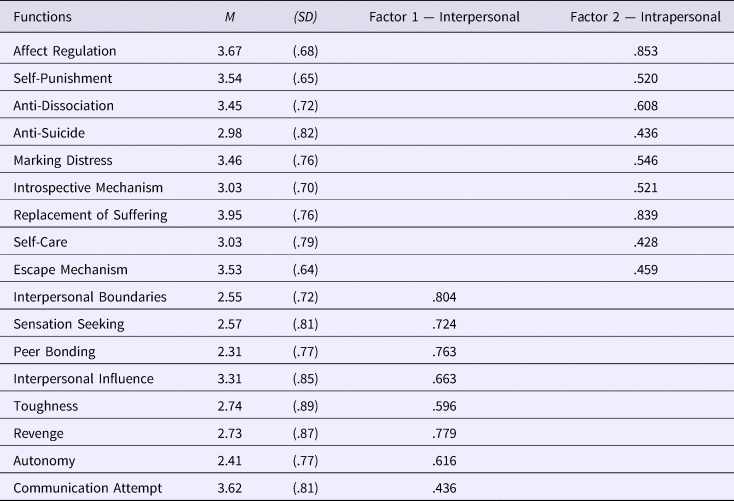
A first EFA testing the two-functions model provided a four-factor solution with eigenvalues higher than 1. Therefore, a second EFA fixed to extract a two-factor solution was developed, which explained 50.86% of the variance (KMO = .85, χ2 = 4057.91, p < .001). As illustrated in Table 2, the functions of Interpersonal Boundaries, Sensation Seeking, Peer Bonding, Interpersonal Influence, Toughness, Revenge, Autonomy, and Communication Attempt all loaded exclusively on factor 1 (i.e., interpersonal functions); whereas Affect Regulation, Self-Punishment, Anti-Dissociation, Anti-Suicide, Marking Distress, Self-Care, Introspective Mechanism, Replacement of Suffering, and Escape Mechanism all loaded exclusively on factor 2 (i.e., intrapersonal functions).
Exploratory Factor Analysis for the Two-Factor Model

Note: M = mean; SD = standard deviation. Coefficients lower than .40 are suppressed.
Exploratory Factor Analysis for the Intrapersonal Functions
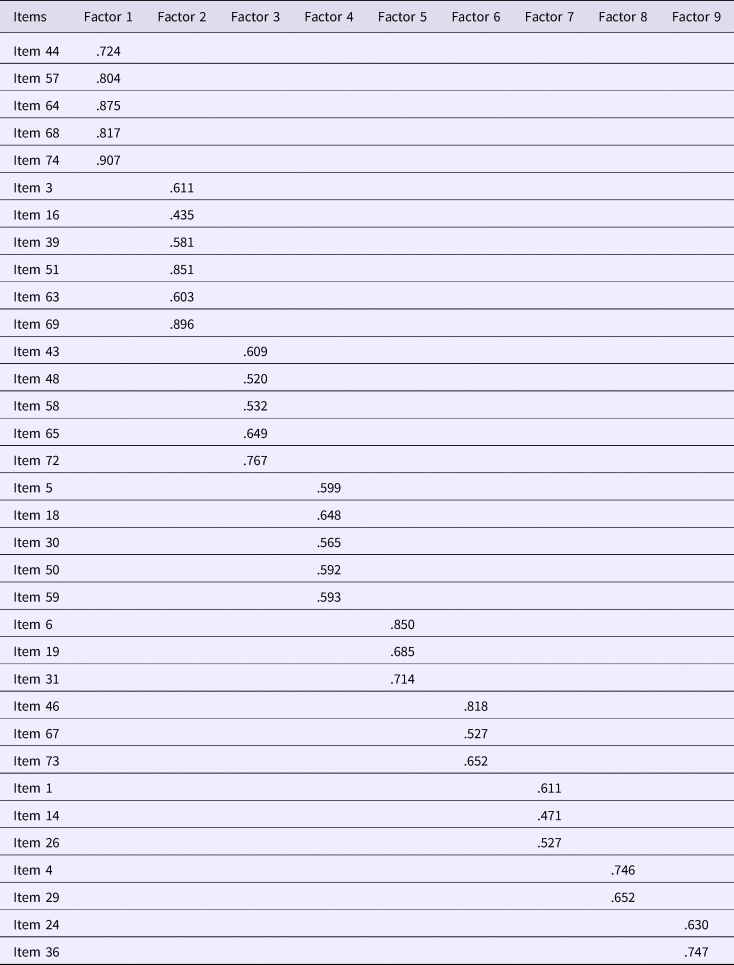
The EFA for all items of intrapersonal factors provided a nine-factor solution (KMO = .91, χ2 = 9019.70, p < .001), though some items showed coefficients lower than .40. Therefore, items 49 and 56 of the Affect Regulation, item 28 of the Self-Punishment, item 17 of the Self-Care, items 40 and 61 of Escape Mechanism, and item 11 of the Marking Distress were removed. After concluding the item-reduction process, the EFA provided a satisfactory nine-factor solution, explaining 66.78% of the variance (KMO = .89, χ2 = 7292.58, p < .001), presented in Table 3.
Exploratory Factor Analysis for the Intrapersonal Functions

Note: Exploratory factor analysis (principal axis with promax rotation). Coefficients >.40. Factor 1 = Replacement of Suffering, Factor 2 = Self-Punishment, Factor 3 = Introspective Mechanism, Factor 4 = Anti-Dissociation, Factor 5 = Anti-Suicide, Factor 6 = Escape Mechanism, 7 = Affect Regulation, Factor 8 = Self-Care, Factor 9 = Marking Distress.
Exploratory Factor Analysis for the Interpersonal Functions
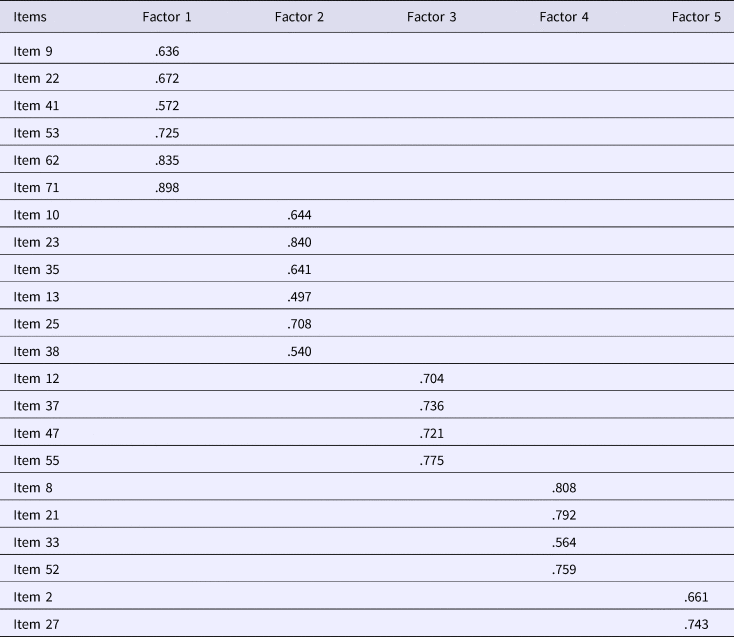
Regarding the interpersonal factors, a similar process (KMO = .936, χ2 = 9327.867, p < .001) resulted in the elimination of the following items: items 15, 45, and 60 of Interpersonal Boundaries; items 7 and 32 of Sensation Seeking; and item 34 from Interpersonal Influence. Moreover, the Sensation Seeking factor was removed because the unique remaining item (i.e., item 20) loaded on the Peer Bonding factor; in the same manner, the Communication Attempt factor was removed because all items (i.e., items 42, 54, 66, 70, and 75) loaded on the Interpersonal Boundaries factor. A final EFA provided a five-factor solution where items from both Autonomy and Toughness loaded on the same factor (which did not disentangle even when the EFA was fixed to six factors). Therefore, we considered the five-factor model a satisfactory factor solution, explaining 65.40% of the variance (KMO = .912, χ2 = 4914.210, p < .001), presented in Table 4.
Exploratory Factor Analysis for the Interpersonal Functions

Note: Exploratory factor analysis (Principal Axis with Promax rotation). Coefficients >.40. Factor 1 = Interpersonal Influence, Factor 2 = Autonomy and Toughness, Factor 3 = Revenge, Factor 4 = Peer Bonding, Factor 5 = Interpersonal Boundaries.
Confirmatory Factor Analysis
The CFA revealed an unsatisfactory solution (χ2/df = 2.684, CFI = .81, PCFI = .77, GFI = .75, PGFI = .69, RMSEA = .060), once the GFI index did not reach the minimum threshold of .80 (Maroco, Reference Maroco2010). Therefore, we considered the modification indices (MI), and the items 47 (MI = 60.01), 50 (MI = 34.24), 37 (MI = 33.05), 62 (MI = 24.44), 59 (MI = 22.88), 64 (MI = 22.72), and 43 (MI = 18.86) were removed. The final solution presented satisfactory fit indices (χ2/df = 2.499, CFI = .84, PCFI = .79, GFI = .80, PGFI = .72, RMSEA = .057).
Internal Consistency
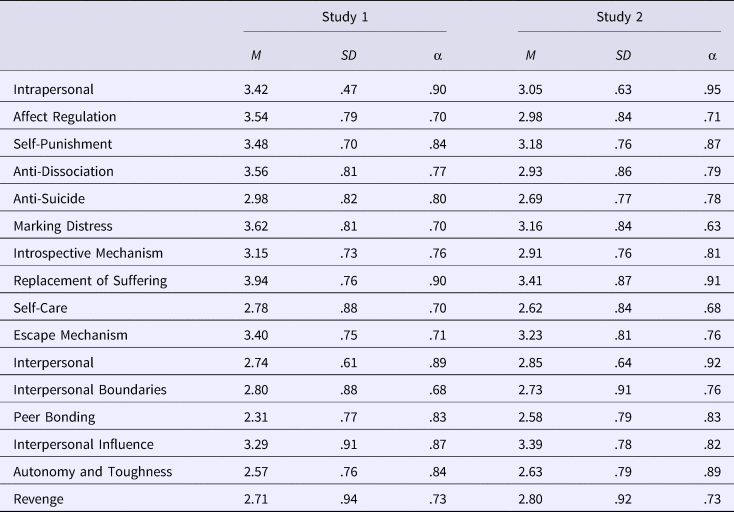
Finally, as illustrated in Table 5, with exclusion of the Interpersonal Boundaries (α = .68) that presented low but still acceptable Cronbach's alphas (Field, Reference Field2013), all functions presented satisfactory to good internal consistency (from α = .70 to α = .90). Furthermore, all intrapersonal items showed good internal consistency (α = .90) and interpersonal functions just slightly lower (α = .89).
Internal Consistency for Both Studies

Note: M = mean, SD = standard deviation, α = Cronbach's alpha.
Study 2: Confirmatory Factor Analysis
Method
Participants
The participants of this study were parents of adolescents who frequented two public schools in the district of Leiria. Four hundred and eighty-four parents completed the questionnaire. Ten foreigner participants were removed, so our final sample was comprised of 474 Portuguese nationals.
From this total, 262 (55.3%) participants were female and 212 (44.7%) were male. Their ages ranged from 33 to 62 years old, with a mean of 46.1 years (SD = 5.51). In terms of education level, 34.5% of the participants had a college/university degree, 31.9% had finished 12th grade, 28.9% had finished 9th grade and 4.8% had finished 4th grade. Most participants were married (77.3%), while 10.2% were in a domestic partnership, 8.5% were divorced, 3.2% were single, and 0.8% were widowed.
Measures
The instruments used in this study comprised the second version of the QRFDSH (see Appendix) and a brief socio-demographic questionnaire. This version of the QRFDSH was reduced according to Study 1 and now presented 14 functions and 49 items. This instrument included a short introduction mentioning that some people have deliberate self-harmed, followed by examples of these behaviours. The sentence ‘When young people have these behaviours they are …’ preceded the items. The answers were organised on a 5-point Likert scale: totally disagree, disagree, neither, agree, or totally agree.
The socio-demographic questionnaire presented questions about the participants’ age, gender, nationality, education level, marital status, and existence of children.
Procedures
The study was carried out with the approval of the administrative office at each school. Participants were recruited through the selection of several classes from different school years. In the first class, the researcher delivered the parents’ questionnaires to students. These questionnaires were sent in an envelope, along with a letter informing parents that they should respond independently and return both questionnaires in the closed envelope to their child, even if they did not complete the questionnaire. In a second class, the students brought back their parents’ questionnaires and the researcher collected them. The participants were informed about the purpose of the investigation and about the confidentiality and anonymity of the collected data.
Data Analysis
Internal consistency was assessed through Cronbach's alpha and a CFA was carried out with the maximum likelihood method considering the MIs based on the Lagrange multiplier. Similar to Study 1, we considered the following fit indexes: Relative chi-square (χ2/df lower than 5); CFI and GFI higher than .80; parsimony comparative fit index (PCFI) and parsimony goodness-of-fit index (PGFI) higher than .60; and RMSEA lower than .10 (Maroco, Reference Maroco2010; Arbuckle, Reference Arbuckle2013). All statistical analyses were carried out using SPSS v22 software and Amos Version 22.0 (IBM SPSS, Chicago, IL).
Results
Internal Consistency
Regarding the factors’ internal consistency, data shows that the functions of Marking Distress (α = .63) and Self-Care (α = .68) presented low but still acceptable Cronbach's alphas (Field, Reference Field2013). Additionally, all remaining functions presented satisfactory-to-good internal consistency (from α = .71 to α = .91). Furthermore, the meta-factor of intrapersonal functions showed very good internal consistency (α = .95) and interpersonal functions showed good internal consistency (α = .92).
Confirmatory Factor Analysis
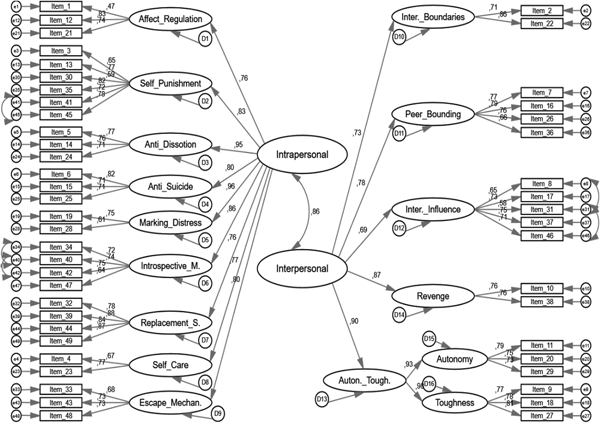
Similar to Study 1, items failed to present multivariate normality (kuMult = 875.19). Nevertheless, skewness (ranging from −.995 to .326) and kurtosis (ranging from −1.080 to 0.916) absolute values fit under the Kline's (Reference Kline2005) criteria, showing that these results do not grossly violate the normality assumption. The CFA results, after considering the MIs and covariate of the errors of six pairs of items, showed a generally acceptable model fit (χ2/df = 3.668, CFI = .80, PCFI = .75, GFI = .71, PGFI = .64, RMSEA = .075), with the exception of the GFI, which failed to reach the minimum threshold of .80 (Maroco, Reference Maroco2010; Figure 1).
Confirmatory factor analysis of the model.

Discussion
The objective of this research was to develop and evaluate the QRFDSH, an instrument designed to assess adults’ social representations about the functions of deliberate self-harm. To build this instrument we utilised the ISAS (Klonsky & Glenn, Reference Klonsky and Glenn2009) as a basis, since it was previously used in the study of these representations and briefly summarises 13 functions of deliberate self-harm. Besides translating and adapting the ISAS to Portuguese, we conducted two additional studies to complement the items and functions of this instrument. The results from both studies allowed us to add more functions and items to the ISAS original structure. Hence, the first version of the QRFDSH comprised 75 items that evaluated 17 functions of deliberate self-harm. Of this total, 13 functions were described in the ISAS and four functions derived from our additional studies.
In Study 1, a first EFA testing the two-functions model provided a four-factor solution. Therefore, a second EFA fixed to extract a two-factor solution was developed. All the functions loaded in the correspondent factors described by Klonsky and Glenn (Reference Klonsky and Glenn2009), except for Self-Care. In our results, this function aligned as an intrapersonal function, which was theoretically expected but not found in the original study (Klonsky & Glenn, Reference Klonsky and Glenn2009) and was later reported in other studies (Kortge et al., Reference Kortge, Meade and Tennant2013).
Following this step, we performed an additional EFA to test all items of intrapersonal factors, which provided a nine-factor solution, and another EFA to test all items of interpersonal factors, which provided a five-factor solution. In this five-factor structure, items from both Autonomy and Toughness loaded on the same factor. Although these two functions are distinct, we consider they share a fundamental notion of self-reliance and individuality since Autonomy is based on the idea that the self-injurer does not need help from others, and Toughness refers to the ability of the self-injurer to deal with pain on his own. Therefore, the loading of these two functions on the same factor is not incompatible nor theoretically incongruent.
These EFAs also allowed us to reduce the scale. Hence, from the initial 75 items, 49 remained, 19 of which were new items derived from the results of the semi-directive interviews and written press analysis. Of the 17 functions of deliberate self-harm, 14 also remained. Focusing specifically on the functions that were added to the scale according to the mentioned process, only three of four new functions remained. These included Escape Mechanism, Introspective Mechanism and Replacement of Suffering. The factor analyses demonstrated that these three functions aggregate in the intrapersonal dimension, which is consistent with their nature. Furthermore, the analyses of the internal consistency of these functions demonstrate good properties in both studies, as well as the reliability of the two dimensions. During this process, the functions Communication Attempt and Sensation Seeking were eliminated.
Study 2 consisted of a CFA designed to test the factorial structure of the scale, including the two dimensions (interpersonal and intrapersonal) and 14 functions. Our results demonstrate a good model with a stable two-factor structure, which is supported by previous research that utilised the ISAS (Bildik et al., Reference Bildik, Somer, Kabukçu-Başay, Başay and Özbaran2013; Klonsky et al., Reference Klonsky, Glenn, Styer, Olino and Washburn2015; Kortge et al., Reference Kortge, Meade and Tennant2013). The factorial organisation of the five interpersonal functions and the nine intrapersonal functions also presented good reliability. Nonetheless, we did not find any studies that evaluated the factorial validity of these functions independently.
Overall, the QRFDSH for adults revealed good psychometric properties, namely regarding its reliability and its factorial validity. It exhibited a robust two-factor structure of the interpersonal–intrapersonal dimensions and an acceptable factorial structure concerning the 14 functions’ scales. These results allow the use of this scale in research and in clinical settings.
Limitations and Directions for Future Research
The present research has limitations that should be noted. One limitation concerns the samples used in both studies, due to the fact that they are relatively homogenous. Second, the QRFDSH was not tested regarding its divergent and convergent validity with other variables. Both limitations could be overcome with further studies.
Since deliberate self-harm is increasing in adolescence (e.g., Hawton et al., Reference Hawton, Saunders and O'Connor2012) and this phenomenon is gaining more visibility in the media (e.g., Whitlock et al., Reference Whitlock, Purington, Gershkovich and Nock2009), further research is clearly needed in this area. There is still limited information regarding the social representations of individuals who did not have direct contact with these behaviours, and most existing investigations followed a qualitative approach. Hence, future research could focus on the study of the social representations about deliberate self-harm in different social groups, resorting to quantitative methodology so that it is possible to design comparative studies.
In addition, understanding the social representations about the functions of deliberate self-harm can be an important factor for the development of prevention and intervention programs. Future research could therefore focus on discovering the aims and needs for educational programs that can prepare adults (namely parents, teachers or healthcare workers) to better recognise and respond to deliberate self-harm.
Thus, we hope that the QRFDSH can be used in investigations focused on the study of Portuguese adults’ social representations about the functions of deliberate self-harm, both in samples with and without these behaviours, contributing to the development of intervention and prevention programs. Moreover, we hope that this questionnaire can be a relevant tool in clinical settings, allowing the assessment and analysis of these representations.
Author ORCIDs
Eva Duarte, 0000-0001-6617-3252.
Appendix
Final Version of the QRFDSH
Some young people have behaviours where they hurt themselves intentionally (that is, according to their own will), for example, young people that cut or burn themselves or ingest medication with the intention of hurting themselves.
These behaviours where young people hurt themselves deliberately have some functions. This means these behaviours have a purpose.
Next, you will find a list of statements that are related with the functions of deliberate self-harm. Please sign whether you agree or disagree with the following statements.
‘When young people self-harm they are …’

Optional: Do you think these behaviours have other functions that are not listed above? If yes, please write them in the following space.
__________________________________________________________________________
__________________________________________________________________________
__________________________________________________________________________