The transactional view of stress and coping suggested that individual or common experience of stress in couples leads each member of the dyad to use coping strategies (problem-focused or emotion-focused) for the partner or both members (Lazarus & Folkman, Reference Lazarus and Folkman1984) in contrast to the well-documented individualistic view of couples’ stress and coping (see Sabourin et al., Reference Sabourin, Laporte and Wright1990). However, no further development took place in the transactional stress and coping paradigm due to the insufficient elaboration of stress and coping within the context of family and couples’ functioning until the Systemic Transaction Model was introduced. Systemic Transactional Model (STM; Bodenmann, Reference Bodenmann1997) views the dyadic stress and coping as a systemic process implying that both dyadic members in a couple relationship are interdependent and stress faced by individuals originating from external (e.g., work stress, financial strains) or internal (e.g., infidelity) sources crossover to the non-stressed partners leaving them feeling stressed too. The dyadic stress and coping begin when stressed individuals communicate stressful experiences with their non-stressed partners who engage in cognitive appraisal and, in return, respond with positive, negative, or common dyadic coping (for review Falconier et al., Reference Falconier, Randall, Bodenmann, Falconier, Randall and Bodenmann2016). The original transactional model (Lazarus & Folkman, Reference Lazarus and Folkman1984) was expanded to include interpersonal relationships as a contextual factor to understand the dyadic nature of stress and coping within a close relationship (Bodenmann, Reference Bodenmann1995). Later, the cultural aspect was embedded within the STM perspective (Kayser & Revenson, Reference Kayser, Revenson, Falconier, Randall and Bodenmann2016) asserting that the choice of dyadic coping strategies largely depends on the socio-cultural context. A study reveals that individuals from different social and cultural backgrounds vary in terms of social norms and cultural values, and practice unique dyadic coping systems (Kuo, Reference Kuo2011).
Conventionally, gratitude has been defined as “the emotion that arises when an individual (beneficiary) perceives that another person (benefactor) or source, has intentionally acted to improve the beneficiary’s wellbeing” (Fredrickson, Reference Fredrickson, Emmons and McCullough2004). Initially, gratitude researchers focused on the intrapersonal benefits of gratitude such as individual’s well-being, life satisfaction, and mental health in Pakistan (Hermaen & Bhutto, Reference Hermaen and Bhutto2020; Ramzan & Rana, Reference Ramzan and Rana2014) and in the West (Bono et al., Reference Bono, Emmons, McCullough, Linley and Joseph2004; Mikulincer & Shaver, Reference Mikulincer, Shaver, Mikulincer and Shaver2010). Given this, Algoe (Reference Algoe2012) re-conceptualized gratitude as an interpersonal construct in the find-remind-and-bind theory. This theory posits that partners’ expression of gratitude helps an individual to find a partner who is trustworthy, reliable, caring, remind oneself to have such a partner, and bind with the partner via strong romantic relationship. Studies have provided strong support for the find-remind-and-bind theory as interpersonal gratitude appears to be positively associated with relationship satisfaction, relationship commitment (Algoe et al., Reference Algoe, Kurtz and Hilaire2016; Algoe & Zhaoyang, Reference Algoe and Zhaoyang2016), and reduced stress in the romantic relationship (Feeney & van Vleet, Reference Feeney and van Vleet2010). Recently, dyadic coping-based gratitude (DC-G) has been incorporated within STM that refers to the reaction of appreciation and thankfulness in response to received problem-focused and emotion-focused positive DC behaviors by the partner (Shujja et al., Reference Shujja, Bodenmann, Randall, Adil and Malik2022). Although find-remind-and-bind theory enjoys empirical support for the role of interpersonal gratitude within romantic relationship, however, it provides insufficient elaboration about the mechanism through which interpersonal gratitude operates. Contrarily, DC-G follows the use of DC and is expected to explain the variance in couples’ DC and relationship satisfaction. However, no study has yet investigated the role of DC-G in conjunction with DC and relationship satisfaction in heterosexual married couples with the special focus on the dyadic stress-coping paradigm.
Pakistan as a Unique Cultural and Religious Site for DC and DC-G
Pakistan is predominantly a Muslim country with a collectivistic cultural orientation in which strong emotional bonds within married couples, family members, relatives, and even non-familial members of the society are encouraged enforcing the need for shared goals and mutual interests as social norms and religious obligations (Ali et al., Reference Ali, Ahmed, Bhatti and Farooq2020). Couples in Pakistan come into contact by formally endorsing the religious obligation (Nikkah) which not only binds the husband and wife into a relationship but also the families of both partners (Ali et al, Reference Ali, Ahmed, Bhatti and Farooq2020; Qadir et al., Reference Qadir, Khan, Medhin and Prince2011). Despite the strong emphasis of the Islamic perspective (approximately 95% Muslim population in Pakistan) on gratitude within an interpersonal relationship, little is known about the way DC-G operates within Pakistani heterosexual married couples’ relationships. Previously, one study examined the relationship between DC and relationship satisfaction in Pakistani married adults and results showed that married adults who engaged in positive DC experience greater marital satisfaction compared to those who engaged in negative DC (Iqbal & Safdar, Reference Iqbal and Safdar2014). This study demonstrated the significant role of DC within an interpersonal relationship in Pakistani married adults, however, we have focused on the association between DC and relationship satisfaction in Pakistan married couples for the following reasons:
1. Couples’ functioning may differ from the individuals’ responses in terms of couples’ common fate, mutual interest and interdependence (Iida et al., Reference Iida, Seidman and Shrout2018).
2. The findings of the Iqbal and Safdar (Reference Iqbal and Safdar2014) are not generalizable over the Pakistani population due to restricted sample characteristics (highly educated and high-income group).
3. In contrast to the conventional theoretical underpinnings on the gratitude and its association with the interpersonal outcomes (Emmons & Shelton, Reference Emmons, Shelton, Snyder and Lopez2002; Miller, Reference Miller1984), Islamic perspective conceptualizes gratitude (Shukar) as a positive virtue that helps the individuals in developing gratitude-laden relationship with the God and the human beings by means of Shukar (tongue, heart, and body; Al-Ghazzali, Reference Al-Ghazzali and Ramzan1999).
Unlike conventional western gratitude perspective (Bowlby, Reference Bowlby1977; Emmons & McCullough Reference Emmons and McCullough2003), Islamic perspective defines gratitude (shukar) as an expression of thankfulness through three modalities: (a) Gratitude expressed by the tongue, (b) gratitude expressed by the inner feelings (heart), (c) gratitude expressed by the body and limbs; and gratitude (shuker) is perceived as adherence to God’s will to develop and maintain healthy interpersonal relationship (Ali et al., Reference Ali, Ahmed, Bhatti and Farooq2020). Consistent with the Islamic perspective on gratitude, researchers reported the gratitude as a unique virtue that predicts wellbeing, positive affect, and healthy interpersonal relationship (see Pasha-Zaidi et al., Reference Pasha-Zaidi, Al-Seheel, Bridges-Lyman, Dasti and Pasha-Zaidi2021). Pakistan as a Muslim country serves as a religious context for investigating in role of DC-G in couples’ functioning.
Mediating Role of Dyadic Coping based Gratitude
Over the last decade, gratitude researchers have been interested in identifying the mechanism through which gratitude operates within interpersonal relationships. Vollmann et al., (Reference Vollmann, Sprang and den Brink2019) argued that gratitude towards a partner (interpersonal gratitude) act as an underlying mechanism in explaining the relationship between attachment avoidance and relationship satisfaction and this finding was consistent with existing literature exploring the mediating role of interpersonal gratitude e.g., Algoe et al., Reference Algoe, Gable and Maisel2010; Gordon et al., Reference Gordon, Impett, Kogan, Oveis and Keltner2012). However, the way gratitude operates in explaining the variance in the relationship between couples’ DC and relationship satisfaction within Pakistani religious and cultural context is yet to be known. A recent study reported specific forms of DC (supportive DC, common DC) to be positively associated with couples’ overall and yearly relationship satisfaction and supportive DC served as a useful positive coping strategy in enhancing couples’ relationship satisfaction (Rusu et al., Reference Rusu, Nussbeck, Leuchtmann and Bodenmann2020). Following the use of supportive DC, DC-G may act as a proactive behavior and a mediator in explaining the positive association between DC and relationship satisfaction in heterosexual Pakistani couples.
The Present Study
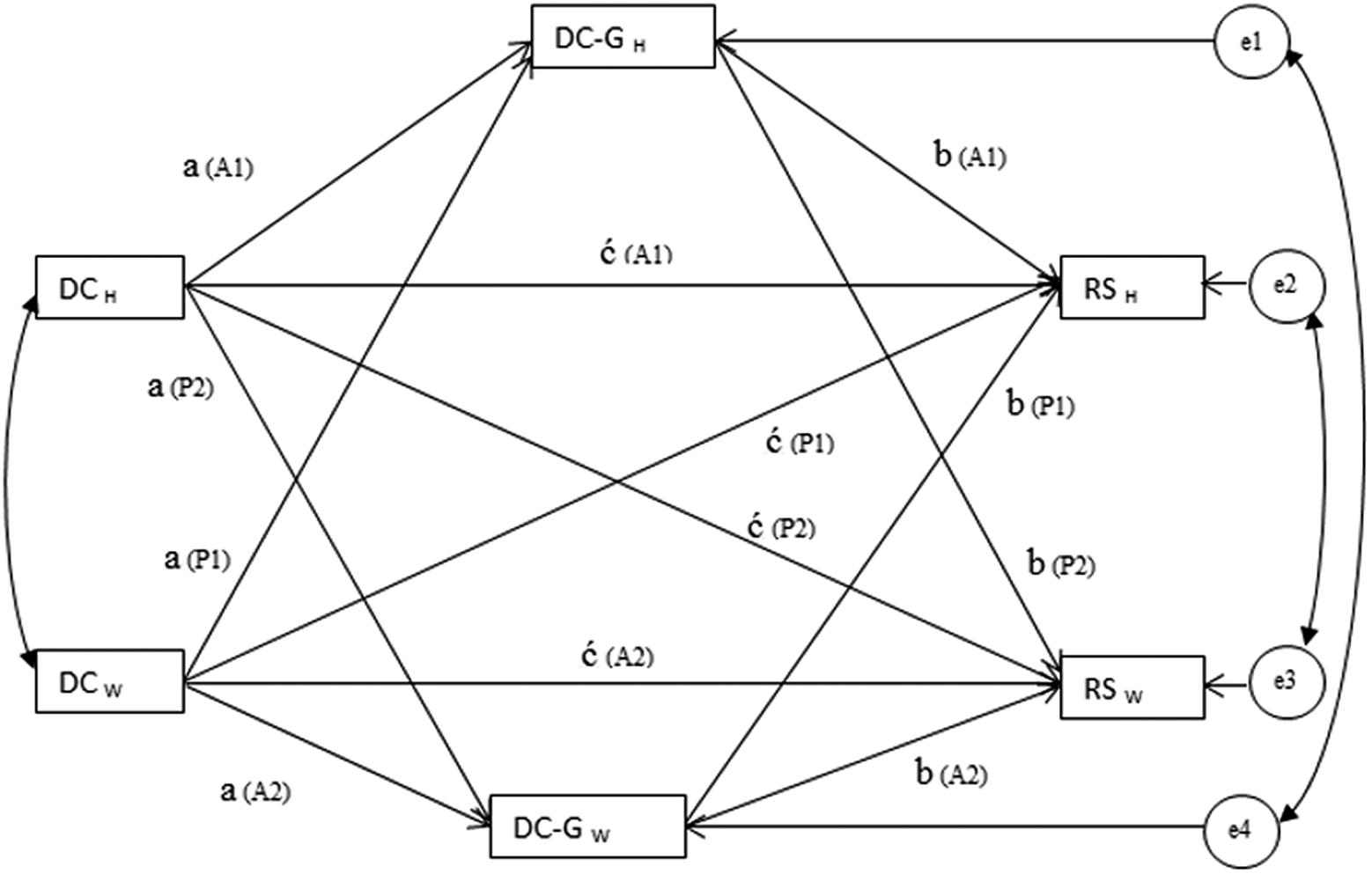
Literature on dyadic stress and coping has shown a significant association between DC and relationship satisfaction for married adults in various cultures including Pakistan (for review Falconier et al., Reference Falconier, Jackson, Hilpert and Bodenmann2015; Hilpert et al., Reference Hilpert, Randall, Sorokowski, Atkins, Sorokowska, Ahmadi, Alghraibeh, Aryeetey, Bertoni, Bettache, Błazejewska, Bodenmann, Borders, Bortolini, Butovskaya, Castro, Cetinkaya, Cunha, David and Yoo2016), the abovementioned association has not been studied for Pakistani couples. It seems plausible that the association between DC and relationship satisfaction may vary as a function of couples’ interaction as Iida et al. (Reference Iida, Seidman and Shrout2018) reflect that both members of a dyad are interdependent and couples’ interaction explains the variance in the above-mentioned relationship differently than treating the dyad members separately. Further, DC-G as a new form of gratitude (Shujja et al., Reference Shujja, Bodenmann, Randall, Adil and Malik2022) is expected to mediate between the DC and relationship satisfaction as it follows the DC behaviors and tends to strengthen the association between DC behaviors and relationship satisfaction in Pakistani couples. Gratitude, in general, has been reported to act as a mediator between interpersonal correlates e.g., attachment styles and relationship satisfaction (Vollmann et al., Reference Vollmann, Sprang and den Brink2019), however, mediating role of DC-G as a specific form of gratitude is yet to be studied. Additionally, collectivistic cultures like Pakistan and within Islamic obligations can be treated as a contextual factor for building a hypothetical model of the study. For example, collectivistic cultural norms and social obligations drive the couples to stay committed, loyal, and sincere with the marital relationship for life and their relationship satisfaction is largely dyadic (Qadir et al., Reference Qadir, de Silva, Prince and Khan2005). It seems that the association of couples’ DC behavior and relationship satisfaction is to be mediated by the DC-G because couples’ marital relationship is deeply rooted in religious obligations (Ali et al., Reference Ali, Ahmed, Bhatti and Farooq2020). Given this, the current study aimed to investigate the mediating role of DC-G between DC behaviors and relationship satisfaction in Pakistani couples. It was hypothesized that actor effect and partner effect of couples’ DC would positively predict relationship satisfaction directly and via mediating role of couples’ DC-based gratitude (see Figure 1). To test the mediating role of DC-G between the DC and relationship satisfaction for both members of the dyad, the actor-partner interdependent mediation model (APIMeM; Ledermann et al., Reference Ledermann, Macho and Kenny2011) was tested using structure equation modeling (SEM) with Amos 25.
Hypothetical Actor-Partner Interdependence Mediation Model
Note. A = actor; P = partner; DC = dyadic coping; H = husbands; W = wives; DC-G = dyadic coping based gratitude; RS = relationship satisfaction.

Method
Participants
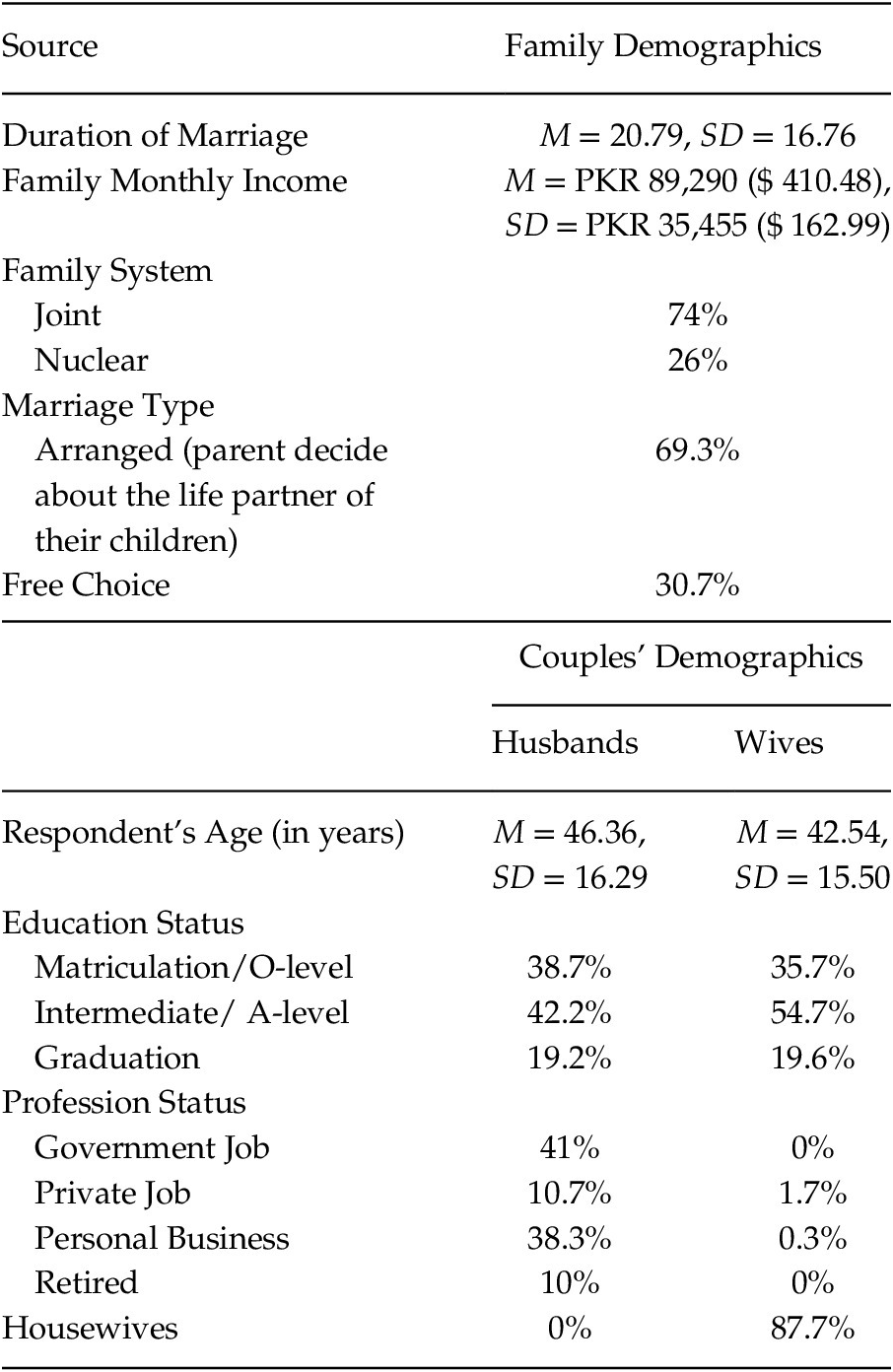
In response to the invitation using purposive sampling technique (for details, see procedure section), 1,152 respondents signed in through the Google Form link. After screening against the criteria, 255 respondents did not mention spousal contact information, 106 respondents’ partners did not respond to the invitation for data collection, 112 respondents left the form incomplete and 79 participants were unable to meet the inclusion criterion of (a) having married relationship for at least one year, (b) living together, and (c) having educational qualification of at least secondary school certificate. The final sample comprised 600 participants (300 couples) with their demographic details presented in Table 1.
Demographic Distribution of the Participants

Measures
Dyadic Coping
The Urdu translation of the Dyadic Coping Inventory (DCI-Urdu; Shujja et al., Reference Shujja, Adil, Randall, Bodenmann and Malik2020) is used that measures stress communication and dyadic behaviors in Pakistani married adults. The DCI-Urdu contained 33 items covering five factors named as communication stress; supportive DC; delegated DC; negative DC and common DC for the partners and the same five factors for the self. The 5-point Likert type response format ranged from very rare (1) to very often (5). The scoring range was 165 (maximum) to 33 (minimum) indicating that respondents’ high score on DCI-Urdu reflects high DC and vice versa. For the current study, mean scores of DCI-Urdu have been utilized. Sample items are I show empathy and understanding to my partner (Emotion Focused Supportive DC); I take on things that my partner would normally do in order to help him/her out (Delegated DC); I blame my partner for not coping well enough with stress (Negative DC) for the self, and My partner helps me analyze the situation so that I can better face the problem (Problem-Focused Supportive DC); My partner takes on things that I normally do in order to help me out (Delegated DC); My partner provides support, but does so unwillingly and unmotivated (Negative DC) for the partner. The original DCI (German version) is a 37-items self-report measure translated in various language including Urdu with the Cronbach alpha ranging from .81 (Pakistan) to .95 (USA) (Nepomuceno et al., Reference Nepomuceno, Gonçalves and Hernandez2022). In the current study, Cronbach alpha for the overall DCI-Urdu was .86 for the husbands and .84 for the wives (see Table 2).
Descriptive Statistics, Paired t, and Correlations among Variables of the Present Study

Note. The bold correlations pertain to dyadic associations.
* p < .01.
Dyadic Coping Based Gratitude
The Dyadic Coping Based Gratitude Questionnaire (DC-GQ-Urdu; Shujja et al., Reference Shujja, Bodenmann, Randall, Adil and Malik2022) has been designed to measure DC-G at the partner (respondents’ perceived partners’ reaction of appreciation and thankfulness in response to received problem-focused and emotion-focused positive DC behaviors) and the self-level (respondents’ reaction of appreciation and thankfulness in response to received problem-focused and emotion-focused positive DC behaviors of the partner). This measure contains 12 items covering two factors i.e., problem-focused DC-based gratitude (Problem-focused DC-G) and emotion-focused DC-based gratitude (Emotion-focused DC-G) for the partner and the same two factors for the self. The scoring ranges from 12 (minimum) to 60 (maximum) on the 5-point Likert type scale with response format as never (1), rarely (2), sometimes (3), often (4), very often (5), and mean scores have been utilized for the current study. The respondents high score on the DC-GQ shows high DC-G and vice versa. Sample items are I express gratitude to my partner for practical help and advice in times when I have been feeling stressed (Problem-focused DC-G); I express gratitude towards my partner for his/her emotional support (e.g., listening, empathy, understanding, helping in regulating my emotions) during times when I have been stressed (Emotion-focused DC-G). DC-GQ enjoys sound psychometric properties (e.g., overall DC-GQ αmen = .90; DC-GQ αwomen = .92) and in the current study, overall DC-GQ reliability estimates for the husbands (α = .91) and for the wives (α = .88) remain within the acceptable range (see Table 2).
Relationship Satisfaction
The Relationship Assessment Scale (RS10– Urdu; Røysamb et al., Reference Røysamb, Vittersø and Tambs2014) has been designed to assess individuals’ satisfaction with their relationship with their partner and is a 10 items one-dimensional scale. Respondents rated on a 6-point Likert type scale indicating low level of satisfaction (1) to high level of satisfaction with scores ranging from 10 (minimum) to 60 (maximum). Sample items are: I have a close relationship with my spouse/partner and I am satisfied with my relationship with my partner. Urdu translation of the RS 10 (Zahra, Reference Zahra2019) has been used with acceptable reliability estimates (αhusbands = .77; αwives = .80). In the current study, an overall reliability estimates of RS– 10 for the husbands (α = .84) and for the wives (α = .85) were satisfactory (see Table 2).
Procedure
The couples who were married for at least one year and living in Pakistan were invited by sending Google Form links through electronic communication channels like Facebook, Wattsapp, emails. The interested participants were required to show willingness by clicking on the “I Agree” option after carefully reading the informed consent on the Google Form before proceeding to the form completion. The informed consent contained the information regarding objectives and procedure of the study, legal and ethical rights of participants and researchers, potential risk, the significance of the study, protection of data, and personal identity. To obtain couples’ data, a specific code was assigned to each participant, and partners’ emails or contacts were sought from the respondents. Using the contact information, partners were invited through the same Google Form Link and the identification code. Three self-report measures i.e., DCI-Urdu (Shujja et al., Reference Shujja, Adil, Randall, Bodenmann and Malik2020); DC-GQ (Shujja et al., Reference Shujja, Bodenmann, Randall, Adil and Malik2022); RS10– Urdu (Urdu; Zahra, Reference Zahra2019) along with the demographic sheet were administered on the designated sample.
Data Analysis
In order to see the initial picture of the dyadic dataset, descriptive statistics (mean, standard deviation) along with the paired sample t-test and Pearson product moment correlation were conducted. In the dyadic dataset, both members of a dyad respond to the same study variables that result in interdependence (non-independence) violating the assumption (i.e, observation must be independent) of the typical parametric tests such as hierarchical regression. Correlation analyses can be helpful in identifying the level of interdependence inherited in the couples (dyads) data. Typically, heterosexual couples are thought to be distinguishable as a function of gender for the interpersonal variables e.g., relationship satisfaction, however, Kenny et al. (Reference Kenny, Kashy and Cook2006) recommend empirical examination of the distinguishability under the null hypothesis that gender is not likely to act as a distinguishing variable on the outcome variable. Before the dyadic data analysis, it is essential to decide whether the dyad is distinguishable because different dyadic analyses are suggested depending on the level of distinguishability between dyad members (Kenny et al., Reference Kenny, Kashy and Cook2006).
For the indistinguishable dyads, Ledermann et al. (Reference Ledermann, Macho and Kenny2011) proposed four steps for APIMeM:
1. Estimate the saturated measurement model by testing all direct, indirect, and total effects.
2. Estimate the k parameters for the path a (K a) and k parameters for the path b (K b) and determining the 95% CIs.
3. Constraining K a and K b to test for specific mediation patterns (the actor only; the couple; the contrast; the partner only). The actor only pattern is indicated if the actor effect is non-zero and partner effect is zero; couple pattern exists if both actor and partner effects are non-zero but equal in magnitude; contrast pattern exists if both actor and partner effects are non-zero, equal in magnitude but opposite in sign; the partner only pattern exists if actor effect is zero and partner effect is non-zero (KActor/KPartner = 0).
4. Removing the k paths if a specific pattern exists, re-specify the model and determine the good fit. On the bases of existing literature (see Arshad & Iqbal, Reference Arshad, Iqbal, Falconier, Randall and Bodenmann2016), marriage duration, family system (joint/nuclear), and marriage types (arranged/free choice) were treated as controlled variables in the current study.
Results
Descriptive Statistics
The mean and standard deviation for the husbands and wives showed that wives exhibited higher DC-G and relationship satisfaction than husbands whereas husbands were high on DC behaviors compared to that of wives. The paired sample t-test demonstrated the difference in study variables as non-significant. Further, correlation coefficients (boldface) showed the positive and significant non-independence (r = .29–.47) between husband-wives scores on the study variables and the positive associations between study variables for husbands and wives remained significant. The alpha reliability estimates for husbands (αhusbands = .84–.91) and for wives (αwives = .84–.88) were within the acceptable range (see Table 2).
Test for Distinguishability of the Dyadic Data
For the current study, – 2 log maximum likelihood method was used to empirically test gender as a distinguishing variable between the actor and partner on relationship satisfaction. To test the distinguishability, two models were run; the First Model estimated the fixed effect including the main effect of gender and interaction effect of gender with other predictors in the study (DC and DC-G) and random effects by considering the dyads as distinguishable and specifying the heterogeneous compound symmetry (CSH) as a variance type. In the second model, dyads were treated as indistinguishable by specifying compound symmetry (CS or CSR) as a covariance type. The difference between CSH and CSR – 2 log-likelihood values was tested through the χ2 difference test with the df = 1 because only one additional change in error variance was made to compare the two models. The results, χ2difference(1) = 1.45, p > .05, demonstrated that the data fail to reject the null hypothesis that gender is not likely to act as a distinguishing variable for the outcome variable (relationship satisfaction) and the dyads are reported to be indistinguishable. To treat the data as distinguishable, dyadic data was restructured into a person period pairwise dataset by entering the scores twice, once for the actor and once for the partner, and adjusting the data and the degree of freedom.
Mediation Analysis
Following the recommended mediation strategy for indistinguishable dyads (see Ledermann et al., Reference Ledermann, Macho and Kenny2011), we estimated the k paths for the a effect, k a1 represented by a(P1) and ka2 represented by a(P2) in Figure 1; k paths for the b effects, K b1 represented by b(P1) and k a2 b(P2) in Figure 1. After constraining the k a and k b, one k for the a effect was β = .22, 95% CI [.16, .29], and one k for the b effect was β = .29, 95% CI [.25, .33]. The confidence interval (CI) for the k a included 1 which indicates a couple’s pattern, however, CI for the K b neither included 1 nor 0 supporting mixed pattern (in between the actor only and couple model) (for review, Ledermann et al., Reference Ledermann, Macho and Kenny2011). The final model refers to the couple within between actor only and couple model.
We test the model for the a effect with additional indistinguishability constraint supporting couple pattern and model comparison test, χ2diff(1) = 3.84, p < .05, supported the significant difference between constraint and unconstrained parsimonious model. After removing the constraints along with two non-significant indirect paths, b(P1) and b(P2) as specified in Figure 1, we re-specified the model and tested the mediation hypothesis that DC-G would mediate the couples’ DC and relationship satisfaction.
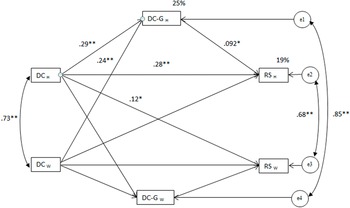
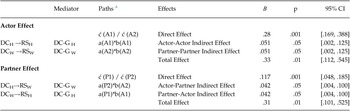
The final model (see Figure 2) treated the couples as indistinguishable and estimated the DC-G as a partial mediator between couples’ DC and relationship satisfaction suggesting that an increase in expression of DC-G is associated with increased couples’ relationship satisfaction. Further, comparison of simple indirect effect (actor-actor or partner-partner) with cross-partner indirect effect (actor-partner and partner-actor) showed that simple indirect effect of DC contributed more significantly to the corresponding direct effect (β = .28, p < .001) via DC-G than cross-partner indirect effect of DC (β = .12, p < .05). A closer examination at the specific indirect effects reflected that couples’ DC more significantly predicted DC-G explaining 25% variance accounting for than DC-G predicted the couples’ relationship satisfaction which explained 19% variance accounted for the relationship satisfaction in couples. We found that a actor effect (β = .29, p < .001) and a partner effect (β = .24, p < .001) were positive and significant indicating that increase in DC is associated with increased expression of DC-G in husbands and wives. For the b effect, both actor and partner effects were positive and moderately significant indicating the husbands’ and wives’ relationship satisfaction is significantly increased following the increase in DC-G (β = .09, p < .05). In short, DC-G emerged as a significant mediator in explaining the relationship between couples’ DC and relationship satisfaction and implied that an increase in DC is associated with an increase in DC-G and, in turn, an increase in relationship satisfaction in couples (see Table 3).
Final Actor Partner Independence Mediation Model of Study Variables for Pakistani Couples
Note. Actor-Partner Interdependence Mediation Model (APIMeM0 showing mediating role of dyadic coping based gratitude (DC-G) between dyadic coping (DC) and relationship satisfaction (RS) for husbands (H) and wives (W) by treating them as indistinguishable. That’s why, only one set of coefficients was included in the final model. Model fit indices are χ2(2) = 1.38, p = .50; GFI = .99; CFI = .99; RMSEA = .002; SRMR=.007.
* p < .05. ** p < .01.

Final Total Effects, Direct Effects, Indirect Effects for Treating the Married Couples as Indistinguishable (N = 300)

Note.
a Paths were specified in the hypothetical model.
Discussion
The current study unfolds a new chapter within stress psychology (Lazarus & Folkman, Reference Lazarus and Folkman1985) and particularly within the dyadic stress and coping paradigm (STM; Bodenmann, Reference Bodenmann1997). Despite the dyadic orientation of gratitude elaborated by find-remind-and-bind theory (Algoe, Reference Algoe2012), DC-G has not been investigated as a mediating factor in explaining the relationship between DC and relationship satisfaction in couples. Previous research stressed that the situational factors may involve strengthening the gratitude within couples’ relationship, however, did not specify a particular factor (Algoe et al., Reference Algoe, Haidt and Gable2008; Algoe & Stanton, Reference Algoe and Stanton2012; Tsang, Reference Tsang2007; Weinstein et al., Reference Weinstein, DeHaan and Ryan2010; Wood et al., Reference Wood, Brown and Maltby2011). The current study provides evidence that couples’ DC behaviors are associated with high level of DC-G which, in turn, enhanced relationship satisfaction. We have contributed to the scientific literature by introducing DC-G as a unique type of gratitude that may have wide implications within interpersonal relationship functioning.
The mediating role of DC-G supports the find-remind-and-bind theory (Algoe, Reference Algoe2012) which implies that partners’ gratitude is associated with ones’ realization of partners’ responsiveness and enhanced trust in the partner and the relationship which ultimately lead towards increased relationship satisfaction. The association between couples’ DC and relationship satisfaction strengthens as the DC-G intervenes and the mediating role of DC-G can be attributed to the collectivistic cultural orientation and religious obligation of practicing gratitude within couples’ interaction in Pakistan (Ali et al., Reference Ali, Ahmed, Bhatti and Farooq2020; Qadir et al., Reference Qadir, Khan, Medhin and Prince2011). It means that collectivistic culture promotes interdependence (Qadir et al., Reference Qadir, de Silva, Prince and Khan2005) in addition to the Islamic religious obligation of practicing gratitude within couples’ relationships (Ali et al., Reference Ali, Ahmed, Bhatti and Farooq2020). However, the role of cultural orientation can be fully understood by investigating the mediating role of DC-G in other cultures (especially cultures with individualistic orientation). Another plausible explanation may be that internalization of religious obligations regarding gratitude practice within couples’ relationships tends to be a more powerful source than assuming the role of DC-G in couples living in a Muslim country. From the Islamic perspective, gratitude (Shukar) does not simply involve the people’s affirmation of the social norms, rather strong desire to adhere with God’s will that human beings ought to be thankful to God and to the other people in response to the help from either source (Al-Ghazzali & Daniel, Reference Al-Ghazzali, Daniel and Field2015; Shah-Kazemi, Reference Shah-Kazemi and Walsh2014). Current study highlights the significance of gratitude (Shukar) and explains the mechanism through which gratitude operates in the dyadic coping and relationship satisfaction within Pakistani couples. This study alluded DC-G as a unique form of gratitude within couples that explain the variance accounting for the association between DC and relationship satisfaction within the cultural and religious context of Pakistan. Thus, these findings provide framework for stress and coping researchers for designing further studies with distinct contextual factors (see Shujja et al., Reference Shujja, Bodenmann, Randall, Adil and Malik2022).
Conclusively, the mediating role of DC-G between DC and relationship satisfaction was investigated using actor-partner interdependence mediation model (APIMeM; Ledermann et al., Reference Ledermann, Macho and Kenny2011). The findings based on the Pakistani married couples demonstrated that DC-G acts as a mediator between DC and relationship satisfaction. It means that DC-G is an underlying mechanism through which couples’ DC is positively associated with relationship satisfaction and the association between couples’ DC and relationship satisfaction strengthens as the DC-G mediates.
Consistent with the previous research (Cohen & Wills, Reference Cohen and Wills1985; Wood, Joseph, et al., Reference Wood, Joseph and Maltby2008; Wood, Maltby, et al., Reference Wood, Maltby, Stewart, Linley and Joseph2008), DC-G acts as a catalyst explaining significant variance in the relationship between couples’ DC and relationship satisfaction. These findings are useful for marital and family counselors in devising the DC-G based intervention in order to enhance relationship satisfaction within cultural and religious context. Although, the support for mediating role of DC-G is based on a cross-sectional dataset which does not provide evidence for temporal validity of the mediating mechanism and requires longitudinal study, the importance of the current study is still in place. This study has special significance for improvement in couples’ relationship functioning using DC-G as a therapeutic intervention. Further, researchers may extend the current study findings by including various types of couples as cohabitating couples, same sex couples, engaged couples within different religious perspectives such as Christianity, Hinduism, Jewism because couples’ functioning tends to differ across different type of couples and all the religions inculcate gratitude as a signature strength for developing and maintaining interpersonal relationship (see Ali et al., Reference Ali, Ahmed, Bhatti and Farooq2020)
The current study has treated the dyad members as indistinguishable implying that both dyad joint DC behaviors predict couples’ relationship satisfaction via DC-G and these findings are generalizable over the couples. Previous research reported that heterosexual couples are treated generally as distinguishable as gender acts as a moderator in predicting the relationship satisfaction in couples (Ledermann et al., Reference Ledermann, Bodenmann, Rudaz and Bradbury2010). The mediating mechanism may differ for the distinguishable couples depending on the gender differences on DC behaviors and DC-G, and subsequent relationship satisfaction. This study guides the researchers to contextualize the DC-G within social, emotional, cultural, or even religious frameworks to unfold interesting aspects within the stress-coping paradigm (STM; Bodenmann, Reference Bodenmann, Revenson, Kayser and Bodenmann2005).
Future research may incorporate individualistic cultural orientation as a contextualizing factor in determining the mediating role of DC-G specifically within the STM framework. The role of culture has been highlighted as a contextual factor in shaping the way couples communicate stress to each other and the way they prefer some of the coping strategies over others (Falconier & Kuhn, Reference Falconier and Kuhn2019). This study has included overall DC and DC-based gratitude; however, DC and DC-G may be analyzed on the self or partner-level as the part of dyadic data analysis or on the component level e.g., low DC or negative DC may be associated with low DC-G when DC-G is treated as an outcome variable. Previously, brief gratitude-based interventions have been effectively used to maintain and enhance relationship satisfaction (see Kanter & Schramm, Reference Kanter and Schramm2018). However, family counselors and clinicians can devise DC-G-based intervention within the STM framework like Couples Coping Enhancement Training Program (CCET; Bodenmann & Shantinath, Reference Bodenmann and Shantinath2004).