





1 Introduction
Modal logic is arguably the most important family of non-classical logics. In the last several decades, the mainstream research on modal logic has been predominantly restricted to normal modal logics (NMLs). For this reason, the theory of NML has flourished and reached the status of a separate subdiscipline of mathematical logic. It is the case, however, that NMLs are just instances of a much richer class of modal logics, that is, classical modal logics, or congruential modal logics (CMLs) as they are also often called. Although CMLs have been around for more than 50 years [Reference Segerberg28], compared to the normal ones, their theory remains rather obscure. Since CMLs are the widest known family of algebraizable modal logics, the studies in CML may lead to the most general theory of modal logic per se. This reason alone justifies the need for regular investigations in CML. Fritz [Reference Humberstone19] and Humberstone [Reference Fritz13] began the research on maximally consistent CMLs.
Humberstone [Reference Humberstone19] has shown that the four well-known Makinson’s [Reference Makinson26] logics are not the only maximal CMLs. He constructed two two-element neighborhood frames, or equivalently, two four-element modal algebras whose theories are not included in any of the four aforementioned logics. A natural open question follows from this result: how many maximal elements are there in the lattice of CMLs?
In 2016 Peter Fritz [Reference Fritz13] has resolved this problem by proving that there are uncountably many maximal elements in that lattice. His proof, however, is non-constructive. In fact, his construction only implies existence of this uncountable set. He managed to construct an infinite countable sequence of finite modal matrices whose theories where maximal in the lattice of CMLs. Since each finite modal matrix has an equivalent neighborhood frame, all of those logics turned out neighborhood complete. Therefore, he posed an open problem [Reference Fritz13, p. 293]: are there neighborhood incomplete maximal CMLs? If any, how many? Since maximality together with incompleteness implies unsoundness (see Fact 3.3 below), the attempt to answer the Fritz question becomes the search for neighborhood unsound CMLs.
Just as Kripke frames are known to be semantic structures used in order to interpret NMLs, the so-called neighborhood frames form an adequate semantic structures for CMLs. It is known that neighborhood frames are the subtler technical tools than Kripke frames, in the sense that each relational frame has an equivalent neighborhood frame while the converse of this statement is not true in general. Within NMLs, the incompleteness phenomenon is known to exist. A given NML is said to be Kripke complete when it has an adequate class of Kripke frames. One of the first Kripke incomplete logics were found by Fine [Reference Fine11] and Thomason [Reference Thomason31]. The general strategy behind the early incompleteness results in modal logic was to construct a complicated logic
$\Lambda $
 such that any Kripke frame that validates
$\Lambda $
 as a part of its theory, also validates some formula
$\varphi $
 such that
$\varphi \notin \Lambda $
 . Probably the simplest single example has been found by Van Benthem [Reference Van Benthem1]. This line of research has culminated in the Blok theorem [Reference Blok4] where it has been shown that there are in fact uncountably many NMLs which are Kripke-incomplete. Thus, the somehow pathological incompleteness phenomenon turned out a rule rather than exception. Since then, both Kripke and neighborhood-incompleteness has been studied even more—not only for modal [Reference Chagrova6, Reference Litak23, Reference Litak24], but also superintuitionistic logics [Reference Litak22, Reference Litak25, Reference Shetman29]. For a comprehensive historical overview of the incompleteness in modal logic consult [Reference Holliday and Litak18].
Closely related to incompleteness is the unsoundness property, also called ‘strong incompleteness’, which in a sense bears even bigger pathology—unsound logics are the ones which do not have frames at all. By Makinson’s theorem, each NML is included in at least one of the two logics of a single-element relational frame. Therefore, any NML is validated by at least one of the two one-element Kripke frames, which means that every NML is Kripke sound. So far, the only examples of unsound logics came in a multimodal setting. The very first example of an unsound logic is due to Thomason [Reference Thomason30]. His example is a tense logic and thus employs two unary modal operators. Another example is due to Venema [Reference Venema32] which uses five unary operators. It has been shown in [Reference Holliday and Litak18] that one can add a second operator to one of the van Benthem’s incomplete logics [Reference Van Benthem1] and obtain a bimodal unsound logic. In case of neighborhood frames, an example of an unsound logic with two unary operators has recently appeared in [Reference Ding, Holliday, Olivetti and Verbrugge8]. According to the author’s knowledge, there is no known example of a single-operator modal logic (congruential or any other) which is neighborhood unsound.
The aim of this paper is to (i) solve the Fritz problem. Our result will yield logics which are incomplete in a strong sense (unsound) and thus, more generally, we want to (ii) shed some light on the unsoundness phenomenon within monomodal logics.
2 Preliminaries
Let
$\{p,q,\ldots \}$
 be a countable set of propositional variables. Members of the set of formulas
$\mathcal {L}$
 are built in a familiar way with the use of the following connectives
$\bot ,\top ,\neg ,\wedge ,\lor ,\to ,\leftrightarrow ,\Box $
 .
$\mathcal {L}$
 will also be understood as an absolutely free algebra and substitutions as its endomorphisms. Modal logic is a set of formulas which contains all tautologies, is closed under modus ponens and uniform substitution. Modal logic
$\Lambda $
 is congruential when additionally it is closed under the congruentiality rule: if
$p\leftrightarrow q\in \Lambda $
 , then
$\Box p\leftrightarrow \Box q\in \Lambda $
 . Congruential modal logics has been also known under the name of CMLs (cf. [Reference Chellas7, Reference Segerberg28]). We choose to stick to the term congruential since it has been used in [Reference Fritz13] which form the main base and inspiration for the present work. By
$\mathsf {CExtE}$
 we shall denote the set of all CMLs. It is a well-known fact that
$\mathsf {CExtE}$
 forms a complete lattice ordered by inclusion with
$\mathcal {L}$
 as the biggest element, and the least element which is denoted by
$\mathbf {E}$
 . The set of coatoms of
$\mathsf {CExtE}$
 is
$\{\Lambda \in \mathsf {CExtE}: \Lambda \neq \mathcal {L}\text {, for any }\Lambda '\in \mathsf {CExtE}\text { such that } \Lambda '\neq \mathcal {L}\text { if } \Lambda \subseteq \Lambda '\text {, then } \Lambda '=\Lambda \}$
 . The lattice
$\mathsf {CExtE}$
 is coatomic, that is, for each
$\Lambda \in \mathsf {CExtE}$
 such that
$\Lambda \neq \mathcal {L}$
 there is a coatom
$\Lambda '\in \mathsf {CExtE}$
 , such that
$\Lambda \subseteq \Lambda '$
 . Coatoms of
$\mathsf {CExtE}$
 are precisely the Post complete logics among CMLs (Fritz calls it C-Post completeness).
From a semantical perspective, CMLs have been interpreted with two different types of structures. The first is the neighborhood semantics. A neighborhood frame
$\mathfrak {F}$
 is a tuple
$\langle W, N\rangle $
 such that W is a nonempty set and N is a function which maps W to
$\mathcal {P}(\mathcal {P}(W))$
 . A neighborhood model
$\mathfrak {M}$
 is a triple
$\langle W,N,V\rangle $
 where first two elements constitute a frame and V is a valuation assigning subsets of W to propositional variables. A propositional variable p is true in a world
$w\in W$
 of a model
$\mathfrak {M}=\langle W,N,V\rangle $
 , formally written as:
$\mathfrak {M},w\vDash p$
 iff
$w\in V(p)$
 . Boolean connectives are treated as usual. For any
$\varphi \in \mathcal {L}$
 ,
$\mathfrak {M},w\vDash \Box \varphi $
 iff
$||\varphi ||:=\{x\in W:\mathfrak {M},x\vDash \varphi \}\in N(w)$
 . Let
$\Gamma \subseteq \mathcal {L}$
 . We will write
$\mathfrak {M},w\vDash \Gamma $
 when for every
$\varphi \in \Gamma $
 we have
$\mathfrak {M},w\vDash \varphi $
 . A formula
$\varphi $
 is globally true in
$\mathfrak {M}=\langle W,N,V\rangle $
 (
$\mathfrak {M}\vDash \varphi $
 ) iff
$\mathfrak {M},w\vDash \varphi $
 for any
$w\in W$
 .
$\varphi $
 is valid on a frame in a world w:
$\mathfrak {F},w\vDash \varphi $
 iff for any V,
$\langle \mathfrak {F},V\rangle ,w\vDash \varphi $
 . Similarly
$\varphi $
 is valid on a frame
$\mathfrak {F}$
 (
$\mathfrak {F}\vDash \varphi $
 ) iff
$\mathfrak {F},w\vDash \varphi $
 for any w from
$\mathfrak {F}$
 . The class of all frames is an adequate semantics for
$\mathbf {E}$
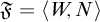
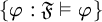
 . Different classes of neighborhood frames form semantics for many congruential logics, however Gerson [Reference Gerson15] formulated two CMLs for which no complete class of neighborhood frames can be found. What is more, there are modal logics which are Kripke incomplete but neighborhood complete [Reference Gerson14]. For any neighborhood frame
$\mathfrak {F}=\langle W,N\rangle $
 , its theory
$\{\varphi :\mathfrak {F}\vDash \varphi \}$
 is a CML. For this reason, we will often write logic of a frame or frame’s corresponding logic to indicate its theory. For an advanced survey on neighborhood semantics consult [Reference Pacuit27].
Modal algebras are the second alternative. A modal algebra is a structure
$\mathfrak {B}=\langle \mathsf {B}, -^{\mathfrak {B}},\wedge ^{\mathfrak {B}},\lor ^{\mathfrak {B}},\bot ^{\mathfrak {B}},\top ^{\mathfrak {B}},\Box ^{\mathfrak {B}}\rangle $
 where
$\Box ^{\mathfrak {B}}$
 is an arbitrary unary operation and
$\Box ^{\mathfrak {B}}$
 —free reduct of
$\mathfrak {B}$
 is a Boolean algebra. We will omit the superscripts for operations when the context is clear. We will also write modal algebras as structures of the form
$\langle \mathfrak {B},\Box \rangle $
 where
$\mathfrak {B}$
 is a Boolean algebra. Given a set W its powerset will be denoted by
$\mathcal {P}(W)$
 . Also
$\mathcal {P}(W)$
 will be sometimes associated with its Boolean algebra defined in a standard way with set-theoretic operations and
$\emptyset ,W$
 as constants. An element a of a Boolean algebra
$\mathfrak {B}$
 is called an atom iff it covers zero, that is,
$\bot ^{\mathfrak {B}}<a$
 and there is no
$b\in \mathfrak {B}$
 such that
$\bot ^{\mathfrak {B}}<b<a$
 . In a powerset algebra atoms are precisely singleton sets. A modal algebra is said to be atomic iff its Boolean reduct is atomic, that is, every non-zero element includes an atom. Similarly, modal algebra is called complete iff its Boolean reduct is complete (has arbitrary joins and meets).
$\langle \mathfrak {B},\Box \rangle $
 is atomic and complete iff it is isomorphic to an algebra of the form
$\langle \mathcal {P}(W),\Box \rangle $
 for some set W. We say that
$\mathfrak {B}\vDash \varphi \approx \psi $
 iff for any homomorphism
$h:\mathcal {L}\longrightarrow \mathfrak {B}$
 we have
$h(\varphi )=h(\psi )$
 . A modal algebra is called normal when it satisfies
$\Box \top \approx \top $
 and
$\Box (x\wedge y)\approx \Box x\wedge \Box y$
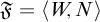
 . There is a full categorical duality between neighborhood frames and modal algebras developed in [Reference Došen9]. We do not need the whole theory for our purposes. We shall confine ourselves to the following: let
$\mathfrak {F}=\langle W, N\rangle $
 be a neighborhood frame. Define
$\mathfrak {F}^+=\langle \mathcal {P}(W),\Box ^{\mathfrak {F}}\rangle $
 where
$\Box ^{\mathfrak {F}} X=\{w\in W: X\in N(w)\}$
 . Now given a complete atomic modal algebra, that is, a powerset algebra
$\mathfrak {B}=\langle \mathcal {P}(W),\Box \rangle $
 define a frame
$\mathfrak {B}_+=\langle W, N_{\mathfrak {B}}\rangle $
 such that
$X\in N(w)$
 iff
$w\in \Box X$
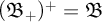
 . We have
$(\mathfrak {F}^+)_+=\mathfrak {F}$
 and
$(\mathfrak {B}_+)^+=\mathfrak {B}$
 for any powerset algebra
$\mathfrak {B}$
 . Moreover, we have
$\mathfrak {F}\vDash \varphi $
 iff
$\mathfrak {F}^+\vDash \varphi \approx \top $
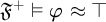 and
$\mathfrak {B}\vDash \varphi \approx \top $
 iff
$\mathfrak {B}_+\vDash \varphi $
 for any
$\varphi , \mathfrak {F}$
 and
$\mathfrak {B}$
 . For arbitrary finite modal algebra
$\mathfrak {B}$
 there is a neighborhood frame
$\mathfrak {F}$
 s.t.
$\mathfrak {F}^+$
 is isomorphic to
$\mathfrak {B}$
 . Therefore, we can say that for a modal algebra, to have an equivalent neighborhood frame, it is enough for its Boolean reduct to be atomic and complete. Note that in case of Kripke semantics, the underlying algebra additionally needs to have a completely additive operator (cf. [Reference Chagrov and Zakharyaschev5, Reference Holliday and Litak18]).
Now we shall recall some basic algebraic preliminaries needed for the further parts of the paper together with some specific results from [Reference Krawczyk21] on modal algebras.
In our approach, we shall focus on varieties of modal algebras instead of axiomatic extensions. Given a class of algebras
$\mathsf {K}$
 , we will use the familiar closure operators
$\mathsf {H}(\mathsf {K})$
 ,
$\mathsf {S}(\mathsf {K})$
 ,
$\mathsf {P}(\mathsf {K})$
 ,
$\mathsf {I}(\mathsf {K})$
 ,
$\mathsf {P}_U(\mathsf {K})$
 , and
$(\mathsf {K})_{SI}$
 for the classes of
$\mathsf {K}$
 ’s homomorphic images, subalgebras, products, isomorphic copies, ultraproducts and subdirectly irreducibles. Variety is class of algebras definable by equations. A quasivariety is a class of algebras definable by quasi-equations (Horn formulas). An arbitrary class of similar algebras
$\mathsf {K}$
 is a variety iff
$\mathsf {K}=\mathsf {H}\mathsf {S}\mathsf {P}(\mathsf {K})$
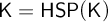 and it is a quasivariety iff
$\mathsf {K}=\mathsf {I}\mathsf {S}\mathsf {P}\mathsf {P}_{\mathsf {U}}(\mathsf {K})$
 . We will use variety and quasivariety closure operators:
$\mathsf {V}(\mathsf {K}):=\mathsf {H}\mathsf {S}\mathsf {P}(\mathsf {K})$
 and
$\mathsf {Q}(\mathsf {K}):=\mathsf {I}\mathsf {S}\mathsf {P}\mathsf {P}_{\mathsf {U}}(\mathsf {K})$
 . Given a set of equations
$\Sigma $
 ,
$\mathsf {Mod}(\Sigma ):=\{\mathfrak {B}:\mathfrak {B}\vDash \Sigma \}$
 , that is, a class of algebras which satisfy every equation in
$\Sigma $
 .
$\mathsf {Mod}(\Sigma )$
 is always a variety and
$\Sigma $
 is its base. Similar notions for sets of quasi-identities can be defined in terms of quasivarieties.
$Con(\mathfrak {A})$
 is the set of congruences on
$\mathfrak {A}$
 . If
$\mathfrak {A}$
 is an algebra and
$\Theta \in Con(\mathfrak {A})$
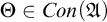 ,
$\mathfrak {A}/_\Theta $
 will denote its quotient and
$[a]_\Theta =\{b\in \mathsf {A}: \langle a,b\rangle \in \Theta \}$
 its equivalence classes. When algebras
$\mathfrak {A}$
 and
$\mathfrak {B}$
 are isomorphic, we will indicate it by writing
$\mathfrak {A}\cong \mathfrak {B}$
 . We say that an algebra
$\mathfrak {A}$
 is congruence distributive iff
$Con(\mathfrak {A})$
 forms a distributive lattice. A class of algebras is congruence distributive iff all its algebras are congruence distributive. Congruence distributivity allows us to use the well-known ‘Jónsson’s lemma’[Reference Jonsson20].
Lemma 2.1 (Jónsson)
If
$\mathsf {H}\mathsf {S}\mathsf {P}(\mathsf {K})$
 is a congruence distributive variety, then
$ (\mathsf {H}\mathsf {S}\mathsf {P}(\mathsf {K}))_{SI}\subseteq \mathsf {H}\mathsf {S}\mathsf {P}_{\mathsf {U}}(\mathsf {K})$
 .
Let
$\mathsf {M}$
 be the class of all modal algebras. Let us gather some facts from [Reference Krawczyk21]:
$\mathsf {M}$
 is a congruence distributive variety which is an equivalent algebraic semantics for the minimal congruential logic E. E is in fact Blok–Pigozzi algebraizable with
$\mathsf {M}$
 by means of equation
$p\approx \top $
 and formula
$p\leftrightarrow q$
 . Thus the lattice of congruential extensions of E is dually isomorphic with the lattice of subvarieties of
$\mathsf {M}$
 . For any modal algebra
$\mathfrak {B}$
 and any elements
$a,b\in \mathsf {B}$
 we define
$a\to b:=-a\lor b$
 and
$a\leftrightarrow b:=\, (-a\lor b)\wedge (-b\lor a)$
 .
Definition 2.2. Let
$\mathfrak {B}$
 be a modal algebra.
$F\subseteq \mathsf {B}$
 is a congruential filter on
$\mathfrak {A}$
 when i)
$\top ^{\mathfrak {B}}\in F$
 , ii)
$a\in F$
 and
$a\leq b$
 implies
$b\in F$
 , iii)
$a,b\in F$
 implies
$a\wedge b\in F$
 , and finally, when it satisfies the congruentiality condition: iv)
$\text {if } a\leftrightarrow b\in F\text {, then }\Box a\leftrightarrow \Box b\in F$
 .
The set of congruential filters of a given modal algebra obviously forms a complete lattice. Let us recall [Reference Krawczyk21] the following fact.
Fact 2.3. For any modal algebra
$\mathfrak {B}$
 ,
$Con\mathfrak {B}$
 is isomorphic with the lattice of its congruential filters.
For comparison, recall the notion of a normal filter where additionally to the standard lattice filter conditions i)–iii) it is stipulated that F is closed under
$\Box $
 operation:
$a\in F$
 implies
$\Box a\in F$
 . It is known that congruences on normal modal algebras correspond to open filters in the exact same sense as above. Given a normal modal algebra, it is easy to check that the notion of an open filter coincide with the notion of a congruential filter. However, this equivalence does not hold for modal algebras in general. To see that a congruential filter does not have to be an open filter, take any modal algebra such that
$\Box \top \neq \top $
 and a filter
$\{\top \}$
 . It is straightforward to see that for any modal algebra, singleton of its top element is a congruential filter. Similarly, not every open filter on a modal algebra has to be congruential. Consider the following modal algebra based on a four element Boolean cube
$\mathfrak {B}_4=\langle \{\top ,a,b,\bot \},\Box \rangle $
 where
$\Box a=\Box b = \top $
 ,
$\Box \top =a$
 and
$\Box \bot =\bot $
 . It is easy to see that
$\{\top , a\}$
 is an open filter. However, it is not congruential because
$b\leftrightarrow 0=a \in F$
 , but
$\Box b\leftrightarrow \Box 0=0 \notin F$
 . See the two diagrams below.

Due to algebraizability, when evaluating formulas of a given logic, we can associate a modal algebra
$\mathfrak {B}=\langle \mathsf {B}, -^{\mathfrak {B}},\wedge ^{\mathfrak {B}},\lor ^{\mathfrak {B}},\bot ^{\mathfrak {B}},\top ^{\mathfrak {B}},\Box ^{\mathfrak {B}}\rangle $
 with its corresponding modal matrix
$\mathfrak {M}^{\mathfrak {B}}=\langle \mathfrak {B},\{\top ^{\mathfrak {B}}\}\rangle $
 . Obviously
$\mathfrak {M}^{\mathfrak {B}}\vDash \varphi $
 iff
$\mathfrak {B}\vDash \varphi \approx \top $
 .
Let
$\Lambda \in \mathsf {CExtE}$
 be a CML. The already mentioned dual isomorphic correspondence with the lattice of varieties of modal algebras is established by
$\tau _L$
 :
$\Lambda \mapsto \mathsf {Mod}(\{\varphi \approx \top :\varphi \in \Lambda \})$
 . The opposite mapping composing with
$\tau _L$
 into identity is given by
$\tau _V$
 :
$\mathcal {V}\mapsto \{\varphi :\mathsf {V}\vDash \varphi \approx \top \}$
 for arbitrary variety of modal algebras
$\mathcal {V}$
 . Thus, due to dual isomorphism of the respective lattices,
$\tau _V(\mathcal {V})$
 is Post complete in
$\mathsf {CExtE}$
 if
$\mathcal {V}$
 is an atom in the lattice of subvarieties of modal algebras. We say that
$\Lambda $
 is neighborhood-complete iff there is a class of frames
$\mathsf {F}$
 such that
$\Lambda =\{\varphi :\mathfrak {F}\vDash \varphi \text { for all }\mathfrak {F}\in \mathsf {F} \}$
 . Furthermore,
$\Lambda $
 is said to be neighborhood-sound iff there is a frame
$\mathfrak {F}$
 such that
$\mathfrak {F}\vDash \Lambda $
 . Under assumption that
$\Lambda $
 is consistent (or equivalently that the class
$\mathsf {F}$
 is non-empty) neighborhood-completeness implies neighborhood-soundness. Combining these with our previous remarks on duality between frames and algebras, we get that
$\tau _V(\mathcal {V})$
 is neighborhood-complete iff
$\mathcal {V}=\mathsf {H}\mathsf {S}\mathsf {P}(\mathsf {K})$
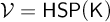 where for any
$\mathfrak {B}\in \mathsf {K}$
 ,
$\mathfrak {B}\cong \langle \mathcal {P}(W),\Box \rangle $
 for some set W. Similarly,
$\tau _V(\mathcal {V})$
 is neighborhood-sound iff
$\langle \mathcal {P}(W),\Box \rangle \in \mathcal {V}$
 for some W,
$\Box $
 .
3 Fritz’s result and the open problem
In [Reference Makinson26] Makinson has provided four modal logics based on two element Boolean algebra which turned out to be Post-complete in various lattices of modal logics. Especially, the two of them validating
$\Box \top \approx \top $
 constitute the only Post-complete NMLs. Humberstone [Reference Humberstone19] has raised the problem if Makinson’s results can also be transferred to the lattice of CMLs and solved it negatively: he constructed two neighborhood frames whose logics are not included in any of the four Makinson’s logics. Further results on Post-completenessFootnote
1
in CMLs have been obtained by Fritz [Reference Fritz13]. Let us recall his two theorems. Since the proof of the first theorem is fairly short, we decide to include it here for the sake of self-containment. We keep the original Fritz’s notation, slightly different from the one we have already adopted, believing it will not lead to any misunderstanding.
Theorem 3.1 (Fritz, Theorem 4.1 in [Reference Fritz13])
There are
$2^{\aleph _0}$
 C-Post complete CMLs.
Proof (Fritz)
Let
$\mathfrak {A}=\langle \mathsf {A},\omega , -,\cap \rangle $
 be the countable Boolean algebra of finite, co-finite sets of natural numbers where
$\mathsf {A}$
 is the countable set of finite and cofinite subsets of the set of natural numbers. Let
$\mathsf {B}$
 be the set of all finite non-empty sets of natural numbers and
$\langle b_n:n\in \omega \rangle $
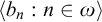 an enumeration of
$\mathsf {B}$
 . For each
$S\subseteq \omega $
 define a modal matrix
$\mathfrak {A}_S=\langle \mathsf {A},\omega , -,\cap ,\ast ,\{\omega \}\rangle $
 , where
$\ast $
 is defined as follows:
$\ast (\omega )=b_0$

$\ast (b_n)=b_{n+1}$
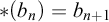 for all
$n\in \omega $

$\ast (-b_n)=\omega $
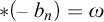 for all
$n\in S$

$\ast (-b_n)=\emptyset $
 for all
$n\in \omega \setminus S$

$\ast (\emptyset )=\omega $
 .
Obviously, the logic of a matrix
$\mathfrak {A}_S$
 ,
$\Lambda (\mathfrak {A}_S)$
 is a CML for any S. Also, for all
$S\cup \{n\}\subseteq \omega $
 ,
$\Box \neg \Box ^n\Box \top $
 iff
$n\in S$

$\neg \Box \neg \Box ^n\Box \top $
 iff
$n\notin S$
 .
Thus for any distinct
$S,S'\subseteq \omega $
 ,
$\Lambda (\mathfrak {A}_S)$
 and
$\Lambda (\mathfrak {A}_{S'})$
 cannot be extended to the same consistent modal logic. As every consistent CML can be extended to a C-Post complete modal logic, there are
$2^{\aleph _0}$
 such logics.
As the author observes, the proof relies not only on S but also on the choice of enumeration B. Its non-constructivity becomes clear: it only implies the existence of uncountably many Post-complete elements in
$\mathsf {CExtE}$
 without providing a single concrete example of such. Fritz recognizes that his proof is inconclusive with respect to the problem of neighborhood-completeness as he states an open problem [Reference Fritz13, p. 293]:
…this raises the question how widespread such incompleteness is among logics Post complete in the set of congruential modal logics. The following result gives a partial answer, by showing that there are infinitely many C-Post complete logics which are the logic of a class of neighborhood frames. What their precise number is will be left open, as well as the question whether there are any C-Post complete logics which fail to be the logic of a class of neighborhood frames, and if so, how many such logics there are.
He managed to construct a countable infinite sequence of finite modal matrices each giving raise to a Post-complete CML and thus he showed the following theorem.
Theorem 3.2 (Fritz, Theorem 4.2 in [Reference Fritz13])
There are at least
$\aleph _0$
 C-Post complete modal logics each of which is the logic of a class of neighborhood frames.
The author closes his paper with several other open problems repeating the most pertinent one [Reference Fritz13, p. 299]: Two clusters of questions were already mentioned above: First, how many modal logics Post complete in the set of congruential modal logics are the logic of a class of neighborhood frames, and how many (if any) are not? Having partially answered the first question, he left the second one completely open. In this paper we are going to give a definite solution to the second problem by constructing an uncountable sequence of minimal varieties of modal algebras which do not contain any algebra whose Boolean reduct is complete and atomic. This will yield a result stating that the Post complete logics in question are not only neighborhood incomplete but also neighborhood unsound (strongly incomplete).
Before we move on to the main part, let us establish two simple facts which relate the notions of unsoundness and Post-completeness.
Fact 3.3. Let
$\Lambda \in \mathsf {CExtE}$
 be Post Complete. If
$\Lambda $
 is neighborhood incomplete, then it is neighborhood unsound.
Proof. By algebraizability
$\Lambda =\tau _V(\mathcal {V})$
 where
$\mathcal {V}$
 is an atom in the lattice of modal subvarieties. Assume
$\mathcal {V}$
 is neighborhood incomplete and let
$\mathsf {K}:=\{\mathfrak {B}\in \mathcal {V}: \mathfrak {B}\text { is atomic and complete}\}$
 . Hence
$\mathsf {H}\mathsf {S}\mathsf {P}(\mathsf {K})\subsetneq \mathcal {V}$
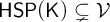 . Atomic and complete modal algebras have at least two elements, so if
$\mathsf {K}$
 is non-empty, then
$\mathcal {V}$
 is not an atom which leads to a contradiction.
Unlike incompleteness, the unsoundness property is ‘upwards hereditary’, meaning unsound logics can only be included in unsound logics.
Fact 3.4. If there is a consistent unsound logic, then there is a Post complete unsound logic.
Proof. Let
$\Lambda $
 be a consistent unsound logic. Each consistent logic is a sublogic of a Post-complete logic. Thus, there is Post complete
$\Lambda '$
 such that
$\Lambda \subseteq \Lambda '$
 . If there was a frame
$\mathfrak {F}$
 such that
$\mathfrak {F}\vDash \Lambda '$
 , then it would mean
$\mathfrak {F}\vDash \Lambda $
 . Thus
$\Lambda '$
 cannot be sound.
Existence of an unsound logics inevitably leads to an existence of Post-complete unsound logics. Thus, the unsoundness phenomenon appears to be strongly intertwined with Post completeness.
4 The construction and the proof
Throughout the text, let
$\mathsf {A}\subseteq \mathcal {P}(\omega )$
 denote the set of finite and cofinite sets of natural numbers
$\omega =\{0,1,2,\ldots \}$
 . Let
$\mathfrak {A}=\langle \mathsf {A}, \cap ,\cup ,\setminus , \omega ,\emptyset \rangle $
 be a Boolean algebra associated with
$\mathsf {A}$
 . Given a Boolean algebra
$\mathfrak {B}$
 , by
$\mathtt {At}(\mathfrak {B})$
 we shall denote the set of atoms of
$\mathfrak {B}$
 . Thus, in case of
$\mathfrak {A}$
 ,
$\mathtt {At}(\mathfrak {A}):=\{\{n\}: n\in \omega \}$
 —atoms of
$\mathfrak {A}$
 are singletons. We will also distinguish ‘middle’ elements of a Boolean algebra: Let
$\mathtt {Mid}(\mathfrak {B}):= \mathsf {B}\setminus (\mathtt {At}(\mathfrak {B})\cup \{\bot ^{\mathfrak {B}},\top ^{\mathfrak {B}}\})$
 . Thus
$b\in \mathtt {Mid}(\mathfrak {B})$
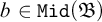 if b is neither an atom, nor zero nor one. In case of
$\mathfrak {A}$
 , we have
$a\in \mathtt {Mid}(\mathfrak {A})$
 iff a is a member of an interval
$a\in (\{n\},\omega )$
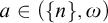 for some
$n\in \omega $
 . We know that
$\mathtt {Mid}(\mathfrak {A})$
 is countable. Hence it is in bijective correspondence with the set
$\mathtt {At}(\mathfrak {A})$
 . Let
$\mathtt {Bij}$
 be the set of all bijections from
$\mathtt {Mid}(\mathfrak {A})$
 onto
$\mathtt {At}(\mathfrak {A})$
 .
$\mathtt {Bij}:=\{f:\mathtt {Mid}(\mathfrak {A})\longrightarrow \mathtt {At}(\mathfrak {A})|f\text { is a bijection}\}$
 . Obviously
$\mathtt {Bij}$
 is uncountable. Let
$f\in \mathtt {Bij}$
 . Define
$\mathfrak {A}_f=\langle \mathfrak {A},\Box _f\rangle $
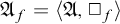 to be a modal algebra with a Boolean reduct
$\mathfrak {A}$
 , such that

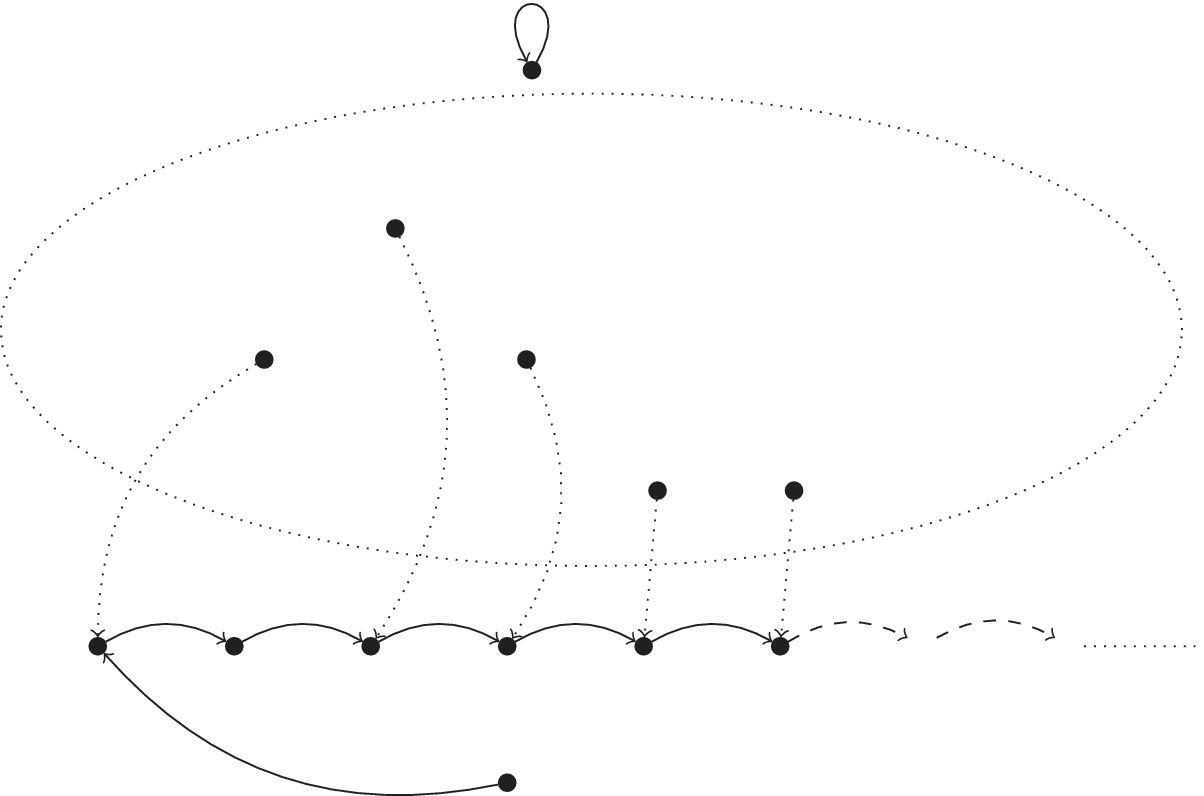
The algebra
$\mathfrak {A}_f$
 is depicted in Figure 1.
Algebra
$\mathfrak {A}_f$
 . Solid arrows indicate the restriction of
$\Box _f$
 to atoms, zero and one. The dotted arrows reflect the interpretation of
$\Box _f$
 which depends on f (restriction to the middle part). Lines indicating lattice order for Hasse diagram are omitted for clarity.

The fundamental theorem which we are after takes the following form.
Theorem 4.1 (Fundamental theorem)
For any
$f\in \mathtt {Bij}$
 , we have the following:
-
(i) $\mathsf {H}\mathsf {S}\mathsf {P}(\mathfrak {A}_f)$
 is minimal in the lattice of subvarieties of modal algebras;
-
(ii) for any $g\in \mathtt {Bij}$
, if
$f\neq g$
, then
$\mathsf {V}(\mathfrak {A}_g)\neq \mathsf {V}(\mathfrak {A}_f)$
; -
(iii) there is no $\mathfrak {F}=\langle W, N\rangle $
, such that
$\mathfrak {F}^+=\langle \mathcal {P}(W),\Box ^{\mathfrak {F}}\rangle \in \mathsf {V}(\mathfrak {A}_f)$
.





The points (i) and (ii) are relatively easy to prove and both will essentially rely on the fact that
$\mathfrak {A}_f$
 will embed into any member of the variety it generates. This part of the theorem is covered in Proposition 4.8. By algebraizability and dual isomorphism of respective lattices, this will yield a set of uncountably many Post complete logics. The challenging part is (iii). The intuition behind the construction and subsequent proof is the fact that ‘middle’ elements cannot be injectively mapped onto atoms in any infinite powerset algebra. The trick is to show that each member of
$\mathsf {V}(\mathfrak {A}_f)$
 somehow preserves this certainly understood ‘injectivity’ into atoms on the part which supposedly should be of strictly larger cardinality in a complete algebra. This part is covered in Theorem 4.11 whose proof will require transfinite induction. Direct logical corollary of (iii) is the unsoundness of respective logics.
Let us start with a simple useful lemma.
Lemma 4.2. Let
$\mathfrak {C}$
 be a modal algebra such that
$\Box ^{\mathfrak {C}}\top ^{\mathfrak {C}}=\top ^{\mathfrak {C}}$
 . If
$F\subseteq \mathsf {C}$
 is a congruential modal filter, then F is an open filter.
Proof. Let F and
$\mathfrak {C}$
 be as in the assumption of the lemma. Let
$a\in F$
 . We have
$a\leftrightarrow \top = a\in F$
 . Thus, by congruentiality of F we have
$\Box a\leftrightarrow \Box \top = \Box a\leftrightarrow \top = \Box a\in F$
 .
Lemma 4.3.
$\mathfrak {A}_f$
 is simple for any
$f\in \mathtt {Bij}$
 .
Proof. Let F be a congruential filter of
$\mathfrak {A}_f$
 , such that
$F\neq \{\omega \}$
 . Thus there is
$a\in F$
 and
$a\neq \omega $
 . But then
$\Box _f a\in \mathtt {At}(\mathfrak {A})$
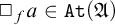 . Thus by Lemma 4.2,
$\Box _f(a)=\{i\}\in F$
 . But also
$\Box _f\Box _f(a)=\Box _f\{i\}=\{i+1\}\in F$
 . So
$\{i\}\cap \{i+1\}=\emptyset \in F$
 which means
$F=\mathsf {A}$
 . By algebraizability, we have that
$\mathfrak {A}_f$
 is simple.
Lemma 4.4. If
$\mathfrak {C}\in \mathsf {S}(\mathfrak {A}_f)$
 , then
$\mathfrak {C}\cong \mathfrak {A}_f$
 for any
$f\in \mathtt {Bij}$
 .
Proof. Let
$\mathsf {C}$
 be a subuniverse of
$\mathfrak {A}_f$
 . Then obviously
$\bot =\emptyset \in \mathsf {C}$
 , which means
$(\Box _f)^{n+1}\emptyset =\{n\}\in \mathsf {C}$
 for any n.
$\mathsf {A}$
 is generated from atoms, so
$\mathfrak {C}=\mathfrak {A}_f$
 .
Thus, we have established that
$\mathfrak {A}_f$
 neither has non-trivial congruences, nor proper subalgebras. What is more, it embeds into each non-trivial member of the variety it generates.
Lemma 4.5. Let
$f\in \mathtt {Bij}$
 . If
$\mathfrak {D}\in \mathsf {V}(\mathfrak {A}_f)$
 is a non-trivial algebra, then
$\mathfrak {A}_f\in \mathsf {S}(\mathfrak {D})$
 .
Proof. Let
$\mathfrak {B}:=\Pi _{i\in I}\mathfrak {A}_f$
 ,
$\mathfrak {C}\in \mathsf {S}(\mathfrak {B})$
 and
$\mathfrak {D}\in \mathsf {H}(\mathfrak {C})$
 . Observe that
$\mathfrak {A}_f$
 is zero-generated, so given an atom
$\{n\}$
 of
$\mathfrak {A}_f$
 ,
$\{n\}=\Box _f^{n+1}\bot \mapsto \Box ^{n+1}\bot ^{\mathfrak {B}}$
 is a natural embedding of atoms into
$\mathfrak {B}$
 . An embedding of the whole algebra
$\mathfrak {A}_f$
 is obtained by a unique extension of this atomic embedding. By zero generation of
$\mathfrak {A}_f$
 , this embedding works for every subalgebra of
$\mathfrak {B}$
 , thus we immediately get that
$\mathfrak {A}_f\in \mathsf {S}(\mathfrak {C})$
 . By assumption,
$\mathfrak {D}\cong \mathfrak {C}/\theta $
 for some
$\theta \in \mathsf {Con}\mathfrak {C}$
 . Let
$\Psi :=\theta \cap \mathsf {A}^2$
 . Obviously
$\Psi \in \mathsf {Con}(\mathfrak {A}_f)$
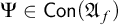 and
$\mathfrak {A}_f/\Psi \in \mathsf {S}(\mathfrak {C}/\theta )$
 . Since
$\mathfrak {D}$
 is assumed to be nontrivial,
$(\bot ^{\mathfrak {C}},\top ^{\mathfrak {C}})\notin \theta $
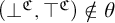 which means that
$(\emptyset ,\omega )\notin \Psi $
 . By Lemma 4.3 we get that
$\Psi $
 is an identity relation, so
$\mathfrak {A}_f\in \mathsf {S}(\mathfrak {D})$
 .
Observation 4.6. The embedding of
$\mathfrak {A}_f$
 into
$\mathfrak {B}$
 from Lemma 4.5 is unique for any
$\mathfrak {B}\in \mathsf {Q}(\mathfrak {A}_f)$
 .
Proof. Let
$e,e'$
 be embeddings of
$\mathfrak {A}_f$
 into
$\mathfrak {B}$
 . Obviously
$e(\emptyset )=\bot ^{\mathfrak {D}}=e'(\emptyset )$
 and
$\mathfrak {A}_f$
 is zero-generated, so
$e(a)=e'(a)$
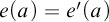 for any
$a\in \mathsf {A}$
 .
Lemma 4.7. Let
$f,g\in \mathtt {Bij}$
 . If
$\mathfrak {A}_f\in \mathsf {S}(\mathfrak {A}_g)$
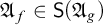 , then
$f=g$
 .
Proof. Assume
$\mathfrak {A}_f\in \mathsf {S}(\mathfrak {A}_g)$
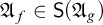 . By Lemma 4.4,
$\mathfrak {A}_f\cong \mathfrak {A}_g$
 . But since every atom is of the form
$\Box ^n\bot $
 , the only isomorphism is given by an identity embedding which immediately gives us
$f=g$
 .
Proposition 4.8. The set
$\{\mathsf {V}(\mathfrak {A}_f): f\in \mathtt {Bij}\}$
 is uncountable and all of its members are minimal.
Proof. Assume that
$\mathsf {V}(\mathfrak {A}_f)=\mathsf {V}(\mathfrak {A}_g)$
 . But this means
$\mathfrak {A}_f\in \mathsf {V}(\mathfrak {A}_g)$
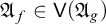 which by Lemma 4.5 means that
$\mathfrak {A}_g\in \mathsf {S}(\mathfrak {A}_f)$
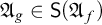 . By Lemma 4.7,
$f=g$
 . The set
$\mathtt {Bij}$
 is uncountable so
$\{\mathsf {V}(\mathfrak {A}_f): f\in \mathtt {Bij}\}$
 is uncountable. Let
$\mathcal {V}\subseteq \mathsf {V}(\mathfrak {A}_f)$
 be a non-trivial variety. Thus, there is a non-trivial algebra
$\mathfrak {B}\in \mathcal {V}$
 . But then by Lemma 4.5
$\mathfrak {A}_f\in \mathsf {S}(\mathfrak {B})$
 which means
$\mathsf {V}(\mathfrak {A}_f)\subseteq \mathcal {V}$
 . Thus
$\mathsf {V}(\mathfrak {A}_f)$
 is minimal for any
$f\in \mathtt {Bij}$
 .
Proposition 4.8 closes the first part of the theorem. Now we will prove the key lemma which will be used in later parts.
Lemma 4.9.
$\mathsf {V}(\mathfrak {A}_f)=\mathsf {Q}(\mathfrak {A}_f)$
 for any
$f\in \mathtt {Bij}$
 .
Proof. First we will show that
$\mathsf {H}\mathsf {S}\mathsf {P}_{\mathsf {U}}(\mathfrak {A}_f)=\mathsf {I}\mathsf {S}\mathsf {P}_{\mathsf {U}}(\mathfrak {A}_f)$
 . We will show that members of
$\mathsf {S}\mathsf {P}_{\mathsf {U}}(\mathfrak {A}_f)$
 are simple. Let
$\mathfrak {B}\in \mathsf {S}\mathsf {P}_{\mathsf {U}}(\mathfrak {A}_f)$
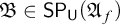 . Consider a first order sentenceFootnote
2
$\varphi :=\forall x(x\not \approx \top \Rightarrow \Box x\wedge \Box \Box x\approx \bot )$
 . It is easy to see that
$\mathfrak {A}_f\vDash \varphi $
 so by Łoś theorem
$\varphi $
 is true in any ultrapower of
$\mathfrak {A}_f$
 . Moreover, it is a general sentence which means that it is preserved by subalgebras. Hence
$\mathfrak {B}\vDash \varphi $
 . Take any non-trivial congruential filter F of
$\mathfrak {B}$
 . So there is
$a\neq \top ^{\mathfrak {B}}$
 such that
$a\in F$
 . But F is open by Lemma 4.2, which means
$\Box a\in F$
 and also
$\Box \Box a\in F$
 . Thus
$\Box a\wedge \Box \Box a\in F$
 . By
$\varphi $
 we get that
$\bot ^{\mathfrak {B}}\in F$
 which proves simplicity of
$\mathfrak {B}$
 . By Jónsson lemma, we have
$\mathsf {V}(\mathfrak {A}_f)=\mathsf {I}\mathsf {S}\mathsf {P}\mathsf {H}\mathsf {S}\mathsf {P}_{\mathsf {U}}(\mathfrak {A}_f)= \mathsf {I}\mathsf {S}\mathsf {P}\mathsf {I}\mathsf {S}\mathsf {P}_{\mathsf {U}}(\mathfrak {A}_f)=\mathsf {Q}(\mathfrak {A}_f)$
 .
Before we move on, let us make some observations about the ultrapowers of
$\mathfrak {A}_f$
 . Let
$f\in \mathtt {Bij}$
 and
$\mathfrak {B}= (\mathfrak {A}_f)^I/_U$
 for some I and an ultrafilter U in
$\mathcal {P}(I)$
 . First of all, notice that due to Observation 4.6, we can identify elements of
$\mathfrak {A}_f$
 with their unique images in
$\mathfrak {B}$
 . Let
$a\in \mathsf {A}$
 . Let
$\overrightarrow {a}\in \Pi _{i\in I}\mathsf {A}$
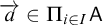 be a diagonal I—tuple consisting only of a, that is, for any
$i\in I$
 we have
$\overrightarrow {a}(i)=a$
 . Thus, the unique embedding is given by
$a\mapsto \mathbf {a}$
 , where
$\mathbf {a}:=\overrightarrow {a}/_U$
 . In particular, given an atom
$\{n\}$
 of
$\mathsf {A}$
 , we will write
$\mathbf {n}$
 instead of
$\mathbf {\{n\}}$
 to indicate its corresponding element.Footnote
3
Further, note that ‘being an atom’ and ‘being a middle element’ as unary predicates are first-order definable within the basic signature of modal algebras. Thus, we have

Obviously, strict ordering
$<$
 and partial ordering
$\leq $
 are definable within the lattice operations. Now let us take a look at the following two first order sentences:


Atm says that
$\Box $
 sends ‘middle’ elements to atoms and Inj expresses injectivity of
$\Box $
 on the set of ‘middle’ elements. It is easy to see that
$\mathfrak {A}_f$
 satisfies both Atm and Inj so by Łoś theorem they are also valid on
$\mathfrak {B}$
 . Furthermore,
$\mathfrak {B}$
 is atomic since the first-order sentence
$\forall x(x\not \approx \bot \Rightarrow \exists y (\mathtt {At}(y)\,\,\&\,\,y\leq x)$
 is true on
$\mathfrak {A}_f$
 and thus on
$\mathfrak {B}$
 . Hence, we can already state that
$\mathfrak {B}$
 cannot be complete as by Atm and Inj the set of
$\mathfrak {B}$
 ’s middle elements are injectively embedded into the set of its atoms.
$\mathfrak {B}$
 is infinite because it contains
$\mathfrak {A}_f$
 as a subalgebra and for any infinite atomic and complete Boolean algebra the cardinality of the set of its middle elements is strictly bigger then the cardinality of its atoms.
Let us introduce some further conventions. Let
$\mathfrak {B}\in \mathsf {I}\mathsf {S}\mathsf {P}\mathsf {P}_{\mathsf {U}}(\mathfrak {A}_f)$
 . Precisely, let
$\mathfrak {B}$
 be embeddable into algebra
$\mathfrak {C}\cong \Pi _{i\in I}\mathfrak {C}_i$
 where each
$\mathfrak {C}_i$
 is an ultrapower of
$\mathfrak {A}_f$
 . Given a subset
$Y\subseteq \mathsf {B}$
 , we call it a zero-meet antichain iff it is an antichain with a property that for any
$a,b\in Y$
 , if
$a\neq b$
 , then
$a\wedge ^{\mathfrak {B}} b=\bot ^{\mathfrak {B}}$
 . Let us note the following simple fact.
Fact 4.10. Let
$\mathfrak {B}$
 be an atomic complete modal algebra. Let
$X\subseteq \mathsf {B}$
 be an meet-zero antichain of cardinality
$\kappa $
 . Then
$\mathfrak {B}$
 has at least
$\kappa $
 —many atoms.
Proof. Let
$X\subseteq \mathsf {B}$
 be as in the assumption of the fact. Since
$\mathfrak {B}$
 is complete, for any
$a\in X$
 we have
$a\wedge \bigvee (X\setminus \{a\})=\bigvee \{a\wedge b: b\in X, \,b\neq a\}=\bot ^{\mathfrak {B}}$
 . Since
$\mathfrak {B}$
 is atomic, for any
$a\in X$
 there is an atom
$a'\leq a$
 such that for any
$b\in X\setminus \{a\}$
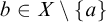 we have
$a'\not \leq b$
 . Therefore there are at least as many atoms in
$\mathfrak {B}$
 , as there are elements in X.
An element
$a\in \mathsf {B}$
 will be called super-atomic iff for any
$i\in I$
 we have
$\mathtt {At}^{\mathfrak {C}_i}(a(i))$
 , that is, a has an atom at each coordinate within the respective ultrapower. We call a set
$X\subseteq \mathsf {B}$
 super-atomic iff all elements of X are super-atomic. It is straightforward to see that any super-atomic set is an antichain. Furthermore, for any super-atomic antichain Y which is meet-zero and any
$a,b\in Y$
 such that
$a\neq b$
 , we have
$a(i)\neq b(i)$
 for all
$i\in I$
 . Obviously, super-atomic elements are not atoms of the product algebra. Atoms of
$\mathfrak {C}$
 are of the form
$\langle \bot ^{\mathfrak {C}_1},\ldots ,x,\ldots ,\bot ^{\mathfrak {C}_n},\ldots \rangle $
 , where
$\mathtt {At}^{\mathfrak {C}_j}(x)$
 . Analogously, we will call and element a of
$\mathsf {B}$
 a super-middle element when it is middle at each coordinate:
$\mathtt {Mid}^{\mathfrak {C}_i}(a(i))$
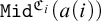 for any i. Similarly, we extend this nomenclature to talk about super-middle sets.
The next theorem will require transfinite induction over cardinals. Recall the Beth function from the class of ordinals into the class of ordinals:
$\beth : ON\longrightarrow ON$
 s.t.


For any
$\alpha \in ON$
 we have
$\aleph _\alpha \leq \beth _\alpha $
 . We choose beths instead of alephs, because the behaviour of
$\beth $
 function naturally resembles the powerset character of complete and atomic Boolean algebras. Just for clarity, let us mention that we do not need to assume anything about CH or GCH in later investigations. The cardinality of a set W will be denoted by
$\overline {\overline {W}}$
 . Thus,
$\overline {\overline {W}}=\kappa $
 means W is of size
$\kappa $
 or has
$\kappa $
 many elements. Whenever we mention the cardinality of a structure (frame/algebra/model), we mean the cardinality of its underlying domain. Now we are ready to state the crucial theorem. Recall from the preliminary section that
$\tau _V(\mathsf {V}(\mathfrak {A}_f))$
 is the logic corresponding to a variety
$\mathsf {V}(\mathfrak {A}_f)$
 .
Theorem 4.11. There is no frame which validates
$\tau _V(\mathsf {V}(\mathfrak {A}_f))$
 .
Proof. Throughout the subsequent parts we assume the contrary: let
$\mathfrak {F}=\langle W, N\rangle $
 be such that
$\mathfrak {F}^+\cong \mathfrak {B}\in \mathsf {V}(\mathfrak {A}_f)$
 . By Lemma 4.9 we have that
$\mathfrak {B}\in \mathsf {I}\mathsf {S}\mathsf {P}\mathsf {P}_{\mathsf {U}}(\mathfrak {A}_f)$
 . Let
$\mathfrak {B}$
 be a subalgebra of
$\mathfrak {C}=\Pi _{i\in I}\mathfrak {C}_i$
 where each
$\mathfrak {C}_i$
 is an ultrapower of
$\mathfrak {A}_f$
 . By our previous observations, elements of
$\mathfrak {C}_i$
 corresponding to atoms of
$\mathfrak {A}_f$
 are of the form
$\mathbf {n}$
 ,
$n\in \omega $
 . Hence atoms of
$\mathfrak {A}_f$
 embed into
$\mathfrak {C}$
 in the following way
$\{n\}\mapsto \overrightarrow {\mathbf {n}}$
 (cf. notation from the observations above). Furthermore, for any
$n\in \omega $
 we have
$\overrightarrow {\mathbf {n}}\in \mathfrak {B}$
 since
$\mathfrak {A}_f\in \mathsf {S}(\mathfrak {B})$
 by Lemma 4.5. We will (ab)use this notation and write
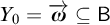
$\overrightarrow {\omega }:=\{\overrightarrow {\mathbf {n}}: n\in \omega \}$
 . Obviously
$\overrightarrow {\omega }\subseteq \mathsf {B}$
 . For an arbitrary infinite subset
$Y\subseteq \mathsf {B}$
 , let

Thus, by
$\Psi _Y$
 we mean the subsets of Y which both themselves, as well as their Y-complements are infinite. Obviously, for any
$Z\subseteq Y$
 ,
$Z\in \Psi _Y$
 iff
$Y\setminus Z\in \Psi _Y$
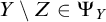 . Furthermore, given an infinite Y, the cardinality of
$\Psi _Y$
 is
$2^\kappa $
 , where
$\overline {\overline {Y}}=\kappa $
 .
Now we define

By assumed completeness of
$\mathfrak {B}$
 , we have
$\Phi _Y\subseteq \mathsf {B}$
 for any infinite
$Y\subseteq \mathsf {B}$
 . Given a subset
$Z\subseteq \mathsf {B}$
 , by
$\Box [Z]$
 we mean
$\{\Box z: z\in Z\}$
 . Define the following ordinal sequence of sets:

The remaining part of the proof will proceed through a series of observations about the above-defined sequence.
Lemma 4.12. If
$\beta \leq \alpha $
 , then
$Y_\beta \subseteq Y_\alpha \subseteq \mathsf {B}$
 . Consequently,
$\Phi _{Y_\beta }\subseteq \Phi _{Y_\alpha }$
 and
$\Box [\Phi _{Y_\beta }]\subseteq \Box [\Phi _{Y_\alpha }]$
 .
Proof. We proceed via transfinite induction on
$\alpha $
 . For the base case, we already observed that
$Y_0 = \overrightarrow {\boldsymbol {\omega }}\subseteq \mathsf {B}$
 because
$\mathfrak {A}_f$
 embeds into
$\mathfrak {B}$
 .
For the successor case, assume the lemma holds for any
$\gamma \leq \alpha $
 . To show the statement for
$\alpha +1$
 , observe that by the inductive hypothesis we get that
$Y_\alpha \subseteq \mathsf {B}$
 . By the assumed completeness of
$\mathfrak {B}$
 we have
$\Phi _{Y_\alpha }\subseteq \mathsf {B}$
 and consequently
$\Box [\Phi _{Y_\alpha }]\subseteq \mathsf {B}$
 . Thus, by definition of
$Y_{\alpha +1}$
 we get that
$Y_{\alpha +1}\subseteq \mathsf {B}$
 . Now let
$\beta \leq \alpha +1$
 . Either
$\beta =\alpha +1$
 or
$\beta \leq \alpha $
 . In the first case we get the result immediately. For the second case, by the definition of
$Y_{\alpha +1}$
 we get
$Y_\alpha \subseteq Y_{\alpha +1}$
 so we use the inductive hypothesis to conclude that
$Y_\beta \subseteq Y_{\alpha +1}$
 .
The limit case follows immediately from the construction and hypothesis.
Lemma 4.13. For any ordinal
$\alpha $
 , if
$a\in Y_\alpha $
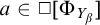
 , then either (i)
$a\in \Box [\Phi _{Y_\beta }]$
 for some
$\beta <\alpha $
 , or (ii)
$a\in \overrightarrow {\omega }$
 .
Proof. If
$\alpha =0$
 , the statement is true by definition.
For successor case: assume that the theorem holds for
$Y_\alpha $
 . By definition,
$Y_{\alpha +1} = Y_\alpha \cup \Box [\Phi _{Y_\alpha }]$
 . If
$a\in Y_\alpha $
 , use inductive hypothesis. If
$a\in \Box [\Phi _{Y_\alpha }]$
 , then we get the result immediately.
Let
$\gamma $
 be a limit ordinal. Let
$a\in \bigcup \{Y_\beta :\beta <\gamma \}$
 . Hence
$a\in Y_\beta $
 for some
$\beta <\gamma $
 . The result follows immediately by the hypothesis.
Lemma 4.14. Let
$Y\subseteq \mathsf {B}$
 be a super-atomic meet-zero antichain of cardinality
$\kappa $
 . Then
$\Box [\Phi _Y]$
 is a super-atomic meet-zero antichain of cardinality
$2^\kappa $
 .
Proof. Let Y be as in the assumption of the lemma. Let
$a\in \Phi _Y$
 . First observe that for any
$i\in I$
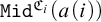
 we have
$\mathtt {Mid}^{\mathfrak {C}_i}(a(i))$
 . Indeed, since
$a=\bigvee ^{\mathfrak {B}} S$
 for some
$S\in \Psi _Y$
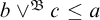
 , a is an infinite join of super-atomic elements, hence there are at least two super-atomic elements
$b,c\in Y$
 such that
$b\lor ^{\mathfrak {B}} c\leq a$
 . Since Y is meet-zero, we get
$b\wedge ^{\mathfrak {B}} c=\bot $
 , and thus given arbitrary
$i\in I$
 , we have
$b(i)\neq c(i)$
 . Hence
$a(i)$
 contains at least two distinct atoms, which means it is strictly above some atom. To show that
$a(i)\neq \top ^{\mathfrak {C}_i}$
 , note that
$\bigvee ^{\mathfrak {B}} (Y\setminus S)\leq - a$
 and
$Y\setminus S\in \Psi _Y$
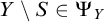 , so
$-^{\mathfrak {B}} a$
 contains infinitely many super-atomic elements, hence
$-^{\mathfrak {C}_i}a(i)\neq \bot ^{\mathfrak {C}_i}$
 which gives us
$a(i)\neq \top ^{\mathfrak {C}_i}$
 . So we have established that
$\Phi _Y$
 is super-middle.
Now, let
$a,b\in \Phi _Y$
 and
$a\neq b$
 . We are going to show that for any
$i\in I$
 , we have
$a(i)\neq b(i)$
 . There are
$S,T\subseteq Y$
 ,
$S\neq T$
 s.t.
$a=\bigvee S$
 and
$b=\bigvee T$
 . Without loss of generality, we can assume
$k\in S\setminus T$
 . But for all
$l\in T$
 , we have
$k\wedge l=\bot $
 . Thus
$k\wedge \bigvee T= \bigvee \{k\wedge l: l \in T\}=\bot $
 . Hence for any
$i\in I$
 , we have
$k(i)\leq a(i)$
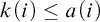 and
$k(i)\not \leq b(i)$
 which shows that indeed
$a(i)\neq b(i)$
 for any
$i\in I$
 . Obviously, the cardinality, of
$\Phi _Y$
 is
$2^\kappa $
 since the cardinality of Y is
$\kappa $
 .
Finally, we are ready to prove the lemma. For any
$a\in \Phi _Y$
 , for any
$i\in I$
 we have
$\mathtt {Mid}^{\mathfrak {C}_i}(a(i))$
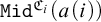 as we already established that
$\Phi _Y$
 is super-middle. Thus, by (Atm), we get that
$\mathtt {At}^{\mathfrak {C}_i}(\Box ^{\mathfrak {C}_i}a(i))$
 for any
$i \in I$
 which means that
$\Box [\Phi _Y]$
 is super-atomic. Now let
$a,b\in \Phi _Y$
 ,
$a\neq b$
 . By previous observation,
$a(i)\neq b(i)$
 for any
$i\in I$
 , so by injectivity of
$\Box ^{\mathfrak {C}_i}$
 on its middle part (see the sentence (Inj)), we have
$\Box a(i)\neq \Box b(i)$
 for any
$i\in I$
 which suffices to show
$\Box ^{\mathfrak {C}_i} a(i)\wedge ^{\mathfrak {C}_i} \Box ^{\mathfrak {C}_i} b(i)=\bot ^{\mathfrak {C}_i}$
 . Thus
$\Box ^{\mathfrak {B}} a\wedge ^{\mathfrak {B}} \Box ^{\mathfrak {B}} b=\bot ^{\mathfrak {B}}$
 so
$\Box [\Phi _Y]$
 is meet-zero. Similarly, by (Inj),
$\Box [\Phi _Y]$
 is of the same cardinality as
$\Phi _Y$
 , that is,
$2^\kappa $
 .
Lemma 4.15. For any ordinal
$\alpha $
 ,
$Y_\alpha $
 is a super-atomic meet-zero antichain of cardinality
$\beth _{\alpha }$
 .
Proof. Base case follows from definition.
Successor case: Let us consider
$\alpha +1$
 . By hypothesis
$Y_\alpha $
 is a super-atomic meet-zero antichain of cardinality
$\beth _\alpha $
 . Furthermore, by Lemma 4.14,
$\Box [\Phi _{Y_\alpha }]$
 is a super-atomic meet-zero antichain of cardinality
$\beth _{\alpha +1}$
 . Thus,
$Y_{\alpha +1} = Y_\alpha \cup \Box [\Phi _{Y_\alpha }]$
 is of cardinality
$\beth _{\alpha +1}$
 . Since both
$Y_\alpha $
 and
$\Box [\Phi _{Y_\alpha }]$
 are super-atomic antichains,
$Y_\alpha \cup \Box [\Phi _{Y_\alpha }]$
 is a super-atomic antichain as well. The only thing left to prove is to show that
$Y_\alpha \cup \Box [\Phi _{Y_\alpha }]$
 is meet-zero. Let
$a,b\in Y_\alpha \cup \Box [\Phi _{Y_\alpha }]$
 be such that
$a\neq b$
 . We need to show that
$a\wedge ^{\mathfrak {B}} b=\bot ^{\mathfrak {B}}$
 . Without loss of generality, we can assume that
$a\in Y_\alpha $
 and
$b\in \Box [\Phi _{Y_\alpha }]$
 . By Lemma 4.13,
$a\in \overrightarrow {\omega }$
 or
$a\in \Box [\Phi _{Y_\beta }]$
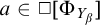 for some
$\beta <\alpha $
 . In the second case, we use Lemma 4.12 and conclude that
$a\in \Box [\Phi _{Y_\alpha }]$
 which gives us the result by Lemma 4.14. Hence, we can assume that
$a\in \overrightarrow {\omega }$
 . Thus
$a=\overrightarrow {\mathbf {c}}$
 for some atom
$c\in \mathsf {A}$
 . At this point it is worth reminding the reader of our notational conventions:
$\overrightarrow {\mathbf {c}}\in \mathfrak {B}$
 , so
$\overrightarrow {\mathbf { c}}\in \Pi _{i\in I}\mathfrak {C}_i=\mathfrak {C}$
 . Furthermore, for any
$i\in I$
 ,
$a(i)=\overrightarrow {\mathbf {c}}(i)=\mathbf {c}\in \mathfrak {C}_i$
 , where
$\mathbf { c}=\overrightarrow {c}/_U$
 and
$c\in \textsf {A}$
 . We also have
$\mathtt {At}^{\mathfrak {A}_f}(c)$
 and
$\mathtt {At}^{\mathfrak {C}_i}(\mathbf {c})$
 .
Therefore, there is
$d\in \mathsf {A}$
 s.t. for any
$i\in I$
 , we have
$\mathbf {c}=\Box ^{\mathfrak {C}_i} \mathbf {d}$
 (i.e.,
$a=\overrightarrow {\mathbf { c}}=\Box ^{\mathfrak {B}}\overrightarrow {\mathbf {d}}=\Box ^{\mathfrak {C}}\overrightarrow {\mathbf {d}}$
 ). Thus also
$\Box ^{\mathfrak {A}_f}d=c$
 and
$\mathtt {Mid}^{\mathfrak {A}_f}(d)$
 due to bijective correspondence of middle elements and atoms via f. But by definition of
$\Box [\Phi _{Y_\alpha }]$
 ,
$b=\Box ^{\mathfrak {B}}\bigvee ^{\mathfrak {B}} S$
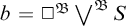 where
$S\subseteq Y_\alpha $
 is an infinite set of super-atomic elements. Let
$e=\bigvee ^{\mathfrak {B}} S\in \Phi _{Y_\alpha }$
 . We already know from the argument in Lemma 4.14, that
$\mathtt {Mid}^{\mathfrak {C}_i}e(i)$
 for any
$i\in I$
 . We will show that for any
$i\in I$
 ,
$e(i)\neq \mathbf {d}$
 .
Assume for reductio that
$e(i) =\mathbf {d}$
 where d is either (1) finite or (2) cofinite subset of
$\omega $
 . As
$\mathfrak {A}_f$
 uniquely embeds into each ultrapower
$\mathfrak {C}_i$
 we can say
$\mathbf {d}$
 is finite, meaning being a join of finite atoms of
$\mathfrak {C}_i$
 or cofinite—being a complement of finite element.
For (1) assume d is finite. But S is an infinite subset of super atomic, meet-zero elements. Hence for any
$x,y\in S$
 s.t.
$x,y\leq e$
 and
$x\neq y$
 , we have also
$x(i)\neq y(i)$
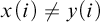 , thus
$e(i)$
 must contain infinitely many atoms of
$\mathfrak {C}_i$
 itself and (1) cannot be the case.
Now assume that
$e(i)=\mathbf {d}$
 is cofinite. But remember that
$\bigvee ^{\mathfrak {B}} (Y_\alpha \setminus S)\in \Phi _{Y_\alpha }$
 is also an infinite join of super-atomic meet-zero elements. Moreover,
$\bigvee ^{\mathfrak {B}} (Y_\alpha \setminus S)\leq -^{\mathfrak {B}}\overrightarrow {\mathbf {d}}$
 which would mean that
$\bigvee (Y_\alpha \setminus S)(i)$
 is finite but this cannot be the case for the reason above. Therefore, we also get contradiction with (2). This way, we established that for any
$i\in I$
 we have
$e(i)\neq \mathbf {d}$
 .
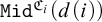
Now we can conclude that
$a(i)\neq b(i)$
 for any
$i\in I$
 because of the following already established facts:
-
• $\mathtt {Mid}^{\mathfrak {C}_i}(d(i))$
and
$\mathtt {Mid}^{\mathfrak {C}_i}(e(i))$
; -
• $a(i)=\Box ^{\mathfrak {C}_i} \mathbf {d}$
and
$b(i)=\Box ^{\mathfrak {C}_i} e(i)$
; -
• $e(i)\neq \mathbf {d}$
; -
• $\Box ^{\mathfrak {C}_i}$
is injective on middle elements by (Inj).

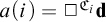



This closes the successor case. We still have the limit case left. Let
$Y_\gamma = \bigcup \{Y_\alpha : \alpha <\gamma \}$
 for limit ordinal
$\gamma $
 . By hypothesis, each
$Y_\alpha $
 is a super-atomic meet-zero antichain of cardinality
$\beth _\alpha $
 . Thus,
$Y_\gamma $
 is a super-atomic set of cardinality
$\beth _\gamma $
 . To show that
$Y_\gamma $
 is meet-zero assume that
$a,b\in Y_\gamma $
 . But this means,
$a\in Y_\alpha $
 ,
$b\in Y_\beta $
 for some
$\alpha ,\beta < \gamma $
 . Without loss of generality we can assume
$\alpha \leq \beta $
 . By Lemma 4.12 we get that
$a,b\in Y_\beta $
 . By hypothesis
$Y_\beta $
 is meet-zero, so
$a\wedge ^{\mathfrak {B}} b=\bot ^{\mathfrak {B}}$
 which proves the lemma for the limit case.
Finally, we are able to prove Theorem 4.11. Remember our initial assumption that
$\mathfrak {F}^+\cong \mathfrak {B}$
 , where
$\mathfrak {F}=\langle W,N\rangle $
 . W is a set so it has cardinality. Let
$\overline {\overline {W}}=\kappa $
 . Thus
$\kappa =\aleph _\alpha $
 for some ordinal
$\alpha $
 . We have
$\aleph _\alpha \leq \beth _\alpha $
 . By Lemma 4.12,
$Y_\alpha \subseteq \mathsf {B}$
 . But by the same lemma
$Y_{\alpha +1}\subseteq \mathsf {B}$
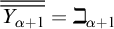
 . By Lemma 4.15 we get that
$\overline {\overline {Y_{\alpha +1}}}=\beth _{\alpha +1}$
 and
$Y_{\alpha +1}$
 is a meet-zero antichain. By Fact 4.10 we get that
$\mathfrak {B}$
 has at least
$\beth _{\alpha +1}$
 many atoms. This means that
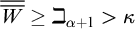
$\overline {\overline {W}}\geq \beth _{\alpha +1}>\kappa $
 which gives us contradiction.
Combining Proposition 4.8 and Theorem 4.11, we conclude that fundamental Theorem 4.1 holds.
5 Final comments
As it has been demonstrated before, for Post complete logics, incompleteness implies unsoundness, see Fact 3.3. Therefore, one could wonder if we could simplify our proof by adopting a different strategy—constraining ourselves to proving incompleteness. Note that in case of Kripke semantics, incompleteness can be shown by proving that there is no Kripke-complete subdirectly irreducible member in a variety. This strategy has been successfully employed in [Reference Blok4] due to the fact that any Kripke frame is a morphic image of a disjoint union of rooted frames (dually—any atomic, complete and completely additive modal algebra is a subdirect product of subdirectly irreducible complete, atomic and completely additive modal algebras). Note that showing that there is no powerset algebra in
$\mathsf {S}\mathsf {P}_{\mathsf {U}}(\mathfrak {A}_f)$
 would be a much easier enterprise than proving Theorem 4.11 (it certainly would not require transfinite induction). It is the case, however, that Blok’s strategy does not apply in case of neighborhood frames—Litak has shown that not every powerset modal algebra is a subdirect product of subdirectly irreducible powerset modal algebras, solving an open question posed in [Reference Dziobiak10].
Secondly, observe that due to Lemma 4.9, each
$\tau _V(\mathsf {V}(\mathfrak {A}_f))$
 , when perceived as a consequence relation, is structurally complete. Furthermore, due to Post completeness of the constructed logics, it immediately follows that they are in fact hereditarily structurally complete, see [Reference Bergman2] for the algebraic counterparts of the notion of structural completeness.
The algebras from our construction refuse to “behave well” in the sense that the logics associated with the varieties lack some standard nice properties of the
$\Box $
 operator, like (anti)monotonicity or any sort of distribution over other connectives. As it has been said in the introduction, unsoundness is a pathological phenomenon, so it seems safe to assume that the algebras witnessing this pathology have to be pathological themselves. The question arises: to what extent pathological? Let us note that a result concerning congruence extension property [Reference Krawczyk21] within varieties of modal algebras was based on even more ad hoc construction. In [Reference Gyenis and Molnár16, Reference Gyenis, Molnár and Öztürk17], the authors managed to extend the result from [Reference Krawczyk21] to more “well-behaved” varieties, among others to monotone, extensive and idempotent. However, in the current case, at least (anti)monotonicity is hopeless. Due to Makinson’s theorem, (anti)monotonic modal logics have exactly three Post complete extensions, all of them based on the two element algebras. For this reason, all (anti)monotonic logics are neighborhood sound with respect to some one-element neighborhood frame. The question whether we can force the varieties to obey some other “nice properties” while still obtaining the same unsoundness result remains open. Another immediate question concerns the first problem from [Reference Fritz13]. Can we extend a partial solution of Fritz to a definite answer: provide an exact number of neighborhood complete and Post complete CMLs.
Finally, recall the notion of the degree of incompleteness introduced by Fine in [Reference Fine11]. The degree of incompleteness of a given logic
$\Lambda $
 is the cardinality of the set
$\{\Lambda ': \Lambda '\text { has exactly the same class of frames}\}$
 . In [Reference Blok4] Blok has spotted an NML which has a degree of incompleteness of continuum. Observe that due to the fact that for each
$\tau _V(\mathsf {V}(\mathfrak {A}_f))$
 , the class of frames in question is just an empty set, the degree of incompleteness of each of our logics is also continuum. In another paper [Reference Blok3], Blok has presented an even stronger result, now known as ‘the dichotomy theorem’, which states that any NML has a degree of Kripke-incompleteness of either
$2^{\aleph _0}$
 or just
$1$
 . Chagrova [Reference Chagrova6] has proven that the dichotomy theorem still holds in
$\mathsf {NExtK}$
 for neighborhood semantics. Furthermore, Litak has proven that the dichotomy theorem remains stable for NMLs even in the presence of more than one modal operators [Reference Litak24]. Even though it has been established that there are
$2^{\aleph _0}$
 Kripke-incomplete intermediate logics [Reference Litak22, Reference Litak25], the question whether the dichotomy theorem holds for the lattice of superintuitionistic logics remains open. Interestingly enough, recently it has been shown [Reference Fornasiere and Moraschini12] that for the implicational fragment of superintitionistic logics, the trichotomy theorem holds: any extension of the implicational fragment of INT has either the degree of incompleteness of
$1$
 ,
$\aleph _0$
 , or
$2^{\aleph _0}$
 . Establishing the degree of incompleteness for arbitrary elements of
$\mathsf {CExtE}$
 is left as an open question for the future research.
Funding
This research has been funded by NCN (Narodowe Centrum Nauki), Grant No. 2023/49/N/HS1/04070. AI has not been used at any stage of this research.






 Open access

