Introduction
The Iberian pig is a rustic breed traditionally free-range reared in the southwest of the Iberian Peninsula since ancient times. These pigs are fed making use of the natural resources, mainly acorns from evergreen oaks (Quercus ilex and Quercus rotundifolia) and pasture (López-Bote, Reference López-Bote1998). For Iberian pigs, the influence of the traditional feeding system on the chemical composition and oxidative stability of their tissues has been profusely studied concluding that the high quality of Iberian pig products can be mainly attributed to this feeding regime (Ventanas et al., Reference Ventanas, Ventanas, Ruiz and Estévez2005). Acorns provide high levels of monounsaturated fatty acids (MUFA) (mainly oleic acid) and γ-tocopherol to Iberian pigs, whereas the grass is a recognised source of ω-3 fatty acids (mainly linolenic acid) and α-tocopherol (Ruiz et al., Reference Ruiz, Cava, Antequera, Martín, Ventanas and López-Bote1998; Cava et al., Reference Cava, Ventanas, Tejeda, Ruiz and Antequera2000; López-Bote and Rey, Reference López-Bote and Rey2001). However, this traditional feeding system is not always feasible, because the availability of the natural resources is limited and largely influenced by environmental factors, which led to the development of alternative feeding systems for Iberian pigs. In fact, 2.6 million Iberian dry-cured hams are produced per year and only half million hams are derived from free-range-reared Iberian pigs. At the beginning, these alternative feeding systems involved using conventional mixed diets in semi-intensive conditions in order to minimise costs (López-Bote, Reference López-Bote1998) and led to products with a considerably higher oxidative instability and lower nutritional and sensory quality (García et al., Reference García, Ventanas, Antequera, Ruiz, Cava and Alvarez1996; Timón et al., Reference Timón, Martín, Petrón, Jurado and García2001). Consequently, great efforts have been made to modify the characteristics of the mixed diets with the purpose of enhancing the oxidative stability of the product, improving its nutritional and technological quality (Ruiz and López-Bote, Reference Ruiz and López-Bote2002). The improvement of the oxidative stability of Iberian meat products through dietary means involves not only the supplementation with substances with proven antioxidant activity but also the modification of the fatty acid composition of the tissues, commonly focussed on reducing polyunsaturated fatty acids (PUFA) percentages (Ruiz and López-Bote, Reference Ruiz and López-Bote2002). In fact, a level of linoleic acid above 10% in back fat from Iberian pigs is considered a serious drawback: the production of high-quality dry-cured hams is unadvised and farmers are paid much less money for their pigs (Ventanas et al., Reference Ventanas, Ventanas, Ruiz and Estévez2005). Nowadays, Iberian pigs reared in confinement are fed with MUFA-enriched diets having α-tocopherol supplementation up to 200 mg/kg in order to imitate the effects of the traditional free-range feeding system (Ruiz and López-Bote, Reference Ruiz and López-Bote2002; Isabel et al., Reference Isabel, López-Bote, de la Hoz, Timón, García and Ruiz2003; Rey et al., Reference Rey, López-Bote, Kerry, Lynch, Buckley and Morrissey2004; Daza et al., Reference Daza, Rey, Ruiz and López-Bote2005). The supplementation with supranutritional levels of α-tocopherol leads to higher levels of such compounds in muscles and other tissues, since the deposition of α-tocopherol in porcine tissues is dependent on the concentration of that compound in the feed (Ruiz and López-Bote, Reference Ruiz and López-Bote2002). Particularly interesting is the fact that α-tocopherol is a lipid-soluble compound that is thought to be accumulated in cellular membranes where the initiation of oxidative processes in muscle foods takes place (Ruiz and López-Bote, Reference Ruiz and López-Bote2002). α-Tocopherol inhibits the free-radical oxidation by reacting with peroxyl radicals to stop the chain propagation and prevent, in addition, from the hydroperoxides decomposition decreasing the generation of aldehydes and other lipid-oxidation products (Frankel, Reference Frankel1996). The protective role of tocopherols against lipid oxidation in dry-cured Iberian ham is manifested by a reduction of the generation of lipid-oxidation products during ripening and improving some particular sensory characteristics such as flavour and odour intensity (Cava et al., Reference Cava, Ruiz, Ventanas and Antequera1999).
According to the recently published Spanish Quality Policy regarding the Iberian dry-cured hams and loins (BOE, 2001), throughout the whole processing chain, the feeding background of the animals and the products must be clearly specified. Final products must be additionally labelled according to the feeding background of the animals and those obtained from free-range-reared Iberian pigs are the highest priced and largely preferred by consumers (García et al., Reference García, Ventanas, Antequera, Ruiz, Cava and Alvarez1996; Timón et al., Reference Timón, Martín, Petrón, Jurado and García2001). Although the beneficial effects of dietary α-tocopherol supplementation on products from Iberian pigs have been clearly described (Cava et al., Reference Cava, Ventanas, Tejeda, Ruiz and Antequera2000; Rey et al., Reference Rey, Kerry, Lynch, López-Bote, Buckley and Morrissey2001; Isabel et al., Reference Isabel, López-Bote, de la Hoz, Timón, García and Ruiz2003), the effect of the traditional extensive feeding and the use of modern oleic acid- and tocopherol-supplemented diets on the chemical composition and oxidative status of tissues from Iberian pigs has not yet been considered for a comparative study.
The aim of the present study was to evaluate the effects of the aforementioned feeding systems on the chemical composition and oxidative stability of the muscle biceps femoris and adipose tissues from Iberian pigs and their implications on technological and nutritional aspects.
Material and methods
Animals and sampling
This study was carried out with 30 Iberian pigs with an initial weight of 80 kg. Pigs were divided into three batches (n = 10) according to the type of feeding during the finish-fattening period (60 days prior to slaughter). MON pigs were free-range reared and exclusively fed on acorns and grass according to the traditional ‘Montanera’ feeding system. HOVE pigs were reared indoors and fed on a mixed diet containing high-oleic sunflower oil (115 g/kgof diet) and supplemented with 250 ppm of vitamin E (α-tocopherol). Finally, CON pigs were reared indoors and fed on a tocopherol non-supplemented control mixed diet.
Animals were slaughtered by electrical stunning and exsanguinated at a local slaughterhouse after the fattening period at a live weight of 165 to 175 kg and approximately 12 months of age. Sampling was carried out within the hour following slaughter. Hams and back fat were removed from the carcasses. The muscle biceps femoris was dissected from the hams, freed from visible fat, vacuum packaged and stored, together with the back fat, at −80°C until the experiments were carried out (less than 2 weeks).
Analytical methods
Chemical analysis of diets
Proximate composition of diets was carried out according to the following Association of Official Analytical Chemists (AOAC) procedures (AOAC, 1990): nitrogen content by the Kjeldahl method (976.05), crude protein (954.01), crude fat (920.39), crude fibre (962.09) and ash (942.05).
Moisture, fat extraction and fatty acid analysis of tissues
Moisture was determined in muscles using Official Methods (AOAC, 1990). Intramuscular total lipids were extracted from the muscles and quantified according to the method described by Bligh and Dyer (Reference Bligh and Dyer1959). For the analysis of the fatty acid composition of the muscles and back fat, fatty acid methyl esters (FAMEs) were prepared by acidic-trans-esterification in the presence of sulphuric acid (5% sulphuric acid in methanol) (Sandler and Karo, Reference Sandler and Karo1992). FAMEs were analysed by gas chromatography using a Hewlett-Packard HP-5890A gas chromatograph (Agilent Technologies Inc., Santa Clara, CA, USA), equipped with a flame ionisation detector (FID). Separation was carried out on a polyethylene glycol-TPA-modified fused silica semicapillary column (30 m long, 0.53 mm id, 1 μm film thickness) maintained at 225°C. Injector and detector temperatures were 230°C. Carrier gas was nitrogen with a flow rate of 1.8 ml/min. Individual FAMEs peaks were identified by comparing their retention times with those of standards (Sigma, St Louis, MO, USA). Results are expressed as percentage of the total fatty acids analysed.
Tocopherol quantification
For the determination of α- and γ-tocopherol, 0.8 g muscle was homogenised in 6 ml 0.054 M dibasic sodium phosphate buffer adjusted to pH 7.0 with HCl. After mixing with absolute ethanol and hexane, and centrifugation (2000 rpm, 5 min at 4°C), the upper layer containing tocopherol was evaporated to dryness and subsequently dissolved in ethanol prior to analysis by reverse-phase HPLC (HP 1050, with a UVD, HPIB 10 detector; Hewlett-Packard, Waldbronn, Germany). Separation was made on a Lichrocart PR 18 endcapped column (250 × 4 mm i.d., 5 μm particle size) (Merck Darmstad, Germany), the mobile phase was methanol : water (97 : 3 v/v) at a flow rate of 2 ml/min, and peaks were registered at 292 nm (Rey et al., Reference Rey, López-Bote, Soares and Isabel1997).
Induced muscle lipid oxidation
The iron-induced lipid oxidation was carried out in muscle homogenates as described by Kornbrust and Mavis (Reference Kornbrust and Mavis1980). To prepare homogenates, 1 g ground muscle was homogenised with 9 ml 0.15 M KCl for 45 s. During homogenisation, tubes were kept in ice to avoid heating. Protein content was measured in 1 ml homogenate following the Lowry procedure (Lowry, Rosenberg, Farr and Randall, 1951). 1 ml of muscle homogenate was incubated at 37°C in 40 mM tris-maleate buffer (pH 7.4) with 1 mM FeSO4 and 2 mM ascorbic acid in a total volume of 10 ml. At fixed intervals (0, 50, 100 and 200 min) aliquots were removed for measurement of thiobarbituric acid-reactive substances (TBARS) by the method of Buege and Aust (Reference Buege and Aust1978). Results were expressed as nM of malondialdehyde (MDA) per mg protein.
Volatile aldehydes analysis
The SPME fibre, coated with a carboxen-poly(dimethylxilosane) (CAR/PDMS) 70 μm, was preconditioned prior to analysis at 220°C for 30 min. The Headspace (HS) sampling was performed as follows: 1 g of adipose tissue was placed in 2.5 ml vials and the SPME fibre was exposed to the HS of the adipose tissue while the sample equilibrated for 30 min immersed in water at 37°C. Analyses were performed on a HP5890GC series II gas chromatograph (Hewlett-Packard, Houston, TX, USA) coupled to a mass-selective detector (Agilent model 5973, Agilent Technologies Inc.). Volatiles were separated using a 5% phenyl–95% dimethyl polysiloxane column (Restek Corporation, Bellefonte, PA, USA) (30 m × 0.25 mm i.d., 1.0 mm film thickness). The carrier gas was Helium at 18.5 psi, resulting in a flow of 1.6 ml/min at 40°C. The SPME fibre was desorbed and maintained in the injection port at 220°C during the whole chromatography run. The injector port was in the splitless mode. The temperature programme was isothermal for 10 min at 40°C and then raised at the rate of 7°C/min to 250°C, and held for 5 min. The GC/MS transfer line temperature was 270°C. The mass spectrometer operated in the electron impact mode with an electron energy of 70 eV, a multiplier voltage of 1650 V and collecting data at a rate of 1 scan/s over a range of m/z 40 to 300. Six saturated aldehydes (pentanal, hexanal, heptanal, octanal, nonanal and decanal) were identified by comparing their linear retention indexes (LRI) with those from standard compounds (Sigma-Aldrich, Steinheim, Germany). Results from the volatiles analysis are provided in area units (AU).
Statistical analysis
The results from the experiments (n = 10 within each batch) were used as variables and analysed using an analysis of variance (ANOVA) (Statistical Packages for the Social Sciences (SPSS), 1997) in order to compare chemical parameters between muscles and adipose tissues from pigs fed different finishing diets. Tukey’s tests were used when ANOVA found significant differences between treatments. Statistical significance was predetermined at 0.05.
Results and discussion
Chemical composition of diets
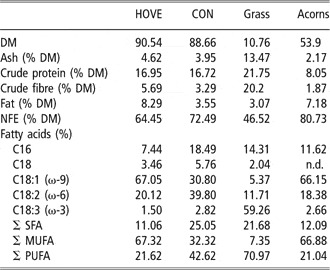
Proximate composition and fatty acid profiles of CON and HOVE mixed diets, grass and acorns are shown in Table 1. Grass contained the highest crude protein (21.75% dry matter (DM)), crude fibre (20.2% DM) and ash (13.47% DM), whereas the acorns showed the highest content of nitrogen-free extractives (NFE) (80.73% DM) and the lowest of protein (8.05% DM). HOVE mixed diet presented higher levels of fat than the control diet (8.29% v. 3.55% DM) but similar to those found in acorns (7.18% DM). These results are in agreement with previously reported data (Ruiz et al., Reference Ruiz, Cava, Antequera, Martín, Ventanas and López-Bote1998; Cava et al., Reference Cava, Ventanas, Tejeda, Ruiz and Antequera2000; Muriel et al., Reference Muriel, Ruiz, Ventanas and Antequera2002).
Proximate composition and fatty acid profile of mixed diets (high oleic acid and tocopherol-enriched mixed diet (HOVE) and control diet (CON)), grass and acorns

DM = dry matter; MUFA = monounsaturated fatty acids; n.d. = not detected; NFE = nitrogen-free extractives; PUFA = polyunsaturated fatty acids; SFA = saturated fatty acids.
HOVE diet containing (mg/kg of diet): barley 48 × 104, wheat 15 × 104, bran 15 × 104, soybean meal 8.5 × 10⁴, beet pulped 5 × 10⁴, sunflower high oleic 5.75 × 10⁴, calcium carbonate 9 × 10³, calcium phosphate 7 × 10³, sodium chloride 4 × 10³, corrector 5 × 10³ and mix vitamin E 250 ppm.
Control diet containing (mg/kg of diet): barley 15 × 104, wheat 50 × 104, corn 20 × 104, soybean meal 1.1 × 10⁴, lard 1.2 × 10⁴, calcium carbonate 8 × 10³, calcium phosphate 1.1 × 10⁴, sodium chloride 4 × 10³ and corrector 5 × 10³.
The proportion of total saturated fatty acids (SFA) MUFA and PUFA in feeds revealed significant differences amongst acorns, grass and mixed diets (Table 1). Grass had a relatively high proportion of PUFA (70.97%), particularly of ω-3 fatty acids, while CON diet had higher levels of SFA and PUFA (25.05% v. 11.06% and 42.62% v. 21.62%, respectively) and lower level of MUFA (and 32.32% v. 67.32%) compared to HOVE mixed diet. As intended, HOVE mixed diet and acorns presented similar fatty acid profile, showing the highest content of MUFA and a relative low content of PUFA, according to previous published works (Muriel et al., Reference Muriel, Ruiz, Ventanas and Antequera2002).
Chemical composition of the muscle biceps femoris
The chemical composition of the muscle biceps femoris from pigs fed different finishing diets is shown in Table 2. Moisture and intramuscular fat (IMF) contents ranged from 68.3 to 71.1 g/100 g muscle and from 3.1 to 5.4 g/100 g muscle, respectively. Although these IMF values are lower than those previously reported by Andrés et al. (Reference Andrés, Cava, Mayoral, Tejeda, Morcuende and Ruiz2001) and Tejeda et al. (Reference Tejeda, Gandemer, Antequera, Viau and García2002), they are in good agreement with those reported by Carrapiso and García (Reference Carrapiso and García2005) in the muscle biceps femoris from Iberian pigs. The feeding background significantly affected the proximate composition of the muscles since those from MON pigs contained less moisture than muscles from CON pigs, whereas those from HOVE pigs showed intermediate values. The IMF content followed an opposite behaviour and muscles from MON pigs contained significantly higher amounts of IMF than those fed with mixed diets (CON and HOVE pigs). These results are in agreement with those previously reported by Cava (1999), Andrés et al. (Reference Andrés, Cava, Mayoral, Tejeda, Morcuende and Ruiz2001) and Tejeda et al. (Reference Tejeda, Gandemer, Antequera, Viau and García2002), who reported significantly higher IMF contents in the muscle biceps femoris from free-range-reared Iberian pigs fed on acorns and grass than in those from intensively reared Iberian pigs fed on mixed diets. The high levels of IMF in muscles and meat products from Iberian pigs have been profusely documented and generally attributed to the breed-dependent ability to synthesise and accumulate large amount of lipids in tissues (Ventanas et al., Reference Ventanas, Ventanas, Ruiz and Estévez2005), and, according to results obtained in the present study, the IMF content in muscles is also affected by the finishing diets given to Iberian pigs. The intake of acorns during the finishing phase of fattening would explain the higher levels of IMF in free-range-reared Iberian pigs. Acorns provide a high calorific value due to their high fat and carbohydrates content, whereas they had relatively low protein contents (Ruiz et al., Reference Ruiz, Cava, Antequera, Martín, Ventanas and López-Bote1998). According to Goerl et al. (Reference Goerl, Eilert, Mandigo, Chen and Miller1995), a low ratio of protein/calorific value in diets leads to high fat deposition in porcine tissues. Accordingly, D’Souza et al. (Reference D’Souza, Pethick, Dunshea, Pluske and Mullan2003) found that reducing the ratio of protein/dietary energy in finishing pigs was a successful strategy to increase the IMF levels in porcine muscles. The IMF level influences essential-quality traits in Iberian dry-cured ham and largely determines consumer’s acceptability (Ruiz et al., Reference Ruiz, García, Muriel, Andrés and Ventanas2002). IMF has a clear effect on eating quality of meat, because it improves juiciness and tenderness sensation (Lawrie, Reference Lawrie1998). The contribution of IMF to juiciness is particularly relevant in dry-cured ham because of the strong dehydration of the product during the ripening process (Gandemer, Reference Gandemer2002; Ventanas et al., Reference Ventanas, Ventanas, Ruiz and Estévez2005). Therefore, the significantly higher amounts of IMF in the muscle biceps femoris of hams from MON pigs compared to those from crossbred pigs could affect the acceptability of the final product.
Moisture, fat and tocopherol contents (mean ± standard deviation) in m. biceps femoris from Iberian pigs fed different finishing diets

IMF = intramuscular fat.
MON: samples from pigs fed outdoors on ‘Montanera’ system.
HOVE: samples from pigs fed on the high oleic acid and tocopherol-enriched mixed diet.
CON: Samples from pigs fed on the control diet.
a,b,cMean values with different superscript differ significantly.
Tocopherol content in the muscle biceps femoris
As expected, the feeding background affected the levels of α- and γ-tocopherol in porcine muscles (Table 2). Muscles from MON and HOVE pigs contained significantly higher α-tocopherol levels than those from CON pigs. The α-tocopherol contents in porcine tissues reflect the tocopherol concentration of the diets (Daza et al., Reference Daza, Rey, Ruiz and López-Bote2005), and therefore, the high levels of α-tocopherol in the grass and acorns with which Iberian pigs were fed explain the high levels of such substances in their tissues. The influence of the intake of natural resources on the tocopherol levels in porcine tissues from free-range-reared pigs has been previously described (Rey et al., Reference Rey, Isabel, Cava and López-Bote1998; Cava et al., Reference Cava, Ventanas, Tejeda, Ruiz and Antequera2000; Nilzén et al., Reference Nilzén, Babol, Dutta, Lundeheim, Enfält and Lundström2001), which is consistent with the present results. On the other hand, the dietary supplementation with α-tocopherol was a successful strategy to increase α-tocopherol levels in porcine tissues. According to Cava et al. (Reference Cava, Ventanas, Tejeda, Ruiz and Antequera2000) and Daza et al. (Reference Daza, Rey, Ruiz and López-Bote2005), muscles from Iberian pigs fed with diets supplemented with α-tocopherol up to 200 mg/kg contained similar α-tocopherol levels as those from pigs fed on natural resources (grass and acorns). In the present study, HOVE pigs were supplemented with higher levels of α-tocopherol (250 mg/kg), which would explain the fact that muscles from HOVE pigs contained significantly higher amounts of α-tocopherol than muscles from MON pigs. Ventanas et al. (Reference Ventanas, Estévez, Tejeda and Ruiz2006) found similar results working on the muscle longissimus dorsi from Iberian pigs supplemented with 250 mg/kg α-tocopherol and free-range-reared pigs fed on natural resources. In addition, it is reasonable to consider that the incorporation of α-tocopherol to porcine tissues through the intake of natural resources is more variable than the effect of the dietary supplementation with α-tocopherol, because the availability and compositions of the pasture and acorns are greatly variable and depends on environmental factors (López-Bote, Reference López-Bote1998; Cantos et al., Reference Cantos, Espín, López-Bote, de la Hoz, Ordóñez and Tomás-Barberán2003).
Muscles from MON pigs had significantly higher levels of γ-tocopherol than muscles from CON and HOVE pigs (Table 2). Acorns have been highlighted as important sources of γ-tocopherol for extensively reared pigs, and the presence of such tocopherol isomer in pig muscles is almost restricted in tissues from pigs fed with that fruit (Rey et al., Reference Rey, Isabel, Cava and López-Bote1998; Daza et al., Reference Daza, Rey, Ruiz and López-Bote2005), which is in agreement with the results obtained in the present work.
Tocopherols are the most important natural antioxidants in meat and meat products and their protective activity against oxidation has been largely described in meat and several meat products (López-Bote and Rey, Reference López-Bote and Rey2001; Nilzén et al., Reference Nilzén, Babol, Dutta, Lundeheim, Enfält and Lundström2001). Tocopherols have been described as successful inhibitors of lipid-oxidative reactions during ripening of Iberian dry-cured ham improving some particular sensory characteristics such as flavour and odour intensity (Cava et al., Reference Cava, Ruiz, Ventanas and Antequera1999). Recently, Estévez et al. (Reference Estévez, Morcuende and Cava2006) isolated phenolic compounds from tissues from free-range-reared Iberian pigs, which could have been accumulated as a result of the intake of natural resources. In fact, a large variety of polyphenols have been described as components of the acorns with which Iberian pigs are fed (Cantos et al., Reference Cantos, Espín, López-Bote, de la Hoz, Ordóñez and Tomás-Barberán2003). There is no evidence, however, that these substances actually contribute to enhance the oxidative stability of porcine tissues.
Fatty acid composition of adipose tissues
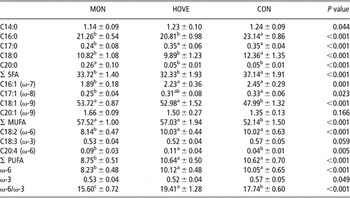
Significant differences were found between the fatty acid profiles of the adipose tissues from pigs fed different finishing diets (Table 3). Adipose tissues from CON pigs had significantly higher percentages of palmitic fatty acid (C16:0), stearic fatty acid (C18:0) and total SFA than those from MON and HOVE pigs. Compared to adipose tissues from CON pigs, those from MON and HOVE pigs showed significantly higher proportions of oleic acid (C18:1) and total MUFA. Adipose tissues from CON and HOVE pigs contained significantly higher percentages of linoleic fatty acid (C18:2) and total PUFA than those from MON pigs. In addition, adipose tissues from MON pigs contained significantly smaller amounts of ω-6 fatty acids and lower ω-6/ ω-3 values, mainly derived from their smaller percentages of linoleic (ω-6) fatty acid.
Fatty acid profile (mean ± standard deviation) of adipose tissue from Iberian pigs fed different finishing dietsFootnote †

SFA = saturated fatty acids; MUFA = monounsaturated fatty acids; PUFA = polyunsaturated fatty acids.
MON: samples from pigs fed outdoors on ‘Montanera’ system.
HOVE: samples from pigs fed on the high oleic acid and tocopherol-enriched mixed diet.
CON: samples from pigs fed on the control diet.
† Results are expressed as means in per cent.
a,b,c Mean values with different superscript differ significantly.
The influence of the feeding background on the fatty acid composition of porcine tissues was expected since it is principally affected by the fatty acid composition of the fat from the feeds given to the animals (Miller et al., Reference Miller, Shackelford, Hayden and Reagan1990; Enser et al., Reference Enser, Richardson, Wood, Gill and Sheard2000). Consistently, adipose tissues from MON pigs reflected the high levels of oleic acid from the acorns with which MON pigs were fed. Ruiz et al. (Reference Ruiz, Cava, Antequera, Martín, Ventanas and López-Bote1998), Timón et al. (Reference Timón, Martín, Petrón, Jurado and García2001) and Carrapiso et al. (Reference Carrapiso, Bonilla and García2003) reported similar results studying the fatty acid profiles of adipose tissues from free-range-reared Iberian pigs. High levels of oleic acid in back fat and subcutaneous fat from Iberian hams are related to a low consistency and an ‘oily’ appearance in Iberian hams, which is highly appreciated by consumers (Ruiz et al., Reference Ruiz, García, Muriel, Andrés and Ventanas2002). In addition, the pleasant flavour associated to Iberian products with high levels of oleic acid and MUFA is probably explained by the presence in these products of high levels of oleic-acid-derived volatiles (Martín et al., Reference Martín, Timón, Petrón, Ventanas and Antequera2000; Estévez et al., Reference Estévez, Ventanas, Ramírez and Cava2004). According to our findings, using mixed diets enriched with high levels of oleic acid was a successful strategy to increase the proportion of such fatty acids in adipose tissues from Iberian pigs, with those levels being similar to the levels of oleic acid in adipose tissues from pigs fed on acorns. Muriel et al. (Reference Muriel, Ruiz, Ventanas and Antequera2002), Isabel et al. (Reference Isabel, López-Bote, de la Hoz, Timón, García and Ruiz2003) and Ventanas et al. Reference Ventanas, Ventanas, Tovar, García and Estévez(2007) found similar results working on tissues from Iberian pigs fed elevated levels of MUFA. However, this strategy failed to imitate the fatty acid composition of tissues from free-range-reared Iberian pigs, since HOVE pigs had significantly higher levels of linoleic and PUFA than those from MON pigs. The presence of high levels of linoleic acid in the lard from Iberian pigs is considered a serious drawback because of its unpleasant effects on particular quality traits such as the texture, the appearance and the oxidative stability of Iberian dry-cured products (Ventanas et al., Reference Ventanas, Ventanas, Ruiz and Estévez2005). Based on the recommendations of processing industries and the Protected Designation of Origin policies, levels of linoleic acid around 10% in adipose tissues from Iberian pigs are considered the acceptable limit for the production of dry-cured Iberian hams. According to this indication, tissues from MON pigs are more suitable for the manufacture of high-quality dry-cured hams than those from CON and HOVE pigs.
Fatty acid composition of the muscle biceps femoris
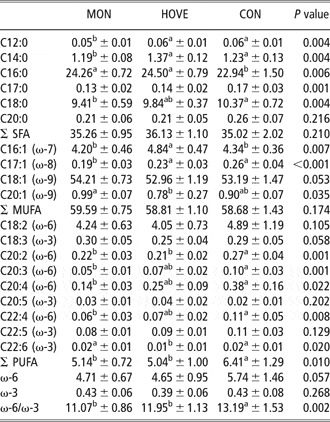
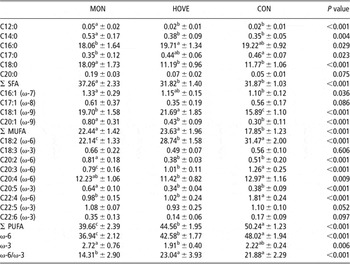
The fatty acid profiles of the neutral (NL) and polar lipids (PL) of the porcine muscle biceps femoris are shown in Tables 4 and 5, respectively.
Fatty acid profile (mean ± standard deviation) of the neutral lipids of m. biceps femoris from Iberian pigs fed different finishing dietsFootnote †

SFA = saturated fatty acids; MUFA = monounsaturated fatty acids; PUFA = polyunsaturated fatty acids.
MON: samples from pigs fed outdoors on ‘Montanera’ system.
HOVE: samples from pigs fed on the high oleic acid and tocopherol-enriched mixed diet.
CON: samples from pigs fed on the control diet.
† Results are expressed as means in per cent.
a,b,c Mean values with different superscript differ significantly.
Fatty acid profile (mean ± standard deviation) of polar lipids of m. biceps femoris from Iberian pigs fed different finishing dietsFootnote †

SFA = saturated fatty acids; MUFA = monounsaturated fatty acids; PUFA = polyunsaturated fatty acids.
MON: samples from pigs fed outdoors on ‘Montanera’ system.
HOVE: samples from pigs fed on the high oleic acid and tocopherol-enriched mixed diet.
CON: samples from pigs fed on the control diet.
† Results are expressed as means in per cent.
a,b,c Mean values with different superscript differ significantly.
The fatty acid profiles of NL from porcine muscles did not reflect the fatty acid composition of the finishing diets of Iberian pigs to the extent the adipose tissues did. NL in muscles from HOVE and CON pigs contained significantly higher percentages of lauric and myristic fatty acids than NL in muscles from MON pigs. NL in muscles from MON and HOVE pigs contained significantly higher percentages of palmitic acid than NL from CON pigs. Significant differences were also detected amongst groups for other minor fatty acids such as palmitoleic acid and certain long-chain PUFA. NL in muscles from CON pigs contained a significantly higher proportion of total PUFA than ML in muscles from MON and HOVE pigs. In addition, NL in muscles from MON and HOVE pigs contained significantly lower ω-6/ω-3 values than NL in muscles from CON pigs.
In contrast to these results, the analysis of the fatty acid profiles of PL in the muscle biceps femoris revealed significant differences amongst groups for the most abundant fatty acids (Table 5). These results are in overall agreement with those described by Ventanas et al. Reference Ventanas, Ventanas, Tovar, García and Estévez(2007), who reported larger differences between the muscle longissimus dorsi from Iberian pigs fed differently when the fatty acid profiles of PL were analysed. Since PL show a higher turnover rate than NL (Leray et al., Reference Leray, Andriamampandry, Gutbier, Raclot and Groscolas1995), it is plausible to consider that PL are more intensely affected by the feeding composition of the period prior to slaughter. PL in muscles from MON pigs contained significantly higher percentages of stearic and total SFA than PL in muscles from CON and HOVE pigs. In agreement with the results from the adipose tissues, PL in muscles from MON and HOVE pigs contained significantly higher proportions of oleic acid and total MUFA than PL in muscles from CON pigs. PL in muscles from MON pigs showed the smallest percentages of linoleic acid and PUFA, whereas PL in muscles from HOVE and CON pigs contained significantly higher percentages of such fatty acids. Compared to NL, PL are highly susceptible to undergo oxidative reactions in muscle foods and are considered the primary target of reactive oxygen substances (ROS) while NL play a secondary role (Asghar et al., Reference Asghar, Gray, Booren, Gomaa, Abouzied, Miller and Buckley1991; Gandemer, Reference Gandemer2002). This is explained by the high proportion of long-chain PUFA in PL, which are very susceptible to be oxidised, and by the close relationship between PL in cell membranes and oxidation promoters in the aqueous phase of the muscle cell (Asghar et al., Reference Asghar, Gray, Booren, Gomaa, Abouzied, Miller and Buckley1991). Therefore, the fatty acid composition of PL in muscles largely determines the susceptibility of muscle foods to suffer oxidative reactions during processing or storage. Lipid-oxidative reactions take place during ripening of dry-cured hams (Cava et al., Reference Cava, Ruiz, Ventanas and Antequera1999), and the fatty acid composition of the fresh muscles and particularly of the PL are considered to influence the intensity of the reactions and the adverse effects on flavour and other quality traits (Cava et al., Reference Cava, Ventanas, Tejeda, Ruiz and Antequera2000). In that sense and according to the fatty acid composition of the PL, muscles from MON pigs are more suitable for the production of dry-cured meats than those from pigs fed on mixed diets.
According to the results from the analysis of the adipose tissues and the NL, PL in muscles from MON pigs showed the lowest ω-6/ω-3 values than PL in muscles from CON and HOVE pigs. Currently, nutritionists have focussed on the ω-6/ω-3 ratio because of its role in biological processes. Long-chain ω-3 fatty acids derived from linolenic acid have been found to improve the status of the cardiovascular system and regulate the immune response control, whereas long-chain ω-6 fatty acids derived from linoleic acid are implicated in pro-inflammatory processes (Wood and Enser, Reference Wood and Enser1997). Diets with inappropriate ω-6/ω-3 ratios have been highlighted as risk factors in cancers and coronary heart diseases (Enser, Reference Enser2001), and therefore, it is recommended to keep this ratio below 4 (Wood and Enser, Reference Wood and Enser1997). In that sense, products manufactured with tissues from MON pigs would provide appreciably lower ω-6/ω-3 ratios than products from CON and HOVE pigs. According to Muriel et al. (Reference Muriel, Ruiz, Ventanas and Antequera2002), free-range rearing and feeding pigs on pasture increase the levels of long-chain ω-3 fatty acids in porcine muscles, which is in agreement with the present results.
Oxidative stability of the muscle biceps femoris and adipose tissues
Results obtained from the induced lipid oxidation in the muscle biceps femoris at different times of incubation (0, 50, 100, 200 and 300 min) are presented in Table 6. No statistical differences were found between groups at any time of incubation for MDA content until minute 300 of incubation. At this incubation time, muscle homogenates from HOVE pigs contained significantly smaller MDA levels than those from CON and MON pigs. The susceptibility of muscle to lipid oxidation depends upon the balance between antioxidant and pro-oxidant factors (Frankel, Reference Frankel1984; Gandemer, Reference Gandemer2002). In this sense, the presence of high levels of α-tocopherol in muscles from HOVE pigs likely contributed to the lower amount of MDA in muscle homogenates. The protective effect of α-tocopherol supplementation against iron-induced lipid peroxidation have been previously described in Iberian pigs (Cava et al., Reference Cava, Ventanas, Tejeda, Ruiz and Antequera2000; Daza et al., Reference Daza, Rey, Ruiz and López-Bote2005). In a previous study, Ventanas et al. Reference Ventanas, Ventanas, Tovar, García and Estévez(2007) reported a negative significant correlation between MDA content in muscle homogenate after 200 min of incubation and muscle α-tocopherol content supporting the influence of α-tocopherol on the susceptibility of muscle to oxidative reactions. The lack of significant differences between muscle homogenates from MON and CON pigs were unexpected since the former contained significantly higher levels of tocopherols and significantly lower proportion of PUFA in both NL and PL than the latter. The significantly higher amount of IMF in muscles from MON pigs could have influenced the oxidative stability of the muscles as a pro-oxidant factor. MDA is generated as a result of the oxidative degradation of lipids; therefore, the higher total lipid content is the larger substrate that undergoes oxidative reaction and generates MDA. Jo et al. (Reference Jo, Lee and Ahn1999) and Estévez et al. (Reference Estévez, Morcuende and Cava2003) found significant correlation between IMF level in muscles and MDA content.
Malondialdehyde (MDA) content during iron induced lipid oxidation (mean ± standard deviation) in muscle biceps femoris from Iberian pigs fed different finishing dietsFootnote †

MON: samples from pigs fed outdoors on ‘Montanera’system.
HOVE: samples from pigs fed on the high oleic acid and tocopherol-enriched mixed diet.
CON: samples from pigs fed on the control diet.
† Sampling times at min 0, 50, 100, 200 and 300. Results expressed as nM MDA/mg protein.
a,b Mean values with different superscript differ significantly.
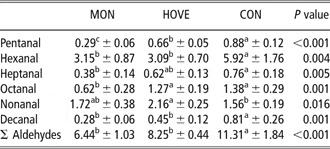
The chromatographic areas of the lipid-derived volatiles isolated from the HS of the adipose tissues are shown in Table 7. The feeding background affected the generation of each of the six saturated aldehydes. Adipose tissues from HOVE pigs had significantly smaller amounts of pentanal, hexanal, octanal and decanal than those from CON pigs. The dietary supplementation with α-tocopherol enhanced the oxidative stability of the adipose tissues, significantly inhibiting the generation of lipid-derived volatiles. Except for nonanal, adipose tissues from MON pigs contained significantly smaller amounts of all saturated aldehydes than those from CON pigs. Compared to adipose tissues from HOVE pigs, those from MON pigs contained significantly smaller amounts of pentanal and octanal. Free-range-rearing and feeding Iberian pigs on natural resources led to adipose tissues with the highest oxidative stability. The chromatographic areas of nonanal did not follow the general trend of the other lipid-derived volatiles, since no differences were detected between adipose tissues from CON and MON pigs and significantly higher levels of nonanal were found in adipose tissues from HOVE pigs than in those from CON pigs. Nonanal is mainly derived from the oxidative decomposition of oleic acid (Shahidi, Reference Shahidi1994), and, therefore the large proportion of this fatty acid in adipose tissues from HOVE and MON pigs would explain the high levels of nonanal in their HS. High levels of oleic acid-derived volatiles such as nonanal have been isolated from the HS of high-quality Iberian products (Martín et al., Reference Martín, Timón, Petrón, Ventanas and Antequera2000; Estévez et al., Reference Estévez, Ventanas, Ramírez and Cava2004 and Reference Estévez, Ventanas, Ramírez and Cava2005), which is considered an appreciated quality indicator, because nonanal is considered to contribute pleasant aromatic notes (Specht and Baltes, Reference Specht and Baltes1994).
Saturated aldehydes (means ± standard deviation) isolated from the headspace of adipose tissues from Iberian pigs fed different finishing dietsFootnote †

MON: samples from pigs fed outdoors on ‘Montanera’ system.
HOVE: samples from pigs fed on the high oleic acid and tocopherol-enriched mixed diet.
CON: samples from pigs fed on the control diet.
† Results expressed as area units (AU × 106).
a,b,c Mean values with different superscript differ significantly.
The effect of the feeding background on the chemical composition and oxidative stability of porcine tissues could have a reflection on particular sensory traits and influence consumer’s acceptability of the final product. In fact, the sensory evaluation of the Iberian dry-cured hams produced with the raw material analysed in the present study revealed significant differences between hams from pigs with different feeding backgrounds (Ventanas, personal communication). Hams from MON pigs obtained higher scores of desirable flavour, intensity and persistence of aroma than those from pigs fed on mixed diets (Ventanas et al., Reference Ventanas, Ventanas, Tovar, García and Estévez2007). Hams from HOVE pigs do not reach the sensory quality of MON pigs, which are in agreement with results from the present study and could be related to IMF levels. Results obtained in the present study regarding the chemical composition and oxidative stability of the raw tissues would explain the different sensory qualities assessed in different types of dry-cured ham.
Conclusions
The feeding background influences the oxidative status of the porcine tissues through the modification of their fatty acid composition and the incorporation of substances with antioxidant activity. According to the results obtained in the present study, the tissues from free-range-reared Iberian pigs fed on natural resources are more suitable than those obtained from pigs fed on mixed diets for the production of high-quality dry-cured hams. The dietary supplementation with tocopherol in oleic acid-enriched diets is a successful approach to increase the levels of α-tocopherol and oleic acid in tissues from Iberian pigs, although the relatively high proportion of PUFA and the low IMF level could be considered serious drawbacks of this strategy.
Acknowledgements
Sonia Ventanas thanks the ‘Ministerio de Educación’ for the ‘FPU’ grant and support. This study was supported by the ‘Ministerio de Ciencia y Tecnología’ project entitled ‘Hacia el establecimiento de predictores de calidad en la materia prima y en productos del cerdo ibérico mediante parámetros fisico-químicos (ULTRAFAT)’ (Project AGL 2001-6932-01). The authors thank Ana Galaz for laboratory support. We are grateful to Prof. Jesús Ventanas for his supervision and helpful comments on the manuscript.