Human systems of socioeconomic stratification are recognized to have been diverse in time and space even for societies of relatively comparable hierarchical complexity (Bögenhold 2001; Spilerman 2000). Although archaeologists have for decades generally agreed on some of the key correlates of higher status and/or rank (e.g., Marcus and Flannery 1996:93–110; Peebles and Kus 1977; Wason 1994), the nature of the patterning between these correlates, and how descriptively valid they tend to be, has not proved to be uniform in all global cases. For example, in the Classic period (ca. a.d. 200–800) of pre-Hispanic Mesoamerica, the nature of rulership and political organization varied considerably in different parts of that macroregion (Blanton, Feinman, Kowalewski, and Peregrine 1996; Blanton, Kowalewski, Feinman, and Finsten 1993; Chase and Chase 1992; Feinman 2001; Lohse and Valdez 2004).
Contemporary studies in Mesoamerica traditionally have endeavored to compare a range of archaeological indices to assess synchronic and diachronic variation in wealth (Smith 1987) and socioeconomic status (Hirth 1992, 1993; Kowalewski et al. 1992). The increasing attention paid to household archaeology in Mesoamerica (Ashmore and Wilk 1988; Blanton 1994; González Licón 2003; Manzanilla 1986; Santley and Hirth 1993) has advanced this research focus. In examining socioeconomic stratification, archaeologists generally employ a suite of attributes and indicators that includes measures of differential access to raw materials and finished goods (usually non-local in origin), as well as variation in residential architecture (e.g., Abrams 1994; Flannery 1998).
Yet the measurement of social differentiation is more than a facile quantification of these distributional patterns (Bögenhold 2001; Spilerman 2000) or indices in the archaeological record (Kowalewski et al. 1992; Smith 1987). In Mesoamerica, evaluating differential access to highly crafted or exotic goods is more complex than a simple issue of presence or absence, as rare and socially valued materials vary considerably in contexts and quantities, and different material classes have diverse distributions. Nevertheless, the overall nature of this distributional variation across houses, sites, and regions is one key for understanding how social differentiation is manifested and interpreted for the distant past.
Our focus is on the nature of differential access, socioeconomic inequality, and the manifestations of status during the Classic period (a.d. 200–800) in the Valley of Oaxaca, a core region of pre-Hispanic Mesoamerica (Palerm and Wolf 1957) where the hilltop urban center of Monte Albán dominated for more than a millennium (ca. 500 b.c.–a.d. 800; Figure 1). Social stratification during the Classic period (as well as earlier; see Blanton et al. 1999) is manifested archaeologically through variation in the nature of domestic architecture (e.g., Flannery 1983) and in mortuary contexts (most notably in increased formality of tomb constructions). Access to rare, highly crafted, and socially valuable goods, however, was less markedly restricted or limited to one subset of the population (e.g., Feinman et al. 2006).

State of Oaxaca, showing the location of the Valley of Oaxaca and the places mentioned in the text.
Based on the concentration of monumental public architecture and elaborate residences at the apex of Monte Albán, there is no doubt that Classic-period Zapotec civilization was a stratified society that included people of different socioeconomic means. Pre-Hispanic Mesoamerican societies in general are considered to have been divided into separate social strata, loosely defined as elite and nonelite, that were externally stratified (Blanton et al. 1993:204; Flannery 1983; Marcus 1992, 2004; Spores 1983; cf. Chase and Chase 1992). This simple dichotomy, however, rarely maps on to empirical findings in regard to past behaviors in any simple manner, as there are more complex gradations in actual power and “wealth” (Cowgill 1992). In addition, the customs and practices of economic access, wealth distribution, and, hence, stratification in pre-Hispanic Mesoamerican societies were clearly different (e.g., Blanton et al. 1996; Feinman 2001).
Fostered to a degree by the kinds of data that are available and those that are lacking, researchers have advanced a number of different perspectives concerning the nature of Classic-period social stratification in the Valley of Oaxaca. The most detailed records, in terms of evidence for stratification, come from excavated residences and tombs at Monte Albán (Caso et al. 1967; González Licón 2003; Kuttruff and Autry 1978; Winter 1974, 1995; Winter and Payne 1976). Kent Flannery (1983), for example, has noted marked differences in the sizes and plans of domestic complexes, as well as the elaboration of the burial contexts and tomb architecture, that are associated with different domestic settings. On one hand, Marcus Winter (1974) has interpreted architectural data at Monte Albán as indicative of a three-class system, whereas Richard Blanton (1978:96–98), drawing on a larger sample of surface and subsurface domestic plans at the site, found a less clearly demarcated distribution of total room areas and domestic patio sizes. Winter's three-class interpretation also is at odds with the model of two social divisions advanced by Joyce Marcus (1992, 2004), which was derived to a considerable degree by analogy with documentary accounts of the sixteenth-century Zapotec.
These varying interpretations of social divisions for Classic-period Oaxaca are based on a relatively small sample of excavated domestic households from Monte Albán (Caso et al. 1967; González Licón 2003; Kuttruff and Autry 1978; Winter 1974; Winter and Payne 1976), which for the most part have not included artifactual distributions. Although no clear distinctions in burial assemblages were drawn in an earlier simple bimodal contrast of tomb and non-tomb burials from Monte Albán (Wilkinson and Norelli 1981), the energy and planning invested in tomb architecture does vary markedly in general correspondence with the elaboration and size of the residential unit in which the specific tomb is situated (Flannery 1983; Winter 1995). Although associated grave goods and offerings are variable at Monte Albán (e.g., Caso 1932, 1938; Winter 1995), no distinct classes or modes have been statistically defined. There are no Classic-period burials at Monte Albán or other contemporaneous sites in the valley at which large quantities of highly elaborate goods have been uncovered. Even the most ornate Classic-period tombs at Monte Albán, such as Tomb 104, with its painted frescos (Caso 1938; Miller 1995), do not contain the quantity and quality of goods that have been found in certain burials of the Classic-period Maya Lowlands (e.g., Ruz Lhuiller 1973; Welsh 1988). Only with the later, Postclassic (a.d. 800–1500) reuse of Classic-period Tomb 7 at Monte Albán (Caso 1933, 1982; see also Gallegos 1978; Middleton et al. 1998) were such large quantities of highly crafted and exotic grave goods found in the Valley of Oaxaca.
In this paper, we examine socioeconomic inequality at another Oaxacan hilltop settlement, El Palmillo, a smaller, secondary center in the eastern arm of the valley that had significantly less monumental architecture than Monte Albán (Figure 1). Although the findings from El Palmillo cannot be explicitly compared or facilely extrapolated to Monte Albán (or entirely reconcile the diverse perspectives outlined earlier), they yield potentially insightful parallels that provide new vantages on extant debates. Through six seasons of excavation in domestic contexts at El Palmillo, we have gained valuable information on production, access, and consumption for a series of Classic-period households. As at Monte Albán, the most clear-cut and marked differences are in the arrangement and formality of domestic structures and burial features, as well as in specific bodily modifications (i.e., head molding and dental inlays; Feinman et al. 2003). Distributional variation in portable objects (ceramics, greenstone, obsidian, and local chipped stone) is present from one residence to another, but the patterning is subtle and more complex (Feinman and Nicholas 2004b; Feinman et al. 2002, 2006; Haines et al. 2004).
By focusing on the site's faunal assemblage, we expand the set of indices by which social differentiation at El Palmillo—and, by implication, elsewhere in the Valley of Oaxaca—may be examined and compared. Access to and consumption of differential foodstuffs is one traditional indicator of status (Appadurai 1981, 1986; Berry 1994; Bourdieu 1990, 1994; de Garine 1976; Diamond 1997; Dietler 1996; Dietler and Hayden 2001; Goody 1982; Hayden 2001, 2003, van der Veen 2003). For Classic-period Oaxaca, however, the faunal record is not well documented, and assessments of differential access to faunal resources, in terms of socioeconomic status, primarily rely on ethnohistoric analogy (Marcus 1992; cf. Middleton et al. 2002). Yet based on analyses of zooarchaeological materials from Formative-period sites in the Valley of Oaxaca (e.g., Marcus and Flannery 1996:103), it seems likely that differential access to meat and socially valuable animal species in Classic-period Oaxaca also would provide a further perspective on socioeconomic inequality. Later, after presenting background information on El Palmillo and zoological indicators of socioeconomic status, we identify consumption patterns in terms of meat quantity and quality for a range of domestic settings at El Palmillo to see how variation in access to faunal resources corresponds with other patterns of socioeconomic differentiation that have been observed at El Palmillo.
PRIOR INVESTIGATIONS AT EL PALMILLO
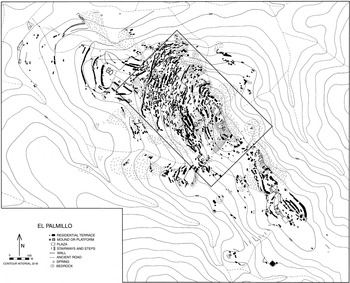
Situated near the modern community of Santiago Matatlán, El Palmillo is the largest Classic-period hilltop terrace site in the Tlacolula, or eastern, arm of the Valley of Oaxaca (Figure 1). The site, which was first visited and mapped during the 1980 regional survey of the Valley of Oaxaca (Kowalewski et al. 1989) and was later intensively surveyed and mapped (Feinman and Nicholas 2004a), consists of more than 1,400 residential terraces positioned on the top and slopes of a steep rock cliff at the eastern edge of the valley (Figure 2). Arranged in concentric rings that often shared long retaining walls, the majority of terraces were densely packed on the hill's western face. A series of public buildings, including a three-mound group with an enclosed plaza, was constructed on the ridge top.

Map of El Palmillo. The area inside the box is enlarged in Figure 3.
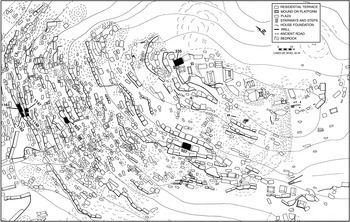
In 1999 we started excavating a series of residential terraces to provide information on households and the domestic economy at El Palmillo. To assess variation in residential and funerary architecture, economic activities, and access to goods, we selected a sample of terraces spanning the western face of the site. The first investigated terraces (1147/1148, 1162, and 1163) are located close to the base of the hill (Figure 3). The residential complexes on those terraces contain several rooms arranged around three sides of a small patio (Feinman et al. 2002:Figure 5); the complexes were rebuilt several times, with the residential occupations spanning several centuries. The nature of the fill indicates that there was little or no gap in occupation between construction episodes. The rooms were built with foundation walls of cut and shaped stone, and they had floors of lime plaster, underneath which human remains were interred. Economic activities centered on the production of a variety of stone tools from local chert, which were used in processing a range of xerophytic plants for food and fiber.

Plan of El Palmillo showing the location of the excavated terraces.
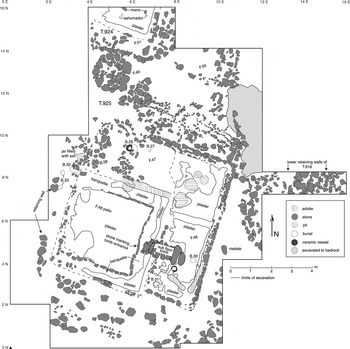
The overall layout of residential space on Terrace 925 and Terrace 507, both located farther up the slope but still below the site's civic-ceremonial core, was basically similar to that of the lower terraces. Yet architecturally, these residential complexes were a bit more elaborate, with small patios that had floors and narrow banquettes made of lime plaster (Figure 4; Feinman and Nicholas 2004b; Feinman et al. 2002). During the final occupational level on both of these terraces, a small domestic subfloor tomb was constructed, each of which had been reopened several times and possibly reused for generations (e.g., Lind and Urcid 1983; Middleton et al. 1998). Although evidence of economic activities on these terraces was similar to that recovered on the lower ones, the nature of artifact assemblages points to slightly different emphases in craft activities, with more stone reduction on the lower terraces and, possibly, lapidary crafts on Terrace 507 (Haines et al. 2004).

Plan of the final residential complex on Terrace 925.
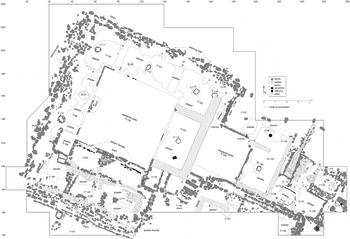
The final excavated terrace (335) is situated adjacent to the site's civic-ceremonial precinct at the top of the hill (Feinman and Nicholas 2004c; Feinman et al. 2003). The residential architecture on Terrace 335 was much more elaborate and of greater size than the residential complexes on any of the lower terraces (Figure 5). It also appears to have been rebuilt more frequently. While the earlier occupational surfaces on the terrace consisted of a single large patio surrounded by a series of rooms, the later residential complexes consisted of two patios surrounded by up to 11 rooms. Two of the rooms were L-shaped corner rooms that were formally similar to those found in palaces at Monte Albán (Caso 1938; Flannery 1983; Marcus and Flannery 1996:208–212) and Lambityeco (Lind 2001; Lind and Urcid 1983; Paddock et al. 1968). On Terrace 335, the southern set of rooms was raised on a platform reached by a cut-stone staircase, a feature not encountered on the lower terraces. Many of the rooms on Terrace 335 were fabricated of thick adobe walls lined with plaster; room and patio floors often were covered in thick layers of plaster, some of which were painted with red pigment.

Plan of the final residential complex on Terrace 335.
A masonry subfloor tomb excavated on Terrace 335 is by far the richest and most elaborate of any mortuary context so far uncovered at El Palmillo (Feinman and Nicholas 2003; Feinman et al. 2003). Built on the west side of the complex during the first building episode, this tomb was constructed of five courses of faced stone blocks, with lime plaster covering the mortared joints. The tomb was entered through a series of cut-stone steps leading down from the patio. Yet in spite of the architectural contrasts between the Terrace 335 tomb and those on Terraces 925 and 507, the differences in the burial objects associated with these contexts were less marked. The tomb on Terrace 335 did contain more ceramic objects (25 ceramic vessels) than any other interment at the site, but these vessels were neither painted nor carved. Some of the vessels were more finely made than burial objects on the other terraces, and the Terrace 335 tomb assemblage included more vases and spouted vessels. In addition to the elaborate tomb, body markings set some of the residents of Terrace 335 apart; the only teeth with dental inlay (e.g., Romero 1970, 1986) recovered at the site were found isolated and disarticulated in fill in front of the tomb.
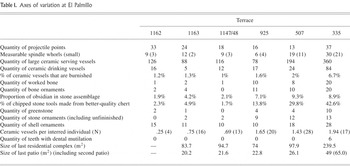
The nature and kinds of other status-related objects varied between terraces, although the differences were more subtle (Table 1). Obsidian, greenstone, and other non-local objects were found with slightly greater frequency on the upper three terraces. Local (non-obsidian) chipped stone follows a similar pattern: upper terraces have greater proportions of tools made from higher-quality raw materials, and lower terraces have more tools made from lower-quality materials (Feinman et al. 2006). In addition, although spindle whorls were recovered on all terraces, smaller finer whorls that are thought to have been used in spinning fine maguey fiber or cotton (Parsons and Parsons 1990; Parsons 1972) were more abundant (but certainly not exclusively recovered) on the upper terraces (Feinman and Nicholas 2004c:Figure 9). In contrast to cloth made of coarse maguey fibers, these finer materials are generally associated with higher-status individuals in pre-Hispanic Mesoamerica (Berdan 1987:244–245). Based on these findings, patterns of access at the site were more continuous and subtle than marked or categorical.
Axes of variation at El Palmillo

In sum, the clearest evidence for social differentiation at El Palmillo derives from architectural variation (size of compound, number of rooms, size of patio, and the elaboration of domestic tombs) and bodily mutilation (Table 1). In these regards, the residential complex on Terrace 335 stands out from any excavated below, and at least some of the residents of this complex marked their bodies to be physically distinct from their neighbors who lived down-slope. The architectural differences among all the other terraces are much less marked, although the degree of elaboration varies consistently from higher to lower residences. The distribution of portable wealth such as exotic shell and obsidian follows the same basic pattern, with greater quantities on Terrace 335, close to the site's apex, and lower quantities on terraces near the base of the hill. Based on our findings to date, the patterns of consumption on Terrace 335 vary more in degree than kind with residents of the lower terraces. The subtle yet consistent nature of the differential distribution of portable goods across the site sets the stage for us to examine other dimensions—the faunal assemblage—by which we might assess variation in socioeconomic distinction between these six Classic-period households at El Palmillo.
The remainder of this paper focuses on the faunal assemblage at El Palmillo and, more broadly, the Valley of Oaxaca. In making comparisons among the excavated terraces, we assume that the domestic and craft-related debris found in association with structures and other contexts on each terrace primarily reflects activities carried out on or very near that terrace. The trash is most likely to have originated with the inhabitants of that residential complex or households in the immediate vicinity (e.g., Bayman 1996; Beck 2003; Beck and Hill 2004; Blinman 1989). Given the limited size of the terraces and their hill-slope location, some refuse undoubtedly has been lost through erosion down-slope. Such processes would have affected all the terraces, and considerable quantities of debris remained on each terrace and in association with all the residential complexes.
ZOOARCHAEOLOGICAL INDICATORS OF SOCIOECONOMIC STATUS
A traditional and broadly recognized indicator of status is differential access to and consumption of foodstuffs (Appadurai 1981, 1986; Berry 1994; Bourdieu 1990, 1994; de Garine 1976; Diamond 1997; Dietler 1996; Goody 1982; Hayden 2001, 2003; van der Veen 2003). The specific ways in which access to different dietary elements (in terms of quality and quantity) is or was manifested behaviorally has been associated with differences in social complexity (de Garine 1976; Diamond 1997; Goody 1982; Kirch and O'Day 2003; van der Veen 2003). In less hierarchically organized societies, with more minor distinctions in social status, special foods are used only on rare occasions (i.e., feasts). In contrast, basic foods are consumed with regularity by most members of the group. Alternatively, in hierarchically complex societies, dietary distinctions are more prevalent; with rare or highly desired foods usually in part or entirely restricted to elites, who may consume them with some frequency (de Garine 1976; Goody 1982; van der Veen 2003).
Zooarchaeologists, in particular, have demonstrated a similar connection between socioeconomic status and diet that partly supports this basic pattern. For example, elites at Moundville and other southeastern chiefly centers enjoyed differential access to many foods, including rare and exotic species and the best anatomical parts of wild game (e.g., deer haunches; Jackson and Scott 1995, 2003; Kelly 2001). Commoners may have provided better cuts of meat to elites as a form of gift or tribute; these cuts were then used as part of the high-status diet or redistributed through feasting (Jackson and Scott 1995; Knight 2001). Likewise, Patrick Kirch and Sharyn Jones O'Day (2003) demonstrated that Hawaiian nobles had restricted access to higher quality meat (dog, chicken, and shark), whereas rat, an inferior meat source, was found in greater proportions in commoner middens. Overall, high-status Hawaiians had a comparatively specialized diet that emphasized fatty and greasy luxury foods; commoners had a more generalized and opportunistic diet (Kirch and O'Day 2003:495).
Similar dietary distinctions may have been present in Mesoamerica during the Classic period. Zooarchaeologists working in the Maya Lowlands argue that Classic-period elites in general had greater access to meat and restricted access to rare or luxury species (Emery 2003; Pohl 1985, 1990, 1994)—a pattern also postulated for the Preclassic and Postclassic periods (Emery 1999; Hamblin 1984; Masson 1999; Pohl 1994; Shaw 1999; Sorayya Carr 1985:129; Wing 1978). Mary Pohl (1985, 1990) argues that elites at Classic-period Seibal ate more and better-quality meat than commoners, who subsisted more on locally obtained species (e.g., turtle). In addition, the remains of felids (e.g., jaguar) have been found only in elite contexts (Pohl 1985:142). In a study of animal resources at Preclassic to Postclassic sites in the Petexbatun area of Guatemala, Kitty Emery (2003:502) found that elites consumed quantities of deer and dog, but the lack of adequate comparative samples from commoner middens limits any conclusive finding regarding the overall association between status and diet. Despite claims drawn from zooarchaeological studies that elites had greater access to meat and that access to socially valuable species (i.e., felids) was restricted, the most convincing empirical evidence that differential access to faunal resources correlates with socioeconomic status in the Maya Lowlands comes from ethnohistoric and ethnographic documentation (e.g., Tozzer 1941:57) rather than archaeological contexts.
In the consideration of socioeconomic inequality in the Valley of Oaxaca, the subsistence base has not received as much attention for the Classic period largely due to the dearth of domestic contexts. Faunal analyses have focused primarily on assemblages at earlier Archaic-period (8000–2000 b.c.) and Formative-period (2000 b.c.–a.d. 200) sites (Drennan 1976; Flannery 1986; Flannery and Wheeler 1986; Marcus and Flannery 1996), and basic subsistence strategies rather than differential access have been emphasized. Nevertheless, drawing from sixteenth-century accounts that discuss dietary restrictions, scholars have suggested that status-related dietary distinctions, as described earlier, were present in the Valley of Oaxaca. For the end of the Early Formative period (San Jose phase; 1100–900 b.c.), Joyce Marcus and Kent Flannery (1996:103) suggest that, even though social strata did not yet exist, a gradient in social prestige from low to high had developed, manifested by differential household access to goods and resources, including venison. By the end of the Formative period (100 b.c.–a.d. 200), after the emergence of the Zapotec state, venison is postulated to have been restricted to elites (Marcus and Flannery 1996:172). At the time of Spanish contact, it is reported that the amount of venison received by a household was determined by its social status (Spores 1965:969). Rabbits were another animal resource with restricted access. As depicted in several late pre-Hispanic sources (Anawalt 1993; Horcasitas and George 1955), they were a high-status food associated with the consumption of the native alcohol pulque. The Aztecs named pulque after the octli gods, collectively known as centzontotochchin, or “400 rabbits” (Quiñones Keber 1989:73; Sahagún 1950–1982:IV:16–17). Likewise, at the time of Spanish contact, elites in the Valley of Oaxaca distinguished themselves from commoners by their consumption of pulque (Marcus 1992:223).
In a prior investigation of faunal remains from Classic-period household contexts in the Valley of Oaxaca, William Middleton and colleagues (2002) found that dog, deer, and lagomorphs (cottontail and jackrabbit) were consumed in association with a residence at the Classic-period Ejutla site, in the southern arm of the valley, and on the lower terraces (1147/1148, 1162, 1163) at El Palmillo. We now have zooarchaeological data from three additional terraces at El Palmillo that provide an opportunity to assess the role that differential access to faunal resources played in expressing socioeconomic inequality at this hilltop site. Using both quantity and quality of meat as potential indicators of socioeconomic status, we examine the distribution of faunal resources on the excavated terraces at El Palmillo. Is there variation in meat consumption among households that matches the patterns we have noted for other portable artifacts? If frequencies of faunal resources do vary from one terrace to another, are the differences subtle, or are there marked or categorical distinctions in access or consumption between residents of different domestic units? What can these findings tell us about different procurement strategies and activities at the site?
Specifically, we examine the faunal assemblage in light of three different patterns of consumption: (1) If access to and consumption of faunal resources parallels the general pattern found for portable artifacts (for example, obsidian and chipped stone) at El Palmillo, then we should expect to find consistent but minor or subtle differences between the terraces, with greater quantities consumed closer to the site's apex. (2) If access to faunal resources was much more restricted, mapping onto status distinctions associated with architectural variation and body markings (dental mutilation), then we should expect to find that the inhabitants of the uppermost household (on Terrace 335) acquired much greater quantities of (and better-quality) animal foods, while inhabitants of the other, lower terraces practiced more generalized, or opportunistic, procurement strategies, resulting in the absence of the most desirable species. (3) If access to faunal remains did not correlate in a positive manner with socioeconomic status, then we would expect to find basic comparability or homogeneity in faunal access among households at the site (or a distributional pattern that did not correlate with the elevation gradient of the terraces at the site). To date, each previous indicator of status examined at El Palmillo (Feinman and Nicholas 2004c; Feinman et al. 2006) has varied in a manner reflecting that higher-status residents lived closer to the top of the site, although the specific nature of that patterning is not consistent from one measured attribute to another.
To assess differential access to and consumption of faunal resources among residential units at El Palmillo, we examine the overall quantity (number of identified specimens [NISP] and the minimum number of individuals [MNI]) and quality of meat (better cuts [minimum number of elements, or MNE] and rare species). With the inclusion of faunal resources, we endeavor to expand and refine our perspective on the nature of socioeconomic variation between different householders at El Palmillo and, by implication, to help build the empirical record necessary to investigate such relations across the Classic-period Valley of Oaxaca.
THE FAUNAL ASSEMBLAGE AT EL PALMILLO
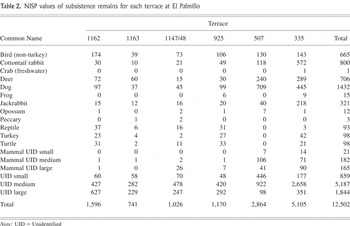
Excavations undertaken at El Palmillo (each year beginning in 1999) have recovered a large faunal assemblage from six residential complexes. All intact archaeological deposits on the terraces were screened using a one-quarter-inch or one-eighth-inch mesh, depending on context and the nature of the excavated materials, to recover as much fauna and other materials as possible. Flotation samples were taken from all non-plastered floors and surfaces, as well as from other selected contexts, including the contents of ceramic vessels and trash-filled deposits. In the analyses discussed here, we include only those faunal remains that can be attributed to food waste. Most of these remains are from trash and fill contexts; very few animal bones were found directly on house floors, which were kept very clean by the site's ancient inhabitants. Human bone, animal offerings, and bone tools and ornaments are excluded from this discussion. In total, the subsistence faunal assemblage considered here consists of 12,502 specimens (Table 2), approximately 80% of all animal remains recovered on-site. Although much of the bone is too small to be identified to a specific species, 3,373 specimens could be identified to the level of taxon. The most common animals identified in the El Palmillo faunal assemblage include cottontail rabbit (Sylvilagus spp.), jackrabbit (Lepus spp.), white-tailed deer (Odocoileus virginianus), dog (Canis familiaris), and turkey (Meleagris gallopavo; see also Middleton et al. 2002). Opossum (Didelphis marsupialis), peccary (Dicotyles tajacu), and freshwater crab were recovered in very small numbers. Larger groupings of fauna (birds [non-turkey], frog, reptile, turtle, and mammal) incorporate remains that could not be placed into more specific categories. Unidentified Mammalia specimens often could be divided into three categories: small (possibly cottontail or jackrabbit); medium (possibly dog or jackrabbit); and large (most likely deer or human). All other unidentified remains are categorized by size only. Except for several shark's teeth and small gastropod shells used for ornamental purposes, we did not recover any other marine resources in the flotation samples (light or heavy fractions), screens, or excavation contexts.
NISP values of subsistence remains for each terrace at El Palmillo

The residential complex (or household) is the basic analytical unit used for this study. The uppermost level of every complex was exposed largely in its entirety through broad horizontal excavations. Outside work areas adjacent to the residential complexes also were excavated. As we proceeded to earlier layers on each terrace, the size of the area excavated varied depending on the nature of the architecture that was preserved and other findings. Generally, lower surfaces on all terraces were less exposed, resulting in small sample sizes for all recovered materials. Carbon-14 dates and associated ceramics indicate that each terrace was occupied for several hundred years. Yet on all terraces there was considerable continuity in architectural plan and overall layout from one surface to the next. Between occupations, we found intentionally deposited and generally clean construction fill, as opposed to eroded fill that might have collected accretionally following abandonment. Such findings would seem to indicate marked continuity in the specific residential groups that inhabited each terrace. For the analyses that follow, we group faunal remains by terrace to compare differences between long-standing domestic groupings across space (using reasonably comparable samples and contexts).
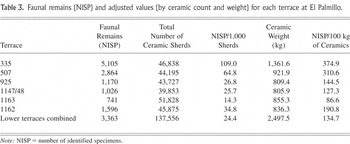
To be confident that the observed patterns are not simply the result of sampling error or other non-behavioral factors, we calculated adjusted figures for animal remains per 1,000 ceramic sherds (e.g., Bayman 1996:408) and per 100 kg of total ceramic weight on each terrace (Table 3). Ceramics are by far the most common artifact in most excavation contexts at El Palmillo. In the absence of large-scale production contexts, ceramics can provide a reasonable measure of relative intrasite occupation and population levels. Ceramics are durable and subject to broadly similar patterns of refuse dispersal, as are bone and other domestic artifacts. The relative frequencies of animal remains per 1,000 sherds or per 100 kg of ceramics on each terrace provide consistent and similar results, which are in line with the patterns that we observed for unadjusted bone distributions.
Faunal remains (NISP) and adjusted values (by ceramic count and weight) for each terrace at El Palmillo.

Quantity of Meat and Animal Species
Comparison of the adjusted densities of total faunal remains on each terrace reveals a fairly consistent pattern of increasing faunal density as one moves up the hill (Table 3). In addition, the uppermost terraces (335 and 507) stand apart from the others. If we combine the lower group of contiguous terraces (1147/1148, 1162, and 1163)—“Lower Terraces”—then there is a perfect rank-order correlation, with high significance, between terrace elevation and density of faunal remains (rs = 1.000; p = .05). Since terrace elevation reflects positioning on the hill, the residents of higher terraces had greater access to meat, generally in line with other indicators of increased consumption of exotic and non-local portable goods.
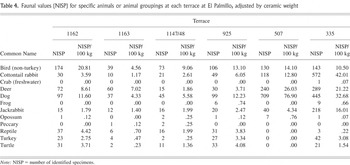
Breaking down the faunal remains by individual taxa, orders, or other groupings yields similar results (Table 4). Again combining the lowest contiguous terraces (1147/1148, 1162, 1163), we find three broad patterns. First, there is a perfect rank-order correlation, with high significance, between terrace elevation and density of cottontail rabbit and jackrabbit (rs = 1.000; p = .05); a strong correlation, but low significance, between terrace elevation and density of dog (rs = .800; .10 < p < .20); and a moderately strong correlation, with low significance, for white-tailed deer (rs = .600; p > .20). Second, there is a moderately strong negative correlation, with low significance, between increasing terrace elevation and increasing density of reptile and turtle remains (rs = −.600; p > .20). That is, reptile and turtle remains pattern in an inverse manner to the larger mammals. Third, some animal varieties do not consistently pattern in regard to the elevation gradient. Only low strength and very low significance exist for the negative correlation between increasing terrace elevation and increasing density of bird (rs = −.200; p = .80); no correlation exists for turkey remains (rs = .000; p = 1.0). That is, avian remains pattern differently in relation to the two prior faunal groups.
Faunal values (NISP) for specific animals or animal groupings at each terrace at El Palmillo, adjusted by ceramic weight

Although not all the rank correlations between increasing (or decreasing) abundance of certain animal groups and increasing terrace elevation are statistically significant, there are strong numerical trends in the distribution of deer, dog, and lagomorphs (cottontail and jackrabbit), based on adjusted NISP, across terraces. Cottontails and jackrabbits are without question most abundant on Terrace 335—roughly four and twenty times more abundant than on Terraces 507 and 1163, respectively. Domesticated dog, by contrast, is more than twice as common on Terrace 507 as on Terrace 335, and densities on both terraces are still considerably higher than on the lower terraces. White-tailed deer remains are more or less equally abundant on both of the uppermost terraces and well above adjusted values for the terraces below. If the divisions of the class Mammalia (small, medium, large) represent specific sets of species, as suggested earlier, then their distribution (Table 2) in general supports the conclusions based on more specific biological identifications that certain animal species were preferentially obtained by individuals residing on the uppermost terraces.
The Distribution of Faunal Elements
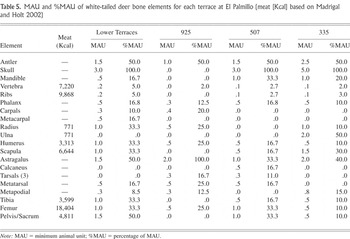
The residents of higher terraces had access to greater quantities of meat, but what about patterns of consumption in terms of meat quality? In other words, did the inhabitants of the upper terraces also obtain better cuts of meat? For these analyses, we determined the minimum number of elements (MNE) for each terrace (we considered each occupational layer on each terrace as a separate context). MNE values were then converted into the minimum animal unit (MAU) and percentage of MAU (%MAU). The MAU is a standardized measure of the minimum number of animal units in an assemblage that takes into account how many of these elements naturally occur in one individual (Binford 1978; Lyman 1994:104–105). For example, although there might be twice as many tibia as cranial elements, both of these elements would be considered equally represented because each animal has two tibia and one cranium. The percent of MAU (%MAU) is a manner of normalizing the MAU, where the most abundant MAU receives a %MAU of 100 (Binford 1978). In addition, differential preservation of bone can bias the recovery of certain elements in a faunal assemblage (Lyman 1984, 1994). The concern is that elements with higher bone-structural density will be more frequently recovered. Therefore, the values of bone-structural density (Lyman 1984, 1994) were correlated with the abundance of individual elements (%MAU).
The ultimate goal of this methodological exercise was to determine whether bone elements with more available meat are differentially distributed among the terraces. We used figures by T. Cregg Madrigal and Julie Holt (2002) for white-tailed deer to provide a relative scale for examining the distribution of meat, in terms of quality, at El Palmillo. Caloric indices for other animals are not available. Nevertheless, we comment on other species (e.g., dog, cottontail, and jackrabbit) when possible.
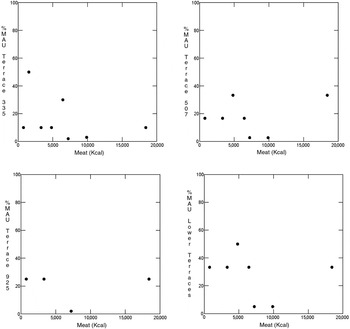
Because deer assemblages were small on the lower terraces (1147/1148, 1162, 1163), with few identifiable individual elements, we combined them into one grouping for comparison (Table 5). Overall, for white-tailed deer there do not appear to be any meaningful differences among the faunal assemblages from each terrace or terrace grouping in terms of the inter-assemblage variability in quality of meat (Table 5; Figure 6). Although the lower terrace group does have higher percentages of what would be considered high-utility elements (e.g., femur), the correlation between increasing abundance of elements (%MAU) and increasing available meat (Kcal; Madrigal and Holt 2002) for each terrace is negative, and overall the correlations are weak, with little significance (T.335 [rs = −.43; p = .356], T.507 [rs = −.1; p = .94]. T.925 [rs = −.26; p = .672], and lower terraces [rs = −.43; p = .26]). In other words, white-tailed deer elements that would provide the highest relative proportion of meat are not abundant in the faunal assemblage from any terrace. Given the low frequency of cut or gnaw marks on animal bones at El Palmillo, selective attrition by dogs does not appear to be a factor in these patterns.
MAU and %MAU of white-tailed deer bone elements for each terrace at El Palmillo (meat [Kcal] based on Madrigal and Holt 2002)


Scatter plots of white-tailed deer elements (%MAU) versus meat (Kcal) for each terrace at El Palmillo.
This distribution of deer elements at El Palmillo does not conform to the proposed utility curves for consumption sites (Binford 1978; Metcalfe and Jones 1988; Reitz and Wing 1999:236). Instead, they are similar to the bulk strategy for kill/butchery sites (Figure 6). One possible factor contributing to the lack of higher meat-utility bones (e.g., femur, humerus, and tibia) is that they would have provided the best sources of raw material for making bone tools (e.g., Dean 2005), the processing of which sometimes reduces our ability to identify them. The weak negative correlation, with very low significance (rs = −.141; p = .49), also does not support the conclusion that differential survivorship (based on bone-structural density) of deer bone can explain the observed patterns. Although we see a quantitative increase in the abundance of white-tailed deer bones as one moves up the hill to the highest terraces, there is no corresponding increase in quality of meat. Thus, it appears that both butchering and consumption occurred on all terraces.
Estimates of Meat Consumption
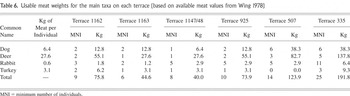
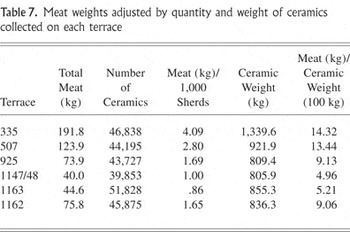
As discussed earlier, animals with more available meat (i.e., cottontail, deer, dog, and jackrabbit) are more abundant on the two upper terraces. Adjusted faunal densities generally increase as one moves up the hill at El Palmillo (Table 3), indicating that the inhabitants of the upper terraces had greater access to faunal resources (i.e., meat). To more fully evaluate this observation, we followed methods described by Theodore White (1953) to derive available meat estimates from MNI. In contrast to the results reported by Middleton and colleagues (2002), where MNI calculations were based on more narrowly defined contexts, the MNI figures employed here rely on more conservative assumptions (Table 6). We grouped all faunal remains from each occupational level of a terrace to calculate the MNI values employed in this analysis. This methodological change does not affect the relative relationships between terraces. To determine meat estimates from the MNI counts on terraces at El Palmillo, we then used Elizabeth Wing's (1978) biomass and usable meat estimates from faunal assemblages at Late Formative and Early Classic-period sites in Veracruz. Based on these estimates, the total amount of available meat increases consistently as one moves from the lowest to the highest terraces as the site (Table 7).
Usable meat weights for the main taxa on each terrace (based on available meat values from Wing 1978)

Meat weights adjusted by quantity and weight of ceramics collected on each terrace

IMPLICATIONS
Differential access to faunal resources clearly existed at El Palmillo. The total quantity of faunal remains (adjusted NISP; Tables 3–4) and available meat (Tables 6–7) consistently increase from the bottom of the hill to the top, broadly in line with other indicators of increasing status at the site (Table 1). Yet quantitative and qualitative (species) differences in access to faunal resources are more marked than for other portable artifacts (e.g., obsidian, shell ornaments, greenstone, high-quality chipped stone). At the same time, differences in the faunal assemblages are not as marked as the dichotomy in architectural elaboration and body mutilation between Terrace 335 and all the other excavated terraces. Instead, the two highest terraces (335 and 507) followed similar patterns of access to faunal resources that distinguished them from the lower terraces. Thus, the differential distribution of meat does not correspond precisely to the distinctions noted for portable goods, such as stone and shell, or for residential architecture. More to the point, while the consumption of desirable meats is elevated on the top two terraces at El Palmillo, only the uppermost of those terraces is distinct when it comes to residential architecture and the biological markers of status.
Status-Related Variation
The Spanish noted in the sixteenth century that only Zapotec nobles were permitted to consume deer, rabbit, and turkey (Marcus 1992:226; Zárate 1905 [1581]:200) and that the amount of venison received by elites was determined by social status (Marcus and Flannery 1996:172; Spores 1965:969). Commoners ate more general diets that included lizards, snakes, and other small game (Marcus 1992:226; Marcus and Flannery 1996:14). Such status-related variation also existed at El Palmillo in the Classic period. White-tailed deer, domesticated dog, cottontail rabbit, and jackrabbit remains are more abundant on the uppermost terraces (Terraces 335 and 507); reptile and turtle remains are more commonly found on the lower terraces (Table 4). Although there is no mention of sumptuary rules concerning domesticated dog for Oaxaca, its differential distribution at El Palmillo is similar to that of deer and rabbits (see Emery 2003; Pohl 1985 for the Maya). Yet it also is significant to note that neither deer, nor dog, nor rabbit was entirely absent from the lower terraces, and thus all these species likely were eaten, albeit in differing quantities, by El Palmillo inhabitants who crosscut the socioeconomic spectrum.
The abundance of lagomorphs on the uppermost terraces (especially Terrace 335) dovetails with later ethnohistoric descriptions of rabbit as a high-status food in the Valley of Oaxaca (e.g., Horcasitas and George 1955). The high frequencies of cottontail rabbits and jackrabbits on Terrace 335 at El Palmillo also may be associated with ritual importance and uses of these animals, as in later documents that describe Aztec and Oaxacan pulque consumption (Anawalt 1993; Horcasitas and George 1955; Marcus 1992:223; Quiñones Keber 1989:73). Although outside the main scope of this paper, the distribution of rabbits used for subsistence on this terrace is amplified by the frequency of lagomorph offerings. The overwhelming majority of animal offerings recorded at the site so far are from Terrace 335, and many of these include rabbits.
Procurement Strategies
The inhabitants of the uppermost terraces had greater access to faunal resources than those living lower down the slope, but how did they obtain their meat? Were they involved directly in the procurement of fauna (through hunting or raising animals) or indirectly through tribute? Sixteenth-century Zapotec nobles organized deer hunts in which commoners participated in driving the prey; however, only elites had access to the venison (Marcus and Flannery 1996:14). It is possible that elites also organized or sponsored jackrabbit drives, as these animals live in open environments and do not burrow (Marcus and Flannery 1996:45, 47; Schmitt et al. 2004). Cottontail rabbits, however, are not well suited to communal drives, as they use burrows for escape. Traps would have been effective in hunting rabbits (Marcus and Flannery 1996:49–50). With less evidence for stone working and other domestic activities on Terrace 335, the inhabitants might have had more leisure time to engage in hunting. We did recover more projectile points on Terrace 335 than on any other at the site (Table 1). Most likely, the inhabitants on the uppermost terraces obtained faunal resources, including animals used for sumptuary purposes, through a combination of direct and indirect procurement strategies, whereas the inhabitants of the lower terraces followed more of an opportunistic foraging strategy.
In contrast to the provisioning of southeastern U.S. chiefly elites (Jackson and Scott 1995, 2003; Kelly 2001), we have found no indication that the occupants of Terrace 335 received meat through tribute offerings. Although the occupants of the uppermost terraces had greater access to faunal resources, there is no evidence that they received and consumed higher quantities of better-quality cuts of meat (Figure 6). When the Spanish arrived in Oaxaca, indigenous people of higher status were expected to host rituals and feasts that were attended by commoners. Noble peoples (penipaalana ‘generous persons’) could afford to be generous (Marcus 1992:226). The ceramic assemblage on Terrace 335 contains higher proportions of vessels that appear to be associated with feasting, including large serving basins, lids for chocolate pots, cups, and vessels with pitted interiors (a possible indicator of alcohol consumption) than found on other terraces (Table 1). In conjunction with the abundance of meat, these ceramic findings seem to point to the greater importance of ritual feasting on Terrace 335 relative to other domestic units at El Palmillo.
CONCLUSIONS
Access to social valuables and exotics, such as greenstone ornaments, obsidian, and better-quality chipped stone, varied consistently across terraces at El Palmillo, increasing from the base of the hill to its apex. Although larger quantities of these goods were associated with the palace-like domestic complex at the top of the hill, the quantitative differences between one terrace and the next were generally graded or subtle. In contrast, the residential complex on Terrace 335 was significantly larger than other complexes at the site, had considerably greater patio space, and included a far more elaborate masonry tomb. The architectural plan was similar to palaces at Monte Albán (Flannery 1983). Only on Terrace 335 did we find any individuals with dental inlays, a self-marker of high status in the Valley of Oaxaca and elsewhere in Mesoamerica (e.g., Romero 1970, 1986). From the vantage of architectural elaboration and dental modification, status distinctions between the residents of Terrace 335 and those residing below were quite marked. Yet these distinctions did not translate into significant disparities in access to portable wealth. The differential access to meat at El Palmillo appears to follow an intermediate course.
The quantities of faunal remains and available meat recorded for each terrace consistently increase as one moves up the hill. The differences become more significant when specific species are considered. White-tailed deer, domesticated dog, cottontail rabbit, and jackrabbit remains are considerably more abundant on the uppermost terraces (335 and 507), whereas reptile and turtle remains are more prevalent on the lowest terraces. Although the differential distribution of animal species is more marked than overall access to meat, the greatest difference in access to more desirable species does not map onto the break in architectural elaboration and bodily self-identification that is observed between Terrace 335 and all other terraces at the site. In terms of access to faunal resources and specific animal species, Terrace 507 (the terrace closest to 335) is much more similar to Terrace 335 than to any of the lower terraces.
A case can be made that there were two socially defined strata resident at El Palmillo, one of the largest Classic-period settlements in the Valley of Oaxaca. This self-identified social distinction, however, was not tightly associated with dramatic differences in the access to wealth. Although the populace at El Palmillo may have identified themselves as belonging to two distinct, possibly endogamous strata, these distinctions did not translate into extreme disparities in wealth or more discrete, class-like distinctions in access and behavior. Even the most prized mammal species were consumed on all terraces, although in unequal quantities, and inhabitants of a reasonably modest residence on Terrace 507 ate almost as well as the people who lived in the more elaborate residential complex on Terrace 335.
In a sense, our findings broadly conform to what William Haviland (1970:195) opined decades ago for the Classic Maya when he observed that “Tikal was not divided simply into a ruling class and a peasant class.” In access to wealth and the accumulation of portable goods, a more continuous and less dichotomous pattern is evident at El Palmillo. The consumptive manifestation of inequality did not simply divide into elites and commoners. Likewise, we also have found no clear indications of an easily definable or archaeologically distinct Zapotec “middle class” (see Marcus 1992). Even if Classic-period Oaxacan and other Mesoamerican societies were “emically” divided into two social strata, the specific distribution of and access to resources and social valuables can potentially vary in many different ways through time and across space (e.g., Cowgill 1992; Kowalewski et al. 1992), and in fact at El Palmillo we did not find a clear agreement between these distinct axes of status. The trappings of residential (and the self-identified physical insignia of) status still were not all that marked at El Palmillo, certainly compared to the later ethnohistorically documented rhetoric. Whether the socioeconomic relationships that we have observed to date at El Palmillo are applicable in a more general manner to Classic-period Zapotec society ultimately will require additional excavated and published findings from domestic contexts at the region's main center of Monte Albán and other contemporaneous settlements in the Valley of Oaxaca.
RESUMEN
El estatus y la desigualdad son marcados diferentemente en contextos sociales distintos. Para las sociedades en la Mesoamérica prehispánica, arqueólogos han tratado de investigar un rango de índices para evaluar las variaciones sociales y temporales en la riqueza y el estatus socioeconómico. El carácter y el nivel de estas diferencias a través complejos residenciales, sitios y regiones proporcionan una base empírica para entender cómo sistemas de diferenciación socioeconómica variaron en el pasado. El acceso diferencial a los recursos animales (carne) tradicionalmente ha sido considerado como un índice del estatus socioeconómico, pero no fue investigado bien en la Mesoamérica antigua. Excavaciones recientes en contextos residenciales del El Palmillo, un sitio con terrazas encima de un cerro, situado en el valle de Oaxaca (México), han producido una gran muestra de restos faunísticos de una serie de unidades domésticas. A través de unas comparaciones entre las terrazas, hemos notado variabilidad espacial en la distribución de restos animales, con el grado de acceso corriendo desde casas en la base hacia contextos cerca la cumbre del cerro. Habitantes de esas unidades domésticas cerca la cima no solamente tuvieron acceso mayor a carne, pero también de especies específicas que tenían alto valor social. No obstante, estas gradaciones en el acceso a carne no son tan bien marcadas como las diferencias arquitectónicas entre varias unidades residenciales en el sitio, ni tampoco coinciden exactamente con patrones de variación arquitectónica ni con la distribución de objetos de riqueza portátil, como la obsidiana y la piedra verde. En general, la estratificación socioeconómica en el sitio prehispánico de El Palmillo parece haber sido manifestada por dimensiones múltiples y no es fácil definir esta variación en dos o tres divisiones categóricas o clases sociales.
ACKNOWLEDGMENTS
The authors gratefully acknowledge the National Science Foundation for the support awarded to Dr. Gary Feinman for investigations at El Palmillo (SBR-9805288). We also thank the National Geographic Society, the H. John Heinz III Fund of the Heinz Family Foundation, The Field Museum, Robin and Richard W. Colburn, and Elisabeth C. Meeker. This research would not have been possible without the dedicated assistance of our Oaxacan and North American field, laboratory, and museum crews, to whom we are thankful for all their hard work. William Middleton and Jennifer Clark analyzed the El Palmillo faunal assemblages in the field, and we are indebted to them. Lora Lee Fry, Adam Leon, Jennifer Ringberg, Jill Seagard, Jeremy Sherman, and Elizabeth Vogel also have made particularly significant contributions over the years. Dra. Nelly Roblés García has greatly assisted our project in many ways. We are deeply indebted to the Instituto Nacional de Antropología e Historia of Mexico, the Centro Regional of Oaxaca, and the local authorities of Santiago Matatlán for the necessary permission to implement these field studies, as well as their support throughout the course of this research.