Introduction
The goals of tympanoplasty are reconstruction of a healthy middle-ear cavity, closure of the perforation and optimal restoration of hearing. The insertion of membranous materials such as fascia and perichondrium results in successful tympanic membrane closure in 90 per cent of normally ventilated middle ears. However, the prognosis is poorer in cases with tubal dysfunction, adhesive processes, infection, tympanic fibrosis and defects of the entire tympanic membrane.Reference Kazikdas, Onal, Boyraz and Karabulut1, Reference Indorewala2 In these cases, some authors have reported better results for cartilage tympanoplasty techniques, probably due to this material's resistance to infection and higher mechanical stability under negative pressure changes within the middle ear.Reference Dornhoffer3, Reference Songu, Aslan, Unlu and Celik4 This inference, although not proven in an evidence-based manner, influences surgeons to use cartilage grafting in patients with bilateral chronic otitis media, due to implied poor eustachian tube function.
Tympanoplasty graft healing in patients with contralateral tympanic membrane perforation is a controversial topic. Such contralateral perforation may indicate eustachian tube dysfunction as well as severe, prolonged middle-ear infection, leading to bilateral perforation. It is commonly accepted that eustachian tube function is one of the leading factors determining the success of tympanoplasty.Reference Songu, Aslan, Unlu and Celik4 Although this assumption is still debated, many surgeons still prefer not to repair paediatric tympanic membrane perforations associated with minimal hearing loss until the child is six or seven years old, in the hope that eustachian tube function will be adequate at that point to maintain an air-filled middle-ear space post-operatively, with normal hearing. The status of the contralateral ear may give some indication of the function of the involved ear; however, it is not a universally accepted predictor. The association between contralateral ear status and tympanoplasty outcome has not previously been thoroughly assessed.
The present study aimed to examine both graft success rates and hearing results after primary type I tympanoplasty using either a temporalis muscle fascia graft or a perichondrium and cartilage island flap, in patients with bilateral chronic otitis media.
Materials and methods
Study design
A retrospective study was performed to assess the anatomical and functional results of patients with bilateral chronic otitis media who had undergone type I tympanoplasty in our institution between February 2002 and July 2008.
Five hundred and three patients underwent tympanoplasty procedures during this period, all performed by experienced otologists. The present study included a homogeneous group of patients with bilateral chronic otitis media, in order to facilitate accurate comparisons. We included in the study primary tympanoplasty cases with a subtotal perforation (on the operated side), an intact ossicular chain, a dry ear for at least one month and normal middle-ear mucosa, together with bilateral chronic otitis media and contralateral tympanic membrane perforation. In order to avoid a selection bias, we included only the results of the first operated ear in this study.
We excluded from the study patients younger than 15 years of age, those requiring concomitant mastoidectomy, ossiculoplasty or atelectasis procedures, and those with cholesteatoma, syndromes that may affect the middle ear (e.g. Down's syndrome, Kartagener's syndrome or cleft palate) or previous otological surgery.
Eighty patients were finally enrolled in the study, 41 in the fascia group and 39 in the cartilage group. We recorded information on these patients' graft success rate, and on their pre- and post-operative air conduction pure tone average (PTA), bone conduction PTA, and air–bone gap (ABG).
Surgical procedures
All procedures were performed under general anaesthesia with endotracheal intubation, using a postauricular approach, under the supervision of the senior author (K.O.). Graft material comprised either temporalis muscle fascia or a perichondrium and cartilage island flap, harvested from the tragus and placed in an over-underlay fashion. For the latter graft type, the perichondrium from the convex side of the tragal cartilage was dissected off and an island graft prepared. A complete strip of cartilage 2 mm in width was removed vertically from the centre of the cartilage, to accommodate the malleus handle. All patients had a mobile, intact ossicular chain at the time of surgery, and none required ossicular chain reconstruction.
Outcome measures
The main outcome measures used were graft success rate and hearing improvement level.
Graft success was defined as full healing of the grafted tympanic membrane, without perforation, retraction or lateralisation, for at least 12 months post-operatively.
Patients received regular audiometric evaluation every three months for the first post-operative year and then on a yearly basis. The guidelines of the American Academy of Otolaryngology–Head and Neck Surgery Committee on Hearing and Equilibrium were used to determine functional outcomes.5 Hearing outcomes were calculated from the most recent audiogram available, by comparing the pre- and post-operative air conduction and bone conduction PTAs at 0.5, 1, 2 and 3 kHz. The ABG was calculated from this information. Hearing gain was defined as the difference between the pre- and post-operative ABG.
Statistical analysis
Data were analysed using the Statistical Package for the Social Sciences version 16.0 for Windows software (SPSS Inc, Chicago, Illinois, USA). Statistical comparisons were made using one-way analysis of variance, the chi-square test, and the t-test for independent samples. The results were assessed within a 95 per cent reliance, and at a significance level of p < 0.05.
Results
Forty-one patients (27 female, 14 male) underwent fascia tympanoplasty, while 39 patients (28 female, 11 male) underwent perichondrium-cartilage tympanoplasty. The indication for surgery in all cases was chronic otitis media with perforation. The mean ± standard deviation (SD) age was 29.5 ± 11.5 years (range, 16 to 63 years) in the fascia group and 31.9 ± 12.8 years (range, 16 to 65 years) in the cartilage group; the difference in mean age was not statistically significant (p = 0.392).
All patients were followed up for at least one year after surgical intervention. The mean ± SD follow-up period was 24.9 ± 13.4 months in the fascia group and 20.9 ± 9.3 months in the cartilage group; the difference in mean follow up was not statistically significant (p = 0.134).
The overall graft success rate was 78.8 per cent (63/80). The incidence of graft success was 65.9 per cent (27/41) in the fascia group and 92.3 per cent (36/39) in the cartilage group; this difference was statistically significant (p = 0.005).
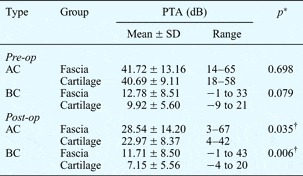
There were no statistically significant differences between the fascia and cartilage groups regarding pre-operative air and bone conduction PTAs (Table I). However, there were statistically significant differences between the two groups regarding post-operative air and bone conduction PTAs (Table I). Both groups showed a significant post-operative improvement in air conduction thresholds, compared with pre-operative values (p = 0.001 for both groups). For all patients combined, the mean ± SD air conduction PTA was 41.20 ± 11.30 dB pre-operatively and 25.82 ± 11.98 dB post-operatively (p = 0.001).
Pre- and post-operative PTA by graft material

*Fascia group vs cartilage group mean pure tone average (PTA). †Statistically significant at p < 0.05. SD = standard deviation; Pre-op = pre-operative; AC = air conduction; BC = bone conduction; Post-op = post-operative
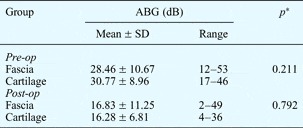
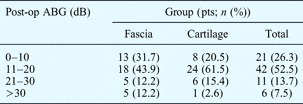
There were no statistically significant differences between the two groups regarding either pre- or post-operative ABGs (Table II). Table III shows post-operative ABG results by graft material. A post-operative ABG of 20 dB or better was identified in 75.6 per cent (n = 31) of the temporalis fascia graft ears and in 82 per cent (n = 32) of the cartilage graft ears. Post-operative ABGs were significantly improved in both groups, compared with pre-operative values (p = 0.001 for both groups). For all patients combined, the mean ± SD ABG was 29.59 ± 9.88 dB pre-operatively and 16.56 ± 9.30 dB post-operatively (p = 0.001).
Pre- and post-operative ABG by graft material

*Fascia group vs cartilage group mean air–bone gap (ABG). SD = standard deviation; Pre-op = pre-operative; Post-op = post-operative
Post-operative ABG by graft material

ABG = air–bone gap; Post-op = post-operative; pts = patients
There was no statistically significant difference in post-operative hearing gain between the two groups (Table IV).
Post-operative hearing gain by graft material

HG = hearing gain; SD = standard deviation
Discussion
Tympanoplasty failure is associated with severe middle-ear disorders (including a chronic discharging ear with irreversible mucosal disease), pathology of the malleus handle and stapes arch, revision surgery, atelectasis, cholesteatoma, tympanosclerosis, and large and anterior perforations; it is also associated with poor prognostic factors such as tobacco smoke exposure and bilateral disease.Reference Onal, Uguz, Kazikdas, Gursoy and Gokce6, Reference Pinar, Sadullahoglu, Calli and Oncel7
In the quest to improve tympanoplasty success rates, research has focussed on the eradication of disease and the creation of a healthy, well aerated middle-ear cleft with an intact tympanic membrane.Reference Onal, Uguz, Kazikdas, Gursoy and Gokce6 Clinical studies of tympanic membrane reconstruction with fascia, perichondrium and cartilage have obtained differing results. These results may have been influenced by confounding variables such as revision surgery, variable perforation size and location, perforation drainage during surgery, and bilateral perforation.
The current study included a homogeneous group of patients in order to facilitate comparison. The study included primary tympanoplasty cases with a subtotal perforation, an intact ossicular chain, a dry ear for at least one month, and normal middle-ear mucosa. Patients with cholesteatoma and those younger than 15 years were excluded from the study.
• The effect of contralateral tympanic membrane perforation on tympanoplasty is controversial
• In this study, tympanoplasty was less successful in patients with bilateral chronic otitis media with perforation
• In these patients, cartilage graft tympanoplasty was more successful than temporalis fascia graft tympanoplasty
Reported tympanoplasty success rates vary. This may be attributed to various otological, surgical and patient-related factors, including the type of tympanoplasty graft material.Reference Onal, Uguz, Kazikdas, Gursoy and Gokce6 Gerber et al. compared temporalis fascia versus cartilage tympanoplasty in patients undergoing primary surgery, and found no significant difference in hearing outcomes.Reference Gerber, Mason and Lambert8 Roger et al. compared limited posterior cartilage reinforcement and subtotal tympanic reinforcement, and found no post-operative hearing differences.Reference Roger, Bokowy, Coste, Moine, Monier and Florant9 Kazikdas et al. found a 95.7 per cent graft success rate for palisade cartilage grafts, compared with 75 per cent for temporalis fascia grafts.Reference Kazikdas, Onal, Boyraz and Karabulut1 Finally, in contrast to other authors, Harner reported poorer, but still acceptable, post-operative hearing levels after chondro-perichondrial grafting.Reference Harner10
It is important to emphasise that these results relate to cases in which bilaterality of disease was not taken into consideration.
In the current study, graft success and hearing results were assessed in patients with bilateral chronic otitis media, a poor prognostic factor for tympanoplasty outcome. At the final clinic visit, 78.75 per cent of ears had healed grafts (65.9 per cent in the fascia group and 92.3 per cent in the cartilage group). Good post-operative hearing was observed for the majority of patients in the cartilage group. This result is somewhat surprising, given that the rigidity and thickness of the cartilage graft could be expected to adversely affect sound conduction through the tympanic membrane.
The status of the opposite ear has been widely studied as a prognostic factor for tympanoplasty success. Because eustachian tube function is usually symmetrical, the status of the contralateral ear may predict success when localised mucosal disease is not present.Reference Songu, Aslan, Unlu and Celik4
Chandrasekhar et al. found no effect of abnormal contralateral ears on healing rates, in a study of 318 tympanoplasties.Reference Chandrasekhar, House and Devgan11 Similarly, Koch et al. reported no correlation between an abnormal contralateral ear and surgical success, in a limited patient group involving 64 tympanoplasties.Reference Koch, Friedman, McGill and Healy12 Gianoli et al. identified no statistically significant difference, comparing an even smaller group of nine abnormal contralateral ears.Reference Gianoli, Worley and Guarisco13
However, other investigators have reported that an abnormal contralateral ear represents a negative prognostic factor for tympanoplasty patients. Adkins and White identified a higher tympanoplasty failure rate in patients with bilateral perforations; in their small group of eight children, three of the four tympanoplasty failures had bilateral perforations.Reference Adkins and White14 Kessler et al. identified more post-tympanoplasty re-perforations in patients with an abnormal contralateral ear.Reference Kessler, Potsic and Marsh15 Caylan et al., Collins et al. and Merenda et al. all reported that contralateral disease was associated with a lower tympanoplasty success rate.Reference Caylan, Titiz, Falcioni, De Donato, Russo and Taibah16–Reference Merenda, Koike, Shafiei and Ramadan18 One of our group's previous studies also indicated that the status of the opposite ear was a negative prognostic factor for tympanoplasty, in a non-homogeneous group of patients.Reference Onal, Uguz, Kazikdas, Gursoy and Gokce6
On the basis of the present study findings, we believe that the status of the opposite ear may indicate the presence of ongoing bilateral eustachian tube dysfunction, which may lower the success rate of tympanoplasty surgery performed with temporalis fascia grafting.
Conclusion
Tympanoplasty is less successful in patients with bilateral chronic otitis media; thus, bilaterality of disease represents a poor prognostic factor. In patients with bilateral chronic otitis media, tympanoplasty with cartilage grafts appears to have better results, compared with temporalis fascia grafts.