INTRODUCTION
Although species distribution changes over time, sudden range extensions are often prompted by anthropic and natural causes. This may be direct, by the introduction of a new species for a defined purpose (e.g. aquaculture) or indirect (e.g. ballast water). Natural changes (e.g. global warming) could also provide opportunities for species to colonize areas where, until recently, they were not able to survive (Kolar & Lodge, Reference Kolar and Lodge2001; Padilla et al., Reference Padilla, McCann, Shumway and Shumway2011).
The Adriatic Sea is an elongated semi-enclosed basin in the north-eastern Mediterranean Sea. It extends in a north-west–south-east direction, with a shallow northern part and a deeper southern part. The Adriatic Sea ecosystems are influenced by regular exchanges of water with the Mediterranean Sea (Gačić et al., Reference Gačić, Eusebi Borzelli, Civitarese, Cardin and Yari2010); Mediterranean waters enter the Adriatic basin from the Ionian Sea through the Strait of Otranto and flow towards the northern part due to the northward coastal current. Therefore, Ionian Sea water masses, consisting of Levantine Intermediate Water and Ionian Surface Water, flow along the eastern coast of the basin. The volume of this flow varies, depending on climatic fluctuations that occur from the Atlantic to the south-east Mediterranean, but it is generally greater during the winter (Batistić et al., Reference Batistića, Jaspricaa, Carića, Čalića, Kovačevićb, Garića, Njirea, Mikušc and Bobanović-Ćolića2012).
Moreover, in the northern Adriatic Sea, ballast water is an important vector for the introduction of non-indigenous species (David & Jakomin, Reference David and Jakomin2003).
We report the first record of three bivalves, Thyasira succisa (Jeffreys, Reference Jeffreys1876), Lyonsia norwegica (Gmelin, Reference Gmelin and Gmelin1791) and Poromya granulata (Nyst & Westendorp, Reference Nyst and Westendorp1839), in the Adriatic Sea. The presence of these three species has not yet been formerly reported in the official checklist for the Italian marine faunal species for the Adriatic Sea (Schiaparelli, Reference Schiaparelli and Relini2008).
The family Thyasiridea (Dall, 1900) includes 14 genera. The species belonging to this family have a small, mostly thin, light shell, with more or less marked plicae on the posterior end. The anterior margin is often flattened and the hinge is almost without teeth (Jeffreys, Reference Jeffreys1876; Pope & Goto, Reference Pope and Goto1991).
The Thyasiridae have a wider distribution; they are found in coastal areas over abyssal depths, in different types of sediments and from both Polar Regions to the equator (Oliver & Killeen, Reference Oliver and Killeen2002; Dufour, Reference Dufour2005). Only the genus Thyasira (Lamarck, 1818), which includes 12 species, has been reported in the Italian waters. To date, only one species of this genus, Thyasira biplicata (Philippi, 1836), has been reported in the Adriatic Sea (Schiaparelli, Reference Schiaparelli and Relini2008).
The family Lyonsiidae (Fischer, 1887) comprises four genera. They usually have a white and elongated shell, presenting ornaments formed by ribs and radiating lines. The valves are often partially covered by a fibrous periostracum, on which fine grains of sand are deposited (Scudieri & Terlizzi, Reference Scudieri and Terlizzi2012). The members of the family Lyonsiiadae are shallow burrowers and they are widely distributed (Ansell, Reference Ansell1967; Harper et al., Reference Harper, Dreyer and Steiner2006). Only two genera (Lyonsia Turton, 1822 and Allogramma Dall, 1903) are present in the Mediterranean Sea (Schiaparelli, Reference Schiaparelli and Relini2008) and, as yet, no species have been reported in the Adriatic Sea.
The family Poromyidae (Dall, 1886) includes five genera. The shells are usually thin and fragile, with a shape that goes from trigonal to oval and without sculptures (Allen & Morgan, Reference Allen and Morgan1981). The members belonging to this family show a cosmopolitan distribution, being present from shallow to deep and abyssal waters (Allen & Morgan, Reference Allen and Morgan1981; Morton, Reference Morton1981; Harper et al., Reference Harper, Dreyer and Steiner2006). Many species of this family are good predators of small crustaceans (Morton, Reference Morton1981). Only two genera, Poromya Forbes, 1844 and Cetoconcha Dall, 1886, have been reported for the Mediterranean Sea (Schiaparelli, Reference Schiaparelli and Relini2008). The genus Poromya is present in the Mediterranean waters, with only one species Poromya granulata (Nyst & Westendorp, Reference Nyst and Westendorp1839) not yet reported for the Adriatic Sea.
MATERIAL AND METHODS
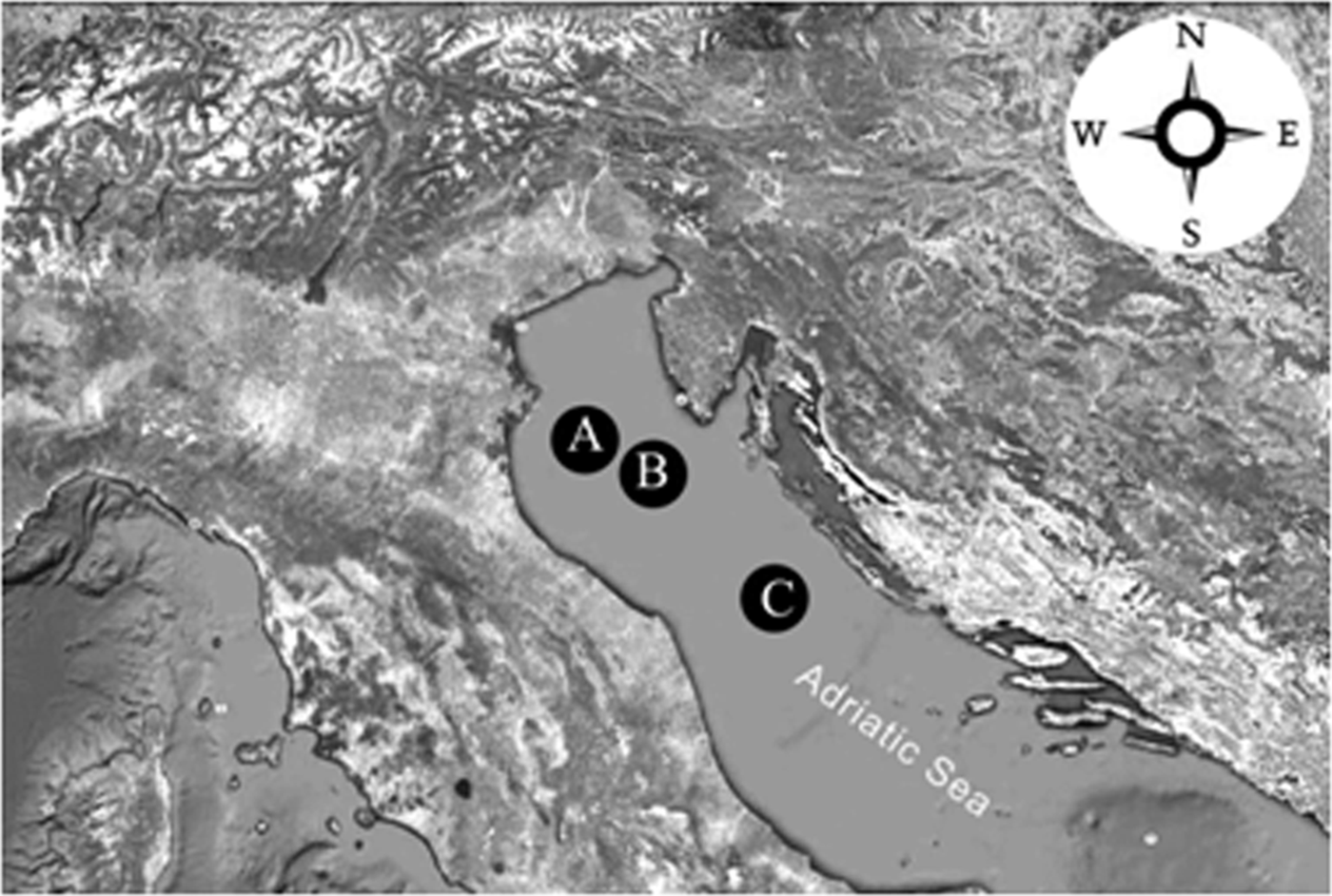
Macrozoobenthos samples were collected in three different areas – A, B and C (Figure 1) – in the northern Adriatic Sea during six surveys, two per year (autumn and spring), carried out from 2010 to 2012. For each survey, a total of 44 stations were sampled in the ‘A’ area, having a surface area of 28 km2 (Latitude 44°33′–44°30N; Longitude: 12°52′–13°00′E) and located at a depth of about 40 m. The bottom texture consists of a mix of sand and mud (sand 55–65%). For the ‘B’ area, 54 stations were sampled for each survey (Latitude: 44°10′–44°25′N; Longitude: 13°00′–13°25′E). This area represents a surface of 140 km2 and the depth ranged from 54 to 60 m. The seafloor is characterized by offshore relict sand (sand: 80–85%). The ‘C’ area (Latitude: 43°34′–43°35′N; Longitude: 14°21′–14°26′E) is located on offshore relict sand (sand: 80–85%) at a depth of 80 m and covers a surface area of 15 km2. A total of 34 stations were sampled in this area at each survey.
Geographic overview of the Adriatic Sea with the locations of the surveyed areas A, B and C.

Six samples were collected at each station using a Van-Veen grab (capacity = 13 l; surface = 0.1 m2). The grab samples were sieved in situ through a 0.5 mm mesh and all the retained organisms were preserved in 5% buffered formalin and then transferred to 70% ethanol. In the laboratory, the macrofauna was sorted using a stereomicroscope, identified to species level and quantified. The nomenclature herein follows the World Register of Marine Species. Voucher specimens are presently kept in the reference collection of ISMAR-CNR.
SYSTEMATICS
Class BIVALVIA Linneus, 1758
Order VENEROIDEA H. & A. Adams, 1857
Superfamily Thyasiroidea Dall, 1900
Family THYASIRIDAE Dall, 1900
Genus Thyasira Lamarck, 1818 ex Leach MS
Thyasira succisa (Jeffreys, Reference Jeffreys1876)
Figure 2
Thyasira succisa (Jeffreys, 1876), external view: right valve.
MATERIAL EXAMINED
374 specimens (12 in A stations, 109 in B stations and 184 in C stations).
DIAGNOSIS
Shell small, fragile, oblique to pyriform or sub-round in outline, stretched and roundish anteriorly, inequilateral. Shell length ranging in length from 1.2 to 2.0 mm. Surface smooth, sculpture of weak concentric lines and growth stops. Ferruginous deposits mostly restricted to anterior margin and posterior area. Finely inequivalve, left valve little larger than right one. Small and protuberant umbo. Posterior margin sharp-cornered at crossing with ventral margin. Only one furrow originating one small auricle in posterior area. Well-defined lunule with slightly eccentric striae.
TAXONOMIC REMARKS
Thyasira succisa was originally described by Jeffreys (Reference Jeffreys1876) with the name of Axinulus succisus. After its first description this bivalve was called Axinus incrassatus var. succisa Jeffreys, Reference Jeffreys1876, but at present the accepted name is Thyasira succisa (Scaperrotta et al., Reference Scaperrotta, Bartolini and Bogi2010).
ECOLOGY
This species is a suspension feeder and it prefers habitat with detrital-muddy bottoms and well-oxygenated sediment of the deep circalittoral zone (Scaperrotta et al., Reference Scaperrotta, Bartolini and Bogi2010).
Order ANOMALODESMATA Dall, 1889
Superfamily PANDOROIDEA Rafinesque, 1815
Family LYONSIIDAE P. Fischer, 1887
Genus Lyonsia Turton, 1822
Lyonsia norwegica (Gmelin, Reference Gmelin and Gmelin1791)
Figure 3
Lyonsia norwegica (Gmelin, 1791), external view: (A) left valve; (B) right valve.
MATERIAL EXAMINED
28 specimens (all in B stations).
DIAGNOSIS
Shell ranging in length from 9.0 to 20.0 mm. Shell stretched, weak, with two open ends, inequivalve. Left valve more convex, protuberant and larger than the right one. Ventral margin straight or sinuous, parallel to the dorsal one. Anterior side roundish, posterior one truncated. Ornamentation weak with radial sinuous striae. Surface finely granulose. Sand conglomerates may cover anterior part of the shell. Colour dirty white or uniform grey, a little bit iridescent in fresh specimens. Periostracum brown.
TAXONOMIC REMARKS
Lyonsia norwegica was originally described by Gmelin (Reference Gmelin and Gmelin1791) with the name of Mya norwegica. After its first description, this bivalve was given several names: Mya nitida Fabricius, 1798; Lyonsia striata Montagu, 1815; Mya striata Montagu, 1815; Amphidesma corbuloides Lamarck, 1818; Mya pellucida Brown, 1818; Tellina coruscans Scacchi, 1833; Pandora aequivalvis Philippi, 1836; Anatina elongata Hanley, 1842; Myatella montagui Brown, 1845 (Dautzenberg & Dollfus, 1889). At present, the accepted name is Lyonsia norwegica (Scaperrotta et al., Reference Scaperrotta, Bartolini and Bogi2013).
ECOLOGY
Lyonsia norwegica lives in the circalittoral and infralittoral zones on sandy and muddy bottoms (Scaperrotta et al., Reference Scaperrotta, Bartolini and Bogi2013) and it is a borrower or suspension-feeder (Gmelin, Reference Gmelin and Gmelin1791; Scaperrotta et al., Reference Scaperrotta, Bartolini and Bogi2013).
Superfamily POROMYOIDEA Dall, 1886
Family POROMYIDAE Dall, 1886
Genus Poromya Forbes, 1844
Poromya granulata (Nyst & Westendorp, Reference Nyst and Westendorp1839)
Figure 4
Poromya granulata (Nyst & Westendorp, 1839), external view: (A) left valve; (B) right valve.
MATERIAL EXAMINED
24 specimens (16 in A stations and 8 in B stations).
DIAGNOSIS
Shell ranging in length from 8.0 to 12.0 mm. Shell weak, sub-round or oval. Valves inflated, the right slightly more convex than the left one. Anterior margin roundish, posterior one truncated due to a radial plica extending from umbo to antero-ventral margin. Surface translucent, cream or grey, with close and regular tiny tubercles. A bit iridescent inside. Periostracum brown. One cardinal tooth in the hinge of right valve, in front of chondrophore. Internal margin smooth.
TAXONOMIC REMARKS
Poromya Granulata was originally described by Nyst & Westendorp (Reference Nyst and Westendorp1839) with the name of Corbula Granulata. After its first description, this bivalve was given several names: Poromya anatinoides Forbes, 1844 (Pope & Goto 1993); Embla korenii Lovén, 1846 (Pope & Goto, Reference Pope and Goto1991); Cumingia parthenopaea Tiberi, 1855; Poromya rotundata Jeffreys, Reference Jeffreys1876. At present, the accepted name is Poromya granulata (Scaperrotta et al., Reference Scaperrotta, Bartolini and Bogi2013).
ECOLOGY
Poromya granulata lives in the circalittoral and bathyal zone on muddy bottoms, from about 70 m up to 3700 m and it is carnivorous (Nyst & Westendorp, Reference Nyst and Westendorp1839; Morton, Reference Morton1981; Olabarria, Reference Olabarria2005; Scaperrotta et al., Reference Scaperrotta, Bartolini and Bogi2013).
DISCUSSION
The mode of entry for these three bivalves into the Adriatic Sea is uncertain. The introduction of some alien species as planktonic larvae, carried within the ballast waters, could be one of the main modes (Galil & Zenetos, Reference Galil, Zenetos, Leppäkoski, Gollasch and Olenin2002; David & Jakomin, Reference David and Jakomin2003; Morello et al., Reference Morello, Solustri and Froglia2004; Zenetos et al., Reference Zenetos, Cinar, Pancucci-Papadopoulou, Harmelin, Furnari, Andaloro, Bellou, Streftaris and Zibrowius2005; Arias & Anadón, Reference Arias and Anadón2012). Other vectors (e.g. marine currents) should not be excluded (Gačić et al., Reference Gačić, Eusebi Borzelli, Civitarese, Cardin and Yari2010).
Scarce information is available on the ecology of these species, making it difficult to understand how they have been able to establish in the Adriatic Sea.