There is no need for paper records to confirm this ancestral connection. It is there in your DNA.
—Brian Sykes, DNA USA: A Genetic Portrait of America (2012, p. 23)
Oh no. Oh no. . . . We got to have a re-vote. This ain’t right.
—Snoop Dogg, on learning through DNA testing that he has four percent more European ancestry than Charles BarkleyFootnote 1
INTRODUCTION
Viewed from one angle, DNA ancestry testing is a small, rather esoteric parlor game. Either alone or in “spit parties” (Salkin Reference Salkin2008), people produce a sample of saliva, mail it off, and a few weeks later open a website to discover the region of the world from which one ancestral line came or the proportion of their full ancestry from different continent-wide areas of the world. This technological novelty is intriguing, but it says nothing about the rich history of one’s forebears or why they moved from (or remained at) their original location. As two scientists put it, “Genetics researchers are telling us that you are better off digging around in your loft than doing a DNA ancestry test if you want to find out about your family tree” (Collins Reference Collins2013). Or more simply, “This is business, and the business is genetic astrology” (Collins Reference Collins2013).
Viewed from another angle, however, and regardless of whether the science is any better than astrology, DNA ancestry testing raises profound issues, potentially affecting everything from a person’s identity to a society’s strategy for categorizing purported racial groups. Two such issues are whether and how to incorporate biological elements into the meaning of “race” or the distinctions among groups, and how to evaluate the relative merits of single-race ancestry and multiple group heritages.
We cannot finally adjudicate whether biology is implicated in race, or whether single-race or multiracial identity is preferable. No one can; these are matters of definition, ideology, and preference, not matters of fact. But we can add a new element to long-standing debates over biology and identity by analyzing how Americans understand and respond to DNA ancestry testing. Do citizens reject it as coming too close to the old and discredited “racial science,” or do they embrace it as a new tool for learning more about their own and others’ heritage? Do Americans prefer to understand themselves through a clean, clear single group lineage, or do they embrace the messy contingencies of multiracialism? Since both of these questions have been especially fraught throughout the long history of Blacks in America, we focus on the views of African Americans, comparing their views to those of others in order to see what is distinctive and what is shared across groups.
We first briefly explicate the large issues at stake and justify scholarly attention to DNA ancestry testing in that context. We then develop a theory that in turn leads to two hypotheses. The theory is based on the fact that many African Americans have suffered forcible breaks in their knowledge of their genealogical past, due to both the Middle Passage and the history and legacy of American slavery. For African Americans, the widely shared human desire to know where one came from seemed to be irretrievably frustrated—until DNA ancestry testing offered a possible way to gratify it. This “broken chain” theory leads to two hypotheses: First, despite the dangers of biologizing race, Black Americans are interested in and receptive to DNA ancestry testing, perhaps more than other Americans are. Second, although African Americans may especially appreciate tests showing a single line of ancestry from Africa, they appreciate tests showing multiple ancestral lines as well. The logic here is that, since descendants of African slaves hunger for any information about their genealogical ancestry, DNA tests that result in plural lineages are almost as gratifying as those that show a singular ancestry, despite the painful history of much racial mixing in the United States. This view contrasts with that of racial and ethnic groups that have not experienced the broken chain of genealogical knowledge; these groups have more psychological space to express preferences about the biological implications of DNA testing, and about either a singular ancestral line or a multiple set of heritages.
We examine these two hypotheses in several steps. First, we look to a new General Social Survey (GSS) module that suggests public, especially Black, receptivity to genomic science in general and to DNA ancestry testing in particular—giving initial credence to the first hypothesis. Second, we conduct a content analysis of almost 6000 newspaper articles to show the usefulness of the simple distinction between singular and multiple ancestral heritages—giving initial credence to the second hypothesis. This analysis also shows that Americans are more likely to receive the message that genomic testing reifies or strengthens racial boundaries than to receive the message that DNA testing blurs or dissolves them. Third, through an extended analysis of a vignette survey, we examine the two hypotheses about Blacks’ distinctive interest in DNA ancestry testing and their attention to both a single ancestral line and multiple ancestries. Finally, we explore a subset of the newspaper articles in more qualitative detail in order to explicate the impulses and motivations behind the survey results. We conclude by discussing the implications of DNA ancestry testing for Blacks’ fraught relationship with the view that racial identity is inherited, and for links between biology and race more generally.
THE LARGE ISSUES BEHIND DNA ANCESTRY TESTING
Social Construction, Biology, and Race
How should one understand the connection between the genetics of ancestry and racial identity? This is a new version of the old debate about whether distinctions among races and the concept of “race” itself are biologically based, purely human inventions, or some combination.
Although the idea has been extant at least since the nineteenth century, social constructivism now predominates among social scientists. The American Anthropological Association’s (AAA) 1998 Statement on Race depicted it as “a worldview, a body of prejudgments that distorts our ideas about human differences and group behavior” (p. 713). The AAA argued that scholars should abjure its use (American Anthropological Association 1998).Footnote 2 Many geneticists and medical researchers concur; as Luca Cavalli-Sforza and his co-authors put it in the pathbreaking History and Geography of Human Genes: “Classification into races has proved to be a futile exercise. . . . The level at which we stop our classification is completely arbitrary. . . . We can identify ‘clusters’ of populations . . . [but] at no level can clusters be identified with races, since every level of clustering would determine a different partition and there is no biological reason to prefer a particular one” (Cavalli-Sforza et al., Reference Cavalli-Sforza, Menozzie and Piazza1994, p. 19).
Nevertheless, the historically stronger association between biology and race persists, in a new version. Researchers are exceedingly careful when they link race to genetic inheritance, but some nonetheless find it scientifically necessary to do so. One professor of medicine, for example, argues that “the debate . . . should not be over the existence of population differences, but how to describe those differences with more precision. . . . Railing against what some claim are misguided efforts to use racial, ethnic, or geographic distinctions does not make the differences disappear” (Cohn Reference Cohn2006, p. 553). Even Cavalli-Sforza and his co-authors provide color maps showing “very distinctly the [genetic] differences that we know exist among the continents: Africans (yellow), Caucasoids (green), Mongoloids, including American Indians (purple), and Australian Aborigines (red)" (Cavalli-Sforza et al., Reference Cavalli-Sforza, Menozzie and Piazza1994, p. 136).Footnote 3
Firms selling DNA tests straddle this divide; they state explicitly that results will not identify the user’s race or ethnicity, but some of their language is more ambiguous. For example, geneticists Mark Shriver and Rick Kittles point to a “potential negative consequence” if data about ancestral categories are “misinterpreted as indications of ‘real’ racial divisions”—but they also assert that a personalized genetic history “has the potential to affect ethnic, religious, racial, and family identities” (Shriver and Kittles Reference Shriver, Kittles, Koenig, Lee and Richardson2008, p. 209). DNA Spectrum, an online seller of ancestry tests, advertises that its “propriety Full Spectrum Plus test [an autosomal DNA test—see below] has helped customers like James Shoemaker discover their true heritage” (PRWeb 2013). Thus a person choosing to do a DNA ancestry test, or confronted with questions about her views of such a test, is implicitly participating in a long-standing discussion that can be as subtle and as sophisticated as Shriver and Kittles’, or as blatant as eugenicists’ claims about ethnic bloodlines.
Singular and Multiple Ancestral Lineages
The decision to take a DNA ancestry test leads to another decision, about which type of test to take. In very quick compass, one has two basic alternatives (although, unlike Robert Frost’s traveler, one can take both roadsFootnote 4 since the tests are not empirically or analytically incompatible).Footnote 5 Autosomal (non-sex-linked) tests seek to determine the proportions of a person’s ancestry from different regions of the world. Such a test might show one hundred percent ancestry from one population group, but given human migration and marital patterns, it is likely to show descent from more than one region of the world. Mitochondrial (also known as mt-DNA) tests and Y-DNA tests, in contrast, determine a particular ancestral lineage, often described as a tribe or indigenous population, from the paternal line for men or maternal line for women. This test does not show population group mixtures since it provides information about one line of forebears.
Thus a person taking a DNA test necessarily participates in a second old debate on the relative merits of attachment to a single group versus embrace of multiple ancestries or identities. Like willingness to grant legitimacy to DNA tests, this is a political and moral as well as personal and idiosyncratic choice. Endorsement of singular racial identity and clear boundaries between groups goes back at least to the racial nationalism of David Walker and Martin Delany, the inventors of blood quantum to determine Native American status, and (with a different political connotation) the White Citizens League. For Blacks, singular racial identity may be associated with commitment to the betterment of the group (Shelby Reference Shelby2005) and pride in one’s previously denigrated heritage (Joseph Reference Joseph2007). The slogans “Black is beautiful” and “Black power” arose at roughly the same time, often among the same people, and usually conveyed the same political message: “[F]rom now on we shall view ourselves as . . . Black people who are in fact energetic, determined, intelligent, beautiful, and peace-loving” (Ture and Hamilton, Reference Ture and Hamilton1992, p. 38).Footnote 6
Support for multiracial complexity and the blurring or dissolution of boundaries has different though equally robust historical roots: de Crèvecoeur’s celebration of “the American, this new man”; Israel Zangwill’s melting pot; and José Vasconcelos’ raza cósmica. In the African American population, engagement with racial mixture has ranged from shame and outrage at slave owners’ exploitation to pride in “good” hair and light skin color to endorsement of the right to celebrate the breadth of one’s heritage, whatever it is. As Barack Obama put it, “I can no more disown [the Rev. Jeremiah Wright, Jr.] than I can disown my White grandmother;” he once observed that the kind of dogs he would most like to give his daughters would be “mutts like me.” Henry Louis Gates, Jr. makes the same point, more exuberantly: Now that “we know [through DNA testing] that Jane Gates’ children were fathered by an Irishman, I’m in pursuit of him twenty-four hours a day. He’s my great-grandfather. I want nothing more than to find his identity and travel to Europe and claim his people for my own” (Morton 2012).
THEORIZING RESPONSES TO DNA ANCESTRY TESTING
Biology and Race
DNA ancestry testing draws one, willy nilly, into the issues of whether biology has any relationship to racial identity and whether one should focus on a discrete, singular racial identity or on a heterogeneous mixture of group identities. Consider the first issue first. We know of no systematic theories, never mind a developed literature, on why people might endorse, accept, or resist the idea of an association between race and biology, so we provide the initial outline of such a theory and its links to DNA ancestry testing and African Americans below.
If a person believes it to be an indisputable fact that race is purely a social construction, he or she is likely to reject DNA ancestry testing as misleading.Footnote 7 Similarly, if a person is a social constructivist out of ideological commitment or disgust at the uses to which purported racial science has been put, he or she is likely to reject DNA ancestry testing as dangerous. Conversely, a person who is willing to do a DNA ancestry test or who gives credence to its results can be assumed to accept the legitimacy of some sort of association between race and biology.
Given the uses to which racial science has been put, one might expect African Americans to reject any suggestion of such an association, and therefore to reject DNA ancestry testing. However, we theorize that Blacks might instead be drawn to DNA ancestry testing, perhaps even more than members of other groups are, and therefore willing to overcome any lingering fears of racial science. Our “broken chains” theory has two elements.
The first element is shared with other Americans—the profound urge to find one’s roots. As Businessweek puts it, “today, genealogy ranks second only to porn as the most searched topic online” (Falconer Reference Falconer2012, p. 1). Forbes magazine reports that the genealogy industry is worth $2 billion a year (Anderson Reference Anderson2014), with the website Ancestry.com reporting over two million paying subscribers as of 2012 (Farnham Reference Farnham2012). Groups vary in the geographic stability and therefore traceability of their ancestry, with American Blacks at the end of the continuum of difficulty. Unlike in other groups, the vast majority of Blacks whose ancestors came to America before the twentieth century are almost always unable to use conventional records to trace their antebellum ancestry. Slave ships counted but did not name their cargo. The United States census recorded only the number of slaves held by a (named) White owner through 1840, and only occasionally included (first) names in the 1850 and 1860 censuses. People changed their names or their names were changed regardless of their preferences. Few Blacks owned land or were on the tax rolls, many Black marriages and births were never officially recorded, few attended formal schools, and so on—written records are scant and incomplete at best. So African Americans typically find popular genealogical sites such as Ancestry.com to be useless beyond a few generations.
The second element in the broken chains theory is distinctive, perhaps unique, to Black descendants of enslaved Africans. Finding one’s ancestry can represent a type of victory over subjugation by Europeans:
For the first time since the seventeenth century, we are able, symbolically at least, to reverse the Middle Passage. Our ancestors brought something with them that not even the slave trade could take away: their own distinctive strands of DNA. . . . So an exact match between an American’s DNA and an African’s DNA reveals a shared ancestor, and possibly a shared ethnic identity, that has been lost for centuries (Gates Reference Gates2008, p. 10).
Thus one woman cried for joy when discovering her Kenyan ancestry. “She carried a message from her ancestors in every cell [sic] of her body, in her own DNA. It was a secret document, a talisman of her African roots. . . . It had slid unseen past slave owners who had strived to erase any sense of individual identity from her ancestors” (Sykes Reference Sykes2012, p. 135). By this logic, the deeper the erasure of history and family through enslavement, the more precious is the knowledge that can be gained only from DNA ancestry testing. “For 400 years, to have no clue as to your name, culture, heritage, where you came from—how could you not search? You need to find out who you are, just to get that fulfillment, even if it is just for a day, a second” (Ataiyero Reference Ataiyero2007, p. A5).Footnote 8
The broken chains theory generates our first hypothesis:
H1: African Americans are interested in, persuaded by, and influenced by DNA ancestry tests—and are more interested, persuaded, and influenced than are members of other American racial and ethnic groups.
Singular or Multiple Heritage
As with the issue of links between race and biology, the extensive literature on racial mixture has not produced a systematic theory about when or why people will prefer singular or plural group identities, or how that preference connects to DNA ancestry testing. So we begin with the broken chains theory and develop it in a new direction in order to generate a testable hypothesis about views on racial mixture.
We expect two sets of people to be especially committed to a singular, or pure, group identity. The first set includes those whose social superiority depends in large part on belonging to a disproportionately favored group. Examples include Brahmins in the caste system of sub-continental India, the Cohanim among observant Jews, and Anglo-Saxon Whites through much of American history. The second set includes those reacting with anger and solidarity against the social inferiority predicated on belonging to a disproportionately disfavored group. Examples include homosexuals embracing the pejorative appellation of “gay” or “queer,” the Roma across much of Europe, and Black Americans. In contrast to both sets, members of groups with mixed, mid-range, or highly variable social status are less likely to place a great deal of stock in singular or pure ancestry.
Following this logic, we expect African Americans who are interested in DNA ancestry testing to be especially focused on and responsive to tests promising knowledge of singular African ancestry. This could either be an autosomal test that shows mostly African descent, or a mitochondrial or Y-DNA test that explicitly traces an African lineage.
A strong commitment to singular racial identity need not conflict, either logically or empirically, with acceptance of or enthusiasm about racial mixture. Analysts who embrace multiracialism argue that it permits a fluid racial identity, such that one’s self-definition can vary with context or preferences.Footnote 9 That perspective seems less plausible for those whose social superiority depends on racial purity than for those who resist social inferiority; the former will lose status if they admit to multiple heritages, while the latter may gain status, or at least not lose it. Thus, African Americans who are interested in DNA ancestry testing can take pride in their African heritage without having to reject the possibility of non-African ancestors. Hence our second hypothesis, which emerges from an extension of the broken chains theory:
H2: African Americans are especially favorable toward tests that reveal a single ancestral line, and favor racial singularity more than do all other groups except White Americans. Unlike White Americans, however, African Americans are also favorable toward DNA ancestry tests that reveal multiple ancestral lines.
METHODS AND RESULTS
Expanding Awareness
If only a few Americans are aware of the revolution in genomic science, or of genetics more generally, DNA ancestry testing will be of little interest except to a handful of specialists. But that is not the case.
Three initial analyses show that public attention to biology and genetics is growing or reasonably high. The first uses published books. A Google Books Ngram (Figure 1) shows the diffusion of the words “genetic,” “DNA,” “biological,” “gene[s],” and “genomic” in books published between 1940 and 2008.Footnote 10 As Figure 1 shows, the proportion of books with all of these terms, except the specialized “genomic,” increased markedly over those seventy years.
Google Ngrams for “DNA,” “Genetic[s],” “Biological,” “Gene[s],” and “Genomic[s],” 1940-2008
Note: The y-axis represents the percentage of Ngrams that contained the above words out of the universe of Ngrams in English-language books.

The second piece of evidence about public attention to biology and genetics uses newspapers rather than books; it focuses specifically on genomic science and race or ethnicity. We conducted an automated content analysis of what we believe to be all newspaper articles published in the United States on the topic of genomics and race or ethnicity through 2009.Footnote 11 We used the broadest available database on the grounds that it would best show how the print media are reporting this topic. For the same reason, we retained duplicates; an article’s appearance in more than one newspaper is directly relevant to the question of public attention to biology and genetics. We erred on the side of being over-inclusive in order not to bias our corpus of texts toward or against our expectation of increasing attention, or toward or against our second hypothesis on the singular or multiple framing of DNA ancestry.
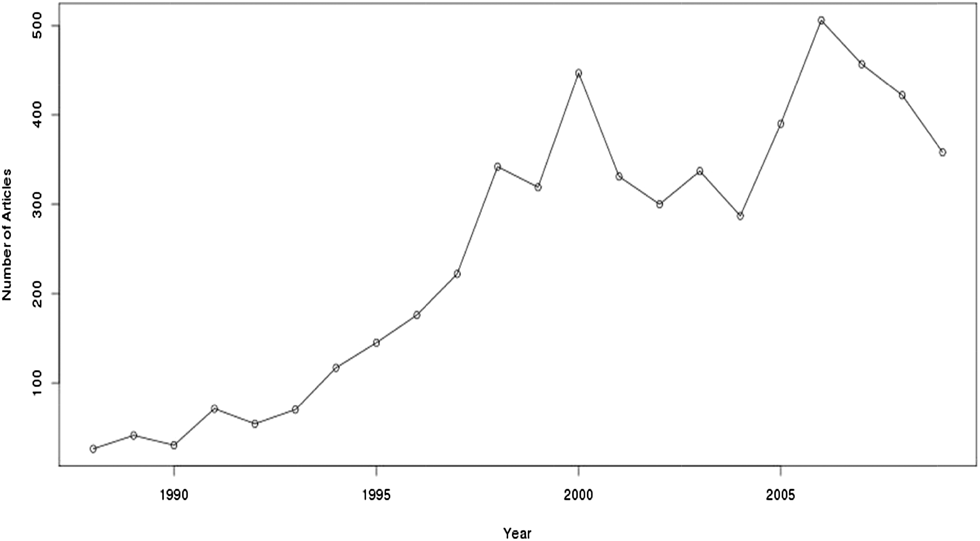
Specifically, we searched Lexis-Nexis Academic for texts using a genetics-related term (“DNA,” “genetic,” or “genomics”)Footnote 12 within the same sentence as a word associated with race, ethnicity, or heredity (“race,” “racial,” “ethnicity,” “genealogy,” “descendant,” “ancestor,” or “lineage”). We added keywords to exclude articles clearly outside our inquiry, such as those on rape or murder forensics, genetic food modification, television schedules, and death notices. We avoided words that would slant the search toward any particular group (e.g., “Black,” “White,” “African,” “Celtic”). The final search yielded 5580 newspaper articles from 1969 through 2009; their yearly frequency is shown in Figure 2.
Newspaper Articles per Year Addressing Race or Ancestry and DNA, 1988-2009Footnote 38
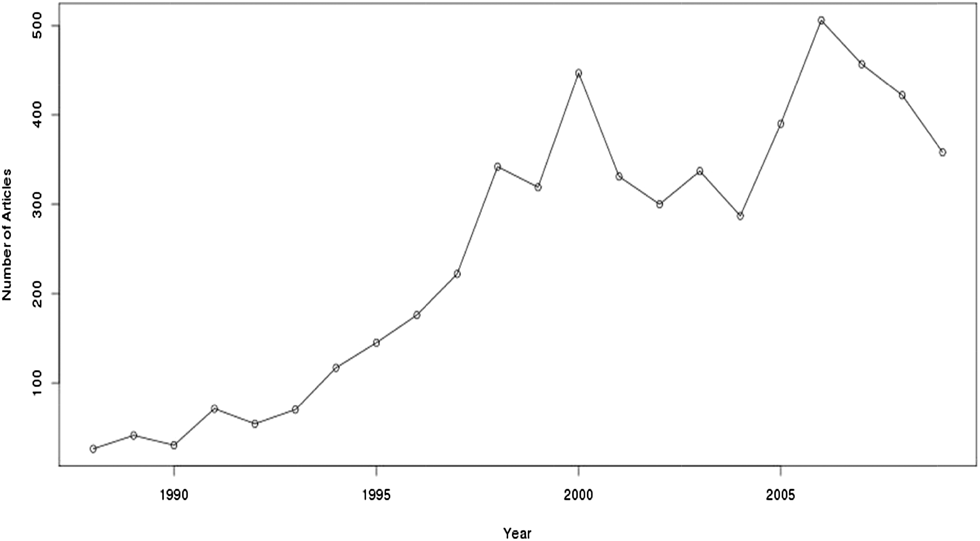
The curve in Figure 2 resembles that of Figure 1; the annual number of newspaper articles linking DNA and race rose from fewer than 50 in 1990 to as many as 500 by the late 2000s. The number of relevant articles peaks around 2006, coinciding with Gates’ first public television documentary on prominent African Americans’ use of genetic testing. Journalistic interest remained strong through 2009.Footnote 13
Perhaps the best way to determine if someone is paying attention to an issue is to ask him or her directly; that is our third measure of awareness of genetics. By that criterion, 13% of respondents to the 2010 GSS have heard “a great deal” about genetic testing, and an additional 66% have heard “something” about it.Footnote 14 Similarly, in 2007, 49% of survey respondents claimed to have thought “a great deal” or “a small amount” about “issues to do with genes or genetics” over the previous few months (VCU Center for Public Policy 2007). We have no way of knowing if these figures are accurate; they are best understood as an indicator that half (in 2007) to four-fifths (in 2010) of Americans think they should be paying attention to genetics.
Media Presentations of Singular and Multiple Heritage
Given that Americans are learning about genetics—or at least books and newspapers are providing more information and Americans think that they should be learning about genetics—we can move to the more focused question of what they are learning. The database of 5580 newspaper articles provides a lens through which to view the initial stages of public learning about links between the new genomic science and the construction or discovery of racial and ethnic categories.Footnote 15 In particular, the database enables a determination of whether the distinction between group singularity and multiplicity, on which H2 is based, is broadly meaningful.
We sorted the media reports of links between DNA ancestry tests and race or ethnicity into two bins: (1) those that emphasize multiplicity by focusing on group mixture or the softening of distinctions among conventionally defined races or ethnicities, and (2) those that emphasize singularity by focusing on reinforcement of one ancestral line or single-group identity, or on the hardening of distinctions among conventionally defined races or ethnicities (we also created two other bins for articles that do both, and articles that do neither). Since we could not code 5600 articles by hand, we used ReadMe (Hopkins and King, Reference Hopkins and King2010), an automated content analysis method for the R statistical computing language. Two research assistants and the authors hand coded over 600 articles selected across the full period, dividing them into four mutually exclusive categories. This was the “training set.” We ran the content analysis program on the training set, thereby allowing the program to use the proportion of documents observed with each pattern of word profiles to make predictions. We then used the same classification method to analyze all 5580 articles (the “test set”). The program estimated the proportion of articles in each substantive category with good accuracy (Hopkins and King, Reference Hopkins and King2010).
The four categories and the coder instructions were:
Blend [now called Plurality]: The article implied or stated that recent advances in genetics or DNA technology blend racial or ethnic identity or identification. Articles that imply shared ancestry fall in this category.
Strengthen [now called Singularity]: The article suggested that recent advances in genetics or DNA technology could reify, strengthen, or focus racial or ethnic identity or classification by others.
Both: The article stated or implied that advances in genetics or DNA technology can both blend and strengthen racial identity or classification by others. Or it discusses different people, some of whom move in the direction of blending and others in the direction of strengthening racial identity.
Neither: The article did not mention these issues, or expressed or implied no view on whether advancements in genetics blend or reinforce racial identity.
For example, a description of recent research that included analysis of a newly discovered gene shared among humans from all regions of the world would be coded as “Blend,” since it conveys the idea that DNA points to a shared human origin. In contrast, an article discussing the relatively high prevalence of breast cancer among Jewish women and speculating that genetic factors unique to Jews are linked to the increased risk would be coded as “Strengthen,” since it implies that genomic science reveals biological distinctions among racial or ethnic groups.
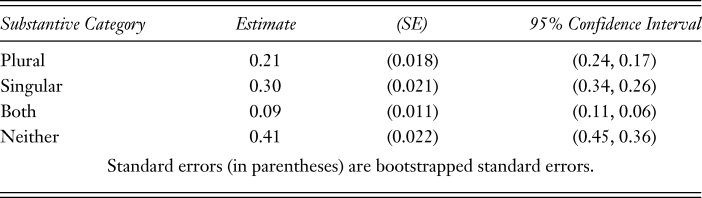
Table 1 shows the estimated proportion of articles in each category, as generated by the automated content analysis. About three-tenths of the articles framed DNA ancestry testing in terms of singular racial identifications, while a fifth focused on multiplicity across racial groups. Another tenth addressed both concepts.Footnote 16 Methodologically, these results show that the dichotomous framework of plurality and singularity is meaningful and useful. We can effectively hand code, and then automatically code, articles according to this distinction, and the coding yields interpretable and internally consistent patterns. Substantively, the results show that since genomics research has come into public view, both singularity and plurality of heritages have been included in public discourse. However, Americans have been more exposed to the idea that genomic science distinguishes races genetically or that people “belong” to only one group than to the idea that genomic science erodes group boundaries or shows people to have mixed biogeographical origins. This emphasis on racial singularity could have political impact—but whether it reifies harmful and artificial barriers between groups or encourages solidarity and group pride remains to be seen.
Proportion of Newspaper Articles Focused on Plurality, Singularity, or Both, 1969-2009
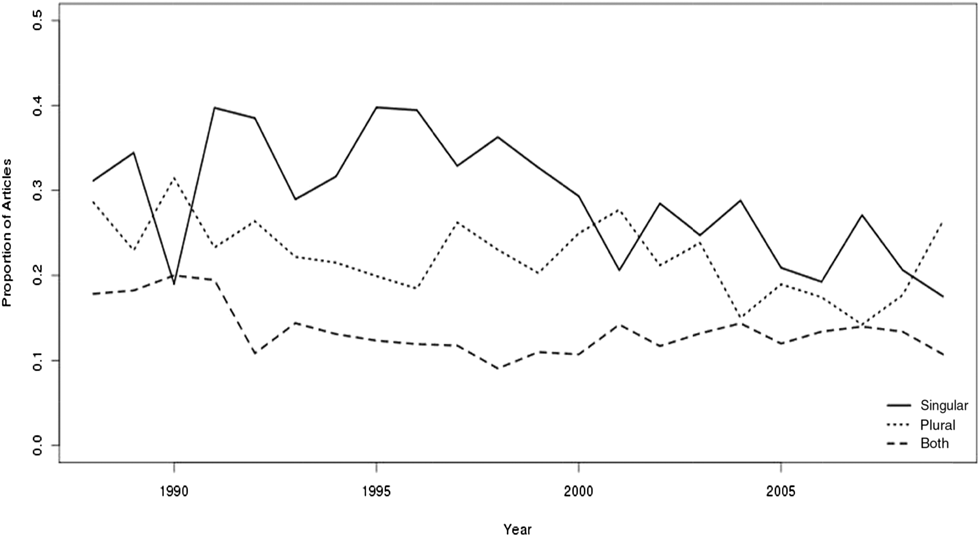
Figure 3 provides a more dynamic portrait of what newspapers are conveying to Americans about genomics and race. It shows the proportion of articles in each of the three substantive coding categories separately by year from 1988 through 2009. (For ease of interpretation, we removed the fourth category, “Neither,” from the denominator in calculating these proportions.)
Proportion of Newspaper Articles on Plurality, Singularity, or Both, 1988-2009

The proportion of articles discussing both multiplicity and singularity (the dashed line) is consistent but low. More interestingly, after the instability due to a small number of articles in the early 1990s settles down, in almost every year the articles focus as much or more on a single racial group (dark line) as on mixture or multiple groups (dotted line). The first exception is 2001, which is probably due to publicity about the new mixed-race option on the U.S. census, and the public unveiling of the Human Genome Project. J. Craig Venter’s statement in his White House speech that geneticists have shown that “the concept of race has no genetic or scientific basis” (Venter Reference Venter2007, p. 315) was widely noted in that year, but Figure 3 shows that its message did not last in the media. The only other exception to the dominant message about racial singularity is 2009, which is probably due to publicity about President Obama’s racially mixed ancestry. Footnote 17
H1: Views of DNA Ancestry Testing
The Ngrams, newspaper content analysis, and survey results show that the media are providing Americans with information about genetics and the links between genetics and race. They also show that a considerable portion of Americans is aware of this new endeavor. The distinction between singular and multiple ancestries in newspaper stories reveals a meaningful structure in ongoing public discussions about genomics and race or ethnicity. That set of findings provides a sufficient empirical foundation to enable us to turn directly to the hypotheses. We focus first on H1: African Americans are interested in, persuaded by, and influenced by DNA ancestry tests—and are more interested, persuaded, and influenced than are members of other American races and ethnicities.
Initial support for H1 comes from our 2010 GSS module. So far as we can tell, this is the first nationally representative survey to ask views on the use of DNA to research one’s ancestry. According to the survey, 63% of the respondents were “strongly” or “somewhat” favorable to the use of DNA for this purpose and only 9% were unfavorable. Blacks were more likely than Whites and Hispanics to be “strongly” favorable (proportions were 42%, 29%, and 39%, respectively), as well as more likely to “somewhat” favor it. Overall, three-fourths of Blacks, compared with just over three-fifths of Whites and Hispanics, approved of DNA ancestry testing.
The GSS result is clear, but thin. For a richer understanding of just what people approve and why, we turn to a new vignette survey, first reported here. It included a random sample of 1095 American adults, divided among 242 non-Hispanic Whites, 201 non-Hispanic Blacks, 233 non-Hispanic Asian Americans, 205 Hispanics, and 214 non-Hispanic multiracials.Footnote 18 All respondents identified their own race or ethnicity. The survey was conducted over the Internet by Knowledge Networks (now part of GfK) in August 2010, through the peer-reviewed Time-sharing Experiments for the Social Sciences (TESS) program.
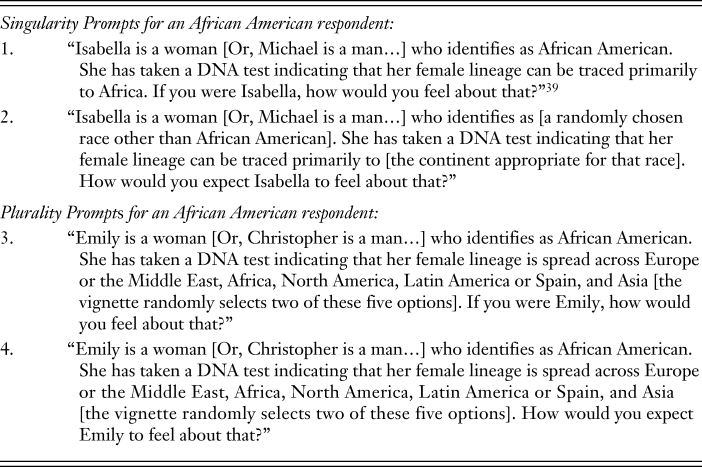
In order to examine difficult concepts with which few people have direct experience, we developed vignettes (Finch Reference Finch1987) featuring imaginary people who have just received the results of a DNA ancestry test. Each participant responded to four vignettes. The respondent’s gender always matched that of the imagined subject. Two vignettes (one each for racial plurality and racial singularity) asked the respondent to imagine that he or she was the vignette individual; in these cases, the respondent’s pre-test race (including Hispanic as a separate category) matched the pre-test race of each imaginary subject. The other two vignettes (again, one each for racial plurality and racial singularity), asked the respondent to imagine how the vignette individual would feel after receiving test results. Here the respondent's pre-test race differed randomly from the pre-test race of each imaginary subject.
These variations allow for an analysis of the internal validity of responses to the vignettes. That is, given the United States’ fraught racial history, we anticipate that meaningful answers will vary in intelligible ways depending on whether the respondent is considering a vignette subject with the same or a different race from his or her own. Furthermore, people may consider their own experiences differently than they think about the experiences of others. For example, a Black respondent might convey more enthusiasm when asked to identify with a Black vignette character than when asked to assess the likely level of enthusiasm held by someone of a different race.
Each vignette had the same three sets of response categories, addressing: (1) emotional reactions to the ancestry test on a seven-point scale from “pleased” to “displeased”; (2) cognitive responses on a seven-point scale from “believable” to “unbelievable”; and (3) the test’s impact with two alternatives, “would the results matter a lot to your identity” or “not matter at all to your identity.”Footnote 19 For each vignette, the screen showed a map of the world with the relevant continent(s) highlighted, as in Figure 4.
Map Showing Highlighted Continents, Vignette Survey, 2010
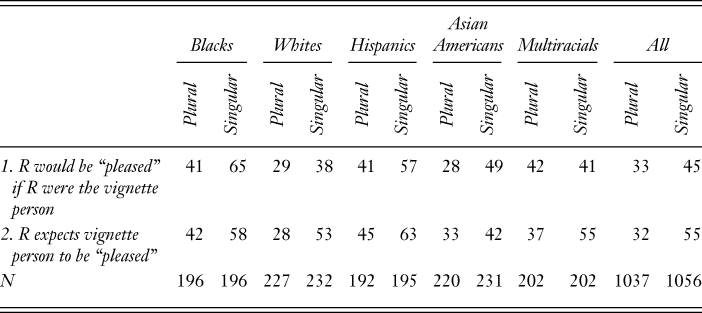
Table 2 provides examples of how the vignettes appeared to a respondent.Footnote 20Table 3 presents results for the emotional response of “pleased,” after collapsing the first three points on the seven-point scale.Footnote 21 H1, which posits that Blacks are especially favorable to DNA ancestry testing, receives strong support. The simplest measure makes the point most clearly. Averaging across the four vignettes, 51.5% of both Blacks and Hispanics would be pleased with either result or would expect others to be pleased with either result. This compares with 43.8% of multiracials, and only 38% of Asians and 37% of non-Hispanic Whites. Using simple Chi-square tests, overall differences in response categories between Blacks and Whites are significant at the 0.01 level (with a test statistic of 51.5); the differences between Whites and Hispanics are also significant at the 0.01 level (with a test statistic of 52.1).
Illustrative Items in the Vignette Survey, 2010
Emotional Reactions to Vignette DNA Test Results, 2010 (% of Respondents in Each Cell)
Dividing the results in Table 3 between vignettes that present the respondents’ views of how they would feel about a DNA ancestry test (row 1) and those that present respondents’ expectation of how others (from a randomly selected group) might feel (row 2) provides a bit of nuance while reinforcing H1. With regard to their own view, averaging across the two conditions of singular and plural test results, a higher proportion of Blacks (53%) express pleasure than is the case in any other group. Hispanics are close behind at 49%, but the proportions decline to a third among Whites.
For the question prompts looking only at the multiple-ancestry narrative, the differences between Blacks and Whites, and Hispanics and Whites, are all significant at conventional levels of statistical significance, as determined by a series of weighted Chi-squared tests. For the White-Black comparison under the multiple-ancestry prompt, the weighted Chi-square statistic was 8.06 (p-value = 0.018) and the White-Latino comparable Chi-square statistic was 8.60 (p-value = 0.013). For the question prompts looking only at the singular-ancestry narrative, the differences between Whites and Blacks, and between Whites and Hispanics, are only narrowly non-significant.
With regard to expectations of others’ reactions, a slightly smaller proportion of Blacks, and slightly more than half of Latinos (50% and 54%, respectively), anticipate that others would feel as they do. Some African Americans, that is, perceive their own group’s exceptionalism.Footnote 22 The share of multiracials, Whites, and Asians who anticipate others’ pleasure with DNA ancestry test results range downward to 38% among Asian Americans. However, these differences are not significant at the standard levels.
Some Blacks are indifferent to the results posited in the four vignettes, but only an average of 11% would be displeased with the outcomes of the enterprise (that is the same or marginally fewer than in any other group; results not shown).Footnote 23 A majority of African Americans surveyed, in sum, do not harbor mistrust toward DNA ancestry testing—instead, they hold positive views of it. They are not associating DNA ancestry testing with the old and dangerous tropes of eugenics or racial science; it seems reasonable to infer that they perceive it to be a way of restoring the links in the broken chain of genealogy.
We turn next to the second set of responses to the vignettes, asking whether respondents would meet DNA test results with skepticism or acceptance. The results do not contradict H1 but they support it only marginally (data not shown). There is no substantial difference across the groups in agreement on whether the DNA test results would be believable if the respondent were the person in the vignette;Footnote 24 the average proportion saying “yes” varies only from 59.5% for Asian Americans to 62.5% for multiracials and Blacks. On the vignettes about whether a target person of another race would find the test results believable, the proportion saying yes ranges from 58% for multiracials to 64.5% for Whites; Blacks are in the middle, at 61.5% saying yes. At the other end of the scale, Blacks and multiracials are less likely to say that the results are not believable than are the other three groups (14% and 13% for Blacks and multiracials, respectively, and 17% to 19% for the other three groups). Nonetheless, a series of Chi-square tests show no meaningful differences between Blacks and Whites, Hispanics and Whites, and also across all of the groups in levels of belief. In sum, a solid majority of respondents in all groups trust the outcome of a hypothetical DNA ancestry test—a result reassuring in terms of external validity of the survey but not strongly supportive of H1 about Black exceptionalism.Footnote 25
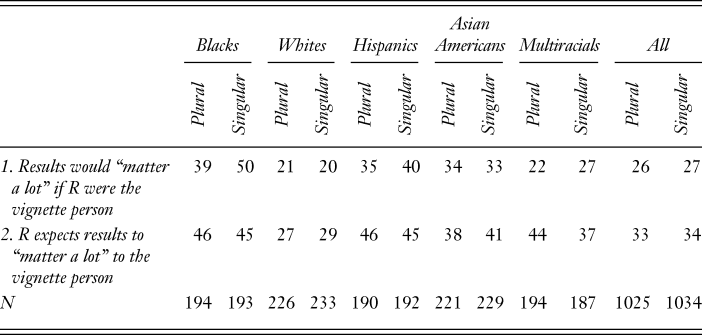
We turn finally to the third set of responses to the vignette, which queried respondents’ views about the impact of the DNA ancestry test result on their self-understanding or identity. Our goal for this item was to operationalize the rather abstract question of whether Americans see race or ethnicity as purely a social construction or whether, in their view, it has a meaningful biological or “factual” component. Since this is the most cognitively difficult item, we offered only two stark choices rather than a 7-point range: would the test results “matter a lot/not matter at all to your [or to his/her] identity?” Table 4 shows the results.
Impact on Identity of Vignette DNA Test Results, 2010 (% of Respondents in Each Cell)
The results support H1. Averaging across the four vignettes asked of each respondent, 45% of African Americans agree with the strong statement that the test results would “matter a lot” to identity. That compares with 41.5% of Latinos, 36.5% of Asian Americans, 32.5% of multiracials, and only 24.5% of Whites. These differences are highly statistically significant. For example, for the multiplicity prompt asking respondents to identify with the vignette character, the differences between Blacks and Whites (Chi-square statistic = 18.9, p-value = 0.00), Hispanics and Whites (Chi-square statistic = 12.7, p-value = 0.00), and across all of the groups (Chi-square = 28.9, p-value = 0.00) are significant at conventional levels. The desire not to be associated with the old racial science probably leads some Whites to deny that genetic inheritance affects identity—but social desirability seems unlikely to explain why almost twice as many Blacks as Whites agree that knowing one’s genetic heritage would strongly affect one’s self-understanding. Other responses to this survey have reassured us about its external validity, so the relatively and absolutely high level of Black agreement that DNA tests matter to identity seems worth taking seriously.
As before, looking at rows 1 and 2 separately helps to refine the general finding of support for H1 that we have seen so far in Figure 4. Members of all groups except African Americans are more likely to claim that DNA test results would matter to other people than to admit that they would matter to themselves. Put the other way around, Blacks are the only group among the five to agree that they would be as much influenced by ancestry tests as they would expect others to be. The consistency of this pattern is reassuring from the perspective of internal validity, since it implies that respondents were meaningfully distinguishing between projecting themselves into the vignette and predicting how others might react. Why both White and non-White Americans (except Blacks) think DNA ancestry tests will matter to others but not themselves remains one of the many topics for further exploration that this research has opened up. The central point is clear, however: As our theory proposed, DNA ancestry tests are especially if not uniquely meaningful to Black Americans, many of whom want to find links that can repair the broken chain caused by the Middle Passage and enslavement.
H2: Singular and Multiple Ancestries
Given evidence of Blacks’ unusually strong interest in DNA ancestry testing, we can turn to H2: African Americans are especially favorable toward tests that reveal a single ancestral line, and are more favorable to racial singularity than are all other groups except White Americans. Unlike White Americans, however, African Americans are also favorable toward DNA ancestry tests that reveal multiple ancestral lines.
As with H1, broadly framed survey questions provide initial support for H2. African Americans have long expressed a strong sense of group solidarity: across ten rounds of the GSS from 1996 through 2014, with a total sample size of 14,000, on average three in five Blacks report feeling “very close” to other Blacks (9 on a 9-point scale). About a third of Whites on average feel equivalently close to other Whites. One must discount the low White results to some unknown degree because of social desirability effects; the only conclusion one can draw with confidence is that of Black solidarity.Footnote 26 Similarly, a 2004 GSS item asked which, on a list of ten options, is “most important to you in describing who you are.” Respondents could give three answers; combining respondents’ first, second, and third choices, two-fifths of Blacks and “others” (mostly Hispanic), but only a tenth of Whites, chose their race or ethnicity.
But Blacks’ racial consciousness and solidarity need not imply rejection of multiracialism or of an identity as mixed race. From 1982 forward, every relevant GSS survey has shown stronger support among Black than White respondents for interracial marriage, by twenty percentage points or more in the first decade. Blacks’ support eventually became almost unanimous. In contrast to the opposition of almost all members of the Congressional Black Caucus on this issue, as early as 1995 half of Black, compared with just over a third of White, respondents to a Newsweek poll agreed that “the U.S. Census should add a ‘multiracial’ category to population surveys so some people aren’t forced to deny part of a family member’s heritage by having to choose a single racial category” (authors’ analysis of Newsweek (1995)).
These data underlie the second hypothesis, predicting both Black endorsement of racial singularity and Black acceptance of racial mixture or multiple heritages in DNA ancestry tests. Given the weight of social desirability, we do not anticipate strong support for singular ancestry from Whites despite our theoretical prediction. All of those expectations are borne out in the vignette survey. Consider again Table 3. Averaging across both “self” and “other” vignettes, African Americans are more likely than most other groups to express pleasure at single-continent-of-origin outcomes. Just over three-fifths (61.5%) do so, compared with the same proportion of Hispanics (60%), but only 48% of multiracials and 45.5% of both Whites and Asian Americans.Footnote 27 The difference between Blacks and Whites, as we noted above, is highly significant.
However, and crucially for H2, Blacks are also more likely than some other groups to express pleasure at multiple-continent-of-origin outcomes. The proportion is smaller, 41.5%, but it remains higher than among Whites (28.5%) or Asian Americans (30.5%).Footnote 28 Support for H2 is reinforced by looking at the other end of the scale, at the proportions expressing displeasure at the purported DNA test results (results not shown). As our theory would suggest, more Whites (17%) and Asian Americans (20%) than Blacks (13%) were displeased with tests showing a plural ancestry for themselves as the vignette subject.Footnote 29Table 3, row 2, shows that African Americans expect members of other races to be displeased with plural results—again suggesting that Blacks see themselves as distinctive, in this case distinctively open to multiple ancestries.Footnote 30
With regard to the question of whether the respondent trusts the DNA ancestry test results, we have already reported very little difference across groups for H1. A similar pattern holds with regard to H2 (results not shown). As we reported above, overall three-fifths of the respondents would find the DNA test trustworthy. There are only minor differences across the five groups with regard to whether respondents would find test results showing either singular or multiple ancestry compelling. Blacks are in the middle of the range.
The most interesting feature of this question is its reinforcement of the pattern found in the newspapers’ portrayal of DNA and race. As Table 1 and Figure 2 showed, the media consistently report more single group than multiple group results in articles on genetics and race. We cannot claim causality here, but we note that across the board, respondents trust single group results even more than they trust plural group results. Overall, 54% find the latter believable compared with 71% who find the former believable; the difference is highly statistically significant. Furthermore, as Table 3 shows, nine of the ten within-group comparisons show that respondents would be more “pleased” with singular than with plural test results in the vignettes. Thus, in addition to revealing systematic differences between Blacks and other groups of Americans, the vignette study shows that DNA ancestry tests, like newspapers, do more to reinforce than to dissolve racial categories in the understanding of the American public.
Returning directly to H2, the results in Table 4, with regard to identity or self-understanding, again show Blacks’ distinctive commitment to singular racial ancestry in combination with their acceptance of multiple heritages. Averaging across the two conditions (how would you be affected, how would another person be affected), Blacks are much more likely than any other group to say that discovery of a singular ancestry would affect their identity “a lot.” Agreement ranged from 47.5% among African Americans down to 24.5% among Whites.Footnote 31 The difference in means in responses between Black and White respondents on this dimension is highly significant (t-statistic = 6.94, p-value = 0.00). Crucially for H2, the same result holds for the discovery of a plural ancestry; Blacks anticipate more impact regardless of what the DNA test reveals. Agreement that a multiple heritage would affect identity ranges from 42.5% among African Americans down to 24% among Whites, with a difference-in-means t-statistic of 5.83 (p-value = 0.00).Footnote 32
As our theory predicted, the most historically subordinated group held a stronger commitment to its denigrated racial label than other groups did with regard to their own labels, and it held a stronger commitment to its denigrated racial label than to the proffered alternative. But, arguably due to their desire to mend the broken chain of ancestral connections, Blacks’ positive response to racial singularity was almost matched by their positive response to racial multiplicity.
EXPLORING RESPONSES TO DNA ANCESTRY TESTS
Both hypotheses have received strong support; despite the history of racial science, Blacks are more pleased with and responsive to DNA ancestry testing than are other groups, and Blacks’ search for roots enables them to engage positively with the ideas of both single and multiple ancestral lines. However, in the time-honored tradition of social science, the vignette survey raises at least as many questions as it answers. Why are many Americans, especially African Americans, open to the links between race and biology that are implicit in DNA ancestry tests, and why are they attracted to multiple as well as singular racial lineages? Newspaper stories about individuals who have actually done DNA ancestry testing provide some clues to addressing the puzzles opened by the vignette survey described above. They also enrich our understanding of what the print media are teaching Americans about the links between genetics and race.
We explore these questions with another content analysis of a different set of newspaper articles from those described above. We again used Lexis-Nexis Academic’s database of U.S. newspapers and identified articles through search terms meant to be somewhat but not too overinclusive. We began with the same search terms as in the automated content analysis, but constrained the search to include only articles that also used (in the same sentence) stems related to particular groups: Asian, Asian American, White, Pacific Islander, Native American, Alaskan Native, Latino/a, Hispanic, African American, Black, and Afro American (and their plurals or other variants). We again included keywords in the query to eliminate many extraneous articles.
The search yielded 717 articles from 1980 to 2009; its manageable size permitted hand coding and qualitative evaluation. The unit of analysis is unique profiled individuals, of whom there are 131. Eighty-three (64%) identified as African American, thirty-four (26%) as White, six as Hispanic, seven as racially mixed, and one was unknown.Footnote 33 This is far from a random sample of test-taking experiences since the analysis reflects five layers of selection: people who took a DNA ancestry test; whether they took Y-DNA, mt-DNA, or autosomal tests; whether a journalist profiled them; what they told the journalist; and what appeared in the newspaper. These articles tell us about the social practices of a self-selected group as filtered through journalists’ stories—not about demographics or genealogy.
Nonetheless, the stories are illuminating, and so far as we know this is the first and only complete set of print media articles about DNA ancestry testing. Using the same coding rubric as with the automated content analysis (discussed above), DNA tests (presumably autosomal) showed mixed ancestry, usually African and European, for two-fifths of the Blacks (33 people). Tests for the remaining three-fifths (50 people) pointed to a singular heritage, generally by providing a link to a tribe or geographic area in Africa through Y-DNA or mt-DNA testing. In contrast, test results for a higher proportion—almost three-fifths—of the Whites (19 people) showed multiple ancestries, as did test results for all six Hispanics. Overall, singular racial ancestry predominated over multiple ancestries (56% and 44% of the stories, respectively); with some exceptions, test-takers—or the journalists who write about them—seem more interested in information about a single maternal or paternal lineage than in the range of their heritage.Footnote 34
From a qualitative perspective, testers’ responses to the DNA results clustered in three themes, each of which evoked both positive and negative reactions. First, some people simply wanted any relevant information, and were either pleased to receive it, dismayed that they did not receive what they were looking for, or did not trust it. This reason corresponds to the “broken chain” theory behind our first hypothesis—members of some groups turn to DNA ancestry testing because they cannot use conventional genealogical techniques to trace their roots, and Blacks have a uniquely strong motivation to use the only individual resource not stolen by slave traders. On the positive side, “when a radio host in Chicago revealed at a Kwanzaa festival last year that he was of Mende descent, several attendees who had received the same DNA result gathered to trade notes, a moment some said they found especially meaningful because slave owners made a point of separating Africans from the same tribes to prevent them from communicating” (Harmon Reference Harmon2005). On the negative side, some articles reflected the view of the author Pearl Duncan, who was “terrified of finding a racist or a separatist on my family tree” (Duncan Reference Duncan2004). Even she, however, found a source of meaning in the use of DNA tests, asserting that she nonetheless “would not be stopped from claiming my heritage” (Duncan Reference Duncan2004).
A second theme is more focused—a desire to know and explore the range and relative proportions of ancestral lines. People with this motivation use autosomal tests, although that technical fact is seldom reported in the newspaper stories. This motivation corresponds to the second half of the theory behind H2: people in a socially inferior position are more likely to be positive about, or at least accepting of, multiple ancestral lines than are people in a socially superior position.
Results showing multiplicity may be revelatory. One tester told a reporter that, after explanations of how DNA tests work and what her own surprising results showed, “her perspective on race has totally changed. ‘It’s a real paradigm shift. I will never look at race in the same way’” (Karen Hill, quoted in Zamora Reference Zamora2006). Even more dramatically, Wayne Joseph “grew up a Black American” with a strong racial identity. He expected his DNA test to “come back about 70 percent African and 30 percent something else.” Upon receiving the results, however, “I was floored” (Kalb Reference Kalb2006, p. 55). He was found to be 57% Indo-European, 39% Native American, and 4% East Asian—no African ancestry at all. “For almost a year, Joseph searched his soul. . . . Before the test, ‘I was unequivocally Black. Now I’m a metaphor for America’” (Kalb Reference Kalb2006, p. 55).
Results showing multiplicity may also cause dismay; Snoop Dogg was not the only tester eager for a re-vote upon discovering how much of his ancestry was White. One member of a genealogical group “was crushed to learn that her line of male ancestors traced back to a White Italian, and not a Black resident of Madagascar as she had expected. ‘She couldn’t get past it. . . . She ordered more tests’” (Willing Reference Willing2006, p. 4A, quoting a testing expert). Lisa Lee, a former Black Power activist, similarly discovered that she had no African ancestry on her father’s side. “What does this mean; who am I then? For me to have a whole half of my identity to come back and say, ‘Sorry, no African here,’ it doesn’t even matter what the other half says. It just negates it all. . . . It doesn’t fit, it doesn’t feel right” (Harmon Reference Harmon2006, p. 18).
A third theme focused on a yet more specific set of links in the broken chain—a search for information about particular genealogical lines or ancestral locations. People with this goal use mt-DNA or Y-DNA tests. Their motivation corresponds to the first half of the theory behind H2: People seeking to either reinforce social superiority or counteract social inferiority are especially pleased to discover a lineage that they can cherish. Mika Stump grew up in foster homes, knowing nothing of her roots except that she is Black. A DNA test showed “strong similarities between Stump’s genetic code and the Mende and Temne people of Sierrra Leone. . . . Now, ‘I have a place where I can go back and say, “This is who I am; this is my home.” That’s something I never, ever expected to say’” (Willing Reference Willing2006, p. 4A). Reverend Al Simpson of Chicago traveled to Sierra Leone in order to give tribal elders of the village of Lunsar the test results showing his Temne lineage. “‘Five hundred years ago my DNA was removed from here by slave traders and taken to America, so I’m coming back for my seat. My seat’s been vacant’” (Gibson Reference Gibson2008). He asked for a Temne name in order “‘to reclaim what was taken away from me.’” On the other end of the social hierarchy, the Centre for Forensic Investigation at Glasgow Caledonian University announced its “intention to have DNA swabbing kits in all the tourist information offices and hotel lobbies across the UK, so people can go and pick up a kit for a few pounds then post it off to us and we will do the DNA tests for them.” The Scottish tourist industry hopes that “DNA testing will be a draw for ancestral tourists who might want to ‘walk in the footsteps of their ancestors’” (Lei Reference Lei2007).
The search for particular connections may extend beyond the location of one’s ancestors to contemporary family ties. Testing revealed a close genetic link between Herman Mason, Jr. and Augustin Gouayou, a recent immigrant to the United States. “Gouayou, 36, can hardly believe his good fortune. The reunion has given childhood lessons about the slave trade and the African diaspora more personal meaning. ‘You can't change history, but for me that was one, if not the best moment I've gotten since I came here [to the United States],’ Gouayou said. This milestone now has the Barton-Thomas clan planning a trip to Cameroon,” while Mason “is even more driven to learn more about his family's history, particularly its African and slave roots, and document it on paper and film. ‘There will be plenty for me to research for the rest of my life’" (Reid Reference Reid2007, p. 1B). Another example: Although Pat’s genealogical research persuaded her of “Hottentot” ancestors, a mitochondrial DNA test showed descent from the Akan of Ghana. She has since “established a friendship with a Ghanaian neighbor and has embarked on research into the history and culture of the Akan. . . . ‘I bought my first Ghanaian flag last year’” (Nelson Reference Nelson2008, pp. 770-771).Footnote 35
The themes may, of course, overlap. Even as a ten year old, Gates sought general information about his forebears, more focused information about his African heritage, and particular knowledge of specific ancestors: “I was searching not just for the names of my ancestors but for stories about them, the secrets of the dark past of Negroes in America. . . . Eventually . . . I even allowed myself to dream about learning the name of the tribe we had come from in Africa” (Gates Reference Gates2008, p. 5).
Overall, the themes revealed by these articles parallel and give depth to the themes explored in the quantitative analyses of the vignette survey. For the most part, profiled African Americans express enthusiasm about the use of genetic ancestry testing, particularly insofar as it can help bridge the chasms left in their genealogical record. In addition, we find engagement in the articles with both ancestral singularity and ancestral multiplicity.
CONCLUSION
Genetic ancestry testing is typically described as recreational, and people do indeed give test kits to their relatives for Christmas. Roughly a million people have submitted such kits to testing companies over the past decade—a large sample, but a tiny fraction of the world’s, or even the United States’, population. So why should scholars other than genealogists or genetic anthropologists explore the larger meanings underlying the enterprise?
We see several reasons. First, the number of participants in genetic genealogy and DNA ancestry testing may well grow. “Genotyping cost is asymptoting to free,” such that within a generation “it will be easier to know someone’s genome than their name” (Altman Reference Altman2008). Ancestry testing can now be done for roughly $100. As costs have decreased, accuracy, speed, and the quantity and quality of comparison samples have dramatically improved (Royal et al., Reference Royal, Novembre, Fulleron, Goldstein, Long, Bamshad and Clark2010; Wagner et al., Reference Wagner, Cooper, Sterling and Royal2012). Market analysts predict that genealogical research will continue to grow rapidly, and “the speed and enthusiasm with which the American genealogy community has embraced genetics has been truly astounding” (Sykes Reference Sykes2012, p. 72).
As it becomes cheaper and technically better, DNA ancestry testing may not only expand among individuals but also develop broad policy implications. “[D]eterminations of ancestry or ‘blood’ affect citizenship rights throughout the world; the right of return of displaced people; membership in tribal bands . . . and affirmative action eligibility. . . . Determining one’s ancestry through genetic evidence would fundamentally transform these types of political identity. . . . Genetics can affect questions of ethnic identity . . . religious identity . . . family identity or caste” (Elliott and Brodwin, Reference Elliott and Brodwin2002), p. 1469). Several countries are experimenting with the use of DNA tests to decide eligibility for inheritance or immigration, and Americans’ responses to DNA ancestry tests might feed into debates about the role of multiracialism in collecting data and determining group and individual rights.
Most important here is the fact that purportedly recreational genetic testing speaks to and may help to shape individuals’ moral and ideological understandings of race and selfhood. “DNA testing results have the power to potentially reshape how individuals think of themselves and their ethnic heritage. . . . Genetic ancestry has the potential to separate us from, and bind us to, specific groups of people. . . . We now are likely at the tip of a potential paradigmatic shift in how human ties are viewed and measured” (Hirschman and Panther-Yates, Reference Hirschman and Panther-Yates2008, p. 64). For some, that is a terrifying prospect: “[T]he use of markers for individual identification”—that is, DNA ancestry testing—risks “the subtle, sometimes inadvertent, reinscription of race at the molecular level” (Duster Reference Duster2006, p. 428).Footnote 36 Similarly, “defining identity in genetic terms creates a biological essentialism that is antithetical to the shared political values that should form the basis for unity” (Roberts Reference Roberts2011, p. 255). For others, this potential paradigmatic shift is enormously attractive: If Americans are, in the Reverend Martin Luther King, Jr.’s terms, “caught in an inescapable network of mutuality, tied in a single garment of destiny” (King Reference King1963), then accepting the idea that socially-defined races have a biological element can work to the benefit of all. “Black and white citizens are bound together in this country at the most fundamental level possible—the level of the genome. And it turns out that Dr. King’s stirring conclusion—that ‘whatever affects one directly, affects all indirectly’—has been literally true genetically of these two groups of the American people for a very long time” (Gates Reference Gates2013).Footnote 37
Two media content analyses and two new surveys cannot adjudicate these widely disparate views of the implications of DNA ancestry testing. Our evidence nonetheless enables us to conclude that, at least at the individual level, the dire concerns are not empirically supported. The media emphasize single rather than multiple lineages, but they also include stories about plural ancestry. The GSS shows widespread public support for DNA ancestry testing, especially though not uniquely among African Americans. The vignette survey shows African Americans to be disproportionately pleased with and influenced by hypothetical results of such a test compared with other Americans, and to embrace multiple ancestral lineages as well as singular connections to Africa. People want to forge some of the links in the broken chain of their heritage, even if the result is not exactly what they had hoped for. In so doing, the American public seems prepared to absorb the information available in this new technology without either succumbing to the biologization of race or drawing apparently immutable boundaries around groups. For most people, ancestry testing is “one part of who you are, not your identity, only as much of your identity as you want it to be.” Whether that clear-headed view persists once it becomes “easier to know someone’s genome than their name” remains an open question.
ACKNOWLEDGMENT
Thanks to Natalie Padilla, Andrew Benitez, Anna Remus, Claire Wheeler, and especially Alex Crabill for invaluable research assistance. We are grateful for the help of Patrick Moynihan, Jeremy Freese, Penny Visser, two TESS reviewers, and the Knowledge Networks staff on the vignette survey. Further thanks to Eleanor Singer, Gail Henderson, Tom Smith, and Peter Marsden for enabling and helping to develop the General Social Survey items, and to anonymous reviewers, including two at the Du Bois Review, who helped us to develop and sharpen our arguments. We want to express deep appreciation to the many people who have shared their expertise on genomic science; we promised confidentiality, so we cannot thank them by name. This research was sponsored by the National Science Foundation through TESS (Time-sharing Experiments for the Social Sciences), the General Social Survey, and the Robert Wood Johnson Foundation through its Investigator Award in Health Policy Research.