Introduction
Dengue is a major emerging and re-emerging arboviral disease of public health importance in the tropical regions of the world, with high morbidity and mortality rates involving approximately 2.5 billion people, who are at risk of becoming infected with the disease (WHO, 1981). Dengue prevention and control rests mainly on the control of the Aedes aegypti (Linn.) mosquito vector, as there is no available vaccine. In the 1950s, as part of its Ae. aegypti eradication campaign, the Pan American Health Organization (PAHO) relied on the use of dichlorodiphenyltrichloroethane (DDT) insecticide; but failure resulted, in part, due to the development of resistance in the Ae. aegypti populations (PAHO, 1994).
DDT resistance in the Caribbean was first documented in a larval strain from Trinidad in 1954, when workers noticed low mortality levels of Ae. aegypti larvae in treated containers, and this resistance was later confirmed through laboratory investigations (Gilkes et al., Reference Gilkes, Kellett and Gillette1956). With the manifestation of resistance to DDT and its subsequent removal from the list of approved/recommended insecticides due to its impact and persistence in the environmental and their associated problems came the need for finding suitable alternative insecticides. Organophosphate (OP) insecticides, such as malathion and temephos, have since been used in Ae. aegypti control programmes in the Caribbean for the past 50 years; but, without suitable management practices, resistance has developed to these OPs (Rawlins, Reference Rawlins1998).
Pyrethroid insecticides (PYs) have been proposed as ‘new’ insecticides to replace the OPs to which resistance is already widespread. To date, no major work has been done on the surveillance of resistance of Trinidad and Tobago Ae. aegypti populations to PYs nor on the current status of DDT resistance. To fill this gap, this study was conducted, to investigate the status of DDT and PY resistance in Trinidad and Tobago populations of Ae. aegypti and to identify the biochemical mechanisms involved.
Methods
Mosquitoes
Populations of Ae. aegypti mosquitoes were collected as eggs from eight sites in Trinidad and one in Tobago, by use of enhanced ovitraps (Reiter et al., Reference Reiter, Amador and Colon1991). Four populations were collected from the north-western region of Trinidad (Haleland Park, Sea Lots, St Clair, St James); two populations from the eastern region (Curepe and Valencia) and one population each from the central (Spring Vale) and southern (San Fernando) regions of the island. The Tobago strain was collected from a locality in the central region of Tobago. The CAREC strain Ae. aegypti, a known reference susceptible laboratory strain from Trinidad, which has not been exposed to insecticides for over 30 years, was used as the control reference strain in all experiments (Rawlins, Reference Rawlins1998). The Rockefeller (ROCK) strain, which is the ‘universal Ae. aegypti reference strain’, is included as a comparator for the CAREC reference strain.
Larval bioassays
Bioassays were conducted on late 3rd to early 4th stage larvae of the F2–F4 generations of Ae. aegypti (Belkin et al., Reference Belkin, Heinemann and Page1970), using the method developed by the Centers for Disease Control and Prevention (CDC, 2004). This method is a variation of the WHO bioassay (WHO, 1981) and follows the same principles as the CDC bottle bioassay for adult mosquitoes (Brogdon & McAllister, Reference Brogdon and McAllister1998b). Diagnostic dosages of DDT, deltamethrin and permethrin were first determined by exposing 20±5 larvae of the CAREC strain, in replicates of four, to six concentrations of each insecticide (0.01, 0.1, 0.2, 1.0, 2.0 and 2.5 mg l−1) and recording mortality counts at 15 min intervals until all larvae died or up to two hours after the start of the experiment. The diagnostic dosage (DD) was established as the concentration of each insecticide beyond which further increases did not result in a faster kill of mosquitoes (saturation point). Populations of Ae. aegypti larvae were then subjected to the known DD of each insecticide and mortality counts recorded as previously stated. The total number of mosquito larvae in each cup was recounted, and the percentage mortality calculated for each 15 min interval.
As an internal control, the CAREC strain larvae were exposed to the DD, for the respective insecticide being tested, simultaneously with each assay. Also, for each assay, a negative control was included which consisted of the addition of 1 ml of acetone, instead of insecticide, to a cup containing 20±5 larvae of the Ae. aegypti population being tested. Insecticides used in bioassays were obtained from Chem-Service, West Chester, PA, USA.
Biochemical assays
Thirty mosquito larvae from each strain were assayed for α-and β-esterases, mixed function oxidase (MFO) and glutathione-S-transferase (GST) enzymes. Each larva was homogenised in 100 μl of potassium phosphate (KPO4) buffer (6.6 g dibasic potassium phosphate per 1.7 g monobasic potassium phosphate per 1000 ml distilled water (dH2O); pH7.2) and then diluted to 2 ml with the same buffer. Each mosquito was analysed in triplicate with 100 μl of mosquito homogenate and transferred to three wells on a 96 well flat-bottomed microtitration plate. Absorbance levels were measured spectrophotometrically with a microplate reader (Spectra MAX®), at wavelengths indicated for each enzyme, and the mean absorbance calculated based on data for the three replicate wells per mosquito. Procedures followed were based on slight modifications of those detailed in previous studies (Brogdon et al., Reference Brogdon, McAllister and Vulule1997). Replicates which had a variation coefficient higher than 0.20 were discarded to eliminate differences due to manual errors. Reagents and substrates for biochemical assays were provided by Sigma (St Louis, MO).
α-esterases assay
One hundred microlitres (100 μl) of α-naphthyl acetate (56 mg per 20 ml acetone per 80 ml KPO4 buffer) was added to each plate well containing 100 μl of homogenate. The preparation was incubated at ambient temperature for 20 min, after which 100 μl Dianisidine (100 mg 0-dianisidine tetrazotized per 100 ml dH2O) was added to each well. After a further 4 min incubation period, absorbance was read at 620 nm.
β-esterase assay
To each 100 μl of homogenate was added 100 μl of β-naphthyl acetate (56 mg per 20 ml acetone per 80 ml KPO4 buffer). The preparation was incubated at ambient temperature for 20 min after which 100 μl Dianisidine (100 mg 0-dianisidine tetrazotized per 100 ml dH2O) was added to each well. After a further 4 min incubation period, absorbance was read at 540 nm.
Mixed function oxidase (MFO) assay
This assay measures the haem content of the mosquito, thus enabling an indirect estimate of the activity of the cytochrome P450 enzyme with which haem is mainly associated. For this assay, sodium acetate (NaOAC) buffer was prepared by mixing 83 ml of 3M sodium acetate (NaOAc) with 900 ml dH2O and then adjusting the pH to 5. Into each plate well was aliquoted 200 μl Tetramethyl-Benzidine Dihydrochloride (TMBZ- 50 mg 3,3′,5,5′- Tetramethyl-Benzidine Dihydrochloride per 25 ml Methanol per 75 ml 0.25M NaOAc buffer). To this was added 25 μl 3% hydrogen peroxide (H2O2). The plate was then incubated for 10 min at room temperature and then read with a 620 nm filter.
Glutathione S-transferase assay
To each 100 μl mosquito homogenate was added 100 μl reduced glutathione (61 mg reduced glutathione per 100 ml KPO4 buffer) and 100 μl cDNB (20 mg 1-chloro-2,4′-dinitrobenzene per 10 ml acetone per 90 ml KPO4 buffer). Assay was read immediately (T0) and then again after 10 min, using 340 nm filter. The T0 reading was subtracted from the T10 reading and this was used in the statistical analyses.
Total protein assay
The protein microplate assay measures the amount of total proteins in each mosquito. To 20 μl aliquots of mosquito homogenate was added 80 μl KPO4 buffer and 200 μl protein dye reagent (20 ml protein dye concentrate per 80 ml dH2O). Absorbance was read immediately at 620 nm (Brogdon, Reference Brogdon1984a,Reference Brogdonb).
Controls
Three positive and negative controls were used per plate. Positive controls for α-esterase, β-esterase and MFO were 100 μl of α-naphthol acetate solution at 0.5 μg μl−1, β-naphthol acetate solution and Cytochrome-C solution at 0.1 μg μl−1, respectively. For the total protein assay, 20 μl of 1 μg μl−1 bovine serum album (BSA) was used as the positive control. However, standard substrates are not available for GST, so negative controls only were included in these assays. KPO4 buffer, in the same volumes as that of the positive controls, was used as the negative control in all assays, and controls were treated in the same manner as the homogenates. The CAREC reference susceptible strain was used as the standard strain for all the biochemical assays.
Data analyses
Resistance thresholds and susceptibility status
Graphs of time vs percentage mortality were constructed for the CAREC and ROCK reference susceptible Ae. aegypti strains, and the resistance threshold (RT), the time in which 98–100% mortality was observed, was ascertained for each insecticide. Mean percentage mortalities calculated for each population were compared to the CAREC and/or ROCK strain at the respective RT and populations with survivors beyond the RT were considered to be resistant (Brogdon & McAllister, Reference Brogdon and McAllister1998b). The experiments were allowed to run until the cut-off time of 120 min, and mean percentage mortalities were again recorded at the end of the experiments. At both the RTs and end of experiments, mosquito populations were assessed as resistant or susceptible using the criteria defined by Davidson & Zahar (Reference Davidson and Zahar1973) and modified by WHO (1998). Mosquitoes showing 98–100% mortality were classified as ‘susceptible’; 80–97% mortality, ‘incipient resistance’; and <80% mortality, ‘resistant’.
Biochemical assays
Absorbance values which were obtained for mosquito replicates were corrected in relation to the volume of mosquito homogenates, the enzyme activity unit and the total protein content of each mosquito. The means of enzyme activities for each Ae. aegypti larval strain were compared with the susceptible CAREC and/or ROCK strain by Kruskal-Wallis and Tukey's non-parametric tests (P<0.05).
Results
Larval bioassays
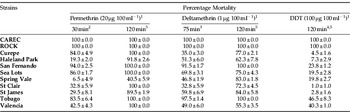
Diagnostic dosages for DDT, permethrin and deltamethrin were determined as 1.0 mg l−1, 0.2 mg l−1 and 0.01 mg l−1, respectively. Similar susceptibility profiles were observed in both the ROCK and CAREC populations to all three insecticides, and percentage mortalities of all populations at the established RT for each insecticide are presented in table 1. The established RT for DDT was the same as that found at the end of the experiment, that is, with respect to cut-off time (two hours) and strong resistance to DDT in the Trinidad populations with percentage mortalities ranging from 1.0% (St Clair) to 40.3% (Valencia) (table 1).
Mean Percentage Mortalities (±SEM) of Aedes aegypti larval strains to DDT and Pyrethroids.

1 Diagnostic dosages.
2 resistance threshold for Permethrin, 30 min.
3 resistance threshold for Deltamethrin, 75 min.
4 resistance threshold for DDT, 120 min.
5 cut-off time for end of experiment.
Resistance status: resistant <80% mortality; incipiently resistant 80–97% mortality; susceptible ≥98% mortality.
At an RT of 30 min, five populations were resistant to permethrin with percentage mortalities ranging from 6.5% (Spring Vale) to 42.5% (Valencia). The Curepe, Sea Lots and San Fernando populations were incipiently resistant to permethrin with mortalities of 84.0%, 86.0% and 94.0%, respectively (table 1). At the two-hour end of the experiments, the Spring Vale population was the only one which showed resistance to permethrin (40.5% mortality). The St James and Haleland Park populations were incipiently resistant, while all other populations achieved 100% mortality (table 1).
Resistance to deltamethrin was evident at an RT of 75 min with all populations, except San Fernando (91.5% mortality), having mortalities ranging from 32.8% (St Clair) to 69.8% (Sea Lots) (table 1). After two-hour exposure, five populations were still resistant to deltamethrin (<80% mortality), while the Spring Vale and St James populations showed incipient resistance with mortality levels of 83.0% and 84.0%, respectively. The San Fernando strain was the only Trinidad population to achieve 100% mortality (table 1).
The Tobago strain, with 46.5% mortality, was resistant to DDT but incipiently resistant to permethrin (83.5% mortality) and susceptible to deltamethrin (97.5% mortality). At the two-hour cut-off time, the Tobago population had 100% mortality to permethrin and deltamethrin (table 1).
Biochemical assays
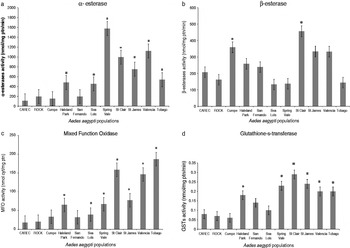
Results showed that there was an overall increase in activity levels of α- and β-esterases, MFO and GST enzymes in Trinidad and Tobago Ae. aegypti populations (fig. 1). The mean activity levels of α- and β-esterases in the CAREC reference susceptible strain were 109.76 and 207.53 nmol mg−1 ptn min−1, respectively. Increases in α-esterases activity were observed in all Trinidadian populations, with the highest mean activity seen in the Spring Vale population (1578.53 nmol mg−1 ptn min−1) and the lowest in the Curepe population (153.16 nmol mg−1 ptn min−1). The Curepe population was the only one with α-esterases levels which were not significantly different from those in the CAREC reference strain (P>0.05) (fig. 1a).
Enzyme activity levels in Trinidad and Tobago populations of Aedes aegypti. Aedes aegypti populations with enzyme activity levels significantly different from the CAREC reference susceptible strain are marked with . (a) α-esterase enzymes, (b) β-esterase enzymes, (c) mixed function oxidase enzymes (MFOs), and (d) glutathione-s-transferase enzymes (GSTs). Error bars indicate standard error of the mean.

The Sea Lots (132.88 nmol mg−1 ptn min−1) and Spring Vale (137.17 nmol mg−1 ptn min−1) populations showed lower levels of β-esterases activity than the CAREC strain, albeit not significantly different (P>0.05) (fig. 1b). All other populations had elevated levels of β-esterases ranging from 238.71 nmol mg−1 ptn min−1 (San Fernando) to 456.66 nmol mg−1 ptn min−1 (St Clair). The Curepe and St Clair populations were the only ones in which β-esterases activity was significantly higher than the CAREC strain (P<0.05) (fig. 1b).
MFO and GST activity levels in the CAREC strain were 17.76 nmol cyt mg−1 ptn and 0.08 nmol mg−1 ptn min−1, respectively. All Trinidadian populations, except Haleland Park, had significantly elevated levels of MFO enzymes ranging from 31.81 nmol cyt mg−1 ptn (San Fernando) to 158.83 nmol cyt mg−1 ptn (St Clair) (P<0.05) (fig. 1c). With respect to GST enzymes, the Curepe population was the only one which had lower levels than the CAREC strain, whereas all others, except San Fernando and Sea Lots, had significantly elevated GST levels ranging from 0.18 nmol mg−1 ptn min−1 (Haleland Park) to 0.29 nmol mg−1 ptn min−1 (St Clair) (P<0.05) (fig. 1d).
The Tobago population had elevated levels of α-esterase (538.53 nmol mg−1 ptn min−1), MFO (186.77 nmol mg−1 ptn min−1) and GST (0.20 nmol mg−1 ptn min−1) enzymes which were significantly different from levels observed in the CAREC reference susceptible strain (P<0.05) (fig. 1). However, the CAREC strain had higher levels of β-esterases than the Tobago population (fig. 1b).
Discussion
Caribbean populations of Ae. aegypti have been shown to be resistant to DDT since the 1950s (Gilkes et al., Reference Gilkes, Kellett and Gillette1956), which resulted in the subsequent introduction of Organophosphorous (OP) insecticides for vector control programmes, but resistance quickly developed to these insecticides (Rawlins, Reference Rawlins1998). Pyrethroid (PY) insecticides were later introduced, but resistance was soon reported in Ae. aegypti populations from Puerto Rico (Hemingway et al., Reference Hemingway, Boddington and Harris1989), the Dominican Republic (Mekuria et al., Reference Mekuria, Gwinn, Williams and Tidwell1991) and Cuba (Rodríguez et al., Reference Rodríguez, Bisset, De Armas and Ramos2005). PYs have not been officially introduced for widespread vector control in English-speaking Caribbean countries, but householders have been using them for personal use. In spite of this, however, in a study conducted by Polson et al., (Reference Polson, Rawlins and Hylton2002), resistance to PYs was seen in adult Ae. aegypti populations from some of these countries, including Trinidad. The development of resistance to these insecticides or classes of insecticides threaten the efficacy of vector control programmes which continue to be reliant on insecticidal control and may, therefore, contribute to the continued spread of dengue fever.
The fact that DDT slowly biodegrades in the environment and accumulates in the food chain and tissues of living organisms (Turusov et al., Reference Turusov, Rakitsky and Tomatis2002) suggests its ubiquitous nature. These factors could partially explain the results of the present study, which show that DDT resistance is prevalent in Trinidad and Tobago larval populations of Ae. aegypti, despite it not being used in vector control for over five decades. Resistance could also be due to residue from previous DDT use in vector control and/or agriculture (Diabate et al., Reference Diabate, Baldet, Chandre, Akogbeto, Guiguemde, Darriet, Brengues, Guillet, Hemingway, Small and Hougard2002).
Some populations were highly resistant (<10% mortality), possibly due to more intensive DDT treatment in those areas during the earlier eradication programme and, as a result, may be carrying a DDT-resistant gene since DDT was last used some 50 years ago.
The present results showed that most Trinidad populations were resistant to PYs, except for the Sea Lots and Curepe populations, which were incipiently resistant to permethrin, and the San Fernando population was incipiently resistant to both deltamethrin and permethrin. The Tobago population, while being incipiently resistant to permethrin, was susceptible to deltamethrin. Lower resistance levels in the Tobago population could have resulted from the fact that this population of Ae. aegypti has a shorter history of insecticide exposure, having been re-introduced in the early 1980s after its earlier successful eradication in 1960 (Chadee et al., Reference Chadee, Cornell, Le Maitre and Ferreira1984). Trinidad had also achieved Ae. aegypti eradication in 1960 but was re-infested at least 20 years before Tobago (Yan et al., Reference Yan, Chadee and Severson1998); hence, Trinidad populations have a longer history of exposure to insecticides. The presence of incipient resistance to PYs is an early indication that surveillance of these populations is important to prevent the development of resistance.
The current status of PY resistance could be explained by cross-resistance due to earlier DDT use (Rongsriyam & Busvine, Reference Rongsriyam and Busvine1975) or the increased selection pressure of PYs due to domestic and agricultural use of insecticides and pesticides which are PY-based. DDT and PYs both act on the sodium channels of the central nervous, and the main mechanism which has been linked with DDT/PY cross-resistance is known as knockdown resistance (kdr) (Hemingway et al., Reference Hemingway, Boddington and Harris1989).
Although kdr mechanism may be involved, resistance to DDT and PYs could be due to metabolic detoxification mechanisms (Rodríguez et al., Reference Rodríguez, Bisset, Ruiz and Soca2002).
The most common enzymes which have been implicated in metabolic detoxification associated with DDT and PY resistance are MFOs, esterases and GSTs (Vulule et al., Reference Vulule, Beach, Atieli, McAllister, Brogdon, Roberts, Mwangi and Hawley1999), and elevated levels of these enzymes have been known to enhance the tolerance of insects to insecticides (Brogdon & McAllister, Reference Brogdon and McAllister1998a). Biochemical assays performed in this study demonstrated elevated levels of α-esterase and MFO enzymes in all Trinidad and Tobago Ae. aegypti populations. All populations, except Curepe, showed high levels of GSTs, whereas elevated β-esterases were seen in most populations. The Sea Lots, Spring Vale and Tobago populations were the only ones with decreased levels of β-esterases; and, although these levels were lower than those seen in the CAREC reference susceptible strain, the differences were not significant (P>0.05). These results suggest that detoxification by these enzymes may be involved in DDT and PY resistance. Earlier studies have shown an association between elevated enzyme levels and the manifestation of resistance to DDT and PY insecticides in Ae. aegypti populations (Paeporn et al., Reference Paeporn, Supaphathom, Srisawat, Komalamisra, Deesin, Ya-umphan and Leeming2004; Rodríguez et al., Reference Rodríguez, Bisset, De Armas and Ramos2005). Rodríguez et al. (Reference Rodríguez, Bisset and Fernandez2007) showed varying levels of resistance to PYs in some Latin American strains of Ae. aegypti with resistance to deltamethrin, in particular in the Cuban strains, associated with elevated activity levels of esterases and GSTs. Our study suggests, for the first time, the involvement of detoxification enzymes in DDT/PY resistance in Trinidad and Tobago populations of Ae. aegypti.
The control of Ae. aegypti, the primary vector of dengue in the Caribbean, is mainly reliant on the use of chemical insecticides, even though environmental control through source reduction has been stressed (Rosenbaum et al., Reference Rosenbaum, Nathan, Ragoonanansingh, Rawlins, Gayle, Chadee and Lloyd1995). The choices are limited with respect to the number of insecticides that are available for vector control, and so the fight against dengue is ongoing. With all four dengue serotypes co-circulating in the Caribbean and high infestation levels of Ae. aegypti, increases in the number of cases of the more severe forms of the disease, dengue haemorrhagic fever and dengue shock syndrome, may have devastating effects on the health systems and economy of the region. There is no cure or vaccine for dengue; and, with the main control weapon, insecticides, being compromised by the development of resistance, there is urgent need for sustainable alternative control methods. Our current reliance on chemical insecticides is, therefore, only a short term ‘stop gap’ measure; but, for future programmes, it is, therefore, essential to institute integrated vector control management strategies which are sustainable and involve all stakeholders. Therefore, the results of this study emphasise the need for proper insecticide surveillance programmes which will provide data to guide control programmes in the use and selection of insecticides and other management strategies.
Acknowledgements
The authors would like to sincerely thank the staff of the Insect Vector Control Division of Trinidad and Tobago and the Port of Spain Health Corporation Vector Control Unit for their invaluable assistance in the collection of Aedes aegypti eggs from the field. The authors are also indebted to the Centers for Disease Control and Prevention (CDC) for use of its Entomology Laboratory and resources for the conduct of the experiments. Thanks also to Dr Indira Omah-Maharaj for her useful comments on the manuscript and to the Caribbean Epidemiology Centre (CAREC) for graciously supplying the CAREC reference-susceptible Aedes aegypti strain.