In using the word ‘Oratorium’ in the title of his Christmas Oratorio, bwv248, J. S. Bach acknowledged its gospel narration in the voice of an evangelist and the direct speech of a few interlocutors, features it shares with the Ascension Oratorio, bwv11, and with his settings of the Passion story. But a distinguishing characteristic of the work is its division into six segments presented over a span of twelve days during the observance of the Christmas season, first done in 1734/1735. Bach called each of the units a ‘part’ (pars) designed to stand on its own both in interpretive theme and in musical organization, but the six also fit into a larger narrative and musical scheme encompassing the entire work.
Since the reappearance of the Christmas Oratorio in the middle of the nineteenth century, commentators have sought models for the decision by Bach and his anonymous librettist to spread the oratorio's narration over multiple days. Although several of the proposed antecedents are relevant to some degree, most are fundamentally different in one or more textual and musical dimensions. The biggest problem is that none appears with certainty to have been performed over several days. Despite many hopeful assertions, the proposed antecedents do not really fit, and there does not seem ever to have been a tradition of multi-day Christmas pieces.
In fact there were models for this feature of the Christmas Oratorio: Passion settings designed for or adapted to presentation over multiple days that spread the musical setting of the narrative over Holy Week or all of Lent. There is a larger number of these Passions than has been recognized, and they represent a more significant aspect of central German Passion music than has been understood. These multi-day Passion performances are closely analogous in structure to the Christmas Oratorio, and given that several were probably known to J. S. Bach, they could well have served as models.
The most inviting comparison to the Christmas Oratorio has been the Actus musicus auf Weyh-Nachten by Bach's Leipzig predecessor Johann Schelle. From a textual point of view the comparison is only approximate, as the text of Schelle's work after the opening liturgical formula is drawn entirely from gospel passages and chorale stanzas, and lacks poetic commentary. Bernd Baselt, the work's champion, argued that Schelle's composition represented an antecedent to Bach's oratorio, but he pointed out that there was no reason to assume the older piece had been performed over several days.Footnote 1 None the less, this has been repeatedly proposed in the literature. The work is in three parts, and its gospel narrative consists of the readings from Luke specified for the first and second of the three days of Christmas.Footnote 2 The gospel text in the first part of the Actus musicus corresponds to the reading for the first day of the feast, ending with the chorus ‘Ehre sei Gott in der Höhe’. The reading for the second day, in contrast, is distributed between the second and third parts, displacing a portion of the Christmas 2 reading to Christmas 3 in a hypothetical performance spread over three days.Footnote 3
Even if it is liturgically plausible that Schelle's work was heard over three days, the brevity of the musical setting makes this unlikely. Part 2, consisting of a ten-bar sonata, one gospel verse and single chorale stanza, lasts approximately two and a half minutes and seems unlikely to have stood on its own. I think Schelle's composition was a single-day piece and thus not a model for bwv248's multi-day narrative organization.Footnote 4
Almost inevitably, Heinrich Schütz's Christmas Oratorio has likewise been proposed as a model for Bach's, including with respect to a multi-day presentation.Footnote 5 One problem with this is that except for the opening quasi-liturgical introduction announcing the subject and the closing doxology, the text of Schütz's work is simply the gospel narration of the nativity story; there are no interpolated commentaries of any kind. (The eight little concertos Schütz called ‘intermedii’ are settings of words of direct speech by interlocutors in the story, not interpolations.) The work is thus only loosely comparable to Bach's Christmas Oratorio in this regard. But once again the division of the work over several days is the real problem. At least one writer suggests the possibility of dividing Schütz's composition after ‘Ehre sei Gott in der Höhe’ (presumably because that represents the end of the gospel text for the first day of Christmas), making for a presentation over two days.Footnote 6 I do not see any indication that this was part of the piece's design or (to the limited extent that we know about the work's performance in the seventeenth century) that this was ever done.
The diary of Johann Philipp Krieger's Weißenfels church music performances in the late seventeenth and early eighteenth centuries led Walter Blankenburg to speculate that the lost Christmas works listed there may have been designed for the entire season, and evidently to interpret the Christimas pieces cited there as parts of a multi-day oratorio. Unfortunately, there does not appear to be any evidence to support this suggestion.Footnote 7 One wonders whether the motivation here, as with the works by Schelle and Schütz, is a desire to see Bach's plan for the Christmas Oratorio as part of a tradition.
Claims like this have accumulated. A Christmas oratorio by Friedrich Funke performed in Lüneburg in 1693 is documented in a printed libretto, and this work has recently surfaced among supposed antecedents of bwv248. The libretto's title-page unambiguously describes it as having been performed on the first and second days of Christmas. Of course the gospel readings for those days constitute a continuous narrative, and it is unsurprising that concerted music performed over two days would reflect this division. But a two-day musical setting of the nativity story represents only a loose connection to Bach's Christmas Oratorio, which spans not only the three days of Christmas but all the way to Epiphany as well.Footnote 8
The search for multi-day antecedents has extended beyond Christmas to Antonio Scandello's Resurrection Historia, composed for Dresden around 1570 and widely printed in the seventeenth century.Footnote 9 This responsorial setting, with a monophonic intonation of the Evangelist's words and four-part homorhythmic accounts of the words of others, employs the text of Johannes Bugenhagen's Evangelienharmonie.Footnote 10 The sections into which Scandello's setting is sometimes now divided correspond largely to the gospel readings for the three days of Easter, and it would certainly have been possible to spread the work over several days. As with some of the Christmas pieces, though, this represents simply the succession of gospel readings.Footnote 11 The work was printed in the Leipzig hymnal and liturgical book edited by Gottfried Vopelius in 1682, but shows no division at the points at which Leipzig practice broke the readings for the three days of Easter. The presentation by Vopelius provides no introductions or conclusions other than at the beginning and end of the entire narrative, suggesting that in Leipzig, at least, this work was heard continuously on one day. It is thus difficult to regard Scandello's Easter work as a model for the Christmas Oratorio's presentation over multiple days.
It is not hard to see why writers would hope to find close connections between bwv248 and works by predecessors, particularly iconic ones like that of Schütz. Baselt's view, put forward in connection with Schelle's Actus musicus, is typical in suggesting a line of development of Christmas oratorios – particularly in what he calls a popular or folk-like line (‘volkstümlicher Zug’) – from Rogier Michael in Dresden (represented by a 1602 responsorial setting) in the early seventeenth century through to Bach in the eighteenth.Footnote 12 This idea is everywhere. Ignace Bossuyt writes that ‘A line can be drawn from the Schütz historia via the actus musicus (by Schelle, one of Schütz's pupils) through to the oratorio of Bach's time’.Footnote 13 Blankenburg writes of the ‘development’ from the historia to the actus musicus to the oratorio, with the clear implication of culmination in Bach, whose setting he calls a ‘true oratorio’.Footnote 14 But this appears to be an invented tradition; even leaving aside the dubious concept of ‘development’, there does not appear to be a line of multi-day Christmas pieces before Bach's, largely because there appear to be hardly any such pieces at all.
The temptation of inventing a tradition of multi-part Christmas works can be observed in the marketing of recordings, too. Recordings of Christmas works by several of Bach's contemporaries have been packaged as ‘Christmas oratorios’, a fiction that evidently helps sell CDs but that misrepresents the repertory. The works on these recordings (for example, by Christoph Graupner and Gottfried Heinrich Stölzel) are Christmas-season liturgical cantatas, mostly without narration, put in order as if they were direct parallels to the parts of bwv248.Footnote 15 The motivation is probably commercial but the result is the same as with the scholarly efforts: these claims build the impression that multi-part Christmas oratorios were commonplace. We need to abandon this line of thinking and with it the fanciful idea that Bach was following an established pattern in the multi-day design of his work for Christmas.
We have a somewhat better model in the Lübeck Abendmusiken, which (at least under the direction of Dieterich Buxtehude from 1678) presented dramatic oratorios spanning multiple days. They took place initially on the second and third Sundays in Advent, eventually extending to five Sundays from approximately 1681. The practice continued under Johann Christian Schieferdecker at least until 1729, and under Johann Paul Kunzen after that.Footnote 16 Kerala Snyder has shown points of contact between the Abendmusiken and Bach's Christmas Oratorio, particularly in the performance of each over multiple days.Footnote 17 But the parallel goes only so far because the Lübeck events were non-liturgical. Their librettos also soon abandoned biblical narrative for poetic versions, and emphasized reflection and dialogue over continuous narration. It is also worth noting that the Abendmusiken that Bach experienced in the autumn of 1705 on his famous trip to Lübeck, works designated ‘extraordinary’, were not narrative but rather consisted of allegorical representations of mourning and celebration of the old and new emperors that year. Bach may have known the text or music of later narrative Abendmusiken, but his own experience in Lübeck did not supply a direct model for the Christmas Oratorio.
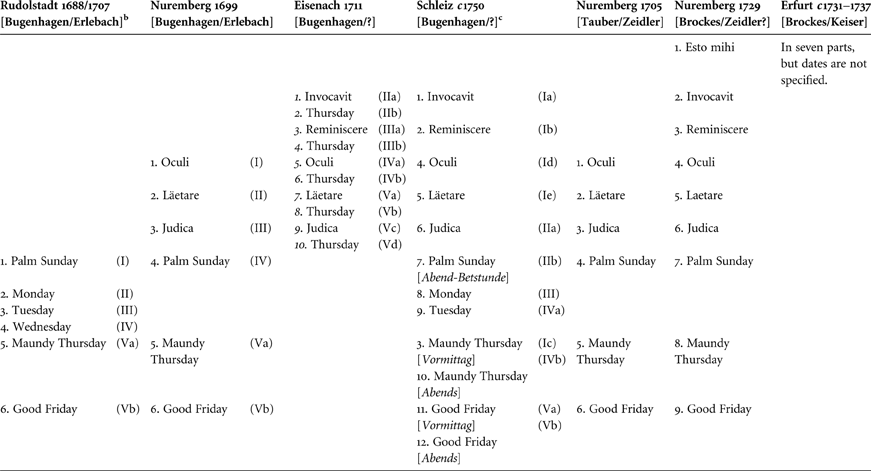
In fact there is a more direct set of comparisons to the Christmas Oratorio: Passion performances spread over multiple days. I am not the first to point out the connection, but I do not think the significance of these directly comparable oratorio performances has been sufficiently appreciated.Footnote 18 I have found documentation for this practice in five places, concentrated in Saxony and Thuringia, showing a variety of ways in which a continuously narrative musical work could be spread over days or weeks. They involved both newly composed and adapted works, and were presented in both liturgical and devotional contexts (see Table 1).
Multi-day passion performancesa

a Roman numerals refer to parts of Bugenhagen's Evangelienharmonie; dividing points differ among the various performances.
b Dates are conjectural; the libretto specifies only that the work's six parts were performed daily in Holy Week.
c Evidently an expanded version of a work from c1729.
The earliest known Passion spread over multiple days – and a particularly influential work – is the setting heard in Rudolstadt beginning at the latest in 1688, documented in printed librettos from that year and from 1707. The wording of the title-pages suggests daily presentation of the work's six parts during Holy Week, presumably beginning on Palm Sunday and ending on Good Friday.
Die Hochtröstliche Geschicht des bittern Leidens und Sterbens Unsers HERRN und Heylandes Jesu Christi / aus den 4. Evangelisten zusammen getragen / In VI. Actus abgetheilet und mit füglichen Arien und Liedern hie und da untermenget / Wie solche In der Hoch-Gräfl. Schwartzb. Hof-Capelle zu Rudolstadt Die heil. Marter-Woche durch / von Tage zu Tage / pflegt musiciret zu werden. Rudolstadt / Gedruckt bey Heinrich Urban. 1707.Footnote 19
The most consoling history of the bitter suffering and death of our Lord and Saviour Jesus Christ assembled from the four Evangelists, divided into six actus and intermingled here and there with apt arias and hymns, as it is customarily performed from day to day during Holy Week in the Schwarzburg-Rudolstadt Hofkapelle. Rudolstadt, printed by Heinrich Urban, 1707.
According to Irmgard Scheitler the work was presented during devotions rather than as part of a normal liturgy.Footnote 20 The text is Bugenhagen's Evangelienharmonie assembled from the four gospel accounts, following his original division and additionally splitting the last of his five parts immediately after the report of Jesus’ death for a total of six actus; the resulting six-part division matches Luther's 1545 presentation of the synoptic gospels. The complete Bugenhagen narration, rarely set in its entirety as a concerted Passion, lent itself to multi-day presentation because of its length and wealth of detail. In fact, the multi-day presentation in Rudolstadt may have been inspired by a desire to perform the entire Evangelienharmonie musically.
The work is typical for its time in its elaboration of the Passion narrative by interpolated chorale stanzas and free poetry (‘hie und da untermenget’, according to the title-page) at places of narrative and theological significance. Many familiar interpolations appear, including multiple stanzas of ‘Christe, du Lamm Gottes’ and of ‘O Lamm Gottes, unschuldig’, a multi-strophe presentation of ‘O Traurigkeit, o Herzeleid’ near the end of the narration, and so on. Each actus is organized as a free-standing unit, with an opening chorale or aria (typically labelled ‘Zum Anfange’ or something similar) and a closing one (sometimes labelled ‘Zum Beschluß’).Footnote 21 The actus each contain four to six interpolated chorales or arias; the fifth (narrating the crucifixion) has eleven, counting the individual stanzas of ‘Christe, du Lamm Gottes’.
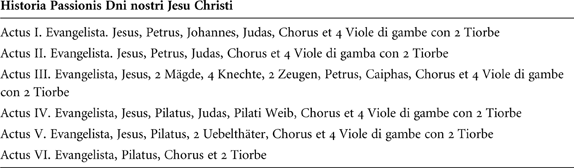
We do not know much about the lost musical setting, presumably composed by Philipp Heinrich Erlebach. The title-page reports that the work was ‘musiciert’, pointing to a concerted performance. The work represented in the libretto corresponds closely to an entry in an inventory Erlebach prepared around 1700 (see Table 2), and the instrumental disposition specified there suggests a musically consistent approach despite the work's distribution over many days. The role of the four violas da gamba in parts I to V is not certain; possibilities include sinfonias, as in several numbers in the St Matthew Passion attributed to Friedrich Funke; the accompaniment of narration, as in portions of Johann Sebastiani's St Matthew Passion and in Johann Theile's St Matthew Passion (two gambas) and Heinrich Schütz's Resurrection Historia (four gambas); or the accompaniment of chorales or ‘arias’ as in the Sebastiani Passion, where a homorhythmic texture of four violas and continuo characterizes the interpolated chorale settings throughout. The absence of the gambas in the sixth actus, along with the absence of Jesus (whose death is reported at the end of part V) among the listed interlocutors might suggest that the gambas were associated with his words. It is also possible that the instruments were withdrawn for symbolic reasons from this portion, presumably meant for Good Friday, whatever their function elsewhere in the setting.
Rudolstadt inventory entry (c1700) for Erlebach's Passion historia a
a Philipp Heinrich Erlebach: Harmonische Freude musikalischer Freunde. I. und II. Theil, ed. Otto Kinkeldey (Leipzig: Breitkopf & Härtel, 1914; revised edition by Hans Joachim Moser, 1959), xxvii.
The vocal disposition is suggested by the listing of the Evangelist and interlocutors and by references to a ‘chorus’, whose placement at the end of the list of interlocutors may suggest that their role was the delivery of the words of groups, as in responsorial Passions. In the libretto there are two references to ‘der Chor’: a partial chorale stanza at the end of part IV, and three repetitions of the gospel line ‘Jesus von Nazareth, der Jüden König’ articulating the stanzas of an aria. The labelling of these passages for chorus suggests that most of the interpolated poetry was, in contrast, sung in solo settings.
Erlebach's own inventory calls the six parts collectively a ‘Historia Passionis’ – a single work – and the six portions of the text were published as an entity. These features all point to a conception of the six-day work as a unified composition. We can note the absence of the typical liturgical introduction (‘[Höret] das Leiden und Sterben’), which would have served only the first part. Each of the parts was evidently meant to stand on its own as well; the first section begins like all the others, with a commentary text, and each part (including the last) ends the same way.
The title-page's wording (‘pflegt musicirt zu werden’) suggests that the multi-day musical presentation of the Passion was a regular practice in Rudolstadt in 1688, which is confirmed by the reprinted text from 1707. As Scheitler has pointed out, the practice was influential; the Rudolstadt work was performed not only in that city but also in the Nuremberg Frauenkirche in 1699, a presentation documented in a printed text that largely matches the one from Rudolstadt.Footnote 22 As in Rudolstadt, the work was heard not during the principal worship service but at vespers. It was evidently adapted to local practice in the division of each actus in two to accommodate the sermon typical of vesper liturgies.
The libretto specifies the performance of the six parts over multiple days, but rather than Rudolstadt's presentation during Holy Week, the Nuremberg libretto places the six parts of the Passion narrative on four Sundays during Lent (beginning with Oculi) and on Maundy Thursday and Good Friday.Footnote 23 This goes a step beyond the work's design in stretching the performance over nearly four weeks. I do not think we should be surprised to encounter the presentation of elements of the Passion story throughout Lent, but the narrative (and presumably also musical) continuity of a setting performed over this span is striking. And the six parts were fitted into services on days that conventionally saw liturgies in Lutheran Germany – Sundays in Lent, Maundy Thursday and Good Friday – leading to a performance spread over non-consecutive days.
The Bugenhagen Passion narrative was also the basis for a multi-day musical setting represented in a libretto published in Eisenach in 1711 and documenting its performance there:
Die höchst=tröstliche Fasten=Zeit Wurde nebst andern gottseeligen Betrachtungen über das bittere Leiden und Sterben unsers HErrn und Hey= landes JEsu Christi / auch mit Harmonischer Devotion, nach Anleitung der Vier Evangelisten zugebracht / Also / daß wöchentlich zweymal / nemlich Sonntags und Donnerstags / von Invocavit an bis auf Palmarum des 1711ten Jahres / bey öffentlichem Gottesdienste / einen Theil davon musicalisch aufführete Ihr. Hochfl. Durchl / zu Sachsen=Eisenach Capelle. GOTHA / gedruckt bey Christoph Reyhern / F. S. Hof=Buchdr.Footnote 24
During the most consoling time of Lent, in addition to other pious meditations, the bitter suffering and death of our Lord and Saviour Jesus Christ was performed with harmonic devotion, according to the four Evangelists; that is, that twice a week (namely Sundays and Thursdays) from Invocavit to Palm Sunday, 1711 in public worship; a portion thereof was performed musically by the Saxon-Eisenach Kapelle. Gotha, printed by Christoph Reyhern, court printer.
Bugenhagen's text is divided into five ‘Abhandlungen’, omitting his first actus and once again subdividing the last. This performance was distributed over ten days and was heard on Sundays and Thursdays in Lent, beginning with Invocavit and finishing before Holy Week. The occasions are not specified beyond the general ‘öffentliche Gottesdienst’, which suggests a regular liturgy rather than a devotional service but does not confirm it.
No music is known to survive; we know only that the libretto's title-page says that the work was ‘musicalisch aufführete’, again suggesting concerted performance. The reported participation of the Eisenach court ensemble raises the possibility that Georg Philipp Telemann was responsible for the music, as Werner Braun has suggested.Footnote 25 Telemann had become Konzertmeister in Eisenach late in 1708 and Kapellmeister in 1709, remaining until early 1712; the performance documented by the libretto fell within a time during which Telemann composed a great deal of church music.
The interpolated texts are a mix of familiar chorales and evidently new poetry. Each of the ten sections opens and closes with poetic material; each is thus framed and potentially free standing. Aside from these additional poems, though, the scheme of interpolations in the Eisenach libretto is almost identical to that in the Rudolstadt Passion. Most of the texts are different (though the stanzas of ‘O Lamm Gottes, unschuldig’ and ‘Christe, du Lamm Gottes’ are placed identically), but the moments of commentary are the same in both. The only exceptions are two places in the Eisenach text in which the narrative is broken off for an additional poetic text, and one of those is to allow the subdivision of Bugenhagen's second actus into the first Sunday and Thursday sections in Eisenach. Either the compilers of the Eisenach libretto knew the Rudolstadt text and adapted it by substituting new poems, or the two Passions drew on some common scheme of interpolations in the Bugenhagen Evangelienharmonie.Footnote 26 If the Eisenach setting was indeed modelled on the Rudolstadt text (with updated and perhaps locally preferable poetic interpolations), then the additional interpolated poems – the ones that open and close sections – represent the process of adapting a work originally designed to be heard in five parts to a presentation in ten units, an extended performance made possible by the provision of framing poetic numbers.
One further libretto documents the musical performance of the Bugenhagen Evangelienharmonie over multiple days. In his biography of J. S. Bach, Philipp Spitta cited a Passion performed in the town of Schleiz.Footnote 27 According to Spitta, the work was presented during the reign of Count Heinrich XII; that is, between 1726 and 1784.Footnote 28 It is likely but not certain that this is the same work Spitta cites elsewhere, a 1729 ‘Schleizer Passion’ with twenty-seven chorales, from which he quotes a poetic movement said to be a parallel to ‘Ruht wohl’ from Bach's St John Passion, bwv245.Footnote 29
The source or sources cited by Spitta are not known to survive,Footnote 30 but another printed libretto from Schleiz preserved in Berlin may be closely related:
Die mit andächtigen Betrachtungen Ihres leidenden Erlösers Jesu Christi zur heiligen Fasten=Zeit beschäftigte Gläubige Seele, Nach Veranlassung der aus den vier Evangelisten zusammen gezogenen Leidens=Geschichte, Mit untermischten geistlichen Arien und Gesängen, aufgeführet von der Gräfl. Reuß = Plauisch. Hof=Capelle zu Schleitz. Schleitz, gedruckt bey Johann Michael Goderitsch hinterlassenen Wittbe. [added by hand: Autor Henr: XII Reuss.]Footnote 31
The faithful soul, occupied during Lent with meditation on its suffering saviour Jesus Christ, motivated by the history of his suffering assembled from the four Evangelists, with intermingled arias and hymns, performed by the Reuß-Plauen Hofkapelle in Schleitz. Schleitz, printed by Johann Michael Goderitsch's widow.
The libretto presents Bugenhagen's text divided into twelve parts, specified for Invocavit through to Good Friday, but it contains far more than twenty-seven chorales: there are twenty-three single-stanza pieces labelled ‘aria’, almost all indicated as ‘da capo’;Footnote 32 forty-eight interpolations labelled ‘Chor’ (and one ‘Choral’), many identifiable as familiar chorale texts, with some tunes specified and many in multiple strophes; one da capo ‘chorus’ near the end (curiously multi-strophe, a feature that appears to conflict with a ‘da capo’ indication); and two pieces labelled ‘Soliloquium’ on the model of the Brockes Passion, one after the description of Peter's bitter tears (‘Soliloquium des bußfertigen Sünders’) and the other after Judas’ betrayal that alternates stanzas for Judas and a ‘Gläubige Seele’ (Faithful Soul, one of Brockes's allegorical characters). The text cited by Spitta as a supposed model for a movement from bwv245 is not present. The identity of the printer suggests that this publication dates from around 1750.Footnote 33 If this is fundamentally the same work as Spitta's twenty-seven-chorale setting from 1729, it evidently represents a later revision and expansion and suggests a continuing practice of multi-day Passion presentations in Schleiz.
The gospel narrative in the Schleiz libretto is distributed over twelve days, beginning with Invocavit; portions were heard on the Sundays in Lent and on Monday, Tuesday, Thursday and Friday of Holy Week (two parts on each of the last two days). Part 3, which relates Jesus’ sharing of bread and wine (the words of institution), was performed out of scriptural order; it is listed in its narrative place in the printed text, but its text is found later as the first of the two parts designated for Maundy Thursday.
Each of the twelve sections begins and ends with a chorale, representing a familiar framing of the narrative. Several of these framing poems supply two stanzas; otherwise the interpolations are mostly individual stanzas, in contrast to the frequent multiple-stanza interpolations in the other settings based on Bugenhagen's narrative. Overall the Schleiz setting, at least in this version, offers many more interpolations than the others. This stems partly from the division into so many units (requiring more opening and closing poetic texts), but the text is also interrupted more frequently within them.
If the performance of an earlier version indeed took place in 1729, then the music director in Schleiz at the time would have been Johann Sebastian Koch, who had been promoted in 1728 from the position of Figural-Cantor.Footnote 34 Koch has a J. S. Bach connection: he had been in Schleiz since 1719 and was thus presumably present when the latter visited in 1721. Johann Sebastian may also have known Koch through connections in Mühlhausen, where Koch became a prefect just after Bach's time there; Bach evidently returned to the city for a musical performance at least once during Koch's tenure, so might well have encountered him there.Footnote 35 No music for the Schleiz Passion is known to survive, and it is unknown who was responsible for the setting, though Koch is an obvious possibility.
We have seen that the six-part Rudolstadt Passion setting by Erlebach was heard over multiple days in Nuremberg in 1699. Evidently based on this model, early eighteenth-century Nuremberg heard several further divided Passion settings based on other texts. A printed libretto from 1705 documents a Passion presented during Lent and Holy Week; two years later this material was republished as part of a full annual cycle of church works:
Gottselige Gedancken über die vom Sonntag Oculi an / bis auf den Char-Freytag / einfallende Evangelien / und darauf folgende H. Betrachtungen / Des unschuldigen Leidens und Sterbens unsers HErrn und Hey= landes JESU Christi / Wie solche in der Kirche zu St. Ma= rien vor und nach der Predigt in sechs Abtheilungen vorge= stellet werden. Nürnberg / bey den Felßeckerischen Erben / Anno 1705.Footnote 36
Pious thoughts on the Gospels from Oculi Sunday to Good Friday and consequent meditations on the guiltless suffering and death of our Lord and Saviour Jesus Christ, as presented in six sections in St Mary's Church before and after the sermon. Nuremberg, Felßecker's heirs, 1705.
The 1705/1707 libretto differs from other multi-day Passions in two significant respects. First, the musical setting of the Passion narrative, which was presented in six parts starting with Sundays in Lent (Oculi to Palm Sunday) and on Maundy Thursday and Good Friday, is described as part of the regular liturgy, not a devotional service (as is a possibility for some of the performances discussed above). For each day, two independent works are specified: a mixed-text cantata libretto related to the pericope (typically alternating short scriptural passages and arias) before the sermon, and a segment of the Passion narrative (with framing and interpolated poetry) after. The Passion story was thus integrated into the service in a way that did not displace the usual Sunday readings or their musical elaboration.
The second principal difference is that the Passion narrative employed is not Bugenhagen's Evangelienharmonie. The last two of the six parts (for Maundy Thursday and Good Friday) are a pastiche drawn from various gospels, a mixture that is not identical with Bugenhagen's famous compilation and in fact much shorter than it. The first three parts are based on Mark's gospel, presented in a continuous narration over three Sundays in Lent, and the fourth part (for Palm Sunday) continues Mark's narration, with two interpolations from Matthew. The first four parts, then, are a nearly integral presentation of Mark's gospel spread over four weeks, a continuous narrative derived almost entirely from a single source.
The Preface to the 1705 print is unsigned, and the libretto ends only with the monogram ‘D. T. L. E. P. G.’, but the Preface to the expanded 1707 publication is explicitly signed by Andreas Tauber, who identifies himself as ‘Pelias’ in the literary society known as the Pegnischer Blumenorden. That Preface also identifies the composer of the musical setting as Maximilian Zeidler. Zeidler had been a student of Pachelbel in Nuremberg and according to his own account in Johann Mattheson's Grundlage einer Ehren-Pforte became organist of the Marienkirche in 1705 and Kapellmeister there in 1712.Footnote 37 The texts of five annual cycles of church cantatas are known, confirming his activity as a composer.Footnote 38 No music by him survives, but Mattheson's entry cites his abilities and explicitly mentions the composition of at least one Passion setting. His multi-day Passion represents an original composition of a work intended for presentation over an extended period.
As Irmgard Scheitler has discussed in detail, the practice of dividing a musical Passion setting over many days continued in Nuremberg.Footnote 39 The ongoing cultivation of this way of presenting the Passion is documented in a 1729 libretto also connected with the Marienkirche:
Der für die Sünder der Welt gemarterte und sterbende Jesus / aus den vier Evangelisten in gebundener Rede vorgestellet, und in der St. Marien-Kirche, vom Sonntag Esto mihi, bis h. Char-Freytag musicalisch aufgeführet. Nürnberg, Zu finden bey Maximilian Zeidler, Capell-Meister. 1729.Footnote 40
Jesus, martyred and dying for the sins of the world, presented from the four Evangelists in verse and performed musically in St Mary's Church from Estomihi Sunday to Good Friday. Nuremberg, to be had from Maximilian Zeidler, Kapellmeister. 1729.
The Passion performance in that year took place in nine parts spread over all of Lent, beginning with its first Sunday. As with the other pieces, the last two sections were heard on Maundy Thursday and Good Friday. This division is an expansion of the principle behind the Nuremberg performances of Erlebach's Rudolstadt setting and the successor Tauber/Zeidler work, extended backwards to the Sunday before Lent. Rather than Bugenhagen's Evangelienharmonie or a gospel narrative, this libretto presents a poetic text originally designed as a single unit. In fact it is the Passion oratorio by Barthold Heinrich Brockes, a text famously set to music by Telemann, Handel, Keiser and Mattheson, along with many successors. This libretto was immensely popular in the 1710s and 1720s, and was the source (direct and indirect) of poetic texts interpolated in gospel oratorio Passions by both J. S. Bach and Telemann in the 1720s.Footnote 41
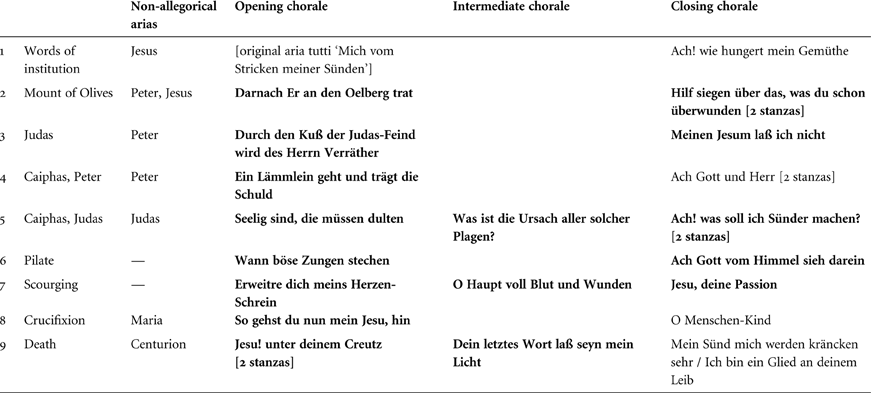
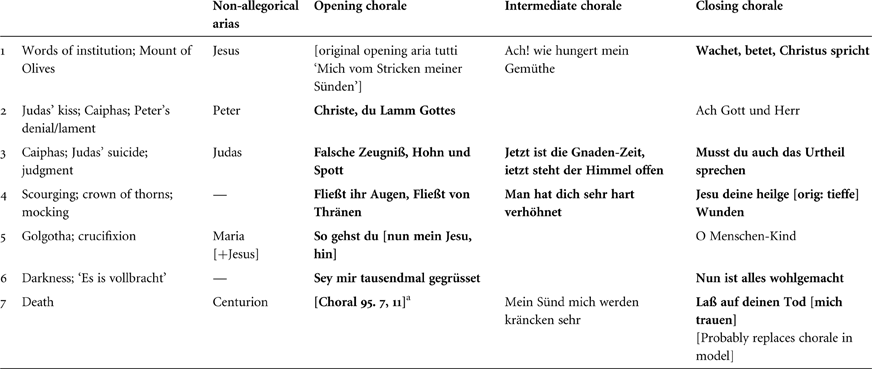
The important issue here is not the choice of this famous text but the adaptation of an integral libretto into a multi-day oratorio. This was accomplished, unsurprisingly, by the provision of chorale stanzas to open and close most of the parts. The first begins with Brockes's original aria tutti, ‘Mich vom Stricken meiner Sünden’, and the last ends with the complex of chorales and arias that closed the work in Brockes's version. Each of the other parts has been provided with an opening chorale stanza relevant to the narrative (see Table 3). Each has also been supplied with a hymn stanza to close the part except the first, fourth and eighth, which were divided at places where Brockes's text already included a chorale. Three parts have been supplied with internal hymn stanzas as well. Throughout, each stanza is labelled (following Brockes) ‘Choral der christlichen Kirche’.Footnote 42 The musical setting performed in Nuremberg in 1729 is unknown. It may have been a composition of Zeidler, listed on the title-page as the person from whom the printed libretto could be purchased. The work extends the practice of dividing a musical Passion setting to a poetic oratorio originally designed for integral performance.
Chorales in the 1729 Nuremberg libretto; added chorales in boldface
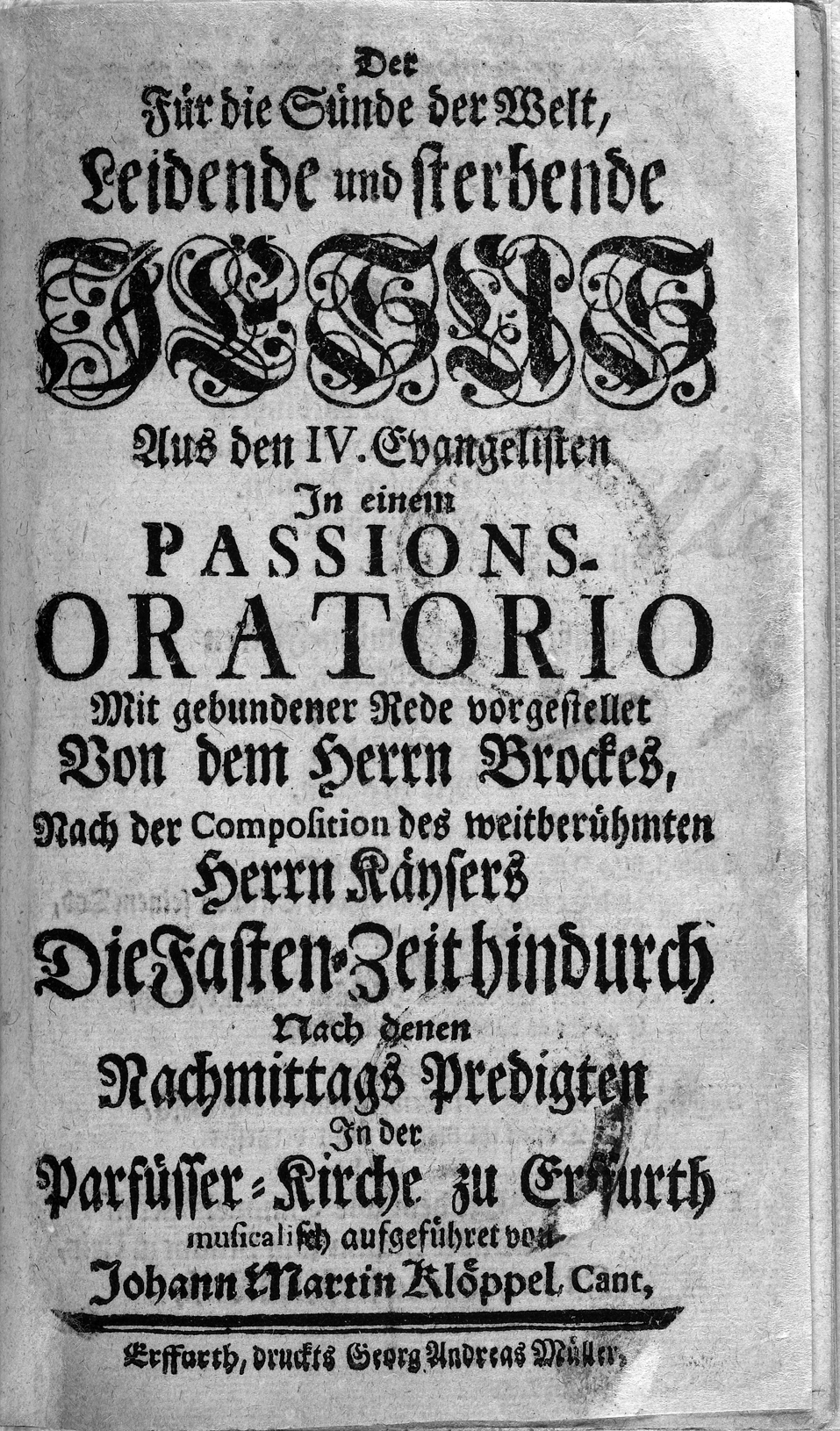
My last example is documented by a new source. The Harold Jantz Collection of German Baroque Literature housed at Duke University, well known to scholars of the seventeenth and eighteenth centuries and widely available on microfilm, does not represent the entirety of Jantz's prodigious collecting. Jantz assembled many additional volumes, including some from the baroque era, catalogued outside the Baroque Collection proper. Item 2398 in the general collection, a libretto for Reinhard Keiser's setting of Brockes's celebrated poetic Passion oratorio, documents a previously unnoticed performance of the work in Erfurt in the first half of the 1730s (see Figure 1):
Der Für die Sünde der Welt, Leidende und sterbende JESUS aus den IV. Evangelisten In einem PASSIONS-ORATORIO Mit gebundener Rede vorgestellet von dem Herrn Brockes, Nach der Composition des weitberühmten Herrn Käysers Die Fasten-Zeit hindurch Nach denen Nachmittags Predigten In der Parfüsser-Kirche zu Er[f]furth musicalisch aufgeführet von Johann Martin Klöppel, Cant. Erffurth, druckts Georg Andreas Müller.Footnote 43
Jesus, suffering and dying for the sins of the world, presented as a Passion oratorio from the four Evangelists in verse by Herr Brockes, musically performed according to the composition by the world-famous Herr Keiser throughout Lent after the afternoon sermon [service] in the Barfüsser Church by Johann Martin Klöppe, cantor. Erfurt, printed by Gorg Andreas Müller.
Passion libretto, Erfurt, 1730s (Duke University Library, Harold Jantz Collection 2398). Used by permission
The libretto does not appear to be mentioned in any of the modern literature on Brockes, the Brockes Passion or Reinhard Keiser;Footnote 44 nor is this Brockes Passion discussed in any publication on Erfurt's musical history that I have seen.Footnote 45
Johann Martin Klöppel, under whose direction the performance took place, was born in 1697 in Isseroda (just outside Erfurt), where his father was a preacher, and enrolled in 1717 at the university in Jena. In 1722 he became cantor at Erfurt's Thomaskirche, in June 1730 cantor at the Barfüßerkirche, and around 1737–1738 cantor and Schulkollege at the prestigious Predigerkirche, where Johann Pachelbel, Nicolaus Vetter and Johann Heinrich Buttstett had earlier served as organists. He also served as director of the collegium musicum of the Ratsgymnasium. He married twice (in 1725 and 1742); his six children, born between 1726 and 1735, were each baptized in the Barfüßerkirche; and he was buried on 19 November 1755. He is known to have directed a dramatic work in 1740 for a celebration by Erfurt printers, and in 1743 to have composed and performed a ‘Trauerstück’ in the Predigerkirche for Phillip Carl, Archbishop of Mainz.Footnote 46
Typographically, the Erfurt libretto closely resembles earlier printed texts of the Brockes Passion, and was evidently modelled on them. Its title-page reflects two variants that appear together in only one other edition of the text: the phrases ‘leidende und sterbende JESUS’ (rather than the typical ‘gemarterte und sterbende’) and ‘mit gebundener Rede vorgestellet’ (as opposed to ‘in gebundener Rede’ in other prints).Footnote 47 These wordings are otherwise unique to the libretto prepared for the sensational premiere of Georg Philipp Telemann's setting of Brockes's text in 1716.Footnote 48 The Erfurt title-page suggests that the compiler or printer had access to a copy of the Frankfurt libretto or (less likely) to some unidentified common source. I suspect that the Frankfurt libretto was well circulated and that it was indeed the model for the Erfurt version, even though the performance there was of Keiser's setting, not Telemann's.Footnote 49
The text of the Erfurt version is divided into seven parts, each beginning and ending with a chorale stanza except for the first, which opens with Brockes's original poetic text ‘Mich vom Stricken meiner Sünden’. Most of the chorale stanzas that open and close each part are additions to Brockes's text and to Keiser's composition, and provide framing movements for the narrative and poetic commentary in each section. The addition of these chorales results in a work systematically divided into seven potentially free-standing units, each lasting approximately ten to twenty minutes. All but the sixth (which is shorter) contain four to six arias in addition to narrating recitative, ariosos and accompagnatos.
The divisions do not correspond to the traditional actus of the Passion story but do break up the narrative into distinct scenes. Part 1 includes the Last Supper and Jesus’ words on the Mount of Olives; Part 2 narrates Jesus’ capture and ends with Peter's lament, a traditional dividing-point for Passion narratives; and Part 3 covers Jesus’ trial and judgment. Part 4 focuses on the scourging and mocking, Part 5 narrates the crucifixion and Part 6 relates Jesus’ suffering on the cross. The sole action in Part 7 is Jesus’ death, related in one brief line of paraphrased gospel text.
Each part has a distinct interpretive theme, suggested by the narrative and reflective poetry and frequently reinforced by the added chorales (see Table 4). For example, Part 3 (on the trial) opens with a reference to ‘Zeugniß’ (witness) and closes with an invocation of ‘Urtheil’ (judgment); both of the framing chorales in Part 6 invoke the image of Jesus on the cross. The chorales at the ends of Parts 2 and 5 are original to Brockes's text and were retained. Intermediate chorales also original to Brockes's text appear in Parts 1 and 7 (in the latter as part of the complex of closing numbers). The adapters added intermediate chorales to Parts 3 and 4 as well, perhaps to divide these relatively long sections, with their six arias. But Part 2, which also contains six arias, has no intermediate chorale.
Chorales in the 1730s Erfurt libretto; added chorales in boldface
a Two chorale verses from an unspecified hymnal.
The division into parts also distributes the work's solo interpolations in a significant way. Arias by the allegorical characters Tochter Zion (Daughter Zion) and Gläubige Seele (Faithful Soul), both individual numbers and those that are part of the multi-section scenas Brockes called ‘soliloquia’, appear throughout in all seven parts. But five of the seven parts contain arias for exactly one non-allegorical character: Jesus in Part 1, Peter in Part 2, Judas in Part 3, Maria in Part 5 (including a duet with Jesus) and the Centurion in Part 7. (Parts 4 and 6 contain arias only for the two allegorical characters.) Each section thus not only treats specific portions of the narrative but also isolates the responses and interpretive perspective of one character in it. This is partly a feature of Brockes's original text, whose commentary is passed from one character to the next in ‘soliloquia’ over the course of the work, but it is emphasized by the division of the oratorio into parts. As with the other divided works, one gets the impression of an attempt to create seven units that could each stand on their own, framed by added chorales where the original lacked them.
The libretto's title-page is ambiguous in specifying that the oratorio was heard after the ‘Predigt’ throughout Lent. This could literally mean after the sermon – within the liturgy – or could use ‘Predigt’ in its eighteenth-century sense in which the word stood not just for the sermon but for the entire service of which it was a part. This would mean that the Erfurt performances took place outside the liturgy, perhaps in a devotional service. It is not certain, either, on which days in Lent the parts of Keiser's work were performed in Erfurt. The seven Sundays including Estomihi (strictly speaking before Lent) are a possibility, as are Maundy Thursday and Good Friday. There were as many variants of a schedule for a divided Passion as there were librettos, as we have seen, so there are any number of possibilities.
The Erfurt performances almost certainly took place between 1731 and 1737. Klöppel was apparently appointed to the cantorate of the Barfüßerkirche (named on the title-page as the venue) too late in 1730 to have led music there during Lent, making 1731 the first plausible year. The date of his appointment to his next post at the Predigerkirche is not entirely clear. A volume of cantata texts planned for performance there under his direction has a preface dated November 1737, so it is possible that Klöppel was still active at the Barfüßerkirche as late as Lent 1737.Footnote 50
Klöppel appears to have been an ambitious musician, working his way up the hierarchy of Erfurt church music positions, prospectively publishing an ambitious two-year cycle of cantata librettos when he assumed the cantorate at the Predigerkirche, and presenting our seven-part Passion at the Barfüßerkirche. That he chose Brockes's oratorio testifies to the continuing appeal of this twenty-year-old text, the most influential Passion libretto of the early eighteenth century. His selection of Keiser's setting may reflect the availability of musical materials but also the popularity of the excerpts the composer had published shortly after the work's composition.
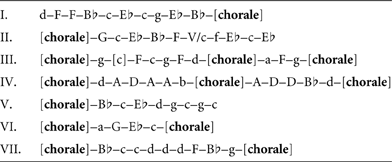
Uniquely among the documented multi-day Passions discussed here, this work survives – or at least most of it does, in the sources that transmit Keiser's Brockes Passion. No source reflects the version performed in Erfurt, so we do not have the added movements, which limits what we can say about Klöppel's musical procedures in adapting the work.Footnote 51 There is reason to suspect that the added framing chorales were simple four-part harmonizations, like those original to Keiser's setting. We do not know their keys, which might tell us something about the degree of tonal coherence Klöppel tried to maintain – or at least his tolerance for juxtapositions (see Table 5). The division into parts and the addition of framing chorales appears to have been guided more by textual considerations than musical ones in any event, and the text may well have been the principal guide to the adaptation process rather than the music.
Keys of concerted movements in the Erfurt Brockes Passion; added chorales in boldface
Together with the 1729 Nuremberg performances, the documented presentation of the Keiser Brockes Passion in Erfurt over multiple days shows that in Thuringia and Saxony this practice extended to the performance of an integral poetic work. Over the first half of the eighteenth century, multiple-day performance was applied to changing textual and musical kinds of Passion settings. These performances and those in Schleiz at least as late as 1750 demonstrate that the practice was observed throughout the first half of the eighteenth century. Multi-day performance of continuous Passion narratives, including in concerted settings, was a familiar practice in central Germany.
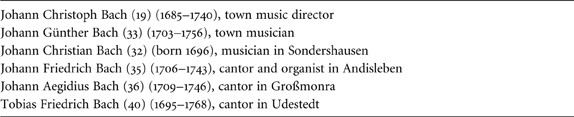
It is probable that J. S. Bach knew of these divided Passion performances. He certainly had connections to Erfurt. During the 1730s several Bachs were employed as musicians there and in surrounding towns (see Table 6). Bach's eldest son Wilhelm Friedemann was named as a godfather to Tobias Friedrich's daughter in 1732, suggesting continued contact between Johann Sebastian's family and that of his older brother Johann Christoph (1671–1721). There were other Erfurt connections as well: his parents had been married there, he had served as an organ examiner in the Augustinerkirche in 1716 and he was involved in an inheritance from the Lämmerhirt family there in 1720–1722. It is plausible that Bach knew of the performance of Keiser's Brockes Passion, in which some members of the Bach family could have taken part. We do know that Bach was deeply interested in the Brockes text, which played a role in almost all his Passion music, and in the music of Reinhard Keiser.Footnote 52
Bachs in Erfurt and surrounding villagesa
a Information on Bach family members (including identifying numbers in parentheses following the names) is from Christoph Wolff and others, ‘Bach’, in Grove Music Online <www.oxfordmusiconline.com> (20 September 2009), and from Helga Brück, ‘Die Erfurter Bach-Familien von 1635 bis 1805’, Bach-Jahrbuch 82 (1996), 101–131.
There are some indications of closer connections between Bach and Nuremberg than have been suspected, particularly in the realm of Passion music. Scheitler cites a performance in 1730 of a Brockes Passion adaptation in two parts (Monday and Wednesday of Holy Week), at the Kartäuserkirche under Johann Jakob Schwarz. In 1729 that same church had heard a performance of an unlikely setting of the ‘Erbauliche Gedanken’, a Passion poem by Bach's Leipzig collaborator Picander that he later drew on for the St Matthew Passion but that may not have been intended for musical setting.Footnote 53 In 1736 it was the site of a performance of a poetic Passion by Gottfried Heinrich Stölzel, the same work (as was recently discovered) that Bach performed in Leipzig in 1734.Footnote 54 The Leipzig connections to this Passion repertory do not guarantee a link to Bach, but do suggest that he was in a position to be aware of the long tradition in Nuremberg of Passion performances spread over many days.
Bach also had musical connections to Schleiz, as we have seen, and to Eisenach – the city of his birth, home to family members, including Johann Bernhard Bach, and workplace of Telemann, C. P. E. Bach's godfather. In all it seems likely that Bach was familiar with the central German practice of performing Passions over multiple days, and I think this is the context in which we need to view his Christmas Oratorio, which has many features in common with the multi-day Passion performances, particularly those that presented integral concerted settings. The Christmas Oratorio presents a continuous gospel narrative spread into six parts heard over twelve days, partly aligned with daily readings but partly distributed over the available dates. It constitutes an integral work but is divided into self-sufficient units. Each of its six parts except the second begins with a poetic chorus, in contrast to most of the multi-day Passions, but each was also designed to end with a chorale, the typical articulating movement in those works.Footnote 55
If Bach was interested in presenting a musical treatment of the nativity, he was limited by the lack of a liturgical place for such a setting in Leipzig beyond the usual weekly cantata. Put another way, there was evidently no outlet for an oratorio at Christmas, at least not one longer than a usual cantata. We do not know the context for Schelle's Actus musicus, and can note that Bach's narrative oratorios for Easter (bwv249) and Ascension Day (bwv11) are each on the scale of long individual cantatas and that they were presumably presented in the usual slot for a cantata. The six-part design of the Christmas Oratorio made it possible to present a long musical setting of the Christmas narrative. Composing such a work meant striking a balance between the necessity of the parts’ standing on their own and a desire to create a single musical entity. In this regard the multi-day Passion offered a model.
And if the idea of a multi-day oratorio of any kind interested Bach, his options were limited. A divided Passion oratorio was ruled out by Leipzig's observance of the tempus clausum, which dictated that no concerted church music was heard during Lent. The Good Friday vespers performance of a concerted Passion was an exception (as was the feast of the Annunciation), but presumably one that was not extended to allow performances throughout Lent and Holy Week. A multi-day Passion setting was evidently not possible. Easter was another option, but I do not know of any tradition of multiple-day Easter works; that narrative does not appear to have been treated at great length in Lutheran Germany in any event. The Christmas Oratorio may thus have represented Bach's only Leipzig outlet for this extended sort of narrative work other than the Good Friday Passion, one evidently modelled on a well-established central German practice of multi-day Passion performances.