1. Introduction
The Carboniferous–Permian transition coincides with an important period of global climate change (Berner Reference Berner1994; Miller & Eriksson, Reference Miller and Eriksson1999; Mii et al. Reference Mii, Grossman, Yancey, Chuvashov and Egorov2001; Poulsen et al. Reference Poulsen, Tabor and White2015), particularly with respect to glacial expansion in the southern part of Gondwana around the late Carboniferous–Permian period (Fielding et al. Reference Fielding, Frank and Isbell2008; Abadi et al. Reference Abadi, Soreghan, Heavens, Voeten and Ivanova2019). In response to the joint action of global plate movement and continuous transgression, limestone deposits, tens to hundreds of metres thick, were laid down in the North China, North American, Siberian and Yangtze blocks (Fielding et al. Reference Fielding, Frank and Isbell2008; Haq & Schutter, Reference Haq and Schutter2008). As a consequence of changing sea levels, the Taiyuan Formation of the southern North China Craton (NCC) typically comprises a set of strata with different lithologies, including mudstone, sandstone, coal and carbonate rocks. The average thickness of the Taiyuan Formation in the NCC is approximately 158 m and, from top to bottom, the limestone comprises 13 carbonate rock layers, namely, L 1 to L 13 (Zheng et al. Reference Zheng, Liu, Chou, Qi and Zhang2007, Reference Zheng, Liu, Wang and Chen2008). However, there is still a lack of consensus regarding the geological age of the Taiyuan Formation, that is, the boundary between late Carboniferous (Pennsylvanian) and Permian time. In previous studies, the uppermost limestone layer (L 1) of the Taiyuan Formation was considered to indicate the lower boundary of the Carboniferous–Permian transition (Li et al. Reference Li, Xu, Huang, He, Luo and Yan2009; Wu, Reference Wu2013; Wu & Zhang, Reference Wu and Zhang2019), whereas the findings of later studies indicated that the origin of the Taiyuan Formation should be assigned to the lower Permian strata (Xu et al. Reference Xu, Wang, Wei, Wu, Zhang, Wang and Sun2017; Hu et al. Reference Hu, Pang, Jiang, Li, Zheng and Shao2019).
In general, palaeobiota are considered key indicators of stratigraphic divisions and are routinely used for determining geological age. In this regard, the Aidalash Creek section in northern Kazakhstan, featuring the first appearance of the conodont Streptognathodus isolatus, has been selected as the global stratotype section of the lower Permian boundary, which is roughly equivalent to the bottom of the fuzulinid Sphaeroschwagerina zone (Ross, Reference Ross1984; Zhu et al. Reference Zhu, Zhang, Jia, Zhang and Wang2005). Accordingly, the Carboniferous–Permian boundary in China has been revised for better correspondence with other international records (Zhu et al. Reference Zhu, Zhang, Jia, Zhang and Wang2005). On the basis of the aforementioned criteria, Li et al. (Reference Li, Yuan, Yin, Zhao and Cui2015) demonstrated that the geological age of the Taiyuan Formation in the NCC is Carboniferous–Permian, and that the boundary lies at the bottom of limestone layer L 4. Our analyses and interpretations in the present study are based on the boundary designation of Li et al. (Reference Li, Yuan, Yin, Zhao and Cui2015). In addition, our examination of the sedimentological and geochemical characteristics of the Taiyuan Formation, comprising multiple assemblages of sedimentary facies, will provide a basis for further investigations of the tectonic evolution of the North China epicontinental basin, as well as the sedimentary responses of the epicontinental sea to eustatic changes (Lv & Chen, Reference Lv and Chen2014).
The evolution of sedimentary facies is primarily dependent on the following factors: (1) sea-level fluctuation (e.g. Hanken & Nielsen, Reference Hanken, Nielsen, Gąsiewicz and Słowakiewicz2013); (2) sediment source (e.g. Jipa & Olariu, Reference Jipa and Olariu2013); (3) palaeo-environment (e.g. Abadi et al. Reference Abadi, Soreghan, Heavens, Voeten and Ivanova2019; Liu et al. Reference Liu, Liu, Wang, Zhu, Wu and Xu2019 a; Harries et al. Reference Harries, Gailleton, Kirstein, Attal, Whittaker and Mudd2021); and (4) tectonic setting (e.g. Zhang et al. Reference Zhang, Li, Yan, Zeng, Lu, Zhang, Hui, Jin and Tang2017; Chamov et al. Reference Chamov, Sokolov, Garetskii and Patina2019; Liu et al. Reference Liu, He, Zheng, Peng, Chen, Yu, Yun and Xu2019 b). Accordingly, the information contained within these sedimentary sequences can be used to construct models of atmospheric and oceanic circulation (Sun & Wang, Reference Sun and Wang2009; Zhang et al. Reference Zhang, Wang, Li, Cao, Song, Hu, Lu, Wang, Du and Cao2016). In terms of reconstruction of the tectonic setting, although magmatic and metamorphic rocks, particularly in the collision suture zone, provide essential evidence of the transformation of the regional tectonic setting, the limitations of these approaches have yet to be sufficiently established. For example, the orogens experienced strong subduction, shortening and denudation, such that primary information regarding the settings of certain tectonic units has been obscured (e.g. Roberts & Clemens, Reference Roberts and Clemens1993; Beard, Reference Beard2008; Gao et al. Reference Gao, Zeng and Asimow2017; Garcia-Arias & Stevens, Reference Garcia-Arias and Stevens2017). Some constructive analyses have, nevertheless, revealed that interpretation of the geochemical characteristic of primary carbonate sedimentary rocks can be used as a potential indicator (Zhang et al. Reference Zhang, Xia, Zhang, Liu, Zeng, Li and Xu2014, Reference Zhang, Li, Yan, Zeng, Lu, Zhang, Hui, Jin and Tang2017), and that these proxies can be used to obtain detailed semi-quantitative information (Tarduno et al. Reference Tarduno, McWilliams, Debiche, Sliter and Blake1985; Alonso-Zarza, Reference Alonso-Zarza2003; Zhang et al. Reference Zhang, Xia, Zhang, Liu, Zeng, Li and Xu2014, Reference Zhang, Li, Yan, Zeng, Lu, Zhang, Hui, Jin and Tang2017).
In this study, we present a comprehensive set of petrographic thin-section, X-ray diffraction and geochemical data on upper Palaeozoic ‘thin-layer’ limestones from the upper Taiyuan Formation (L 1 –L 5) of the southern North China Plate. Using this information, combined with that presented in previous studies, we reconstruct the redox conditions, palaeoclimate and depositional environment associated with the deposition of limestone along the southern margin of the NCC, with a particular emphasis on the geological significance of the tectonic setting.
2. Geological setting
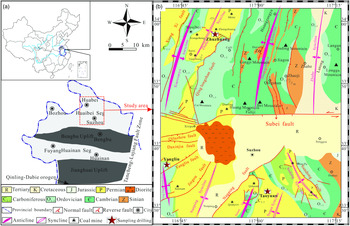
The study area, the Huaibei Coal Basin (HCB) (33° 20ʼ–34° 28ʼ N, 115° 58ʼ–117° 12ʼ E) is located in the NCC and spans Suzhou–Huaibei City in the northern region of Anhui Province (Fig. 1a; Li et al. Reference Li, Gui, Chen, Fang, Li and Li2021 a). During the late Palaeozoic Era, the NCC underwent a period of orogenic collision, which was marked by an uplift of the North Qinling Belt (NQB) (southern margin) and subduction of the Palaeo-Asian oceanic plate (northern margin) (Cao et al. Reference Cao, Xu, Pei, Guo and Wang2012; Li et al. Reference Li, Zhou, He, Wang, Wu, Liu, Yao, Xu, Zhao and Dai2018; Wang et al. Reference Wang, Liu, Li and Jiang2020; Li et al. Reference Li, Pei, Li, Li, Pei, Gao and Wang2021 b). The geodetic structure of this area is located in the main part of the Xusu structural belt, namely the Huaibei Seg (Fig. 1a). The Subei Fault, a 240-km-long and 4- to 6-km-wide normal fault that is steeply inclined to the south, is the main structure bisecting the study area (Fig. 1b) in an east to west direction, and it is speculated that the south side of the Subei Fault moved 420–9130 m downwards during late Palaeozoic time. Additionally, on the northern side of this fault zone, magma upwelled through the Subei Fault, invading the HCB (Jiang et al. Reference Jiang, Cheng, Wang, Li and Wang2011). The magmatic rocks include quartz porphyry, diorite and diabase, with an age of c. 110 Ma (Rb/Sr isotopic), indicating that the fault zone was highly active during the Yanshanian–Xishanian period (approximately Early Cretaceous) (Yang et al. Reference Yang, Liu, Sun, Chou and Zheng2011). In addition, the fault cuts the Palaeozoic strata, which also indicates that fault movement occurred subsequent to the late Palaeozoic Era.
Simplified geological map.

The alternating upper Palaeozoic marine and continental depositional strata in the NCC represent a complete basin-filling sequence, recording the entire process of basin development and disappearance (Lv et al. Reference Lv, Fan, Ejembi, Wu, Wang, Li, Li and Li2020). In terms of stratigraphic division, this area is part of the North China stratigraphic super-region–Luxi stratigraphic subregion–Xusu stratigraphic minor region (Zheng et al. Reference Zheng, Liu, Chou, Qi and Zhang2007; Lv & Chen, Reference Lv and Chen2014; Lv et al. Reference Lv, Fan, Ejembi, Wu, Wang, Li, Li and Li2020). In addition to the denudation of the Silurian–Lower Carboniferous strata caused by the Caledonian Taikang tectonic event, Palaeozoic and Quaternary strata in the NCC have been completely preserved, particularly that of the Late Carboniferous–Permian period (the main coal-bearing strata) (Han, Reference Han1990).
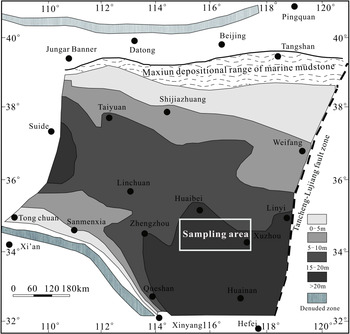
The Taiyuan and Benxi formations of the Carboniferous are unconformably overlaid on the Ordovician Majiagou Formation (referred to as the Fengfeng Formation in some areas). The Taiyuan Formation consists of carbonate rocks (c. 13 layers), mudstones, sandstones and coal seams (c. 10 layers), reflecting multiple sedimentary cycles, accompanied by transgression and regression (Lv & Chen, Reference Lv and Chen2014; Lv et al. Reference Lv, Fan, Ejembi, Wu, Wang, Li, Li and Li2020). From top to bottom, the sequence of carbonate rocks in the Taiyuan Formation have been numbered L 1 to L 13, respectively. Furthermore, the thickness of carbonate rocks (0–80 m) in the upper Palaeozoic strata of the NCC has been determined by the direction of transgression, with carbonates in the south being thicker than those in the north and the largest area of thick carbonates being located in the SW (Wu et al. Reference Wu, Chen, Zhang and Ge1995), as shown in Figure 2.
Carbonate thickness distribution of Taiyuan Formation in the NCC.

3. Sampling and testing
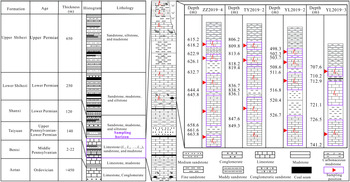
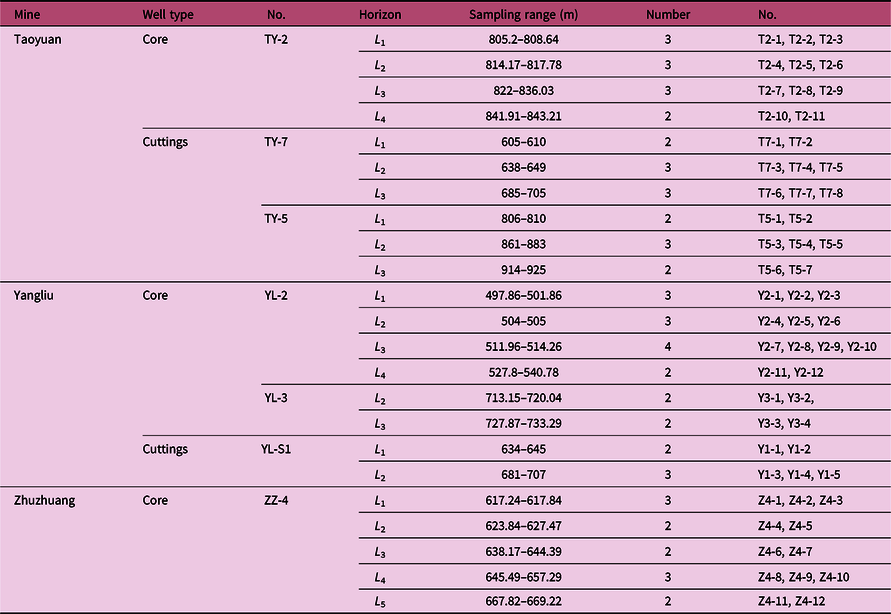
In the HCB, extremely thick Cenozoic strata (c. 550–600 m) covers the upper Palaeozoic Erathem. For a reference comparison, we selected seven wells in the north (Zhuzhuang coal mine), SE (Yangliu coal mine) and south (Taoyuan coal mine) regions of the Subei Fault for sampling. The core boreholes are designated ZZ2019-4, YL2019-2, YL2019-3 and TY2019-2, and the cutting borehole numbers are denoted TY-7, TY-5 and YL-S1, respectively; sampling horizons are L 1 (c. 2.90 m), L 2 (c. 3.90 m), L 3 (c. 6.22 m), L 4 (c. 13.10 m) and L 5 (c. 13.29 m). Each limestone layer was divided into upper, middle and lower segments (or upper and lower segments), and a total of 59 samples were collected. A lithologic column and stratigraphic distribution of the limestones is shown in Figure 3, and detailed information on the samples is presented in Table 1.
Simplified stratigraphic column and limestone distribution in the HCB.

Details of samples

To ensure the purity of the samples, combined with the observation results under the optical microscope, we removed samples with recrystallization and geological processes such as weathering before the analysis (Okewale & Coop Reference Okewale and Coop2017; Okewale Reference Okewale2020). The samples were crushed into small pieces (c. 1 cm3) and washed three times with ultrapure water. Thin-sections were prepared from the samples collected from layers L 1 to L 5, and biological fossils and debris were observed under a polarizing microscope. Finally, for the purposes of major- and trace-element analysis, we used a contaminant-free crusher and an agate mortar to grind the crushed core and for cutting samples to a particle size of less than 200 mesh (≤ 0.074 mm).
Subsequent to petrological observations, we selected 59 fresh limestone samples for whole-rock chemical analyses, namely those of major, trace and rare earth elements. Major elements were analysed by X-ray fluorescence (XRF) using an XRF-1800 spectrometer (Shimadzu Corporation, Japan), with specific flow conforming to the national standard GB/T14506.30-2010. Trace-element analysis was performed based on inductively coupled plasma–mass spectrometry (ICP-MS), using an Agilent 7500 instrument (Agilent Technologies, Inc., Agilent), and X-ray diffraction (XRD) was employed for the analysis of mineral composition, using an X’Pert PRO MPD instrument (Panac, the Netherlands). Analysis of rock carbon and oxygen isotopes, conducted at the Stable Isotope Laboratory of the Third Institute of Oceanography, Ministry of Natural Resources, was based on the phosphoric acid method, in which the carbon dioxide released by reaction with phosphoric acid was transferred cryogenically to a dual microinlet, followed by isotopic measurement using a GasBench II-IRMS instrument (Thermo Fisher, United States of America). These analytical techniques have been described in detail by Baker et al. (Reference Baker, Peate, Waight and Thirlwall2004), Trofanenko et al. (Reference Trofanenko, Williams-Jones, Simandl and Migdisov2016) and Li et al. (Reference Li, Wang, Zeng, Luo, Yu and Zeng2020).
With the exception of isotope analyses, the aforementioned analyses were performed at the Analysis and Testing Center of the Hefei University of Technology. To ensure analytical precision, the national rock standard series samples GSR-1, GSR-2, GSR-3, GSR-4, GSR-5 and GSR-13 were selected for quality control, with every tenth sample analysed being a set blank. The precision of the XRF and ICP-MS results was accordingly established to be approximately ± 0.5%.
4. Results
4.a. Mineralogy
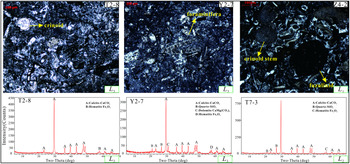
The lithology of the L 1–L 5 limestones in the middle and upper Taiyuan Formation was found to be consistent. Diverse bio-fossil debris is distributed in each of the limestone layers, with bioclastic fragments, such as those of crinoids, foraminifera, gastropod molluscs, fuzulinids and shells (mainly from gastropods and bivalves) being found in the thin-sections of L 1 (ZZ-2) and L 3 (T2-8, Y2-7) samples, as shown in Figure 4a–c. On the basis of the distribution of bioparticles in thin-sections, we were able to establish that the content of bioparticles in limestone (L 1) at the top of the Taiyuan Formation is greater than that in the middle (L 3). Furthermore, carbonate lithology in the HCB was found to be dominated by bioclastic limestone and bioclastic wackestone, indicating a medium–low-energy water environment during the depositional period. Taking into consideration the comparative thickness of L 3, it can be inferred that the aquatic environment during the deposition of L 3 limestone was calmer than that during the deposition of L 1.
Microscopic photographs and XRD mineral analysis.

Analyses of the mineral component of the core and powdered samples revealed that the main mineral types of sample T2-8 are calcite and hematite, with a single mineral composition (Fig. 4d); such mineral combinations are the most commonly detected in layers L 1–L 5. Notably, however, sample Y2-7 was found to contain small amounts of quartz and dolomite, with the appearance of dolomite being mostly associated with rock diagenesis (Fig. 4e). In addition to the common component (calcite), minor amounts of quartz were also detected in sample T7-10, as shown in Figure 4f. However, such samples appear to be rare in this area. We therefore established that calcite is the main mineral comprising limestone in the study area, which indicates that most samples of Taiyuan Formation layers L 1–L 5 have retained the original geochemical composition of seawater.
4.b. Geochemistry
4.b.1. Major elements
Results obtained from analyses of the major elements of the different samples are presented in online Supplementary Table S1 (available at http://journals.cambridge.org/geo). Among the minerals assessed, the content of MgO in samples of layers L 1–L 5 was found to be comparatively low at between 0.49% and 1.81%, whereas that of CaO was highest, with average values of 46.70%, 48.28%, 49.49%, 49.82% and 52.64% in layers L 1–L 5 respectively, which is slightly higher than that of Huainan L 4 (average, 46.46%) in the Taiyuan Formation and is closer to the theoretical CaO content in pure limestone (56%) (Chen et al. Reference Chen, Liu, Wu and Sun2016). The content of the terrestrial clastic contaminant indicator Al2O3 in layers L 1–L 5 was found to range from 0.41% to 2.02%, which is similar to that of Cenozoic Leitha limestone (0.61–1.77%), although significantly lower than that of the Palaeozoic limestone in Iran (4.15–6.08%) (Abedini & Calagari, Reference Abedini and Calagari2015; Ali & Wagreich, Reference Ali and Wagreich2017).
4.b.2. Trace elements
Trace elements such as molybdenum (Mo), vanadium (V), chromium (Cr), cadmium (Cd) and uranium (U), which show different properties in water bodies of different environments characterized by particular geochemical behaviour, are referred to as redox-sensitive elements (RSE) (Tribovillard et al. Reference Tribovillard, Algeo, Lyons and Riboulleau2006; Meinhold et al. Reference Meinhold, Howard, Strogen, Kaye, Abutarruma, Elgadry, Thusu and Whitham2013; Wu et al. Reference Wu, Glarborg, Frandsen, Dam-Johansen, Jensen and Sander2013), and can be used to interpret palaeo-seawater properties and limestone depositional environments.
The data obtained from trace-element analysis and the results of related parameter processing of selected samples are presented in online Supplementary Tables S2 and S4. The alkaline earth elements strontium (Sr) and barium (Ba) are chemically similar, have good mobility and are highly abundant in seawater (Torres et al. Reference Torres, Brumsack, Bohrman and Emeis1996; Tribovillard et al. Reference Tribovillard, Algeo, Lyons and Riboulleau2006). In the present study, we detected the average contents of Sr (833.44–1043.75 and 55.62–193.75 μg g–1 for Sr and Ba, respectively) in L 1–L 5 samples from the upper Taiyuan formation (online Supplementary Table S2), which are slightly higher than those of the upper Palaeozoic limestone (Sr, 366.19–751.8 μg g–1; Ba, 12.65–124.84 μg g–1) in the Huainan area (Lv et al. Reference Lv, Hu, Van Loon and Wu2021). Compared with the trace-element content in the upper continental crust (UCC), the average contents of Sr and Ba show enrichment and depletion, respectively (Taylor et al. Reference Taylor, McLennan, Armstrong and Tarney1981; Taylor & McLennan, Reference Taylor and McLennan1985, Reference Taylor and McLennan1995). Additionally, we detected relatively low amounts of RSE (Mo, Cd and U) in layers L 1–L 5, with average contents of 1.33, 0.51 and 2.14 μg g–1, respectively; compared with the UCC samples, this collectively shows different degrees of depletion (Taylor et al. Reference Taylor, McLennan, Armstrong and Tarney1981; Taylor & McLennan, Reference Taylor and McLennan1985, Reference Taylor and McLennan1995).
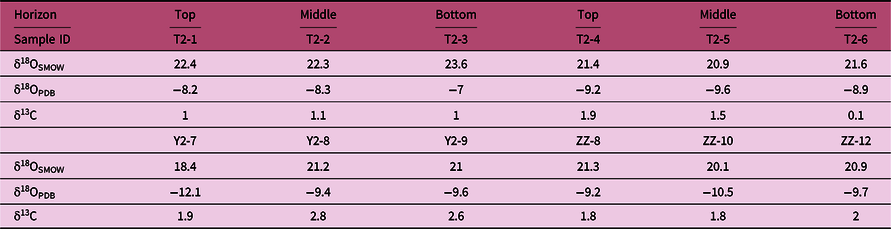
Carbon and oxygen isotope data for L 1–L 5 samples.

4.b.3. Rare earth elements
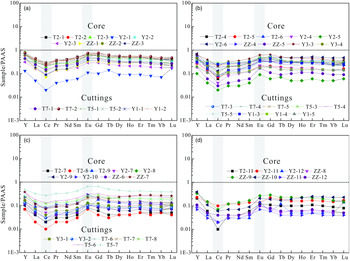
Rare earth elements (REEs) include the 14 lanthanide elements and yttrium (Y), which have similar chemical properties and, given their extremely insoluble natures, tend to have low contents in carbonate rocks (total contents generally < 100 μg g–1) (Sholkovitz, Reference Sholkovitz1993; Tribovillard et al. Reference Tribovillard, Algeo, Lyons and Riboulleau2006). We did, however, find that the total contents of light REEs (LREEs) and heavy REEs (HREEs) gradually increased in samples taken from layers L 5 to L 1, with respective increases of 5.72 to 37.69 and 3.52 to 21.85 μg g–1 (online Supplementary Table S3). The average ratios of (Nb/Yb) were found to range from 0.61 to 0.78, collectively indicating a depletion of LREEs and an enrichment of HREEs (Nothdurft et al. Reference Nothdurft, Webb and Kamber2004). Similarly, the total amount of REEs (∑REY) (9.24–59.54 μg g–1) in the underlying samples were invariably found to be lower than those in the overlying layers (∑REY L1 > ∑REY L2 > ∑REY L3 > ∑REY L4 > ∑REY L5). Furthermore, we detected similar Post-Archaean Australian Shale (PAAS) -normalized REY patterns in layers L 5–L 1, and observed that the overall shape was characterized by subparallel patterns. REEs in layers L 1–L 5 were found to be depleted to different degrees relative to PAAS, whereas Ce was clearly depleted (Fig. 5).
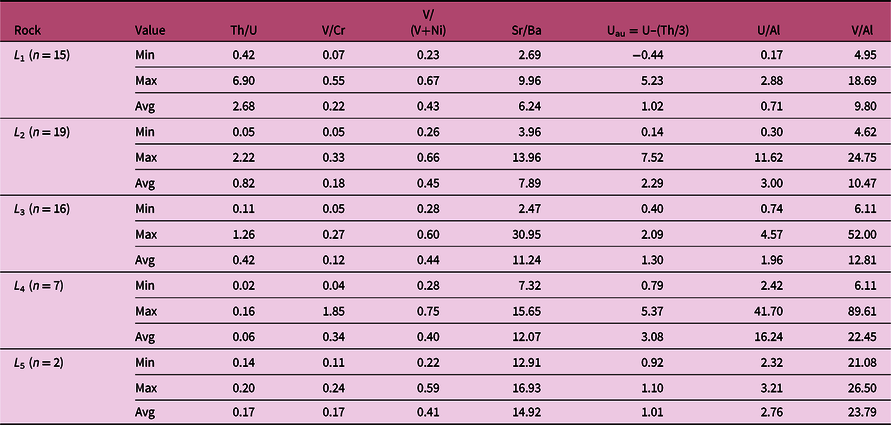
The average ratios of the geochemical proxies of L 1–L 5. Avg – average; Max – maximum; Min – minimum.

PAAS-normalized REY patterns of the Taiyuan Formation samples.

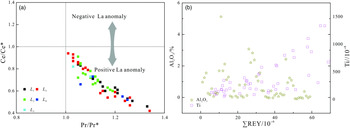
To determine the degree of anomaly in the examined samples, we selected five elements (Ce, Eu, Pr, Gd and Y) (online Supplementary Table S3) among which the Ce/Ce* ratio (average, 0.50–0.77) showed a moderate negative anomaly, whereas those of Eu/Eu* (average, 1.23–1.61), Pr/Pr* (average, 1.29–1.06), Y/Y* (average, 1.39–1.75) and Gd/Gd* (average, 1.09–1.32) showed moderate to slightly positive abnormalities. However, the relationship between Ce/Ce* and Pr/Pr* (Fig. 6a) indicates that all samples have positive La anomalies (Bau & Dulski, Reference Bau and Dulski1996).
Correlation diagram of Ce/Ce* versus Pr/Pr*, Al2O3 versus ∑REY and Ti versus ∑REY.

4.b.4. Stable isotopes
Analyses of samples obtained from the HCB revealed δ13CPDB and δ18OPDB values varying from 0.1 to 2.8‰ and −12.1‰ to −7.0‰, respectively, with corresponding ranges of 2.7‰ and 5.1‰ (Table 2). We detected significant positive anomalies in δ13CPDB values for the L 3 limestone layer (1.9–2.8‰) and uncommonly high positive excursions in layers L 4 and L 3 (1.8–2.88‰). Conversely, in the case of sample T2-7, we identified significant negative anomalies in δ18OPDB values (−12.1‰), with an overall reduction in anomalies from L 5–L 1 (Table 2). Moreover, the δ18OPDB values of layers L 5–L 1 were found to be slightly higher than those recorded in Huainan L 5–L 1 (average, −10.8‰) (Lv et al. Reference Lv, Fan, Ejembi, Wu, Wang, Li, Li and Li2020).
5. Discussion
5.a. Data availability evaluation
The composition of carbonate rocks, as products of typical biochemical deposition, is determined to a large extent by two factors inherent in the original sedimentary properties of ancient water bodies (Wang et al. Reference Wang, Liu and Schmitt1986; Bolhar & Van Kranendonk, Reference Bolhar and Van Kranendonk2007; Bennett & Canfield, Reference Bennett and Canfield2020). The first of these is the mixing of detrital substances (silicates, sulphates, phosphates, Fe oxides and Mn oxides), which masks the original chemical composition of the carbonate rock with a high concentration of chemical components; the second is the redistribution of elements when the rock undergoes an epigenetic stage. For carbonate rocks, even if anthropogenic contamination has been avoided during the sample processing stage, the degree of purity of the collected samples must therefore be evaluated prior to data assessment (Tribovillard et al. Reference Tribovillard, Algeo, Lyons and Riboulleau2006).
5.a.1. Mixing of terrigenous materials
Because of the effects of clay mineral adsorption, chemical properties and other factors on the behaviour of elements in limestone, the ∑REY in limestone is relatively low, such as the values of 8.74 ± 0.33 μg g–1 obtained for Rosenberg limestone (Ali & Wagreich, Reference Ali and Wagreich2017). Aluminium (Al) and titanium (Ti) are typical terrestrial elements that can serve as good proxies of terrigenous materials; we therefore used Al content (expressed as the oxide), Ti content and ∑REY to qualitatively evaluate the mixing of terrigenous materials. Figure 6b shows a linear relationship between Al2O3, Ti and ∑REY for the examined samples, although the adjusted R 2 value (c. 0.5) indicates the limited contribution of terrigenous flux to the content of rare earth elements in carbonate rocks in the study area. Consequently, it can be speculated that REEs in the HCB carbonate samples are mainly derived from ancient water bodies.
Y and Ho are characterized by different behaviours in water bodies, and it has been established that the Y/Ho ratio of present-day seawater (> 45) is higher than that of estuarine waters (25–28) (Nozaki et al. Reference Nozaki, Zhang and Amakawa1997; Lawrence et al. Reference Lawrence, Greig, Collerson and Kamber2006 Ali & Wagreich, Reference Ali and Wagreich2017). In the present study, we determined the average Y/Ho ratios of L 1–L 5 samples to be 38.19, 39.21, 41.54, 46.84 and 48.49, respectively, which is higher than that of present-day terrestrial water bodies, indicating a weakened detritus intrusion effect in the Taiyuan Formation samples.
In addition, Liu et al. (Reference Liu, Chi, Wang, Zhou, Liu, Liu, Gao and Zhai2018) demonstrated that a small amount (> 1%) of detrital material can alter the PAAS-normalized distribution pattern of carbonate REEs, and can change the curve of the distribution pattern (Nothdurft et al. Reference Nothdurft, Webb and Kamber2004). However, the distribution polylines of REEs in the HCB are characterized by an undulating shape (Fig. 5), and the ∑REY values of the samples (9.24–59.54 μg g–1) were found to be considerably lower than the PAAS value of 184.8 μg g–1, thereby providing evidence in support of the conclusion that upper Taiyuan Formation limestones are not significantly affected by terrigenous materials.
The presence of the insoluble trace elements Th and Zr in carbonate can also be used as an indicator of whether the debris material is mixed (Kamber & Webb, Reference Kamber and Webb2001). The contents of Th (240 μg g–1) and Zr (2.3 μg g–1) in the upper continental crust are higher than the respective values of 3.60–23.87 and 0.19–1.99 μg g–1 in layers L 1–L 5 (Taylor et al. Reference Taylor, McLennan, Armstrong and Tarney1981; Taylor & McLennan, Reference Taylor and McLennan1985), thereby indicating that ancient water bodies may have been less affected by debris.
5.a.2. Evaluation of diagenetic alteration
Diagenetic alteration can occur during both the early and late stages of diagenesis (including hydrolytic, hydrothermal alteration and burial metamorphic stages), thereby destroying the original record of the depositional information of carbonate rocks (Knauth & Kennedy, Reference Knauth and Kennedy2009). The findings of our XRD mineral analyses in the present study revealed that calcite is the main mineral component of limestones in the HCB, which is consistent with the content of CaO (c. 50%). We also established that these limestones are generally characterized by a low Mg content, with average MgO values of 0.99%, 0.88%, 0.69%, 1.48% and 0.76% being recorded for layers L 1 to L 5, respectively. We did, nevertheless, record an abnormally high content of Mg (6.19%) in the ZZ-9 (L 4) core, which could be attributed to dolomitization. However, the XRD results revealed that a few samples of limestone in this area have been altered, and therefore indicate that marine minerals can inherit palaeo-seawater properties.
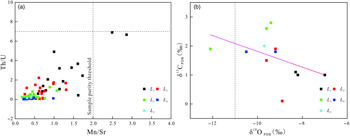
Diagenetic alteration of carbonate rock can be effectively evaluated based on geochemical parameters such as Mn/Sr ratios (Kaufman et al. Reference Kaufman, Jacobsen and Knoll1993; Wu, Reference Wu2013). The content of Mn in precipitation is higher than that in seawater, and consequently diagenetic alteration will be manifested as an increase in the ratio of Mn to Sr; an Mn/Sr ratio of < 2 is considered to indicate that carbonate rock has not been altered by an interaction with water (Kaufman et al. Reference Kaufman, Jacobsen and Knoll1993; Kaufman & Knoll, Reference Kaufman and Knoll1995). The correlation between Mn/Sr and Th/U ratios, particularly the latter, can also reveal whether trace elements reflect information pertaining to the original deposition. As shown in Figure 7a, we found the Th/U ratio to be weakly associated with that of Mn/Sr, which therefore tends to indicate that Th and U provide a record of the sedimentary information of palaeo-seawater. With the exception of two samples collected from layer L 1, for which we obtained Mn/Sr ratio values of > 2, other limestone samples were characterized by values of < 2. Relatively higher Mn/Sr ratios were recorded for certain L 1 and L 2 samples (c. 1.5), with overall values obtained for L 3 to L 5 samples being lower than those in layers L 1 and L 2. Accordingly, with the exception of the two aforementioned abnormally high Mn/Sr ratios of samples from the upper segment of L 1, the values obtained for layers L 1 and L 5 would generally tend to indicate that these limestones were not affected by diagenesis.
Correlation diagram of Th/U versus Mn/Sr and δ13CPDB versus δ18OPDB.

As a consequence of the combined effects of atmospheric precipitation, hydrothermal fluids and pore water, the δ18O values of carbonate rocks are significantly reduced during diagenesis (Jacobsen & Kaufman, Reference Jacobsen and Kaufman1999). In this regard, the findings of previous studies have revealed that a δ18OPDB value of < −11‰ is indicative of an obvious diagenetic alteration of carbonate rocks (Kaufman et al. Reference Kaufman, Jacobsen and Knoll1993; Derry et al. Reference Derry, Brasier, Corfield, Rozanov and Zhuravlev1994; Kaufman & Knoll, Reference Kaufman and Knoll1995). In this study, we obtained a δ18OPDB value of −12.1‰ for the Y2-7 core from layer L 3, which is consistent with our findings for dolomite based on XRD analyses; however, the average value (−9.1‰) obtained for the remaining samples was > −11‰ (Table 2). Furthermore, given that δ18OPDB has a higher sensitivity that of δ13CPDB, the range of variation in the former will be greater than that in the latter, with the values of δ13CPDB and δ18OPDB in samples showing a positive or negative correlation (Qing & Veizer, Reference Qing and Veizer1994; Jacobsen & Kaufman, Reference Jacobsen and Kaufman1999; Knauth & Kennedy, Reference Knauth and Kennedy2009). In this study, we found that δ13CPDB and δ18OPDB values obtained for the L 1–L 5 samples failed to show the expected correlations (Fig. 7b). However, we were unable to ascertain whether the observed weak correlations indicated that the samples are less diagenetic, or whether this is reflective of the small number of samples analysed. Collectively however, our evaluation of stable oxygen isotopes tends to indicate that some of the Taiyuan Formation samples have been affected to a slight extent by diagenesis, and that there has been at least some alteration in oxygen isotope composition.
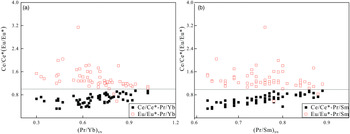
With respect to rare earth elements, Webb & Kamber (Reference Webb and Kamber2000) have argued that the distribution pattern of these elements in carbonate rocks is not readily altered, even if the rocks are subjected to strong weathering. However, in the case of Ce and Eu, differences in valence states under different redox conditions determine their activity, which is often associated with the abnormal activity of Ce and Eu and differentiation in co-occurring REEs (Webb & Kamber, Reference Webb and Kamber2000; Tribovillard et al. Reference Tribovillard, Algeo, Lyons and Riboulleau2006). In this study, we assessed the correlations between Ce/Ce* and Eu/Eu*, and between Pr/Yb and Pr/Sm, to evaluate the degree of diagenetic alteration in the samples of the Taiyuan Formation (Webb & Kamber, Reference Webb and Kamber2000; Liu et al. Reference Liu, Chi, Wang, Zhou, Liu, Liu, Gao and Zhai2018), with PAAS being used to standardize the data, and thereby to determine the relevant parameters (online Supplementary Table S3). With the exception of the weak correlation between Eu/Eu* and Pr/Yb, the parameters (Ce/Ce*, Eu/Eu*, Pr/Yb and Pr/Sm) showed a strong linear relationship (with correlation coefficients of −0.44, 0.56 and 0.79) (Fig. 8), indicating that the analysed samples had not been affected by diagenesis.
Evaluation of REEs anomaly discrimination alteration of Taiyuan Formation Samples.

In this section, evidence based on our analyses of elemental geochemistry and mineralogy indicates that most samples are only slightly affected or remain unaffected by diagenesis; that is, the elemental composition of samples is collectively inherited from an ancient water body. Accordingly, this enables us to confirm that the elemental signatures retained within the limestones can serve as proxies for reconstructing the deep-time background of the Taiyuan Formation.
5.b. Palaeoredox conditions
Different combinations and ratios of trace elements have been widely used to reconstruct the redox environments of ancient water bodies and, in this regard, V/Cr, V/(V + Ni) and authigenic U (Uau) have been shown to perform well in previous studies (Jones & Manning, Reference Jones and Manning1994; Shi et al. Reference Shi, Feng, Shen, Ito and Chen2016; Wu, Reference Wu2013; Wang et al. Reference Wang, Chen, Liang, Chang and Deng2019).
With respect to vanadium, the main ionic forms are V5+, V4+, V3+ and V5+, which in an oxidizing environment are present as HVO42 or H2VO4. Under conditions of increasing reducibility, high-valence V is initially converted to 4+ (VO(OH)3, VO2+, VO(OH)2), prior to subsequent conversion to 3+ oxide (V2O3) or hydroxide (V(OH)3), which is enriched in sediments under reducing conditions. Comparatively, enrichment of Cr is lower than that of V in the anoxic state and, consequently, a sediment V/Cr ratio of 2 is considered to be indicative of the boundary distinguishing between oxic and anoxic environments (Jones & Manning, Reference Jones and Manning1994). The V/Cr ratios determined for samples in the Taiyuan Formation were found to range from 0.11 to 1.85, with average values of 0.22, 0.18, 0.12, 0.34 and 0.17 being obtained for layers of L 1 to L 5, respectively, indicating the oxygen-rich nature of the ancient water environment (Table 3).
Sensitive redox proxy indices such as the V/(V + Ni) ratio and Uau have been successfully used to assess the redox conditions of palaeo-seawater (Wignall & Myers, Reference Wignall and Myers1988; Rimmer, Reference Rimmer2004; Wu, Reference Wu2013). A V/(V + Ni) ratio of ≥ 0.6 is considered to be indicative of an anoxic environment (Rimmer, Reference Rimmer2004); in this study we obtained average V/(V + Ni) values of 0.43, 0.45, 0.44, 0.40 and 0.41, for layers L 1 to L 5, respectively, although abnormal values ranging from 0.62 to 0.75 were obtained for certain samples collected from layers L 1 (2), L 2 (3) and L 4 (1). Wignall & Myers (Reference Wignall and Myers1988) identified carbonate and phosphate minerals as hosts of uranium and demonstrated that Uau may represent a good redox substitute for rocks derived from marine sources. An authigenic U value of > 5 is taken to be indicative of a reduced environment, and a corresponding value of < 5 is considered to denote an oxic environment. In this study, we obtained average Uau values ranging from 1.01 to 3.08 for the L 1–L 5 samples, thereby indicating an oxidizing environment. However, these data indicate that the samples are representative of sediments deposited in an oxic water environment, and few samples provide evidence of anoxic conditions.
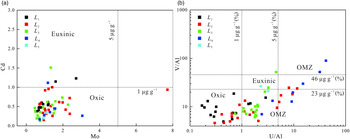
The solubilities of Cd and Mo under oxidizing conditions are higher than those under reducing conditions, which contributes to their enrichment in anoxic sedimentary facies. In this regard, Wu (Reference Wu2013) has suggested that Cd and Mo contents greater than 1 and 5 μg g–1, respectively, jointly indicate a reduced water environment. Moreover, Mo is enriched in organic matter under reducing conditions, which is more used for the reconstruction of palaeoredox conditions in shale (Algeo & Li, Reference Algeo and Li2020). However, it has been observed to be enriched only in extremely reducing environments. We therefore assessed the different projection areas of Cd under palaeoredox conditions (Fig. 9a) and found that the samples were mainly concentrated in an oxidized water zone (Cd < 1). Bennett & Canfield (Reference Bennett and Canfield2020) used Al, a typical terrestrial element, to standardize the redox-sensitive elements V and U, which enabled the delimition of oxic (OZ), oxygen-minimum (OMZ), perennial oxygen-minimum (P-OMZ) and euxinic (EZ) zones. The results presented in Figure 9b show that L 1 and L 2 samples are distributed in the OZ, whereas samples obtained from layers L 3–L 5 are distributed in the OMZ, which indicates that the depth of the overlying water body during the period of L 5–L 3 limestone deposition was deeper than that during the period of L 2–L 1 deposition.
Palaeoredox conditions of Taiyuan Formation Samples.

The enrichment and depletion of Ce (Ce/Ce*) relative to that of co-occurring elements can serve as an indicator of the redox state of water bodies during the deposition of carbonate rock (Frimmel, Reference Frimmel2009; Wang et al. Reference Wang, Chen, Liang, Chang and Deng2019). Collectively, the Ce/Ce* values of the samples obtained in this study (0.32–0.91) reveal a slight to moderate negative anomaly, reflecting an oxic palaeo-seawater environment (online Supplementary Table S3). Combined with the presence of minerals such as hematite (indicating an oxidative environment) as revealed by XRD analysis, the observed patterns of geochemical proxies provided convincing evidence that limestones in the HCB were deposited in an oxic water environment that was deeper during the period represented by layers L 3–L 5.
5.c. Depositional palaeo-environment
The reconstruction of palaeoclimates also makes an important contribution to determining the sedimentary environment. Under conditions in which it is difficult to establish palaeoclimate characteristics based on carbonate geochemical theory, certain indirect evidence can enable researchers to speculate on the palaeoclimate conditions prevalent during limestone deposition. Palaeomagnetic evidence, for example, has revealed that the latitude of the NCC during the Late Carboniferous – early Permian time was 17–18° N, which indicates that, during this period, the NCC was probably characterized by a tropical and subtropical climate, proving that the palaeoclimate of the HCB was mainly warm or hot at that time (Nie, Reference Nie1991; Li et al. Reference Li, Zhang, Gao, Li, Zhao, Li and Guan2012). Moreover, along the northern margin of the North China plate (Fig. 2), the thinner limestone deposited during Late Carboniferous – early Permian time is replaced by thicker coal seams (> 3 m), sandstones and mudstones (Lv et al. Reference Lv, Wei, Liu and Liu2010). The contemporaneous presence of these coal seams with limestones is considered to reflect a warm palaeoclimate. Additionally, Li et al. (Reference Li, Gui, Chen, Fang, Li and Li2021 a) reported on the palaeoclimatic conditions during consolidation of the marine mudstones of the HCB Taiyuan and Shanxi formations, and suggested that these mudstones were formed during a period characterized by a warm and arid climate, which is also consistent with speculations based on palaeomagnetic data.
One of the methods that can be used to determine the depositional environment is the REE distribution model. Typically, normal marine carbonate rocks have a distinctive rare earth distribution pattern characterized by uniform HREE enrichment, La and Y positive anomalies, and a high Y/Ho ratio, and carbonate rocks deposited in oxidized water generally have negative Ce anomalies (Webb & Kamber, Reference Webb and Kamber2000; Kranendonk et al. Reference Kranendonk, Webb and Kamber2003). Figure 7 shows that deposits analysed in this study are characterized by a significantly positive anomaly in lanthanum (La), and that the average values of positive Y anomalies in layers L 1 to L 5 were 1.39, 1.43, 1.53, 1.75 and 1.75, respectively. Combined with slight to moderate Ce/Ce* ratios (0.32–0.94), the distribution pattern of REEs and lithologic associations tend to indicate that the depositional environment was an epicontinental sea (Lv et al. Reference Lv, Hu, Van Loon and Wu2021).
A further method for determining depositional environments utilizes trace elemental proxies. Derived from Sr and Ba, Th and U have differing abundances under different deposition systems; these two groups of elements are therefore often employed to characterize the depositional environment (Dhoundial et al. Reference Dhoundial, Paul, Sarkar, Trivedi, Gopalan and Potts1987; Lv et al. Reference Lv, Fan, Ejembi, Wu, Wang, Li, Li and Li2020; Wang et al. Reference Wang, Wang, Liu, Xu and Li2021). Generally, an Sr/Ba ratio and a Th/U ratio greater (less) than 1 and 2, respectively, are considered to be indicative of a typical marine or continental sedimentary environment (Sarin et al. Reference Sarin, Krishnaswami, Somayajulu and Moore1990; Zhang et al. Reference Zhang, Tian, Chen, Hou, Hou, Li and Liu2008; Chen et al. Reference Chen, Liu, Wu and Sun2016). In this study, we obtained average Sr/Ba ratios of 6.24, 7.89, 11.24, 12.07 and 14.92, for L 1–L 5 samples, respectively; the Sr/Ba ratio in the Y1-3 core reached 30.95, indicating a typical marine sedimentary environment. The average Th/U ratios of samples collected from layers L 2–L 5 were 0.82, 0.42, 0.06 and 0.17, respectively. Notably, in contrast to other sections in which Th/U ratios were < 2, we obtained Th/U ratios of 6.9 and 6.76 for samples T2-1 and T2-2 in the upper and middle segments of layer L 1, respectively, which might indicate that these segments of L 1 have been affected by small amounts of freshwater during the current period. It is conceivable that the anomalous values of these two samples are attributable to the coincidence of L 1 upper segment deposition during the final large-scale regression experienced by the southern NCC during late Palaeozoic time (Chen et al. Reference Chen, Liu, Wu and Sun2016; Lv et al. Reference Lv, Fan, Ejembi, Wu, Wang, Li, Li and Li2020). Collectively, the observed REE distribution patterns, trace elemental proxies (Sr/Ba and Th/U) of samples and palaeomagnetic data indicate that Taiyuan Formation limestones were deposited in a typical epicontinental sea sedimentary environment during a period characterized by a hot and arid palaeoclimate, which is consistent with the conclusions drawn by Li et al. (Reference Li, Gui, Chen, Fang, Li and Li2021 a) and Lv et al. (Reference Lv, Fan, Ejembi, Wu, Wang, Li, Li and Li2020).
5.d. Tectonic setting and geological significance
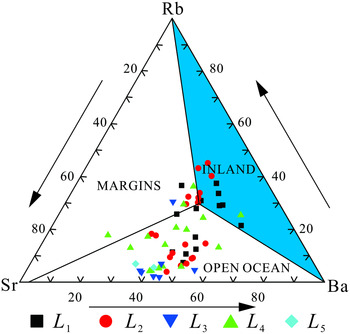
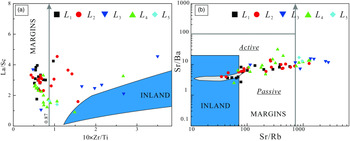
Despite the general paucity of studies concerning limestone geochemistry, systematic investigations of the geochemistry of limestone are essential for determining the tectonic settings of limestone sedimentary basins (Zhang et al. Reference Zhang, Li, Yan, Zeng, Lu, Zhang, Hui, Jin and Tang2017). The authors of previous studies have proposed that the types and amounts of particulates (metalliferous and terrigenous), as well as trace-element concentrations in seawater, generally depend on the plate tectonic environment of basins (Murray et al. Reference Murray, Buchholtz Ten Brink, Jones, Gerlach and Russ1990, Reference Murray, Buchholtz Ten Brink, Jones, Gerlach, Russ and Jones1991, Reference Murray, Buchholtz Ten Brink, Gerlach, Russ and Jones1992; Holser, Reference Holser1997). The multiple stages of tectogenesis can complicate application of the magmatic rock geochemical theory. Moreover, in certain cases, orogens have undergone intense subduction, shortening and denudation, thereby obscuring primary information relating to tectonic unit settings. Consequently, there is still a lack of consensus regarding tectonic involvement in the composition of limestone deposits (e.g. Tarduno et al. Reference Tarduno, McWilliams, Debiche, Sliter and Blake1985; Zhang et al. Reference Zhang, Xia, Zhang, Liu, Zeng, Li and Xu2014). However, with the development of geochemical research on magmatic and carbonate rocks, trace elements (including REEs) have proven to be powerful tools for determining the original information of magmatic source areas and sedimentary settings (Murray et al. Reference Murray, Buchholtz Ten Brink, Jones, Gerlach and Russ1990, Reference Murray, Buchholtz Ten Brink, Jones, Gerlach, Russ and Jones1991, Reference Murray, Buchholtz Ten Brink, Gerlach, Russ and Jones1992; Zhang et al. Reference Zhang, Xia, Zhang, Liu, Zeng, Li and Xu2014). Notably, the study of sedimentary rocks (particularly limestone) that provide a record of the initial properties of seawater may contribute additional information that can enhance our understanding of the evolution of tectonic environments in sedimentary basins (Webb & Kamber Reference Webb and Kamber2000). Zhang et al. (Reference Zhang, Li, Yan, Zeng, Lu, Zhang, Hui, Jin and Tang2017), for example, have reported the validity of employing trace elements and REEs to reconstruct the plate tectonic setting, despite confounding factors such as diagenetic modification, and the high siliciclastic content of limestones, and have proposed some effective geochemical proxies (e.g. Sr/Rb versus Sr/Ba). Consequently, for the purposes of this study, we selected these proxies to reconstruct the plate tectonic setting of the southern NCC during late Palaeozoic time.
Limestone layers are deposited under different tectonic settings, including passive/active continental margin basins, oceanic highs, oceanic floors (above the carbonate compensation depth) and inland freshwater lakes (Tarduno et al. Reference Tarduno, McWilliams, Debiche, Sliter and Blake1985; Alonso-Zarza, Reference Alonso-Zarza2003; Zhang et al. Reference Zhang, Li, Yan, Zeng, Lu, Zhang, Hui, Jin and Tang2017). Generally, the contents of Sr, Rb and Ba in the limestones of discrete tectonic environments are characterized by different patterns of distribution, which is reflected in the distinct fields visualized in Rb–Sr–Ba triangular diagrams (Zhang et al. Reference Zhang, Li, Yan, Zeng, Lu, Zhang, Hui, Jin and Tang2017). Our plots of data obtained for L 1–L 5 samples revealed two distinct fields, namely, the open ocean (L 5–L 3) and marginal and inland water bodies (L 2 and L 1), as shown in Figure 10. In addition, the ratios of continental and marine elements, such as Zr, Ti, Sr and Ba, in carbonate rocks have been successfully used to decipher various tectonic environments (continental margins and inland freshwater lakes) (Zhang et al. Reference Zhang, Li, Yan, Zeng, Lu, Zhang, Hui, Jin and Tang2017; Savko et al. Reference Savko, Kuznetsov and Ovchinnikova2020). Consequently, our 10×Zr/Ti versus La/Sc and Sr/Rb versus Sr/Ba discriminant diagrams show that L 1–L 5 samples tend to concentrate in the continental margin group (passive or active), whereas a few samples plotted within the inland group (Fig. 11a, b). Overall, the use of geochemical proxies has indicated that, during late Palaeozoic time, the tectonic environment of the plate in the southern NCC changed from an open ocean to a passive continental margin, which is consistent with the conclusion arrived at by Li et al. (Reference Li, Gui, Chen, Fang, Li and Li2021 a).
Rb–Sr–Ba triangular diagram of limestones deposited in Taiyuan Formation.

Geochemical proxies of limestones for the plate tectonic settings deposited in Taiyuan Formation.

Tectonic evolution of the southern NCC during the late Palaeozoic Era was closely associated with the history of the northeastern branch of the Palaeotethys Ocean. Notably, structural mélanges identified in the A’nimaque–Mianlue suture zones have provided evidence for the existence of an ocean basin (part of the Palaeotethys Ocean) between the NCC and the South China Craton (SCC) during Palaeozoic – early Mesozoic time (Dong et al. Reference Dong, Zhang, Neubauer, Liu, Genser and Hauzenberger2011; Dong & Santosh, Reference Dong and Santosh2016). Furthermore, previous studies have indicated that the Qinling tectonic belt, which records the subduction and closure of the A’nimaque–Mianlue Palaeotethys Ocean, was formed by a collision between the NCC and SCC (Dong & Santosh, Reference Dong and Santosh2016; Xing et al. Reference Xing, Li, Xu, Mo, Shan, Yu, Hu, Huang and Dong2020). However, it is widely believed that the A’nimaque–Mianlue Palaeotethys Ocean entered the mature stage as early as the Devonian period, whereas subduction commenced in Late Carboniferous or Permian time (300–250 Ma) (Li et al. Reference Li, Mo, Yu, Ding, Huang, Wei and He2013; Dong & Santosh, Reference Dong and Santosh2016). Although the geological age of complete closure is still subject to debate, it has, nevertheless, been confirmed to have occurred at some point during late Permian – Middle Triassic time (c. 253–233 Ma) (Liu et al. Reference Liu, Qian, Li, Dou and Wu2015; Qiu et al. Reference Qiu, Yu, Gou, Liang, Zhang and Zhu2018).
Li et al. (Reference Li, Hou, Yang, Sun, Zhang and Li2004) proposed that the Mianlue Ocean Basin was open in the Devonian Period, and a comparison of the age spectra of detrital zircons from the meta-sedimentary rocks of the Mianlue structural belt with those of its adjacent areas led Li et al. (Reference Li, Pei, Li, Li, Pei, Gao and Wang2021 b) to conclude that the Mianlue structural belt and surrounding areas were probably parts of the same tectonic environment during late Palaeozoic time. Furthermore, Li et al. (Reference Li, Gui, Chen, Fang, Li and Li2021 a) used geochemical proxies to interpret the tectonic setting of the passive continental margin of marine mudstones in the Shanxi Formation (integrated above the Taiyuan Formation). In the present study, we examined tectonic proxies of the L 1–L 5 limestone samples to determine the plate tectonic setting of the Taiyuan Formation, which we found to be consistent with the evidence presented by the aforementioned studies, indicating a transition from an open ocean to a passive continental margin. In addition, the stratigraphic column depicted in Figure 3 shows the successional limestone deposits (L 1–L 5) that were laid down under repeated transgressions and regressions (as a consequence of tectonic evolution). The scale of seawater movement was presumably associated with global climate (glacial–interglacial) during the late Palaeozoic Era, with the strata overlying L 1 undergoing conversion to continental sediments, marking the end of seawater movement (Mii et al. Reference Mii, Grossman and Yancey1999; Miller & Eriksson, Reference Miller and Eriksson1999; Haq & Schutter, Reference Haq and Schutter2008; Poulsen et al. Reference Poulsen, Tabor and White2015). However, on the basis of extensive experimental evidence, including the lack of continental ice sheets around the North Pole during the late Palaeozoic Era, the authors of similar studies on near-field glacial deposits have argued that large-scale sea-level fluctuations were unlikely to have occurred (Isbell et al. Reference Isbell, Henry, Gulbranson, Limarino, Fraiser, Koch, Ciccioli and Dineen2012; Montañez & Poulsen, Reference Montañez and Poulsen2013). Consequently, it is speculated that, in addition to the influence of glacial expansion, the decline in sea levels associated with plate tectonic evolution may have led to a gradual thinning of the sedimentary L 4–L 1 limestone sequence in the HCB.
Further evidence for the commencement of subduction and closure of the Mianlue Ocean is provided by studies on regional geology and isotopic geochronology (Dong & Santosh, Reference Dong and Santosh2016). Arc-related volcanic rocks in the ophiolite exposed near Lueyange and the high-Mg andesite and adakite andesite from the Sanchazi area indicate subduction of the oceanic slab (Lai & Yang, Reference Lai and Yang1997; Xu et al. Reference Xu, Wang and Yu2000), whereas geochronological analyses have indicated that the U–Pb zircon ages of anorthosite associated with the Sanchazi arc and diabase from the Sanchazi island-arc setting are 300 ± 61 Ma and 295–264 Ma, respectively, representing the subduction age of the Mianlue Ocean, which is consistent with the geological age of the Taiyuan Formation (Li et al. Reference Li, Hou, Yang, Sun, Zhang and Li2004; Lai & Qin, Reference Lai and Qin2010). Furthermore, the findings of a study by Li et al. (Reference Li, Pei, Li, Li, Pei, Gao and Wang2021 b) have provided convincing evidence to indicate that the Mianlue oceanic basin during late Palaeozoic time should include the entire South Qinling area. Accordingly, taking into consideration regional isotopic geochronology, sedimentology and the limited influence of glacial–interglacial transitions on sea levels, we propose that the change in tectonic environment was caused by subduction of the Mianlue Ocean to the NQB and NCC.
On the basis of the findings of this study, we propose a pattern for tectonic evolution of the NCC before and after subduction of the northeastern branch of the Palaeotethys Ocean during the late Palaeozoic Era (Fig. 12a, b).
-
(1) The Mianlue Ocean became a mature ocean basin between the Devonian and Late Carboniferous periods and began to undergo subduction. During the Pennsylvanian period, a thick limestone succession (L 5, L 6, etc.) of the lower Taiyuan Formation was deposited in the Huaibei Coal Basin, which revealed the tectonic setting of the open ocean (Lv & Chen, Reference Lv and Chen2014). The primary factors driving changes in sea levels during this period were glacial and interglacial cycles. Until late Pennsylvanian time, the mid-ocean ridge formed slowly, and the subduction of the Mianlue Ocean began (Fig. 12a).
-
(2) During the early Permian period, following deposition of a thin limestone succession (L 2 and L 1), the residual ocean basin of the Huaibei Coal Basin began its transformation into continental strata (coal seam, sandstone and mudstone assemblage), and the tectonic environment changed from an open ocean to a passive continental margin. Furthermore, the North Qinling Belt was uplifted as a result of oceanic subduction (Fig. 12b; Xing et al. Reference Xing, Li, Xu, Mo, Shan, Yu, Hu, Huang and Dong2020). As an important provenance, this provided the main materials of the Huaibei Coal Basin continental sediments, derived from weathering and denudation (Fig. 12b; Li et al. Reference Li, Gui, Chen, Fang, Li and Li2021 a).
Schematic, not-to-scale cartoon of the tectonic evolution of the HCB during late Palaeozoic time.

6. Conclusions
We have examined the mineralogy and geochemistry of the limestone succession in the Taiyuan Formation of the southern North China Craton, and report our observations in the following.
-
(1) The lithology of the Taiyuan Formation (L 1–L 5) is one bioclastic limestone, with a mineral composition including calcite, hematite and dolomite, among which calcite is the most abundant.
-
(2) The elemental geochemistry of samples and palaeomagnetic evidence indicate that the limestones were deposited in a typical epicontinental sea sedimentary environment under conditions of a warm or hot palaeoclimate.
-
(3) The transformation of the tectonic setting of the Taiyuan Formation limestone succession deposited during Late Carboniferous – Permian time may represent a response to the subduction and closure of the northeastern Palaeotethys Ocean.
Supplementary material
For supplementary material accompanying this paper visit https://doi.org/10.1017/S0016756821001126
Acknowledgements
We are grateful to the editors and anonymous reviewers, whose constructive comments helped to improve the quality of this manuscript. This study was supported by the National Natural Science Foundation of China (grant nos 41773100 and 41972256), the Research Project of Wanbei Coal Electricity Group Co. Ltd. (2020) and the Project for research activities of academic and technological leaders of Anhui Province (grant no. 2020D239).
Conflicts of interest
None.