Introduction
Identification methods based on molecular markers can provide an efficient means of distinguishing species for which morphological traits are not informative or may even be error-prone. Various tools have been developed in this aim, ranging from PCR-based allelic discrimination assays to the use of highly polymorphic markers, such as microsatellites (Blaxter, Reference Blaxter2004). In the last decade, some of these molecular tools have been developed towards identifying species of insect which are of economical importance or currently endangered (Phuc et al., Reference Phuc, Ball, Son, Hanh, Tu, Lien, Verardi and Townson2003; Contreras-Diaz et al., Reference Contreras-Diaz, Lopez, Oromi and Juan2006; Nolan et al., Reference Nolan, Carpenter, Barber, Mellor, Dallas, Mordue and Piertney2007). For such species, the lack of accurate morphological keys for adults and juveniles often greatly limits our knowledge regarding various ecological parameters (Behura, Reference Behura2006).
Morphological identification problems arise more particularly for some species of the Acrididae family belonging to the Calliptamus genus, such as C. siciliae (Ramme, 1927), or C. italicus (Linneaus, 1758) and C. wattenwylianus (Pantel, 1896) – both recognized as potential pests – as well as for C. barbarus (Costa, 1836). C. italicus and C. barbarus are observed in an area extending from the Mediterranean Basin to the southern part of Siberia. Calliptamus barbarus has a more restricted distribution area than C. italicus in Siberia but is observed slightly more to the south, in Italy, Spain and North Africa. Calliptamus wattenwylianus is only present along the Mediterranean Coast, in France, Spain and North Africa (COPR, 1982). Calliptamus siciliae has the most limited distribution area, which extends from the south-east of France through Italy and Sicily (Harz, Reference Harz1975). Because these four species are observed in similar habitats in the south of France and are under the focus of ecological surveys, there is a crucial need for accurate determination tools based on morphological or molecular diagnostics.
Distinction among species of the Calliptamus genus relies mainly on males' traits and is based on wings and genitalia characteristics. It is more difficult to identify females and larvae, which have few or no morphological diagnostics enabling determination keys to be designed (Jago, Reference Jago1963; Harz, Reference Harz1975). Moreover, depending on the localities, some morphological characteristics used for identification are subject to variation (see fig. 1: Chopard, Reference Chopard1943, Reference Chopard1951; Fontana et al., Reference Fontana, Buzzeti, Cogo and Odé2002; Olmo Vidal, Reference Olmo Vidal2006) and morphological taxonomy still remains unconfirmed by molecular studies. Only a few studies have been performed on the Calliptamus genus, focusing mainly on their mitochondrial genome (Bensasson et al., Reference Bensasson, Zhang and Hewitt2000). More recently, the sequencing of the mitochondrial genome has revealed the presence of nuclear mitochondrial copies (numts) in C. italicus (Fenn et al., Reference Fenn, Cameron and Whiting2007; Song et al., Reference Song, Buhay, Whiting and Crandall2008). However, none of these studies have proposed any identification protocol based on unambiguous genetic characteristics. In this paper, we present a quick and inexpensive molecular method to efficiently identify the four species present in southern France using a multiplex PCR assay.
Discrimination of the four Calliptamus species using morphological characteristics taken from guides published for various localities.
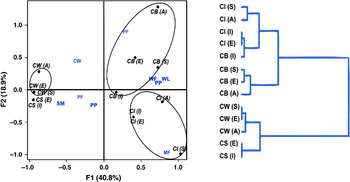
On the left, factorial correspondence analysis of table 2. In bold and italic, species associated with different localities: CW, C. wattenwylianus; CB, C. barbarus; CI, C. italicus; and CS, C. siciliae. In brackets, species guide definitions: (A) means North Africa and use of Chopard (Reference Chopard1943) to determinate the species; (E), Europe and use of Chopard (Reference Chopard1951); (S), Spain and use of Olmo Vidal (Reference Olmo Vidal2006) ; and (I), Italy and use of Fontana et al. (Reference Fontana, Buzzeti, Cogo and Odé2002). In standard format, different characteristics taken into account: WF, tegmen form; WL, tegmen length; PF, pallium form; PP, pallium position; CW, colour of posterior wings; MF and SM, number and size of marks on the inner side of posterior femur. Bold characters explain significantly (high contribution) the distribution over axes 1 and 2 of the different species definitions.
On the right, a dendrogram derived from a species classification (ascending hierarchical classification based on the species' coordinates in the first four axes of FCA).

Material and method
Congruence of morphological characteristics
To verify the congruence of different determination keys, we first performed a factorial component analysis (FCA) based on seven different characteristics used for Calliptamus determination in various geographical localities (table 1). We used an appropriate guide for each locality: Olmo Vidal (Reference Olmo Vidal2006) for Spain, Chopard (Reference Chopard1943) for North Africa, Chopard (Reference Chopard1951) for Europe, and Fontana et al. (Reference Fontana, Buzzeti, Cogo and Odé2002) for Italy. All characteristics were taken as factors and were broken down into different modalities. Some characteristics were not used in all guides (colour of posterior wings, number and size of marks on the inner side of posterior femur). However, these were not considered as non-available data but assigned particular and separate modalities to enable FCA calculation.
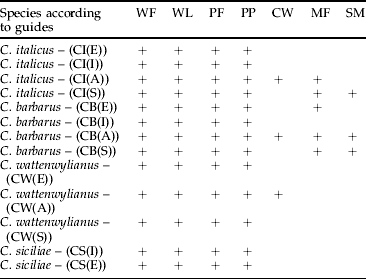
Morphological characteristics used by various authors for the identification of Calliptamus species.
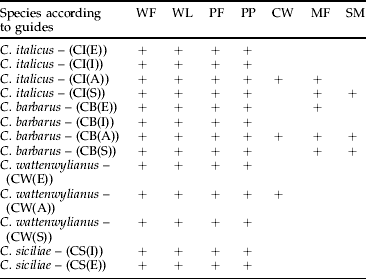
The first column indicates the species by to geographical zone (E, Europe; A, North Africa; I, Italy; S, Spain) and the determination keys used (Chopard (Reference Chopard1951) for Europe; Chopard (Reference Chopard1943), for North Africa; Fontana et al. (Reference Fontana, Buzzeti, Cogo and Odé2002) for Italy; Olmo Vidal (Reference Olmo Vidal2006) for Spain). Following columns show the different characteristics used by these authors to identify the Calliptamus species: WF, form of anterior wings; WL, wing length; PF, pallium form; PP, pallium position; CW, colour of posterior wings; MF, number of marks on the inner side of posterior femur; SM, mark size on the inner side of Femur. Crosses indicate that the characteristics are used in a particular guide to determine the respective species.
Two modalities were considered for the form of anterior wings (WF), tegmen narrowed from the beginning of the second third or tegmen parallel from the beginning of the second third. Two modalities were used for the wing's length (WL), tegmen longer or shorter than posterior knees. For the form of the pallium (membrane covering penis valves, PF) seen in profile, we separated long and curved or rounded. Two modalities were also distinguished for pallium position (PP), proximal or near the apex of sub-genital plates. We used four modalities for the colour of posterior wings (CW): colourless, pink, pale pink and ‘NA’ when this characteristic was not used in a guide. Number (MF) and size (SM) of marks on the inner side of posterior femur were described by three modalities (MF: number of marks is one, two or more, or not used in a guide; SM: marks are small, wide or characteristic not used).
Wing length and form and pallium position appeared to supply the best explanation for the distribution of species over the first two axes (fig. 1). Calliptamus italicus and C. barbarus were clearly distinguished from C. siciliae and C. wattenwylianus on the basis of these three combined characteristics. Differentiation between C. italicus and C. barbarus was more obvious in terms of the size of marks on the inner side of posterior femur and the form of pallium, whereas C. siciliae and C. wattenwylianus were differentiated on the third axes according to pallium position (PP) and wing colour (CA).
The dendrogram on the right side of fig. 1 shows species classification, on the basis of different guides (ascending hierarchical classification based on the species' coordinates in the first four axes of FCA). Calliptamus siciliae and C. wattenwylianus stay close to each other but remain clearly distinct, as do C. barbarus and C. italicus. Only CB (I) was not correctly classified within the branch characterizing the C. barbarus species. This error of assignment suggests that key characteristics used in different guides could be subject to range overlap and shows their failure to discriminate between species from different localities. In such a context, the development of accurate molecular tools could be especially useful.
Insect sampling
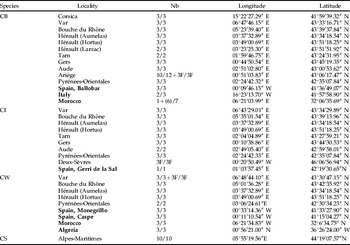
Each Calliptamus species observed in France was represented in 123 samples, which were taken from different locations from France, as well as from neighbouring locations such as Spain, Italy, and North Africa (see table 2). Females were tested and came from localities where only one species was present, in order to be certain of their species identity, and were verified through morphological identification proposed by Jago (Reference Jago1963) and Harz (Reference Harz1975). No female of C. siciliae could be tested because such a sample was not available.
Tested samples and their origins.
The number of samples successfully amplified per number of tested samples is shown in the third column; the presence of brackets indicates a contradiction between morphological determination and the molecular diagnostic. All the samples used for tests were males, except where F is specified alongside the species name.

Species names are provided in the first column: CW, C. wattenwylianus; CB, C. barbarus; CI, C. italicus; and CS, C. siciliae. The second column indicates the sample's origin; French localities are indicated by department name and border samples (in bold) by country, sometime with other different localities such as Spain.
In order to ensure high specificity to the Calliptamus species for the primer design step, we also took into account two additional samples of a species belonging to a genus close to Calliptamus. We selected Paracaloptenus bolivari (Uvarov, 1942), since the morphology of this species during the first development stages is similar to that of Calliptamus species and because it is sympatrically distributed with Calliptamus species in some French localities.
Molecular method design and application
DNA was extracted using a CTAB protocol (Doyle & Doyle, Reference Doyle and Doyle1987) from the hind femur in each of the five species: C. italicus (CI), C. barbarus (CB), C. wattenwylianus (CW), C. siciliae (CS) and Paracaloptenus bolivari (PB). Using aligned mitochondrial sequences of Cytochrome Oxydase I (COI) from two Acrididae species, Locusta migratoria (Linneaus, 1758) and Chortippus parallelus (Zetterstedt, 1821) (respective accession numbers: X80245 and X95575), we designed primers on conserved regions over both species to amplify the COI gene in each of the five species under focus. Using primer pairs COI75F: 5′-GCATGAGCAGGAATAGTAGG-3′ and COI1524R: 5′-CTGAATATCTATGTTCTGCAGG-3′, we amplified sequences of the five species with different localities for C. barbarus, C. wattenwylianus and C. italicus. All sequences were submitted to Genbank (accession numbers GQ355945 to GQ355955 and GU326338).
These sequences were then aligned, and we determined a conserved region for the four Calliptamus species, but differentiated from the Paracaloptenus genus by some nucleotides in 3′. Moreover, for each species a specific primer region, containing at least two discriminating mutations, was screened in order to obtain species-specific amplification products of different lengths.
We designed a reverse primer (COI-1070-R) in the genus conserved region, as well as a forward species-specific primer for each species: CBA-260F for C. barbarus, CI-510F for C. italicus, CW-720F for C. wattenwylianus and CS-910F for C. siciliae (table 3).
Primer pairs developed for the molecular diagnostic.

From left to right: species names, primers names, primers' and length of the PCR products (in pairs of bases).
For all individuals analysed, DNA extraction was performed as explained above: PCR amplifications were run in a 25 μl total volume using a Qiagen core kit (QIAGEN, Courtaboeuf, France), with 2.5–5.0 ng DNA. The PCR buffer contained 0.1 mM of each dNTPs, 1.5 mM MgCl2, 1 U of Taq DNA polymerase and 0.4 μM of reverse common primer and 0.4 μM of each specific F-primer, except for CB, for which 0.8 μM was necessary. PCR reactions were performed on T-personal thermocycler (Biometra) using the following parameters: denaturation at 94°C for 5 min, followed by 35 cycles with denaturation for 30 s at 94°C, annealing for 30 s at 52°C and elongation for 1 min at 72°C, followed by a final elongation step of 10 min at 72°C. PCR products were then electrophoresed in 2% agarose gel for 40 min at 100 volts.
Results
Null amplification checked on two different samples of P. bolivari (Uvarov, 1942), and sequence identity confirmed that our method was specific to the Calliptamus genus.
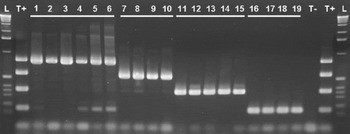
Four different PCR products were obtained (see fig. 2), in which C. barbarus showed a PCR product of 610 pb, C. italicus of 560 pb, C. wattenwylianus of 350 pb and C. siciliae of 160 pb.
Results of molecular diagnostics for the four Calliptamus species of southern France.
L on each side is Ladder (1 kb) Invitrogen. T+, DNA positive control; we gathered the four PCR Product types (160/350/560/810 pb) from our assays. 1–6: C. barbarus from Spain (1), Pyrénées-Orientales (2), Hérault (Aumelas) (3), Var (4), Corsica (5), Italy (6); 7–10: C. italicus, from Spain (7), Pyrénées-Orientales (8), Hérault (Aumelas) (9), Var (10); 11–15: C. wattenwylianus from Spain (11), Pyrénées-Orientales (12), Hérault (Aumelas) (13), Var (14), Morocco (15); 16–19: C. siciliae from Alpes-Maritimes; T−, negative control of PCR with only H2O. CB gave a band at 810 pb, CI at 560 pb, CW at 350 pb and CS at 160 pb.

For 123 individuals tested, molecular diagnostics confirmed morphological determination for 113 samples, irrespective of their geographical origins. Four PCR samples failed to amplify, and six molecular diagnostics disagreed with the respective morphological identification. These discrepancies concerned C. barbarus specimens from Morocco, which were identified as C. wattenwylianus using our method. Additional verification of morphological traits revealed that these individuals did not display the typical morphological criteria proposed by Chopard (Reference Chopard1943) and that it was difficult to distinguish between C. barbarus and C. wattenwylianus. To be certain of their species membership, we sequenced two individuals coming from Morocco, one identified as C. barbarus with morphological and molecular diagnostic and one morphologically undetermined sample revealed as C. wattenwylianus by the molecular diagnostic. Estimation of p-distance (p-distance=0.39) between both sequences, using Mega v.4 (Tamura et al., Reference Tamura, Dudley, Nei and Kumar2007) was enough to confirm their membership to two different species. Moreover, the second sequence was closed to other C. wattenwylianus' sequences (p-distance<0.01) confirming their membership to the C. wattenwylianus species.
All PCRs led to highly specific amplification products, although C. barbarus from the Var, Corsica, Algeria and Italy had a very slight secondary band present, which did not interfere with their identification.
All females were successfully amplified, and identification was the same using both morphological and molecular methods.
Discussion
Species identification of insects is not always straightforward. In particular, the absence of suitable morphological keys for immature stages often requires specialist knowledge, and it can be time-consuming or even impossible.
Consequently, molecular diagnostic tools are increasingly being developed for insects (Saccaggi et al., Reference Saccaggi, Kruger and Pietersen2008; Ståhls et al., Reference Ståhls, Vujic, Pérez-Bañon, Radenkovic, Rojo and Petanidous2009) and other arthropods (Hinomoto et al., Reference Hinomoto, Muraji, Noda, Shimizu and Kawasaki2004; Hosseini et al., Reference Hosseini, Keller, Schmidt and Framenau2007). Not only do these enable differentiation between different species irrespective of the sex or larvae instars, but they also provide essential security for any additional investigation into population dynamics, development time in the wild and the possible coexistence of different species in the same habitat. Moreover, molecular identification methods may be helpful for the study of outbreak dynamics in the case of insect pests such as C. italicus or C. wattenwylianus.
Our molecular diagnostic is especially straightforward and fast (five hours), since it uses a simple multiplex PCR assay which does not involve an endonuclease restriction step.
The four failed amplifications were most probably explained by a poor DNA quality due to a problem of sample storage. Moreover, amplification of 13 samples over 15 of C. barbarus from Ariège ruled out the possibility of a primer mismatch, which strengthens the hypothesis of poor DNA quality. Even if slight non-specific amplification products were observed for particular samples of C. barbarus, the competition between the different primers during the multiplexed PCR always favoured the most specific amplification.
Although we cannot be certain that the specificity of our primers makes it possible to avoid the amplification of DNA mitochondrial copies (numt and possibly heteroplasmy), the following points explain why the potential presence of numt (or other mitochondrial copies) would probably not seem to affect the reliability of our method. The high number of different haplotypes obtained in the case of C. italicus in Song et al. (Reference Song, Buhay, Whiting and Crandall2008) shows that several different copies of COI can be found in the nuclear genome of this species. Nevertheless, the homology between all the haplotype sequences in Song et al. (Reference Song, Buhay, Whiting and Crandall2008) (EU589059, EU589086–EU589094) is very high (only a few points of difference). It follows that the presence of numt or mitochondrial copies would not lead to a wrong diagnostic in this case. Moreover, the absence of amplification failure during our tests shows that the primers' target regions were well conserved across samples. Even if some mitochondria copies were amplified, their lengths are probably very close. Moreover, all sequences obtained from C. italicus were close (p-distance=0.004) to the COI' sequence from the whole mitochondrial genome (EU938373) given by Fenn et al. (Reference Fenn, Cameron and Whiting2007). This high similarity allowed confidence about the origin of our sequences. All the more so, regarding p-distances values (>0.03) between all pair species, it showed and strengthened their usefulness. This does not affect the ability to discriminate species since this is based on the length of the amplified DNA fragments.
Indeed, the 123 samples tested in this study, the length of the four amplification fragments was highly repeatable, and all the samples from the same species showed the same band length on agarose gel. It, therefore, appears that the potential presence of numt or mitochondrial copies is not a hindrance to applying the multiplex PCR method.
Although no test was performed on other Calliptamus species observed elsewhere, as for example C. ictericus or C. tenuicercis from North Africa (Chopard, Reference Chopard1943), the tests conducted on foreign samples seemed to match with morphological characteristics supplied in the different determination keys developed for each of these countries.
The relevance of this method is further confirmed by the difficulty of distinguishing morphologically certain individuals of C. wattenwylianus and C. barbarus from North Africa.
However, while FCA discrimination power based on morphological characteristics (fig. 1) suggests that C. siciliae is more closely related to C. wattenwylianus, a slight non-specific amplification of C. barbarus with C. siciliae primers and sequence similarity indicated that C. siciliae could be closer to C. barbarus from some localities like Corsica. Species genetic proximity was confirmed by the estimation of p-distance while all species were significantly distinguished (p-distance>0.03). According to the sequences presented here, analyses revealed a weaker p-distance (0.03) between C. barbarus and C. siciliae than between all other pair species ranging from 0.034 to 0.076. These conflicting observations derived from morphology (see FCA analysis) and DNA sequences highlight the need to study the molecular phylogeny of the Calliptamus genus in more detail.
Acknowledgements
This work was supported by the Languedoc-Roussillon council and CIRAD. We are grateful to all those who assisted with sampling: Daniel Petit, Filippo M. Buzetti, Eduardo García Muñoz, Yoan Braud, Isabelle Badenhausser and Mohamed Lazar. We especially wish to thank Patrick Berrebi and Marie-Pierre Chapuis for their help and advice, Mélanie Marguerettaz for her comments and Christine Pages for her help during the lab work.