Introduction
The genus Myrionora was described to accommodate a single species, M. albidula, that was at the same time reported from Maine (Harris in Harris et al. Reference Harris, Selva, Buck, Guccion, Nelson and Schmitt1988). The name was based on Biatora albidula, a minute and poorly known species that had previously been collected near New Bedford, Massachusetts, in 1884 (Willey in Tuckerman Reference Tuckerman1888). On account of its polysporous asci, it was treated as Biatorella albidula by Zahlbruckner (Reference Zahlbruckner1928) and Magnusson (Reference Magnusson1935). Ekman (Reference Ekman1996) retained Myrionora but speculated that it might be related to Scoliciosporum, as polyspory was already known in S. curvatum Sérus. The combination Scoliciosporum albidulum was eventually made by Etayo (in Etayo & Sancho Reference Etayo and Sancho2008). The fact remained, however, that Willey's type material had not been scrutinized since Magnusson's work on Biatorella in the 1930s.
In recent years, all of the authors independently discovered what later turned out to be M. albidula in very different parts of the world. Spribille et al. (Reference Spribille, Pérez-Ortega, Tønsberg and Schirokauer2010) reported the species from Alaska, along with a brief mention of finds from Europe and Russia. A subsequent review of all material that has been brought to our attention, including Willey's type material, has provided a picture of the morphology, chemistry and relationships of M. albidula that substantially augments the little information currently available in the literature. Suspicion also arose that the recently described Scoliciosporum pseudocyphellariae Etayo (Etayo & Sancho Reference Etayo and Sancho2008) might represent a close relative of M. albidula, an idea that turned out to be correct upon closer examination. In the light of the extended number of available specimens of M. albidula and the discovery of a second species, we aim to summarize current knowledge of the members of Myrionora and to discuss generic affinities.
Materials and Methods
Paraphyses, ascospores, and excipular hyphae were consistently measured in 10% aqueous KOH, because they were otherwise obscured by crystals. The width of the excipular rim surrounding the apothecial disc was measured in sections, following Ekman (Reference Ekman1996: 55). Ascus apex structures were observed in an aqueous solution of 0·3% I2 and 0·6% KI, following pretreatment with KOH to remove crystals and separate paraphyses. Quantitative characters for which data was collected systematically were checked for deviations from normality using EasyFit Professional 5.0. Methods for thin-layer chromatography followed Arup et al. (Reference Arup, Ekman, Lindblom and Mattsson1993). Measurements of apothecia, hymenium, paraphyses, and ascospores are given as ‘minimum – first quartile – median – third quartile – maximum’ together with the total sample size n. Abbreviations of herbaria follow Index Herbariorum (http://sciweb.nybg.org/science2/IndexHerbariorum.asp), except KLGO, which refers to the Klondike Gold Rush National Historical Park herbarium in Skagway, Alaska.
Taxonomy
Myrionora R. C. Harris
in Harris et al., Evansia 5: 27 (1988); type: M albidula (Willey in Tuck.) R. C. Harris (generic type species).
Thallus crustose. Photobiont chlorococcoid, cells globose or ellipsoid, unevenly sized, (7–)12–20(–24) µm long with a median c. 16 µm.
Apothecia biatorine, sometimes more or less speckled with blue-green (K−, N+ purple-red) pigment in epithecium and/or excipular rim. Proper exciple composed of hyphae with heavily gelatinized cell walls, not separating when squashed in K, inspersed with abundant, minute, colourless, bacilliform crystals up to 1(–2) µm long, most of which are soluble in K and insoluble in N and acetone. Excipular hyphae irregularly dichotomously branched as well as anastomosing, not clearly radiating towards edge, cell lumina up to 2·5 µm wide, unevenly thick and constricted at septa, terminal cells not or moderately enlarged (to 4 µm wide), sometimes with blue-green pigment around terminal cells. Hypothecium colourless, composed of irregularly branched and thin-walled cells with cell lumina up to 4 µm wide. Hymenium poorly delimited from tissues below, in upper part with same crystals as in exciple, colourless except for occasional blue-green pigment crystals encrusting terminal paraphysis cells or embedded in hymenial gel further down in hymenium. Paraphyses superficially similar to excipular hyphae, more or less dichotomously branched and occasionally anastomosing, abundantly branched in uppermost part, apices not or moderately enlarged, partially almost parallel to apothecial surface, often forming a network of hyphae above the asci. Asci clavate, outermost wall layer slightly thicker around apex compared to rest of ascus; young spore mass with a pointed ocular chamber; tholus staining dark blue in I with a paler blue, narrowly conical axial body and a deep blue zone surrounding the axial body (=‘Biatora-type' sensu Hafellner Reference Hafellner1984). Ascospores more than 12 per ascus, non-septate, more or less ellipsoid, short-bacilliform with rounded ends, or broadly ovoid.
Chemistry
Both species probably contain lobaric acid as part of the hymenial crystal layer, as evidenced by the C− but KC+ transiently purple reactions in apothecial sections. Although difficult to see because of the small size of the apothecia, the reaction with KC was consistent when observed on a microscope slide against a white background through a stereo microscope. The KC reaction is identical to the one seen in apothecia of Scoliciosporum pruinosum, in which the presence of lobaric acid has been confirmed (Tønsberg Reference Tønsberg1997). We did not attempt chromatographic identification of substances in the lectotype of M. albidula, nor in any of the specimens of M. pseudocyphellariae. We did, however, perform HPTLC on apothecial tissue from two other specimens of M. albidula (Palice 11222 and Printzen 8544), which turned out negative, possibly because of the small amounts of lobaric acid in the crystal layer. It should also be noted that the majority of the crystal layer consists of one or more other substances, as most crystals are insoluble in acetone.
Notes
The generic description above is essentially an account of the characteristics that the two species currently included have in common. Should the circumscription of Myrionora (see Discussion below) change to include an ensemble of species currently treated in Jarmania, Scoliciosporum and Bacidia, the generic characteristics will of necessity change.
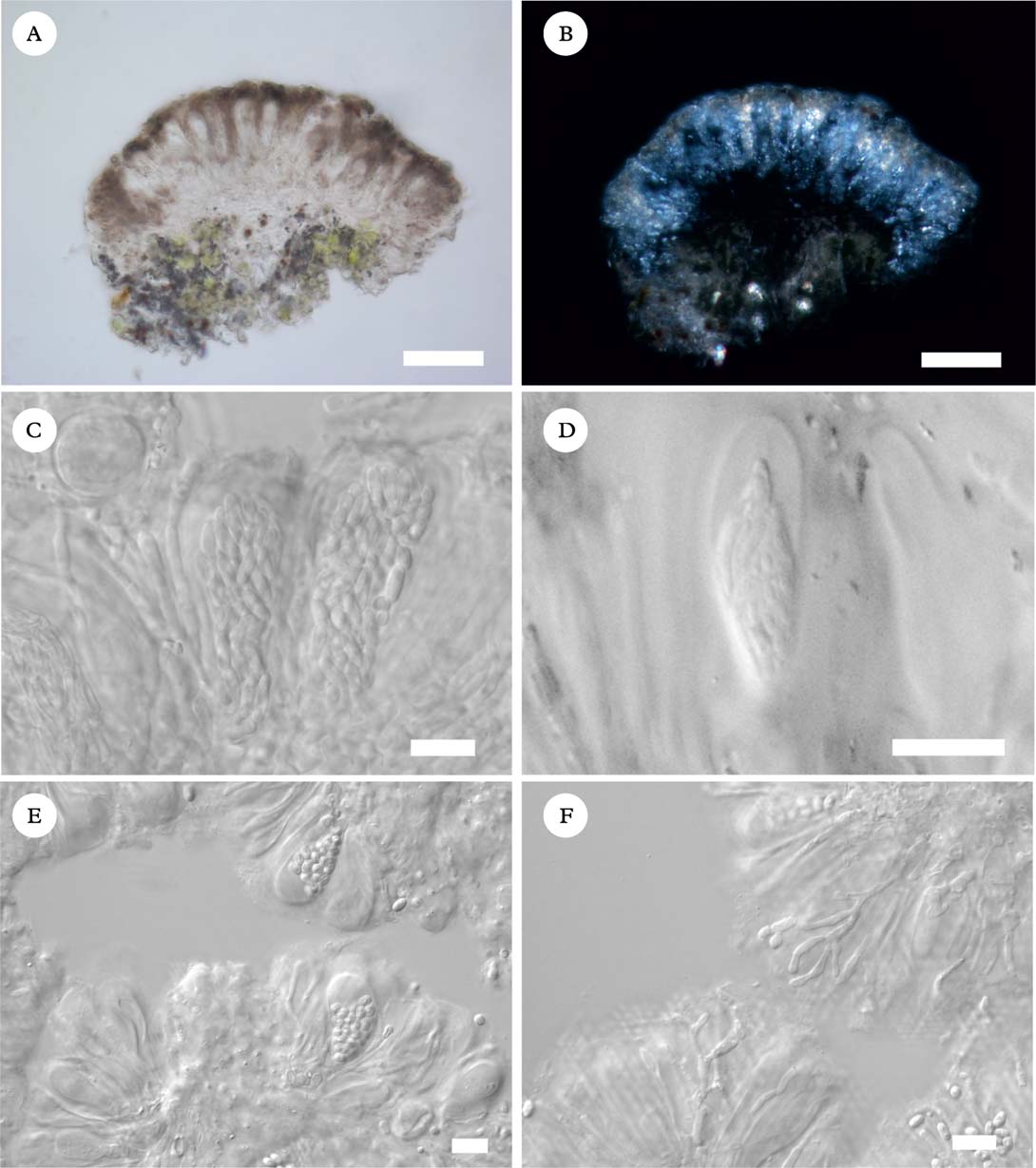
According to our observations, young and undamaged asci in Myrionora always possess the Biatora-type apex structure. However, Lecanora-type asci have been reported for both species (see references under the species below). We have noticed that asci in Myrionora are extremely fragile, particularly after pretreatment with KOH, and easily rupture basally if the preparation is squashed more than very lightly. Such damaged asci often display a Lecanora-type apex structure. As already pointed out by Hafellner (Reference Hafellner1984: 250), ruptured asci often display quite different apex structures than undamaged ones.
Distributions of quantitative characters in Myrionora were generally right-skewed, the best-fitting ones often being Wakeby or Burr distributions. Kolmogorov-Smirnov tests of goodness of fit rejected normality at P≤0·05 for ascospore width and length-breadth ratio in M. albidula, and apothecial size in both species. This prompted us to select medians and quartiles instead of means and standard deviations to describe quantitative variation in the species below.
Key
-
1 Apothecia pale yellowish with blue speckles to bluish black; ascospores ≥32 per ascus, more than twice as long as wide; hymenium always ≥35 µm and usually ≥40 µm thick ... M. albidula
Apothecia yellowish white; ascospores ≤24 per ascus, less than twice as long as wide; hymenium ≤35 µm thick ... M. pseudocyphellariae
M. albidula (Willey in Tuck.) R. C. Harris
in Harris et al., Evansia 5: 27 (1988).—Biatora albidula Willey in Tuck., Syn. N. Am. Lich. 2: 130 (1888).—Biatorella albidula (Willey) Zahlbr., Cat. Lich. Univ. 5: 34 (1928).—Scoliciosporum albidulum (Willey) Etayo in Etayo & Sancho, Bibl. Lichenol. 98: 223 (2008); type: USA, Massachusetts, Bristol Co., “on beech, N. B.” (=New Bedford), 1884, H. Willey (FH-TUCK barcode 302680 sheet 2883, lectotype selected here; FH-TUCK barcode 302682 sheet 2884, isotype, both seen).
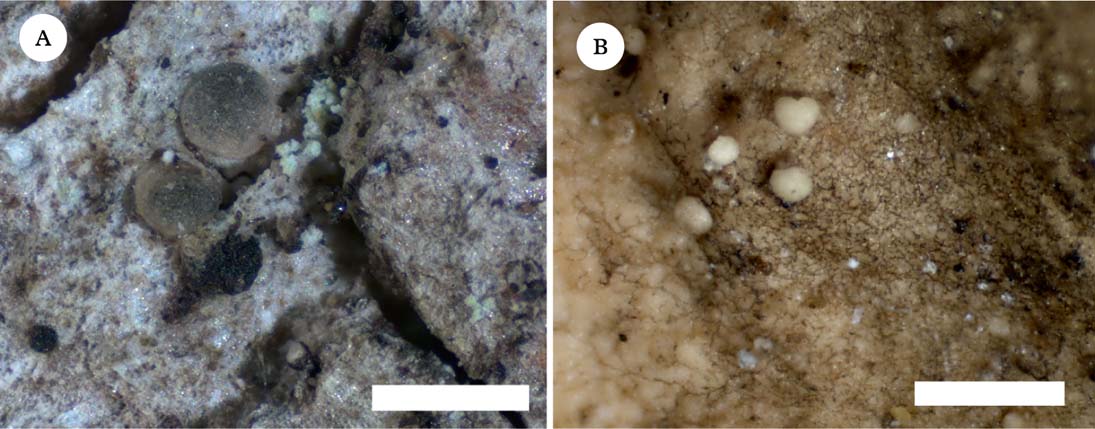
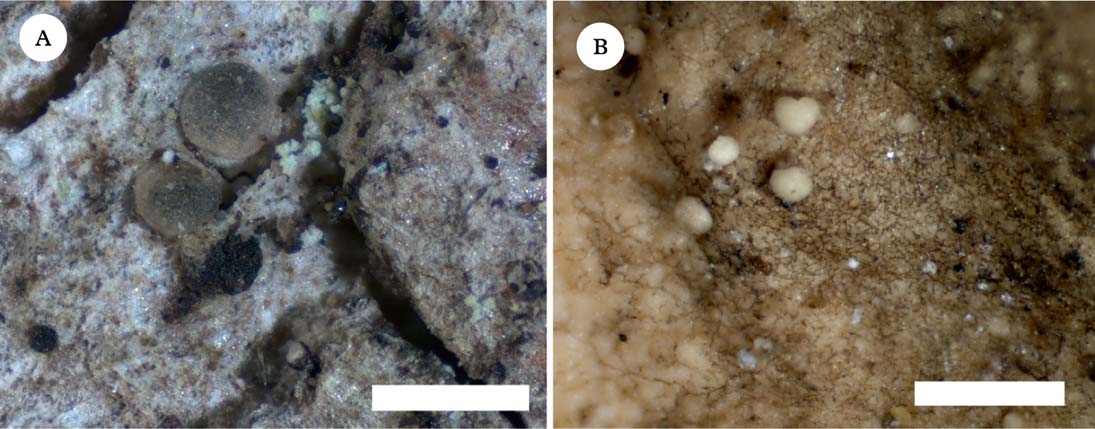
Myrionora, thalli with apothecia. A, M. albidula (Harris 46105); B, M. pseudocyphellariae (Etayo 23245, Gómez-Bolea, Søchting & Vilches). Scales=0·5 mm. In colour online.
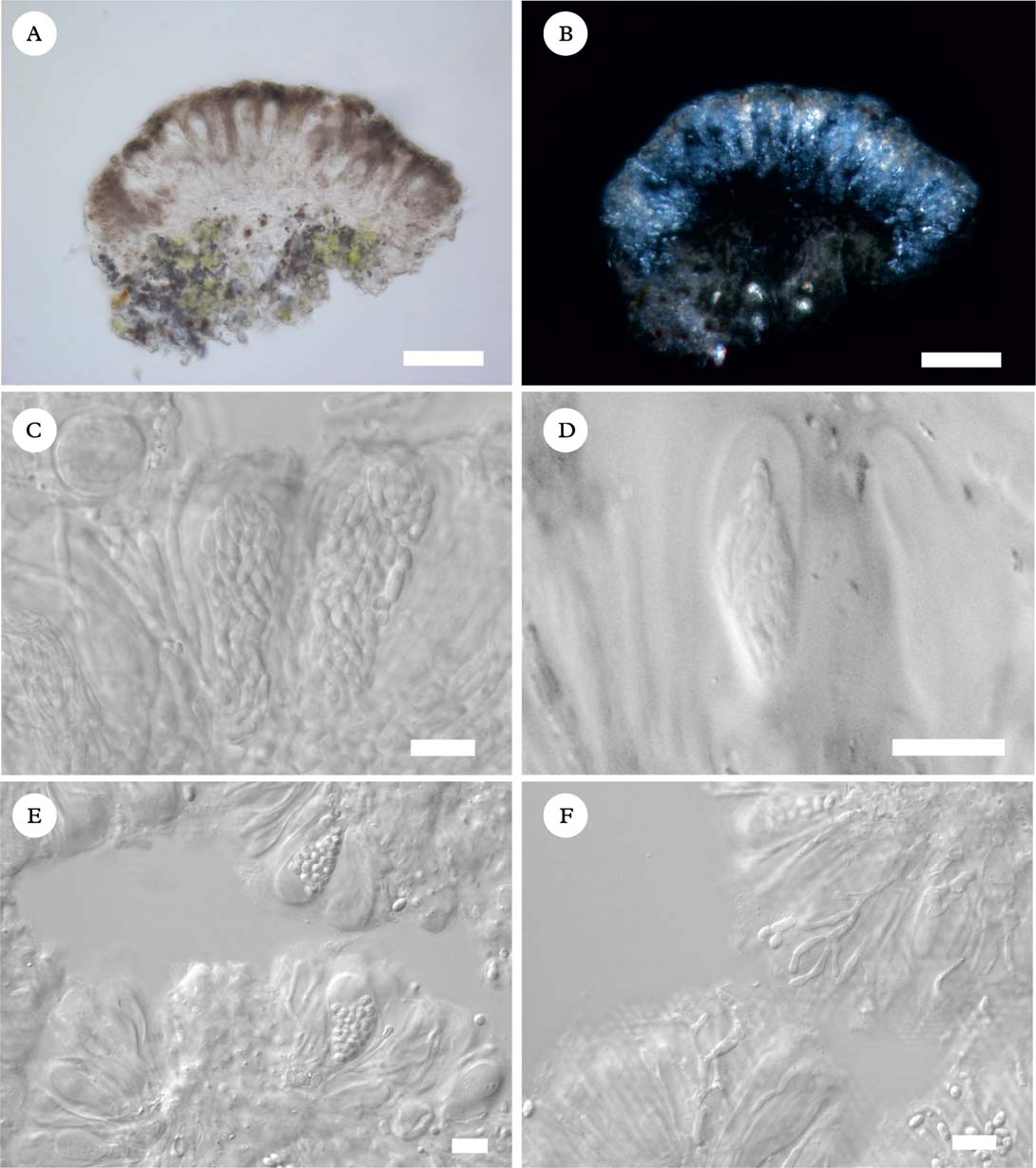
Myrionora, apothecial anatomy. A–D, M. albidula; A, section through apothecium of M. albidula, showing crystals blocking the light and causing the impression of brown pigmentation (Harris 46105); B, same as in A but through polarized light, showing shining white crystals; C, asci with ascospores in M. albidula (lectotype, 1884 Willey); D, young ascus in M. albidula showing apex structures (Palice 11222). E–F, M. pseudocyphellariae; E, asci with ascospore (Palice 3710); F, paraphyses (Palice 3710). Scales: A & B=100 µm; C–F=10 µm. Illumination: bright field (A), cross-polarized light (B), differential interference contrast (C–F). Matrix: pure water (A & B), pure water with some 10% aqueous KOH added. In colour online.
Thallus crustose, endophloeodal to thinly epiphloedal, when epiphloedal consisting of minute granules on which apothecia form, whitish to pale grey, without prothallus.
Apothecia 0·11–0·18–0·21–0·27–0·50 mm diam. (n=120), at first flat, becoming convex with age, starting as sessile on thallus, often becoming constricted at base. Disc whitish to dark blue-grey, often piebald with bluish speckles, occasionally entirely whitish or yellowish. Margin level with disc, at first distinct but becoming partially excluded with age, usually paler than disc (occasionally concolorous). Proper exciple forming 35–60 µm wide rim around disc, unpigmented except sometimes with more or less abundant blue-green pigmentation around terminal cells. Hymenium 35–45–55–60–65 µm thick (n=15). Paraphyses±abundant, dichotomously branched in upper half and occasionally anastomosing, 1·2–1·7–1·9–2·1–2·7 µm wide in mid-hymenium (n=120); apices not or moderately swollen, 1·6–2·2–2·6–3·0–5·0 µm wide (n=56), occasionally coated with blue-green pigment that extends as coarse crystals deep into the hymenium. Ascospores more than 32 per ascus (“50–75” according to Magnusson 1935, “>30” according to Sérusiaux 1993), narrowly ellipsoid to short-bacilliform with rounded ends, 4·7–6·0–6·6–7·6–11·3 µm long, 1·6–2·0–2·2–2·3–3·3 µm wide, 2·2–2·7–3·0–3·6–5·1 times as long as wide (n=120).
Pycnidia seen in a single specimen (Urbanavichene L10352), unilocular, of two types: 1) semi-immersed to immersed, globose, 25–30 µm wide, with protruding masses of conidia. Conidia broadly ellipsoid 2·5–3·5×1·5–2·0 µm; 2) immersed, semiglobose but slightly flattened and resembling juvenile apothecia, 40–60 µm wide. Conidia ellipsoid, 3·0–4·0(–4·5)×1·3–1·7 µm. Wall of both pycnidial types with the same blue-green pigment as in the apothecia. Conidiogenous cells lining wall of pycnidial cavity, narrowly cylindrical, forming conidia acrogenously.
Distribution and habitat
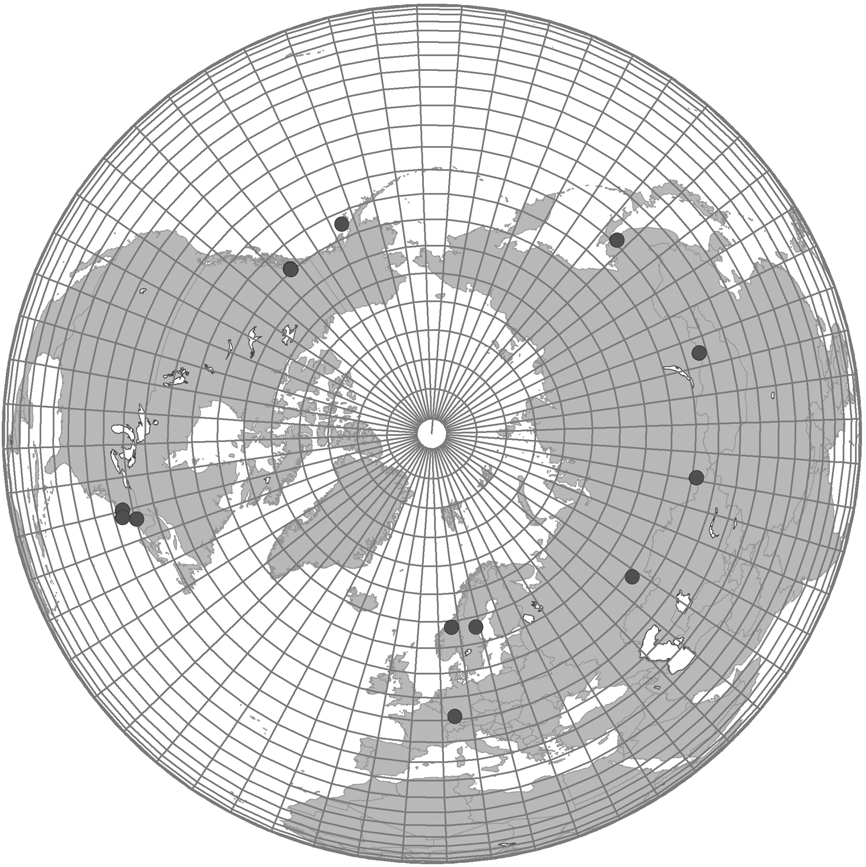
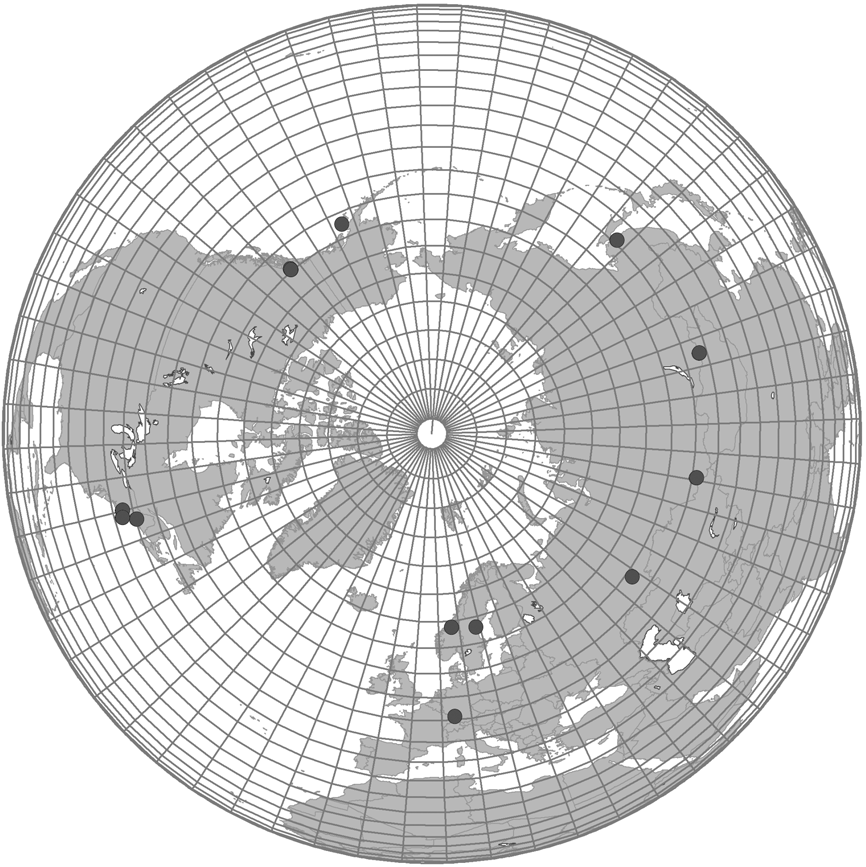
Myrionora albidula appears to be a circumpolar species occupying the deciduous and coniferous forest belts in the northern temperate zone (Fig. 3). Its altitudinal range stretches from near sea level to around 1400 m above sea level in southern Transbaikalia, and its latitudinal distribution spans from around 41°N in New England to over 63°N in Norway. Habitats include deciduous, coniferous, or mixed forests, where the species inhabits smooth or moderately rough bark of Alnus, Sorbus, Salix, Fagus, Acer, Quercus, Picea, and Abies in shade or semi-shade. In one of the localities in Russian Transbaikalia, the substratum choice is extended to dry decorticated twigs of Abies sibirica. One of the two Swedish localities deviates from these natural forest habitats by consisting of an overgrown garden at an abandoned farm, where M. albidula was found to be abundant on shrubs of planted Syringa vulgaris. We believe that M. albidula is rare but widespread throughout the northern temperate zone. It has been widely overlooked but may, if given the proper attention, turn out to be locally frequent. The main reason for being overlooked is that it forms very small thalli with minute apothecia, which, even if detected, may be mistaken for juvenile or stunted apothecia of other crustose lichens with biatorine apothecia.
Known world distribution of Myrionora albidula.
Comments
The ascus in M. albidula has been referred to the “Lecanora-type” (Harris et al. Reference Harris, Selva, Buck, Guccion, Nelson and Schmitt1988; Sérusiaux Reference Sérusiaux1993). In our experience, however, the ascus is consistently of Biatora-type, which can also be described as a Bacidia-type with a dark amyloid zone around the axial body. The characteristic bluish pigment often present in the apothecia was not mentioned by Willey (in Tuckerman Reference Tuckerman1888) or Magnusson (Reference Magnusson1935). It was, however, implicated by Harris et al. (Reference Harris, Selva, Buck, Guccion, Nelson and Schmitt1988): “…the color of the apothecia varies from whitish to dark greenish brown, apparently depending on exposure to light”. In addition, we have observed an inverse relationship between the density and thickness of the apothecial crystal layer and the amount of bluish pigment. Absorption spectra of lobaric acid suggest that this substance provides protection to UV-B radiation (Hidalgo et al. Reference Hidalgo, Bascuñan, Quilhot, Fernández and Rubio2005).
Additional specimens examined. Germany: Baden-Württemberg: Schwarzwald, Kette des Zeller Blauen (Wiesental) beim “Dachseck”, on Abies, alt. 1060 m, 47·7347°N 7·8524°E, 31 viii 1913, G. Lettau (B).—Norway: Sør-Trøndelag: Meldal, SE of Svorkmo village, forest reserve Urvatnet, boreal forest on the W shore of the lake, on Sorbus aucuparia, alt. 300 m, 63·1233°N 9·8065°E, 2006, Z. Palice 11222 (PRA).—Russian Federation: Altayskiy Kray: Soloneshenniy district, along the river Shinok between the villages Tog-Altay and Chernye Anuy, forest of Picea obovata, Betula and Salix along creek, on Picea obovata, alt. 910 m, 51·3621°N 84·5890°E, 2003, C. Printzen 8544 (FR). Chelyabinskaya Oblast': Southern Ural Mts, foot of Mt. Malyi Uvan, forest of Abies sibirica and Picea obovata, on Sorbus aucuparia, alt. 720 m, 54·8131°N 58·9881°E, 2009, I. Urbanavichene L10352 (LE). Khabarovskiy Kray: De Kastri-Komsomolsk route, 30 km WSW of De Kastri, near watershed divide between Chistiy and Khanda River watersheds, Abies nephrolepis-Picea jezoensis-Ledum palustre forest with large Populus maximowiczii along stream, on Alnus, alt. 135 m, 51·3877°N 140·3626°E, 2009, T. Spribille 31187 (UPS). Zabaykal'skiy Kray: Sokhondinskiy Zapovednik, valley of Dyrda spring, 2·5 km ESE of forest station “Enda” and upstream from Dyrda spring, Betula platyphylla-Larix gmelinii forest with occasional Salix rorida, on Salix rorida, alt. 1410 m, 49·4361°N 110·8231°E, 2003, L. Yakovchenko 1061 (VBGI); Sokhondinskiy Zapovednik, valley of Agutsa River, 3·8 WNW of forest station “Buninda”, mixed forest with conifers and deciduous trees, on dry decorticated twigs of Abies sibirica, alt. 1220 m, 49·7236°N 111·3280°E, 2009, L. Yakovchenko 3513 (VBGI, UPS).—Sweden: Medelpad: Liden par., below the NE slope of Mt. Vättaberget, 700 m ESE of Hajet, just SE of the shooting range, semi-open stand of old deciduous trees, on Sorbus aucuparia, alt. 70 m, 62·6969°N 16·7774°E, 2011, S. Ekman 5601 (UPS), M. Svensson 2375 (UPS); Liden par., E side of river Indalsälven, about 150 m NNE of the outlet of the stream Ytterbomsbäcken in the valley Krångdalen, garden surrounding abandoned farm, on Syringa vulgaris, alt. 90 m, 62·6609°N 16·8781°E, 2011, S. Ekman 5602 (UPS), M. Svensson 2383B (UPS).—USA: Alaska: Kodiak Island Borough, Kodiak Island E, along road to Buskin Lake, 0·6 miles along the road from Chiniak Hwy junction, on Alnus, alt. 10–20 m, 57·767°N 152·520°W, 1991, T. Tønsberg 15186B (BG); Klondike Gold Rush National Historic Park, near Dyea, west bank of the Taiya River, upstream of West Creek, on Alnus incana, alt. 16 m, 59·5381°N 135·2426°W, 2007, T. Spribille 24600 & L. Fairchild (KLGO); ibid., lower Taiya River, Chilkoot Trail, on Alnus incana, alt. 300 m, 59·6582°N 135·2655°W, 2008, T. Tønsberg 38395 (BG). Connecticut: Windham Co., town of Ashford, Yale Forest, along Boston Hollow Road, c. 0·6 mi NE of junction with Eastford Road, conifer-hardwood swamp along small stream and adjacent dry slope with hemlock, on Acer rubrum, alt. 260 m, 41·9283°N 72·1586°W, 2002, R. C. Harris 46105 (NY). Maine: Kennebec Co., [near Woodbury Game Sanctuary: Harris et al. 1988], Mud Pond c. 3 mi SW [sic; should be NW] of Litchfield along Highway 126, swamp forest, on Quercus, alt. 50 m, 44·1953°N 69·9728°W, 1987, W. R. Buck 15330 (NY).
Myrionora pseudocyphellariae (Etayo) S. Ekman & Palice comb. nov.
MycoBank No.: MB803243
Scoliciosporum pseudocyphellariae Etayo in Etayo & Sancho, Bibl. Lichenol. 98: 220 (2008); type: Chile, Navarino (35), Lum, bosque costero de lengas, sobre Pseudocyphellaria vaccina en Nothofagus pumilio, 54°56′25·5″S 68°05′53·5″W, alt. 65 m a.s.l., 26 January 2005, Etayo 23245, Gómez-Bolea, Søchting & Vilches (MAF—holotype, not seen; hb. Etayo—isotype, seen).
Thallus crustose, episubstratal, composed of minute, granular areoles beneath the apothecia (and much smaller than the apothecia), possibly also consisting of discrete, scattered, minute greenish granules (which cannot be attributed with certainty to this species).
Apothecia 0·07–0·10–0·11–0·13–0·21 mm diam. (n=100), more or less convex from the start, sessile. Disc yellowish white. Margin indistinct, at first level with disc but soon becoming excluded, concolorous with disc. Proper exciple forming c. 30 µm wide rim around disc, unpigmented. Hymenium 28–28–31–34–35 µm thick (n=6). Paraphyses relatively few, branched mainly in the middle and lower part, 1·6–1·7–1·8–1·9–2·3 µm wide in mid-hymenium (n=40); apices not or very slightly swollen, 1·6–1·8–2·0–2·3–2·7 µm wide (n=40). Ascospores 12–24 per ascus, broadly ellipsoid or sometimes broadly ovoid, 3·5–4·0–4·5–4·8–5·2 µm long, 2·4–2·7–2·9–3·4–4·1 µm wide, 1·1–1·3–1·5–1·7–2·0 times as long as wide (n=40).
Pycnidia not seen.
Distribution and habitat
Known from two nearby sites close to sea level in Tierra del Fuego, Chile, and a third locality at high altitude in the Cordillera Real of Ecuador. All localities are ancient woodlands. At the Chilean localities, M. pseudocyphellariae was collected on Pseudocyphellaria vaccina and P. coriifolia on Nothofagus pumilio. At the Ecuadorian site, it was found directly on soft decaying bark of Gynoxys sp. It was described as a lichenized parasymbiont (hence its epithet), but we have observed a lichenized thallus with a photobiont very similar to the one in M. albidula. We suspect that M. pseudocyphellariae is simply overgrowing the decaying thalli of Pseudocyphellaria. The Pseudocyphellaria specimens are also inhabited by other lichens, notably young thalli of Usnea and Parmelia s. lat.
Comments
The hymenial thickness was given as 40–45 µm in the original description by Etayo & Sancho (Reference Etayo and Sancho2008). Also, these authors depict an ascus of more or less Lecanora type (their fig. 104 on p. 221). However, M. pseudocyphellariae possesses a typical Biatora-type ascus, with the axial body approaching but not penetrating the strongly amyloid central wall layer of the ascus apex (the d-layer in the sense of Bellemère & Letrouit-Galinou Reference Bellemère, Letrouit-Galinou and Galun1988).
Additional specimen examined. Ecuador: Chimborazo: Sangay National Park, El Altar, fragment of Gynoxys forest on the crest descending E of Laguna de Collantes (“Yellow Lagoon”), on bark of Gynoxys, alt. 4150 m, 1·6694°S 78·4292°W, 1999, Z. Palice 3710 (PRA).
Discussion
Myrionora was described by Harris et al. (Reference Harris, Selva, Buck, Guccion, Nelson and Schmitt1988) as a member of the Lecanoraceae, a view that has been upheld (Hafellner Reference Hafellner1995; Lumbsch & Huhndorf Reference Lumbsch and Huhndorf2010). Both species of the genus also have a history of being treated in Scoliciosporum, a misunderstanding that was probably caused by 1) the existence of a polysporic member of Scoliciosporum s. str., S. curvatum Sérus., and 2) the traditional treatment of close relatives of Myrionora in Scoliciosporum, viz. S. pruinosum (P. James) Vězda and allies. However, Myrionora is not closely related to Scoliciosporum s. str. The latter genus is characterized by having a ‘Lecanora-type’ ascus apex with a wide axial body that reaches throughout the entire d-layer (in the sense of Bellemère & Letrouit-Galinou 1988), abundantly anastomosed paraphyses, a poorly developed proper exciple, and a lack of crystals in the hymenium. Recent molecular evidence indicates that Scoliciosporum s. str. may be the sister group to Sphaerophoraceae, Psoraceae, and Ramalinaceae (Ekman et al. Reference Ekman, Andersen and Wedin2008). Lumbsch & Huhndorf (Reference Lumbsch and Huhndorf2010) treated Scoliciosporum in a separate family, the Scoliciosporaceae.
The features of Myrionora instead place it in the Ramalinaceae, more specifically close to Jarmania (Kantvilas Reference Kantvilas1996, Reference Kantvilas2008) which includes two currently recognized species (the type species J. tristis as well as J. scoliciosporoides) known from the Australian states of Tasmania and Victoria (Elix et al. Reference Elix, McCarthy and Kantvilas2009), as well as the members of the “Bacidia lutescens group” sensu Ekman (Reference Ekman1996), namely Bacidia lutescens Malme, B. americana (Fée) Zahlbr., B. fuscula (Nyl.) Zahlbr. and Scoliciosporum pruinosum (P. James) Vězda; added to this can be B. lobarica Printzen & Tønsberg (Printzen & Tønsberg Reference Printzen and Tønsberg2007), S. schadeanum (Erichsen) Vězda, and S. pensylvanicum R. C. Harris (Harris Reference Harris2009).
The close relationship between Jarmania scoliciosporoides and Scoliciosporum pruinosum was first noted by Kantvilas (Reference Kantvilas2008). Apart from the idiosyncratic difference in the number of ascospores per ascus, Myrionora shares most features of the apothecial anatomy and chemistry, including the presence of lobaric acid, with most of the above mentioned species. Lobaric acid has previously been reported from a few other members of the Ramalinaceae, viz. the two known species of Myelorrhiza (Verdon & Elix Reference Verdon and Elix1986), Phyllopsora cinchonarum (Fée) Timdal (Timdal Reference Timdal2008), as well as Biatora ligni-mollis T. Sprib. & Printzen (Spribille et al. Reference Spribille, Björk, Ekman, Elix, Goward, Printzen, Tønsberg and Wheeler2009).
There is reasonable evidence that J. scoliciosporoides and the B. lutescens groups are congeneric (Ekman Reference Ekman1996; Kantvilas Reference Kantvilas2008). However, the type species of Jarmania, J. tristis, is set apart from these species, as well as from Myrionora, by the brown hypothecium turning yellowish in K, acicular (not filiform or more or less bacilliform) ascospores, irregular (not minutely bacilliform) crystals in the proper exciple and hymenium, and the presence of grayanic acid instead of lobaric acid. We have observed paraphyses in J. tristis (isotype in GZU) that are few, moderately branched and hardly (if at all) anastomosed, which is in contrast to the description given by Kantvilas (Reference Kantvilas1996). Attention should also be given to Scoliciosporum arachnoideum (Aptroot Reference Aptroot2008), which we have not seen but may turn out to be closely related to J. tristis.
If Myrionora and Jarmania are treated as congeneric, the name Myrionora has priority, as it antedates Jarmania by eight years. For the time being, however, we think it best to treat Myrionora as distinct from Jarmania, whether the latter is taken in a strict sense (including only the type species J. tristis and possibly also Scoliciosporum arachnoideum) or a broad sense (including also J. scoliciosporoides and the B. lutescens groups) on account of the additional difference in photobiont, the green-algal cells in Myrionora being larger (mostly 12–20 µm) than in Jarmania s. lat. (mostly 5–12 µm).
A molecular phylogeny is needed to resolve these relationships. Unfortunately, repeated attempts to acquire DNA sequences from our fresh specimens of M. albidula have so far been unsuccessful.
We thank Javier Etayo (Pamplona, Spain) and the curators of the herbaria FH, GZU, and NY for loans of specimens. TS was supported by a grant from the Austrian Science Foundation (FWF P21052-B16). SE was supported by a grant from the Swedish Taxonomy Initiative (dnr. 146/07 1.4). ZP acknowledges financial support for long-term research development (project no. RVO 67985939) and the Ministry of Education, Youth and Sports of the Czech Republic (project no. 0021620828). IU thanks the Ministry of Education and Sciences of the Russian Federation (project no. 16.518.11.7071) and the Russian Foundation for Basic Research (project no. 11-04-00901-a). CP acknowledges a travel grant from the Paul Ungerer Stiftung which made the collecting trip to the Altai Mountains possible.